Shank's Mare (Hizakurige) follows two amiable scoundrels, Yajirobei and Kitahachi, on a madcap journey of adventure and misadventure along the great highway leading from Tokyo to Kyoto. The lusty tale of their disreputable doings is Japan's most celebrated comic novel. Issued serially in 1802, Hizakurige was a tremendous success both with readers of its own time and with later generations. The book's earthy humor typifies the brash and devil-may-care attitude of the residents of Tokyo, both then and now.
Jippensha Ikku (十返舎 一九, 1765 – September 12, 1831) was the pen name of Shigeta Sadakazu (重田 貞一), a Japanese writer active during the late Edo period of Japan. He lived primarily in Edo in the service of samurai, but also spent some time in Osaka as a townsman. He was among the most prolific yellow-backed novel (黄表紙 kibyōshi) writers of the late Edo period — between 1795 and 1801 he wrote a minimum of twenty novels a year, and thereafter wrote sharebon (洒落本), kokkeibon (滑稽本) and over 360 illustrated stories (合巻 gōkan). From Otsuriki, a funny book about how to make shadow pictures, 1810
Little is known of Jippensha Ikku's adult life. He was married three times, two of which were quickly ended by fathers-in-law who could not understand his literary habits.
His masterpiece, Tōkaidōchū Hizakurige, was published in twelve parts between 1802 and 1822. Aston calls it "the most humorous and entertaining book in the Japanese language."
Sampled 62 pages. The overwhelmingly time-specific Japanese references and the incorrectly numbered endnotes in this edition made the reading process wearisome.
L'umorismo giapponese per uno straniero è abbastanza ostico. In particolare, in questa opera per poterlo comprendere fino in fondo è necessaria una buona conoscenza della lingua e della cultura letteraria dell'epoca. Inoltre, essendo un'opera del XIX secolo bisogna saper anche contestualizzare certe situazioni e battute.
Detto questo, l'ho trovata comunque una lettura interessante soprattutto perché dà un'idea di come fosse la vita in quel periodo e come funzionassero i viaggi. Una lettura scorrevole e non pesante.
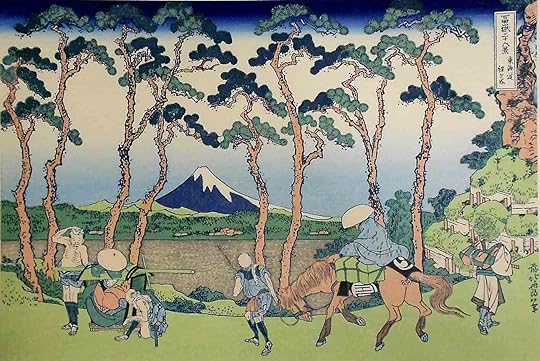
I found this book while I was writing a paper on Hiroshige's Tokaido Road ukiyo-e print series. While doing research I found this book and even though it wasn't completely relevant since it was a work of fiction I decided to take time out and read it. I am so glad that I did. It is hilarious! Not only does it give the reader a good sense of what every day life was like in late 19th century Japan, it gives a taste of a great sense of humor. It ended up being a great primary source of background info for my paper and a welcome respite from some of the extra dry art history/history texts I had been reading.
Livre très répétitif, on suit le même schéma de narration, les deux arrivent dans un relais, font des poèmes et des blagues et repartent sur la route. Tout ça pendant une bonne partie du livre. Également, les poèmes sont humoristiques mais la traduction de ceux ci n'arrivent pas à retransmettre l'humour ou mêmes les rimes faites dans la version originale. C'est normal mais cet aspect d'incompréhension est ennuyeux pour le lecteur.
Summary: This book follows two traveling friends from Edo as they work their way across Japan causing mischief and trouble along the way. It is primarily a comedy, however as someone with relatively little knowledge of the Japanese language and culture of the time period, at least half of the jokes went over my head. In spite of this, it was a worthwhile read, providing an interesting glimpse into Japan’s past through a comic lens. Besides this interest, the book does have a wide variety of humor, equal parts crude and bawdy as well as witty and clever, ranging from puns (which for the most part did not translate) to slapstick and situational comedy (which translated surprisingly well). I would recommend getting a physical rather than electronic copy of this book for the sake of better editing and easier access to translation notes.
Setting: This novel takes place along the Hokaido road connecting Edo and Kyoto during the Edo period. This was one of the main draws of the novel for me as I have a particular interest in Japanese history. Being a comic novel, it is likely not an accurate representation of the period, but in my opinion, reading a comedy of that era provides an equal but different insight into the time in which it is set.
Characters: The story follows two travellers, Kita and Yaji, as the wander across Japan. They are tricksters, pranksters, and con-men. Normally such characters would not be to my taste, but what made these two surprisingly likable in my opinion was their earnest nature. Whatever con or scheme they cook up, they never fail to laugh at their own misfortune when it inevitably goes awry. They admit when they are beaten, pay their dues, and ultimately never lose their happy-go-lucky spirits when things go wrong for them. This makes them much more endearing characters than your average prankster.
Story/Structure: The story has no overarching plot, rather consisting of episodic plots that cover the two protagonists’ misadventures on each leg of their journey. This makes it ideal for reading in parts. The tone and style is extremely homogeneous throughout. One could read the stories in virtually any order and not lose any context. Thus, if you don’t enjoy this book from the beginning, you likely won’t enjoy it at all.
Translation: I can only imagine what a daunting task it must have been to translate not only a comedy, but a historical comedy from an extremely different culture and language to English. Overall, I believe the translator did a commendable job, but the text does suffer from some awkward translations (note: as I read the electronic copy, I did not realise the existence of translation notes until the end as they were not indicated in-text. Thus, some of these issues may be resolved with reading of the notes). For example, puns seem to have always been literally translated, creating a scenario that is obviously supposed to be a joke, but makes no sense in english. Likewise, there are many cultural references that I imagine are funny with context, but fall flat from an modern english perspective. As mentioned above, the humor that translates most well is the sort of situational comedy and gags that occur, rather than wordplay. There are some interesting translation choices where often an original Japanese word is left in, but other times, words are substituted. One stand out example of this is the use of “macaroni.” I imagine this was used in favor of a common Japanese dish to convey the type of food it was, but it felt out of place when surrounded by other Japanese words that were maintained. However, these are minor issues and don’t take away from the enjoyment of the book overall.
Overall: A worthwhile read if you are at all interested in the culture of this time period and location. While much of the humor doesn’t translate, the book is so full of comedy that it is entertaining, and even laugh-out-loud funny at times. Definitely a good book if you are looking for something very different.
Traditionally known as the Tokaidochu Hizakurige, this book was originally written by Jippensha Ikku in the 19th century when increasing prosperity and relaxation of certain laws allowed more people in Japan to travel. The book tells the tale of the two friends Yajirobēi and Kitahachi. They are traveling along the famous Eastern Sea Road to undertake a pilgrimage from Edo to the Ise shrine in Kyoto. Hence, this book historically functioned as both a comic novel and a travel guide. This can still be seen when the author briefly explains why certain towns are associated with certain products.
Shank's Mare reads as an episodic story of two guys on a road trip. The meat of the story are the humorous, slapstick-like situations that they get themselves into by their own hubris, naïvité and tomfoolery. It is a story of constantly backfiring capers and varies in its humour from somewhat intelligent jokes to simple gags and jokes that would be considered very crass today. Besides the capers and scams, the book also gives the reader a glimpse on what life along the Tokaido was like: how innkeepers interacted with their guests, how Daimyo processions carried on, how travellers would interact with one another, how people haggled...There are probably few books out there that communicate these things so directly as this one does.
The book is a fun read, although not an easy one. Its target audience kicked the bucket roughly 150 years ago, so having some knowlegde of Japanes culture or history helps to get invested into this story and understand some of the jokes. Furthermore, this particular translation features some quirks where the translater has tried to make the story more readable for a Western audience. For example, there are some references to macaroni, where (I assume) the translator has tried to come up with a rough equivalent for a typically Japanese dish. Yet, despite these hurdles, Shank's Mare provides an intriguing look into Japanese society during the time of people such as Katsushika Hokusai and Utagawa Hiroshige. If you can get invested in the book, it is absolutely worth reading all the way to the end and you will certainly find yourself sniggering more than you'd think on the road there.
A great read for me; I am interested in life during this Edo era in Japan, plus I like crass humour. This book combines both the two! It is not something I would recommend my daughter to read for it’s blatantly sexist, but my son might be able to get some enjoyment from it. Actually I read a simplified Japanese version of this book with my eldest son who is of primary school age - that version features lots of the amusing but kiddie safe episodes from their travel along the Tokaido.
As others have mentioned, the footnotes are a bit difficult to make easy use of, but they are still better than nothing.
I read Ihara Saikaku’s Eitaigura around the same time; personally I would recommend Eitaigura as a study of life in the Edo era more, although Hizakurige has a ton of laughs throughout and is better for that purpose.
Why? Why was this book so painfull to read? Was it because some key ingredient was lost in translation to french, or that the japanese humor of that time did not age well? The journey seems to be an excuse for the two travellers to make rhymes yet all the interest of those rhymes are the inuendos, local references, homophones they contain, they are almost like private jokes to the non-japanese reader. This does not translate into a smooth reading experience: the translated rhymes lack style and have extensive footnotes attached to them. These footnotes try to transmit these references etc.... but its like trying to explain a joke... it's come down to this then all the effect is lost. As for the rest of the story, I can not understand why the narative is done in such elaborate wording with an incredibly rich vocabulary when the characters are so foul-mouthed. If this was to be a funny and light story about two travelers then both were absent...
Es un libro de humor japonés sobre dos pícaros que emprenden un viaje hasta kiotto desde Tokio , narra sus estancias en las posadas, los personajes que conocen y sobre todo sus aventuras y pesares porque generalmente se meten en líos, los engañan y sus desaventuras son lo central del libro
Se supone que es un libro cómico pero no me hizo reír, fue un bestseller en su época pero no me llegó
Lo mejor del libro es la descripción que hace de la vida cotidiana de Japón de fines del siglo XVIII, de cómo viajaba y se divertía la gente, de lo que comía del tipo de personajes que existían y de los lugares y templos que visitaban, eso sí me resultó interesante
I was going to give if two stars until I read the appendix, which changed it to a one as the humor took a dark turn.
If you want to get a flavor of the book, I’d read Part 8 first, which takes place in Osaka. Books 1 through 7 are very repetitive in that the two characters keep running into the same situations at the various stops. That probably makes sense as this was written as a series. It’s as if the author found something successful early on and then found ways to continue to capitalize on that.
This entire review has been hidden because of spoilers.
Sí y no. Tiene sus momentos divertidos (muchos), pero la mayoría no concuerdan con mi tipo de humor (en resumen, van de listos y terminan pagando ellos la jugarreta). Y tiene un formato que entiendo que funcionaba por etapas, pero al leer de seguido se me ha hecho un pelín repetitivo. No está mal, pero tendría que estar de otro humor para releerlo, me da la impresión.
I haven't finished this yet, but here's how it looks so far. Picture the movie Dumb & Dumber, but starring Pinky of Pinky and the Brain as both main characters. Also, set it in late eighteenth century Japan.
There are notes that try to explain some of the cultural references and awful puns, but (a) notes aren't marked in the text, so you have to check in the back whenever you think you might be missing something, and (b) the notes have page numbers included, but the page numbers are to the original printing. I assume. In any case, if you are on, say, page 80 and you have a question, you probably want to check all the notes that claim to be from pages 56 through 60.
UPDATE: This remained pretty accurate throughout the book.
I checked this out due to constant references to in several of Kyōka Izumi's tales. It is actually quite enjoyable, rather sweet and good-natured little picaresque novel. It is as much a far cry from Izumi's dark, labyrinthine works as it is from what i initially expected. Whilst I expected comic picaresque, I also expected something cynical, wry and lewd, perhaps because one naturally expects something like that from this novel's European rough equivalents. But no, "sweet and good-natured" is the perfect description of this novel. It is easy to see why Izumi, being so disgusted with modernity and ever changing Japan of his time, oft found solace in bright, idyllic vision of the past contained herein.
Viaje por el Tokaido es un libro de humor que nos acerca al folclore japonés de la época feudal. Un título didáctico y divertido que disfrutarán aquellos que sientan afinidad por el exotismo de la cultura japonesa.
Men making mischief on the road. A time-honored literary form. Like it very much but agree with the reviewer who said it's not as good as Monkey (the great Chinese road novel).