

What do you think?

Horror Unmasked: A History of Terror from Nosferatu to Nope
From the silent-film era to the blockbusters of today, Horror Unmasked is a fun-filled, highly illustrated dive into the past influences and present popularity of the horror film genre. The horror film’s pop-culture importance is undeniable, from its early influences to today’s most significant and exciting developments in the genre. Since 1990, the production of horror films has risen exponentially worldwide, and in 2021, horror films earned an estimated $580 million in ticket sales, not to mention how the genre has expanded into books, fashion, music, and other media throughout the world. Horror has long been the most popular film genre, and more horror movies have been made than any other kind. We need them. We need to be scared, to test ourselves, laugh inappropriately, scream, and flinch. We need to get through them and come out, blinking, still in one piece. This comprehensive guide A perfect reference and informational book for horror fans and those interested in its cultural influence worldwide , Horror Unmasked provides a general introduction to the genre, serves as a guidebook to its film highlights, and celebrates its practitioners, trends, and stories.
232 pages, Hardcover
First published September 5, 2023
Ratings & Reviews
Friends & Following
Create a free account to discover what your friends think of this book!
Community Reviews
Displaying 1 - 30 of 40 reviews

February 12, 2024
I've gone back and forth on my rating for HORROR UNMASKED: A HISTORY OF TERROR FROM NOSFERATU TO NOPE several times. On the one hand, it provides quite a good overview of the growth of horror movies (and their trends) from the silent era to the 2020's. It also contains lots of "quick reference" suggestions in case the Reader wants to explore further. And, always a plus, it is filled with photographs ... although none gave me cause for more than a quick glance.
At the same time, it had four aspects that definitely annoyed me. The first is one that I want to acknowledge, but that is no more than is expected in books of this type. The writer's taste in films is quite different from mine. Now, to be fair, we all like and dislike different movies. There's absolutely nothing wrong with that. (That's where many of my best film discussions have been born.) In this case, the writer described a fair number of films as something akin to meager efforts that I quite enjoyed. (Part of this is probably petty annoyance that he was harsher to many more films that I liked while I could "return the favor" with only three or four titles!)
However, there were other areas of concern that are more legitimate. For instance, on multiple occasions, the writer perpetuates a "myth" about an aspect of film history that has been falsely passed on for years as gospel. As an example, he mentioned that Karl Freund took over directing 1931's DRACULA when Tod Browning lost interest in it. Can you imagine budget-conscious Universal (which frequently had a front-office representative on the set during shooting) shrugging off Browning's absence and deciding to keep on paying him since the movie was being completed anyhow? (A good reference work that debunks this myth is TOD BROWNING'S DRACULA by Gary D Rhodes.)
Then, there are the inclusions of films that are not horror films. Yes, I know that definitions of "horror" vary. Yet, in this case, the writer will occasionally note that a specific title is technically not a horror movie ... and then include it anyway! An example is THE HUNCHBACK OF NOTRE DAME ... and its first remake.
Finally, writers of books such as this one often include "asides." (I am reminded of Tom Weaver's intrusive attempts at humor in the book about THE MUMMY'S HAND.) Here, this writer also has his asides. But, there was one that completely pulled me out of the book and sent me scribbling notes to myself. It was at the end of a chapter about Zombie movies.
Here's what he wrote:
"This tribute to man's baser proclivities is what stands for a concept of strength now, in a time when the United States has chosen to break off with the world, to indulge its most deep-set prejudices, to openly hate and discriminate, to live in a simmering state of fear. Fast decisions and brutal actions are the answer. Kill them before they kill you. Worst-case thinking in a cynical time."
Wow.
Regardless of the writer's beliefs ... and I am not here to endorse or debate them ... I was unaware that he was an acknowledged political analyst. This is very opinion-centered, as opposed to noting that many film attendees sought "escape" from the many burdens of The Great Depression.
Yet, I readily acknowledge that I many be engaging in bouts of petty overreacting. Fair enough. I can assert, though, that this is one book that I wish I had waited for it to arrive at my local library instead of purchasing a copy that I will not consult again.
At the same time, it had four aspects that definitely annoyed me. The first is one that I want to acknowledge, but that is no more than is expected in books of this type. The writer's taste in films is quite different from mine. Now, to be fair, we all like and dislike different movies. There's absolutely nothing wrong with that. (That's where many of my best film discussions have been born.) In this case, the writer described a fair number of films as something akin to meager efforts that I quite enjoyed. (Part of this is probably petty annoyance that he was harsher to many more films that I liked while I could "return the favor" with only three or four titles!)
However, there were other areas of concern that are more legitimate. For instance, on multiple occasions, the writer perpetuates a "myth" about an aspect of film history that has been falsely passed on for years as gospel. As an example, he mentioned that Karl Freund took over directing 1931's DRACULA when Tod Browning lost interest in it. Can you imagine budget-conscious Universal (which frequently had a front-office representative on the set during shooting) shrugging off Browning's absence and deciding to keep on paying him since the movie was being completed anyhow? (A good reference work that debunks this myth is TOD BROWNING'S DRACULA by Gary D Rhodes.)
Then, there are the inclusions of films that are not horror films. Yes, I know that definitions of "horror" vary. Yet, in this case, the writer will occasionally note that a specific title is technically not a horror movie ... and then include it anyway! An example is THE HUNCHBACK OF NOTRE DAME ... and its first remake.
Finally, writers of books such as this one often include "asides." (I am reminded of Tom Weaver's intrusive attempts at humor in the book about THE MUMMY'S HAND.) Here, this writer also has his asides. But, there was one that completely pulled me out of the book and sent me scribbling notes to myself. It was at the end of a chapter about Zombie movies.
Here's what he wrote:
"This tribute to man's baser proclivities is what stands for a concept of strength now, in a time when the United States has chosen to break off with the world, to indulge its most deep-set prejudices, to openly hate and discriminate, to live in a simmering state of fear. Fast decisions and brutal actions are the answer. Kill them before they kill you. Worst-case thinking in a cynical time."
Wow.
Regardless of the writer's beliefs ... and I am not here to endorse or debate them ... I was unaware that he was an acknowledged political analyst. This is very opinion-centered, as opposed to noting that many film attendees sought "escape" from the many burdens of The Great Depression.
Yet, I readily acknowledge that I many be engaging in bouts of petty overreacting. Fair enough. I can assert, though, that this is one book that I wish I had waited for it to arrive at my local library instead of purchasing a copy that I will not consult again.

July 23, 2025
This was a pretty cool horror movie overview from the silent movie days up until just a couple of years ago. Thank you to Mr. Weismann for helping my Letterboxd watchlist grow!

August 14, 2023
Comprehensive and informative, but still fun to read. Whether you want to be a horror movie expert or just fool people into thinking you're one, this is the book for you.
The chapters cover various aspects of horror films (countries, genres, studios, etc.) and include lots of color photos. I've been racking up horror movie views over the past several years but there are many films in this book I've never heard of and now need to track down.
And this isn't just a compendium or history. We're treated to lessons on horror philosophy and how previous efforts have informed later works, leaving readers equipped to carry on well-informed conversations about horror as a whole.
I received my copy from NetGalley for review purposes.
The chapters cover various aspects of horror films (countries, genres, studios, etc.) and include lots of color photos. I've been racking up horror movie views over the past several years but there are many films in this book I've never heard of and now need to track down.
And this isn't just a compendium or history. We're treated to lessons on horror philosophy and how previous efforts have informed later works, leaving readers equipped to carry on well-informed conversations about horror as a whole.
I received my copy from NetGalley for review purposes.
July 23, 2024
Solid review of horror in the movies...from the birth of silent movies...to the horror blockbusters of today. Chapters include Atomic Age Monsters, Mainstream Horror, Post Horror and beyond, and Monster Central, among others.
Weisman discusses societal rends that impact on the development of horror in movies, and discusses horror trends, such as the development of the "slasher" movie.
I'm not sure I agree with all his opinions.....as he rates Tobe Hooper's "Salem's Lot" as one of the best King adaptions....but the book is worth your time.
Jeff McIntosh
Weisman discusses societal rends that impact on the development of horror in movies, and discusses horror trends, such as the development of the "slasher" movie.
I'm not sure I agree with all his opinions.....as he rates Tobe Hooper's "Salem's Lot" as one of the best King adaptions....but the book is worth your time.
Jeff McIntosh
June 20, 2023
This book has been written multiple times before by different people but every single time it happens I'm still going to read it and love it. I've already learned everything that is in here from multiple other sources but it's enjoyable to me every single time and with this book it looks a lot prettier then some of the other books out there.

Did Not Finish
August 27, 2024DNF at 25 %, it wasn’t what I expected. It’s rather detailed history of horror movies but I was missing the ‘unmasking’ part. There is some interpretative work done but there’s not enough space for deep dive given how many films the book attempts to squeeze in.

June 30, 2023
So very informative, I have some issues with the language used in this book. The author properly uses the word Roma when dealing with the Romani people, but still uses words like "freaks" ,"monsters", and "midget" without quotes around them. This gives the impression that he approves and/or holds the beliefs of the people in the past in regards to these words. If there is time before this book comes out, I recommend going back and changing some of the language, or using quotation marks around the words that we no longer use.

August 27, 2024
2.5 stars
"Horror is an irreplaceable genre in world culture. It's based in our biology, the fight-or-flight impulse. We seem to need it, for a variety of reasons. To artificially recreate the feeling of being reduced to predator or prey. To quench suppressed impulses. To articulate and defuse dread. To express awe and dismay in the face of the incomprehensible universe. To feel the giddy thrill of terror. We still need darknesses to overcome, and monsters to defeat."
I'm always seeking more books about the horror genre because I'm fascinated by it, so over these past few years I've learned so much. But unfortunately I was pretty disappointed by this book.
I had trouble with the writing style used by the author. His tone was a bit condescending/pompous, he uses big words to convey his ideas, but really there is not much depth and he only scratches the surface. I didn't feel like this was a deep dive on the history of horror movies.
The chapters on more recent horror (2000-2023) were much more brief than the ones on the other decades, which is understandable in a way, but I would have liked more.
I liked that there is a chapter on horror comedies, since it's one of my favorite subgenres, and I agree that horror and comedy go hand-in-hand, much more than we would think, even in other more serious subgenres.
His glossary on horror subgenres was fun, I especially chuckled at the description of teen horror: "The adults are clueless. It's up to the kids to set things straight."
I enjoyed his top ten lists and other types of lists, although for a lot of the movies I didn't agree that they were the best of the decade/genre, but taste is so subjective, so I didn't mind.
Overall, I'm glad I picked it up because I discovered some horror movies I didn't know about that I added to my watchlist, but it was a bit of a slog to get through.
"Horror is an irreplaceable genre in world culture. It's based in our biology, the fight-or-flight impulse. We seem to need it, for a variety of reasons. To artificially recreate the feeling of being reduced to predator or prey. To quench suppressed impulses. To articulate and defuse dread. To express awe and dismay in the face of the incomprehensible universe. To feel the giddy thrill of terror. We still need darknesses to overcome, and monsters to defeat."
I'm always seeking more books about the horror genre because I'm fascinated by it, so over these past few years I've learned so much. But unfortunately I was pretty disappointed by this book.
I had trouble with the writing style used by the author. His tone was a bit condescending/pompous, he uses big words to convey his ideas, but really there is not much depth and he only scratches the surface. I didn't feel like this was a deep dive on the history of horror movies.
The chapters on more recent horror (2000-2023) were much more brief than the ones on the other decades, which is understandable in a way, but I would have liked more.
I liked that there is a chapter on horror comedies, since it's one of my favorite subgenres, and I agree that horror and comedy go hand-in-hand, much more than we would think, even in other more serious subgenres.
His glossary on horror subgenres was fun, I especially chuckled at the description of teen horror: "The adults are clueless. It's up to the kids to set things straight."
I enjoyed his top ten lists and other types of lists, although for a lot of the movies I didn't agree that they were the best of the decade/genre, but taste is so subjective, so I didn't mind.
Overall, I'm glad I picked it up because I discovered some horror movies I didn't know about that I added to my watchlist, but it was a bit of a slog to get through.

December 9, 2024
Real Rating: 4.5* of five
The Publisher Says: Horror Unmasked offers a general introduction to the popular film genre, serves as a guidebook to its film highlights, and celebrates its practitioners, trends, and stories.
From the silent-film era to the blockbusters of today, Horror Unmasked is a fun-filled, highly illustrated dive into the past influences and present popularity of the horror film genre.
The horror film’s pop-culture importance is undeniable, from its early influences to today’s most significant and exciting developments in the genre. Since 1990, the production of horror films has risen exponentially worldwide, resulting in impressive ticket sales in the modern day, not to mention how the genre has expanded into books, fashion, music, and other media throughout the world.
Horror has long been the most popular film genre, and more horror movies have been made than any other kind. We need them. We need to be scared, to test ourselves, laugh inappropriately, scream, and flinch. We need to get through them and come out, blinking, still in one piece. This comprehensive guide features:
A thorough discussion on monster movies and B-movies (The Thing; It Came from Outer Space; The Blob)
The destruction of the American censorship system (Blood Feast; The Night of the Living Dead; The Texas Chainsaw Massacre)
International horror, zombies, horror comedies, and horror in the new millennium (Matango; Suspiria; Ghostbusters)
A dissection of the critical reception of modern horror (Neon Demon; Pan’s Labyrinth; Funny Games)
Stunning movie posters and film stills, plus fan-made tributes to some of the most lauded horror franchises in the world (Aliens; The Evil Dead; The Hills Have Eyes; Scream)
A perfect reference and informational book for horror fans and those interested in its cultural influence worldwide, Horror Unmasked provides a general introduction to the genre, serves as a guidebook to its film highlights, and celebrates its practitioners, trends, and stories.
I RECEIVED A DRC FROM THE PUBLISHER VIA EDELWEISS+. THANK YOU.
My Review: It is astonishing how important the horror-movie industry has grown to be. It began with a bang...pardon the wordplay...and pretty much reliably made money for the film industry for decades. Its reach into pop culture has never stopped making the puckerhole set very, very, very anxious and uncomfortable. The trends in horror-film making have huge impacts on things from politics to design aesthetics. It's all in here, though of course not in great, or academically sourced, depth. This is an exciting gift book, not a film studies text.
That is a feature, not a bug. My enjoyment of the read was thorough while we were in the past; in the modern day, I felt...impatient...this is current events! Do we really need to go into the stuff from day-before-yesterday? Yes, of course, said my old-man common sense. Not everyone sees the same information I do. Still, I'm docking a half-star for it because I'm giving *my* impression, and it might match up with your possible giftee's. Forewarned is still forearmed.
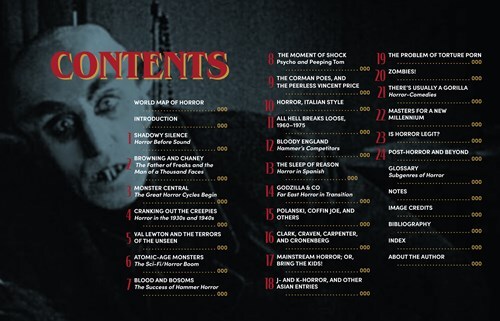
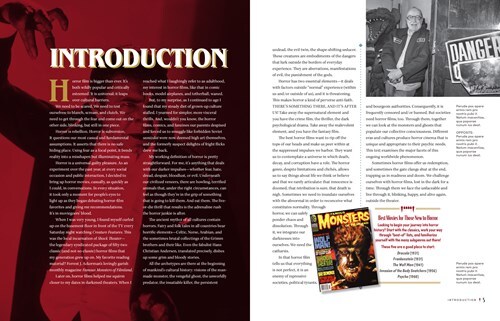
The Table of Contents, and the Introduction, are typical excitement-building spreads:
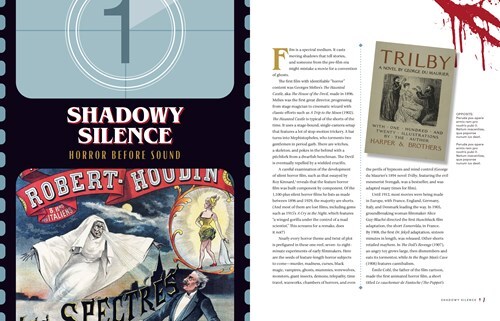
The Chapter One opening spread, and first text spread, gives us the basic format's development into the informative delivery medium for the deep-enough dive into the development and trends in horror film from the initial efforts through our present era of splatters in place of scares.
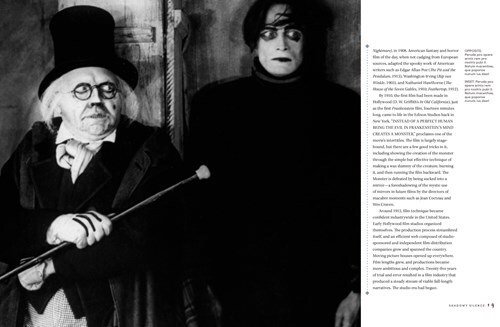
Gross oversimplification on my part, and not universally true; like all generalizations, exceptions abound. Go look into Bollywood horror...go learn about the reason we've seen such an explosion of horror franchises...find out who directed a horror film that you'd swear an oath would never have done such a thing.
Here's your chance to thrill the horror aficionado in your life with a hardcover book that will teach about the genre while pleasing the eyes and teasing the memory. Believe me, you'll never lose at trivia if you read this one.
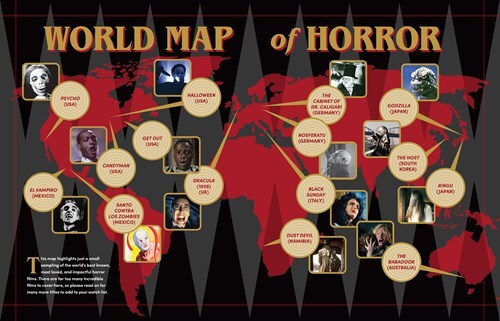
A really really great graphic representation of the interconnectedness of the global horror industry.
The Publisher Says: Horror Unmasked offers a general introduction to the popular film genre, serves as a guidebook to its film highlights, and celebrates its practitioners, trends, and stories.
From the silent-film era to the blockbusters of today, Horror Unmasked is a fun-filled, highly illustrated dive into the past influences and present popularity of the horror film genre.
The horror film’s pop-culture importance is undeniable, from its early influences to today’s most significant and exciting developments in the genre. Since 1990, the production of horror films has risen exponentially worldwide, resulting in impressive ticket sales in the modern day, not to mention how the genre has expanded into books, fashion, music, and other media throughout the world.
Horror has long been the most popular film genre, and more horror movies have been made than any other kind. We need them. We need to be scared, to test ourselves, laugh inappropriately, scream, and flinch. We need to get through them and come out, blinking, still in one piece. This comprehensive guide features:
A thorough discussion on monster movies and B-movies (The Thing; It Came from Outer Space; The Blob)
The destruction of the American censorship system (Blood Feast; The Night of the Living Dead; The Texas Chainsaw Massacre)
International horror, zombies, horror comedies, and horror in the new millennium (Matango; Suspiria; Ghostbusters)
A dissection of the critical reception of modern horror (Neon Demon; Pan’s Labyrinth; Funny Games)
Stunning movie posters and film stills, plus fan-made tributes to some of the most lauded horror franchises in the world (Aliens; The Evil Dead; The Hills Have Eyes; Scream)
A perfect reference and informational book for horror fans and those interested in its cultural influence worldwide, Horror Unmasked provides a general introduction to the genre, serves as a guidebook to its film highlights, and celebrates its practitioners, trends, and stories.
I RECEIVED A DRC FROM THE PUBLISHER VIA EDELWEISS+. THANK YOU.
My Review: It is astonishing how important the horror-movie industry has grown to be. It began with a bang...pardon the wordplay...and pretty much reliably made money for the film industry for decades. Its reach into pop culture has never stopped making the puckerhole set very, very, very anxious and uncomfortable. The trends in horror-film making have huge impacts on things from politics to design aesthetics. It's all in here, though of course not in great, or academically sourced, depth. This is an exciting gift book, not a film studies text.
That is a feature, not a bug. My enjoyment of the read was thorough while we were in the past; in the modern day, I felt...impatient...this is current events! Do we really need to go into the stuff from day-before-yesterday? Yes, of course, said my old-man common sense. Not everyone sees the same information I do. Still, I'm docking a half-star for it because I'm giving *my* impression, and it might match up with your possible giftee's. Forewarned is still forearmed.
The Table of Contents, and the Introduction, are typical excitement-building spreads:
The Chapter One opening spread, and first text spread, gives us the basic format's development into the informative delivery medium for the deep-enough dive into the development and trends in horror film from the initial efforts through our present era of splatters in place of scares.
Gross oversimplification on my part, and not universally true; like all generalizations, exceptions abound. Go look into Bollywood horror...go learn about the reason we've seen such an explosion of horror franchises...find out who directed a horror film that you'd swear an oath would never have done such a thing.
Here's your chance to thrill the horror aficionado in your life with a hardcover book that will teach about the genre while pleasing the eyes and teasing the memory. Believe me, you'll never lose at trivia if you read this one.
A really really great graphic representation of the interconnectedness of the global horror industry.

September 2, 2023
Brad Weismann is an award-winning writer and editor who returned to the place he grew up, in the shadow of the Colorado Rockies, after 15 years of performing standup, improvisational, and sketch comedy on stage, radio, and television. He has worked as a journalist, feature writer, and contributor to publications and websites worldwide such as Senses of Cinema, Film International, Backstage, Muso, Parterre, Movie Habit, 5280, EnCompass, Colorado Daily, and Boulder Magazine. As a film writer, Brad Weismann has interviewed figures ranging from Roger Ebert to Monty Python’s Terry Jones to Blaxploitation superstar Pam Grier, and legendary director Alex Cox. Lost in the Dark: A World History of Horror was his first book, and Horror Unmasked: A History of Terror from 'Nosferatu' to 'Nope' is his second.
Horror Unmasked is a photojourney through horror cinema. Weismann progresses, era by era, from the early silent films all the way up to modern cinema, and even includes a few thoughts about the meaning and purpose of horror cinema, as well. This is a really comprehensive book, considering its scope, and serves as a solid introduction and overview of horror cinema. It is graphically intense, as well, with lots of pictures and maps and art, so it serves as a beautiful visual object as well as an informative text. One could easily see this as a coffee table book in the right horror fan’s home.
Some readers may be less than enthused by the lack of deep probing in this text, but that’s not the point. This is a reference book, a visual book, meant to give an overview. It’s actually pretty impressive how much information is packed into this text, and how this could easily serve as a guidebook for those weekends when the plan is binging horror flicks, but you’re not exactly sure which ones to pursue. It would also serve as an introductory text for younger fans and students of horror film that need a solid guide to explore the field.
Overall, Horror Unmasked: A History of Terror from 'Nosferatu' to 'Nope' is an excellent book. It addresses the horror film genre from a comfortable and accessible direction, providing a wide-ranging and extensive overview of the genre. While it doesn’t go into all the nuanced depth that some fans might want, as an overview and history book, it does exactly what it says its going to do, and does it extremely well. It’s a beautifully created book, too, with lots of visual components to attract readers. Fans of horror cinema, old and new, will want to own this book and display it prominently in their collection.
Horror Unmasked is a photojourney through horror cinema. Weismann progresses, era by era, from the early silent films all the way up to modern cinema, and even includes a few thoughts about the meaning and purpose of horror cinema, as well. This is a really comprehensive book, considering its scope, and serves as a solid introduction and overview of horror cinema. It is graphically intense, as well, with lots of pictures and maps and art, so it serves as a beautiful visual object as well as an informative text. One could easily see this as a coffee table book in the right horror fan’s home.
Some readers may be less than enthused by the lack of deep probing in this text, but that’s not the point. This is a reference book, a visual book, meant to give an overview. It’s actually pretty impressive how much information is packed into this text, and how this could easily serve as a guidebook for those weekends when the plan is binging horror flicks, but you’re not exactly sure which ones to pursue. It would also serve as an introductory text for younger fans and students of horror film that need a solid guide to explore the field.
Overall, Horror Unmasked: A History of Terror from 'Nosferatu' to 'Nope' is an excellent book. It addresses the horror film genre from a comfortable and accessible direction, providing a wide-ranging and extensive overview of the genre. While it doesn’t go into all the nuanced depth that some fans might want, as an overview and history book, it does exactly what it says its going to do, and does it extremely well. It’s a beautifully created book, too, with lots of visual components to attract readers. Fans of horror cinema, old and new, will want to own this book and display it prominently in their collection.

August 13, 2023
"Horror Unmasked: A History of Terror from Nosferatu to Nope" by Brad Weismann is an engaging journey through the captivating evolution of the horror film genre. Weismann's book delves deep into the genre's roots, tracing its development from the eerie silence of silent films to the spine-chilling blockbusters that haunt our screens today. With its vivid illustrations and insightful prose, the book beckons readers into the chilling world of horror, unraveling its past influences and present-day popularity.
The book skillfully highlights the undeniable cultural significance of horror films. It unveils how the genre has transcended time, leaving an indelible mark on pop culture. From its early inception to the cutting-edge advancements of today, horror films have continually captivated audiences worldwide. The staggering rise in horror film production since 1990 is a testament to its enduring allure, with the genre now extending its icy grip into literature, fashion, music, and various other media forms.
Weismann masterfully underscores the essential role horror films play in our lives. They allow us to confront our fears, test our limits, and experience a range of emotions from guttural laughter to heart-pounding terror. In a world that often demands an escape, horror films provide a thrilling, cathartic outlet. This comprehensive guide aptly captures the essence of horror's appeal, catering to both seasoned fans and those seeking to understand its far-reaching cultural influence.
"Horror Unmasked" is more than just a book; it's a portal into the heart of the horror genre. Serving as a comprehensive reference and guidebook, it unveils the genre's finest cinematic moments, celebrates its visionary creators, and highlights its ever-evolving trends. With its accessible language and engrossing narratives, the book invites readers of all ages to explore the depths of horror's enigmatic realm.
In conclusion, Brad Weismann's "Horror Unmasked: A History of Terror from Nosferatu to Nope" is an essential addition to any horror aficionado's collection. Its gripping exploration of horror's evolution and its role in our lives provides a captivating narrative that will leave readers both enlightened and entertained. Whether you're a die-hard fan or a curious novice, this book guarantees a chillingly delightful reading experience.
The book skillfully highlights the undeniable cultural significance of horror films. It unveils how the genre has transcended time, leaving an indelible mark on pop culture. From its early inception to the cutting-edge advancements of today, horror films have continually captivated audiences worldwide. The staggering rise in horror film production since 1990 is a testament to its enduring allure, with the genre now extending its icy grip into literature, fashion, music, and various other media forms.
Weismann masterfully underscores the essential role horror films play in our lives. They allow us to confront our fears, test our limits, and experience a range of emotions from guttural laughter to heart-pounding terror. In a world that often demands an escape, horror films provide a thrilling, cathartic outlet. This comprehensive guide aptly captures the essence of horror's appeal, catering to both seasoned fans and those seeking to understand its far-reaching cultural influence.
"Horror Unmasked" is more than just a book; it's a portal into the heart of the horror genre. Serving as a comprehensive reference and guidebook, it unveils the genre's finest cinematic moments, celebrates its visionary creators, and highlights its ever-evolving trends. With its accessible language and engrossing narratives, the book invites readers of all ages to explore the depths of horror's enigmatic realm.
In conclusion, Brad Weismann's "Horror Unmasked: A History of Terror from Nosferatu to Nope" is an essential addition to any horror aficionado's collection. Its gripping exploration of horror's evolution and its role in our lives provides a captivating narrative that will leave readers both enlightened and entertained. Whether you're a die-hard fan or a curious novice, this book guarantees a chillingly delightful reading experience.

July 16, 2023
This book is all about the history of horror movies. It starts with the very first and goes all the way to modern day. It dives into original black and white, movies that have been lost to time, and many modern day classics.
Overall I really enjoyed this book. The author deep dives into many examples of each kind of horror movie that is talked about, including many movies that I hadn't heard of before this. I've added a bunch of movies to my must see list thanks to this book. He goes into the life and history of many horror movie actors as well and it was very interesting to learn about. The different chapters follow different categories of films and films from different countries and most of the chapters were very well researched and interesting to read. The chapter on extreme horror (dubbed torture porn in the book, a must disliked term among horror fans) was lacking to me though. it was very short and not many examples were provided. I think the author let their bias toward the genre to show. You can tell from reading the chapter that the author was not a fan and I think they allowed that to color how they wrote the chapter. (It straight up says at the end of the chapter that the author doesn't think that the genre should even exist.)
The book is enhanced with illustrations and scenes from the movies that it talks about, actor pictures, and movie posters. There are also several inserts that talk about specific movies, actors, and directors that provide a lot of interesting back stories to each thing that is talked about.
The book did unfortunately get a little repetitive toward the end. Thanks to the way the book was formatted and written multiple books were mentioned and explained in several chapters and it got a little tedious in my opinion. I also agree with the another review about the sometimes problematic language that was used throughout the book in reference to some of the movies. If the author is quoting how the movie was talked about when it was released then those terms should really be put in quotations. It looks like the authors own wording when they aren't.
Overall I would have to say that I enjoyed the book. It's not perfect but its an enjoyable read. I recommend this for fans of horror in general and horror movies in specific.
Overall I really enjoyed this book. The author deep dives into many examples of each kind of horror movie that is talked about, including many movies that I hadn't heard of before this. I've added a bunch of movies to my must see list thanks to this book. He goes into the life and history of many horror movie actors as well and it was very interesting to learn about. The different chapters follow different categories of films and films from different countries and most of the chapters were very well researched and interesting to read. The chapter on extreme horror (dubbed torture porn in the book, a must disliked term among horror fans) was lacking to me though. it was very short and not many examples were provided. I think the author let their bias toward the genre to show. You can tell from reading the chapter that the author was not a fan and I think they allowed that to color how they wrote the chapter. (It straight up says at the end of the chapter that the author doesn't think that the genre should even exist.)
The book is enhanced with illustrations and scenes from the movies that it talks about, actor pictures, and movie posters. There are also several inserts that talk about specific movies, actors, and directors that provide a lot of interesting back stories to each thing that is talked about.
The book did unfortunately get a little repetitive toward the end. Thanks to the way the book was formatted and written multiple books were mentioned and explained in several chapters and it got a little tedious in my opinion. I also agree with the another review about the sometimes problematic language that was used throughout the book in reference to some of the movies. If the author is quoting how the movie was talked about when it was released then those terms should really be put in quotations. It looks like the authors own wording when they aren't.
Overall I would have to say that I enjoyed the book. It's not perfect but its an enjoyable read. I recommend this for fans of horror in general and horror movies in specific.

July 29, 2023
As a big fan of horror since I was way too young, I was convinced that there were films so obscure that only I remembered them (The House on Skull Mountain, anyone?). This impeccably illustrated book proved me wrong. From the horror movies of the silent era to films that were just in theaters a few months ago, Weismann explores the general tendencies of each movement, along with their historical background and specific details on the directors or the shooting of the movies. I learned much about my favorites, remembered some that I haven’t seen in ages, and maybe felt a little discouraged because I’m not a fan of the most recent crop of horror. The photographs are fantastic and the design of the book makes it easy to read. For readers who want more than just Dracula or The Shining, there are chapters devoted to Asian horror (not just Godzilla or The Ring, but Bollywood horror), Spanish-speaking movies, and films from a large variety of countries. It also explores horror from both cult directors and household names. I wasn’t a fan of the random political opinions tacked on at the end of the volume. It’s clear that all art and especially these type of movies are influenced by politics, but I was looking for the mindless entertainment that horror provides. This may also not be for the casual horror fan, since it is a dense book that may be more suitable for diehards who enjoy sleepless nights and have seen Army of Darkness so many times that they can whistle the music. If this is you, you may want to pounce on this book like a zombie on a juicy brain.
I chose to read this book and all opinions in this review are my own and completely unbiased. Thank you, #NetGalley/#Quarto Publishing Group – becker & mayer!
I chose to read this book and all opinions in this review are my own and completely unbiased. Thank you, #NetGalley/#Quarto Publishing Group – becker & mayer!

November 11, 2023
Brad Weismann, author of Lost in the Dark: A World History of Horror Film, has with his latest offering accomplished something praiseworthy indeed: He has managed to compress a whole century of international genre film history into a concise but highly informative, lavishly illustrated guide that will entrance newcomers and offer plenty of neat tidbits for hardened fans. With intelligence, wit, and obvious enthusiasm, Weismann organizes his material into 24 largely chronological chapters – ‘‘different eras and cultures,’’ he notes, ‘‘produce horror cinema that is unique and appropriate to their psychic needs’’ – but he isn’t constrained by this arrangement, skipping ahead or circling back whenever it serves thematic or aesthetic cohesion.
In the introduction, where we learn that as a child Weismann watched Creature Features and read Famous Monsters of Filmland, he opines that horror possesses two key elements: ‘‘it deals with factors outside ‘normal’ experience (within us and/or outside of us), and it is threatening.’’ As he moves through the decades, he returns to test these statements, and further elaborates on the uses of horror, concluding that it ‘‘is an irreplaceable genre in world culture’’ because it allows us to safely ‘‘recreate the feeling of being reduced to predator or prey,’’ ‘‘quench suppressed impulses,’’ and ‘‘express awe and dismay in the face of the incomprehensible universe,’’ along with other factors.
Weismann’s opening chapter, a fascinating exploration of the silent era, eloquently showcases how ‘‘the seeds of feature-length horror subjects to come’’ were planted in the 1920s, including ‘‘murder, madness, curses, black magic, vampires, ghosts, mummies, werewolves, monsters, giant insects, demons, telepathy, time travel, waxworks, chambers of horrors, and even the perils of hypnosis and mind control.’’ It also sets the stage for Weismann’s approach: efficient prose, relatively light on interpretative analysis, that covers a lot of ground with historical discernment, contextualizing societal and economic pressures along the way. Insights are peppered throughout. For instance, Weismann astutely observes that The Cabinet of Dr. Caligari, in his estimation ‘‘the first great horror film,’’ ‘‘can be read as a pointed attack on the dangers of unquestioning obedience.’’ His sense of humor also shines through, as when he says, ‘‘She [The Brain That Wouldn’t Die] is not happy, and neither is anyone else by the end of the film, especially the viewer.’’ These personal touches, including a brief reminiscence about meeting Vincent Price, keep his chronicle lively and engaging.
The chapters that deal with English-language films from the ‘30s through the ‘70s, and those that generally focus on foreign-language cinema, strike me as particularly strong. Weismann often connects the historical dots in fun ways, as for example when he threads together Carnival of Sinners (1943) and It Follows (2014) via Robert Louis Stevenson, or points out that Mario Bava’s ‘‘Hatchet for the Honeymoon (1970) is a clear forerunner of Mary Harron’s American Psycho (1990).’’ Two other standout discussions: the intersection between science fiction and horror, and horror-comedies. ‘‘Comedy and horror naturally go together,’’ Weismann reflects. ‘‘Both disciplines demand timing, nuance, and surprise in order to deliver immediate, quantifiable results.’’ He credits screenwrit ers, cinematographers, production designers, composers, and actors as appropriate, which further enhances the text’s historical richness. As we near the present, Weismann surmises that ‘‘the biggest change in recent horror film is the increase in directors who neither remain specialists in ‘straight’ horror nor use horror as a stepping-stone to mainstream films.’’ This claim is bolstered by plenty of examples.
The book boasts plentiful lists, an attractive feature for casual browsers or those seeking film recommendations. There are decade-related Top Tens, and key genre figures such as Lon Chaney, Jr., Bela Lugosi, Boris Karloff, Mario Bava, and David Cronenberg, along with many others, receive their own Personal Best lists. There are also delightful asides dealing with such topics as ‘‘Best Horror Movies for Scaredy Cats,’’ ‘‘Best Horror Movies for Sleepovers,’’ ‘‘Hammer Horror’s Best,’’ and ‘‘Overlooked Gems.’’ In addition, Weismann spotlights Jamie Lee Curtis, long-running franchises, horror movie Oscar-recognition, and so on. The decade-specific lists provide an irresistible opportunity for disputation: ‘‘Brad, how could you omit Carrie, Jaws, and Dawn of the Dead from your 1970s list, while including It’s Alive and Deep Red? Outrageous! No Hellraiser, The Fly, or Poltergeist in your 1980s list? Come on!’’
As the book hits the ‘80s and beyond, the explosion of content makes the coverage feel less comprehensive. Some genre aficionados may also find Weismann biased against movies that feature heavy gore and violence, or are, as a number of modern reviewers tend to describe them, ‘‘gnarly.’’ This may explain, for example, why Terrifier and Terrifier 2 aren’t mentioned, though they have made a splash with a number of fans. Dealing with recent movies, Weismann’s counts are sometimes off, as when for example he writes that The Purge has prompted ‘‘three sequels to date’’ (it’s four, plus a two-season television series), or lists the Halloween franchise as having 12 entries (it’s 13, and elsewhere the text references the most recent one, Halloween Ends [2022]). His list of remakes and reboots misses the third The Body Snatchers treatment, Abel Ferrara’s Body Snatchers (1993), though he does credit Ferrara for other movies. South Park gets a shout-out, but The Simpsons’ well-known ‘‘Treehouse of Horror’’ episodes aren’t mentioned. In short, minor items.
Other books, such as James Marriott & Kim Newman’s Horror: The Definitive Guide to the Cinema of Fear, which in its hardcover edition in some ways resembles Horror Unmasked, have explored similar territory. But Weismann’s, which includes a solid bibliography, rises above. He strikes a commendable balance between sure-footed historicity, global sweep, effortless didacticism, and a celebration of all that is joyous in a genre that can sometimes be quite grim. Weismann has pulled off an enviable trick, producing a treat that renders the pleasures of the spooky season a perennial affair.
In the introduction, where we learn that as a child Weismann watched Creature Features and read Famous Monsters of Filmland, he opines that horror possesses two key elements: ‘‘it deals with factors outside ‘normal’ experience (within us and/or outside of us), and it is threatening.’’ As he moves through the decades, he returns to test these statements, and further elaborates on the uses of horror, concluding that it ‘‘is an irreplaceable genre in world culture’’ because it allows us to safely ‘‘recreate the feeling of being reduced to predator or prey,’’ ‘‘quench suppressed impulses,’’ and ‘‘express awe and dismay in the face of the incomprehensible universe,’’ along with other factors.
Weismann’s opening chapter, a fascinating exploration of the silent era, eloquently showcases how ‘‘the seeds of feature-length horror subjects to come’’ were planted in the 1920s, including ‘‘murder, madness, curses, black magic, vampires, ghosts, mummies, werewolves, monsters, giant insects, demons, telepathy, time travel, waxworks, chambers of horrors, and even the perils of hypnosis and mind control.’’ It also sets the stage for Weismann’s approach: efficient prose, relatively light on interpretative analysis, that covers a lot of ground with historical discernment, contextualizing societal and economic pressures along the way. Insights are peppered throughout. For instance, Weismann astutely observes that The Cabinet of Dr. Caligari, in his estimation ‘‘the first great horror film,’’ ‘‘can be read as a pointed attack on the dangers of unquestioning obedience.’’ His sense of humor also shines through, as when he says, ‘‘She [The Brain That Wouldn’t Die] is not happy, and neither is anyone else by the end of the film, especially the viewer.’’ These personal touches, including a brief reminiscence about meeting Vincent Price, keep his chronicle lively and engaging.
The chapters that deal with English-language films from the ‘30s through the ‘70s, and those that generally focus on foreign-language cinema, strike me as particularly strong. Weismann often connects the historical dots in fun ways, as for example when he threads together Carnival of Sinners (1943) and It Follows (2014) via Robert Louis Stevenson, or points out that Mario Bava’s ‘‘Hatchet for the Honeymoon (1970) is a clear forerunner of Mary Harron’s American Psycho (1990).’’ Two other standout discussions: the intersection between science fiction and horror, and horror-comedies. ‘‘Comedy and horror naturally go together,’’ Weismann reflects. ‘‘Both disciplines demand timing, nuance, and surprise in order to deliver immediate, quantifiable results.’’ He credits screenwrit ers, cinematographers, production designers, composers, and actors as appropriate, which further enhances the text’s historical richness. As we near the present, Weismann surmises that ‘‘the biggest change in recent horror film is the increase in directors who neither remain specialists in ‘straight’ horror nor use horror as a stepping-stone to mainstream films.’’ This claim is bolstered by plenty of examples.
The book boasts plentiful lists, an attractive feature for casual browsers or those seeking film recommendations. There are decade-related Top Tens, and key genre figures such as Lon Chaney, Jr., Bela Lugosi, Boris Karloff, Mario Bava, and David Cronenberg, along with many others, receive their own Personal Best lists. There are also delightful asides dealing with such topics as ‘‘Best Horror Movies for Scaredy Cats,’’ ‘‘Best Horror Movies for Sleepovers,’’ ‘‘Hammer Horror’s Best,’’ and ‘‘Overlooked Gems.’’ In addition, Weismann spotlights Jamie Lee Curtis, long-running franchises, horror movie Oscar-recognition, and so on. The decade-specific lists provide an irresistible opportunity for disputation: ‘‘Brad, how could you omit Carrie, Jaws, and Dawn of the Dead from your 1970s list, while including It’s Alive and Deep Red? Outrageous! No Hellraiser, The Fly, or Poltergeist in your 1980s list? Come on!’’
As the book hits the ‘80s and beyond, the explosion of content makes the coverage feel less comprehensive. Some genre aficionados may also find Weismann biased against movies that feature heavy gore and violence, or are, as a number of modern reviewers tend to describe them, ‘‘gnarly.’’ This may explain, for example, why Terrifier and Terrifier 2 aren’t mentioned, though they have made a splash with a number of fans. Dealing with recent movies, Weismann’s counts are sometimes off, as when for example he writes that The Purge has prompted ‘‘three sequels to date’’ (it’s four, plus a two-season television series), or lists the Halloween franchise as having 12 entries (it’s 13, and elsewhere the text references the most recent one, Halloween Ends [2022]). His list of remakes and reboots misses the third The Body Snatchers treatment, Abel Ferrara’s Body Snatchers (1993), though he does credit Ferrara for other movies. South Park gets a shout-out, but The Simpsons’ well-known ‘‘Treehouse of Horror’’ episodes aren’t mentioned. In short, minor items.
Other books, such as James Marriott & Kim Newman’s Horror: The Definitive Guide to the Cinema of Fear, which in its hardcover edition in some ways resembles Horror Unmasked, have explored similar territory. But Weismann’s, which includes a solid bibliography, rises above. He strikes a commendable balance between sure-footed historicity, global sweep, effortless didacticism, and a celebration of all that is joyous in a genre that can sometimes be quite grim. Weismann has pulled off an enviable trick, producing a treat that renders the pleasures of the spooky season a perennial affair.

July 11, 2023
Horror is my favorite movie genre so this book captured my attention as soon as I saw the cover. A simple yet effective title with a nice cover image. The book also makes great use of photos of movie screengrabs, posters, etc. I feel like this would be a good-looking book to have a physical copy of on a bookshelf.
The actual content of the book is great as well.. The author has a conversational yet informative style. His writing keeps you reading at a brisk pace while never seeming like a droning lecture. He manages to cover different types of horror films and even delves into the styles of horror that countries outside of the USA are known for. I also feel like newer horror fans will appreciate the multiple film lists throughout the book, curated by the author himself.
Due to the size of the horror genre, it would be impossible for any author to contain it in one book. So don't expect deep dives into every topic presented. But if you are interested in a retrospective of horror that covers the silent film era up to the modern day, this book would be a welcome addition to your collection. The author's love and knowledge of the horror genre is clearly visible as you read through this book.
The actual content of the book is great as well.. The author has a conversational yet informative style. His writing keeps you reading at a brisk pace while never seeming like a droning lecture. He manages to cover different types of horror films and even delves into the styles of horror that countries outside of the USA are known for. I also feel like newer horror fans will appreciate the multiple film lists throughout the book, curated by the author himself.
Due to the size of the horror genre, it would be impossible for any author to contain it in one book. So don't expect deep dives into every topic presented. But if you are interested in a retrospective of horror that covers the silent film era up to the modern day, this book would be a welcome addition to your collection. The author's love and knowledge of the horror genre is clearly visible as you read through this book.

October 3, 2024
(copy received via goodreads giveaway)
This is a really great introduction to horror film. I am not a horror film fan, mostly, although I am interested in exploring the genre more, as it is one I like in other media but know I have some limits with a medium this immersive. And Weismann does cover the history of horror, mostly but not entirely in the US, with some great explorations of subgenres. The reason I rated this what I did is because it’s pretty superficial. While Weismann covers the wide expanse of horror, he doesn’t dive too deep into any aspect. I am especially a fan of production and film history, and was left wanting here. There’s a bit of context, but mostly this reads like a horror greatest hits. That’s not a bad thing at all! In fact, I added dozens of films to my watchlist based on his recommendations here (most chapters have a top-10 or personal best list included). But it’s just not the type of film book I typicall go for.
That said, I’m absolutely holding onto it for reference. It’s got a great index and a long bibliography, so it will serve as a great starting point for further ventures into the genre.
This is a really great introduction to horror film. I am not a horror film fan, mostly, although I am interested in exploring the genre more, as it is one I like in other media but know I have some limits with a medium this immersive. And Weismann does cover the history of horror, mostly but not entirely in the US, with some great explorations of subgenres. The reason I rated this what I did is because it’s pretty superficial. While Weismann covers the wide expanse of horror, he doesn’t dive too deep into any aspect. I am especially a fan of production and film history, and was left wanting here. There’s a bit of context, but mostly this reads like a horror greatest hits. That’s not a bad thing at all! In fact, I added dozens of films to my watchlist based on his recommendations here (most chapters have a top-10 or personal best list included). But it’s just not the type of film book I typicall go for.
That said, I’m absolutely holding onto it for reference. It’s got a great index and a long bibliography, so it will serve as a great starting point for further ventures into the genre.

August 28, 2025
I wanted to address some of the points from other reviewers - this is not the best written book ever. And there are parts that barely make sense. However, if you pick up this book it's not because you want a perfectly written story. You are picking this up because you love horror. I thought it scratched the itch. I didn't agree with half of what he said in terms of what was great and "the best" but I got to remember movies I watched long ago. I learned a few things. I have a long list of movies to look for to watch.
I think I would have given a higher score if there had been a comprehensive movie list either at the end of each chapter or at the end of the book. There are a lot of movies referenced and some just in passing which are hard to find later when you want to look for them to watch.
Don't pick this book up as a historical reference book. Don't pick it up if you want something literary. Pick this up because you are a horror movie nerd (or really more a wanna be but you just want to watch all the movies and move on). Enjoy the nostalgia and the very long list of movies to watch.
I think I would have given a higher score if there had been a comprehensive movie list either at the end of each chapter or at the end of the book. There are a lot of movies referenced and some just in passing which are hard to find later when you want to look for them to watch.
Don't pick this book up as a historical reference book. Don't pick it up if you want something literary. Pick this up because you are a horror movie nerd (or really more a wanna be but you just want to watch all the movies and move on). Enjoy the nostalgia and the very long list of movies to watch.
September 8, 2023
"Horror Unmasked: A History of Terror from Nosferatu to Nope" by Brad Weismann is a true treasure for horror aficionados like myself. I recently picked up this book, and I couldn't be happier with my purchase.
Weismann's deep dive into the evolution of the horror genre is nothing short of spectacular. He skillfully navigates through the history of horror, providing fascinating insights into its origins, key milestones, and contemporary triumphs. His writing is both informative and entertaining, striking a perfect balance that kept me hooked from start to finish.
The book's structure is well thought out, making it easy to follow the chronological progression of the genre. Weismann also spices things up with anecdotes and interviews, offering a glimpse behind the scenes and into the minds of horror's creative geniuses.
Visual learners will appreciate the stunning selection of images, posters, and stills from iconic horror films peppered throughout the book. They complement the text perfectly and add an extra layer of depth to the narrative.
Weismann's deep dive into the evolution of the horror genre is nothing short of spectacular. He skillfully navigates through the history of horror, providing fascinating insights into its origins, key milestones, and contemporary triumphs. His writing is both informative and entertaining, striking a perfect balance that kept me hooked from start to finish.
The book's structure is well thought out, making it easy to follow the chronological progression of the genre. Weismann also spices things up with anecdotes and interviews, offering a glimpse behind the scenes and into the minds of horror's creative geniuses.
Visual learners will appreciate the stunning selection of images, posters, and stills from iconic horror films peppered throughout the book. They complement the text perfectly and add an extra layer of depth to the narrative.
July 23, 2023
I generally live in the here and now, and am easily bored by history...and yet, I love horror, so I was instantly intrigued by this book. It goes way back to the beginning of movie making, and I learned a lot about that time, not realizing how early horror actually took part in film. I quite enjoyed moving along through the decades and the changing styles of horror movies. The closer to the present I got, the more familiar I was, and curious as to Brad's thoughts on movies I've quite enjoyed. There are a good amount of pictures, and yet I hoped for more actual footage and less posters. I also quite like sidebars with lists and more would have been merrier. Overall I quite enjoyed reading this and would recommend it as a coffee table book to any horror movie lovers, though sadly my wife is not one of them and therefore it would be hidden on a shelf. Thanks to Netgalley and the author for the opportunity to read this ahead of launch.

October 29, 2023
I love horror movies even though I tend to watch a lot of them peeking through my fingers or walking around my home nervously while the scary or gruesome is unfolding on my television screen or on a big movie theater screen. This book touches upon the history of horror movies from the very first silent films all the way to movies released this past year. I loved that each chapter is dedicated to different types of horror films and the book doesn't just focus on movies made in the United States. We learn about movies industries in Germany, Italy, Spain, Japan, Korea, and elsewhere. That's awesome! I also liked that the author doesn't hold back on his criticisms of certain aspects of horror including torture porn movies such as "Hostel" and "Saw," as well as the long history of misogyny in these types of movies. This isn't a long book, but it does touch upon a lot of movies, many I've never seen before and now I want to add to my ever expanding list of must watches. Such a fun read!

June 21, 2023
I’m a lover of horror! In my house we watch it all from old school silent films to pivotal movies like The Thing and Psycho to the classic films we grew up with like Halloween, Friday the 13th, and Scream.
This book literally gives reference to it all from directors of horror from the very beginning in the late 1800s to today along with amazing actors that are so well known in the horror genre including the classic “Scream Queens.” This also gives insight to how the horror genre has influenced us over the decades and why we love it so much.
I loved the illustrations along side the references. Overall, this was a quick but great read of all things horror! Definitely would recommend to true horror lovers who are interested in some horror history.
Thank you to Netgalley for the eARC in exchange for an honest review!
This book literally gives reference to it all from directors of horror from the very beginning in the late 1800s to today along with amazing actors that are so well known in the horror genre including the classic “Scream Queens.” This also gives insight to how the horror genre has influenced us over the decades and why we love it so much.
I loved the illustrations along side the references. Overall, this was a quick but great read of all things horror! Definitely would recommend to true horror lovers who are interested in some horror history.
Thank you to Netgalley for the eARC in exchange for an honest review!
July 6, 2023
The spooky skull cover drew me into this book and I was not disappointed. "Horror Unmasked" took me on a complete journey from the silent film era to the latest and greatest horror flicks of the 2020s. The pictures are the real draw here, but I also enjoyed reading the stories behind some of my favorite movies and film stars. While I was expecting just a straight-up anthology, I was pleasantly surprised by some of the special features, especially the chapter on "Mainstream Horror Or: Bring the Kids!" as well as the "From Scream Queens to Final Girls" section. There's even an entire chapter devoted to J and K-Horror, which was unexpected but awesome to read about.
My one complaint about this book is the tiny font. It was tough to read on an e-reader and I think this book would best be experienced in print.
My one complaint about this book is the tiny font. It was tough to read on an e-reader and I think this book would best be experienced in print.

July 11, 2023
This deep dive into horror was such a treat for a lover of the genre! I've always had an interest in film, especially the scarier genres so this was a really interesting one for me.
Horror Unmasked brings you through different decades and countries, showcasing some of the classic movies, tropes and series! From Hitchcock, to Hammer Horror, to Argento all the way up to Raimi, American Horror Story and Jordan Peele, this book has it all! I kept getting so excited flipping to the next page and seeing either a favourite movie or director being discussed, there's even a Buffy mention!
This book would be a great addition to any shelf or table and would make a perfect gift for any horror lover!
Horror Unmasked brings you through different decades and countries, showcasing some of the classic movies, tropes and series! From Hitchcock, to Hammer Horror, to Argento all the way up to Raimi, American Horror Story and Jordan Peele, this book has it all! I kept getting so excited flipping to the next page and seeing either a favourite movie or director being discussed, there's even a Buffy mention!
This book would be a great addition to any shelf or table and would make a perfect gift for any horror lover!

July 26, 2023
I really wanted to like Horror Unmasked, and for the most part I did. However, after about the midpoint it became clear that the author was more interested in Pre-1960's film than anything more recent. Films of the last 30 years felt like they went by in the last couple chapters without much expansion. The chapter on torture porn was horrendous with little commentary on what the films were attempting, then dismissing the entire genre subset. But the most egregious to me was the lack of info on any but a handful of films created especially for streaming. For a short book there just seemed to be way to much meat missing.

July 25, 2023
This is a thorough and very engaging text on the history of the horror film. I really enjoyed the way the chapters and topics were grouped together and as a huge horror fan and librarian, I will certainly recommend this book to other horror nuts and library patrons! My students sometimes ask for books about horror films and I think this is the best and most comprehensive one I have come across. Thank you to Netgalley for letting me take a look at it!

September 4, 2023
As an avid horror fan, this was loads of fun to read and had loads of information. This book goes from the beginnings of horror films to modern day making it very comprehensive. This is a wonderful book for those that are horror fans. Special Thank You to Brad Weismann, Quarto Publishing Group and NetGalley for allowing me to read a complimentary copy prior to publication in exchange for an honest review.

July 20, 2025
As an avid horror movie watcher all my life, I found this to be informative and helpful in finding new and different movies to watch. I learned a few things, although I expected a little more due to the title but it’s a very well put together history of my favorite genre. There have been many new movies added to my lists across my streaming services because of this book and I’m very excited about that.

November 9, 2023
Are horror movies your favorite? If so, you are definitely NOT alone! Horror movies are the most popular and there are more of this kind of movies than any other genre. This is a practical guide to the genre and the movies than have been made over the many years of horror movies! Delve into this one if you are looking for a GREAT book on the subject.

October 25, 2024
A good overview of horror movies that does just that, the bare minimum.
Keep in mind, I'm a slasher/giallo fan.
While I understand the author and I have different tastes regarding horror movies, I can't help but feel that several of his commentary regarding some of my favorite films as condescending and borderline self-righteous. Obviously that pullled me out of the book.
Keep in mind, I'm a slasher/giallo fan.
While I understand the author and I have different tastes regarding horror movies, I can't help but feel that several of his commentary regarding some of my favorite films as condescending and borderline self-righteous. Obviously that pullled me out of the book.
January 25, 2025
A good, but not great read; It accomplishes the goal of being a general overview of horror movies, but never fully decided if it's an analysis or guidebook. I appreciate the coverage of horror in the last 20 years, but at times it becomes repetitive. There's also some interesting inclusions that, depending on your taste, you may or may not consider to be horror or horror-adjacent.
Displaying 1 - 30 of 40 reviews