

What do you think?

Yo, Juan de Pareja
Juan de Pareja, the slave who prepares the paints and canvases of the artist Velaazquez, describes his work with his master and the climate of Spanish court life.
217 pages, Hardcover
First published June 1, 1965
Ratings & Reviews
Friends & Following
Create a free account to discover what your friends think of this book!
Community Reviews
Displaying 1 - 30 of 598 reviews

May 20, 2012
**3.5 stars**
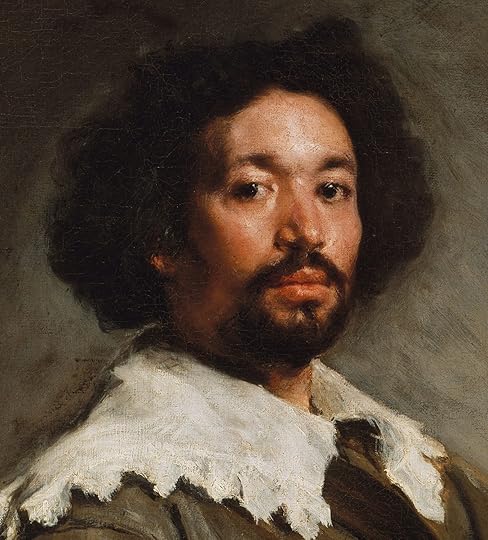
Juan de Pareja's portrait by Velázquez is my favorite painting (every time I see it, it makes me cry) so it was with trepidation and excitement that I started this audio.
The book follows the story of Juan de Pareja and his life as the slave of Diego de Velázquez, the leading painter in the court of King Philip IV of Spain. Historically, we know little of their life except what is portrayed in the paintings and important acts that were documented like marriages and deaths. The author did a good job of weaving known facts with situations that may well have happened. My only issue is that although Juan is an adult for most of the book, he doesn't seem like a grown-up but maybe this is so because the book was written for children. This book was also written in the 60s (around the time of the Civil Rights Movements) so there are also a lot of important thoughts regarding race relations and freedom.
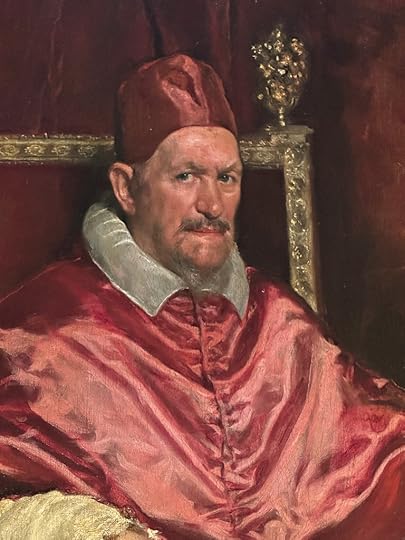
Velázquez is considered an early precursor of the realist and impressionist movements so hearing some of this thoughts on painting the truth (one of the few quotes that can be attributed to him) explained why he differed so much from his contemporaries and why he was so ahead of his time. Learning about the relationship between the portraits of Juan and Pope Innocent X's


was extremely enlightening and even a bit ironic. Both are masterpieces of a slave and a king painted around the same time and when you look at them, you feel like you know the real person (to me Juan looks the better person of the two; the Pope looks the type to stab people in the back. :)
The narrator did a good job with the characters and the pacing. She also had good knowledge of Castilian Spanish because she pronounced the 'Z' in the proper way (it may sound weird for people that are not familiar with this pronunciation but it is correct.:) However, she mispronounced Velázquez' name which drove me nuts (in Spanish, the U in QUE is silent but she would pronounce it as in Queen.) But this is something that would probably only bother a native Spanish speaker like me so if you want to listen to this, I wouldn't let that deter you.
I'm glad at the end that I picked this up because it really just makes me want to learn more. :)
Juan de Pareja's portrait by Velázquez is my favorite painting (every time I see it, it makes me cry) so it was with trepidation and excitement that I started this audio.
The book follows the story of Juan de Pareja and his life as the slave of Diego de Velázquez, the leading painter in the court of King Philip IV of Spain. Historically, we know little of their life except what is portrayed in the paintings and important acts that were documented like marriages and deaths. The author did a good job of weaving known facts with situations that may well have happened. My only issue is that although Juan is an adult for most of the book, he doesn't seem like a grown-up but maybe this is so because the book was written for children. This book was also written in the 60s (around the time of the Civil Rights Movements) so there are also a lot of important thoughts regarding race relations and freedom.
Velázquez is considered an early precursor of the realist and impressionist movements so hearing some of this thoughts on painting the truth (one of the few quotes that can be attributed to him) explained why he differed so much from his contemporaries and why he was so ahead of his time. Learning about the relationship between the portraits of Juan and Pope Innocent X's
was extremely enlightening and even a bit ironic. Both are masterpieces of a slave and a king painted around the same time and when you look at them, you feel like you know the real person (to me Juan looks the better person of the two; the Pope looks the type to stab people in the back. :)
The narrator did a good job with the characters and the pacing. She also had good knowledge of Castilian Spanish because she pronounced the 'Z' in the proper way (it may sound weird for people that are not familiar with this pronunciation but it is correct.:) However, she mispronounced Velázquez' name which drove me nuts (in Spanish, the U in QUE is silent but she would pronounce it as in Queen.) But this is something that would probably only bother a native Spanish speaker like me so if you want to listen to this, I wouldn't let that deter you.
I'm glad at the end that I picked this up because it really just makes me want to learn more. :)

December 15, 2010
I gave this book 5 stars for several reasons. The first of which probably has more to do with my personal tastes, I have studied art history throughout high school and college, and am fascinated by the subject. The next reason is that there was never a dull moment. The book kept me wanting to read, which is always a sign of a good book. The story was very touching, and I found myself relating to and sympathizing with the main character on several levels. The character development was astounding. Finally, after reading this book I was aching to know more. Obviously, as a children's historical fiction book, the author could not lay out all the details of the painters' lives (what little is known about them, anyway.) But I want to study that time period in Spain and learn more about their customs. I want to learn more about Catholicism and the meaning behind the Rosary and some of the religious implications of the book.
I highly recommend this book! It's a well-written, quick reading book.
I highly recommend this book! It's a well-written, quick reading book.

March 2, 2025
Written as the first person story of Juan de Pareja, the Black slave of Diego Velasquez, arguably Spain’s finest painter. It was a fine excuse to slip off and gaze at Diego’s work while reading fiction about its creation.
After Velasquez is entrenched as Philip IV’s official art dude, Rubens passes through - the latter was, at the time, considered a much bigger deal. The scenes with these two great painters together were creatively and thoughtfully imagined; particularly the one where they visit a local icon sculptor especially since that entailed some particularly gory bits about a live crucifixion for modelling purposes.
You know, gotta have gravitas.
And, oh boy, Crucifixes! lent some bite to this news story which appeared this week:
https://www.theguardian.com/world/202...
(The Guardian March 2o25 search: “She has this power”if the link doesn’t work)
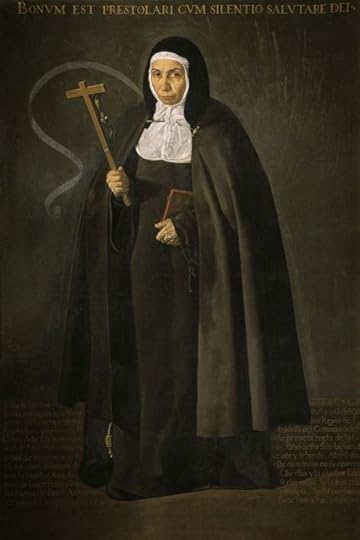
Which links the sizable and vaguely scary crucifix (weapon?) in the hands of this formidable nun painted by Velasquez when she, at 66 in 1620, passed through Sevilla en route to cross Mexico on her way to start the first convent in the Philippines, where she lived (and scourged) herself for another 10 years. What did you do last week?
They believe the original crucifix that hers was based on, was sculpted by Michelangelo (in a different century and country of course) in bronze. The painting and the bronze are both going on sale, if you have some spare nickels.
Truth
“I would rather be first in painting something ugly….” DV
It is said that Velasquez was not concerned about beauty, just honesty. That he would stare at something for an unnervingly long time.
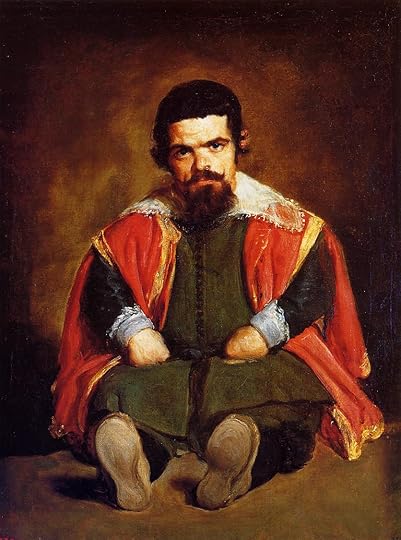
I think that is what has always attacted me to Spanish painters. Velaquez was unafraid to paint the misery, demoralization and exhaustion in the eyes of dwarves whose entire lives were spent at the Hapsburg court being mocked like Sebastián de Morra:
Or the clarity in Juan de Pareja’s eyes:
The Master’s portraits of Philip IV all show him as the terrified puppy that he was, albeit posing majestically wrapped in jewels and satin. His intellectual and speech impediments due to that monstrous Hapsburg jaw are honestly shone, yet the King himself loved the portraits, as he loved the artist.
Likewise Pope Innocent X, revealed to the world as cruel with his unmistakably cold, calculating eyes and tight lips as painted by Velasquez, also loved his likeness as it was truly and honestly his face; the very one he saw smugly reflected in the looking glass each day.
Light
There are lovely discussions of this. The light and dark in paintings, of course, but on their arrival in Italy how different the light there is in comparison to Spain. This delighted me as it is something that has wondered me as well, especially Tuscany which has light just like my past home, San Francisco and my current home on the eastern tip of Uruguay. Nowhere else I’ve been has this magical brew of breeze, sky, temperature, latitude - who knows what?
It’s fictionalized:
“The light here is different from that of Spain,” he told me. We were being pulled slowly through fields of golden grain where blue flowers and red poppies shone among the sheaves. “Here the light seems liquid and has a soft glow, light firelight. In Spain the light is clear and sharp and blinding. Shadows are deeper, more dramatic, in Spain. Here they are gentle, and they soften the outlines of objects.”
A Softer Fluffier Racism
This is written as the memoir of the Black slave who came to be possibly Velasquez’ closest confidant, if not best friend and who was eventually freed by him. Although before Pareja became a free man it was illegal for him to paint at all - because slaves could not “practice the arts” - the freed Juan de Pareja became a famous painter in his own right.
Sevilla was the site of a major slave market and Andalusia was a multiracial place filled with slaves in the 17th century. The issues of dehumanization and racism are dealt with in this story only superficially and with a facile naivete that is quite grating to my 2025 ear. But this was published in 1965 at the height of the Civil Rights era when we really couldn’t imagine that 60 years later troglodytes would not only be trumpeting racism, but formally instituting it again in the USA as the law of the land - as though there had never been any struggle for equality and justice - for anyone, ever.
We really believed things would be better, that people would learn to judge people on the content of their character, not the color of their skin. We thought they would actually want to do so.
This is fiction, dianne, and written for Youth.
After Velasquez is entrenched as Philip IV’s official art dude, Rubens passes through - the latter was, at the time, considered a much bigger deal. The scenes with these two great painters together were creatively and thoughtfully imagined; particularly the one where they visit a local icon sculptor especially since that entailed some particularly gory bits about a live crucifixion for modelling purposes.
You know, gotta have gravitas.
And, oh boy, Crucifixes! lent some bite to this news story which appeared this week:
https://www.theguardian.com/world/202...
(The Guardian March 2o25 search: “She has this power”if the link doesn’t work)
Which links the sizable and vaguely scary crucifix (weapon?) in the hands of this formidable nun painted by Velasquez when she, at 66 in 1620, passed through Sevilla en route to cross Mexico on her way to start the first convent in the Philippines, where she lived (and scourged) herself for another 10 years. What did you do last week?
They believe the original crucifix that hers was based on, was sculpted by Michelangelo (in a different century and country of course) in bronze. The painting and the bronze are both going on sale, if you have some spare nickels.
Truth
“I would rather be first in painting something ugly….” DV
It is said that Velasquez was not concerned about beauty, just honesty. That he would stare at something for an unnervingly long time.
I think that is what has always attacted me to Spanish painters. Velaquez was unafraid to paint the misery, demoralization and exhaustion in the eyes of dwarves whose entire lives were spent at the Hapsburg court being mocked like Sebastián de Morra:
Or the clarity in Juan de Pareja’s eyes:
The Master’s portraits of Philip IV all show him as the terrified puppy that he was, albeit posing majestically wrapped in jewels and satin. His intellectual and speech impediments due to that monstrous Hapsburg jaw are honestly shone, yet the King himself loved the portraits, as he loved the artist.
Likewise Pope Innocent X, revealed to the world as cruel with his unmistakably cold, calculating eyes and tight lips as painted by Velasquez, also loved his likeness as it was truly and honestly his face; the very one he saw smugly reflected in the looking glass each day.
Light
There are lovely discussions of this. The light and dark in paintings, of course, but on their arrival in Italy how different the light there is in comparison to Spain. This delighted me as it is something that has wondered me as well, especially Tuscany which has light just like my past home, San Francisco and my current home on the eastern tip of Uruguay. Nowhere else I’ve been has this magical brew of breeze, sky, temperature, latitude - who knows what?
It’s fictionalized:
“The light here is different from that of Spain,” he told me. We were being pulled slowly through fields of golden grain where blue flowers and red poppies shone among the sheaves. “Here the light seems liquid and has a soft glow, light firelight. In Spain the light is clear and sharp and blinding. Shadows are deeper, more dramatic, in Spain. Here they are gentle, and they soften the outlines of objects.”
A Softer Fluffier Racism
This is written as the memoir of the Black slave who came to be possibly Velasquez’ closest confidant, if not best friend and who was eventually freed by him. Although before Pareja became a free man it was illegal for him to paint at all - because slaves could not “practice the arts” - the freed Juan de Pareja became a famous painter in his own right.
Sevilla was the site of a major slave market and Andalusia was a multiracial place filled with slaves in the 17th century. The issues of dehumanization and racism are dealt with in this story only superficially and with a facile naivete that is quite grating to my 2025 ear. But this was published in 1965 at the height of the Civil Rights era when we really couldn’t imagine that 60 years later troglodytes would not only be trumpeting racism, but formally instituting it again in the USA as the law of the land - as though there had never been any struggle for equality and justice - for anyone, ever.
We really believed things would be better, that people would learn to judge people on the content of their character, not the color of their skin. We thought they would actually want to do so.
This is fiction, dianne, and written for Youth.

April 23, 2018
It was a nice quick read. I liked that it was told in the narration of the slave Juan de Pareja. The author gave him a sad but happy life, with what little is known about him and his Master, Spanish painter Diego Velazquez of the 17th c. Pareja meets good people that want to help him throughout his life journey. Juan has a good heart and loves his Master and Mistress, which turn out to be a blessing to him bc they are good hearted people that actually treat him well almost like a family member, an equal. He recognizes his Masters talent and would love to paint except it is illegal that a slave learn art. So he teaches himself but it is agony to him to do it secretly. The author has done a good job of giving Juan a life, esp since now I am interested in someone (2 someones) I knew nothing about which is the point I believe. ENJOY!!

February 26, 2023
A slice of life novel designed to teach a young audience about Juan de Pareja, slave to the painter Diego Velazquez.
I enjoyed the descrptions of everyday life, though they probably make the book too slow for the actual intended audience. What I didn't enjoy was how a lot of things were handled. From the description of the book I already expected that the relationship between master and slave would be glorified and I was prepared to look past it since it's from the sixties. However, the way other people are characterized made it very hard not to be annoyed. Good people are always beautiful while everyone Juan dislikes or pities is less attractive and/or part of a minority. That seemed contradictary to the message of the novel. Apart from that, the important plot points felt rushed, some even came out of nowhere. The result is that I didn't get a sense of Juan as a painter, only as a slave, while his own journey just seemed to get started.
Good concept and writing, but not really a book that stood the test of time.
I enjoyed the descrptions of everyday life, though they probably make the book too slow for the actual intended audience. What I didn't enjoy was how a lot of things were handled. From the description of the book I already expected that the relationship between master and slave would be glorified and I was prepared to look past it since it's from the sixties. However, the way other people are characterized made it very hard not to be annoyed. Good people are always beautiful while everyone Juan dislikes or pities is less attractive and/or part of a minority. That seemed contradictary to the message of the novel. Apart from that, the important plot points felt rushed, some even came out of nowhere. The result is that I didn't get a sense of Juan as a painter, only as a slave, while his own journey just seemed to get started.
Good concept and writing, but not really a book that stood the test of time.

June 18, 2008
I enjoy books about real people from long ago, though there is often not enough info to create a biography. This book is from a perspective of a black slave of Diego Velazquez. While Velazquez' paintings are not as luminescent as those I remember seeing while reading "Girl With a Pearl Earring" about Vermeer, I thought the characters created were admirable and worth learning about. Because they were both historical fiction from the perspective of the servant of famous painters, I couldn't help comparing the books to each other and I felt less haunted reading this one!

April 23, 2021
What a surprise! I stubbornly think of biographies as boring but I absolutely loved this book! It is full of wonderful reflections on the true, good, and beautiful in art and life.
I was fascinated by the art history and inspired to look up the works of the artists Velasquez, Rubens, Murillo...
I was especially pleased that the author included the importance of the Catholic faith and sacraments in the lives of these historical figures.
I was fascinated by the art history and inspired to look up the works of the artists Velasquez, Rubens, Murillo...
I was especially pleased that the author included the importance of the Catholic faith and sacraments in the lives of these historical figures.

June 3, 2017
A tremendous book. Though intended for children, it is the work of a mature writer, showing depth and nuance.
There are two odd errors that, to my knowledge, have never been corrected in the half century since publication: p.44 "an access of enthusiasm" should be "an excess" and p.66 "weasle-eyed" should be "weasel-eyed." Of course, these do nothing to diminish the greatness of the book.
I see that some editions have taken the image of Juan with King Philip that was originally on the back of the dust jacket and moved it to the front cover. This is a mistake, I think, giving away too much of the story.
There are two odd errors that, to my knowledge, have never been corrected in the half century since publication: p.44 "an access of enthusiasm" should be "an excess" and p.66 "weasle-eyed" should be "weasel-eyed." Of course, these do nothing to diminish the greatness of the book.
I see that some editions have taken the image of Juan with King Philip that was originally on the back of the dust jacket and moved it to the front cover. This is a mistake, I think, giving away too much of the story.

May 24, 2012
An excellent book for young readers, with the caveat that Borton's vocabulary will challenge many.
This is fiction, not biography. Told first person through Juan's eyes, this story of himself and the seventeenth century Spanish painter Diego Velazquez develops in a warm and realistic manner. It betrays it 1965 origin by not sufficiently projecting then current American attitudes toward race and slavery unto its main characters. Yet, in her way, Borton does not deny or misrepresent.
The book's Newberry Medal was well deserved.
A good read.
This is fiction, not biography. Told first person through Juan's eyes, this story of himself and the seventeenth century Spanish painter Diego Velazquez develops in a warm and realistic manner. It betrays it 1965 origin by not sufficiently projecting then current American attitudes toward race and slavery unto its main characters. Yet, in her way, Borton does not deny or misrepresent.
The book's Newberry Medal was well deserved.
A good read.

October 14, 2022
I enjoyed this as much as I did when I first read it in the 1990's.

February 29, 2024
Pretty good school book

June 2, 2021
I did enjoy this book, but I can’t deny its problematic & dated content. The conflicts and complications are interesting and the characters are well-developed with the glaring exception being the eponymous character of Pareja. Quite simply, the book paints him as a “good” slave and glosses over the horrors slaves experienced daily. He only truly suffers at the hand of a “gypsy” who brings him to his new master. When informed he may not pursue his heart’s desire of painting, he accepts it without pain nor complaint. This is a stretch I just can’t accept; denied his pursuit of his passion, Juan lives mildly and peacefully according to the will of another with no pain and wasting his days for another? Even if it’s true, it shouldn’t be lauded as this book does.
While I trust the author’s good intentions, I can’t ignore the unintended effect of minimizing the suffering that slaves would endure. This perpetuates the notion that slaves didn’t have it so bad here in America and their ancestors therefore do not suffer disadvantage because of it. It renders the book inappropriate for young readers; it should only be studied as a pillar of institutional, systemic racism. I know this is a provocative statement, but this book winning the Newbery Award in the 60s demonstrates that even well-intentioned authors and librarians hoping to ease racial tensions only exacerbated the ignorance built into Americans race relations.
On a final, barely related note, I’d like to add that this completes my 9 year project to read all of the Newbery Award books. Even with more than a few novels such as these, I’ve thoroughly enjoyed them. If you’re interested, my advice is to read from the extremes to the middle: start with the most recent and enjoy it and then find the first and read it. Bounce back between now and the 20s. It provides interesting insights on the evolution of our society by contrasting the lessons our kids get in their books now vs. the lessons they got 100 years ago.
Thanks for reading - I hope you found this review useful!
While I trust the author’s good intentions, I can’t ignore the unintended effect of minimizing the suffering that slaves would endure. This perpetuates the notion that slaves didn’t have it so bad here in America and their ancestors therefore do not suffer disadvantage because of it. It renders the book inappropriate for young readers; it should only be studied as a pillar of institutional, systemic racism. I know this is a provocative statement, but this book winning the Newbery Award in the 60s demonstrates that even well-intentioned authors and librarians hoping to ease racial tensions only exacerbated the ignorance built into Americans race relations.
On a final, barely related note, I’d like to add that this completes my 9 year project to read all of the Newbery Award books. Even with more than a few novels such as these, I’ve thoroughly enjoyed them. If you’re interested, my advice is to read from the extremes to the middle: start with the most recent and enjoy it and then find the first and read it. Bounce back between now and the 20s. It provides interesting insights on the evolution of our society by contrasting the lessons our kids get in their books now vs. the lessons they got 100 years ago.
Thanks for reading - I hope you found this review useful!

March 12, 2013
"I, Juan de Pareja, was born into slavery early in the seventeenth century." I have never yet been disappointed with a winner of the ALA Newbery Medal and "I, Juan de Pareja," the 1966 winner by Elizabeth Borton de Trevino kept my string intact. With expressive descriptions of people and places, de Trevino introduces us to "a Europe yeasty with new ideas" and towns "bathed in a golden light."
Juan is a slave of African descent, and following the fever death of his mistress in Seville, he becomes the property of her nephew, one Don Diego Rodriguez de Silva y Velazquez. Although for her book, de Trevino built upon the few extant personal facts regarding Velazquez, the bare bones are true, and it all makes for a good story.
Juan survives an arduous trip to Madrid and matures into an invaluable assistant to Velazquez who is already a well-established painter. "The eye is complicated. It mixes the colors for you." explained Master. "The painter must unmix them and lay them on again shade by shade, and then the eye of the beholder takes over and mixes them again."
Juan learns to grind colors, build frames and stretch linens, and, after several years, accompanies Velazquez to the Spanish Court and eventually to Italy and the Vatican. He secretly hones his painterly skills and becomes an accomplished artist himself. Juan and Velazquez develop "bonds of deep respect and affection," while entrusting their lives to God. Before Velazquez dies, he gives Juan his freedom.
The sole authenticated Velazquez quote describes his approach to his craft: "I would rather be first in painting something ugly than second in painting beauty." De Trevino gives us an interesting glimpse into the lives of these two men and the book should provoke interest in searching out images of their works which hang in famous galleries around the world.
Juan is a slave of African descent, and following the fever death of his mistress in Seville, he becomes the property of her nephew, one Don Diego Rodriguez de Silva y Velazquez. Although for her book, de Trevino built upon the few extant personal facts regarding Velazquez, the bare bones are true, and it all makes for a good story.
Juan survives an arduous trip to Madrid and matures into an invaluable assistant to Velazquez who is already a well-established painter. "The eye is complicated. It mixes the colors for you." explained Master. "The painter must unmix them and lay them on again shade by shade, and then the eye of the beholder takes over and mixes them again."
Juan learns to grind colors, build frames and stretch linens, and, after several years, accompanies Velazquez to the Spanish Court and eventually to Italy and the Vatican. He secretly hones his painterly skills and becomes an accomplished artist himself. Juan and Velazquez develop "bonds of deep respect and affection," while entrusting their lives to God. Before Velazquez dies, he gives Juan his freedom.
The sole authenticated Velazquez quote describes his approach to his craft: "I would rather be first in painting something ugly than second in painting beauty." De Trevino gives us an interesting glimpse into the lives of these two men and the book should provoke interest in searching out images of their works which hang in famous galleries around the world.

July 8, 2014
One of my summer reading goals was to read three Newbery Medal winning books that I hadn't before. I brought three home from the library at random, and this was one of them. I can understand why it won the Newbery Medal. It's a beautiful and well-written piece of historical fiction, with luminescent characters and an engaging story line. I can also see why it's not popular with today's young readers. Unfortunately, historical fiction seems to have really fallen out of favor with the readers of today. Even third graders are begging for Dystopian, and if it's not that it's fantasy or adventure. In historical fiction, often the action is much more subtle, and for the less accomplished reader, there is not as much to draw them in.
This story, though fictionalized, is based on the life of Juan de Pareja, who was a slave in the household of Diego Velazquez, official painter of the Spanish court in the 17th century. Juan becomes Velazquez' assistant, and becomes an invaluable and cherished part of both his studio and his home. Written from Juan's point of view, it follows his life from early childhood through a tumultuous change of ownership, after which he ends up with Velazquez. Then we continue with Juan through his many years of service to the painter, in which he becomes an accomplished artist in his own right, earns his freedom, and eventually finds love.
Beautifully written, and very obviously a labor of love for the author. I was the first person to check this out from our library in years. I will recommend this to my higher readers at school, and have high hopes that I will get someone to read it.
This story, though fictionalized, is based on the life of Juan de Pareja, who was a slave in the household of Diego Velazquez, official painter of the Spanish court in the 17th century. Juan becomes Velazquez' assistant, and becomes an invaluable and cherished part of both his studio and his home. Written from Juan's point of view, it follows his life from early childhood through a tumultuous change of ownership, after which he ends up with Velazquez. Then we continue with Juan through his many years of service to the painter, in which he becomes an accomplished artist in his own right, earns his freedom, and eventually finds love.
Beautifully written, and very obviously a labor of love for the author. I was the first person to check this out from our library in years. I will recommend this to my higher readers at school, and have high hopes that I will get someone to read it.

January 4, 2013
I totally see why this won the Newbery. From page one I was enchanted. It had a calming feel to the read. An autobiographical fiction that read so vividly that I felt as if I was there and liked this 17th century setting. I felt honored getting to know the wonderful Spaniard painter, Diego Rodríguez de Silva y Velázquez, and his slave, Juan de Pareja. The truth and fiction meshed so well that everything was believable and in my head what was told was how it happened. What a thrill it was to be privy to such a look into a story of respect and friendship and not about slavery as one may imagine this might be about. Definitely my kind of book and I am quick to highly recommend this as a must read.
It warms my heart that this is targeted to young readers. What a great example of integrity this would surely grant them.
Simply, this story made me happy. :)
My quote-ables:
“The months went by, and at first I thought every day of Miri. But Time is a great traitor who teaches us to accept loss. I was young, and young hearts cannot always be sad.” pg76
“Lately I added a prayer for Miri, too. As I knelt, it seemed as if an angel folded me within his wings, shutting out all that was ugly or hurtful in the world.” pg 78
“But I am a slave!”
Is it a sin, then, to be a slave?”
No. It is an injustice. But I am a religious man. I do not expect justice here on earth, but only in heaven and I am not a rebellious slave. I love Master and Mistress.” pg 126
Jinky is Reading
It warms my heart that this is targeted to young readers. What a great example of integrity this would surely grant them.
Simply, this story made me happy. :)
My quote-ables:
“The months went by, and at first I thought every day of Miri. But Time is a great traitor who teaches us to accept loss. I was young, and young hearts cannot always be sad.” pg76
“Lately I added a prayer for Miri, too. As I knelt, it seemed as if an angel folded me within his wings, shutting out all that was ugly or hurtful in the world.” pg 78
“But I am a slave!”
Is it a sin, then, to be a slave?”
No. It is an injustice. But I am a religious man. I do not expect justice here on earth, but only in heaven and I am not a rebellious slave. I love Master and Mistress.” pg 126
Jinky is Reading

September 12, 2012
I read this aloud to the kids (ages 8 and 6) and we all enjoyed it - they usually color while I read, but they ask questions so I know they are listening most of the time. The language was a bit over their heads - even a few words I was unsure of - but the story was very interesting.
This is juvenile historical fiction about Diego Velazquez (the painter) and his slave, Juan de Pareja. I love reading stories about real people and events to the kids, even if they are fictionalized, because then we can look at the real deal afterwards on the internet; in this case, the real paintings of Velazquez and Pareja. They are old enough to understand that the people were real, but the dialogue was created. We were able to talk about slavery, illness (the plague), what people's lives were like "back then," and honesty, among other topics. It is a Newbery winner, and a wonderful read to expand their repertoire beyond graphic novels, Disney princesses, and cartoon characters in their underpants. :)
This is juvenile historical fiction about Diego Velazquez (the painter) and his slave, Juan de Pareja. I love reading stories about real people and events to the kids, even if they are fictionalized, because then we can look at the real deal afterwards on the internet; in this case, the real paintings of Velazquez and Pareja. They are old enough to understand that the people were real, but the dialogue was created. We were able to talk about slavery, illness (the plague), what people's lives were like "back then," and honesty, among other topics. It is a Newbery winner, and a wonderful read to expand their repertoire beyond graphic novels, Disney princesses, and cartoon characters in their underpants. :)

September 26, 2011
"The first half of the seventeenth century was brilliant with names that still shine with the luster of courage, art, science, and glory...Rubens and Van Dyke were painting in the Low Countries: Galileo, Newton, and Harvey were contributing scientific knowledge that would turn conceptions of the material world into new channels.." (from Elizabeth Borton de Trevino's forward)
So along comes Juan de Pareja, a humble, sometimes mistreated slave who changes masters and cities of residence until finally he begins working for an artist who appreciates him as a person, a real individual with an interest in life, painting, and who understands that Juan eventually hopes to be a free man. I could not stop reading the story, more out of getting to know Juan de Pareja than of finding out about his masters' current assignment. This is a culturally rich book loaded with colorful medieval images and lively Spanish neighborhoods. Great for a high school Spanish class!
So along comes Juan de Pareja, a humble, sometimes mistreated slave who changes masters and cities of residence until finally he begins working for an artist who appreciates him as a person, a real individual with an interest in life, painting, and who understands that Juan eventually hopes to be a free man. I could not stop reading the story, more out of getting to know Juan de Pareja than of finding out about his masters' current assignment. This is a culturally rich book loaded with colorful medieval images and lively Spanish neighborhoods. Great for a high school Spanish class!
July 6, 2020
Not only is this an enjoyable book that teaches much about history, and art, and courage, honor, & friendship, but it's more.
This is also an important book, very relevant right now as African-Americans are giving voice to the feeling many have that they are still not truly free.
It might not be to every child's taste, but I highly recommend it to every homeschooling family and at least one classroom in every Middle School.
More background, quotations, and discussions in the Children's Books group here: https://www.goodreads.com/topic/show/...
This is also an important book, very relevant right now as African-Americans are giving voice to the feeling many have that they are still not truly free.
It might not be to every child's taste, but I highly recommend it to every homeschooling family and at least one classroom in every Middle School.
More background, quotations, and discussions in the Children's Books group here: https://www.goodreads.com/topic/show/...

February 29, 2024
Stop, why am I crying to a FRICKING SCHOOL BOOK!! This is not okay
June 26, 2025
Only two books have ever managed to bring tears to my eyes, and this is one of them. Treviño is an absolute master writer - her story is full of glory, goodness, truth, and beauty; blended perfectly with the heart-rending realities of unspeakable pain, death, and sorrow. The whole tapestry is weaved together with a that strange, rich Spanish flow which she herself describes so well in Juan's accounts of his mother, Miri, Master, Don Carmello, Lolis, and many others. No matter how many times I will read this book, it never gets old.
March 5, 2024
I cried. Pretty good for a book I had to read in school.

Read
June 13, 20222.5
I thoroughly enjoyed most of this story about a slave learning to become an artist from his master. However, a white author telling the story of an enslaved young man had a couple of cringe worthy moments that felt dated. In particular, slaves that chose to stay with their "good masters" after being given their freedom didn't sit right with me.
Newbery Medal - 1966
I thoroughly enjoyed most of this story about a slave learning to become an artist from his master. However, a white author telling the story of an enslaved young man had a couple of cringe worthy moments that felt dated. In particular, slaves that chose to stay with their "good masters" after being given their freedom didn't sit right with me.
Newbery Medal - 1966

December 31, 2015
This factionalized biography is the saga of Juan de Pareja, a multiracial slave born in the 1600’s. After Juan enjoys a loving, easy childhood, both Pareja’s mother and his owner die, and he is bequeathed to the artist Diego Velazquez. Pareja must endure terrors with an evil slave driver to travel to the home of the painter; once he arrives, however, through Juan’s diligence, intelligence, and loyalty, he becomes Velasquez’s personal assistant and ultimately, his friend.
The Newbery Award winner of 1966, this book would probably not be selected by today’s standards. There is not enough action, too much religiosity, too much internal conflict, not enough wit. That said, I love this quotation at the time from the Hornbook: “Many paths of interest lead from this original, beautifully written story.” I believe that thoughtful, young readers of today would also appreciate Juan's story.
Some of the paths to which the Hornbook refers include art, painting, the history and creation of pigments in paint, and society in the 17th century, as well as friendship, kindness, fidelity, and passion for the art of painting. Because the Catholic Church was omnipresent in people’s lives, there are many references to its beliefs. The book sent me to the Internet to read more about Velasquez, the Baroque period, and to see his paintings that the book describes.
I, Juan de Pareja reminded me of Amos Fortune, Free Man. Both men were slaves who were extremely fortunate to escape slavery and many of its horrors. The reader glimpses hideous events, but also sees the main characters’ redemptions. Both were lucky enough to have benevolent owners, but both men helped make their good fortune.
Because of its complexity, Juan is best for middle-school and older readers. I, an older reader, was definitely enriched by reading I, Juan de Pareja.
The Newbery Award winner of 1966, this book would probably not be selected by today’s standards. There is not enough action, too much religiosity, too much internal conflict, not enough wit. That said, I love this quotation at the time from the Hornbook: “Many paths of interest lead from this original, beautifully written story.” I believe that thoughtful, young readers of today would also appreciate Juan's story.
Some of the paths to which the Hornbook refers include art, painting, the history and creation of pigments in paint, and society in the 17th century, as well as friendship, kindness, fidelity, and passion for the art of painting. Because the Catholic Church was omnipresent in people’s lives, there are many references to its beliefs. The book sent me to the Internet to read more about Velasquez, the Baroque period, and to see his paintings that the book describes.
I, Juan de Pareja reminded me of Amos Fortune, Free Man. Both men were slaves who were extremely fortunate to escape slavery and many of its horrors. The reader glimpses hideous events, but also sees the main characters’ redemptions. Both were lucky enough to have benevolent owners, but both men helped make their good fortune.
Because of its complexity, Juan is best for middle-school and older readers. I, an older reader, was definitely enriched by reading I, Juan de Pareja.

December 12, 2024
Seeped in the Renaissance era of the Spanish painter, Don Diego Velazquez, this book drips with an appreciation of the artist. Our narrator is the titular, Juan de Pareja. A man of African decent, born into slavery. Pareja voice is kind and tender toward much of the world and shares the genius of Velazquez’s art. The touches of the story tied to his surviving painting were truly satisfying. I googled both the portrait of Pareja and the Las Meninas paintings. The red cross on the Artist’s chest stirred quite a bit of emotion. The story of Pareja gaining his freedom was also moving.
I expected to suffer a bit with this book, but found the straight-forward and quick-paced delivery refreshing. I am aware that a white author telling a story of slavery is not without its issues. I do appreciate how she found a voice, in Juan’s eventual wife, that railed against not having freedom, even from generous masters. All in all, I’m not sad to knock off one more Newbery and find my read for a children’s book published in the 1960s.
I expected to suffer a bit with this book, but found the straight-forward and quick-paced delivery refreshing. I am aware that a white author telling a story of slavery is not without its issues. I do appreciate how she found a voice, in Juan’s eventual wife, that railed against not having freedom, even from generous masters. All in all, I’m not sad to knock off one more Newbery and find my read for a children’s book published in the 1960s.

February 13, 2017
A beautiful book, faithful to history, about the lives of Velázquez and his slave Juan de Pareja, who also became an accomplished painter and was eventually freed by Velázquez and became his assistant. The first chapters, with their array of characters while Juan is not yet living with Velázquez, seemed inspired by El Lazarillo or El Buscón. Other important painters, such as Rubens and Murillo also appear in the book.
Español: Precioso libro sobre la vida de Velázquez y su esclavo Juan de Pareja, que Velázquez liberó y se convirtió en su ayudante y un buen pintor. Los pintores Rubens y Murillo también aparecen en la historia e influyen en los acontecimientos. Los primeros capítulos recuerdan, por su estilo y por la variedad de personajes que aparecen, a episodios del Lazarillo o el Buscón.
Español: Precioso libro sobre la vida de Velázquez y su esclavo Juan de Pareja, que Velázquez liberó y se convirtió en su ayudante y un buen pintor. Los pintores Rubens y Murillo también aparecen en la historia e influyen en los acontecimientos. Los primeros capítulos recuerdan, por su estilo y por la variedad de personajes que aparecen, a episodios del Lazarillo o el Buscón.

October 11, 2014
A slow-moving, typical Newbery. I'm starting to get a hunch that some of these slow-moving, typical Newberies were chosen because of the beauty of the writing. That's most likely the case with Juan, who's narration is nice, with some great descriptions of art, but quite matter-of-fact. It isn't as much a book about art than a book about the adventure of life and helping your friends along the way. Also, it could have ended way earlier than it did, and I tend to feel inclined to subtract a star off my review if the ending seems too long-winded. On the plus side, it did make me want to do some research on Diego Velazquez and the real Juan de Pareja, and it might be something that appeals to adult readers looking for a relaxing easy read. Just don't expect much action or major surprises.

March 24, 2018
Newbery Medal Winner--1966
This started off slow, but by the end I was surprisingly emotionally invested in Juan, his kind master Diego, and their families. The fact that this is based on real people (though little is actually known about their lives other than their names and that they were painters, along with a few other tidbits included in the story) made it even more interesting. I think I would have enjoyed it more had there been more dialogue, but it's told like an autobiography so there's lots of narration.
This started off slow, but by the end I was surprisingly emotionally invested in Juan, his kind master Diego, and their families. The fact that this is based on real people (though little is actually known about their lives other than their names and that they were painters, along with a few other tidbits included in the story) made it even more interesting. I think I would have enjoyed it more had there been more dialogue, but it's told like an autobiography so there's lots of narration.

August 24, 2017
This story begins as a picaresca, but then changes into a kind of a sentimental novel. It's definitely not bad, but I didn't love it either.


July 31, 2023
This book was always around at libraries when I was growing up, and I distinctly remember intentionally not reading it. Maybe I didn’t like the cover. Maybe the odd title put me off. Maybe I was just stubborn. But I do find that people tend to like books at the right time, and today I did like it a lot. I read the whole thing in a single evening and recommended it to a brand-new acquaintance at the pool (AS YOU DO).
It does not follow contemporary dogmas about referring to Black or enslaved people, due to having been published in 1965, but I found this book big-hearted and kindly and a glimpse of a better world.
It does not follow contemporary dogmas about referring to Black or enslaved people, due to having been published in 1965, but I found this book big-hearted and kindly and a glimpse of a better world.
Displaying 1 - 30 of 598 reviews