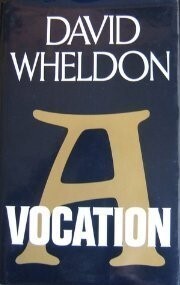
From a tower in the mountains the bells ring out, without prediction, at uncanonical hours... a communication real enough but with no apparent purpose. The peasant, who has heard the bells while still within his mother's womb, seeks to find no meaningful sound beyond the elements of a system by which he may live; the magistrate, an educated man, a representative of the state, finds in the unpredictability only an arbitrary and meaningless communication from above.
The landscape, both physical and spiritual, of David Wheldon's strange and mysterious new novel, is seen through the eyes of a foreigner who is both lost and ill: Thomas Colver, a traveller through this land, who though he knows nothing of the place he is in, sees the predicament of the magistrate as though it were a parable, a paradigm of his own condition: in the attempt to gain understanding, all logic becomes the logic of superstition.
Here's the jacket description in case anyone cares:
"From a tower in the mountains the bells ring out, without prediction, at uncanonical hours...a communication real enough but with no apparent purpose. The peasant, who has heard the bells while still within his mother's womb, seeks to find no meaningful sound beyond the elements of a system by which he may live; the magistrate, an educated man, a representative of the state, finds in the unpredictability only an arbitrary and meaningless communication from above.
The landscape, both physical and spiritual, of David Wheldon's strange and mysterious new novel, is seen through the eyes of a foreigner who is both lost and ill: Thomas Colver, a traveller through this land, who though he knows nothing of the place he is in, sees the predicament of the magistrate as though it were a parable, a paradigm of his own condition: in the attempt to gain understanding, all logic becomes the logic of superstition.
A Vocation is perhaps even more compelling than David Wheldon's acclaimed earlier novels, The Viaduct and The Course of Instruction. It is a work that puzzles and intrigues and like his previous novel 'it is one of those books that bypass the head goes straight to the raw edge of consciousness evoking an irresistible and disturbing response' (Janice Elliott, Sunday Telegraph). This, his third novel, should firmly establish him as one our most interesting and accomplished younger writers."