Jump to ratings and reviews
Rate this book

No Pain Like This Body: A Novel

Rate this book
First published by Anansi in 1972, No Pain Like This Body remains a classic of Canadian and Caribbean writing. Set in a turn-of-the-century Hindu community in the Eastern Caribbean, the novel describes the perilous existence of a poor rice-growing family during the August rainy season. Their struggles to cope with illness, a drunken and unpredictable father, and the violence of the elements end in unbearable loss. Through vivid, vertiginous prose, and with brilliant economy and originality, Ladoo creates a fearful world of violation and grief, in the face of which even the most despairing efforts to endure stand out as acts of raw courage.

160 pages, Paperback

First published December 31, 1987

14 people are currently reading
667 people want to read

About the author

Harold Sonny Ladoo

3 books9 followers
Harold Sonny Ladoo (1945 – 1973) is a Caribbean novelist and author of two books documenting the struggles of living in poverty in the Hindu communities of Trinidad and Tobago.
Ladoo was born and grew up in an environment much like the world of his novels. He was born in Trinidad into extreme poverty and immigrated to Toronto, Canada with his wife and son in 1968 to study English at the University of Toronto.
It was during this time that he wrote his first and most notable novel No pain like this body, published in 1972. The novel is a vivid story of a young boy growing up in a small Caribbean rice-growing community. It focuses on the day-to-day struggles of a single family through illness, storm, and violence during the August rainy season. The writing is raw and often naïve yet manages to create a visceral experience.
His second book, Yesterdays was a much more upbeat book about a young man attempting to launch a Hindu Mission to Canada.
His third book that was intended to be last book of a trilogy, however in 1973 while on a visit home to his Calcutta Settlement, he was mysteriously killed and his body was found on the side of a road in Trinidad.

Ratings & Reviews

What do you think?
Rate this book

Friends & Following

Create a free account to discover what your friends think of this book!

Community Reviews

5 stars
53 (19%)
4 stars
93 (34%)
3 stars
95 (35%)
2 stars
17 (6%)
1 star
9 (3%)
Displaying 1 - 30 of 41 reviews
Profile Image for Alan (the Lone Librarian rides again) Teder.
2,709 reviews251 followers
March 6, 2025
Post-Indentured Servitude
A review of the A List paperback (August 3, 2013) of the House of Anansi hardcover original (1972).
There is no fire like passion;
there is no losing throw like hatred;
there is no pain like this body;
there is no happiness higher than rest. — The Dhammapada (Sayings of the Buddha)
- used as the epigraph for No Pain Like This Body.
The sky twisted like a black snake and the clouds rolled and rolled and rolled as a big spider; the wind shook Tola in a rage and the rain pounded the earth; the lightning came out of the mouth of the darkness like a golden tongue and licked the trees in the forest and the drum ripped through the darkness like a knife. They moved deeper and deeper into the forest, and they felt the rain falling upon their heads from heaven.
No Pain Like This Body was Indo-Trinidadian Canadian🍁 author Ladoo's first book. It is considered a breakthrough in Caribbean literature due to its raw portrayal of the lives of Indian workers in Trinidad. Set in 1905 it centres around a rice-planting family who have served out their period of indentured servitude and now work their own plot. Indians were brought over to work the fields and plantations when slavery was made illegal.

The story is brutal as it revolves around an abusive drunken father who beats his wife and children, killing one of them. In the aftermath of the death, a wake is held in the family home where the mother is driven to drunkenness and eventually goes mad while eating mud off the fields, finally fleeing into the forest. The only lightness and hope is in the grandparents and the children's efforts to survive.

The dialogue is delivered in Indo-Trinidadian Creole which is mostly understandable and is helped further by a several page Glossary that explains most of the Hindi/Bengali terms and cultural references. My understanding was helped by concurrently reading the biography Equal to Mystery: In Search of Harold Sonny Ladoo by documentary filmmaker Christopher Laird who had gathered and filmed material for a planned bio-documentary film which remained uncompleted due to funding constraints.

This follows my reading of Ladoo's 2nd novel Yesterdays (1974) which I felt overdid the absurdities of village life with its fixations on excrement and defilement. I reviewed that book as Indo-Trinidadian Satyr Play.

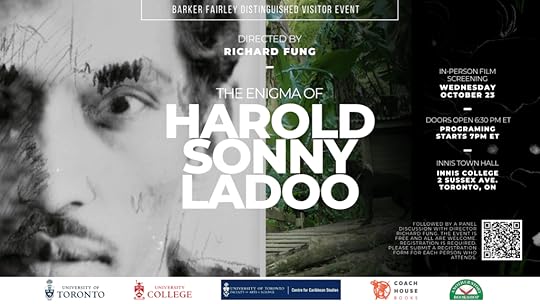
I read No Pain Like This Body through having been introduced to the author Harold Sonny Ladoo from seeing the film The Enigma of Harold Sonny Ladoo directed by fellow Trinidadian-Canadian Richard Fung last year. That excellent film combined archival footage with animation and present day investigation to tell the rather mysterious story of the Indo-Trinidadian Canadian who lived and studied in Canada from 1968 onwards and then died tragically during a trip back home in 1973.
Profile Image for Jim.
422 reviews108 followers
April 8, 2024
This is a decent read, but be warned beforehand that nothing good is going to happen in these pages, in which Ladoo outlines the miserable existence of a family of poor rice farmers in Trinidad. Fortunately, the book is a short one, but any more pages would have been superfluous. Mr Ladoo relates the story through the voice of a young boy, and relies heavily on onomatopoeia to get his point across, like:

"Crax crax cratax doom doommm doomed the thunder rolled."

A carpenter's saw made this sound:

"hoosh hash hoosh hash see saw see

I know a few people from this region so I anticipated that there would be liberties taken with the English language, but I wasn't expecting it to be so thoroughly massacred. Most of the book is written in whatever dialect was in vogue at the time, but it's worth sticking with it. Ladoo is brilliant and can get a point across in very few words. He describes the father in the very first sentence:

Pa came home. He didn't talk to Ma. He came home just like a snake. Quiet.

Those few words tell you all you need to know about this shiftless layabout, the cause of the family's grief. And if you want a sense of the child's despair, there's this:

The sky rolled as an endless spider and the rain fell like a shower of poison over Tola.

All good stuff, and the book is full of it. Something along the line of Tobacco Road with a Caribbean flavor. You can experience the family's utter hopelessness and despair from the comfort of your easy chair. A quick read, well worth your time.
Profile Image for Alan.
Author 15 books191 followers
April 7, 2008
Life amongst the poverty stricken migrant sugar plantation workers in (somewhere like Trinidad?)- like the title it sounds painful and it is. However it is a fantastic feat of writing, it had me riveted. All the sadder because the author was murdered shortly after writing it at the age of 28.
Profile Image for MJ Nicholls.
2,275 reviews4,853 followers
April 12, 2025
A frenetic whoooosh of Caribbean miserablism narrated in melodious dialect with a cast of unfortunates straining against the rage of an abusive paterfamilias. Ladoo’s use of onomatopoeic language lends the novel a primal power as the unforgiving climate becomes an antagonist as evil as the drunken father. An unpleasant and enraging read at times, the novel depicts without comment the fatalism (and absurdity) of the Hindu practices and mysticism that seem to pull these characters further into lives of paranoia, fear, and torment, and those looking for a life-affirming slap on the chops against evil will need to look elsewhere. This is a depiction of unending pain that throbs, thwacks, and howls throughout the novel in a manner you simply won’t forget when the book ends. P.S. The UK Vintage Classics reprint has a tacky, parodically Caribbean illustration for its cover that is offensive not merely on a design level, but is painfully ill-suited to the tone of the book itself. Whoever signed off on this eyesore should be pelted with cabbages for at least two months.
Profile Image for O.
381 reviews2 followers
December 7, 2019
Not a review, just thoughts.

While I was reading this, I felt miserable and just despair. Everything seemed to be just happening,one after the other. But it isn't inaccurate, the stories rang similarly to ones often told by my parents who would have grown up around the same time as Ladoo (author). My parents have told me about planting rice, about tapia houses and drinking from tin cups, about ketching cold and dying, abuse of women, abuse of children. Although the landscape has changed, the behaviour has not, it has evolved. The character Pa is angry, lazy and violent, he wants all , but also wants to do nothing. This is still a characteristic among some Trinidadian men today. Just open a newspaper and see how far men go to assert their power. Then, their shame consumes them, too little, too late. Ma works, she has no choice, she has to provide for her children, just like the women of today, waking up at 4am to catch taxi to get to their jobs, only to be assaulted, raped, robbed. I feel like we are still in this cycle, where women work, to be punished, where their men stay home, kings of the culvert. Is this ingrained in us as Caribbean men and women? I don't know. But look at it, through the generations, it still exists.

Excellent, must-read Caribbean novel.
Profile Image for Joseph Schreiber.
587 reviews182 followers
June 22, 2020
Powerful, intense and emotionally devastating, this slim novella pulls the reader into the tragic life of a poor rice-farming family in a small Eastern Caribbean community in the early twentieth century. The weather, illness, alcohol and superstition are evoked with vivid inventive language. The only book published during the author's short life, this masterpiece of Canadian-Caribbean literature was a chance sale purchase that I am ever grateful for.
For a longer review: https://roughghosts.com/2020/06/22/go...
Profile Image for Agatha.
12 reviews1 follower
Read
November 5, 2025
Life is beauty, life is pain! Incredible sensory detail in this book.
Profile Image for Andrew Sare.
255 reviews
May 10, 2018
Pick up dis kiss me ass book and open it

Oright

Turn da pages.

swish, swish shishh
swish, swish shishh

Den behave youself and respet wot da kiss me ass story man sayin to you and don't let no moderass watersnake in he jangling cola bite you in de ass!
Profile Image for Hester.
650 reviews
May 14, 2023
Audiobook is really good . That singing rhythm and all the noises of the birds, rain and trees . A brutal story of the chaos caused by poverty , violence and death in a family living a hardscrabble life in the rice fields of Trinidad . Have to say it reminded me of As I Lay Dying / William Faulkner in its plot and it's themes and the role of the land but is written through the eyes of a child narrator so the bewildering immediacy present in both novels makes more sense . There's also the same existential theme of death and its boundaries only this novel uses the very real folk and religious beliefs to point up the liminal nature of existence . Really really good . Raw heroism in the face of complete depravation..
May 9, 2024
This novel is very different from anything else I've read, both in its writing style, that is a very dialectical English spoken in Trinidad and in its content, which, though short, is chockfull of arbitrary and tragic incidents that follow one after another. Like it's been already proclaimed in the introduction, not a lot happens in the book, but rather we get an in-depth look into the lives of the Indian labourers living in Trinidad and the surrounding areas.

It's definitely a hard book to get into and even harder to keep reading if you can't get yourself to care about the characters, which I couldn't until the first three chapters, but if you do end up getting hooked once, the story flows quickly.
Profile Image for charlie.
2 reviews
March 20, 2025
Unlike anything I've ever read. Beautiful imagery, tragic story.
Profile Image for Jason.
15 reviews2 followers
October 10, 2022
Book ended rather abruptly and without fully completing the story arc, but the overall storytelling and uniqueness of the prose made me bump it up one star. Sad that the author died before finishing the follow up to this book.
Profile Image for Rabiah TD.
47 reviews15 followers
August 8, 2022
“The wind didn’t care about Tola. The wind was beating the rain and the rain was pounding the earth. There were no lights in the sky; all that Ma and Balraj saw were layers and layers of blackness and rage. The choking sound of the thunder came from the sky zip zip zip crash doom doomm doomed! Then the lightening moved as a gold cutlass and swiped an immortelle tree beyond the river.”

Harold Sonny Ladoo is seen as one of the greatest Caribbean literary stars. According to my research he is infamous in Trinidad and Tobago. He was stabbed to death in 1972 but his two novels have earned themselves the title of being Caribbean classics. No Pain Like this Body is the only novel to be published during his lifetime.

I am very unsure how I feel about this book. By way of plot, nothing really happens. There isn’t much character development, there is no specific plot line and there is a very magnified focus on the everyday mundane.

Despite this, I carried on reading this novel because of the way Ladoo captures the struggle, pain and love of a poverty stricken rice farming family through the dialogue of the characters. Reading this, I only felt misery and despair as we see one tragic event lead to another. Death of a child, domestic violence, alcoholism, suicide and so on.

The prose is interesting as a large part of written in dialect, which I think is part of the reason why it took me two weeks to get through the slim novella! There is a focus on the everyday mundane such as descriptions of the weather in depth, descriptions of the religious superstitions, the type of alcohol everyone is drinking and the descriptions of all sorts of background animal noises. It really paints a picture of the dire conditions the family has to endure. There were parts where I felt I was present at the scene such as the funeral scene of own of the sons.

Overall, the prose is vibrant, vulgar and violent, seamlessly incorporating vernacular and explosive onomatopoeic passages into a stunning portrait of a dark world marked by poverty, grief and fear.

This wasn’t really for me, but I think if you’re someone who perhaps enjoyed the Story of a Brief Marriage you will enjoy this as the prose is similar in some ways.
95 reviews6 followers
May 6, 2008
a small miracle about a small world with universal applications--an allegory of poverty and struggle and helplessness--ladoo maintains the tone of the first page, which is excellent--again, thanks, lowell--
Profile Image for Regitze Xenia.
950 reviews107 followers
August 31, 2021
I give this book two stars mainly because I am very confused as to how I feel about it right now. Somehow it felt unfinished to me and I missed an explanation as to why the mother went mad in the end. But I didn't hate it, in fact I think it was just what two stars mean: "ok".
This entire review has been hidden because of spoilers.
Profile Image for lostcupofstars.
256 reviews14 followers
November 11, 2023
This is not a well written book. I didn’t enjoy the lack of flow in the text and it had nothing to do with the dialect.
The story seemed to lack depth because of it and it ended up being a book I was eager to finish so I could move on to something else.
Profile Image for Vart.
7 reviews2 followers
February 2, 2025
A breathtaking story that will make you shout; you are part of it, yet you are unable to do anything.
Profile Image for Nyambura.
295 reviews33 followers
July 7, 2015
Ladoo wrote such a deprressingly good book, I am bereft of words.
10 reviews
October 8, 2025
An incredibly powerful book unlike anything else I've read. It is a book that chronicles the unrelenting poverty, desperation and despair of the lives of this family.

It was brilliant for Ladoo to use an omniscient child narrator as the voice for this novel. The narrator speaks like a child and has a child's understanding of the world. His use of simple language and onomonopea is so effective. So, in this way, a lot of reading the book is seeing a child describes peoples actions and expressions and then as an adult reader, you are able interpret what is actually happening, how people are actually feeling.

I love Ladoo's decision to write the dialog in the vernacular. As a fan of Irvine Welsh's writing, reading the dialog and leaning to understand it was powerful and rewarding, something I usually don't get to experience. One a more personal note, I am an Indian American who was raised Hindu, and it really piqued my interest to see how these traditions I grew up with translated halfway across the world.

It's a damn shame that this was the only book that Ladoo published before his life was cut short. I look forward to reading some of his other work that was published post-humously.
Profile Image for Rose Kaur.
76 reviews
June 30, 2024
3.5 ⭐

This book is a perfect example of how beautifully poetry can embody pain and violence, yet instil a deep sense of impending doom from page one. The use of repetition and onomatopoeia adds the essence of poetry, while the author uses animals - snakes, spiders, scorpions - to describe the wild, predatory, and beastly predisposition of people and nature.

The author portrays the various ways in which God makes his omnipresence felt to this family - punisher of sin, threat to spirits, and a protector of life. Yet, only the innocent seem to suffer the most, depicting even his ruthlessness.

I was really invested in learning more about the characters’ behaviour and emotions, but it wasn’t explored in this story. I wasn’t sure why the mother put herself and her kids through the father’s abuse - especially since her parents encouraged her to leave him. The author makes it evident that it’s her choice to stay, but doesn’t explore the “why”. Towards the end, I found it hard to keep my attention since it felt like I was being distanced from the characters, watching them from afar rather than being among them - not knowing how they felt or why they felt a certain way.
Profile Image for Jane Mulkewich.
Author 2 books18 followers
October 27, 2024
I was recently introduced to Ladoo through a screening of a new film about him, called "The Enigma of Harold Sonny Ladoo" by filmmaker Richard Fung. Some of the passages from this book were used in the film, so when I read the book, I already felt some familiarity with the text. The story itself is a bleak one, depicting an Indo-Trinidadian family in about 1905, living in dire poverty and headed by Pa who is a mean drunk and his four children and his wife live in fear of him. The story is told largely from the point of view of the children, and is full of onomatopoeic phrases (he was snoring hort snort hort snort; they heard the raindrops tarat tat tarat tat tat; his teeth went clax clax clax; their feet went flip flop flip flop as if mules were running). The story does not wrap up with a tidy ending, it just ends abruptly, and partly because it seems to be an ongoing story, and partly because of the vivid wriitng and the brutality of the world portrayed, this is a memorable book that will stay with me for a long time.
Profile Image for Tiara Chutkhan.
Author 3 books41 followers
September 9, 2020
This novel was a very raw portrayal of the toxic practices in Indo-Caribbean culture. Poverty, alcohol abuse and domestic violence are issues we are still currently battling but thankfully there is much more awareness than there used to be. The children are memorable and lovable, providing bits of humor amongst the heavy content.
Profile Image for Candy.
62 reviews3 followers
November 18, 2021
This book was definitely a snore fest....a continuous episode of unfortunate happenings that never seemed to end. I understand the author's plight but I honestly felt like the disasters and sufferings of the characters were too exaggerated.
Profile Image for Danie.
124 reviews4 followers
May 19, 2019
Slice of life, realist novel over a few days.

That slice is not easy to swallow.
Profile Image for Annabel.
51 reviews8 followers
December 31, 2021
3.2
I really enjoyed reading it there were just some parts which didn't flow for me as much as others - also not too sure how I feel about the ending?
Profile Image for Helen.
204 reviews
December 29, 2023
The foreword by Dionne Brand kinda sums it up when she says "not much happens". But it means you can appreciate the writing style with the use of the local dialect and the abundance of onomatopoeias.
Displaying 1 - 30 of 41 reviews

Can't find what you're looking for?

Get help and learn more about the design.