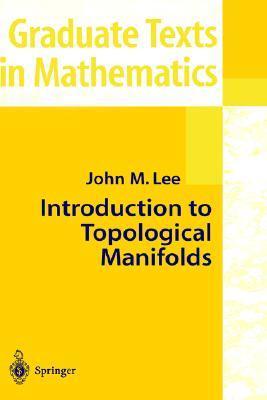
To reach the research frontier, the graduate student in mathematics must acquire a mastery of algebraic topology and the theory of differentiable manifolds. Naturally, with such venerable subjects there is no lack of superb textbooks from which to choose: Dold, Spanier and Warner, to name a few among the old war-horses. John Lee’s motive for writing the present recent work on topological manifolds (first in a series of three volumes in the Springer series of graduate texts in mathematics, the second on smooth manifolds and the third on Riemannian manifolds, i.e., spaces equipped with the notion of a distance between any two points) seems to be the observation that one can successfully get to the heart of the subject of algebraic topology while remaining within the category of topological manifolds, i.e., topological spaces that are locally homeomorphic to ordinary Euclidean space. The most general topological spaces can harbor the most paradoxical pathologies and, as such, are not very representative of our spatial intuition. By sticking to spaces that have the nice local features of a manifold, one frees oneself to investigate the algebraic machinery without inessential complications due to the above-mentioned pathologies; the interesting topological properties, after all, are those that manifest themselves at the global level—for instance, the genus of a surface. Therefore, little is lost if we insist on the local level being well-behaved like a manifold.
Is Lee justified in coming out with this new entrant on the textbook market? A glance at the table of contents shows that he does propose to traverse a (not-too-idiosyncratic) path through the standard topics, but keeps the coverage selective so as to be able to reach a stopping point in homology theory within a half year. One would expect after finishing Lee to go on with a full-length course in algebraic topology occupying at least another semester. A little below on what Lee omits.
After an introductory chapter on what manifolds are and the varied motives why one might wish to study them, both internal to pure mathematics and coming from physics, Lee gets down to business in the second chapter with introductory point set topology. The reader will have seen most of this material before, as an undergraduate, and Lee’s coverage is the bare minimum needed to state sensibly the full definition of a (topological) manifold as a second-countable Hausdorff locally Euclidean space (possibly with boundary). The text progresses in the next chapter to standard constructions of topological spaces, namely, subspaces, product spaces, disjoint union spaces, quotient spaces and adjunction spaces. A nice feature of Lee’s thorough discussion is that he always proves theorems on the characteristic properties of these spaces and the uniqueness of the topologies so defined. Chapter four goes on to the circle of ideas surrounding connectedness and compactness, including path-connectedness, local compactness, paracompactness, partitions of unity and proper maps. Along the way he arrives at some substantial results, such as Urysohn’s lemma, the Baire category theorem and the embeddability of compact manifolds into Euclidean space.
The subsequent chapters contain a presentation of all the basic ideas of algebraic topology, as applied to topological manifolds: homotopy and the fundamental group, lifts and covering maps, homology. The machinery of CW complexes, strong deformation retracts, degree theory and group actions, universal covering spaces and deck transformations, the Seifert-van Kampen and Mayer-Vietoris theorems etc. is introduced to enable computations in concrete spaces. For those who are not familiar with these concepts, they enable one to break down the given topological space into pieces and to put together local data stepwise until one recovers the global situation. A certain amount of ingenuity is called for in this, as there does not seem to be a deterministic algorithm, but by employing one’s intuition one can eventually picture how to proceed. Lee supplies some worked examples and asks the reader to attempt his own in the homework exercises. Along the way, he devotes some space to algebraic concepts necessary in order to carry out such a program: free products, free groups, presentations of groups, free abelian groups, abelianization, short and long exact sequences. These ideas are put to satisfying use in deriving topological invariants for a number of example spaces, in particular, to obtain a classification theorem for compact surfaces. How else is one to know that, say, a pretzel could not be continuously deformed into a doughnut or into a ball? The exposition hews to an appropriate level for the beginning graduate student: not condescendingly simple, but not arcane, either. Certainly, Lee tells us plainly enough what he is doing and usually takes care to spell out what has been achieved in very clearly stated theorems. The one drawback this reviewer noted is that the final chapter on homology theory seems somewhat rushed and opaque, as if Lee were pulling his formulae out of a bag of tricks. Where do chain homotopies, which figure so largely in the proof of the Mayer-Vietoris theorem, come from, for instance? Contrary to Lee’s accustomed habit, the proof of this theorem is a little hard to follow, strewn as it is across a number of related propositions and lemmas on homological algebra. Perhaps if he were not constrained to be so concise in this chapter, a more leisurely account of the theory would be less puzzling.
Considering the number of topics it contains in a single volume, Lee’s treatment will seem remarkably complete. He cannot be faulted for any lack of clarity, and by the end, one will have seen a good sampling of example spaces and computed their fundamental group and homology. The homework problems are quite illustrative, and fall into two classes: those calling for a concrete derivation of a proposition or computation in example spaces, and those meant to point the way to more advanced points of view (for instance, there is one problem in the chapter on the Seifert-van Kampen theorem, to define a category-theoretic pushout and give its characteristic property and to work out what it is in some familiar categories). A note of complaint: most of the problems, though not trivial, tend to be on the easy side; the serious student may be disappointed not to encounter any that demand hours upon hours, if not days, of hard thought before one can discern the way to its solution. Just as with athletic training, mathematical maturity comes only through much mental exertion and, in consequence, the ablest students may find themselves becoming impatient with Lee. One could, thus, criticize the author for failing to provide at least a few very difficult problems to match the generally excellent quality of his exposition of the material in the text.
A word about what Lee omits: there is nothing here on spectral sequences, just the briefest of allusions to higher homotopy (as the requisite machinery has not been developed), nothing on homology or cohomology with coefficients other than Z and the Künneth formula, only a smattering of category theory and homological algebra etc. As mentioned above, Lee deliberately circumscribes the scope of the material he covers. Perhaps the discerning reader of this review will detect a potential problem: doesn’t this put Lee’s text somewhere between the undergraduate and graduate level, as far as algebraic topology is concerned? Yes; there will be some duplication of effort for those who wish to go on to a two-semester course in graduate-level algebraic topology proper. Two apposite remarks: first, Lee’s proximate objective is to prepare the reader for the theory of differentiable manifolds and Riemannian geometry with only as much topology as he judges indispensable; second, everything he does cover is vital material and should be part of the aspiring mathematician’s education. Anyway, this reviewer prefers the spiral approach to the curriculum, in which one does not jump at once to the most advanced possible perspective but has the chance to see the paradigmatic topics treated again from an increasingly sophisticated point of view. There is no royal road to learning; the student should welcome a certain amount of repetition as an opportunity to solidify his understanding of crucial points.
That said, Lee’s forms a pleasing pedagogical contribution to the field of beginning graduate-level textbooks, written with verve in an uncommonly clear style. It can be used with profit if one knows what one is getting into with it.