This episodic novel, originally published in Japan in 1964 and appearing for the first time in translation, scrupulously observes one family's experiences getting used to a new home atop a windy hill near Tokyo. As the three children and their parents discuss the intricacies of buying a new desk, or deal with curious centipedes and residential developers who threaten to destroy the surrounding landscape, they accustom themselves to the trials of moving and the necessity of accepting change as the only constant in life. Each section revolves around the observations of father Oura, whose character is loosely based on Shono himself.
Junzō Shōno was a Japanese novelist. A native of Osaka, Shōno began writing novels after World War II. He won the Akutagawa Prize in 1955 for his book Purusaido Shokei (Poolside Scene). Shōno's other award winning books include Seibutsu (Still Life), for which he won the Shinchosha literary prize, Yube no Kumo (Evening Clouds), which was awarded the Yomiuri literary prize, and Eawase (Picture Cards) which took the Noma literary prize.
Shōno lived for one year in the United States in the late 1950s on a fellowship from the Rockefeller Foundation at Kenyon College in Ohio. Shōno later published a book, Gambia Taizaiki about his experiences at Kenyon.
Shōno was made a member of the Japan Art Academy in 1978. He died of natural causes at his home in Kawasaki on September 21, 2009. Shōno was 88.
Are you looking for a book that helps you slow down and find an inner calm? According to the introduction, this is that kind of book and I agree. These is no plot or drama. It’s an accounting of a period of time when the main character, a writer, and his family moved into a newly built house on the fringe of the Tokyo suburbs. A lot of the story is autobiographical. The author lived in the house described in this book written in 1964. He had a wife and three kids – two boys and a girl, just like the author in the story.
To paraphrase the blurbs and the introduction, this is a book about how we find a place in this world, how we shape it and how it shapes us. How we change the world and how we can’t anticipate how it will change. Time is both a ravager and a healer. There’s not a linear plot. It’s snapshots of their life with metaphors of gardening and dealing with nature.
It was a mistake to build a new house on the edge of the suburbs on a hilltop with no windbreak and a twenty-minute walk to a subway stop. And the main character realizes too late that it’s a risky site for thunderstorms and typhoons, so that’s a worry. We sympathize with him and his family as they watch the woods they loved and played in disappear around them to development, but of course, they started it.
The home environment is completely calm. It makes the setting of Leave it to Beaver look like chaos. Whether it is (was?) something in Japanese culture at that point in time, or just the peculiarities of that family, the children are remarkably docent. At most the father occasionally has to scold one of the boys to finish his homework, but he never raises his hand or even his voice to them. The girl is a perfect, bright, eager student and helpful daughter. The father’s control of the TV remote seems to be enough. (No computers yet.) The father reluctantly lets the boys watch Gunsmoke, Popeye and Disney cartoons, and he then becomes addicted to TV serials himself. If the father has any faults it’s that “he hasn’t gotten around to [fill in the blank] yet.” (Like our TBR piles.)
The whole family is amazingly in touch with nature. We watch incidents with centipedes, dragon flies and snakes. When the forest is still there, the children take a different short-cut path every day through the woods to school. The boys delight in bringing wildflowers from the forest to their mother. They run to the encyclopedia to learn about every new bird or flower. The family keeps a diary marking dates of blossoming and the solstices. They create rituals, such as a citron bath at the time of a solstice.
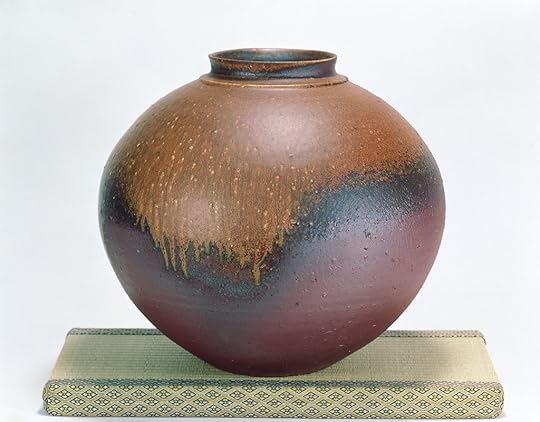
We watch them go on a vacation to the beach where the mother and daughter collect types of seaweed for a school project. They go crazy over varieties of delicious local pears and collecting gingko nuts. The whole family pitches in to help the mother do the heavy work of grating yams for soup. There’s a story of coincidences that result in them acquiring a huge decorative antique vat. We hear of their appreciation of traditional Japanese potteryware such as bizen and kutani.
A good example of the nature metaphor is when he is thinking of his mother, dying at the time, while he splits plant roots and thinks of how each plant carries the potential of re-creating the whole in it.
We are told that the fragments in the book form a whole – and isn’t that just like our lives?
The author (1921 - 2009) was a prolific writer – pretty much a book a year all his life - novels and collections of short stories and essays. He won many literary prizes and he was a visiting professor in the US for a year. His work is considered instrumental in changing the nature of post-war literature in Japan.
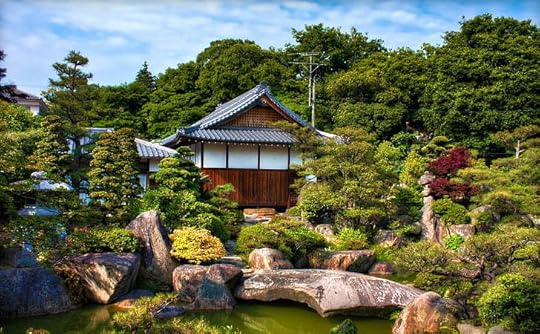
Top photo from wallpaperflare.com Bizen ware from japan-brand.jnto.go.jp The author from prabook.com
3.5 stars, rounded up. I decided to do something about the unread books on my shelves, so closed my eyes and pulled one out. I'm not sure when or why I bought this one, but I know I got it at a used book sale. I figured I'd give it a try and DNR it if I didn't like it.
I figured out pretty early on that this was the literary equivalent of The Jerry Seinfeld Show - a book about nothing. Little snippets of conversation between family members, mother, father, 3 children. No plot, no drama, no theme, none of the things that normally go into a novel. Nothing ever really happened.......but I kept reading.
And chuckling, because on every page was a part of family life that I recognized and sympathized with. Kids who don't want to wash their faces and brush their teeth, who put off homework til the last minute, who don't know school assignments, who fight with each other. Parents conversations, "What shall we have for dinner?" "Where should we go on vacation?" "Should we worry about our son's attitude?" "What should we plant this spring?"
Yeah, I know, it sounds boring......but I kept reading.
This book was written in 1964, when I would have been 11 years old. And even though it took place in Japan, half a world away, and more than 50 years ago, it brought to life a world so familiar to me it actually sent me back to growing up in the little southern town of Catsburg, NC. We kids didn't want to brush our teeth or do homework either. Our parents worried about us. Life just plodded along like the action in this book, nothing ever really happened, except that it did. We grew up, our parents grew old. And I finished the book.
I will end this review with a quote from Maya Angelou:
"We are more alike than not, my friend, we are more alike than not"
I really enjoyed this. There were just a few times, however, that he was a bit too sentimental. Shono's writing about his own family and "Evening Clouds" never really got too far beyond one of those pieces people write every week about their family life for newspaper colour supplements.
"Evening Clouds" has been compared to the films of Yasujiro Ozu. But, perhaps because he didn't have a family of his own, I think Ozu bites harder and is better at avoiding mawk. Classic scene: http://www.youtube.com/watch?v=gumG54...
A very comfortable (4.5) read in the tradition of Jan Karon (as explained by my wife). The Oura family and their episodic learning in the woods, as they were forced to deal with the omnipresent "modern world" was much more entertaining than the 'bumper sticker' style of Thoreau. I will continue to read this author's other "family chronicle" books.
This was boring and weird (different culture) but it was strangely relaxing and comforting. I read it for a book club. Wouldn't have read it otherwise.
"The most celebrated work by one of Japan's master literary stylists, Evening Clouds is a book filled with delicious images of ordinary life, richly and precisely observed. A family moves into a new home on a windswept hilltop in western Tokyo. Around them are forests and farms. But the developers are coming, and the children are growing up. There are meals, quandaries, conversations ... Life appears comfortable and serene, yet Shono's portrayal has a strange an evocative undercurrent, as the most minute details slowly resonate out through a universe that is changing and unforgiving. Evening Clouds combines the crafted naturalism of haiku with the Ozu-like clarity of film to produce a story that is wistful and real. Read Shono slowly, and luxuriate in his vision." ~~back cover
This book is the personification of the amazing range of what readers like, and what speaks most deeply to them. When I had finished reading the book (and it went quite slowly for me because it failed to hold my interest) I was undecided in my opinion -- did I even have an opinion? So I read reviews -- something I don't ordinarily do, preferring to come to my own opinion about what I read. Every one just raved about it. Much to my surprise. After giving it more thought, I realized that the style was meant to mirror the silence and beauty found in meditating, that the book was indeed a kind of meditation: random sketches of various aspects of the life of a Japanese family. In meditation, you're advised to notice thoughts as they arise and then let them slip away. Exactly the pattern and rhythm of these sketches.
But as much as I enjoy meditating, I confess I didn't receive the same comfort and serenity from reading this book. Because I have had little exposure to Japanese culture, I found myself annoyed by the parents' responses to their children and their apparent philosophy of child rearing. I make the assumption that my ignorance of Japanese culture resulted in my not being able to see or appreciate the nuances others could see and appreciate.
It's not a book I can in good conscience I can recommend to other readers, nor is it a book I would have chosen to read left to my own devices (it's a book selected by my online reading group -- each of us chooses a book for the rest of the group to read.) But since so many other readers loved the book, you would be wise to take my lackluster appraisal with a large grain of salt.
one of my favorite books. A description of family life in an evolving word, this is not an adventure book, unless you are able to appreciate the small movements of life that make being a parent an adventure. I loved reading that book , and have re-read in twice in 3 or 4 years.
Reminded me in format of My Neighbors the Yamadas in book form and with a bit less humor and a bit more reflection on nature. It also made me think of the Studio Ghibli movie Pom Poko, about the development of the Tama Hills.