

What do you think?

General History of Europe
Europe in the Central Middle Ages, 962-1154
Established as the best general introduction to the period. Within a firm political narrative it considers the emergence of the distinctive character of medieval Europe. The second edition contains new perspectives on the history of the religious orders, on scholarship, popular religion, architecture and art, and new material on the impact of travel and communication, marriage and the family, and the study of cities.
Paperback
First published January 1, 1975
About the author
Christopher Nugent Lawrence Brooke
49 books11 followersChristopher Nugent Lawrence Brooke CBE FBA FSA was a British medieval historian.
From 1974 to 1994 he was Dixie Professor of Ecclesiastical History at the University of Cambridge. He was married to fellow medievalist, Rosalind B. Brooke.
Brooke was the son of medieval historian Zachary Nugent Brooke (1 December 1883 – 7 October 1946).
From 1974 to 1994 he was Dixie Professor of Ecclesiastical History at the University of Cambridge. He was married to fellow medievalist, Rosalind B. Brooke.
Brooke was the son of medieval historian Zachary Nugent Brooke (1 December 1883 – 7 October 1946).
Ratings & Reviews
Friends & Following
Create a free account to discover what your friends think of this book!
Community Reviews
Displaying 1 - 8 of 8 reviews

June 14, 2019
The Central Middle Ages, and in particular the interval between the second half of the 10th Century and the mid of the 12th Century included, is one of the most critical periods in the long process of cultural, economic and political formation of the civilization that would later consolidate in the embryonic modern Europe.
It is a fascinating, complex and contradictory period, which saw the emergence of religious intolerance and fanaticism, but also of the first symptoms of a renovated and refreshed religious sentiment, instantiated in the monastic and papal revolution that started in the 10th century and fully flowered in the 11th and 12th century.
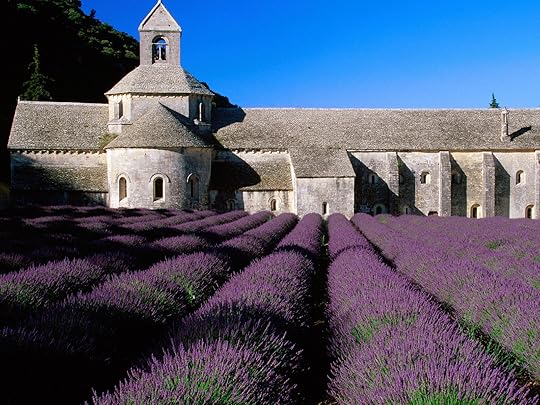
(the Cistercians Abbey of Notre-Dame de Sénanque, near Gordes)
This is undeniably a period of intense political conflicts and factionalism, but it is also characterized by the remarkably cosmopolitan nature of Christendom visible in the eleventh and twelfth century European civilization, when students flocked to the newly established cultural and educational institutions such as Paris and Bologna, and also when travel for varied reasons (commercial, political, religious - this is, after all, the age of the establishment of the great pilgrimage routes) and cultural interchange were surprisingly more widespread than often assumed by past historians. This is a stage in European development that modern historians have stopped characterizing with an oversimplified “age of faith”; in fact, it is quite appropriate to label the intellectual revival of the age as the “twelve century renaissance”.

(a typical medieval scriptorium)
Religion still played a very important role, of course, and an intense popular religious revival flowed through many different channels – in reforms and massacres, in pilgrimages and crusades, in beautiful works of architecture and art, in the flowering of the monastic movement.
But this is also the period that witnessed the first development, for the first time since Late Antiquity, of a lay and urban culture founded on the presence of a urban commercial "patriciate" in the towns of Flanders, northern Germany (where we have the phenomenon of the Free Imperial cities, essentially self ruling cities only subject formally to the distant Emperor) and northern Italy (with the particularly fascinating and impressive example of the mercantile empire established by the Republic of Venice); a period of great economic and demographic expansion that saw enormous areas of waste being brought into cultivation, the development of new agricultural techniques, and the rise of guilds and craft specialization. Some historians have actually referred to the associated expansion of trade as a true commercial revolution, symbolized by the trade fairs, which proved to be an important catalyst, and in a much more local scale by the construction of the first covered markets in smaller market towns and villages.
Many modern historians also rightfully point to this period as the real moment when Europe started to “take off” in terms of social and economic dynamism, where the newly found confidence and expansionary vision of Christendom took the form of the Crusades, and when the first glimpses of the development of Western “modernity” can be perceived.
Sure, this was still an age of political instability, insecurity and recurring disease and famine, ruled by a military aristocracy bred to war, and defined by a large majority of population still living a peasant life of subsistence economy tied to the land, and when land transport was still horrendously expensive (if compared with modern standards). However it is undeniable, even within the most pessimistic outlook, that the Europe at the start of the period analyzed by the author (962 AD, the year of the Coronation of the Emperor Otto the Great, one of the most forceful and fascinating characters of the Central Middle Ages) does look very different, from almost every perspective, to the Europe at the end of the period (1154 AD, the year of the establishment of the “Angevin Empire” with the beginning of the reign of Henry II, and the year after the death of probably the most representative of the “heroic age” of European monastic and militant spirituality, St Bernard of Clairvaux).
I love this particular age, when Europe was overcoming its infancy and reaching its unruly youth, a period when distance between beautiful fortified villages, partially hidden by winter mists and proudly perched on wooded hills dominating serene river valleys, was measured in days of perilous travel through unpopulated forests that were infested, in a still partially pagan and vivid popular imagination, by elves, fairies, and trolls. A period when time was timed by the passage of seasons and by the strokes of churches’ bells, by the Cistercians monks' incessant routines, songs and prayers in their remote abbeys, or by the low creaking of the wooden desk of the scribes, illuminating a manuscript or copying an ancient text in the effort to preserve the flickering and endangered flame of the knowledge and wisdom of antiquity. A time when silence was ever-present, in a world where technology was still extremely rudimentary and the contact with the natural world and its constraints had an immediacy that is now forever lost, and where superstition and the supernatural were immanent and a constant presence, where the fear of the torments of hell was graphically represented in the tympanum and in the capitals of many churches.

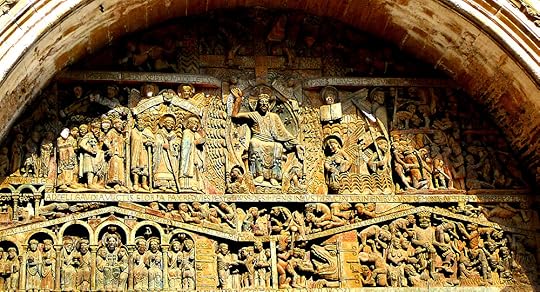
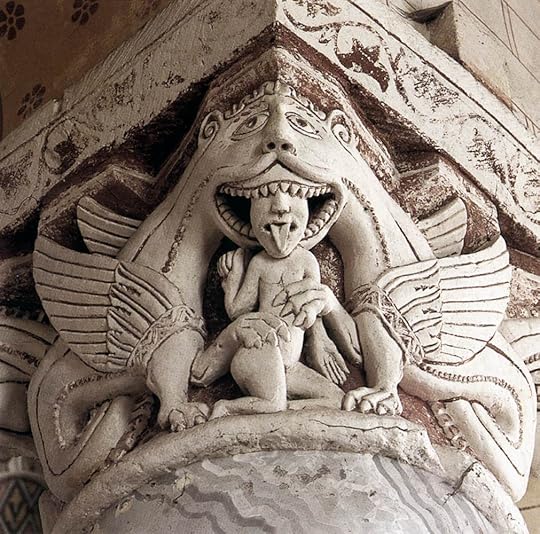
Yes life was cheap, short and often harsh, occasionally brutal, but I always felt an endless fascination for this period. After all, this is the golden age of the Romanesque architecture, which is a style that I always found extremely spiritual and beautiful in its somber, elegant simplicity, and which captures, more than anything else, the particular spiritual attitudes of the medieval "man".
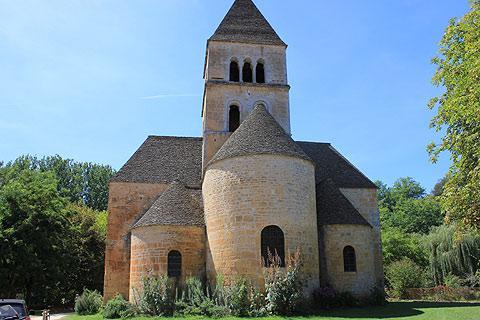
(one of my favourites: Saint-Leon-sur-Vezere, Dordogne - a beautiful small, simple church in a beautiful riverside location - a place that I always see whenever I visit France)
We should not forget that the period between the 10th and 12th century saw an exceptionally high proportion of effort and wealth put into the building of cathedrals, monasteries, abbeys and churches of all sizes. It is a period whose atmosphere can, from my personal experience and in my personal opinion, still be breathed in some utterly beautiful medieval villages that dot a few regions of rural France.
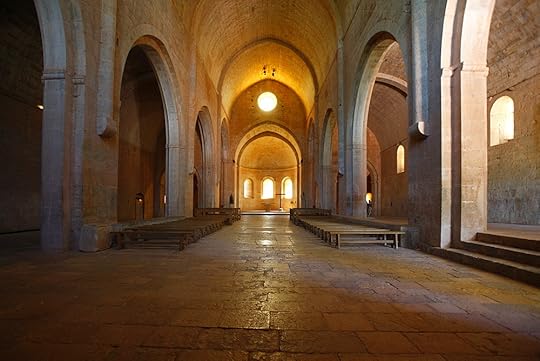
(beauty in simplicity: Thoronet Abbey Church - Provence)

(the beautiful small fortified village of Vigoleno (Piacenza, Northern Italy)- founded in the 10th century and beautifully preserved - I suggest a visit in winter, when you can feel the weight of the past centuries)
And we should not forget that this is the period that also sees the beginnings of some serious castle-building. Beauty and function integrated into impressive and highly atmospheric statements of power:
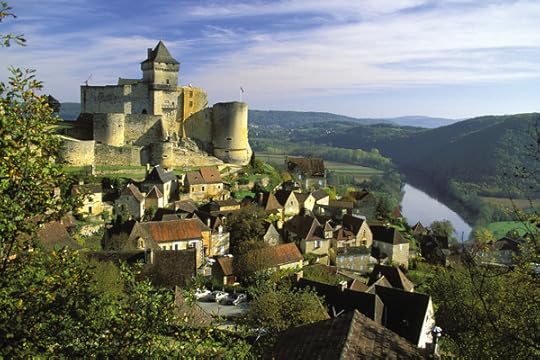
(Castelnaud - founded in the 12th century, it is a quintessential, impressive and beautiful example of a medieval fortress, in a beautiful natural setting overlooking the glorious river Dordogne. Totally worth a visit)
And, in a more objective and detached perspective, this is an extremely important formative period of European history, which simply can't be ignored if we really want to understand the deep origins and the cultural DNA of modern Europe.
Now, let's return to the book, and ask ourselves if the author did render justice, in this work, to the complexity, peculiar features and importance of the European Central Middle Ages: the answer is a definite yes, with a couple of qualifications.
- Firstly, the book is organized thematically and its main focus is not a structured, chronological sequence of main political events; moreover, it is targeted at a relatively knowledgeable audience. It is therefore only recommended to readers with good general grasp of the period, possibly gained through more traditional, structured publications (such as https://www.goodreads.com/book/show/1... ).
- Secondly, the quality and detail of the coverage of the different areas of Europe is not always of homogeneous level; while the coverage of the Papacy, of England and of the Empire are excellent, and the parts of Eastern Europe in close relationship with the latter (Bohemia, Poland and Hungary) are provided with some coverage, I must say that the coverage of France and Italy are good but could have been better, and the rest of Eastern Europe and the polities of the Kievan Rus' are not covered at all. There are also some parts where the book feels a bit rushed and where it loses structure and overall coherence, as it tries to cover too many aspects at the same time.
- Thirdly, this is still just an overview of a very complex and multifaceted period, which simply can't be covered within the limited space of a single volume. It is academically of excellent quality, definitely not a popular history book but a text at least at undergraduate level; however it can only occasionally go to the level of detail in which a sophisticated reader with a more specialist type of needs would really be interested.
- Lastly, I do not think that enough emphasis has been allocated to the considerable influence that the Islamic Civilization (note that I do not call it "Arab" civilization, as this would be grossly unfair to the huge contribution brought by the Persian civilization, especially during the Abbasids caliphate) had on the civilization of Western Europe. Yes it is true that such influence was much more noticeable after our period of interest, but still I would have preferred a bit more focus on this point, and in general on the inter-relationships between Europe and the Eastern world in general.
The limitations above do not significantly detract from the overall value of this solid book, which covers with good accuracy and an excellent methodological approach many fundamental aspects of the period, including society, religion, school and scholarship, travel, cities and towns, the new monastic orders and the evolution of papacy, kingship and government etc.
I particularly appreciated the first chapter after the introduction, where the author highlights his methodological approach (firmly based on a close focus on the available primary sources, which are all cited and briefly analyzed), and where he honestly highlights the paucity and fragmentary nature of available information (especially of a detailed, quantitative nature), and the risk embedded in carelessly extrapolating overall conclusions based on a uncritical application of modern approaches (including the risk to underestimate the great variety of ideas, societies, perspectives and situations within the European world of the time, which was far from homogeneous).
As an example, a too blunt and artificial contrast between the landed aristocracy and the commercial urban class ignores the fact (most noticeable in Italy) that often mercantile capital was provided by the nobility from the lands about the towns; this was landed nobility that actually came to dominate both the trade and government of the cities. Italian cities were notorious for their factionalism and highly litigious nature (not just between cities, but also within cities, just look at the many lofty towers of San Gimignano, typical example of “mine is bigger than yours” mentality), but this was warfare of families, NOT of classes (pace the many neo-Marxist interpretations of medieval history). And this continued well into the so-called Renaissance...
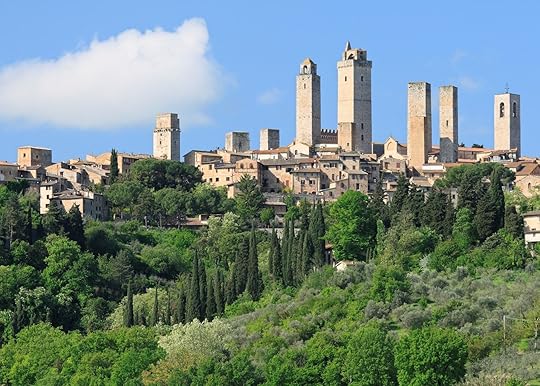
(San Gimignano - "my family's tower is taller than yours")
The chapter on medieval kingship and government is really excellent, and it covers with great accuracy the many contradictory aspects and the fluidity of the concept of authority in the Central Middle Ages, including administrative, ideological and even military and theological aspects. This is, after all, the period of the so-called “Investiture Controversy”, so fundamental in determining the very nature of the political discourse in later European centuries. The role played by the Church's administrative structures in supporting or even running the secular administration is also well explained by the author, with the particularly important, almost symbiotic relationship with the Saxon dynasty, the Salian dynasty until Henry III, and the Capetians (especially under Louis VI and Louis VII). Just as an interesting example, the foundation of the archbishopric of Magdeburg by Otto I was based on political and even military considerations as much as on religious aspects: the archbishop would be a marcher lord, his city a first line of defense and also of military and missionary expansion on the eastern frontier of Germany. The German "Drang nach Osten" started in earnest in the 12th century, but the attention of the Emperor on the eastern lands pre-dates such development.
The survival of a strong monarchy in Germany, and the fact that a weak monarchy survived in France at all, bear witness to the critical importance of the Church in providing legitimacy and support to the very concept of medieval kingship. This also explains the devastating impact of the Investiture Controversy to the ultimate structural stability of the Empire, which after the Indian summer of the first Hohenstaufen's clearly progressively deteriorated into something of a far more precarious and less powerful nature.
The chapters on the religious reforms promoted by the papacy, its ambiguous relationship with the secular powers, and its connection with the intellectual renaissance of the 12th century, are also first-class: a brilliant example of nuanced, balanced and highly articulated and informative treatment based on serious academic work. The many different streams and contradictions of Christianity and of the Papacy are well represented: this is the period of intellectual revival driven by the Church, but also the period of Christian anti-intellectualism (an ambiguity well personified by St Bernard himself, who did not hesitate to condemn what he perceived as the excessive weight given to philosophy and the classics, writing his invective in... brilliant Latin); it is the period of search for ascetic purity, but also the period of the establishment of an autocratic Papal Monarchy; it is the period of the opulence and power of Cluny, but also the simplicity and asceticism of Clairvaux. It is in this period that the complicated, conflictual and strangely modern love story of Abelard and Heloise develops within a highly ambiguous ideological and religious context. This is also the period when the Christian Church tried to rein in the violence of the rapacious European military aristocracy, while at the same time proclaiming the Crusades and sanctifying war against the heathens (and this is the period when more than one Pope directly engaged in military adventures, and was seized by his adversaries!). All of this is well captured by the author.

(the "fighting bishop" - not such a bizarre occurrence in the period, considering that before the Investiture Controversy most candidates for a bishopric were nobles who had been appointed to the position by the king, not to mention the very "relaxed" position that the Church had at the time in relation to the concept of "just" or "holy" war)
The history of the Saxon and Salian dynasties is also very well developed and succinctly but really well treated by the author. I particularly liked how the author explains the ongoing problematic conflictual relationship between monarchy and the magnates, in Germany as well as in France. The remarkable resilience of the very idea of Empire, even several centuries after the end of the original Roman Empire (the legend "Renovatio Imperii Romanorum" was scored on Otto III's seal), and the impressive character of the Emperor Otto I, are also all vividly described by the author. Ideas were important at the time, and very possibly played a significantly more important role, in comparative terms, than in current more "materialistic" times, and historians of the period can't ignore this fundamental aspect.
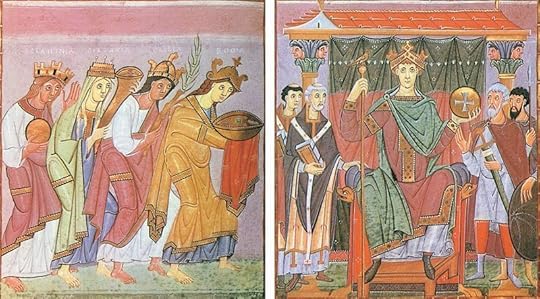
(the Holy Roman Emperor Otto III)
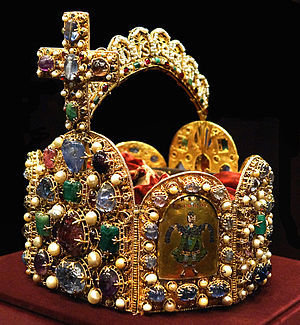
(The imperial Crown of the Holy Roman Empire - on the right side of the arch it is written: ROMANORU(M) IMPERATOR AUG(USTUS). Made for Otto the Great, of clear Byzantine inspiration; kept in the Imperial Treasury at the Hofburg Palace in Vienna)
We should also bear in mind that this is also the period of greater-than-life personalities - forceful characters such as the Otto's, the Emperor Henry IV and Pope Gregory VII, the scholar-Pope Sylvester II (who promoted the study of Arab and Greco-Roman arithmetic, mathematics, and astronomy, reintroducing to Europe the abacus), Eleanor of Aquitaine (Queen of the Franks through her first marriage to Louis VII and Queen of the English through her second marriage to Henry II), St. Bernard and William The Conqueror (just to name a few). The author brilliantly and successfully fleshes out the personalities, actions and influences of many of such important players, in some case really vividly bringing them to life.
The book is also complemented with an extremely handy collection of genealogical charts (absolutely vital in a period where the European dynasties where so closely and intricately connected with each other), and by a brief but useful chronological list of political events. On the not-so-positive side, the accompanying maps are unfortunately of average quality and poor level of detail.
Unfortunately I must hereby succumb to the strict space limitations dictated by GR, therefore I can't explore the many other themes investigated by the author.
To conclude this review, I want to highlight that this book manages to capture quite well the variety of human outlook, interests and experiences that characterise this utterly fascinating period, whose nature and feel, complexities and contradictory nature, are well captured by this quite comprehensive, solid piece of work that, even with its limitations, is highly recommended to all non-beginner readers who want a thematic, well-rounded exploration of this highly formative age.
Definitely recommended - 4 stars.
It is a fascinating, complex and contradictory period, which saw the emergence of religious intolerance and fanaticism, but also of the first symptoms of a renovated and refreshed religious sentiment, instantiated in the monastic and papal revolution that started in the 10th century and fully flowered in the 11th and 12th century.
(the Cistercians Abbey of Notre-Dame de Sénanque, near Gordes)
This is undeniably a period of intense political conflicts and factionalism, but it is also characterized by the remarkably cosmopolitan nature of Christendom visible in the eleventh and twelfth century European civilization, when students flocked to the newly established cultural and educational institutions such as Paris and Bologna, and also when travel for varied reasons (commercial, political, religious - this is, after all, the age of the establishment of the great pilgrimage routes) and cultural interchange were surprisingly more widespread than often assumed by past historians. This is a stage in European development that modern historians have stopped characterizing with an oversimplified “age of faith”; in fact, it is quite appropriate to label the intellectual revival of the age as the “twelve century renaissance”.
(a typical medieval scriptorium)
Religion still played a very important role, of course, and an intense popular religious revival flowed through many different channels – in reforms and massacres, in pilgrimages and crusades, in beautiful works of architecture and art, in the flowering of the monastic movement.
But this is also the period that witnessed the first development, for the first time since Late Antiquity, of a lay and urban culture founded on the presence of a urban commercial "patriciate" in the towns of Flanders, northern Germany (where we have the phenomenon of the Free Imperial cities, essentially self ruling cities only subject formally to the distant Emperor) and northern Italy (with the particularly fascinating and impressive example of the mercantile empire established by the Republic of Venice); a period of great economic and demographic expansion that saw enormous areas of waste being brought into cultivation, the development of new agricultural techniques, and the rise of guilds and craft specialization. Some historians have actually referred to the associated expansion of trade as a true commercial revolution, symbolized by the trade fairs, which proved to be an important catalyst, and in a much more local scale by the construction of the first covered markets in smaller market towns and villages.
Many modern historians also rightfully point to this period as the real moment when Europe started to “take off” in terms of social and economic dynamism, where the newly found confidence and expansionary vision of Christendom took the form of the Crusades, and when the first glimpses of the development of Western “modernity” can be perceived.
Sure, this was still an age of political instability, insecurity and recurring disease and famine, ruled by a military aristocracy bred to war, and defined by a large majority of population still living a peasant life of subsistence economy tied to the land, and when land transport was still horrendously expensive (if compared with modern standards). However it is undeniable, even within the most pessimistic outlook, that the Europe at the start of the period analyzed by the author (962 AD, the year of the Coronation of the Emperor Otto the Great, one of the most forceful and fascinating characters of the Central Middle Ages) does look very different, from almost every perspective, to the Europe at the end of the period (1154 AD, the year of the establishment of the “Angevin Empire” with the beginning of the reign of Henry II, and the year after the death of probably the most representative of the “heroic age” of European monastic and militant spirituality, St Bernard of Clairvaux).
I love this particular age, when Europe was overcoming its infancy and reaching its unruly youth, a period when distance between beautiful fortified villages, partially hidden by winter mists and proudly perched on wooded hills dominating serene river valleys, was measured in days of perilous travel through unpopulated forests that were infested, in a still partially pagan and vivid popular imagination, by elves, fairies, and trolls. A period when time was timed by the passage of seasons and by the strokes of churches’ bells, by the Cistercians monks' incessant routines, songs and prayers in their remote abbeys, or by the low creaking of the wooden desk of the scribes, illuminating a manuscript or copying an ancient text in the effort to preserve the flickering and endangered flame of the knowledge and wisdom of antiquity. A time when silence was ever-present, in a world where technology was still extremely rudimentary and the contact with the natural world and its constraints had an immediacy that is now forever lost, and where superstition and the supernatural were immanent and a constant presence, where the fear of the torments of hell was graphically represented in the tympanum and in the capitals of many churches.
Yes life was cheap, short and often harsh, occasionally brutal, but I always felt an endless fascination for this period. After all, this is the golden age of the Romanesque architecture, which is a style that I always found extremely spiritual and beautiful in its somber, elegant simplicity, and which captures, more than anything else, the particular spiritual attitudes of the medieval "man".
(one of my favourites: Saint-Leon-sur-Vezere, Dordogne - a beautiful small, simple church in a beautiful riverside location - a place that I always see whenever I visit France)
We should not forget that the period between the 10th and 12th century saw an exceptionally high proportion of effort and wealth put into the building of cathedrals, monasteries, abbeys and churches of all sizes. It is a period whose atmosphere can, from my personal experience and in my personal opinion, still be breathed in some utterly beautiful medieval villages that dot a few regions of rural France.
(beauty in simplicity: Thoronet Abbey Church - Provence)
(the beautiful small fortified village of Vigoleno (Piacenza, Northern Italy)- founded in the 10th century and beautifully preserved - I suggest a visit in winter, when you can feel the weight of the past centuries)
And we should not forget that this is the period that also sees the beginnings of some serious castle-building. Beauty and function integrated into impressive and highly atmospheric statements of power:
(Castelnaud - founded in the 12th century, it is a quintessential, impressive and beautiful example of a medieval fortress, in a beautiful natural setting overlooking the glorious river Dordogne. Totally worth a visit)
And, in a more objective and detached perspective, this is an extremely important formative period of European history, which simply can't be ignored if we really want to understand the deep origins and the cultural DNA of modern Europe.
Now, let's return to the book, and ask ourselves if the author did render justice, in this work, to the complexity, peculiar features and importance of the European Central Middle Ages: the answer is a definite yes, with a couple of qualifications.
- Firstly, the book is organized thematically and its main focus is not a structured, chronological sequence of main political events; moreover, it is targeted at a relatively knowledgeable audience. It is therefore only recommended to readers with good general grasp of the period, possibly gained through more traditional, structured publications (such as https://www.goodreads.com/book/show/1... ).
- Secondly, the quality and detail of the coverage of the different areas of Europe is not always of homogeneous level; while the coverage of the Papacy, of England and of the Empire are excellent, and the parts of Eastern Europe in close relationship with the latter (Bohemia, Poland and Hungary) are provided with some coverage, I must say that the coverage of France and Italy are good but could have been better, and the rest of Eastern Europe and the polities of the Kievan Rus' are not covered at all. There are also some parts where the book feels a bit rushed and where it loses structure and overall coherence, as it tries to cover too many aspects at the same time.
- Thirdly, this is still just an overview of a very complex and multifaceted period, which simply can't be covered within the limited space of a single volume. It is academically of excellent quality, definitely not a popular history book but a text at least at undergraduate level; however it can only occasionally go to the level of detail in which a sophisticated reader with a more specialist type of needs would really be interested.
- Lastly, I do not think that enough emphasis has been allocated to the considerable influence that the Islamic Civilization (note that I do not call it "Arab" civilization, as this would be grossly unfair to the huge contribution brought by the Persian civilization, especially during the Abbasids caliphate) had on the civilization of Western Europe. Yes it is true that such influence was much more noticeable after our period of interest, but still I would have preferred a bit more focus on this point, and in general on the inter-relationships between Europe and the Eastern world in general.
The limitations above do not significantly detract from the overall value of this solid book, which covers with good accuracy and an excellent methodological approach many fundamental aspects of the period, including society, religion, school and scholarship, travel, cities and towns, the new monastic orders and the evolution of papacy, kingship and government etc.
I particularly appreciated the first chapter after the introduction, where the author highlights his methodological approach (firmly based on a close focus on the available primary sources, which are all cited and briefly analyzed), and where he honestly highlights the paucity and fragmentary nature of available information (especially of a detailed, quantitative nature), and the risk embedded in carelessly extrapolating overall conclusions based on a uncritical application of modern approaches (including the risk to underestimate the great variety of ideas, societies, perspectives and situations within the European world of the time, which was far from homogeneous).
As an example, a too blunt and artificial contrast between the landed aristocracy and the commercial urban class ignores the fact (most noticeable in Italy) that often mercantile capital was provided by the nobility from the lands about the towns; this was landed nobility that actually came to dominate both the trade and government of the cities. Italian cities were notorious for their factionalism and highly litigious nature (not just between cities, but also within cities, just look at the many lofty towers of San Gimignano, typical example of “mine is bigger than yours” mentality), but this was warfare of families, NOT of classes (pace the many neo-Marxist interpretations of medieval history). And this continued well into the so-called Renaissance...
(San Gimignano - "my family's tower is taller than yours")
The chapter on medieval kingship and government is really excellent, and it covers with great accuracy the many contradictory aspects and the fluidity of the concept of authority in the Central Middle Ages, including administrative, ideological and even military and theological aspects. This is, after all, the period of the so-called “Investiture Controversy”, so fundamental in determining the very nature of the political discourse in later European centuries. The role played by the Church's administrative structures in supporting or even running the secular administration is also well explained by the author, with the particularly important, almost symbiotic relationship with the Saxon dynasty, the Salian dynasty until Henry III, and the Capetians (especially under Louis VI and Louis VII). Just as an interesting example, the foundation of the archbishopric of Magdeburg by Otto I was based on political and even military considerations as much as on religious aspects: the archbishop would be a marcher lord, his city a first line of defense and also of military and missionary expansion on the eastern frontier of Germany. The German "Drang nach Osten" started in earnest in the 12th century, but the attention of the Emperor on the eastern lands pre-dates such development.
The survival of a strong monarchy in Germany, and the fact that a weak monarchy survived in France at all, bear witness to the critical importance of the Church in providing legitimacy and support to the very concept of medieval kingship. This also explains the devastating impact of the Investiture Controversy to the ultimate structural stability of the Empire, which after the Indian summer of the first Hohenstaufen's clearly progressively deteriorated into something of a far more precarious and less powerful nature.
The chapters on the religious reforms promoted by the papacy, its ambiguous relationship with the secular powers, and its connection with the intellectual renaissance of the 12th century, are also first-class: a brilliant example of nuanced, balanced and highly articulated and informative treatment based on serious academic work. The many different streams and contradictions of Christianity and of the Papacy are well represented: this is the period of intellectual revival driven by the Church, but also the period of Christian anti-intellectualism (an ambiguity well personified by St Bernard himself, who did not hesitate to condemn what he perceived as the excessive weight given to philosophy and the classics, writing his invective in... brilliant Latin); it is the period of search for ascetic purity, but also the period of the establishment of an autocratic Papal Monarchy; it is the period of the opulence and power of Cluny, but also the simplicity and asceticism of Clairvaux. It is in this period that the complicated, conflictual and strangely modern love story of Abelard and Heloise develops within a highly ambiguous ideological and religious context. This is also the period when the Christian Church tried to rein in the violence of the rapacious European military aristocracy, while at the same time proclaiming the Crusades and sanctifying war against the heathens (and this is the period when more than one Pope directly engaged in military adventures, and was seized by his adversaries!). All of this is well captured by the author.
(the "fighting bishop" - not such a bizarre occurrence in the period, considering that before the Investiture Controversy most candidates for a bishopric were nobles who had been appointed to the position by the king, not to mention the very "relaxed" position that the Church had at the time in relation to the concept of "just" or "holy" war)
The history of the Saxon and Salian dynasties is also very well developed and succinctly but really well treated by the author. I particularly liked how the author explains the ongoing problematic conflictual relationship between monarchy and the magnates, in Germany as well as in France. The remarkable resilience of the very idea of Empire, even several centuries after the end of the original Roman Empire (the legend "Renovatio Imperii Romanorum" was scored on Otto III's seal), and the impressive character of the Emperor Otto I, are also all vividly described by the author. Ideas were important at the time, and very possibly played a significantly more important role, in comparative terms, than in current more "materialistic" times, and historians of the period can't ignore this fundamental aspect.
(the Holy Roman Emperor Otto III)
(The imperial Crown of the Holy Roman Empire - on the right side of the arch it is written: ROMANORU(M) IMPERATOR AUG(USTUS). Made for Otto the Great, of clear Byzantine inspiration; kept in the Imperial Treasury at the Hofburg Palace in Vienna)
We should also bear in mind that this is also the period of greater-than-life personalities - forceful characters such as the Otto's, the Emperor Henry IV and Pope Gregory VII, the scholar-Pope Sylvester II (who promoted the study of Arab and Greco-Roman arithmetic, mathematics, and astronomy, reintroducing to Europe the abacus), Eleanor of Aquitaine (Queen of the Franks through her first marriage to Louis VII and Queen of the English through her second marriage to Henry II), St. Bernard and William The Conqueror (just to name a few). The author brilliantly and successfully fleshes out the personalities, actions and influences of many of such important players, in some case really vividly bringing them to life.
The book is also complemented with an extremely handy collection of genealogical charts (absolutely vital in a period where the European dynasties where so closely and intricately connected with each other), and by a brief but useful chronological list of political events. On the not-so-positive side, the accompanying maps are unfortunately of average quality and poor level of detail.
Unfortunately I must hereby succumb to the strict space limitations dictated by GR, therefore I can't explore the many other themes investigated by the author.
To conclude this review, I want to highlight that this book manages to capture quite well the variety of human outlook, interests and experiences that characterise this utterly fascinating period, whose nature and feel, complexities and contradictory nature, are well captured by this quite comprehensive, solid piece of work that, even with its limitations, is highly recommended to all non-beginner readers who want a thematic, well-rounded exploration of this highly formative age.
Definitely recommended - 4 stars.

July 3, 2011
This was a hard read, but well worth the effort. I'd be particularly interested to see if there were major differences in style between the 1964 edition (the edition I read) and later re-writes. It was helpful to be reading the story of Saladin at the same time, at least to learn about the later parts of the period from a variety of perspectives. It would be useful for non-Europeans to have an atlas at hand, especially to identify the historical areas outlined. I'd recommend having a general understanding of the period before reading the book; otherwise, much of the detail will be lost on the novice reader. As for the book itself, it lost its coherent thread once the period of the crusades was entered: I am still not sure why the period selected focused so heavily on religious practice, as this was clearly not representative of the title. Nonetheless, well worth the effort to really round-out my understanding of the period, especially the detailed bibliographical notes provided at the beginning of each chapter. Not for the faint-hearted, but I really enjoy finding random old books, reading them, and then discovering they are classic in their field.

September 13, 2010
A pretty straightforward beginner's history with an emphasis on French, German, and Papal/clerical territories and figures. Byzantine, Norman/English, Crusades are covered, though comparatively in less detail. Political figures and spiritual leaders rather than artists are covered, including Pope Urban, Gregory VII, Bernard, the German and French Kings and leading dukes, Robert Guiscard, Peter Abelard, Bohemond, etc... There is however, a section on The Chanson de Roland's effect on the medieval temperament leading to the First Crusade.

May 3, 2020
The perfect book for those who wish to get lost in the central middle ages. And I say "lost" because this book is 470 pages full of information. It covers all aspects of life during this time, although the section(s) on kings and monarchs couldn't help seeming like a lost list of names and dates (and there are more Henry's than I can deal with).
Some interesting tidbits:
Apparently in England people couldn't build towers (because they would threaten the king), so people with a lot of money and wishing to show off, would build churches instead.
I had always considered St. Edward the Confessor the last of the truly British kings, but it turns out he was half Norman and probably grew up in Normandy, which also adds credence to the whole "totally told William the conqueror he'd be the next king" story.
I enjoyed the reasons given for the 1st crusade (Constantinople asked for some mercenaries but got many more than they bargained for), and how all the kings who didn't participate felt left out, so they made sure they participated in the 2nd crusade.
The chapter on marriage was also very enlightening. Apparently until the council of Trent the church wasn't involved in marriage. And apparently there were issues with annulling a marriage just for the reason of no coitus, since that would be mean Mary and Joseph's marriage would have been invalid, which obviously wouldn't do.
The chapter on Abelard and Heloise made for a perfect ending.
Some interesting tidbits:
Apparently in England people couldn't build towers (because they would threaten the king), so people with a lot of money and wishing to show off, would build churches instead.
I had always considered St. Edward the Confessor the last of the truly British kings, but it turns out he was half Norman and probably grew up in Normandy, which also adds credence to the whole "totally told William the conqueror he'd be the next king" story.
I enjoyed the reasons given for the 1st crusade (Constantinople asked for some mercenaries but got many more than they bargained for), and how all the kings who didn't participate felt left out, so they made sure they participated in the 2nd crusade.
The chapter on marriage was also very enlightening. Apparently until the council of Trent the church wasn't involved in marriage. And apparently there were issues with annulling a marriage just for the reason of no coitus, since that would be mean Mary and Joseph's marriage would have been invalid, which obviously wouldn't do.
The chapter on Abelard and Heloise made for a perfect ending.

June 30, 2023
If I could give half-stars, this would be a 3.5.
The book is quite enjoyable and written in a friendly style that draws the reader in. The problem is in the first half; there is an incredible lack of focus as Mr. Brooke tries to address broad aspects of life in the period covered. He wanders into digressions, fails to provide critical information, and for the most part, were just confusing. The best example comes in the "Travel" chapter, which never addresses many facts about travel in the Central Middle Ages. What were the roads like? How were caravans organized, and what tolls and hazards did they face? How many miles a day could you expect to make, and what would a weary traveler do at night? Sea travel? OK, describe the ships of the era, how they navigated, and what they could carry. What were the major trading ports?
Instead, we get a ten-page divergence into the Crusades and the Song of Roland.
The style settled down a bit in the second half, which is a more chronological examination of Europe that focuses on the Holy Roman Empire and the Italian states, which I'll admit is a decent focus to have.
In total, it was an interesting book, but as a proper history, it falls short.
The book is quite enjoyable and written in a friendly style that draws the reader in. The problem is in the first half; there is an incredible lack of focus as Mr. Brooke tries to address broad aspects of life in the period covered. He wanders into digressions, fails to provide critical information, and for the most part, were just confusing. The best example comes in the "Travel" chapter, which never addresses many facts about travel in the Central Middle Ages. What were the roads like? How were caravans organized, and what tolls and hazards did they face? How many miles a day could you expect to make, and what would a weary traveler do at night? Sea travel? OK, describe the ships of the era, how they navigated, and what they could carry. What were the major trading ports?
Instead, we get a ten-page divergence into the Crusades and the Song of Roland.
The style settled down a bit in the second half, which is a more chronological examination of Europe that focuses on the Holy Roman Empire and the Italian states, which I'll admit is a decent focus to have.
In total, it was an interesting book, but as a proper history, it falls short.

April 21, 2020
Good overview of a difficult topic. Well written, somewhat slow at times but that’s because it’s a big topic to cram in in just a few pages.

May 30, 2026
yeah sure

Read
February 27, 2019This book is a non-fictional book which is written by a Professor who worked at the University of Cambridge. It is a historical book talking about the Middle Ages in the 900s and 1100s. Since this is a Professor who taught history and in 1970 became a fellow of the British Academy makes this book even more credible. This book is mostly written for academic research purposes to give University students some bearing of what political and economic events happened in Western Europe from 962 to 1164.
This books as I said before is written about Western Europe and its status both politically and economically in the 900s and stretching all the way to the 1100s. Professor Brooke gives this from a perspective of the Byzantium and the rest of the world at the time of all these events. There are sections that are branched from economic and constitutional structure all the way to Church history as well as the religion of the laity. The book discusses the Crusades and the beginning of the Reconquista in Spain.
I think this book can be a bit boring at times if you aren’t looking for historical pieces of work. This book wouldn’t really be suited for anyone who wants a light read or anything that involves fiction. I quite liked the book for it gave me a bit more information about the Medival Ages and how annals were written and kept a record of. This book is definitely meant for scholars and University students studying history but that shouldn’t frighten you from picking the book up. You can skip to certain parts if interested in those key parts. I would give this book a 10/10 for the amount of information it gave but a 6/10 for entertainment, but of course, it wasn’t intended to be entertaining in the first place.
Displaying 1 - 8 of 8 reviews