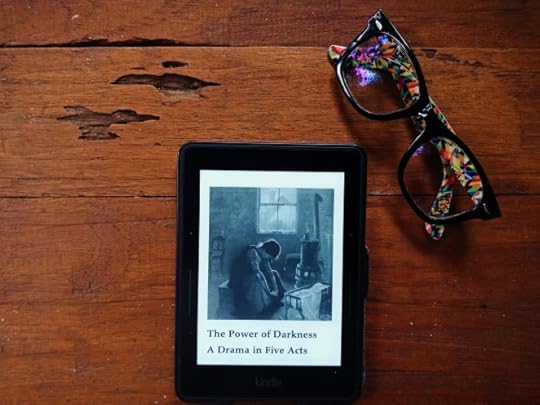
Count Lev Nikolayevich Tolstoy (1828-1910) commonly referred to in English as Leo Tolstoy, was a Russian writer - novelist, essayist, dramatist and philosopher - as well as pacifist Christian anarchist and educational reformer. He was the most influential member of the aristocratic Tolstoy family. His first publications were three autobiographical novels, Childhood, Boyhood, and Youth (1852-1856). They tell of a rich landowner's son and his slow realization of the differences between him and his peasants. As a fiction writer Tolstoy is widely regarded as one of the greatest of all novelists, particularly noted for his masterpieces War and Peace (1869) and Anna Karenina (1877). In their scope, breadth and realistic depiction of 19th-century Russian life, the two books stand at the peak of realist fiction. As a moral philosopher Tolstoy was notable for his ideas on nonviolent resistance through works such as The Kingdom of God is Within You (1894).
Lev Nikolayevich Tolstoy (Russian: Лев Николаевич Толстой; most appropriately used Liev Tolstoy; commonly Leo Tolstoy in Anglophone countries) was a Russian writer who primarily wrote novels and short stories. Later in life, he also wrote plays and essays. His two most famous works, the novels War and Peace and Anna Karenina, are acknowledged as two of the greatest novels of all time and a pinnacle of realist fiction. Many consider Tolstoy to have been one of the world's greatest novelists. Tolstoy is equally known for his complicated and paradoxical persona and for his extreme moralistic and ascetic views, which he adopted after a moral crisis and spiritual awakening in the 1870s, after which he also became noted as a moral thinker and social reformer.
His literal interpretation of the ethical teachings of Jesus, centering on the Sermon on the Mount, caused him in later life to become a fervent Christian anarchist and anarcho-pacifist. His ideas on nonviolent resistance, expressed in such works as The Kingdom of God Is Within You, were to have a profound impact on such pivotal twentieth-century figures as Mohandas Gandhi and Martin Luther King, Jr.
One would be glad not to sin, but what’s one to do?
A dark and tragic tale about the miserable lives of the peasant class, this drama in five acts revolves around excessive drinking, greed, murder, repentance and forgiveness.
Russian village life in the 19th Century was fraught with poverty and deprivation. The village dwellers were peasants who felt the presence of a darkness clouding their very existence. Peter Ignatitch, a middle aged and well-to-do peasant, was in poor health. What might happen to his farm, his wife and children upon his death? Where did he stash his monetary funds?
Peter's wife Anisya was worried about her future. "A peasant woman, what is she? Just mud...So many millions of girls and women, and all like beasts in a forest!" Nikita, their farm laborer might be able to run the farm and control the purse strings. Why not plan Peter's immediate demise and make way for Anisya and Nikita to marry, after all, they are already in an adulterous relationship. Nikita, however, is a multiple philanderer. "If you know how to amuse yourself, you must know how to hide the consequences." Sins and lies multiply on Nikita's "road to ruin".
"The Power of Darkness" by Leo Tolstoy is a five act dramatic play. The story is character driven, the characters extremely well crafted. Anisya is riddled with anxiety, Nikita loves women and spending money, Nikita's mother is a schemer and his father is a God fearing peasant. A compliment of additional protagonists share their detailed stories. Tolstoy displays how greed and lust lead to layer upon layer of lies and deception. A highly recommended read.
As usual, I did not know anything beforehand about this play when I picked it for a year-long challenge to read one short work per week. All I paid attention to was Tolstoy as the author, and knowing that I wanted to read more of his plays. I ended up with two in the same challenge, and what a difference there was between them!
The Fruits of Culture was a comedy, but this play was a tragic drama: just as realistic in character portrayal as the other one, but grim, gruesome, and extremely disturbing. I cannot say I actually liked it, although I do have to admire Tolstoy's unflinching ability to show human beings at their very worst. Greed, lust, murder, cowardice, incredible selfishness, horrific actions....they are all here, bursting off the page. I cannot imagine the reactions this play would have gotten in theaters, I really cannot. I do think Tolstoy was correct to write a variation for the latter section of Act 4. My edition at Gutenberg says the variation is the scene usually acted on stage, which is a good thing, because the original would surely have ladies fainting all over the theater. It was horrible enough to simply read.
So what actually happens in this play? And is the supposed redemption at the end really of any value at all? Well, in a nutshell: secret affairs, death, a marriage, another secret affair, another death in the most disgusting manner imaginable, pushy women, and guilt. Lots of guilt. Tons of guilt. A confession, and an old man saying God will show mercy.
The ending made me angry. The confession is supposed to clear the air, but the other guilty parties did not confess. So does this redeem the one who does? Am I supposed to think of him as a hero now instead of the spineless worm that he is? Maybe God will show mercy, but I won't. I am too old and cynical. If a character cannot be a real human being, whether in fiction or in real life, he deserves whatever he gets.
Well, anyway, the challenge is done (I cheated and have read more than one each week lately so I could finish early) and I have read more of Tolstoy. Now all I have to do is get that scene from Act 4 out of my head.
A masterful play. I had no idea Tolstoy was such a brilliant playwright before reading this. Tolstoy has as good a grasp on evil and religion as Flannery O’Connor did. Incredible portrayal of peasant vernacular.
An all-absorbing drama that begins like a soap opera and suddenly becomes as real as a Greek Tragedy. The pacing is almost frantic, hurling the reader into an abyss of degradation and Dante-esque results. The Power of Darkness belongs in the annals alongside the family and community tragedies of Ibsen, Miller, and O’Neill. A true classic.
Tolstoy is not usually thought of as a playwright, but he did in fact write some plays and this 5-act drama is one of his better known. It was banned for many years. Written in 1886 it had to wait until 1902 to be performed, although there were some unofficial productions before that and it was widely read. I have a sneaking sympathy for the censor because it’s certainly a dark and shocking play. For all his avowed sympathy for the peasants and their place as the “true” representatives of Russia, here Tolstoy doesn’t shrink from portraying the sordid aspects of depraved peasant life. Poverty, drunkenness, adultery, murder and infanticide. Not a redeeming feature in sight. Ignorance and superstition, greed and violence are the downfall of the family depicted in this short, powerful and disturbing play.
📚I received an Advanced Reader Copy (ARC) from NetGalley and the publisher in exchange for an honest review📚
"One sin holds on to another and pulls you along. Nikita, you are stuck in sins. You are stuck, I see, in sins. You are stuck fast, so to speak. I have heard that nowadays they pull fathers' beards, so to speak -- but this leads only to ruin, to ruin, so to speak.... There is your money. I will go and beg, so to speak, but I will not, so to speak, take your money.... Let me go! I will not stay! I would rather sleep near the fence than in your nastiness." -Akim to Nikita
Such a story eh and it evokes my emotion as the reader. I have to praise Tolstoy for being able and being so brilliant in portraying his characters. They seem so real and alive! As a conclusion remarks I just want to highlight that The Power of Darkness is a terrible picture of poverty, ignorance and superstition. It takes a great writer to write this kind of story because it requires a deeply sympathetic human soul. Tolstoy possessed both because he excelled in writing them and wrapped them in this story. He understood that the tragedy of the peasants' life is because an oppression or viciousness of such mechanism that he allegorised as the power of darkness. A book that ones should try to read...at least once in their life time.
'The Power of Darkness' is a play by Leo Tolstoy. It was written in 1886 and forbidden to be produced until 1902, but like a lot of other banned things, it found a way to be seen and read.
The play centers around a well-off peasant in poor health. Questions about what happens to his farm and family when he is gone are discussed. There is also family to marry off, and many dark secrets.
The characters are well rounded and the whole thing feels like a real discussion. I found it interesting, but still a bit dry. That could be because it is a play manuscript and not a narrative.
I received a review copy of this ebook from Dover Publications and NetGalley in exchange for an honest review. Thank you for allowing me to review this ebook.
Kötülüğün hiçbir romantik boyut katılmayan, en hesaplı ve banal halinin anlatıldığı, ismini de hak eden bir oyun. Buna rağmen, Tolstoy'un tamamen umutsuz olduğunu da söyleyemeyiz...
Today, when it seems like we've seen everything, what does it take to shock an audience--to jolt them to attention? There are two scenes in Leo Tolstoy's The Power of Darkness that accomplish precisely that, at least they did for me; neither moment is gratuitous or sensational, but simply and boldly each is a depiction of human behavior at its most desperate and cruel. What must Tolstoy's The Power of Darkness have felt like to audiences when it was first performed, more than a hundred years ago?
The play begins in the autumn of 1886 in the village of Tula, Russia, where Pyotr Ignatich, a peasant who is comparatively well-off, lives with his two daughters and his second wife, Anisya. Pyotr is ill (we never learn precisely what's wrong with him, but we do see him get sicker), and so he has hired a young man, Nikita, to run the farm. We quickly discover that Nikita and Anisya are having an affair; we also learn that Nikita's father, Akim, wants his son to marry an orphan named Marina who has accused Nikita of seducing her. Nikita denies the charge and his mother, Matryona, helps to convince Pyotr that the marriage should not take place and Nikita should continue in Pyotr's employ. Matryona has a plan to install her boy as master of the house, and she conspires with Anisya to set it in motion. Events move quickly from there; but if I tell you more about what happens, I will spoil this remarkable play.
Tolstoy, so astoundingly ahead of his time in this piece, explores a number of thought-provoking themes. Anisya, married to the petty tyrant Pyotr, has essentially become his house slave when we meet her; but in late 19th-century Russia she has no rights to assert against him--a huge issue, as his death looms more imminently, is how she will be able to secure her position in the household when it appears that Pyotr plans to give all of his money (which he has hidden someplace where Anisya can't find it) to his sister.
Meanwhile, Nikita's mother Matryona is a dazzlingly Machiavellian personage, constantly on the lookout for the next opportunity that she can exploit to ensure that herself and her family are taken care of. She's almost monstrous in her quest for self-preservation, anticipating Mother Courage by half-a-century as a woman who understands in her bones that one can't afford morality or religion if one wishes to survive in a harsh world.
Her husband Akim, on the other hand, represents the spiritual realm: he is a very simple (and simple-minded) soul, but he, alone among the play's characters, is a devout Christian, one who always prays before the household icons every time he passes by. For him the way to a good life is concise and clear; in one of the play's most memorable (and delightful) scenes, he is appalled to learn about the then-newfangled notion of banks making money by lending other people's money out for interest.
Caught between these warring sets of principles is Nikita, who is young and handsome and hungry and finds it easy, at first, to take whatever he wants, especially when what he wants--sex, mostly--seems to be so easy to get. At the end of the first scene of The Power of Darkness, he tells a brazen lie in front of the icon of St. Nicholas, something he's been taught is so sinful that he would be cursed for life having done so. This turns out to be precisely what happens, in fact--but the play is not just about religious redemption, it's about finding an ethical way to live among men. The most startling thing for me about Tolstoy's work here is that the modus operandi of Matryona--a mindset that a religious person might easily brand as "evil"--actually starts to make sense in the context of the way she's forced to live.
Gerçekten çok çarpıcı bir hikayeyi işlemiş bu kitabında Tolstoy Baba. Para kazanma hırsı, her çiçekten bal alma arzusu bir insanı nasıl bir felakete ,nasıl bir ruh ölümüne sürüklüyor daha iyi anlatılamazdı!!!
I confess, this is the first play I have read of Tolstoy's, and, in full honesty (though it feels like admitting a vast ignorance), I was not even aware he had written many plays until I purchased a collection of Russian plays (that had other plays by Chekhov, Gorky, Gogol, etc., plays and authors I had read before) containing this piece.
The title is certainly apt--- the play starts dark and gets darker and darker through its five acts.
My review is given on the translation by George Rapall Noyes and George Z. Patrick.
HEAD'S UP--- MY ANALYSIS BEYOND THIS POINT WILL CONTAIN PLOT POINTS (SPOILERS, IF YOU LIKE)--- YOU'VE BEEN ADVISED
Like much of Tolstoy's work, the play deals with familiar themes of class, money, the peasantry, work, and the relationship of all of this to the spiritual life. Nikita, a young man in his 20s, works for a rich member of the peasantry, Petr, an unhealthy man in his 40s, who is on his second marriage to Anisya, who is unhappy in her marriage. Nikita has been having an affair with Anisya, who is flat-out in love with him. Akim, Nikita's father, however, wants Nikita to be married and leave his job with Petr and return home--- if there is a "righteous" character in the play, it would be Akim. You see, Akim wants Nikita to marry Marina, a young orphan woman who claims to have been seduced by Nikita (we find out later it is true), and, according to Akim, the honorable and Godly thing to do is to marry her. This does not sit well with Anisya, who doesn't want Nikita to go, and really upsets Matrena, Akim's wife and Nikita's mother. Matrena, who is portrayed as the real schemer throughout the entire play, the devil on everyone's shoulder (one of my complaints about the play, actually), wants Anisya and Nikita to end up together... once Petr has shuffled off his mortal coil. In this way, Nikita can take over the farm, be wealthy, and she, Matrena, will be well taken care of, too. She gives Anisya some powders to slip into Petr's tea to speed along his demise.
So this sounds a little soap opery, as another reviewer mentioned, but if you think you know where it's going, you probably don't.
So Petr dies, according to plan, Nikita gets the money, treats Anisya terribly as he turns to drink, and seduces Akulina, Petr's daughter from his first marriage (Anisya's stepdaughter). There is a whole act dedicated to Nikita being an even bigger "cur' than in the first act, until Akim walks away from him, charging him to find God. Meanwhile, Anisya says "poor me!" a lot, though this could just be my translation.
Akulina gets pregnant with Nikita's baby. If Anisya and Nikita ever hope to marry off Akulina, they decide, with Matrena's goading, to let the baby be born in secret, and then kill it.
And they do. In my edition, there are two versions of Act IV and how this information is given--- not sure which one I prefer. But in both, Nikita is suddenly struck with guilt and talks about he bones cracking, and how he can still hear it wailing after it is dead.
The play ends at Akulina's wedding. Anisya is happy--- with Akulina married, she feels that she and Nikita can be in love again. Matrena is happy--- things are working out for her son. But Nikita is crazed with guilt and ultimately confesses in front of all the wedding guests after deciding not to kill himself, much to Akim's delight. His son has found God!
I admire how dark this play is, and Tolstoy, like so many Russian writers of his time, asking the big questions and not being afraid of going there.
But I don't like how the play has a refrain of women being the cause of all the ill that happens. Sure, Nikita confesses, takes all of the blame, says it is his alone, but even this robs the female characters of their redemption, just as throughout the play Nikita has robbed them of their humanity (Matrena excepted).
Still it is a powerful drama and I am interested to read more of Tolstoy's plays.
It’s funny that this play was banned because even though what happens in it is so disgusting and disturbing, the resolution of the play rests on the fact that a man can’t live with such disgusting and disturbing sins on his conscience. That’s the funny thing about banning troublesome art. It’s usually a stupid decision based on a misunderstanding of what the art is.
The climax of the 5 act play was an act 4 when the young man crushes his own ill begotten baby to death. He had already seduced the mother of the family and convinced her to poison. The father, his boss. He had already married her and stolen the money to squander it. And then he seduced his stepdaughter and got her pregnant. So sin piles up upon sin and he does the next logical thing to preserve his reputation, and that is to hide the evidence of his sin.
It’s a really disgusting scene as his mother eggs him on as she always has and he is just screaming from our stage about hearing the little bones crush and how it’s still whimpering.
Tolstoy even wrote an alternate scene to try to avoid censorship where the other little girl the family was inside the house with a work man talking about being able to hear this commotion and being told she’s mistaken.
It’s a nicely constructed player that chooses a pretty great key interactions to highlight these themes, but it is a tiny bit old-fashioned
I love that the man’s father never gets a full sentence and just stammers without ever complaining, a thought and yet the way the character is written, he conveys a very upstanding, moral character. In the finale, the young man starts confessing his crime in front of the entire community and the police go to arrest him. The father then had his one clear and complete sentence ordering the cop to wait until the confession is complete before arresting his son.
So yeah the play was involved in some heavily disgusting and troubling plots but the structure was ultimately morally uplifting. I am not the first to say this but the Tsar was stupid for allowing this to be banned.
This entire review has been hidden because of spoilers.
Based on a real life incident, ‘The Power of Darkness,’ a play written in 1886, was banned in Russia until 1902 because of its gruesome content. It has been described as “naturalistic" partly because its realism is so explicit that the actors and spectators at some point are benumbed with horror.
In its basic plot, the play deals with morality, sexuality, murder, greed, ambition, and reaches its climax with on-stage infanticide. The play also offers a strong argument for those of Tolstoy's critics who label him a misogynist, for never could women have been depicted as they have been here, if it had been otherwise. The protagonist, Nikita, weak and loose living, is a contrast to his splendid father, who, though inarticulate, is the play's moral and natural compass, and his wife the antithesis of both. In spite of such strong characters, the play seems to lack psychological depth. It might be the case that Nikita is a lazy, drunken, womanising cheat, but such men are usually too weak in purpose, too fond of the good life, to be murderers as well.
This was the time when Tolstoy's religious faith was becoming very personalized, very radical, almost extreme in its literal interpretation of Christ’s words, until he actually rejected the Orthodox Church of Russia, which in turn excommunicated him. Yet no one could have been more religious than Tolstoy himself, with his commitment to the teachings of Christ, his belief in the mercy of God (one of the chief pillars of ‘The Power of Darkness'), and the brotherhood of man.
For all its darkness, the play ends on a note of grace and redemption, as Nikita confesses to the world. In that moment, we see him not as the scoundrel he is, but in a divine moment of greatness.
How absolutely superb this play was. Tolstoy can’t miss when it comes to delicately crafting his class analysis into every piece of his work.
This naturalistic punch in the teeth is a piece to floor an audience, I honestly don’t know how I would act seeing this performed. He is exploring the depths of what greed and lust can draw people to do, and Nakita is an illuminating case to watch develop. His final confession is one of the richest literary images I’ve come across in a long time! Barefoot and drunk blind, he confesses all his brutally and sin with childlike honesty, it is a really sick sequence to experience. The bubbling of exposition up until that point just made it all the more effective.
It is very clear here and in the rest of his work that Tolstoy had some very brillaint, powerful women in his life. Here, his female characters are the backbone- they steadily move the plot, they aim conversations on the right track, they hold up the meaning. The isolation of this genre’s estates bare witness to some foul humanity, from the dehumanization of country women, to the murder of innocents, to the rather institutionalized blind drunkards; it’s a rough sight. Not many people were having fun here.
I LOVED Katerina’s speech at the end of act two and so many others throughout. Tolstoy can indeed do it all!
This is it! This is the end! Being held down is bitter, so bitter Seeing no ray of hope
This is still Tolstoy so it's super well-written and at least interesting, but this is from his preachy weirdo-phrase where it's all about how great god is and how awful the base temptations are (the power of darkness as it were).
In this case the awful base temptations appear to just be women in general who are trying to get the main character to either kill his boss, murder his infant child, cheat on his wife, etc. Both his lover, step-daughter, and even his mother all try to tempt him into something awful at some point and of course he goes for it every time.
Ultimately god is begged for forgiveness at some point and the dad is so proud of his terrible son for doing so, but it didn't really work for me. It doesn't help there isn't really a compelling character in the lot, outside of maybe his mom for just how awful a person she ends up being.
Many of my thoughts on this play were actually about the challenge of translating culture. The introduction of the copy I picked up explained that Tolstoy wrote this play in the vernacular of the peasants (crude, unrefined speech). He was so good at modeling this culture in his writing, but most translations were converted into literary English and some of that character was lost.
The translation I read tried to embed the crude-ness into the English. At first, I hated it. But I think it was a good exercise and experiment in reading translated works. I want to pick up the literary version and see which one I like more.
As for the play, it flips on its head from comedy to tragedy, building up to a dramatic confession that is quite powerful. I enjoyed it and I want to read some more short Russian plays to gain context.
Tolstoy's play is highly engaging, with darkness itself lying at the heart of many of the characters in multifarious ways. I found the plot very engaging and the moralistic tone an interesting addition to the wealth of debate surrounding the noble fascination with the peasantry. To place darkness within this peasant context is to note the potential degradation of a class slavophiles consistently put on a moral pedestal.
In spite of my enjoyment, I found the stage directions to be lacklustre, although this is likely a result of my love of the beautifully verbose directions seen in the work of Tennessee Williams, much later and on a different continent.
I would recommend this to anyone over 16 (infanticide is a little too dark for this play to be accessible to younger readers/viewers).
Harrowing story. Tolstoy wanted to teach illiterate peasants, who he loved, the error of their immoral acts and sin through the use of theater. This play goes above and beyond in pursuit of that goal.
It is quite a dark ending (there are two because of censorship), so be wary of your darkness limit.
I admire Tolstoy’s unwavering commitment to showing the depths of sinfulness in humanity… but big yikes. I can see why this production was banned in many theatres because of Act 4 being EXTREMELY tragic and drawn out. Also the fact that the other guilty members also don’t repent of what they did??
Anyway, would not actually recommend, I’m just trying to work through a ton of plays.
Three and a half stars. I never would have imagined Tolstoy could/would have written some of the brutality found in this play. For its time, I assume it would have been scandalous. Still, a bit of a meandering plot.
Not commenting on the plot, but the translation does a poor job at transposing Russian peasant speech to English. Where expressions woul be very plain and simple in one language, sound convoluted and posh in the other. The translation seems very literal and close to original sentence structures, and idioms, which are hard to read and lose their meaning completely, unless you're familiar with a language in which those forms of expression are used. This simply doesn't work in English - Russian translations.
Quite hard to listen to the text of a play, incuding scenes and script. All that was available on Archive.org I'd like to find a video version or audio version of a play, in English. Then I'll read/listen again.