Seventeen-year-old Deborah Rosenbaum, ambitious and in love with literature, arrives in the capital of the new Ukrainian Soviet Socialist Republic, Kharkiv, 1930, to make her own fate as a modern woman. The stale and forbidding ways of the past are out; it's a new dawn, the Soviet era, where skyscrapers go up overnight. Deborah finds work and meets a dashing young officer named Samuel who is training to become a fighter pilot. They fall in love, and she becomes pregnant.
But Deborah's prospects - and Ukraine's - soon dim. Famine plagues the over-harvested countryside, and any deviation from Moscow-dictated ideology is punished by without warning, Samuel is sentenced to ten years' hard labour. Deborah is on her own with a baby. And this is only the beginning.
Germany and Russia mobilize, and Ukraine becomes the no-man's-land during World War II, where its yellow fields of wheat run red with blood. Caught in the middle, like her country, Deborah must do whatever it takes to survive. Not only to protect herself, but also her increasingly observant mother and her increasingly anti-Semitic young son, who is being raised as a Russian. Deborah must change her name, renounce her religion, marry a man she doesn't love, and face the possibility of giving up on all her dreams.
Yaroslav Trofimov is the chief foreign-affairs correspondent of The Wall Street Journal and was a finalist for the Pulitzer Prize in international reporting for two consecutive years, in 2022 and 2023. Before covering the Russian war on Ukraine, he reported on most major conflicts of the past two decades, serving as the Journal’s bureau chief in Afghanistan and Pakistan and as a correspondent in Iraq. He holds an MA from New York University and is the author of two critically acclaimed books, Faith at War and The Siege of Mecca.
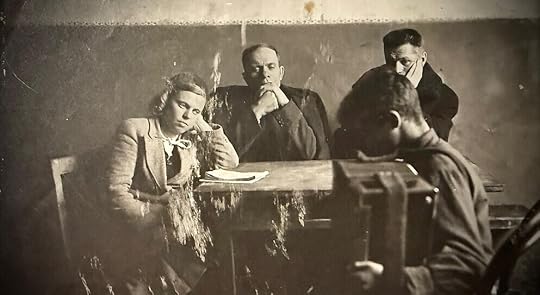
«Yaroslav Trofimov ci ha dato questa fotografia di sua nonna Debora, che ha ispirato il suo romanzo “Non c’è posto per l’amore, qui”» (Il Foglio)
Tre stelle e mezza.
Non è una bella scrittura quella di Trofimov, e la storia a volte è un po' scontata e i dialoghi troppo rigidi, ma a essere bello (se così si può dire) è il racconto del contesto storico che determina i destini di Deborah, giovane e bella ucraina ebrea, della sua famiglia e delle persone che insieme a lei vengono travolte dalla seconda guerra mondiale e gettate nel tritacarne dell'ideologia sovietica, dello stalinismo e di una società in cui tutti spiano e sono spiati e sono disposti a diventare delatori per sopravvivere, per fare carriera, per ideologia o per vendetta. Sullo sfondo, la carestia e l'Holodomor ucraino, il nazismo, i bombardamenti e la distruzione, le purghe staliniste, i pogrom e tutto quello che fa del totalitarismo, da qualsiasi ideologia venga mosso, quanto di peggio possa generare il desiderio di manovrare e coercizzare gli individui e, con loro, le nazioni con il falso intento del bene comune superiore.
In "No Country for Love," Yaroslav Trofimov masterfully transports us to the heart of 1930s Ukraine, a landscape rife with upheaval and transformation. This gripping novel tells the story of Deborah Rosenbaum, a spirited seventeen-year-old with a passion for literature and a hunger for a modern life, far removed from the stale conventions of the past. Trofimov's portrayal of Deborah's journey, set against the backdrop of the nascent Ukrainian Soviet Socialist Republic, is both poignant and compelling.
The author's vivid depiction of Kharkiv in the 1930s is a character in its own right. The city, brimming with new ideologies and architecture that symbolizes the dawn of the Soviet era, serves as the perfect stage for Deborah's ambitions. Her encounter and ensuing romance with Samuel, a young and charismatic officer-in-training, adds a deeply personal layer to the narrative. Their love story, tender yet fraught with challenges, mirrors the tumultuous times they live in.
Trofimov's narrative prowess shines as he navigates through the complex layers of history, personal struggle, and cultural shifts. The descent of Ukraine, and Deborah's life, into the throes of famine, ideological conflicts, and the horrors of World War II, is heart-wrenchingly captured. The author does not shy away from depicting the stark realities of the era, making Deborah’s journey a symbol of resilience and the human spirit's indomitable will to survive.
What stands out in Trofimov's writing is his ability to weave a deeply human story against a grand historical tapestry. Deborah's evolution, from a naive teenager to a woman who must renounce her identity and dreams for survival, is both moving and inspiring. Her struggles as a mother, her internal conflicts amidst rising anti-Semitism, and her forced decisions, all paint a vivid picture of a woman embodying the spirit of a nation caught in the crossfire of history.
"No Country for Love" is more than just a historical novel; it's a testament to the resilience of the human spirit in the face of insurmountable odds. Trofimov's skillful blending of historical accuracy with compelling storytelling makes this book a must-read. As a reader, I was not only enthralled by Deborah's story but also left with a profound sense of admiration for her strength and perseverance.
I eagerly await more works by Yaroslav Trofimov. His ability to bring history to life and create characters that resonate with emotional depth is truly remarkable. "No Country for Love" is not just a novel; it's an experience, a journey through a pivotal time in history, seen through the eyes of a remarkably resilient woman. A highly recommended read for anyone who cherishes historical fiction with a powerful human core.
Prendendo spunto dalla vera vita della bisnonna, l'autore ricostruisce la storia dell'Ucraina tra gli anni Trenta e gli anni Cinquanta del Novecento. La protagonista Debora è inizialmente una ragazza di 17 anni che lascia la campagna per trasferirsi nella grande città ed è piena di entusiasmo e di voglia di dare il suo contributo alla crescita dell'Unione Sovietica. Appassionata di letteratura, il suo sogno è studiare e successivamente insegnare. La Storia e la vita sapranno deluderla, dapprima con le "purghe" contro gli intellettuali promotori della lingua ucraina e la carestia causata dalle dissennate politiche di Stalin, successivamente con la guerra, gli orrori, le falsità propinate alla popolazione e il clima di diffidenza costruito dal regime. Un romanzo capace di costruire un solido legame tra la vita delle persone comuni e la Storia, con le sue conseguenze è tuttavia privo di grandi pretese letterarie. Ad ogni modo è una lettura valida e consigliata: coinvolge il giusto e mostra uno spaccato storico ancora non sufficientemente conosciuto.
Em “Um país sem amor” acompanhamos a história segue Debora, uma jovem que tenta encontrar liberdade e identidade numa Ucrânia devastada por fome, guerra e repressão. A trama leva-nos a uma realidade dura e implacável, onde amar, sonhar ou simplesmente existir é um ato de resistência.
A personagem principal é incrivelmente bem construída, real, imperfeita, teimosa e com uma coragem silenciosa que nos conquista aos poucos. Acompanhamos a sua transformação à medida que o mundo à volta se desmorona, e é impossível não criar empatia com as suas escolhas, mesmo as mais controversas. Debora não é retratada como heroína tradicional; é humana, cheia de contradições, e é isso que a torna tão marcante.
A escrita do autor é intensa, direta e carregada de emoção. Não há floreados desnecessários, mas há uma força quase palpável nas palavras. A história é contada com sensibilidade, equilibrando na perfeição os horrores do contexto histórico com os momentos íntimos que definem uma vida. Apesar do pano de fundo brutal, que inclui perseguições políticas, violência e perda, o livro nunca perde de vista o lado humano da narrativa.
Cada página é uma luta entre a escuridão do mundo e a teimosia de quem insiste em amar, mesmo num país que parece ter esquecido o significado dessa palavra. É um romance histórico, sim, mas é também uma história sobre sobrevivência, identidade, esperança e resiliência. Um livro que emociona, revolta e, acima de tudo, faz pensar.
“Um país sem amor” não é apenas uma leitura que nos marca, é uma viagem intensa por dentro de uma mulher e de um país em ruínas. E é impossível sair ileso dela.
The book tells the story of Deborah, a young Ukrainian woman from a Jewish family, spanning 20+ years, between the early 30s and the mid-50s of the 20th century. The travails of those years slowly turn Deborah from an idealist to a realist to a cynic. Surviving Stalin's persecutions, hunger, and WW2 take a toll, and we see what impact these events have on their survivors. The book is part romance and part the story of a dissolving personality progressing towards nihilism.
I like it quite a bit. While slow-moving, it was difficult to put down, despite the horrific events it described. The writing was often telegraphic in style, but that only added to the sense of urgency and the need to progress. The characters, especially that of Deborah herself, were acutely well executed. Maslov, in some ways, came to life even more, as his journey and corruption emerged as critical shifts to the story's progression. The setting of these small human stories against the background of these pivotal 20 years was also unique - it didn't talk about the holocaust, nor did spend too much time on politics. It was just a story of a Ukrainian-Jewish family and what it meant for them to survive.
There were some minor parts of the book I liked less. There were too many deus-ex-machina moments, suggesting the author, writing in English, was heavily influenced by Western literature, on top of his clear roots in its 20th century Soviet and Russian equivalent. The story, with its atmosphere, reminded me of many other books, predominantly Doctor Zhivago (and perhaps the works of Guzel Yakhina), but lacked the smoothness of flow that many Soviet/Russian novels have.
Overall, highly recommended to anyone interested in the history of the Ukraine, its Jews, and its people.
My thanks to Netgalley and the publisher for providing me with an early copy of this book in return for an honest review.
Geen topper, maar desondanks een interessant boek waarin de geopolitieke gebeurtenissen die tussen 1930 en 1950 een rol speelden in het Oekraïne van toen (Stalin, Holomodor, Nazi-Duitsland) een belangrijke plaats innemen. Een niet totaal fictieve familieroman, want het verhaal is gebaseerd op het leven van de grootmoeder van de schrijver.
Romanzo scoperto per caso ascoltando in un podcast un'intervista all'autore. Una bella rivelazione e anche molto interessante visto il periodo storico che stiamo vivendo e che soprattutto sta vivendo l'Ucraina. Una storia avvincente che aiuta a capire alcune delle motivazioni che stanno alla base degli attuali rapporti tra appunto l'Ucraina e la Russia. L'autore, ucraino che vive in Italia da tanti anni, è un giornalista la sua abilità risulta evidente nella scrittura del romanzo che lo rende appassionante e incalzante. Nell'intervista dice che la storia è liberamente ispirata da quella di sua nonna e in effetti riesce a rendere in modo molto efficace e realistico il racconto. Forse non un capolavoro della letteratura ma una forte testimonianza e anche una bella storia d'amore e riscatto. Consigliato.
The author meticulously recounted the major atrocities the Soviet regime had executed in Ukraine over decades in the XX century. The storyline is great. However, the story was told in such a restrained manner that it didn’t spark any emotions — I neither liked nor disliked the characters, their motivations were not explained, their feelings were not focused on. Well, I hope there are readers who will still like the book as it is very true to life when it comes to Ukrainian history.
Amazing story of the Ukrainian people as they desperately try to preserve their identity and way of life during the brutal assault by outside forces during the 20th century. The story graphically depicts the lives of everyday Ukrainians as they struggle and suffer under the tyranny of the Russian revolution through the oppressive reigns of Stalin and Hitler. Hard to read at times but highly informative as to the struggles of these people. No wonder they are so desperate and determined in their struggle, now in 2025, to prevent being overrun by Russia again.
Captivating historical fiction, set in 1930's Kharkiv.
This story follows the difficult choices Deborah Rosenbaum makes as Ukraine, caught between two totalitarian ideologies, turns into the deadliest place in the world - she is forced to change her name, marry a man she does not love, and renounce her religion, all while trying to protect those she loves most. Debora learns to endure, resist, manipulate and face the possibility of giving up on all her dreams.
Non una brutta lettura, ma, rispetto al peso degli avvenimenti storici che narra, questo romanzo mantiene un ritmo piuttosto monocorde e anti-climatico. Il tono ricorda in effetti quello di un reportage, cosa non sorprendente considerando che l’autore scrive per il Wall Street Journal. Il fatto che ripercorra vent’anni di storia dell’Ucraina sotto l’Unione Sovietica, d’altronde, resta un elemento di indubbio interesse.
4 stelle, specie per le notizie e le atmosfere relative ai rapporti storici Ucraina-Russia. Quanto a trama e stile narrativo, le stelle sarebbero meno...
Debora uma jovem que chega a Kharkiv, cheia de sonhos e vontade de construir um futuro melhor através da literatura. Ela acredita que a nova era soviética trará justiça e oportunidades, deixando o passado para trás.
No entanto, a realidade é muito dura. A fome espalha-se pelo país, o medo cresce e qualquer erro ou opinião diferente é castigado. A liberdade prometida revela-se uma ilusão.
Com a chegada da Segunda Guerra Mundial, a Ucrânia transforma-se num campo de sofrimento e violência. Debora perde tudo o que conhecia e é obrigada a fazer escolhas extremas para sobreviver, num país esmagado por dois regimes totalitários.
É uma história sobre sobrevivência, perda, escolhas e resistência, inspirada na memória da avó do autor.
Muitas das vezes parecia que já tinha lido esta história, ou mesmo ter visto um filme sobre este livro.
Het boek is gebaseerd op een waargebeurde geschiedenis – which is my absolute favorite kind of book... en is tegelijkertijd pijnlijk actueel. Yaroslav Trofimov omschrijft de rauwe realiteit van de oorlog in Oekraïne zo dichtbij dat het onder je huid kruipt. Het is grijpend, urgent en laat je als lezer simpelweg niet meer los. Een absolute must-read.
Uma leitura que me tocou profundamente e que estará sem dúvida no top do ano.
O autor entrelaça a história de Debora, uma jovem apaixonada por literatura com um futuro promissor, com o contexto histórico da Ucrânia, os ideais soviéticos, a opressão e a guerra.
A jornada de Debora é dura e impossível ficar indiferente a cada escolha que esta tem de fazer, da forma como luta pelos seus e de como se vê perante dilemas morais impossíveis.
Uma história de amor, encontros e desencontros, de medo, dor e perdas, mas também de resistência, luta pela liberdade e pela identidade.
O autor revela os mecanismos do poder, a propaganda, a traição, o medo que se vive entre as pessoas, um passado aparentemente distante e infelizmente tão presente e atual.
É um livro marcante, com uma realidade dura, mas que também inspira e nos faz refletir. Uma leitura recomendada para quem procura uma ficção histórica impactante.
Non c'è posto per l'amore qui di Yaroslav Trofimov non si limita a raccontare una storia: la incide nelle ossa, e ci lascia lì a contemplarla senza poter fare nulla. NULLA, nè per noi, nè per tutti gli altri. È un romanzo che non concede respiro, che ci costringe a guardare negli occhi la storia più crudele, a immergerci in un’epoca in cui ogni speranza si sgretola sotto il peso della fame, della guerra e del terrore. Nel mezzo di uno scenario apocalittico, c'è una sorta di eroina al contrario: Debora Rosenbaum, la giovane donna che credeva nel futuro e che invece è stata costretta a barattare i suoi sogni con la sopravvivenza. L’incontro con Samuel, il giovane ufficiale destinato a diventare pilota, sembra offrire a Debora una parentesi di felicità. Ma l’amore, in un mondo che brucia, è fragile come un fiore nel gelo. Il rapporto tra Debora e Samuel diventa un campo di battaglia a sé. In un mondo in cui ogni cosa è regolata dalla politica, anche i sentimenti vengono contaminati. Lui è un uomo che ha scelto l’uniforme, che si è piegato alla logica della guerra, mentre lei è ancora aggrappata all’idea che la vita possa essere altro. Ma fino a che punto è possibile restare fedeli a se stessi quando la Storia decide di stritolarti? Non c’è posto per l’amore, qui è un romanzo che fa male. Ci costringe a guardare il lato più oscuro della storia, ma anche a chiederci cosa significhi resistere, amare, esistere in un mondo che non ci lascia scelta. E per di più solleva interrogativi angoscianti: fino a che punto è giusto sacrificare la propria integrità per restare vivi? Si può ancora parlare di amore in un contesto in cui ogni sentimento è subordinato alla necessità di sopravvivere? Non ci offre nessuna risposta, ma ci costringe a guardare negli occhi l’abisso della Storia. E questo ci rende piccoli, così piccoli, da temere di scomparire.
Che cosa significhi esattamente “sopravvivere” in un contesto di guerra, in una nazione-satellite dell’Unione Sovietica utilizzata esclusivamente come fonte di approvvigionamento, sfruttata e privata di ogni risorsa - economica e umana -, ce lo racconta perfettamente Debora Rosenbaum, la protagonista ucraina ed ebrea del romanzo. Dal 1930 al 1953, Debora attraversa ogni stadio della ferocia: l’invasione tedesca, Babi Yar, l’assedio di Stalingrado, le purghe staliniane, il sistema dei gulag. Lo fa a testa alta, facendo tutto quello che è necessario per la sopravvivenza della sua famiglia. Ma, passato tutto questo, è inevitabile guardarsi indietro e chiedersi: a che prezzo? Un romanzo crudo e intenso per raccontarci la storia dell’Ucraina dell’epoca, che inevitabilmente porta al parallelismo con i giorni nostri e a constatare quanto poco sia cambiato a distanza di quasi un secolo.
Worthwhile historical romance fiction. Captivating love story set in Ukraine before, during and after WW2. How intrinsically are we defined by the random historical facts of our time, out of our control? What does it mean to “survive”? Can love actually prevail?
My review in the Arts Fuse: https://artsfuse.org/305584/book-revi... Book Review: Surviving Stalin in “No Country For Love” February 16, 2025|Leave a Comment Share on Facebook Share on Facebook By Peter Keough
In this compulsively readable novel, a Ukrainian Jewish woman does what she needs to survive in the nationalistic, anti-Semitic, and misogynistic Stalin-era Soviet Union.
No Country for Love by Yaroslav Trofimov. Little Brown. 384 pages. Hardcover $22.76, paperback $17.99.
Ukraine might be the bloodiest country on earth. Since the 20th century, wars, revolutions, pogroms, mass deportations, Nazi genocide, plagues, and famines have taken the lives of millions. Most of this carnage is thanks to their neighbor Russia, now in the third year of a ruthless, unprovoked invasion, the full toll of which has yet to be determined.
Yaroslav Trofimov, the Ukrainian-born Wall Street Journal reporter whose 2023 book Our Enemies Will Vanish: The Russian Invasion and Ukraine’s War of Independence offers trenchant, first-person reporting of the first year of that conflict, provides personal and historical context for the conflagration in his first novel, No Country for Love. Trofimov is no prose stylist, but this account, based on his own family history, is compulsively readable, invaluably informative and insightful, and often powerfully moving. Like Vasily Grossman’s Life and Fate or Boris Pasternak’s Dr. Zhivago, the narrative engages with vast historical catastrophes by focusing on the individuals caught up in them. The story also vividly evokes the trauma of living under a dictatorship with no good choices on how to survive.
Based on Trofimov’s own family history, it opens in medias res in 1953 with a cold-blooded assassination. It then flashes back to 1930 as 17-year-old Debora Rosenbaum, fresh from her backwater hometown of Uman, arrives breathlessly optimistic in Kharkiv, capital of the then Ukrainian Soviet Socialist Republic. She’s there to work at the new tractor factory, but she is hoping to study literature at the university. She is agog at the vitality of the city, its many bookstores, shops, beauty salons, and the presence of a vibrant Ukrainian cultural elite of which she hopes someday to become a member. But for now she must be content painting banners reading Death to the Clique of Traitors and Bourgeois Counter-Revolutionaries! for the factory’s Political Unit.
This initial glow of limitless possibilities dims a bit when she learns that, despite Soviet ideals to the contrary, women are still seen as a commodity. A drunk at a party tries to grope her, but she’s rescued by a shining knight – Samuel Groysman, a cadet in the air force, who whisks her to the dance floor. Their romance is interrupted when he is assigned to another city, but it resumes a couple of years later when he encounters her on a tram, where he again rescues her from the attentions of another inebriated asshole. This time they get married, and again the future looks bright.
As a Ukrainian, a Jew, and a woman, Debora would seem to have three strikes against her in the nationalistic, anti-Semitic, and misogynistic Stalin-era Soviet Union. These vulnerabilities notwithstanding, she still comes from a world of privilege. Her father Gersh, an assimilated Jew who before the Revolution was the bourgeois owner of a dairy processing plant, has managed to conceal his non-proletarian background from Soviet overseers. He has attained a comfortable spot on the People’s Commissariat of Trade. As such, he manages to keep his family well-fed and relatively pampered.
Debora’s marriage to Samuel initially brings even more security. They have a son, Pasha, and Samuel has apparently settled into the Stalinist system and is about to rise in the ranks. But a jealous neighbor seeking their apartment (beware of jealous neighbors seeking apartments in the Soviet Union) reports him for uttering pro-Ukrainian, anti-Stalin remarks. He is arrested and sentenced to exile in Siberia.
After Samuel is not heard from for years and is assumed dead, Debora succumbs to the wooing of Maslov, a boorish officer in the NKVD (a precursor to the KGB and FSB). Though it would have been tempting to caricaturize Maslov as a villain, Trofimov’s characterization of him exemplifies his subtle analysis of and empathy with his characters. None of them are entirely good or evil; all of them have human weaknesses and strengths and possess a potential for redemption. Maslov might be a torturer and murderer of the innocent victims of an unhinged, paranoid tyranny, but he takes no pleasure in his work, though he does enjoy its benefits. In some ways he proves to be a good husband to Debora, who would be doomed without him, and a loving father — if a poor role model — to his stepson Pasha.
Nonetheless, his profession is morally inexcusable, a fact that Debora recognizes. But her marriage to Maslov is not the first time she has compromised principle to survive in an evil, inescapable regime. While at the university she was brought in by the NKVD for questioning about a friend: she offered possibly incriminating testimony. While safe and well fed in the university — and relatively ignorant of the ongoing Holodomor, the famine brought by the Soviet seizure of the Ukrainian grain harvest that killed millions — she visits a close acquaintance in one of the most stricken areas, bearing not food but a stuffed pink dog for her friend’s son.
But the marriage proves a lifesaver with the arrival of Germany’s invasion. Her husband manages to extricate her, her mother Rebecca, and Pasha from one hotspot to another, often just in time, as the Nazi blitzkrieg advances. They escape from Kyiv days before the murder of tens of thousands of Jews at Babi Yar. Seeking refuge in Stalingrad, they are again evacuated as the Nazi assault besieges the city, a battle that will prove a disastrous German defeat and a turning point in the war.
With peace comes not renewed tranquility but a deterioration in Debora’s situation and intensified assaults on her conscience and self-respect. Gratifyingly to the reader, she at last reaches a point where she must resist. “[It]’s the good ones who die early,” she tells her mother. “I am not yet ready to die. I won’t be good anymore.” With cold calculation she assumes the role of an avenging femme fatale. Shockingly, history, long her antagonist, abets her scheme. Though it may be no country for love, perhaps it will prove to be a country for justice.
Editor’s Note: Trofimov will be speaking about his novel at several upcoming events: Feb. 18, Miami, World Affairs Council; Feb. 20, Chicago, University of Chicago, 12:30 p.m.; Feb. 24, Washington, D.C. Johns Hopkins School of Advanced International Studies; Feb. 25, Philadelphia, World Affairs Council; Feb. 26, New York City, University Club; Feb. 28, Washington, D.C., Atlantic Council, 10 a.m.
Oekraïne, 1930. De Joodse Debora Rosenbaum zit vol met plannen. Ze is jong en wil geschiedenis schrijven. Ze reist naar de stad om mee te helpen aan de opbouw van het land. Daar ontmoet ze de knappe officier Samuel. Het leven lacht hen toe.
Maar dan verandert de situatie, Oekraïne stevent af op een hongersnood en Samuel wordt veroordeeld tot dwangarbeid. Debora blijft achter met hun baby en probeert het hoofd boven water te houden. En dan komen ook nog de nazi’s, die het leven voor Debora nog moeilijker maken.
Oekraïne is helaas de laatste jaren weer veel in het nieuws, aangezien Rusland het land binnenviel. Maar de geschiedenis tussen Oekraïners en Russen gaat veel verder terug.
In de tijd dat het boek zich afspeelt, is Oekraïne onderdeel van de Sovjet-Unie en krijg je een goed beeld van hoe het leven destijds was. Het was daardoor een heel leerzaam boek, vele inwoners van Oekraïne werden gemanipuleerd en dachten dat ze meehielpen aan een betere Sovjet-Unie. Later bleek dat de daadwerkelijke plannen heel anders waren. De manipulatie wordt duidelijk uiteengezet, en daardoor kon je ook beter begrijpen waarom veel mensen in hun naïviteit in eerste instantie vrijwillig meewerkten.
De groei van Debora als persoon en van jong naïef meisje naar daadkrachtige vrouw is zichtbaar en goed uitgewerkt. In een tijdslijn van 1930 tot 1954 wordt in zes delen het leven van Debora verteld. Het is een fascinerend leven, waarbij ze steeds gedwongen wordt om keuzes te maken. De auteur heeft het verhaal van Debora opgehangen aan de geschiedenis van Oekraïne, waardoor het als echt aanvoelde. Met daarbij een verhaallijn die mij tot het einde aan toe wist te verrassen.
Een hele dikke aanrader voor liefhebbers van historische romans en mensen die graag wat willen leren over de geschiedenis van Oekraïne. 4.5 ster
Voor uitgeverij de Fontein mocht ik het boek ‘Geen land voor liefde’ geschreven door Yaroslav Trofimov lezen.
In ‘Geen land voor liefde’ word je als lezer meegenomen naar het Oekraine in 1930. Deborah Rosenbaum gaat als moderne vrouw vol ambitie naar de grote stad Charkiv. Het lijkt een rooskleurige toekomst te worden. Ze wordt verliefd op Samuel, een officier. Alleen dan gaat het in Oekraine niet goed. Er volgt een hongersnood. En leef je niet volgens de Sovjet leer dan gebeuren er vreemde dingen zoals verdwijningen. Samuel wordt veroordeeld tot 10 jaar dwangarbeid. Deborah blijft met haar baby achter. De nazi’s worden zichtbaar in de Oekraine en de prachtige gele graanvelden worden rood. Deborah moet noodgedwongen afstand doen van haar geliefde, moet gaan leven onder onderdrukking maar doet dit niet zonder protest.
Dit prachtige verhaal heeft Trofimov gebaseerd op het levensverhaal van zijn oma. Het laat een heftige tijd zien wat de mensen daar in Oekraine hebben meegemaakt. Je leest over diverse grote gebeurtenissen en via de Tweede Wereldoorlog word je meegenomen naar de politiek heftige tijd na de dood van Stalin.
Het verhaal leest zo weg dat het verhaal je hoe dan ook binnenkomt. Het lijkt ‘romantisch ideaal’ te beginnen maar langzaamaan verandert de omgeving en de toekomst in een hel waarin men elkaar verraad, er weinig eten en geld is. Je wordt als lezer met je neus op de feiten gedrukt, doordat je het vanuit verschillende situaties bekijkt.
‘Een land voor liefde’is een indrukwekkende historische roman over een vrouw die probeert te overleven in een hele zware tijd waarin voor de liefde geen plaats is.
Yaroslav Trofimov was in Kabul when it fell to the Taliban in 2021, and he was in Kyiv when the Russians invaded less than a year later. He told National Review that he wondered if President Zelensky would abandon Ukraine just as President Karzai did Afghanistan. Instead, Zelensky stood his ground: “His courage in that moment saved Ukraine. Lots of Ukrainians don’t necessarily like Zelensky. But this is not a fight for Zelensky. It’s a fight for Ukraine. It’s a fight to hang on to independence.”
Trofimov’s debut novel “No Country for Love,” a work of historical fiction spanning twenty traumatic years in Ukraine’s history, is at once a love letter to his people and a tribute to his family. Trofimov, born into the Ukrainian Soviet Socialist Republic (SSR) and now an Italian citizen serving as chief foreign correspondent for the Wall Street Journal, reminds us that a nation is neither a meme nor a talking point, neither a villain nor a hero. A nation is those who find a way to survive together.
I experienced “No Country for Love” as five fictionalized biographies folded together. First and foremost is that of seventeen-year-old Deborah Rosenbaum, a vibrant Jewish-Ukrainian woman modeled, as Trofimov told Ukrainian Jewish Encounter, on his grandmother Debora: “At the risk of revealing the plot and creating a spoiler, the key pivots in the narrative are true. The characters are true. I took some liberties because some of the actions in the book are things she wished she had done but didn't do.”
This is Trofimov’s way of preserving his grandmother’s story, and he opens that story with an act of violence in 1953 before flashing back to 1930 and the rosy dawn of the brand-new Ukrainian SSR. With centuries of Tsarist repression at an end, Deborah believes passionately in the new order of Soviet self-determination, equality, comradeship, and love. But as Stalinist screws tighten and Nazi thunderclouds gather, as Holocaust follows Holodomor, as flames rage from Kyiv to Kharkiv to Stalingrad, she finds that Ukraine is a country where love is what you sacrifice to live.
The novel’s second biography is, of course, that of Ukraine itself. Trofimov recognizes that his modern homeland is a patchwork quilt stitched together from scraps of Austria-Hungary and Poland, the cosmopolitan core of Kyivan Rus', the conquered Tatars of Crimea, and the eastern marches of Kharkiv and the Donbas. Yet despite Muscovite dogma, despite tsars and Soviets and the neo-tsardom of Putin’s Russia, Ukrainians have always known themselves to be a people unto themselves. That knowledge is tested as Bolshevik winds soon shift from Ukrainization back to Russification.
Deborah herself must survive by drowning her identity beneath Russian waves, reflecting the third biography: that of Ukraine’s Jews who, like her, learn to lie low in a world gone mad. Because this is Deborah’s story and not a tale of the Holocaust itself, the horror of German occupation plays only a supporting if devastating role in her character’s arc. But whether caught behind enemy lines or fleeing deep into Russia, Jews suffered from Ukrainians eager to rat them out and from Russians who blamed them for provoking Hitler. Despite it all, the modern-day President Zelensky’s Jewish heritage speaks to the determination of Abraham’s children to persist within a Ukrainian Babylon.
Of the many tragedies that befell Ukraine’s Jews, one I hadn’t known is that Kyivan Jews didn’t need to die. Moscow’s propaganda machine was so untrustworthy that Jews simply didn’t believe what their own government told them about Nazi atrocities. As Deborah’s father Gersh says, “This whole place is built on lies.” Tens of thousands of Kyiv’s Jews failed to escape envelopment, were rounded up, and died in the ravine of Babyn Yar as a direct consequence of their mistrust of Moscow’s policy of disinformation. This leads me to the fourth biography, and to the long shadow of Joseph Stalin.
Stalin’s consolidation of Party power in 1928-29, his terrors and purges, his omnipresent secret police, his ruinous pact with Hitler, and his sudden death in 1953 dominate Deborah’s story. Without bringing the man himself into the frame, Trofimov shows how no corner of Ukrainian life escaped Stalin’s personalist rule. His regime of lies and fear annihilated trust and truth so thoroughly that Deborah wraps her starvation rations in state newspapers praising the triumphs of Soviet agriculture. His cruelty incentives Deborah’s neighbors to watch and inform, and bends her own children toward worship of the state. The man in Moscow exercises more decisive control over Deborah’s life than she does herself.
The fifth and final biography is that of Ukrainian women and, frankly, women throughout time and space. Early in the novel, during the halcyon days of hope in Kharkiv’s Motor Tractor Plant, Deborah’s friend Olena tells her that women are nothing without men and must attach themselves to men to survive. Deborah scoffs at such outdated nonsense in this new and progressive Soviet future, only to find that survival will require her to sacrifice her pride, her identity, her heritage, her body, mind, and soul to the fickleness of men. A woman’s love is worse than useless in a man’s world: it is dangerous.
But push a woman like Deborah too far, push a Ukrainian too far, and you’ll discover what hate means. Stalin’s Russians discovered this when forced to fight a postwar counterinsurgency in western Ukraine. Seven decades later, and one year after the full-scale Russian invasion of Ukraine in 2022, Trofimov met a woman on the streets of Kyiv who told him, “You know, the really bad thing is that I really hate the Russians now. I never hated anyone in my life. And now I just can’t stop. I wish them the worst because of what they have done to us.” He just looked at her, and then they both began to cry.
“We are up against history,” says one of Trofimov’s characters. “History is a wild and bloodthirsty animal. It is on a rampage through this country again, breaking and remaking it anew. You can’t stand in its way, and you can’t stop it. All you can hope is that it misses you as it lashes out and claws its way forward. That it doesn’t notice you. That it crushes someone else.” Perhaps that’s true in a country not made for love; but once again, a nation is those who find a way to survive together. Having survived, they will live. And having lived, they will find their way back to love. “We will be happy again, sweetheart,” says Deborah’s mother Rebecca. “Despite them all, we will be happy again.”
Middelmatig werk over het leven van een jonge vrouw in Oekraïne onder Stalin (Holodomor) en WOII tot aan de dood van Stalin. Het hoofdpersonage is geïnspireerd op het leven van de oma van de auteur Trofimov. Deborah als Joodse maar overtuigde communiste leidt een relatief goed leven eerst als studente en nadien als echtgenote van een jonge officier-piloot. De hongersnood op het platteland is weliswaar confronterend maar ze ontwijkt het door terug te keren naar Kiev. Het noodlot treft haar echter wanneer haar echtgenoot wordt opgepakt op basis van valse beschuldigingen. Uiteindelijk wordt hij veroordeeld tot 10 jaar zonder communicatie wat eigenlijk neerkomt op een doodvonnis.
Bij het uitbreken van WOII zoekt een jonge arrogante officier van de NKVD (geheime dienst) toenadering en kan haar overtuigen om te huwen. Een toevalstreffer zeker nadat de nazi's Stalingrad belegeren waar ze als gezin naartoe zijn gevlucht. En dan komt plots alles in een stroomversnelling....
Vlot geschreven en vooral meeslepend gezien de actualiteit (in WOII ontvingen de Oekraïners de nazi's aanvankelijk als bevrijders van de Russische overheersing en de huidige strijd die het land tegen Rusland voert). Het werk geeft een goed beeld van de USSR in de jaren dertig en veertig onder de nietsontziende dictatuur van Stalin. Maar toch blijf ik op mijn honger zitten over het plot in deze roman. Dat is nogal magertjes en typerend.
Ho letto il libro d’un fiato. Ho sofferto con Debora e capito quanto può distruggere l’anima la guerra, anche senza combatterla in primo piano. Ho capito quanto diamo per scontato ogni giorno: gli affetti, il cibo, una casa, la vita stessa. Ho sofferto senza piangere perché mi sono sentita come Debora mentre la leggevo. Speranzosa, buona e affamata di vita.. ha resistito a lungo e cercato di sopravvivere assieme alla sua famiglia il più possibile e, per forza di cose, mettendo in secondo piano la sua felicità. Le lacrime vengono inghiotte assieme a tutto il resto dal vuoto. Le lacrime finiscono.
La felicità fa parte di quello che diamo per scontato ogni giorno. La felicità può essere semplicemente essere grati di ciò che abbiamo senza la necessità di avere Desiderio di altro nella nostra vita. Felicità é “essere” giorno per giorno e, non solo, “essere liberi”.
É un libro crudo, sincero, diretto. Lo scrittore é riuscito a farmi impersonare nella protagonista più di quello che mi sarei aspettata. É un libro che tutti dovremmo leggere e sarebbe bello che riuscisse a far soffrire tutti, forse ci farebbe bene. Forse soffrire ci ricorda che possiamo ancora “sentire”.. é quando smettiamo di “sentire” che dovremmo iniziare a preoccuparci. E la fine del libro non potrebbe spiegarlo meglio.
Mi sento di ringraziare Trofimov per essere riuscito a realizzare questo atto di trasmigrazione
Questo libro non parla d'amore, lo dice già il titolo, eppure tutto è dettato da questo sentimento. Amore fraterno, amore filiale e amore materno. L'amore vero e proprio è una meteora che passa nella vita di Debora, la illumina e poi svanisce. Come quel Samuel, suo amore giovanile, al quale deve i suoi ricordi di una gioventù felice.
Yaroslav Trofimov racconta la storia dell'Ucraina e permette ai lettori di comprendere meglio le conseguenze che hanno portato ai conflitti dei nostri giorni. Con una scrittura fluida ma che non risparmia dolore, ci accompagna nella vita di Debora. Ci racconta dei suoi sogni, delle sue speranze, dei suoi ideali in una nazione che non ha una sua identità, in una nazione fatta di spie e divisa in una lotta intestina per la vita, letteralmente. Ci racconta di come la Seconda Guerra Mondiale abbia devastato ancor di più regioni d'Europa già povere di per sé. Racconta di innocenti mandati nei campi di prigionia a lavorare, di chi pur di fare carriera abbia distrutto famiglie, amori e amicizie. Debora viene sfiorata da tutto ciò perché è furba e anche abbastanza coraggiosa da mettere al primo posto la sua sopravvivenza e quella della sua famiglia. Piange in silenzio, soffre da sola e offre a ciò che resta della sua famiglia l'opportunità di una vita "migliore". Tutto però si paga a caro prezzo e lei lo scoprirà presto.
Reading this book one is reminded of the words of Christy Moore, the iconic Irish folk singer in his Natives writes” And only the very safe can talk about wrong and right/ Of those who are forced to choose, some will choose to fight” The heroine of this tale, who is rarely if ever safe, Deborah, aka Darya, is repeatedly confronted with moral Gordian knots where there is no correct answer possibly beyond consideration of choosing a course of action that may save her life and those whom she loves. The book weaves a number of disparate elements together with true and sordid history such as the 1931 famine and massacre at Babyn Yar in 1941 reminding the reader at every step of the way of the endless suffering of Ukrainians and in particular Jewish Ukrainians. The plot is excellent and connects the reader to both the times and place. This is quite epic in scale but Trofimov is quite a masterful storyteller and he eloquently conveys the collective suffering and subjugation of the seemingly perpetually occupied Ukranians.