Jump to ratings and reviews
Rate this book

The Essence of Chaos

Rate this book
Chaos surrounds us. Seemingly random events ― the flapping of a flag, a storm-driven wave striking the shore, a pinball's path ― often appear to have no order, no rational pattern. Explicating the theory of chaos and the consequences of its principal findings ― that actual, precise rules may govern such apparently random behavior ― has been a major part of the work of Edward N. Lorenz. In The Essence of Chaos, Lorenz presents to the general reader the features of this "new science," with its far-reaching implications for much of modern life, from weather prediction to philosophy, and he describes its considerable impact on emerging scientific fields.

Unlike the phenomena dealt with in relativity theory and quantum mechanics, systems that are now described as "chaotic" can be observed without telescopes or microscopes. They range from the simplest happenings, such as the falling of a leaf, to the most complex processes, like the fluctuations of climate. Each process that qualifies, however, has certain quantifiable characteristics: how it unfolds depends very sensitively upon its present state, so that, even though it is not random, it seems to be. Lorenz uses examples from everyday life, and simple calculations, to show how the essential nature of chaotic systems can be understood. In order to expedite this task, he has constructed a mathematical model of a board sliding down a ski slope as his primary illustrative example. With this model as his base, he explains various chaotic phenomena, including some associated concepts such as strange attractors and bifurcations.

As a meteorologist, Lorenz initially became interested in the field of chaos because of its implications for weather forecasting. In a chapter ranging through the history of weather prediction and meteorology to a brief picture of our current understanding of climate, he introduces many of the researchers who conceived the experiments and theories, and he describes his own initial encounter with chaos.

A further discussion invites readers to make their own chaos. Still others debate the nature of randomness and its relationship to chaotic systems, and describe three related fields of scientific thought: nonlinearity, complexity, and fractality. Appendixes present the first publication of Lorenz's seminal paper "Does the Flap of a Butterfly's Wing in Brazil Set Off a Tornado in Texas?"; the mathematical equations from which the copious illustrations were derived; and a glossary.

240 pages, Paperback

First published January 1, 1993

34 people are currently reading
871 people want to read

About the author

Edward N. Lorenz

6 books8 followers

Ratings & Reviews

What do you think?
Rate this book

Friends & Following

Create a free account to discover what your friends think of this book!

Community Reviews

5 stars
80 (27%)
4 stars
107 (36%)
3 stars
80 (27%)
2 stars
18 (6%)
1 star
6 (2%)
Displaying 1 - 15 of 15 reviews
Profile Image for Remo.
2,553 reviews181 followers
September 1, 2014
Gran libro, escrito con algún sesgo hacia lo personal por parte de uno de los autores que descubrió el caos como ciencia independiente. No es un libro técnico, pero al autor no le da miedo plantar de vez en cuando un sistema de ecuaciones, lo que me encanta. Se nota la mano del matemático en el estudio del caos. El libro consta de dos partes no diferenciadas. La primera es un estudio sobre un modelo en el que vemos aparecer el caos, un estudio sobre una tabla de esquí que se deja caer por una cuesta llena de bañeras, estudiando su trayectoria. En la segunda parte se trata la historia de la disciplina del caos, desde el punto de vista de la meteorología (rama del autor). El libro es interesantísimo. Por fin aprendo bien lo que es el maldito efecto mariposa.
Vaya una disquisición (sacada de aquí) sobre el Efecto Mariposa (el de verdad, no el de la peli). El enunciado más extendido de este efecto es “El aleteo de una mariposa en Brasil puede provocar un tornado en Texas”, aunque los lugares y la catástrofe natural suelen variar. La idea que quiere transmitir este principio es, dicen, que “pequeñas variaciones en un sistema caótico se pueden convertir al cabo del tiempo en grandes variaciones”. Esta segunda frase es indiscutible, pero la primera…

El efecto mariposa no existe. Sorprendente, estimados lectores. No existe tal y como lo solemos interpretar. El efecto mariposa lo planteó el meteorólogo Edward N. Lorenz, quien es considerado como el “descubridor” del caos, o al menos el primero que lo investigó como materia independiente. Pero lo planteó de aquella manera, no literalmente.


Lorenz trabajaba con un modelo de predicción climatológica basado en un sistema de ecuaciones diferenciales acopladas (lo que técnicamente se denomina un maldito follón). Cada poco tiempo, el ordenador imprimía unos valores para las variables temperatura, humedad y dirección del viento en un punto dado. Llegado un momento, Lorenz tuvo que suspender la simulación y, al reanudarla, introdujo valores que ya tenía impresos para que el ordenador lo retomara donde lo había dejado. Pero no introdujo los últimos que tenía, sino unos anteriores. Al cabo de un rato, las predicciones que hacía el ordenador no tenían nada que ver con las que él tenía impresas en la mano. Extrañado, empezó a investigar hasta darse cuenta de que al introducir de nuevo los datos, lo había hecho usando cinco decimales en vez de los seis que usaba el ordenador. Esta leve variación de los datos había hecho que las predicciones meteorológicas fuesen cada vez más distintas en las dos simulaciones.


En efecto, en sistemas complejos suele haber lo que se denomina “sensibilidad a las condiciones iniciales”. Una variación al principio hará que los datos del sistema (posición de un satélite en el Sistema Solar sometido a la atracción de más de un cuerpo, temperatura y humedad del aire en un punto dado…) se desvíen cada vez más de la predicción inicial, hasta que ambos sistemas no tengan nada que ver entre ellos.


La idea que Lorenz quería plantear es que si medimos con mucha exactitud las variables de un sistema caótico y a partir de ahí empezamos a hacer una predicción, entonces los factores que no hayamos medido (como, por ejemplo, el octavo decimal de todos los factores implicados), serán los responsables de que nuestro modelo empiece a alejar sus predicciones de la realidad. Encontró un ejemplo resultón con lo de las mariposas, pero ese ejemplo ha pasado a ser aceptado como verdad universal (y, sobre todo, literal), sin que el mismo Lorenz lo hubiera dicho con esa intención.


Para reforzar mi tesis, cito el artículo donde Lorenz planteaba esta cuestión. Las negritas, cursivas y smilies (si los hubiere) son míos. Esta cita proviene del muy recomendable libro “La esencia del caos”, de Lorenz:


Predictibilidad: ¿El aleteo de una mariposa en Brasil originó un tornado en Texas?


Por no parecer frívolo aunque sólo sea por plantear la pregunta que sirve de título, y menos aún por sugerir que podría tener respuesta afirmativa, permítanme colocarla en una adecuada perspectiva ofreciendo dos proposiciones.


1.- Si un único aleteo de una mariposa puede contribuir a generar un tornado, del mismo modo pueden hacerlo los aleteos anteriores y posteriores, como también pueden hacerlo los aleteos de otros millones de mariposas, por no mencionar las actividades de innumerables y más poderosas criaturas, incluyendo a las de nuestra propia especie.


2.- Si el aleteo de una mariposa puede contribuir a generar un tornado, igualmente puede prevenirlo.


De forma más general, estoy planteando que al cabo de los años las perturbaciones minúsculas no incrementan ni decrementan la frecuencia de diversos sucesos meteorológicos como los tornados; lo más que pueden hacer es modificar la secuencia en la que se dan estos sucesos. [...] Debemos, por tanto, dejar sin respuesta nuestra pregunta original durante unos años más, incluso aunque hagamos profesión de fe en la inestabilidad de la atmósfera. Mientras tanto, los errores actuales en la predicción meteorológica no pueden achacarse por entero ni en primer lugar a la estructura más fina de las pautas meteorológicas. Principalmente provienen de nuestra incapacidad de observar con suficiente comprensión incluso la estructura más gruesa [...]


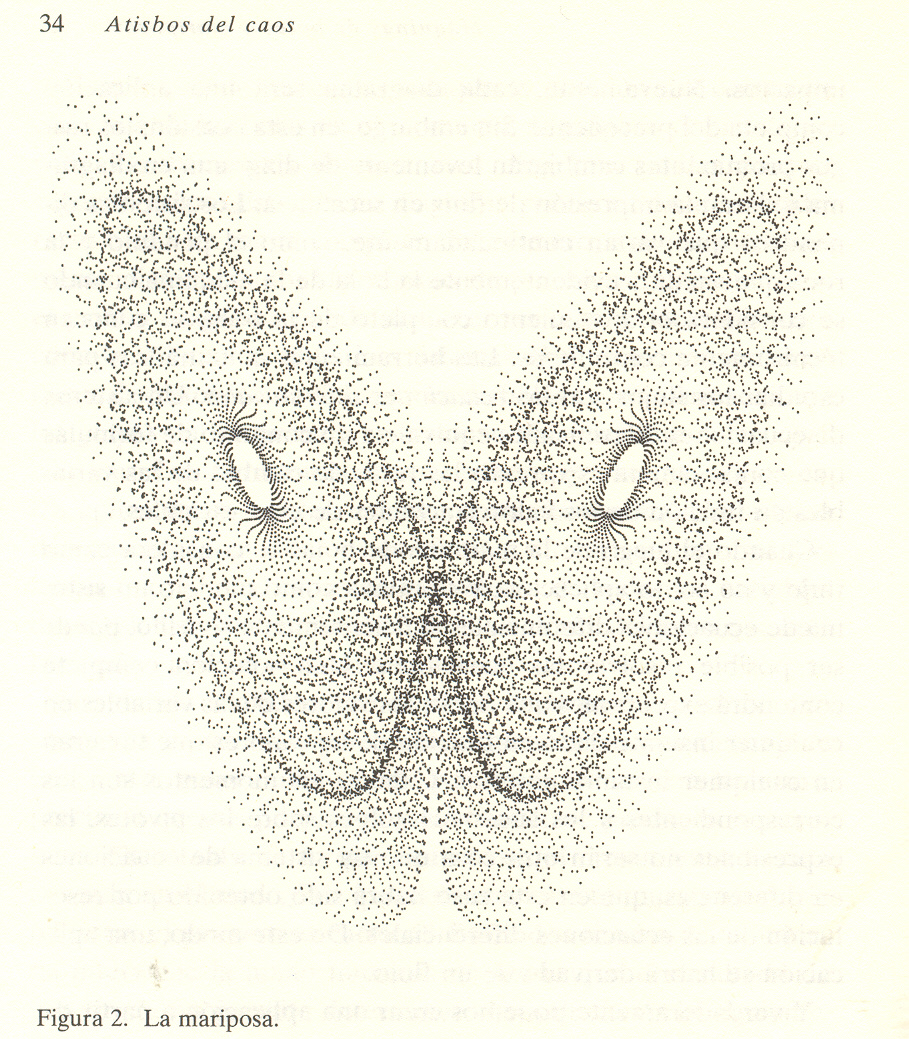
¿Por qué el efecto “mariposa” y no el efecto “pedo de grillo”? Imagínense: El pedo de un grillo en Alaska puede provocar lluvia ácida en Sagunto. Ésa sí es una frase para citar en los bares. Pero Lorenz se inspiró en una cosa llamada el atractor del mapa de fases de sus ecuaciones, que es, más o menos y a grandes brochazos, la gráfica del sistema que estamos estudiando. En uno de los primeros sistemas caóticos que estudió, el atractor tenía esta pinta (clic para ampliar):

efecto-mariposa-s.jpg
Profile Image for DJ.
317 reviews294 followers
July 19, 2009
At last, a somewhat respectable introduction to chaos for anyone not repulsed by a bit of math. Lorenz may not be as polished a writer as James Gleick, but his knowledge of the field, its mathematics, and its development is unrivaled.

The majority of the book is spent exploring several examples of chaotic systems in detail. The book is not necessarily packed with equations (those are saved for the appendices) but it does require some "mathematical maturity" (essentially, you must be able to read slowly and do some thinking as you go). Lorenz is not afraid to take his reader for a stroll through phase space and neither will he protect him or her from subtle jargon such as asymptotic orbits, homoclinities, and Lyapunov numbers. Though the toy examples used to explore these concepts mostly involve artificially idealized pinball machines and mogul-hopping sleds, Lorenz also includes fascinating looks at the chaotic elements of our own atmosphere, his area of specialty. I would have liked more detail on these "real-world" models, but there's just one problem: we're still not quite sure what those models should be. Meteorologists and climate scientists have been handed an unwieldy problem and Lorenz's early insights into the "sensitive dependence" of our weather only reinforced the need for reserved expectations.

That said, I highly recommend skipping Chapter 4: Encounters with Chaos. Lorenz spends 50 pages giving a highly biased and shallow account of the history of chaos, concentrating mostly on his own contribution. For the history of chaos, James Gleick's Chaos: Making a New Science is a much better account.
Profile Image for Duffy Pratt.
643 reviews162 followers
August 17, 2010
I picked this up because I'm interested in studying markets and technical analysis. The Black Swan talks a bit about fractals and the Mandelbrot set. One of the interesting thing about some fractals is that the part resembles the whole. In technical analysis, there are several techniques that apply to charts, and the period of the chart doesn't matter. The same sorts of things work on weekly, daily and hourly charts, etc.... Another part of technical analysis is Elliot Wave theory. Without getting into the details, the proponents of this theory also claim that there are smaller Elliot Waves within a larger Elliot Wave. Both of these observations seem to show that, in market patterns, the smaller part resembles the larger.

So I went looking for a good book on Fractals. Barnes and Noble didn't have anything by Mandelbrot (he's next for me), so I decided to learn something about Chaos, which is related. I'm glad I did.

This book provides a good, and readable, overview of the field. There may be a bit too much about sleds going down mogul fields. But, then again, its a pretty great example for proving the point. For a long time, I've believed that if someone invents the Math, someone else will find a real world application for it. I think Chaos theory might be another example of this phenomenon at work. Unfortunately, it's been a long long time since I've worked with differential equations, and I think I may have to settle for the lay understanding of this sort of field. With the math background that I do have, and the time I've spent away from doing real math, I thought this book was pretty perfectly pitched for me.
Profile Image for Alice.
13 reviews
February 5, 2008
A Great Primer On Chaos Theory.

Edward Lorenz takes a complicated topic and makes it accessible for all people, regardless of prior knowledge of chaos theory. He provides interesting and easy to follow examples of chaos, fractals and complexity. The illustrations are helpful and he includes a glossary of terms to aid the beginning chaos enthusiasts to quickly become familiar with the terminology. Mr. Lorenz gives a brief history of chaos and explains how it is used in the study of mathematics, meteorology, economics, music, and other fields. The book is very interesting and is highly recommended for those who would like to acquaint themselves with the exciting world of chaos.
17 reviews
March 24, 2025
Reading Lorenz gives a better working understanding of nonlinear dynamics with only a few equations while Gleick's Chaos book is a better general introduction to the subject.
Profile Image for Jamie Barringer (Ravenmount).
1,013 reviews58 followers
November 21, 2017
As a book for people with advanced geometry experience or a BA in mathematics, this would be a great intro read for Chaos studies. Lorenz is a recognized name in this subject, and he certainly helped advance exploration into dynamic systems/chaos, as theory and in application to various fields. As a book for the general public this book is a bit less successful. There are a few paragraphs where it seems Lorenz was trying to simplify his writing for the general reader, but even then, the writing style remains more similar to a graduate-level math textbook. Even readers who have sufficient background to understand all the jargon, this book may not be a fun read, since it would still probably feel like homework-type assigned reading. Still, chaos is a cool topic, enough to make this book worth trying. I'd still rather be reading Gleick's Chaos, or a more modern book along those lines, for chaos-themed pleasure reading.
617 reviews8 followers
Read
April 8, 2023
Selected Lectures- People's University-Independent Study-gifts under 30$

The Human Crisis, by Josh Huxley
Of Men and Galaxies, by Fred Hoyle
The Challenge of Science, by George Boas
Of Molecules and Men, by Francis Crick
How Musical is Man?, by John Blacking
World Culture and the Black Experience, by Ali Mazrui
Energy for Tomorrow, by Philip H. Abelson
Plato's Universe, by Gregory Vlastros
Darwinism and Human Affairs, by Richard D. Alexander
Language and Human Behavior, by Derek Bickerton


This book could be useful as a teaching tool for high school students tasked with graduating early in order to provide for their communities.
Profile Image for Stephen.
340 reviews11 followers
September 18, 2018
A sort of "201-level" sibling of James Gleick's CHAOS: MAKING A NEW SCIENCE (which I read and rated 5 stars, it's really good). If you want to read Lorenz's personal thoughts and explanations of chaos, as well as his enlightening perspective on (20th c.) weather modeling, this is worth picking up. There's also a nice bibliography and an Appendix with some actual math in it.
Profile Image for May Ling.
1,086 reviews286 followers
October 2, 2016
I do agree with the reviews, but am perhaps a bit more positive. Here's my thoughts.


The Essence of Chaos is a valiant effort to try to describe the concepts behind chaotic and limited-chaotic systems. He chose some interesting examples, but there might have been others that have greater universal appeal. He stops just at Mandlebrott just short of some of the more interesting possibilities of Chaos theory in describing social system. That's unfortunate. But, hey, it's a short book!!

Profile Image for Leland.
4 reviews3 followers
Currently reading
March 20, 2008
i'm reading about 5 books on chaos theory and fractal geometry. i'm doing research on the mandelbrot set for a mathematics seminar. basically, after my resarch, i'll rate each of the books on mathematical insight, helpfulness, and essentially how easy it is to read ( although this is an extremely complicated level of math and sometimes hard to follow even the easiest of texts)
Profile Image for B.
4 reviews
October 21, 2013
In Essence of Chaos (Lorenz 1993) breaks down Chaos Theory in layman's terms. Excerpt: Appendixes present the first publication of Lorenz's seminal paper "Does the Flap of a Butterfly's Wing in Brazil Set Off a Tornado in Texas?"; the mathematical equations from which the copious illustrations were derived; and a glossary.
10 reviews2 followers
February 5, 2009
I'm re-reading this on a lark. My youngest son sometimes brings Chaos theory to mind. :) It's a fasinating read. Don't fear the math. You can understand most of it w/out an advanced understanding of mathmatics.
Profile Image for Tom.
Author 7 books19 followers
January 26, 2016
A good book on chaos requiring and understanding of more mathematical concepts than Dr. Lorenz discusses, but he provides good examples, particularly the snowboarding ones. For the mathematical oriented readers, I found the glossary to be useful.
Profile Image for Caroline Cheryll.
2 reviews
January 21, 2021
It was difficult to understand but I really couldn't wait to get to the end. And then I wanted to start over.
Displaying 1 - 15 of 15 reviews

Can't find what you're looking for?

Get help and learn more about the design.