Jump to ratings and reviews
Rate this book

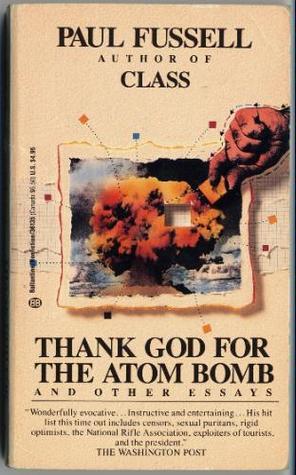
Thank God for the Atom Bomb & Other Essays

Rate this book
Essays discuss nuclear war, George Orwell, tourism, chivalry, nudism, the Indy 500 race, Yugoslavia, modernism, and modern American manners

257 pages, Mass Market Paperback

First published January 1, 1988

7 people are currently reading
322 people want to read

About the author

Paul Fussell

49 books134 followers
Paul Fussell was an American cultural and literary historian, author and university professor. His writings covered a variety of topics, from scholarly works on eighteenth-century English literature to commentary on America’s class system. He was an U.S. Army Infantry officer in the European theater during World War II (103rd U.S. Infantry Division) and was awarded both the Bronze Star and the Purple Heart. He is best known for his writings about World War I and II.

He began his teaching career at Connecticut College (1951–55) before moving to Rutgers University in 1955 and finally the University of Pennsylvania in 1983. He also taught at the University of Heidelberg (1957–58) and King’s College London (1990–92). As a teacher, he traveled widely with his family throughout Europe during the 1950s, 60s and 70s, taking Fulbright and sabbatical years in Germany, England and France.


Ratings & Reviews

What do you think?
Rate this book

Friends & Following

Create a free account to discover what your friends think of this book!

Community Reviews

5 stars
64 (26%)
4 stars
109 (45%)
3 stars
58 (24%)
2 stars
6 (2%)
1 star
4 (1%)
Displaying 1 - 26 of 26 reviews
Profile Image for Eric_W.
1,954 reviews428 followers
August 27, 2009
A very good friend of mine, a history teacher, amd I used to have a running battle over Truman's use of the atomic bomb. I argued that given the time and the context of the decision, Truman had no choice. Ken argued that the sole purpose was a political decision to scare the Russians. Both views are not necessarily contradictory. The reading I've done about both Japanese and American views indicates a certain ambivalence, but clearly the average GI was scared shitless of a proposed invasion of the Japanese homeland given the fierce defense of Iwo Jima, Tarawa, and Okinawa, not to mention Kamikaze attacks.

One has only to read the comments of Admiral Halsey et al to understand the depth of racial hatred of the Japanese and the fear-mongering that had been engendered (often deliberately) but also the result of evidence of barbaric practices, to sympathize with the political pressure and debacle that would have resulted if the US had invaded Japan at the loss of even a few lives had he not used a weapon of this magnitude. (At the time they weren't even sure it would work.)

It must be acknowledged that I think the use of the bombs was horrific and hard to justify, but trying to put myself in Truman's shoes and with the information he had at that time, it's hard to see how he could have made any other decision. General LeMay's (who really should have been charged with being a war criminal)deliberate fire bombing attacks on Japanese cities had been horribly effective at leveling Japanese cities which were constructed of very flammable materials. Hiroshima and Nagasaki were virtually the only cities left.

This book is actually a collection of essays on a variety of topics, but the one about the atomic bomb was the most controversial. It had appears in the The New Republic (August 26 and 29, 1981), pp. 28-30.] This title essay is as much a critique of books like Gray's The Warriors, which Fussell argues "[H:]is meditation on modern soldiering, gives every sign of remoteness from experience.
Division headquarters is miles behind the places where the soldiers experience terror and madness and relieve these pressures by sadism."

There is a nice collection of essays critiquing Fussell's position at http://www.uncp.edu/home/berrys/cours...

It's a discussion that should continue to haunt us.

Fussell has written a great deal about our mythic view of war The Great War and Modern Memory and Wartime Understanding and Behavior in the Second World War.
Profile Image for Nooilforpacifists.
988 reviews64 followers
February 5, 2017
Despite the title, this is a collection of Fussell's critical essays. He was a good critic: Some quite good; others a bit ponderous. The three that begin the volume include the title piece, justly celebrated as a vigorous and manly defense of dropping two atom bombs on Japan written by one in the liberal literary mainstream.

Two other noteworthy essays were "Writing in Wartime", about how much pap is accepted as proper because it's patriotic, and "George Orwell: The Critic as an Honest Man" (no elaboration needed). Almost as good was his analysis how the notion of "The Pastoral" in literature has altered throughout the years, but instead of disappearing, has changed with the times. The "Fate of Chivalry" was overly long, however, and "Nude beaches in Yugoslavia" absurdly outdated.
Profile Image for Phrodrick slowed his growing backlog.
1,077 reviews68 followers
June 25, 2017
Bottom Line Thank God for the Atom Bomb is my second collection of Paul Fussell essays. The first was The Great War and Modern Memory. Of the two the first was a tighter and better book. Having read the two I count myself a fan of Paul Fussell. This book is recommend to any fan of the essay. Do not let the title or the first few selections lead you to believe that this is only about war. This is a collection, some of it published elsewhere and as it covers several topics. It can feel thrown together.

Paul Fussel served his nation as a combat officer on the ground in the European theater during WWII. Had the Japanese not been speed to the surrender tables, he would have been among those sent fight them on the Japanese home Islands. Some would say that this fact is all he has to offer when in the opening essay he is certain that dropping those nuclear bombs was correct. Further, those who think otherwise lack the war time experience to have credibility. His argument is far more than selfish. In pointing out the average number of people who were dying every day in the Pacific, and counting out how many would have died had the war continued for even a few days more it is clear that waiting would not have saved lives. Ours or theirs.

It is to his credit that the next essay is a scholarly disagreement to his case and ending this section is a discussion of American actions that a more peaceful world would consider atrocities. His point was that the War in the Pacific included in its costs, American soldiers who felt it ok to participate in collecting, even gifting the skulls of Japanese dead. Humans in any war do terrible things, this is almost without parallel in American history.

After this much intensity it is almost jarring as Fussell writes about topics like George Orwell, nudist beaches in the Balkans, several more discussions of the impact of modern war on modem literature, ultimately ending with another near non sequitur, the Indianapolis 500.

All of these essays are intelligent and insightful. I will be reading more Gorge Orwell because of Paul Fussell. Also in this book is a passage that has changed my outlook on many issues.

It is the habit of many to believe that their side of any topic is where virtue is to be found. That especially in wartime, but just as passionately in politics the choices are only between the good and the bad. Fussell, quoting others argues that in most cases the choice is between the bad and the worse.
There are essays, or themes included in this book that are too close to ones included in The Great War and Modern Memory. These essays tended to feel like fillers and should have been excluded or placed earlier in this collection following his thoughts on WWII.

I will be reading more books by Paul Fussell. His opinions on matters cultural or more practical are the opinions of a writer with important experience and an insightful command of his topics. I want his opinion on topics about warriors and warriors who are also writers.
Profile Image for Casey Lartigue.
Author 3 books30 followers
January 11, 2023
What’s a book you’ve read more than once, but years or even decades between reads, and had a completely different perspective?

***
When people ask me if I have read a certain book that I indeed have read, I often hesitate to confirm. Reading "To Kill a Mockingbird" or a book about dating is a different experience at age 16 compared to 36 or 56.

I first read the late Paul Fussell's provocative collection of essays "Thank God for the Atom Bomb" as a graduate student. When I reread it a few years later, I noticed that I had completely skipped the chapter about traveling.

I am a "digital immigrant" who still prefers printed books, newspapers and articles so I can markup the text. I didn't mark a single thing in that travel chapter the first time around.

The second time around, years later, I wondered how I could have missed Fussell's profundity. In particular, I appreciated his point distinguishing among travelers, tourists and explorers.

What had changed? Me. I grew up in Texas and Massachusetts, but had not even crossed the U.S. borders nearby in either direction until after graduate school. Now I am living in South Korea.
Profile Image for snorwick.
64 reviews5 followers
March 13, 2023
This was a very high value thrift store find. Took a chance on this one because it only cost me a nickel and the title + cover art were tempting enough. While not all great, there are quite a few excellent essays in this collection and I was happily thorough with my highlighting and annotating once I got going. I will say that overall, I think these works give deep insight into western culture of the mid-20th century across a range of subjects from the dropping of the atomic bomb at the end of WWII to 2nd Amendment debates to nudity and travel. Fussell is witty — sometimes he drops in a hint of sassiness toward debate opponents which I do appreciate — and rigorous with language through social critique, literary analysis, and other investigations that invite us to question why things are as they are. Published in 1988, Fussell’s views can occasionally come across as outdated but are for the most part still relevant today.

I think I’ll take some space here to indicate my favorite essays of the bunch and include a few excerpts I highlighted.

Thank God for the Atom Bomb

Warning: graphic descriptions of war violence and atrocities contained between ****** (hidden spoilers don’t work in-app unfortunately).

******
”When the war ended, Bruce Page was nine years old. For someone of his experience, phrases like “imperialist class forces” come easily, and the issues look perfectly clear.”


It’s worth noting that Fussell actually served in the Pacific during WWII and likely would have been involved in a land invasion of Japan had the atomic bombs not been dropped.

Why delay and allow one more American high school kid to see his own intestines blown out of his body and spread before him in the dirt while he screams and screams when with the new bomb we can end the whole thing just like that?


There are many intense descriptions and accounts of actual fighting at the front. I think we need to be honest about the brutalities of war. We shouldn’t sugar coat what we’re doing to each other “out there”, far from the comforts of home.

”We existed in an environment totally incomprehensible to men behind the lines…even to men as intelligent and sensitive as Glenn Gray, who missed seeing with his own eyes Sledge’s marine friends sliding under fire down a shell-pocked ridge slimy with mud and liquid dysentery shit into the maggoty Japanese and USMC corpses at the bottom, vomiting as the maggots burrowed into their own foul clothing.”


My own stomach turns but it’s only within the limits of empathetic imagination.

”War is not a contest with gloves. It is resorted to only when laws, which are rules, have failed.”


”My object was to offer a soldier’s view, to indicate the complex moral situation of knowing that one’s life has ben saved because others’ have been most cruelly snuffed out.”


Postscript on Japanese Skulls

Skulls, among other corporal “trophies”, were taken by USMC soldiers during the Pacific island campaigns. This was something I feel was white washed in my limited historical learnings of WWII and I feel is important to know and understand in context. We are not without our own atrocities and vile acts.

”[early skull-taking] seems to register less a sinking of the USMC to the Japanese level of brutality—that would come later—than a simple 1940s American racial contempt. Why have more respect for the skull of a Jap than for the skull of a weasel, a rat, or any other form of mad, soulless vermin?”


Of course it’s uncomfortable and even painful to admit our own sins but we must. We did this. Americans, Japanese, and the whole lot. Humanity did this to ourselves.

”He hacked off the head of a Japanese body he found on the beach there, skinned it, and then gave it the salt-water-immersion treatment until it was fit to be held on his flattened hand and gazed at, producing the effect of a sailor-boy Hamlet considering not his childhood friend but a detested enemy.”


Dahmer much?

”We shot prisoners in cold blood, wiped out hospitals, strafed lifeboats, killed or mistreated enemy civilians, finished off the enemy wounded, tossed the dying into a hole with the dead, and in the Pacific boiled the flesh off enemy skulls to make table ornaments for sweethearts, or carved their bones into letter-openers.”


Brutal.

******

Travel, Tourism, and “International Understanding”

A lot is said about the differences between “travel” and “tourism”.

”Those whose goal it is to insulate people from the foreign and to move them around profitably in large groups hope to persuade them that the terms tourism and travel are synonymous.”


And also things Europeans do better or worse.

”I don’t want to suggest that Europeans have a special lien on honest dealing, only that they are sometimes better at facing than euphemizing embarrassing realities, if not unpleasant facts. The bidet is a case in point.”


We’re finally getting on the clean bum train America! You can order a bidet kit straight to your door (they deliver to the back door) from your favorite online retailer!

”...tourism, which is to travel as plastic is to wood.”


He quotes Albert Camus (one of my favorite quotes in the whole collection) in saying,

”What gives value to travel is fear. It breaks down a kind of inner structure we have. One can no longer cheat—hide behind the hours spent at the office or at the plant… Travel robs us of such refuge. Far from our own people, our own language, stripped of all our props, deprived of our masks (one doesn’t know the fare of the streetcars, or anything else), we are completely on the surface of ourselves...But also, we restore to every being and every object its miraculous value.”


Of Americans’ lack of historical context—we are a young nation and the ancient traumas that are second nature to much of the rest of the world escape us—he says,

”In the United States, if you want to sense the ironic relation between past and present, you read The Waste Land or Ulysses. Abroad, you raise your eyes from your book and look around.”


Of the tenets of “post-tourism” he quotes Hilary Mantel saying,

”When you come across an alien culture you must not automatically respect it. You must sometimes pay it the compliment of hating it.”


Taking it All Off in the Balkans

Nudism or “naturism”.

”The naturist feeling? A new and lovely sense of perfect freedom, not just from jocks and waistbands and bras but from social fears and niggling gentilities. You quickly overcome your standard anxieties about what the neighbors or the boss will think. The illusion, which naturists recognize as an illusion, is that all evil has been for the moment banished from the beach. Including the grave risk of skin cancer, which is never mentioned by the naturists.”


Of the anxieties of body image,

”The same with men: if you think nature has been unfair to you in the sexual anatomy sweepstakes, spend some time among the naturists. You will learn that every man looks roughly the same—quite small, that is, and that heroic fixtures are not just extremely rare, they are deformities.”


Funny observations—or I suppose lack thereof—on butthole prudes at nude beaches:

Nature must have known exactly what she was doing, for she took care to hide from customary view the least prepossessing external body opening…In fact, that undignified, even comical, part of the body is never knowingly exposed by a naturist, a fact suggesting that even naturism retains its pruderies, for all its pretense of bravely casting them aside.”
823 reviews8 followers
Read
July 23, 2012
Acerbic essayist Fussell, who died a few weeks ago, deals with topics as diverse as the atom bomb and Indy 500 here. He excells in parsing war literature and many of the essays touch on this genre. May Sarton gets her knuckles rapped in a piece on authors complaining about bad reviews, tourism and naturism are investigated and I've got two new sources of good writing to try out; George Orwell's reviews and Edmund Blunden's WWI memoir "Undertones of War".
Profile Image for John.
299 reviews2 followers
August 30, 2025
Really only 3 stars but I’m keen on essays and am running out of books of essays that are available on audiobook. Half the essays here are pretty good, well written and from the unique perspective of an American WWII veteran who is really into poetry; there’s a lot about those two things, a quarter feels like OK assignments he got, and the rest is inspired stuff. His book Class is supposed to be the real gem but it’s not on audiobook.
Profile Image for Jim Cullison.
544 reviews8 followers
July 23, 2022
Fussell is at his most engrossing and eloquent in his essays regarding war. His essays pertaining to literary criticism might be of similarly elite quality, but my ignorance of, and indifference to, that particular topic render me an inadequate judge. The first eighty pages however, are incisive gems of jagged clarity and persuasion.
Profile Image for Erik Graff.
5,167 reviews1,455 followers
November 19, 2010
Having finished my in-flight book, I depended upon my hosts, Walter and Karen, to recommend books from their library when I arrived for a one week visit to their home in Springfield, Vermont. One, Rick's Fiasco, took up most of the serious reading time. This collection of essays, many of them amusing, served for light bedtime reading.
Profile Image for Kathy Piselli.
1,397 reviews16 followers
August 18, 2017
Fussell served in the infantry in WW2 and I was thinking about him while reading Fleming's mysteries of My Father in which Fleming's father, as a youth in the Great War, learns that no one will kill any Huns with their rifles and that their best weapon is the spade they use to dig their trenches. This collection of Fussell's essays includes his sobering observation about literature that has emanated from wars past, and his prediction that there will be no "weighty, sustained poems, or even short poems of distinction" to come out of the Vietnam war. Perhaps not, but there have been some significantly lasting films.
Profile Image for Jim.
817 reviews
February 14, 2023
excellent rhetorician. he can turn his crankiness to good end, and does a trick of losing you at the beginning of many of his essays and winning you back by the sheer ability with argument. His essay on Orwell (who is obviously his model) explains his style and manages also to be a great survey of mid twentieth century literature, and the essay on Edwin Blunden is great and followed by the one on Indianapolis 500, as if to demonstrate his range of subject
Profile Image for James.
593 reviews9 followers
May 13, 2018
The title essay is not only the best in the collection but pretty much the last word on the bomb, as far as I'm concerned. Other highlights include a really sharp appreciation of Orwell, a look at "naturalist" beaches, and a critical but not condescending appraisal of the Indy 500. If you don't get the book, at least read the title essay online. It's incredibly well done.
Profile Image for Stacy.
799 reviews
December 23, 2020
Just not my cup of tea though I can see how WWII buffs would enjoy it.
Profile Image for Ronnie.
448 reviews4 followers
February 10, 2022
This is a collection of essays by the author. It is a very good read.enjoy it.
Profile Image for Patrick McCoy.
1,083 reviews93 followers
August 1, 2017
The author Paul Fussell recently died and while reading one of the obituary pieces I noticed that he wrote an acclaimed essay called “Thank God For The Atomic Bomb,” which sounded intriguing to me. About a year ago I was taking a history correspondence course to renew my teaching license in America I wrote a research paper on the reasons the US bombed Japan. So I was interested in hearing Fussell’s perspective, since he served as a soldier in the European theater in WWII. It turns out that I had to hunt it down since the book is no longer in print. But it seems that his main reason was to save American soldier’s lives and it follows Japanese civilian lives that would have been lost had the US been forced to invade Japan. This book of essays, from 1988, also has several other war related pieces: “An Exchange Of Views” with a historian who challenges Fussell’s assumptions about the war, “Postscript (1987) on Japanese Skulls” points out that Americans did take grotesque wartime souvenirs such as skulls home as war trophies, and “Writing in Wartime: The Uses of Innocence” about a wartime memoir that was a fake and used for the propagandistic purpose of bringing the US into war with Germany. Being a George Orwell fan I also found his essay “George Orwell: The Critic as Honest Man” interesting and informative. Orwell was also inspiration for his essay “A Power of Facing Unpleasant Facts” about the need for intellectual honesty in the world despite the unpleasantness that this often produces. I found his opinions concerning the 2nd Amendment provocative and timely given the several mass killings in the US recently in his essay “A Well-Regulated Militia.” He makes some interesting points about the distinction between travelers and tourists in “Travel, Tourism, and ‘International Understanding.’” Surprisingly, he is an advocate of “naturist” or more commonly known as “nudism” as “Taking It All Off in the Balkans” attests. However, there were a couple of essays that I couldn’t finish due to lack of interest in the subjects: the pastoral poetry in “On the Persistence of Pastoral,” chivalry in “The Fate of Chivalry and the Assault upon Mother,” and car racing in “Indy.” All in all, it is a provocative collection of essays.
Profile Image for Vel Veeter.
3,597 reviews64 followers
Read
May 29, 2023
This is a tough one to review in part because what Paul Fussell is essentially arguing in the opening essay is that the dropping of the atomic bomb unleashed untold horrors--the death and destruction intended and known prior to, with the legacy of radiation and cancer and unforeseen consequence--but based on the information at the time, and based on the costs of lives, and seen through the eyes of common soldiers, airmen, and sailors to be the best option there was at the time. The goal of the essay is not so much to make this argument in a full-throated pro-American way, but to complicate and push back against what he sees as a too easily made hindsight argument against the bombing. He specifically references that almost all the critics making these arguments (at least in 1989) had no physical stake in the decision as they were either too young to serve in the Pacific theater, not born yet, or not in a position to be in danger. And as someone who was (he was in the military service at the time), and in light of what other people in danger said, that the decision was ultimately defensible and more complex and complicated than too often stated.

So I think again Barbara Tuchman's argument for historical mistakes--that hindsight is not useful in assessing them, that alternatives needed to be available, known, and argued for, and while I think Fussell's question is both not something that requires me to stake anything on, I do think he speaks to a very common historical assessment made over and over in today's climate, that hindsight allows for a lot of people in no moral position to stake a claim of no consequence bravely, decades on.

The rest of the collection goes back and forth among historical studies, literary-historical studies, and art criticism all through historical lenses, and none are as thought-provoking and vexing as the title essay, but I am more interested in Fussell's other works.
Profile Image for Jesse.
501 reviews
January 14, 2014
As always, Fussell provides a deep, nuanced contemplation of serious issues, ranging from the truly horrible to the mundane. Obviously most responses to this book will be to title essay itself, which is much more than an apology for the horror of Hiroshima, but rather a demand that readers understand the complexity and awful brutality of the war in the Pacific. I don't know if Fussell's right in his figures, but if he is, he's expanded the very personal and selfish argument of being grateful for the atom bomb (one he shared with my grandparents, since those two bombings prevented my grandfather's deployment to the pacific) to the mathematical likelihood that continued fighting would almost certainly have led to far more dead on both sides, including civilians.

But it being Fussell, what's important about this argument is that he underlines how truly horrible it is--how racist the US military was, and how unspeakable the violence of the two atomic bombings was. There's no easy solution in any of Fussell's work that I've seen so far. In this book, more than in his others, he seems to be demanding readers come to terms with realizing that gratitude can't outweigh the horror of atrocities that may in some cases have saved their own lives. It's a complicated point, and one that leaves me uncomfortable and puzzled.

As well, in true Fussell style, it begins with a long contemplation of some of the most serious subjects within human grasp, and ends with pieces about nudism in Soviet Yugoslavia, and a day at the Indy 500.
Profile Image for Dale.
1,949 reviews66 followers
December 21, 2012
The works of a brilliant essayist are a joy to read

I admit, I was attracted to Thank God for the Atom Bomb because of the title. Our library had it featured on its web page with some excerpts and I was intrigued. I was not disappointed.

The title essay is simply brilliant. It is also caustic, blunt and nuanced. I'll refer to it before the next time I teach about World War II.

There are two more essays on World War II. I found the two essays on George Orwell to be most interesting. His commentary on the differences between tourism and travel reminded me of the Twain essays I've been reading lately. "Taking It All Off In The Balkans" is the account of his visit to a nudist resort in the former Yugoslavia - very funny and (I've got to say it) revealing.

Two essays were just not interesting to me, being mainly about poetry and I find myself unable to muster the interest to read poetry, let alone read extensive commentary on it. I skimmed those...

Read more at: http://dwdsreviews.blogspot.com/2011/...
Profile Image for Chris.
107 reviews2 followers
October 7, 2009
I would give Thank God for the Atom Bomb a better review, however, the author uses a form of descrimination against other writers based on how old they were at the time of the dropping of the bombs on Japan. If the author had stuck to his primary arguments I believe the book would have been a much stronger case for his and many other peoples' opinions of the usage of atomic power. When Paul Fussell made the argument personal he essentially gave the debate to the other debators.
Profile Image for Jinnul Mukarram Jr..
2 reviews41 followers
April 19, 2015
I have a good copy of it since I was in senior high school, i grabbed a cop of it during a school tour next to our school.. i bought it from a school in a cheap price for it was been used already, but its okey the content is till intact, the essays were so incredible, and i was just like travelling through time when the writers were talking and elaborating the scenes in the content...
Profile Image for Joe Johnston.
78 reviews
April 14, 2008
The title essay alone is a must-read. About how our use of the atomic bomb on Hiroshima and Nagasaki, while morally problematic, saved vastly more lives and suffering by preventing an Allied invasion of mainland Japan.
Displaying 1 - 26 of 26 reviews

Can't find what you're looking for?

Get help and learn more about the design.