Yehuda Amichai (Hebrew: יהודה עמיחי; 3 May 1924 – 22 September 2000) was an Israeli poet. Amichai is considered by many, both in Israel and internationally, as Israel's greatest modern poet. He was also one of the first to write in colloquial Hebrew.
Yehuda Amichai [was] for generations the most prominent poet in Israel, and one of the leading figures in world poetry since the mid-1960s.
(The Times, London, Oct. 2000)
He was awarded the 1957 Shlonsky Prize, the 1969 Brenner Prize, 1976 Bialik Prize, and 1982 Israel Prize. He also won international poetry prizes: 1994 – Malraux Prize: International Book Fair (France), 1995 – Macedonia`s Golden Wreath Award: International Poetry Festival, and more.
Yehuda Amichai was born in Würzburg, Germany, to an Orthodox Jewish family, and was raised speaking both Hebrew and German.
Amichai immigrated with his family at the age of 11 to Petah Tikva in Mandate Palestine in 1935, moving to Jerusalem in 1936. He attended Ma'aleh, a religious high school in Jerusalem. He was a member of the Palmach, the strike force of the Haganah, the defense force of the Jewish community in Mandate Palestine. As a young man he volunteered and fought in World War II as a member of the British Army, and in the Negev on the southern front in the Israeli War of Independence.
After discharge from the British Army in 1946, Amichai was a student at David Yellin Teachers College in Jerusalem, and became a teacher in Haifa. After the War of Independence, Amichai studied Bible and Hebrew literature at the Hebrew University of Jerusalem. Encouraged by one of his professors at Hebrew University, he published his first book of poetry, Now and in Other Days, in 1955.
In 1956, Amichai served in the Sinai War, and in 1973 he served in the Yom Kippur War. Amichai published his first novel, Not of This Time, Not of This Place, in 1963. It was about a young Israeli who was born in Germany, and after World War II, and the war of Independence in Israel, he visits his hometown in Germany, recalls his childhood, trying to make sense of the world that created the Holocaust. His second novel, Mi Yitneni Malon, about an Israeli poet living in New York, was published in 1971 while Amichai was a visiting professor at the University of California, Berkeley. He was a poet in residence at New York University in 1987. For many years he taught literature in an Israeli seminar for teachers, and at the Hebrew University to students from abroad.
Amichai was invited in 1994 by Prime Minister Yitzhak Rabin to read from his poems at the ceremony of the Nobel Peace Prize in Oslo.
"God has pity on kindergarten children" was one of the poems he read. This poem is inscribed on a wall in the Rabin Museum in Tel-Aviv. There are Streets on his name in cities in Israel, and also one in Wurzburg.
Amichai was married twice. First to Tamar Horn, with whom he had one son, and then to Chana Sokolov; they had one son and one daughter. His two sons were Ron and David, and his daughter was Emmanuella.
Come in to this space in my mind that I consider my most intimate chamber. This space filled with light and shadow, dust and cheer, and so many others who have come before you.
Come in and enter the Dead Poet's Society of my psyche. This jumble of words strung together to make the most memorable lines that mimic song.
Clearly you have earned your membership here. The guidelines are simple: candidates must be willing to grind their bones to make my bread. Must know that blood is the most indelible ink.
Enter sir, and find your place among the shadows, the light, the erotic, the rhythmic, the celebration of day, the death wail for night.
You are welcome, Yehuda. You are in good company here.
From the hills I hear voices of men and machines wrecking and building. And there are loves which cannot be moved to another site. They must die at their place and in their time like an old clumsy piece of furniture that's destroyed together with the house in which it stands. But this valley is a hope of starting afresh without having to die first, of loving without forgetting the other love, of being like the breeze that passes through it now without being destined for it.
The world’s awake tonight. On its back with wide-open eyes.
The moon fits the line of your cheeks, your breasts—the line of mine. . . . Your heart plays tug-of-blood inside your veins.
Your eyes are still as warm as beds— time slept in them.
Your thighs two sweet days past, I come to you.
All one hundred and fifty psalms cry out at once.
—from "Six Songs for Tamar" translated by Harold Schimmel
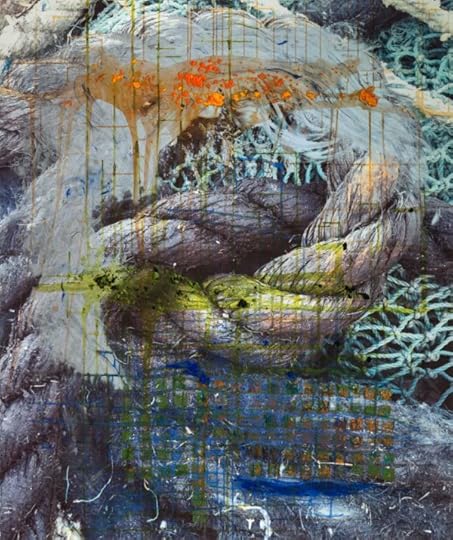
Knots by Ariela Wertheimer*
Yehuda Amichai's Love Poems ache with erotic intensity and loss, or imminent loss — to the erosions of time, failures of love, separations, violence. I was struck by the original vision and language, and the range of emotional expression of these poems, the way they became richer and richer on re-reading. This is my first taste of Yehuda Amichai’s poetry and I want more.
Translator Robert Alter has said: “Yehuda Amichai, it has been remarked with some justice, is the most widely translated Hebrew poet since King David.” I can see why. — The Poetry Foundation
The earth drinks men and their loves like wine, to forget. . . . In the middle of this century we turned to each other, I saw your body, throwing shade, waiting for me, . . . I spoke in praise of your mortal hips, you spoke in praise of my passing face.
from "In the Middle of This Century" translated by Assia Guttmann
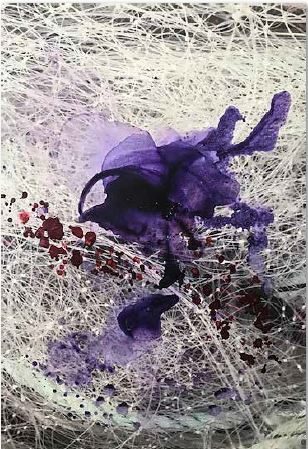
The Deep Blue by Ariela Wertheimer*
This could have been a song of praise to the sweet imaginary God of my childhood. It was Friday, and black angels filled the Valley of the Cross, their wings black houses and abandoned quarries. Sabbath candles rose and fell like ships at the entrance to the harbor. Come Sabbath bride, come bride, wear the clothes of mourning and of your glory the night you thought I would not come to you and I came. The room was tipsy with the smell of black cherry preserve. Papers scattered on the floor rustled below, bitter wings scythed above. Love with parting, like a record— music with applause at the end, love with a cry, love with the stammered despair of the proud departure into exile from each other. Come, bride, hold something of clay in your hand at the hour of sunset, for flesh dissolves and iron doesn’t keep. Hold clay in your hand for future archaeologists to find and remember. They do not know that poppies after rain are also an archaeological find, rich evidence.
—from "The Last Benjamin of Todela" translated by Ruth Nevo
Iris of Soul by Ariela Wertheimer*
Heartfelt thanks to Florencia who introduced me to this unequaled poet, through a different book.
********************************************* Paintings of Israeli artist Ariela Wertheimer represented by The Farkash Gallery
We were together in my time, in your place. You gave the place and I the time. Quietly your body waited for the seasons to change. Fashions passed over it-to shorten, to lengthen, with flowers or in white silk, clinging.
We swapped human values for those of beasts, calm and tigerlike and forever. And for all that, ready to burn at any moment with the dry grass of the end of summer.
I divided the days with you, nights. We exchanged a look with rain. We were not like the dreamers, even in our dreams.
And in the unquiet nestled the quiet, in my time, in your place.
The many dreams I now dream of you prophesy your end with me-
As the multiplying crowds of sea gulls come where the sea ends.
Yes, I found this book on my grandmothers book shelf which made me feel connected to her and Judaism in ways I cling to each time they present themselves to me. It also was one of the times, which I search for, that poetry enveloped me and made me feel so much even when I don’t completely understand what it means. I love being Jewish
I read the English translations though it was obvious it would be so much better if I could understand the original Hebrew. A lot was (apparently) lost in translation. It seemed kind of flat.