

What do you think?

JLA (Original Trades)
JLA, Vol. 6: World War III
The Justice League of America, including superheroes Batman, Wonder Woman, Oracle, and Zauriel, must prevent the peoples of the universe from destroying each other at the promptings of Mageddon, an ancient war machine.
208 pages, Paperback
First published July 1, 2000
About the author
Grant Morrison
1,812 books4,674 followersGrant Morrison has been working with DC Comics for twenty five years, after beginning his American comics career with acclaimed runs on ANIMAL MAN and DOOM PATROL. Since then he has written such best-selling series as JLA, BATMAN and New X-Men, as well as such creator-owned works as THE INVISIBLES, SEAGUY, THE FILTH, WE3 and JOE THE BARBARIAN. In addition to expanding the DC Universe through titles ranging from the Eisner Award-winning SEVEN SOLDIERS and ALL-STAR SUPERMAN to the reality-shattering epic of FINAL CRISIS, he has also reinvented the worlds of the Dark Knight Detective in BATMAN AND ROBIN and BATMAN, INCORPORATED and the Man of Steel in The New 52 ACTION COMICS.
In his secret identity, Morrison is a "counterculture" spokesperson, a musician, an award-winning playwright and a chaos magician. He is also the author of the New York Times bestseller Supergods, a groundbreaking psycho-historic mapping of the superhero as a cultural organism. He divides his time between their homes in Los Angeles and Scotland.
In his secret identity, Morrison is a "counterculture" spokesperson, a musician, an award-winning playwright and a chaos magician. He is also the author of the New York Times bestseller Supergods, a groundbreaking psycho-historic mapping of the superhero as a cultural organism. He divides his time between their homes in Los Angeles and Scotland.
Ratings & Reviews
Friends & Following
Create a free account to discover what your friends think of this book!
Community Reviews
Displaying 1 - 30 of 46 reviews

August 25, 2019
Score: 3.28 out of 5
Grade: 66% (C) | Meh
Morrison’s final take on the JLA faces them off against the Injustice Gang 2.0 while a planet-destroying entity known as Mageddon puts the Earth in peril (again). Here is my review of JLA Vol. 6: World War III:

The Good:
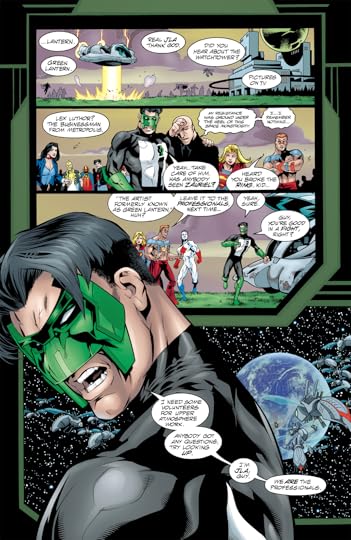
RIOT AT BELLE REVE
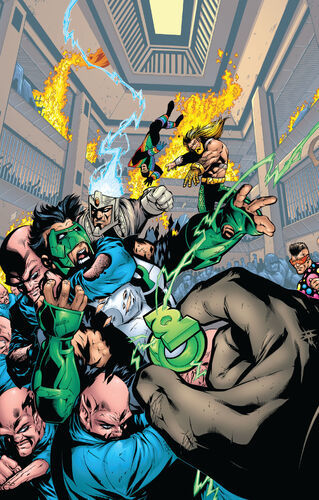
This single-issue story reintroduces us to some of the series-favourite villains as they plot against the JLA! We get an idea of the new roster for the Injustice Gang (still such a lame name), and I’m digging the new recruits. For me, mostly seeing Prometheus again was what got me excited. With the wild riot at Belle Reve, there’s some character moments for Superman and Plastic Man, which were a lot of fun.
RETURN OF THE SPECTRE
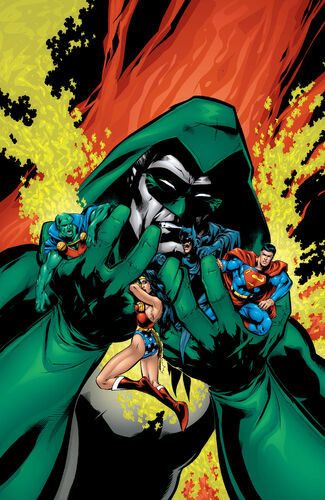
Another single-issue story challenges the JLA to reflect on their actions and determine whether or not what they do is always for the greater good. Martian Manhunter takes it into his own hands to show Spectre that even in the most chaotic of minds, there still remains a glimmer of hope. Spectre also had to look in the mirror and ask himself if everything he does is for the greater good. This was a highly philosophical read, which was unexpectedly great!
WORLD WAR THREE
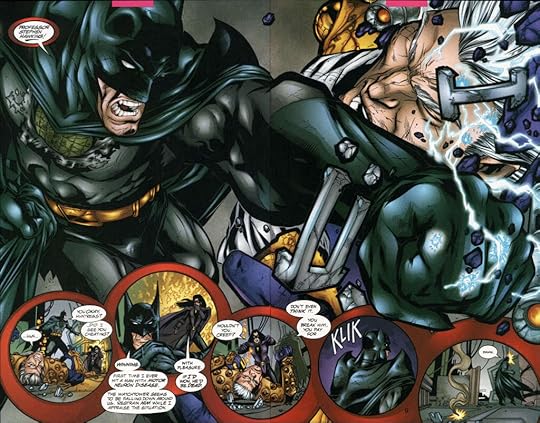
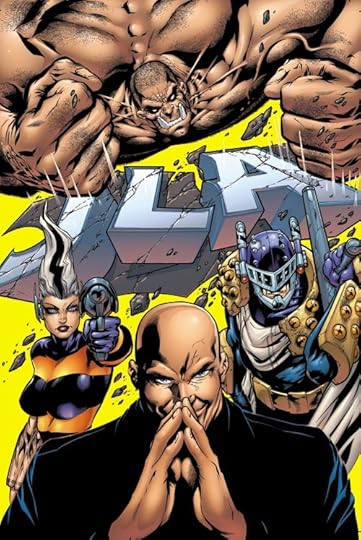
The Injustice Gang this time around features all the favourites from the JLA run so far (minus Queen Bee). I loved seeing Prometheus and Lex Luthor conspire against the JLA. Prometheus has been my favourite villain from Morrison’s run, and watching him go toe-to-toe with the Dark Knight was amazing. Obviously, it’s Batman, so Prometheus got his ass handed to him, but their fight ended in both a clever and funny way.
For some sequences, the art is just amaze-balls! Especially the Shaggy Man and Superman fight – there was no holding back when these two titans went at it. The art for Mageddon was also great! Without any dialogue, just seeing this planet-destroying monster makes you think the JLA are f***ed. They really went all out for this last story and I appreciate that.

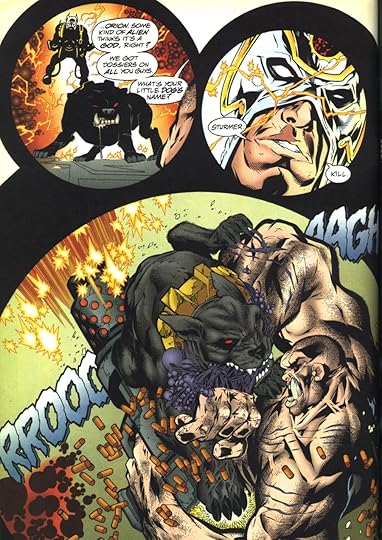
There’s some really good sequences spread throughout this book. Watching Prometheus and Oracle trade insults was unexpectedly great! Who knew Oracle had such a dirty mouth on her. Orion and his doggo, Sturmer, put in some work on the Shaggy Man. Regardless of what happened, Sturmer was a good boy and deserves all the doggy treats in the world!
Martian Manhunter had some good moments too, and I loved how he just downloaded the necessary information Batman needed directly into his brain (wish I had that for exams). It’s also nice to see Green Lantern not feel like an annoying adolescent delinquent. He actually makes himself useful and feels like he deserves to be on the JLA.
The Bad:
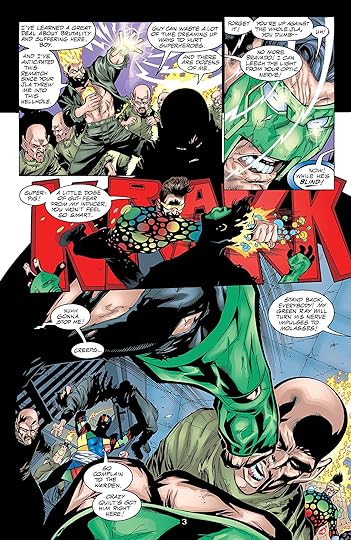
RIOT AT BELLE REVE
The book starts off with this chaotic riot at Belle Reve, and that’s how this single-issue felt, chaotic. There’s just way too much jumping around with too much going on, which made it feel incoherent and all over the place. We also have small tidbits that don’t entirely feel relevant, besides just setting up for World War III. It felt like this book got off to a mad dash before I could even figure out what the hell was going on.
RETURN OF THE SPECTRE
My main problem with this is just how little it contributed to the overall story. It was purely a filler issue that felt out of place. It had little to do with the Injustice Gang storyline, which made me feel less engaged. It’s definitely an interesting read, but just at an awkward time in the book.

WORLD WAR THREE
The setup for World War III was a rocky one. There was too many moving pieces that had very little payoff. The Injustice Gang storyline almost faded into the background to accommodate for Mageddon. Which sucks because I was way more interested in seeing the Injustice Gang 2.0 than Mageddon invading Earth. It would’ve been fine if the finale was good, but it wasn’t – it was just anticlimactic.
No surprise here, Earth is in peril again. And even when Mageddon was defeated, I was extremely underwhelmed. “Was that it?” There’s a dumb kumbaya moment that made me cringe so hard. Let us all, regular everyday people of Earth who just acquired superpowers, fight this crazy planet-destroying monster in space…yeah, that’s a hard f***no! I don’t think everyday people would be down for that.

Although there were some good moments, there were also some really dumb moments:
“Wow Huntress! Thanks for reminding Green Lantern about his will power, which is kind of his whole deal. Otherwise, he’d still be a mind-controlled zombie!”
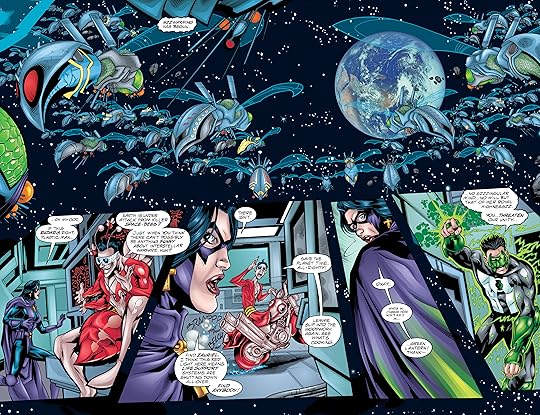
“Oh hey Aztek, where have you been? Oh, you just came from butt-f*** nowhere. Oh, and you just sacrificed yourself because…I actually don’t know why. And I’m not sure I really care.”

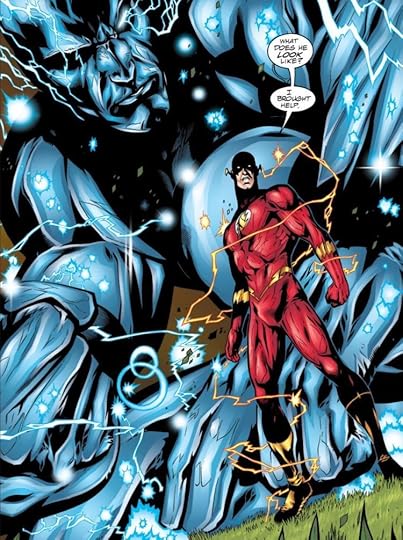
“Ah yes, Flash brought reinforcements everybody, the Glimmer, but all he’s doing is saying, “I AM POWER”. K, we get it dude, now go do something useful.”
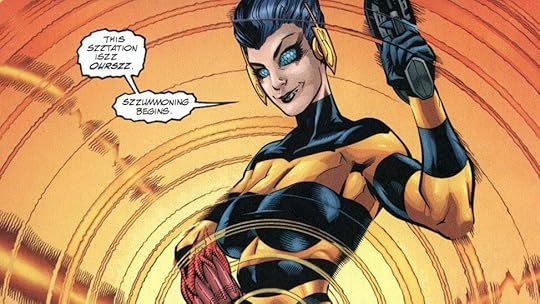
The Injustice Gang lineup was great, except for Queen Bee. She didn’t belong and was annoying as sh** when “szzhe’szz talking like thiszz.” She isn’t interesting or compelling, and she adds very little to the story. I was overjoyed when this “bee-tch” (see what I did there) finally buzzed off.
Conclusion:
For Morrison’s final JLA story, I liked where things were headed, but it just missed the mark. There were elements that were interesting, some cool moments, and stellar action sequences. But the underwhelming finale made World War III feel like just any other JLA/Earth is in peril story. In the end, all the time spent towards building the epic finale never paid off as much as it should have.
Recommended for: Fans of Morrison, or people who just want to wrap things up and move on.

Thanks for reading! :)
Grade: 66% (C) | Meh
Morrison’s final take on the JLA faces them off against the Injustice Gang 2.0 while a planet-destroying entity known as Mageddon puts the Earth in peril (again). Here is my review of JLA Vol. 6: World War III:
The Good:
RIOT AT BELLE REVE
This single-issue story reintroduces us to some of the series-favourite villains as they plot against the JLA! We get an idea of the new roster for the Injustice Gang (still such a lame name), and I’m digging the new recruits. For me, mostly seeing Prometheus again was what got me excited. With the wild riot at Belle Reve, there’s some character moments for Superman and Plastic Man, which were a lot of fun.
RETURN OF THE SPECTRE
Another single-issue story challenges the JLA to reflect on their actions and determine whether or not what they do is always for the greater good. Martian Manhunter takes it into his own hands to show Spectre that even in the most chaotic of minds, there still remains a glimmer of hope. Spectre also had to look in the mirror and ask himself if everything he does is for the greater good. This was a highly philosophical read, which was unexpectedly great!
WORLD WAR THREE
The Injustice Gang this time around features all the favourites from the JLA run so far (minus Queen Bee). I loved seeing Prometheus and Lex Luthor conspire against the JLA. Prometheus has been my favourite villain from Morrison’s run, and watching him go toe-to-toe with the Dark Knight was amazing. Obviously, it’s Batman, so Prometheus got his ass handed to him, but their fight ended in both a clever and funny way.
For some sequences, the art is just amaze-balls! Especially the Shaggy Man and Superman fight – there was no holding back when these two titans went at it. The art for Mageddon was also great! Without any dialogue, just seeing this planet-destroying monster makes you think the JLA are f***ed. They really went all out for this last story and I appreciate that.
There’s some really good sequences spread throughout this book. Watching Prometheus and Oracle trade insults was unexpectedly great! Who knew Oracle had such a dirty mouth on her. Orion and his doggo, Sturmer, put in some work on the Shaggy Man. Regardless of what happened, Sturmer was a good boy and deserves all the doggy treats in the world!
Martian Manhunter had some good moments too, and I loved how he just downloaded the necessary information Batman needed directly into his brain (wish I had that for exams). It’s also nice to see Green Lantern not feel like an annoying adolescent delinquent. He actually makes himself useful and feels like he deserves to be on the JLA.
The Bad:
RIOT AT BELLE REVE
The book starts off with this chaotic riot at Belle Reve, and that’s how this single-issue felt, chaotic. There’s just way too much jumping around with too much going on, which made it feel incoherent and all over the place. We also have small tidbits that don’t entirely feel relevant, besides just setting up for World War III. It felt like this book got off to a mad dash before I could even figure out what the hell was going on.
RETURN OF THE SPECTRE
My main problem with this is just how little it contributed to the overall story. It was purely a filler issue that felt out of place. It had little to do with the Injustice Gang storyline, which made me feel less engaged. It’s definitely an interesting read, but just at an awkward time in the book.
WORLD WAR THREE
The setup for World War III was a rocky one. There was too many moving pieces that had very little payoff. The Injustice Gang storyline almost faded into the background to accommodate for Mageddon. Which sucks because I was way more interested in seeing the Injustice Gang 2.0 than Mageddon invading Earth. It would’ve been fine if the finale was good, but it wasn’t – it was just anticlimactic.
No surprise here, Earth is in peril again. And even when Mageddon was defeated, I was extremely underwhelmed. “Was that it?” There’s a dumb kumbaya moment that made me cringe so hard. Let us all, regular everyday people of Earth who just acquired superpowers, fight this crazy planet-destroying monster in space…yeah, that’s a hard f***no! I don’t think everyday people would be down for that.
Although there were some good moments, there were also some really dumb moments:
“Wow Huntress! Thanks for reminding Green Lantern about his will power, which is kind of his whole deal. Otherwise, he’d still be a mind-controlled zombie!”
“Oh hey Aztek, where have you been? Oh, you just came from butt-f*** nowhere. Oh, and you just sacrificed yourself because…I actually don’t know why. And I’m not sure I really care.”
“Ah yes, Flash brought reinforcements everybody, the Glimmer, but all he’s doing is saying, “I AM POWER”. K, we get it dude, now go do something useful.”
The Injustice Gang lineup was great, except for Queen Bee. She didn’t belong and was annoying as sh** when “szzhe’szz talking like thiszz.” She isn’t interesting or compelling, and she adds very little to the story. I was overjoyed when this “bee-tch” (see what I did there) finally buzzed off.
Conclusion:
For Morrison’s final JLA story, I liked where things were headed, but it just missed the mark. There were elements that were interesting, some cool moments, and stellar action sequences. But the underwhelming finale made World War III feel like just any other JLA/Earth is in peril story. In the end, all the time spent towards building the epic finale never paid off as much as it should have.
Recommended for: Fans of Morrison, or people who just want to wrap things up and move on.
Thanks for reading! :)

January 10, 2008
If there was a flaw to Grant's JLA, it's that it was exhausting to have and-of-the-world crises every story arc. There were some real classics, but effectively each one should be a giant crossover in it's own right.
The finale, World War III, worked well in that it had a lot of foreshadowing leading up. I enjoyed Lex Luthor's Injustice League return now with arch villains Prometheus and the General (although Queen Bee kind of came out of nowhere). But with Mageddon, it worked well as 4th world weirdness, it just wasn't nearly as creative as like One Million and Crisis Times Five.
There is an interesting message about rejecting dark violent themes and embracing everyone becoming a superhero. JLA as a whole was a grand success, and this storyline only kind of didn't hold up because it had to live up to such a high standard. What an iconic series!
The finale, World War III, worked well in that it had a lot of foreshadowing leading up. I enjoyed Lex Luthor's Injustice League return now with arch villains Prometheus and the General (although Queen Bee kind of came out of nowhere). But with Mageddon, it worked well as 4th world weirdness, it just wasn't nearly as creative as like One Million and Crisis Times Five.
There is an interesting message about rejecting dark violent themes and embracing everyone becoming a superhero. JLA as a whole was a grand success, and this storyline only kind of didn't hold up because it had to live up to such a high standard. What an iconic series!

March 12, 2017
The JLA saves the world and then some. Some interesting ideas here and an interesting spotlight on the angels of Heaven.
OVERALL GRADE: B.
OVERALL GRADE: B.

October 18, 2011
I know the idea here was to have Morrison go out with the biggest bang possible but all he really managed to accomplish with this storyline was 6 or 7 issues of total gobbledygook. It was no mystery that Morrison was taking the 'widescreen' approach with this book, and he was playing to the fact that these are the Earth's mightiest heroes from the very beginning, but in the past he was always able to tether these crazy ideas and epic battles to something real. The first story with the white martians ("New World Order") was entertaining, the recruitment drive was entertaining, Connor Hawke running around the Watchtower fighting the Key with his dad's old trick arrows, pretty much everything right up to the World War III story had some balance and was fun on some level.
Not so much here.
And I don't even want to talk about the 'artistic contribution' by Howard Porter.
I guess if one is to look at the bright side of things, it did help with the overall transition to Waid as writer, although the darker tone of his run is something to be discussed at another time.
Not so much here.
And I don't even want to talk about the 'artistic contribution' by Howard Porter.
I guess if one is to look at the bright side of things, it did help with the overall transition to Waid as writer, although the darker tone of his run is something to be discussed at another time.

March 10, 2025
The finale and climax of Morrison’s JLA run, it brings together threads from throughout in a nice way, retroactively justifying some of the lesser stories we got along the way by showing that this was really all one story.

March 2, 2018
Magedon ataca con toda su existencia a la tierra, incluso Lex Luthor es inducido a su poder. La pelea es ardua en todos los frentes. Un arco muy dinámico e intenso desde el principio.
Aunque a juicio muy personal, el final me pareció algo liviano.
Este arco incluye JLA #34 al #41 de la serie regular USA.
Aunque a juicio muy personal, el final me pareció algo liviano.
Este arco incluye JLA #34 al #41 de la serie regular USA.
July 22, 2011
Volume six (and the final volume) of Grant Morrison's JLA run was probably my favorite.
This book had I guess what you'd call three individual stories.
The first (issue #34, "The Ant and the Avalanche") was sort of just a set-up for the issues that were the bulk of the volume, which was the "World War III" story. It was written by Morrison.
The only other story NOT written by Morrison, was the following issue (#35, "The Guilty"), written by J.M. DeMatteis. This may seem like a filler issue at first glance, but it dealt with Hal Jordan and his time as the Spectre and I'm a huge fan of Hal Jordan (who, if you weren't aware, is the now current famed Green Lantern).
The rest of the issues in the book were the actual "World War III" JLA story arc and they were amazing. Morrison does his best job here, in my opinion, of fusing the world of superhero action and the cosmic concepts he so often employs in weaving his genius tales.
In "World War III" a dark force called Mageddon threatens to destroy the earth, infecting all inhabitants with war-like tendencies. Morrison mixes in a bit of social commentary with these iconic superbeings to spin an amazing apocaliptic tale in which a great many Justice League members, noted and forgotten, fight in hope of saving the world.
Of all the books in Morrison's JLA run, I'd recommend this one the most, but would also recommend that you read his WHOLE run on the series leading up to it. It was a great ride...
This book had I guess what you'd call three individual stories.
The first (issue #34, "The Ant and the Avalanche") was sort of just a set-up for the issues that were the bulk of the volume, which was the "World War III" story. It was written by Morrison.
The only other story NOT written by Morrison, was the following issue (#35, "The Guilty"), written by J.M. DeMatteis. This may seem like a filler issue at first glance, but it dealt with Hal Jordan and his time as the Spectre and I'm a huge fan of Hal Jordan (who, if you weren't aware, is the now current famed Green Lantern).
The rest of the issues in the book were the actual "World War III" JLA story arc and they were amazing. Morrison does his best job here, in my opinion, of fusing the world of superhero action and the cosmic concepts he so often employs in weaving his genius tales.
In "World War III" a dark force called Mageddon threatens to destroy the earth, infecting all inhabitants with war-like tendencies. Morrison mixes in a bit of social commentary with these iconic superbeings to spin an amazing apocaliptic tale in which a great many Justice League members, noted and forgotten, fight in hope of saving the world.
Of all the books in Morrison's JLA run, I'd recommend this one the most, but would also recommend that you read his WHOLE run on the series leading up to it. It was a great ride...

May 3, 2019
Meh. It was like a mini Crisis, complete with an incoherent storyline and far too many characters than I can care about at once. I'm sure it would have been slightly better had I read JLA volume 5, 4, etc. before it. But not enough to really sway me. And there was a random issue in there where we all have a therapy session with Hal Jordan (now as The Spectre). As if the rest of the story can just be put on hold.

May 4, 2019
Solid end of the world as we know it plot, solved neatly. It irked me that the threat had a face but no kind of personality. Would have been nice if it had been a totally blank energy, with no kinda sentience or something of that nature.

June 26, 2018
Morrison had big ideas for this arc but I felt that he failed to deliver on them. There were also too many characters and not enough time to give them any meaningful character arc or focus.

April 10, 2024
Morrison's trademark apocalypse comes right on schedule in his version of the JLA, which looks for all the world like a big-budget, mid-summer blockbuster movie. All the loose ends that you thought were forgotten about, all the characters that you thought just showed up for one issue, every superhero you can name (and a few you can't) come to the rescue in Morrison's admirably surreal take on the end of the world at the hands of a giant, planet devouring menace.
This is the end of the world saga foretold in several earlier JLA issues. The Injustice League is back, recruiting previous nemesis Prometheus (although Batman, whom Prometheus handily whooped last time, has a few tricks in store for him). The injustice League also rescues General Eiling from an asteroid where he was marooned several issues ago. But the return of the Injustice League isn't the main event; the end of the world as foretold by many (Metron, Hourman, Zauriel to some extent) is coming, in the form of the aptly named Mageddon. This is the threat that Orion and Barda were sent to Earth to fight, although it seems even greater than their powers.
Batman, Superman, Green Lantern and Plastic Man all get to show their character, flaws and all. Again, this is what makes JLA among the best graphic novels: the heroes have character flaws, even Superman, and the JLAers sometimes dig into each other. The best bit is Batman, the king of despair, helping Superman, the eternal optimist, overcome mental anguish caused by Maggedon.
The worst part JLA is all of the changes that happen in the characters' own comics. It's assumed you've read those and there's no explanation of why things change all of a sudden. Diana is back as Wonder Woman, replacing her mother with no explanation. Other characters wander in and out (though there is some great interaction with Huntress, Superman and Batman).
It's a great read, and Howard Porter has finally gotten a handle on anatomy, as well as the classic Superman. The best of the series.
This is the end of the world saga foretold in several earlier JLA issues. The Injustice League is back, recruiting previous nemesis Prometheus (although Batman, whom Prometheus handily whooped last time, has a few tricks in store for him). The injustice League also rescues General Eiling from an asteroid where he was marooned several issues ago. But the return of the Injustice League isn't the main event; the end of the world as foretold by many (Metron, Hourman, Zauriel to some extent) is coming, in the form of the aptly named Mageddon. This is the threat that Orion and Barda were sent to Earth to fight, although it seems even greater than their powers.
Batman, Superman, Green Lantern and Plastic Man all get to show their character, flaws and all. Again, this is what makes JLA among the best graphic novels: the heroes have character flaws, even Superman, and the JLAers sometimes dig into each other. The best bit is Batman, the king of despair, helping Superman, the eternal optimist, overcome mental anguish caused by Maggedon.
The worst part JLA is all of the changes that happen in the characters' own comics. It's assumed you've read those and there's no explanation of why things change all of a sudden. Diana is back as Wonder Woman, replacing her mother with no explanation. Other characters wander in and out (though there is some great interaction with Huntress, Superman and Batman).
It's a great read, and Howard Porter has finally gotten a handle on anatomy, as well as the classic Superman. The best of the series.

December 2, 2019
Con Tercera Guerra Mundial, acababa finalmente la etapa de Grant Morrison en JLA, y lo hacía cumpliendo con lo que había prometido desde el primer número: la llegada de Maggedon, una amenaza que había atemorizado a los propios habitantes de Wonderworld y que había llevado a los dioses de Nueva Génesis a enviar a Orión y Big Barda a unirse a la Liga de la Justicia para hacer frente a la amenaza que habría de llegar.
Y finalmente llega y resulta ser una amenaza muy "Morrisoniana", un arma conceptual programada para la destrucción de la humanidad a través del conflicto (quizá un poco demasiado parecido al Virus Hourman que habíamos visto ya en Un Millón), lo que provoca el estallido de numerosos conflictos bélicos a los que la JLA tiene que hacer frente por todo el globo, mientras se enfrentan a una nueva Banda de la Injusticia formada por Lex Luthor, el General, la Reina Abeja y Prometeo, que resultan ser una herramienta más de Maggedon en su proyecto de destruir la Tierra.
Y quizá, de toda la etapa de Morrison en JLA, Tercera Guerra Mundial sea su arco más flojo, o esa es mi impresión. Me da la sensación de que la historia es precipitada, poco espectacular a nivel argumental y quizá algo repetitiva y redundante dentro de la propia etapa del escritor escocés. Por supuesto, el dibujo de Porter ayuda poco... pero es que en este caso la edición que hizo Planeta de este arco es taaaaan mala que descuenta. Y es que la traducción es mala, y sobre todo, descuidada. Incluso diría que despreocupada, con errores que demuestran que quien la hizo no tenía ni la menor idea de lo que estaba haciendo (hay un momento en el que buscando una forma de dar energía a una máquina, Flash le da el pie a Relámpago Negro, Black Lighting en inglés, pero en la traducción, lo que hace Flash es exclamar sin venir a cuento "Rayos Negros").
En fin, el cierre es un poco flojo para una etapa que, en conjunto, es una auténtica maravilla.
Y finalmente llega y resulta ser una amenaza muy "Morrisoniana", un arma conceptual programada para la destrucción de la humanidad a través del conflicto (quizá un poco demasiado parecido al Virus Hourman que habíamos visto ya en Un Millón), lo que provoca el estallido de numerosos conflictos bélicos a los que la JLA tiene que hacer frente por todo el globo, mientras se enfrentan a una nueva Banda de la Injusticia formada por Lex Luthor, el General, la Reina Abeja y Prometeo, que resultan ser una herramienta más de Maggedon en su proyecto de destruir la Tierra.
Y quizá, de toda la etapa de Morrison en JLA, Tercera Guerra Mundial sea su arco más flojo, o esa es mi impresión. Me da la sensación de que la historia es precipitada, poco espectacular a nivel argumental y quizá algo repetitiva y redundante dentro de la propia etapa del escritor escocés. Por supuesto, el dibujo de Porter ayuda poco... pero es que en este caso la edición que hizo Planeta de este arco es taaaaan mala que descuenta. Y es que la traducción es mala, y sobre todo, descuidada. Incluso diría que despreocupada, con errores que demuestran que quien la hizo no tenía ni la menor idea de lo que estaba haciendo (hay un momento en el que buscando una forma de dar energía a una máquina, Flash le da el pie a Relámpago Negro, Black Lighting en inglés, pero en la traducción, lo que hace Flash es exclamar sin venir a cuento "Rayos Negros").
En fin, el cierre es un poco flojo para una etapa que, en conjunto, es una auténtica maravilla.

February 10, 2025
3.5 rounded up. Lots of great stuff here, including the role of the angels, new gods, Oracle, and the civilian participation in the end. However, while the storylines and characters are compelling, Morrison struggles with implementing too much into the story with not enough time to do it, so it just comes across as rushed. The injustice gang could have been an interesting arc all on its own separate from the Mageddon threat, especially with everything Queen Bee had going on. With a book called WWIII you’d think you’d get to see more of the war happening and its consequences on a global scale, but it’s sort of just shoehorned in passing. Also, enough with the world ending alien threats. Still a fun read regardless.
August 3, 2023
Holy SHIT Grant Morrison is good at setting a tone. The opening? When General Eiling takes on FUCKING SUPERMAN single-handedly while the news anchor is preparing to kill himself? Oh my god. This needs to be made into a tv show so bad. I would kill for the Grant Morrison run of JLA to be adapted into any other medium. People talk about how Zaddy Snyder should have done the Justice League: HERE IT IS!!!! RIGHT HERE!!!! Anyone who says this book is bad should be taken out back. Sorry!

December 30, 2022
Grant Morrison and Howard Porter wrap up their landmark run with the Justice League, as all of the JLA’s biggest problems return just as the world falls under despair. Morrison’s vision of a DC Universe lead by empathetic, clever, and aspirational icons remains the best tone for these classic heroes.

July 5, 2026
#34 Chaos of a prison riot. Turns out it’s been set up by Lex and Prometheus as they try to get a team together to get revenge on the JLA. They’ve obviously done something to counter Kyle’s ring. And they’ve got General Eiling/Shaggy Man back from his prison in space.
#35 Hal Jordan is the Spectre. This one is a filler issue before the big event occurs. But it’s a bit heavier than your bog standard filler. Hal struggles with his new role as the Spectre and the Spectre lays into Hal’s former friends.
#36 - 41. World War III. You think the bad guys are Lex and the Injustice gang but they’re just puppets for an ancient superweapon. Wally is back (who knows what happened to the other Flash). A mega event with just about every super hero making an appearance.
#35 Hal Jordan is the Spectre. This one is a filler issue before the big event occurs. But it’s a bit heavier than your bog standard filler. Hal struggles with his new role as the Spectre and the Spectre lays into Hal’s former friends.
#36 - 41. World War III. You think the bad guys are Lex and the Injustice gang but they’re just puppets for an ancient superweapon. Wally is back (who knows what happened to the other Flash). A mega event with just about every super hero making an appearance.
November 29, 2018
As high concept and fun as Morrison ever is.

October 26, 2024
still solid good read but I expected more for the final arc of GMs run
3.75 stars
3.75 stars

May 14, 2026
random bullshit go! it’s so boring and way too much stuff is going on at once. i did like oracle getting telepathy that was pretty cool.
This entire review has been hidden because of spoilers.

February 22, 2017
Um artefato, remanescente de uma antiga guerra entre seres divinos, está chegando à Terra, ameaçando extingir toda a vida no planeta. Sua proximidade Sua proximidade infecta a humanidade com tendências bélicas, provocando a Terceira Guerra Mundial. Cabe à LJA achar um meio de deter tal ameaça e salvar a humanidade.
Morrison fecha com chave de ouro seu run em Liga da Justiça, fechando as várias pontas soltas apresentadas em edições anteriores. Ação sem limites, mais tramas cósmicas elevadas a enésima potência e ainda com um roteiro com profundidade tornam essa uma das melhores obras de quadrinhos de super-heróis de todos os tempos, na minha humilde opinião.
Morrison fecha com chave de ouro seu run em Liga da Justiça, fechando as várias pontas soltas apresentadas em edições anteriores. Ação sem limites, mais tramas cósmicas elevadas a enésima potência e ainda com um roteiro com profundidade tornam essa uma das melhores obras de quadrinhos de super-heróis de todos os tempos, na minha humilde opinião.

October 29, 2007
Here's the thing: in six amazing issues, Grant Morrison managed not only to tie a few loose ends together in his now legendary run on this book; he also told what is perhaps the single greatest "pure" superhero story I've ever read. Forget the fact that the climax of the battle gets a little short shrift--in the last issue alone, I got chills at three different points in the story.
It's hard to review this thing without massive spoilers, so suffice it to say that there's a double page spread prominently featuring Wonder Woman that literally makes me cry every time I get to it; every JLA member gets a moment to shine, especially the "magnificent seven" (along with the return of Animal Man and a Steel that will seriously kick in your face with awesome); and, oh yeah, Morrison ties together the origins of Superman, Batman, and Martian Manhunter in a single panel. Because he is that brilliant.
Say what you will about the man, but Morrison really brought superhero books to a different level on JLA. And in this final volume, he writes what very well could have acted as the last DC superhero comic. Seriously, I quit comics for over a year after this thing came out, because I didn't think anything else really could be said with them. It is THAT GOOD.
It's hard to review this thing without massive spoilers, so suffice it to say that there's a double page spread prominently featuring Wonder Woman that literally makes me cry every time I get to it; every JLA member gets a moment to shine, especially the "magnificent seven" (along with the return of Animal Man and a Steel that will seriously kick in your face with awesome); and, oh yeah, Morrison ties together the origins of Superman, Batman, and Martian Manhunter in a single panel. Because he is that brilliant.
Say what you will about the man, but Morrison really brought superhero books to a different level on JLA. And in this final volume, he writes what very well could have acted as the last DC superhero comic. Seriously, I quit comics for over a year after this thing came out, because I didn't think anything else really could be said with them. It is THAT GOOD.
October 22, 2014
Gods, new and old; Angels of Heaven and heroes of Earth; War is upon them!
This. Is. Epic.
Opening with a slightly confusing supervillain prison riot which serves merely to foreshadow a couple of plot points, this collection then switches gears for a captivating standalone issue featuring Hal Jordan & The Spectre. That issue alone was enough to give this book an extra star, but it then kicks seriously into epic action mode and doesn't let up right through to a truly exhilarating conclusion. Honestly, my heart was actually pounding!
Great pure superheroics with some real punch-the-air moments.
I would recommend not coming into this completely cold. I had read the Rock of Ages collection and that was enough to make this one not totally baffling but I now wish I had read all of the preceding collections in this Grant Morrison run as there were a few moments of confusion relating to things that had been set up elsewhere.
I really liked this.
This. Is. Epic.
Opening with a slightly confusing supervillain prison riot which serves merely to foreshadow a couple of plot points, this collection then switches gears for a captivating standalone issue featuring Hal Jordan & The Spectre. That issue alone was enough to give this book an extra star, but it then kicks seriously into epic action mode and doesn't let up right through to a truly exhilarating conclusion. Honestly, my heart was actually pounding!
Great pure superheroics with some real punch-the-air moments.
I would recommend not coming into this completely cold. I had read the Rock of Ages collection and that was enough to make this one not totally baffling but I now wish I had read all of the preceding collections in this Grant Morrison run as there were a few moments of confusion relating to things that had been set up elsewhere.
I really liked this.

February 22, 2008
Read this for the first time since the original issues and really enjoyed it. There was so much going on with so many characters, it really felt like a company-wide crossover-style event and reminded me of what they almost always get wrong, which Grant Morrison gets right. He's got a good grasp of characters and understands the dynamic between them and crafts a story that utilizes them well and designs a self-contained story, whereas something like Infinite Crisis cobbles together a story based on company-mandated changes, plugs in the trendiest characters, and injects a lot of ugly violence to kill off the second-string characters, and leaves a lot of wreckage in its wake that the next completely unnecessary and instantly forgettable crossover event has to bend over backwards to fix.

January 24, 2012
The last volume in Grant Morrison's Justice League run and he ends it with an all-out Armageddon. It's too bad, really, how crowded he let this series get. I think I enjoyed it most back in the beginning when it was just the Big 7. This is more the United States of DC. It's still good, I just wanted more Justice League and less everyone on earth gaining superpowers. Really, I had a hard time caring about the end of this run if only because there were to many heroes to pull for. The joy was just spread to thin. Morrison's patented "crazy weird" get's a little tiring in this volume, but he does go out with a bang. Good, I just wish the whole run had been more focused.

March 5, 2015
In questo volume assistiamo alla fine della gestione di Morrison, con una saga che in parte fa il verso a Rock Of Ages ma che, a mio parere, è meno riuscita. Luthor e la sua Injustice Gang tornano alla carica, e sembrano più incisivi che mai, mentre la minaccia di Mageddon, arma dei Vecchi Dei, si manifesta. Si spiega il perché di Orion e Big Barda nella JLA, e viene fatta luce su Atzek, personaggio creato da Morrison con scarso successo.
Nella conflagrazione finale entra di tutto, in modo forse troppo caotico.
Howard Porter sempre sotto gli standard minimi, non è proprio adatto a serie di tale importanza.
Nella conflagrazione finale entra di tutto, in modo forse troppo caotico.
Howard Porter sempre sotto gli standard minimi, non è proprio adatto a serie di tale importanza.

April 11, 2011
I'm trying real hard to re-read all the older JLA books, but for some reason this is punishing work. When did reading the exploits of a superteam as big as this become so freakin tedious?
I'm half-tempted to just give up at this point and forget about the DCU entirely. *That's* how bad this is - even Morrison can't save this shit.
The second half of the book picks up, and it seemed like Morrison knew he was ending his run so he put some effort back into it. Not sure it wasn't still tedious, but the Clark/Bruce interplay was interesting.
I'm half-tempted to just give up at this point and forget about the DCU entirely. *That's* how bad this is - even Morrison can't save this shit.
The second half of the book picks up, and it seemed like Morrison knew he was ending his run so he put some effort back into it. Not sure it wasn't still tedious, but the Clark/Bruce interplay was interesting.

January 15, 2014
The Grant Morrison JLA broke through the Dark Age by hypercompressing big ideas, iconic tropes, and superhero action. This collection, the climax of his run, punches everything up to the next level, further than it had ever gone before. Everything about it is oversized and amazing, and that's before you count in an extra one-issue story focusing on the good and evil in the heart of every being.

September 14, 2010
A good, fairly solid (but not outstanding) JLA story where they go up against what seems to be their greatest enemy ever: Mageddon - a weapon of the old gods from the other side of the universe who has come to devour the earth. Worth reading for JLA / DC superhero fans, but if you're a casual reader, I'd pass this over.

November 24, 2010
Creo que nunca me aburrí tanto con un comic de Morrison como acá. A lo exageradamente largo del tomo se le suma un dibujo del montón y una edición horrible, llena de errores intentendibles como cuando llaman "Gonder Coman" a Wonder Woman (no, no es chiste). Un broche de barro para una etapa más bien entretenida.
Displaying 1 - 30 of 46 reviews