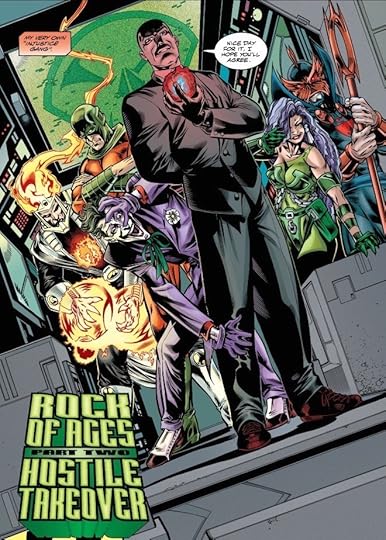
The Justice League of America square off against Lex Luthor's band of villains, unaware that a terrible force called Darkseid is counting on the JLA's victory to ensure his own--over the entire Earth.
Grant Morrison has been working with DC Comics for twenty five years, after beginning his American comics career with acclaimed runs on ANIMAL MAN and DOOM PATROL. Since then he has written such best-selling series as JLA, BATMAN and New X-Men, as well as such creator-owned works as THE INVISIBLES, SEAGUY, THE FILTH, WE3 and JOE THE BARBARIAN. In addition to expanding the DC Universe through titles ranging from the Eisner Award-winning SEVEN SOLDIERS and ALL-STAR SUPERMAN to the reality-shattering epic of FINAL CRISIS, he has also reinvented the worlds of the Dark Knight Detective in BATMAN AND ROBIN and BATMAN, INCORPORATED and the Man of Steel in The New 52 ACTION COMICS.
In his secret identity, Morrison is a "counterculture" spokesperson, a musician, an award-winning playwright and a chaos magician. He is also the author of the New York Times bestseller Supergods, a groundbreaking psycho-historic mapping of the superhero as a cultural organism. He divides his time between their homes in Los Angeles and Scotland.
WOW! This has gotta be one of the most epic JLA stories easily!
So we have Legion of Doom forming under Lex and we see him go against the JL and trap them in weird programs like Joker doing something with MM and Superman and others enacting their own plans, divide and conquer and then what happens when Metron of the New Gods sends three of the major JLers aka Aquaman, Flash and GL in the future to save the world from being ruled by Darkseid and we visit that but before that "Wonder world" and get hints of things to come in DC one million and "Mageddon coming" and its epic and what not and it all involves the "Philosopher's stone" and so its a time travel arc too as the JLA have to save the world in the future and in the present!
I love how it happens with the team divided and carrying their missions and then saving the world and the way you see Batman go against Darkseid in the future, again hints of Final crisis to come 10 years later then but having read both now.. its awesome and then in the present the threat of Luthor is made known and the war between him and his team vs JLA is epic!
Its one of those stories thats epic and everything and makes you love comics even more! The art was iffy but it is of its time and all but still great! Next up: A New JL and Prometheus!
The JLA have their work cut out for them when the Injustice Gang roll into town, only to be hit with another wave of villainy by the name of Darkseid. Here is my review of JLA Vol. 3: Rock of Ages:
The Good:
The Injustice Gang (such a lame name), led by Lex Luthor, was a lot of fun. I barely remember the full roster, but Luthor and Joker were the two standouts. I also enjoyed the Luthor vs. Wayne corporate strategy duel – using business tactics to try and one-up the other was something I haven’t seen in a comic before.
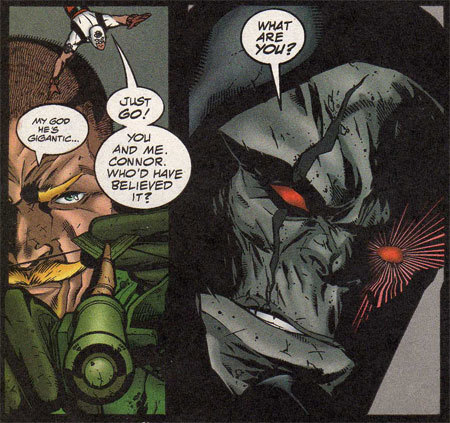
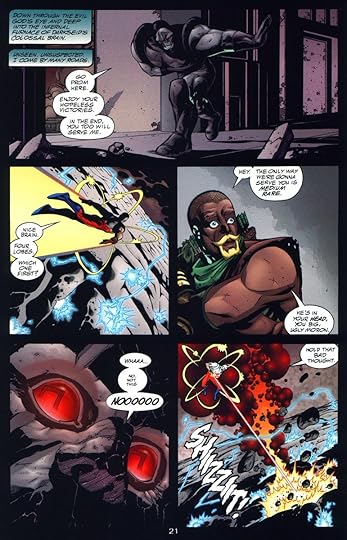
This book really picks up when Darkseid pops up. It was the darker tone instilled by the Darkseid storyline that I enjoyed so much. Some of the action sequences were stellar in this, especially the final fight against Darkseid. I especially enjoyed the pairing of Green Arrow and the Atom.
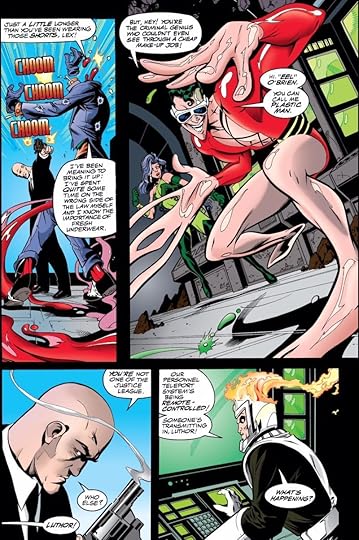
Plastic Man, oh Plastic Man! This was my first real introduction to the character and he’s certainly an interesting one. There’s also a great argument between Green Lantern and a random civilian on how the JLA unintentionally cause mass destruction and traumatize people, then whoosh away to the moon leaving their mess behind. This was a good idea that I wish was fleshed out a little bit more.
The Bad:
This book’s biggest problem was the uneven, confusing, and disjointed storytelling. There were some great ideas here, but they were poorly executed. I enjoyed the cosmic-ness of the story, but nothing felt coherent enough to fully understand what was actually going on. There’s also lengthy detours in its narrative that ultimately go nowhere – feeling like I just wasted my time reading it.
There were too many JLA members that were done dirty in this one! Woman Woman apparently died and no, they didn’t tell us what happened. And could Green Lantern please shut the f*** up, man? He’s written as this “cool guy” to relate to younger readers, but he comes off as an annoying little sh**. You know it’s bad when he says “man” like three times all in the same word bubble, man. Also, not sure what happened to Green Arrow, but he just looked like a dirty Walter White, man.
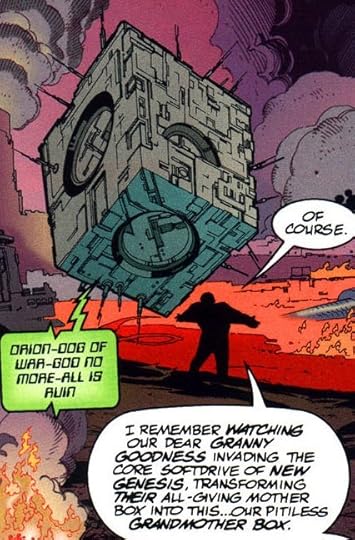
This book introduces Metron, and I wasn’t even sure if he was good or bad, I just wasn’t a fan. There’s also a part with a Grandmother Box that just felt stupid. I wasn’t sure if this was a joke or trying to be serious. I think that’s what I found so frustrating about this book – there were great ideas that I wish were expanded on, but the book spends time on sh** like the f***ing Grandmother Box.
Conclusion:
A valiant effort in packing so much story into one book, but the confusing and disjointed storytelling just left me underwhelmed. There is still some fun to be had and some solid character moments, but I’d recommend this book to only Justice League fans. Though, I’m sure there are better Justice League stories out there than this one.
I have great memories of this book, this was when Grant Morrison truly started blowing my mind and JLA became an epic I could not afford to miss. Beyond simply a supervillain team versus the heroes, Rock of Ages had an over-the-top dark time travel Darkseid story overflowing with ideas and imagination. Still an excellent heroic read after all these years.
I was actually reading the second deluxe edition, which contains this volume and the next one. After finishing Rock of Ages, I just didn't want to move on to the next arc, so I'll review this single volume instead. This is Morrison tapping into Jack Kirby's New Genesis mythology, and it's such a complex and confusing thing for me that I had a hard time getting through this book. It had some very cool moments, but also some of Morrison's most tedious writing traits. Overall, an okay volume, but probably more suited for the fans of Kirby's Fourth World stuff.
The start and ending of this were a little hard to follow, so I'm only giving it a 3. The bits with Darkseid are cool though. I'm also confused over when Wonder Woman died?
With this volume I bring to an end my valiant attempt to read the JLA run by Morrison. I seriously quit. It had started well- Lex Luthor creates an Injustice League to go against the JLA. To do this he has found an alien artifact- aaannnndddd then it goes really weird. Out of nowhere Metron appears into the storyline. It seems Darkseid's coming-no wait he's here. Some of the JLA (Wonder Woman is supposedly dead-but somehow 15 years into the future she's alive? what?) go into some weird alternate reality and then warp 15 years into the future and find Darkseid's conquered the earth. I don't really know what I just read. It was all over the place. It felt like an overly ambitious 8 year old decided to explain Macbeth for his teacher and confused part of it with Henry V. I think that this had some real potential. But it felt like two different stories. I'm not sure, or even really caring, about what really happened. It has convinced me that the JLA series written in the 1990's was awful. I know some people have given this high marks. Not sure why. If you choose to believe them-feel free. I choose to not read any of this series. Ever. Again. I'll look for JLA from more modern times. I'm glad Morrison learned later on in his career how to write a well-crafted and complicated story-I know I've read his work and enjoyed it. This is amateurish and just plain terrible. It's hard to call it cheesy, though parts of it are, it more confusing and all-over the place. I'm am not sorry to put this series to rest. Do yourself a favor and skip this version of the JLA. Oh and Superman is still blue. Lovely.
This story arc started out interesting with the Justice League facing off against hologram doppelgangers created by Lex Luthor and his oh so cleverly named troupe of less than exciting villains, the Injustice Gang...
Anyways the story starts off very promising despite the stupid blue Superman.
It is hard to not enjoy a villain team up and everyone loves when heroes have to essentially fight themselves in evil hologram form. There is even a pretty cool bit where Martian Manhunter is trying to navigate a maze collaboration between Joker and Mirror Master but then everything just goes to hell.
Suddenly there is time travel, alternate timelines, a planet full of giants, past characters inhabiting the bodies of their future selves, and Darksied. I actually had to flip back to see if I missed something or if pages had been ripped out. I was beyond confused. It was all just too much, way too much to the point where it was absolutely ridiculous and incredibly boring. This was so bad I'm tapping out and giving this series a brake.
This arc was better than the previous arcs! I actually enjoyed the story even if it was confusing as hell. Lex Luthor and his Injustice Gang were great villains and the arrival of Darkseid raised the stakes for the JLA even more! I was disappointed with lack of Wonder Woman in the present timeline though (this arc happened during the time when Diana was "death") but seeing future Diana kicked ass was awesome! I wished there was more female characters though.
Pare che Kevin Smith abbia definito questo ciclo "uno dei dieci migliori fumetti mai scritti sulla faccia della Terra". Ora, Kevin, io ti apprezzo, mi sono piaciuti tanto sia Clerks sia "Devil: diavolo custode", ma dammi retta: posa il fiasco! Morrison ha fatto sicuramente cose più belle (Seven Soldiers of Victory, All Star Superman, X-Men): questa storia è confusionaria, butta un mucchio di cose in un calderone (Dèi, viaggi nel tempo, personaggi di Kirby, piani machiavellici...), è sceneggiata male perchè spesso si fa fatica a seguire le cose che accadono, i disegni di Porter non aiutano... Non è illeggibile, ma non è nemmeno una cosa indimenticabile.
I liked it better than the previous arcs there’s some interesting stuff in here with the injustice gang. This was definitely the blue print for final crisis.
Grant Morrison's excellent take on the classic superhero team continues in this volume. I really loved this book and really enjoyed the smorgasbord of DC elements thrown in to the story. Things like Kirby's fourth world, the golden age idea of the injustice league, the blue superman stretching his powers to their limit, it all works perfectly in sync. It never feels like things are forced, the plot moves at its own pace and works to naturally guide the story to its natural conclusion.
I mean, the fact that the story jumps to the future to show you the "bad ending" then brings the heroes back to prevent it, I know that may be the most original idea, but its so well done here that it was really riveting.
The Fourth world element was great. On top of the injustice league, the Justice League has to stop the oncoming onslaught of Darkseid and his minions. This double threat, even though half of the Justice league is unaware of the consequences of their present day actions, is handled very well by Morrison as he balances not only plot points but also different time periods.
I greatly enjoyed this story and cant wait to read the next entry from Morrison's Justice League.
What was that? What had the potential of being an interesting story, got convoluted with time travel, cosmic beings, and bleak apocalyptic futures. Lex Luthor has gathered a team consisting of himself, the Joker, Circe, Ocean Master, and the Mirror Master to defeat the JLA. Oh, and he has a mystical stone that lets him basically create or change anything he thinks of. You would think that would be enough. I don't mind spoling this for you, but somehow this rock is a map of the space-time continuum and if the JLA destroy it, Darkseid rules the Earth in just a mere 15 years. Yeah, if that summary made you scratch your noggin, imagine reading it. It bounced around times and characters in a sporadic way that only added to the garbage that was the plot. A few shining moments include just about every part that Plastic Man was in, how Batman "defeats" Mirror Master, and Green Lantern's personal coming of age as the not so new kid of the JLA. Otherwise, a bleak and poorly put together story arc.
Emm... another confusing comic from Grant Morrison which asks the question - WHAT IN THE WORLD DID I READ? Prior to this I had read his Batman RIP and Final Crisis and I had a feeling, while reading this, that somebody's recycling his own writing. That time space continuum and Darkseid's enslavement of Earth, anti-life equations... all of it was in the Final Crisis. I know I didn't read it chronologically - and this Rock of Ages precedes Final Crisis, meaning that this was supposed to be read before Final Crisis. But it really doesn't matter 'cause these both graphic novels are very much alike, but one thing that's better in Final Crisis - art. Here, everything from plot and characters to art is a train-wreck and only in the final chapter art gears up a notch and is not a pain to look at, but does not save from terrible character designs (Green Lantern's mask? ).
How can one say that this is GREAT writing when Lex Luthor, a genius, almost one of a kind - has The Philosopher's tone in his possession, he could create anything and bend everyone to his will... came up with the idea of Injustice Gang (WHAT??). Yes - he sort of explains his reasoning, but it still doesn't justify his course of action. I simply refuse to believe that a mind of his pulls something like that... but at the same time - Lex was probably the only character in this volume that was interesting, at all. (others were riding the same jolly train of WTF)
And the rest of the cast - too much is too much. Evolved Superman? What? New gods, old gods, super heroes, super villains, teen titans, league of super gods of gods, mega threat of the universe darker than dark etc. Simply too much - it's like a salad with just too many ingredients -in fact - almost entire assortment of ingredients from the shelf. And that time space continuum does not help - I believe many might say that yes, it is supposed to be hard to understand and confusing because it is above man's reasoning and it's even above super heroes understanding of the things, but in the end it all looks to me like the situation when one person is using scientific terms, but in the end they have no meaning and just sound intelligent. It reminds me of how friend told me about Assassimon from Island of Dr.Moreau - who tried to sound intelligent and human just throwing out any wise words he had heard. I really don't think this is a good way of presenting a deep and layered story.
Don't want to rant any longer, so let's wrap this up. The more I get in touch with "the old DC", the more I start to like the New 52, that so many old-school fans loath. I am a new comic reader and to me - those old plot lines had to be ended as they were just too much and too deep for "outsiders." If it's a full story - it always should be understandable to every person reading it - a novel with the beginning and the end, with coherent plot line that has its classy exposition/complication/climax and resolution. And which is smooth (marvel comics have an issue with that). On paper - it sort of corresponds to the checklist. But - it, for me, lacks the whole feeling of "I get it" in it, thus becoming a mambo jumbo of superfluous words.
In the end I give it 2 out of 5 stars, and a moniker - it was "almost" ok, 'cause it wasn't the worst thing I had read and indeed - did manage to fill some check boxes. But it made me vary of the idea to delve deeper into the classy graphic novels from DC (especially Grant Morrison's works)...
This may be the definitive moment Grant Morrison moved from the fringes to the foreground of superhero comics.
This is also, as the title suggests, the third volume of his JLA, which was instantly hailed as the birth of a new era in the medium. Before it, Morrison was best known for subversive comics like Animal Man and Doom Patrol, and even while working on JLA was still writing The Invisibles By the time he left JLA, however, there was no going back, and his slate from that point was dominated by new projects tackling major superheroes.
The first two original collections of JLA were essentially staging ground. Rock of Ages is where Morrison goes for the gusto with his first big attempt at a grand mainstream epic, pitting the Justice League against the Injustice Gang (Lex Luthor, chiefly, attempting a corporate takeover, as he describes it), the villains stabbing at the corners rather than attempting a traditional frontal assault.
Then Morrison truly lets loose. He thrusts several Leaguers into bizarre situations readers only have a chance to glimpse (in hindsight you can probably consider his current run on The Green Lantern to be a kind of expanded extrapolation) and then...
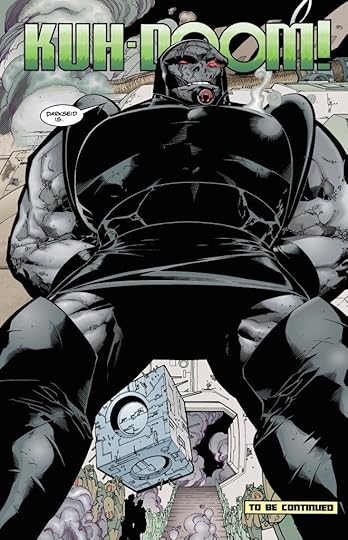
"Darkseid Is."
It's a phrase that became famous in Tom King's Mister Miracle, but when I read it there I instantly flashbacked to Morrison's JLA, where it left as immediate and permanent impression on me as King's did to later readers. The whole page leading up to the splash declaration is worth quoting here:
(text box) First the sudden drop in air pressure. Dogs begin to howl, the few remaining children cry, the faithful turn dead eyes to the heavens.
(text box) Next, the hush that seems to last forever...
(text box) Then the sound of the end of the world.
(text box) And then Darkseid.
(Orion): Father...
(loudspeaker) On your knees for the master!
(loudspeaker) The hour has come!
(loudspeaker) Who is beyond good and evil? Who is the prophet of Anti-Life?
(loudspeaker) Who is the rock and the chain and the lightning?
(loudspeaker) All powerful! All unforgiving! All conquering!
(loudspeaker) Who is your New God now and forever?
And then of course: "Darkseid Is."
You can't help but read it in dark biblical terms. The writing in the whole collection is enduring, is a template few others even now can follow. It is a comic book classic. By the end, even though Luthor has spent the whole story being very much the villain, Morrison is still able to turn him back in the direction he leaned in The Final Night (another '90s classic), the subtle direction of...good. It's not some ploy; Superman realizes that for all his bravado, for all his antipathy toward the Man of Steel himself, Luthor might actually not be such a bad guy after all.
Morrison achieved the impossible in JLA, redeeming superhero comics from the grim conclusions of the late '80s, and Rock of Ages is the climax of his initial summit. And it might just be his best pure example for posterity, embracing, as he later enjoyed saying about his Batman comics, the impossibilities of the genre and crafting something mythic in his wake.
Well, anyway, I think that with, heh, any justice, the legacy of this one is really only just beginning.
I enjoyed this one a lot for everything it just threw in: JLA (major dislike in this story set during the electric energy powered Superman dreck) versus a new Injustice Gang headed by Lex Luthor, with Joker, Mirror Master, Circe, Ocean Master, with Luthor claiming an ingenious 'corporate takeover' defeat of the JLA, and Joker being Joker. But that's not enough so Grant Morrison throws in a load of wacky: the subtitled artifact, essentially the Philosopher's Stone that can recreate all time and space, literal God-like superhero beings who view the end of our universe as an insignificant cosmic blip, a present consciousness/future body jumping side trip to a Darkseid ruled future. All of this ties together a little awkwardly and reads as a great comic book cartoon episode. Which is of course very ironic.
I really enjoyed this volume. I don't know what it is, but there's something about all of DC Universe's futures that I find deeply sad. (Especially when they feature Darkseid.) Perhaps it is seeing the heroes I know and love so diminished and desperate. (After all, rare is the future-verse a glimpse of something lovely. Otherwise, the story would just end right there, no?)
Anyway, I often find graphic novels a little jarring in terms of figuring out which dialog box to read first, but other than that, I liked it a lot. Especially getting to know some of the supers that I normally don't follow/read/know that much about (eg: Green Lantern, The Flash, Aquaman).
Good JLA fun and mayhem. Manhunter on the case. Batmna thinking ahead. Green Lantern [Kyle] and Green Arrow [Connor] out of their depth. Wonder Woman, Aztec [remember him] and oh yeah Plastic Man.
Nice plot, great dialogue. Fun locations and stuff that was hinted at yet not explained. And Plastic Man
Este tomo editado por Salvat, contiene, en rigor, dos historias. La primera es la ya clásica "Rock for the ages" (JLA #10-#15), que los genios traductores han vertido como: "El vaivén de los tiempos", uno de los puntos más altos de la etapa de Grant Morrison y Howard Potter en la JLA de fines de los 90. La segunda historia -también ya clásica- corresponde a la introducción del villano conocido como Prometeo (JLA #16-#17). Voy a restringir mi reseña sólo a "El Vaivén de los tiempos", la más extensa. Además pienso reseñar la historia de Prometeo más adelante. Antes, un poco de historia. Morrison tomó las riendas de la JLA en enero de 1997, luego de años en los que nada importantes pasaba con la Liga de la Justicia, completamente opacada por su contrapartida de Marvel: Los Vengadores. Morrison sabía que debía lograr algo grande para devolverle a la JLA el lugar que merece. Redujo los integrantes a sólo 7 (Batman, Superman, Wonder Woman, Flash, Green Lantern y el Martian Manhunter); decidió -con acierto- que héroes tan poderosos sólo debían tener enemigos igual de poderosos; y concluyó que eso sólo podía lograrse con éxito si metía sus ideas más disparatadas sobre ciencia ficción, desde viajes en el tiempo, alienígenas, y hologramas que combaten. El resultado: un éxito rotundo desde el primer número. En ese contexto, "El vaivén de los tiempos" pronto fue coronada como una de las mejores historias de la JLA de siempre (algunos portales de internet hoy la celebran como "la mejor historia de la JLA", lo cual, a mi juicio, es una exageración). Todo comienza con un repentino ataque a la tierra por parte de un puñado de hologramas con la forma de los miembros de la JLA. Son derrotados con relativa facilidad, pero nustros héroes no quedan tranquilos, especialmente Batman, quien sospecha que detrás hay algo más (Ojo: en la JLA de Morrison Batman es quien siempre lo resuelve todo, siempre). Mientras eso ocurre, en el satélite de la JLA, Green Lantern (Kyle Reyner), Flash (Wally West) y Aquaman, reciben la visita de Metrón, quien les pide que lo ayuden a evitar una catástrofe universal. Allí comienza lo más interesante de la historia, pues el trío de héroes se embarca en una osadía a través del tiempo. Primero visitan un mundo llamado Wonderworld, donde pronto se dan cuenta de que Metrón los ha engañado y abandonado. Logran huir de ahí, pero fallan un poco en el destino de regreso, pues vuelven a una tierra en la que ya han pasado años desde que se fueron y Darkseid gobierna con ferocidad implacable. Se reencuentran con los pocos héroes que han sobrevivido y juntos planean derrotar a Darkseid. ¿Cómo lo harán? Gracias a Batman, por supuesto, quien sin que nadie lo supiera llevaba años -en esa línea temporal- haciéndose pasar por Desaad, la mano derecha de Darkeseid. Tras una batalla épica, en la que vencen, aprenden que la causa de todo ese embrollo temporal es una piedra mágica que está en poder del Lex Luthor de su propia línea temporal. Regresan, por tanto, a su tiempo, con el objetivo claro de hacerce con esa piedra mágica. Sin embargo ocurre que no es tan fácil pues Luthor ha creado una legión del mal compuesta por el Joker, al Amo de los Espejos, Dr. Light, entre otros. ¿Cómo podrán quitarle la piedra? Otra vez, gracias a Batman, quien ha sobornado al Amo de los Espejos y ha conseguido infiltrar en la base de Luhtor a Plastic Man sin que nadie lo sepa. Finalmente, tras superar una serie de pequeños enredos más, la JLA se impone. En fin. Esto es Morrison en estado puro. Ciencia ficción simplificada, argumentos convulsos, y muchos viajes en el tiempo. Durante gran parte de la historia todo funciona perfecto y se mantiene la tensión, si bien hay detalles medio rancios, como el que Martian Manhunter se deforme el cerebro para poder pensar como el Joker o el que, al final, Luthor en todo momento haya sido un holograma. Otra cosa es el dibujo de H. Potter, el cual no puede ser más noventero. Potter exhibe todos los defectos de su época: dibujos desordenados, excesivos, viñetas llenas de explosiones y rayos de luz, etc. Prácticamente en cada página hay una explosión, y las viñetas están tan atiborradas de elementos que en varios momentos uno no sabe qué ha ocurrido. Ni qué decir de las portadas, horribles y sin ningún sentido de la proporción. El dibujo de Potter es, a mi juicio, lo que peor ha envejecido de la etapa de Morrison, es un dibujo muy anclado a su época. En defensa de Potter, no obstante, hay que admitir que hoy ya no dibuja así. "El vaivén de los tiempos" es una gran historia, creada por una gran escritor. Llena de giros y mucha ciencia ficción. ¿Es la mejor historia de la JLA de todos los tiempos? No lo creo. Para mí ese podio lo ocupan "Identity Crisis" (2004), y "Kingdom Come" (1996). Pero eso no quita que sea una historia imperdible.
Reprints JLA (1) #10-15 (September 1997-February 1998). The new Justice League of America is already fracturing. Wonder Woman is dead and the JLA are under attack from a new Injustice Gang. Fighting to stop the Injustice Gang led by Luthor, the Flash, Aquaman, and Green Lantern find themselves off on their own adventure into the future when Metron warns about the danger of Darkseid and the Philosopher’s Stone. Green Lantern, Aquaman, and the Flash are about to learn that saving the Earth might mean stopping the Justice League.
Written by Grant Morrison, JLA Volume 3: Rock of Ages is a DC Comics team book. Following JLA Volume 2: American Dreams, the collection features art by Howard Porter, Gary Frank, Oscar Jimenez, and Greg Land. The issues in the volume were also collected as part of JLA—Volume 2 and the JLA by Grant Morrison Omnibus.
Grant Morrison set a spark under the JLA. While Marvel’s team books always seemed like they really came together, Justice League of America always felt like a second tier book despite having all of DC’s heavy hitters. JLA made the team a force, and Morrison’s team was different in that Morrison used the characters different than previous writers…which sometimes worked and sometimes didn’t work.
The story for this volume has some interesting aspects. It has the team split in two. The first team is involved in a pretty traditional Justice League adventure with the Justice League facing off against the Injustice Gang, but the second story is a bit different. Shuttled to the future, Aquaman, Flash, and Green Lantern find themselves in battle with Darkseid and his forces in a future where Earth has fallen. The reason the Earth has fallen is because of the Justice League. Of course, the alternate-Earth is stopped by the JLA who correct their mistake, and it feels a little bit of a letdown in that sense. The story had really big implications and it feels like it ends too easy.
Morrison does continue to have fun with the characters. He does things like having J’onn tap into the Joker’s madness by expanding the areas of his brain that allow him to think like the Joker. New team members Aztek and Green Arrow both face challenges themselves in the form of the corporate control of Aztek and Green Arrow’s realization that a “guy with arrows” might do better on a smaller scale when fighting crime. Superman gets to play more with his new energy form, and Green Lantern’s insecurities also come into play. This is kind of how the Avengers have worked for decades and it is interesting to see it direct the JLA title.
Despite being fun and a new direction for the Justice League, I will say that I don’t think Morrison’s run holds up as well as some other writers. It was inventive and what the JLA needed at the time (he also manages to skirt the event crossover series Genesis in this volume which was a smart move). Reading issue by issue, you weren’t quite sure where the title would go…something that often was lacking in the Justice League before that. Morrison tries to find a happy medium between Keith Giffen and J.M. DeMatteis’s “fun & funny” Justice League and an action comic. He mostly succeeds, but some of the novelty of the original run has worn off. JLA 3: Rock of Ages is followed by JLA 4: Strength in Numbers.
A La Roca de la Eternidad no puedo ponerle menos de cinco estrellas, ya que se trata probablemente de mi historia preferida de toda la etapa de Morrison en JLA, y a pesar de que está integramente dibujada por Howard Porter... aquí no le voy a restar, creo que el argumento es tan genial y la historia está tan bien contada que llega a no molestar.
Esta trama corresponde al tiempo en el que Wonder Woman estuvo "muerta", convertida en una diosa, pero a la liga se une un nuevo miembro, Aztek, que ayudará al equipo a hacer frente a una nueva amenaza, una nueva Banda de la Injusticia formada por el Joker, el Amo de los Espejos, el Doctor Luz, Circe y Ocean Master, y dirigida por Lex Luthor, que utilizan a uno de esos personajes clásicos de los que no se acuerda nadie más que Morrison, Jemm, el Hijo de Saturno. Lex Luthor ha encontrado una extraña piedra que le permite manipular la mente de este último, y realizar toda una serie de proezas... y esa roca resulta ser lo que Metron de los Nuevos Dioses llama "La Piedra Filosofal", el Worlogog, un mapa de todo el espacio y el tiempo.
Morrison divide a la Liga en dos equipos, y mientras Superman, Batman, el Detective Marciano y Aztek tienen que hacer frente a la Banda de la Injusticia (con una escena escalofriante en la que J'onn moldea su cerebro para poder ver el mundo como lo ve el Joker), mientras Aquaman, Flash y Green Lantern se encuentran con una amenaza inesperada que les lleva a participar en un conflicto de los Nuevos Dioses. Durante esa trama, los tres héroes se encuentran con el extraño Wonderworld, donde se les avisa de una amenaza que avanza imparable hacia la Tierra (y que se convertirá en el leit motiv de la etapa de Morrison), y terminarán ocupando sus propios cuerpos quince años en el futuro, en una Tierra dominada por Darkseid, y donde todo lo que queda de la Liga de la Justicia son Wonder Woman, Argent, Atom, Flecha Verde (Connor Hawke) y un androide Amazo estropeado.
Con estas dos tramas relacionadas, Morrison traza una historia grandilocuente, épica y con tintes de epopeya, como acostumbra a hacer este autor, que además (creo que) supone el primer encuentro del escocés con los personajes del Cuarto Mundo de Jack Kirby, importantísimos en la trayectoria de este autor, como se vería en muchas otras de sus obras posteriores.
I came across the six reasonably-priced individual issues of the "Rock of Ages" storyline in the bins of my local comic store last week, and figured what the hell. I vaguely remembered having heard good things about Grant Morrison's late-90s JLA re-invention, and thought I'd give it a shot. But this shit put me to sleep. I never manage to nap for two hours during the day, but clearly I didn't want to be conscious to contemplate having read this. Honest question: was Morrison 12 years old at the time of publication? That the plot is deranged is not itself a deal-breaker for me. I kind of like the idea of a psychedelic JLA. But there are trips and there are trips. There are trips that feel like listening to "Midnight on Mars" by Ashra, and there are trips that feel like the shrooms you took grew to full potency in front of a TV tuned 24/7 to Cartoon Network, psychically absorbing everything on the screen. This actually reminded me a bit of Rick and Morty, a cartoon that my younger, gamer brother got me to watch a few episodes of a while ago- wildly inventive, sure, but the way the story pinballed every five seconds put me in mortal fear for whatever's left of my attention span. That said, I didn't mind so much the chaos of the JLA plot itself...or I wouldn't have, if I'd found the actual scenes and set-pieces (such as they are) enjoyable, or if there'd been any sense of narrative balance. I have fond memories of reading 60s/70s-era JLA as a kid, and as I suffered through Morrison's interpretation, I found myself wishing for some quiet character moments. I wanted to see Superman and Batman hanging out in their satellite headquarters, debating the nature of evil (Batman, naturally, would take the more pessimistic view). Flash and Green Lantern busting each other's balls. Black Canary flirting with Green Arrow. Morrison as far as I can tell has zero aptitude for or interest in any of that. Two stars for the audacity and because I'm feeling generous, but I'd rather have a colonoscopy without anesthesia than explore his run any further.
Spacey superhero action, and by "spacey" I don't only mean happening in outer space. This is also one of Grant Morrison's strangest tales. It starts as a pretty straighforward adventure of the JLA against Lex Luthor and his Injustice Gang. What the superheros of the JLA, including Superman and Wonder Woman, don't know is that the choices they make in defeating the Lex Luthor might endanger the whole planet and leave it open for an invasion by Darkseid.
Then things get weird.
This story arc is hailed as Morrison's best in his long run on JLA and I recommend it fully. The story throws a few large curves in the beginning. The unexpected part of the Justice League is that all of the characters have their own story lines, so major events like Wonder Woman dying and Superman turning into pure energy contained in a blue and white suit happen outside of the JLA stories. But having Aztek join the JLA in his own story, not in a JLA story, is asking a bit much of the reader (at least he has the grace to leave the JLA in a JLA story!). This should have been handled in the flow, kind of like the old Green Arrow's son taking over his place when the JLA fought the Key.
The other major twist is that the plot starts out as a battle with the newly formed Lex Luthor brainchild The Injustice Gang. This would have been quite ho-hum IMHO. I am quite happy that it took a mind-bending turn into back and forth time travel and multiple-dimensions, in a story worthy of our heroes. The ending of the story is a little forced, but the storyline gives the members many situations to show who they are beneath their powers, which is what makes the League a great book.
One more caveat: this book does indeed feature the horribly designed, conceived, written, advertised, and promoted Super-electricity-man, representing perhaps the single most shameful "let's make a buck" moment in the history of DC Comics. So while the smart, funny writing and blockbuster art make the story fun, you can't turn a page without going, "Oh yeah, that costume." Be warned, but read it anyway.
Grant Morrison, one of the best comic writer ever, takes the helm of this JLA adventure. Some reviewers will tell you that it involves time travel (it does) and that it's confusing (sort of).
The time travel parts aren't hard to follow at all. Morrison, however, appears to be telling several different stories in one volume, and they do get hard to follow at times. The main story involves Lex Luthor organizing an Injustice Gang made up of himself, the Joker, Ocean Master, Circe, Mirror Master, and Doctor Light. Luthor has something called a"worlogog", which helps him exploit the JLA's weaknesses.
The second story involves Morrison trying to match this story to DC's crossover "Genesis" which explains why Metron shows up midway through. A third story involves Green Lantern, Aquaman, and Flash searching for the Philosopher's Stone and, then, in a fourth story, ending up in WonderWorld near the Source Wall and the presumed end of the known universe. The time traveling story involves the heroes leaving WonderWorld and ending up on an Earth that Darkseid has taken over. Seeing Batman fighting Darkseid gave me chills.
The one thread running through all the stories involves a battle of the minds between Bruce Wayne/Batman and Lex Luthor. Both show themselves to be playing 4-D chess, as it were, and are cunning throughout. Morrison characterizes them both well.
Morrison's 'big' DC stories have that feel of reading dense theory, where you know that the author is clearly referencing, without letting you know, something that you're supposed to know about, but are just a bit too ignorant to be aware of.
Just like with theory though, you can either look for every stray detail or just read on attentively and in the end you come out of it like, 'alright that was interesting.' I think I prefer final crisis? Multiversity is almost certainly better. His Batman and X-Men work are still his best superhero stuff imo.
Howard Porter art and blue superman are misses here. I kind of want to rate it higher, but honestly, don't know that I would ever reread it. I have been reading these stories because I enjoy so much of Morrison's other work and people regard this highly. However, maybe the Justice League as a concept is just not my thing.
So much going on. Lex has assembled an Injustice League. He’s working with Joker (great, she muttered sarcastically). Superman and MM are stuck in Joker’s mind. Apparently Wonder Woman is dead! And some New God has arrived. There's a future scenerio with Darksied that Flash, GL and Aquaman have to go back to the present to stop from happening. I hate Pladtic Man. Seriously, what the fuck happened to Superman to change his powers. Lays the seeds for more timey whimey high jinks in the future (with a future Superman?) Ends with them disbanding the JLA!
This is like my fifth time reading it and it still rocks. Easily one of the best Justice League stories ever done.
It's such an incredibly dense story that it's hard to believe it was done in only six issues. The chapter in Apokolips that was told from the perspective of the Black Racer was pure gold.
Grant Morrison wrote some of the best Darkseid lines ever, including "...then I will remake the entire universe in the image of my soul. And when at last I turn to look upon the eternal desolation I have wrought...I will see Darkseid, as in a mirror....and know what fear is." Genius.
Wow, pasa un montón de cosas. Tiene un ritmo muy extraño, si se hubiese manejado mejor la estructura entre presente y futuro quizá hubiese sido más disfrutable. Tampoco fuí fan del dibujo. No obstante, hay momentos muy buenos, como Jon Jonz deformando su propio cerebro para entender al Guasón, La liga conociendo a esos gigantes, y, sobre todo, el último número de la historia, el cual estuvo espectacularmente escrito y por el cual le doy la calificación de 3.5.
P.D.: Grant Morrison, resultaste ser genial para la ciencia ficción también.