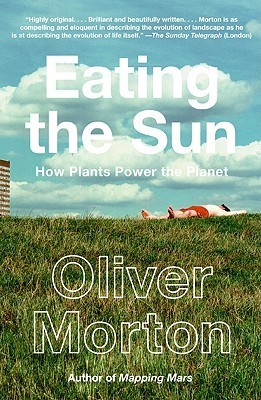
In this book, science journalist Oliver Morton, provides a lucid explanation of the basic process of photosynthesis, and why this plays a fundamental role in the sustenance of life on the planet. The technical level of this book starts at an advanced level in the first chapter, and then maintains an intermediate level for most of the book. Its greatest achievement is in the articulation of basic earth systems and cycles that make life possible, and how the thermodynamic principle of entropy so essential to life on earth is maintained.
Invoking the Gaian hypothesis and subsequent theory, originally expounded by James Lovelock in the 70s and 80s,the author reiterates the inherent connections that exist between the biosystem and the geosystem, and why both systems are needed by the planet to stabilize itself in specific states. In this context, Morton makes the case for why photosynthesis is not just something plants do, but what our planet does, and argues why this is an important distinguishing feature from other planets in the solar system.
This book introduces the reader to the various geological ages such as the Archean and the Proterzoic , to important events in geological time like the Great Oxidation Event, the Cambrian and the Devonian Explosions, and ultimately to the chemistry of photosynthesis. We learn about photorespiration versus photosynthesis, the enzyme Rubisco that powers the Calvin-Benson cycle, the basic process by which photosynthetic energy is used to reduce carbon dioxide. Morton provides an understandable explanation of the two-stage Photosystem process that first uses light energy to take electrons from water and eventually to feed other chemical reactions. In this manner, the author convincingly makes the case for why plants are really beautifully designed "photosynthetic machines" that supply and re-supply the basic needs of our planet.
In conclusion, Morton explains the climate crisis in terms of what elements in this cycle have been thrown off-balance, but paints an optimistic undertone on the feasibility of possible novel solutions for the impending overheating from excess carbon in the atmosphere. Overall, this is a passionate account of a basic process that happens day-in and day-out, that most of us take for granted. After understanding its inherent beauty in its engineering, one is guaranteed to never look at a plant the same way again.