FLINT OF OUTWORLD IS MASTER AND SLAVE, CONQUEROR AND HERO, SLAYER PRIMEVAL AND SEDUCER TRIUMPHANT!
At the farthest reaches of Milky Way Galaxy, on the planet of Outworld, where primitive men and nubile women still battle giant dinosaurs, the barbaric genius of Flint is summoned by the Earthborn to fulfil a mission of galactic magnitude: to save the galaxy's energy source from the marauders of Andromeda Galaxy by transferring his overpowering Kirlian essence to alien spheres, and uniting the galaxy against the invaders.
Vicinity Cluster is the first startling volume of the Cluster series, a brilliant science fantasy saga of cosmic scale and imagination, the most original and ambitious work of science fiction since Frank Herbert's Dune trilogy.
Though he spent the first four years of his life in England, Piers never returned to live in his country of birth after moving to Spain and immigrated to America at age six. After graduating with a B.A. from Goddard College, he married one of his fellow students and and spent fifteen years in an assortment of professions before he began writing fiction full-time.
Piers is a self-proclaimed environmentalist and lives on a tree farm in Florida with his wife. They have two grown daughters.
I have to appreciate it for the sheer imagination that went into the story and the various alien races within. A lot of this book is really neat. However, it loses a star because Anthony lets his typical dirty old man ways cloud the story. There's a point where "attraction and shagging through the species" ceases to add to the story.
Interesting idea -- a guy saves the galaxy by having sex with alien species all over the place. I guess you can call Flint of Outworld the Father of the Galactic Hegemony. Literally.
But this is not human sex. There are three methods of interstellar travel in this book, and the one Flint usually uses transfers his psyche into the body of an alien on another world. And these aliens usually don't look anything like humans, and don't have sex anything like humans. Piers Anthony uses a lot of imagination to describe the various reproduction systems employed across the galaxy.
This is not a dirty or pornographic book at all, at least, not to humans. It might very well be considered pornographic on Polaris.
I read bunches of Piers decades ago. This is one of his earlier works and one of the best from at least a dozen series of his I read. But it's still the best I've read out of literally thousands of sci-fi books for representing truly alien life forms. Truly excellent. And of course there are love affairs. But, the nice twist is that the human is inside an alien body every time. So it's the *psychology* which is making love, not the body. And well, there's some freaky sex also, but not lurid or salacious. Well done indeed. (From a comment, I made on a post looking for recommendations of inter-species love affairs.)
I remember details of few of the books I read back then, but I do remember this series, as it stood out. A novel and unique concept, well, back then, well executed, with an excellent play on the discrepancies between various psychologies, with the hero being a somewhat primitive fellow, but, not, as many automatically assume, stupid and unsophisticated. The hero is neither, after his own fashion. I've been fortunate to extensively interact with a real-life version, but that's another story.
This series provides everything good storytelling has to offer, with the bonus of also being excellent sci-fi. The tour of a potential universe with all its diversity is well worth the read alone. One of the all-time top series I've read.
I heard a funny apocryphal story once: in the late 90s, some academics were compiling an anthropological encyclopedia, and as they were wrapping up, the head editor noticed there was no death date for Claude Lévi-Strauss. He was baffled that this had been missed, and charged a junior editor with adding it. A few days later, the editor returned and admitted he hadn't been able to find it. Annoyed, the head tasked a more senior editor. He also failed. Only after the entire editorial staff was set on the task, was someone able to discover that Lévi-Strauss was in fact alive and well. Once a titan of anthropology, Lévi-Strauss had become so irrelevant, his passing had been assumed without evidence.
So too is Piers Anthony still kicking at 91. You won't find too many people recommending his books now, though they were massively successful back in the day. They litter every used book shop I've ever been to. By lore, they're pun-filled pap with a disturbing focus on (pre?)pubescent sexuality. His reputation is in the gutter, exceeded only by the actual child molesters like MZB. In light of that my expectations for Cluster were low. Imagine my disappointment(?) when it turned out I enjoyed it.
It follows Flint, an intelligent but uneducated caveman on a colony world, who turns out to have a powerful Kirlian aura. His mind is teleported to various planets with inventive alien inhabitants, and has to come to some understanding of them to advance his quest to unite the milky way. It's a pulpy premise, but Piers works it quite well. Each segment functions almost as an independent story, with the penultimate being a sort of locked-room murder mystery. He further enlivens the telling with mythological tales of the constellations, non-unicode characters, Tarot readings, and tons of alien sex.
There is an amount of skeeve in this story, but it's localized in a way that it just wasn't in the Well World books. With Chalker, he was trying to hide his fetishes behind a layer of plausible deniability, but once you realize what's going on, it tainted everything. Even in the alien sex scenes in Cluster, it seems kind of implausible that Piers was jacking off while writing them. They just seem too bizarre, and not in the way you get from a guy who's layering on tons of hyperspecific fetishes onto a single scenario. It's more like he started off with "I've got these unicycle aliens, how do I make them bang...ah the wheel turns into a baby, and then the mom takes the dad's trackball as her new wheel," and then went off to the races.
It's a perfectly reasonable way to write a weird alien. You could explain a shocking amount of human sexual politics just with the two facts that women shoulder 99.99% of the physical burden of childbirth + nursing, and men can almost never be really, truly sure of their paternity (until recently). These things are highly relevant to how organisms live their lives. Our genitals are right next to our excretory orifices, you can't tell me that isn't relevant to human psychology. Flint has to explain the fact that the male urethra is used for waste removal and reproduction to the disgust of an alien.
Piers also displays an understanding of metaphorics and cultural difference that is shockingly deep for this kind of elevated-pulp. When Flint is among the Polarians, he is confronted with the Polarian understanding of debt. Humans, stick-like "thrust" creatures, see two opposite debts cancelling each other out (action-reaction of two opposite thrusts). Polarians, being wheel creatures, see the force of two opposite debts as spinning a wheel faster and faster until disaster. It's not an ultra-deep idea on its own, but just the acknowledgement that understandings of things like that are not universally ordained laws of reality is pretty uncommon. Maybe my expectations were just rock-bottom.
The constellation stories and tarot scenes which mirror the action give the story a mystical flavour, appropriate for an adventure facilitated by effectively magical Kirlian auras. The Kirlian aura is described as something like the force of Star Wars, and Cluster came out barely six months after that movie. I don't know what can be attributed to a common Campbellian heritage or some kind of last minute shoehorning. Piers was prolific, but even for a complete hackfraud six months is a short deadline, and this is not total hackwork. Partial, maybe, but not total.
This book's sexual politics seem to be the big sticking point with modern readers. Flint's fiancee Honeybloom barely qualifies as a character, sex with aliens is always the answer to any given problem, and on three occasions in the Spica section, he technically rapes aliens. It's up in the air how much it qualifies. Their conception of rape is alien to our own experience. What he actually does is basically just go near people, which in the circumstances causes an uncontrollable reaction. The Spicans consider it rape, but can Flint really apply that to his own moral compass? He's a pretty moral hero otherwise, so it's a very strange episode. In particular, I found the later Honeybloom chapter, and his self-sacrifice for her rather touching. It did most of the heavy lifting to portray him as someone who can actually love another, beyond simple physical attraction. I detected close to zero of the pedophilia that people recoil from in his later works. We'll see how the rest of this series fares.
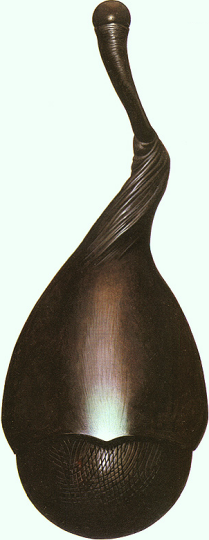
Barlowe chose well selecting the Polarians for his Guide to Extraterrestrials. They're such a fun-looking creature, and have the weirdest reproductive cycle of any alien I've yet read. Just looking at it creates a yearning to know how this thing lives. Barlowe provides a silhouette of their method of mating, where the male removes his wheel and attaches to the female's, effectively turning them into a single organism, explaining why the male and female stalk are called trunk and tail respectively: they are understood as two parts of one organism. The Polarians are something like the deuteragonists of this story, wise allies to humanity who are roughly on our level.
Barlowe takes slight artistic license with the the design of the socket. He makes it look rather hard, whereas in the story the male wheel can shrink down to the ball size in a state of starvation, so I think it should probably be closer to the look of the upper communication ball (there is an evolutionary homology between them in the story). The look of the ball isn't directly described in the story, and I suppose Barlowe thought a grooved ball would have better traction.
I think this one was just not for me. I will probably try Chaining the Lady to give the series another chance now that I have my bearing. I think the story did not personally resonate. The overarching threat was not explained well until the final chapter of the book. Now everything makes a bit more sense, but I would have enjoyed the full context as I was reading the various adventures. I think the book could have been a bit longer and a bit less horney (sexless creatures still integrate a misogynist vibe when explaining - c'mon). The various locations visited were too short and made the "lessons" learned at each place seem sort of childish. I would have enjoyed much more exploration of the different cultures - obviously if you read there is a technological reason the visits are short, but it's make believe so I don't really see that as an excuse.
Also, and this may cause me to take a break from older sci-fi and fantasy, is the never ending misogyny of these older books. We're exploring various planets and galaxies with lots of details about the different alien physiology, cultural and moral systems, etc and we still have to use "the female creatures all across the galaxy are just smitten by the male protagonist and their girlish demeanor gets in the way of their goals" trope to advance the story. I get it - culturally this kind of storytelling and perception of women was more acceptable at the time of the writing of this book, but jeebus christoball does it really stifle a reading experience when going back to these stories. Honestly, the more I read from this era, the more I'm losing respect for the ability of many authors from the time period to commit to being real artists that would assess and comment on culture, rather than take problematic behavior, unquestioned, and use it over and over gain in their stories. I guess I'm getting preachy, but it honestly is a major aspect I am finding that greatly diminished the quality of the art form from that era. I get it takes time to change things and progress, but I wonder how much farther the art could be, just in general, if this was questioned back then. I see good reviews for modern fantasy that praise it for simply not having the female characters portrayed as weak, or not letting the first man to cross their path make them surrender main character status, or not just being the object of rape to progress the story. Not marking this as a spoiler review, so won't say too much, but you read this and tell me there was a satisfying conclusion that made both narrative and character sense for the main female character in this book.
All that said, I did find the writing style enjoyable and there were parts that made me laugh. I felt it could have been presented in a bit more of a cartoonish fashion, as the non-serious, comical parts of the book were by far the best. Flint is an extremely confident dope that grows his intellect along the way. It was fun to experience his growth and the confusion that required it. If we focused more on that and less on "how can Flint relate this body to his humanoid lover from back home so he can get horned up for the Hershey's kiss on a roller ball" then I think this book would have been much more interesting. More focus on how the physiology of the different creatures cause the sociological developments of that sphere, how it impacted common gestures, more exploration of alien slang, and other topics outside of sex would have been more enjoyable.
Piers Anthony is such a disgusting misogynist that even though he wrote an intelligent female character that is more than a match for his hero, he had said hero rape her at least twice before getting them together. If the world-building and concept of the characters being able to 'transfer' into other alien host bodies and experience their cultures wasn't so fascinating, I'd have tossed this book after the third chapter. It's mystifying to me that Anthony is able to write with such interest in and compassion for alien species and societies but persists in treating women (as well as alien females) as second-class, muddle-headed sluts who are all 'asking for it' and must 'like it, at least somewhat' when they're raped.
I won't entirely slag this book because I still have a nostalgic feeling about my teenage obsession with the Xanth and the Immortals novels, but really this is not a good novel, nor a smart premise for a series. Furthermore, I am going to have to recognize that teenage me was less attentive to things like narrative logic and gender representations. In my adult years I now read a book like this and recognize that Anthony was consciously modeling himself as a less fascist alternative to Robert A. Heinlein, and one who believes that because he had read some Ursula K. Le Guin he was 'feminist'. Anthony is clearly a product of the godawful post-Campbell age of Sci-Fi, the time when the writers were all men with a comparable emotional maturity of game programmers today. It was a mass market era so that the plots were pulpy, the women were sexy, the heroes were morally uncomplicated, muscly, and super confident. Basically this was how things would be until The Hitchhiker's Guide to the Galaxy sent SciFi off in more gonzo but interesting and creative directions. In this very dumb novel we meet Flint, who is essentially the James Bond of "Moonraker" as played by Conan the Barbarian. We are told that he loves his stone age girlfriend very much, but he doesn't let that stop him from falling into love, into bed, into rape with pretty much every... female... he encounters. In his mind, this is his mission. It's exactly as shallow and awful as it sounds. The hesitation around the word female is because in Anthony's universe there is always a gender binary, even when he is describing a species of three genders. That's dumb. Also that section made me aware that the plot and the gender politics angle is pretty much a straight lift from Le Guin's much better The Left Hand of Darkness. There are other stupidities: take the premise that cultural regression follows a linear rule of distance, that energy is the universe's one true currency, that somehow one's memories and mind transplant during transfer but one also has access to the memories and mind of the body's previous displaced inhabitant, and that Anthony has written yet another novel where the hero has perfect eidetic memory (how lazy a concept is that?). So although I can accept that this novel is a product of it's time, but this product is the worst garbage from a garbage year (beating out disco, polyester, and Star Wars for the title of 1977's hottest garbage). Turns out I lied. I did slag the book, and I won't read another Anthony novel.
Sci Fi novel of a galactic caveman who gets his kirlian aura beamed around the galaxy, inhabiting strange alien races, all in attempt to combat the Andromedan threat. I read the Cluster series when I was a young adult. I remember liking the inventive take on diverse alien cultures that the protagonist would inhabit. Ultimately, there would be some explanation of how the aliens procreated and our hero would use that to his advantage. Not sure if I'd care to reread as an adult.
There is a good story here, buried somewhere beneath the tedious, high-falutin' language, the varying levels of misogyny, and the tiresome fallback on the supernatural. This was my first Piers Anthony book. I hope it gets better.
You know what, I've had two glasses of Champagne and, as this is five-star Piers material, it gets the full five stars. The usual nonsense, culminating in a very Piersy denouement.
I last read the Cluster books back in high school, so had basically forgotten about them when the series turned up on the free Amazon downloads. Apparently they're out of print, so Piers Anthony manually re-typed them to create new digital versions? Complete with typos! This book is super weird, kind of an interplanetary spy caper, but I love that Anthony scrupulously sticks to physics limitations (no FTL travel!) and has some of the most alien aliens you will encounter in gonzo sci fi. Has some pretty icky sexual politics. Not sure if I'll get through the next 4 books.
Cultures evolve certain behaviors and mating rituals when bodies differ. Flint, green Outworld native sent to enlist other planets, and enemy female assassin of Andromeda both have unusually high Kirlian aura of 200, transfer into alien bodies. Symbols pepper names, odd expressions sprinkle conversations. Flint insults B:::1 "Eat your own eggs" p 74. Enemy instant messages often preface chapters, close ":: CONCURRENCE::". A complicated Tarot-type reading predicts the outcome.
Wheeled Polarians under the Big Wheel incur debts. Humanoid slaves are less civilized than insectoid Masters on Canopia. Tri-sex ameboids merge on water-world Spica. Flint rides a dragon to a Queen emulating Elizabeth I.
On an interplanetary expedition on Godawful IV, an archaelogical site of Ancient technology, one (she) murders others one by one. Only his eidetic memory retains the crucial equations when both beam out to their final meeting. Their distant descendant Melody is supposed to continue series. LCC 7784308
This book is complete rubbish. One star, but I'd have given less if it was permitted. The main character is viscerally repulsive as an embodiment of toxic masculinity. The author's apparent misogyny and fixation on sexual acts are repugnant. Also, the regression idea is so thoroughly abused! How can a population regress to the Paleolithic while still retaining physical, cultural and political contact with a human galactic empire? The author has them forgetting... the wheel! They speak the galactic language, have an influx of immigrants every few decades, have a permanent garrison of imperial personnel, and coexist on the same planet with an alien species that moves on wheels, and they have yet to discover the bloody WHEEL? And in the same vein, the author has another population recreating spontaneously the entire 15th and 16th century Europe (of course) down to codpieces! Complete and utter rubbish.
I first read this book from the library as a young teen. Recently, I bought a used copy, since a few of the ideas have stuck with me over the years (mostly transfer of consciousness). I remembered to expect Piers Anthony's typical focus on sex, and likewise his flawless hero.
I consider Anthony a diehard Mary Sue, but he is a decent writer and Cluster is a good piece of fluff if you are in the mood for such. His descriptions of alien worlds and cultures, as well as their reproductive specifics, is imaginative and interesting. He also incorporates snippets of Greek mythology as they relate to constellations, as his hero travels across the galaxy.
Interesting in how he deals with interactions with aliens, but very sexist in portrayal of female characters and contains many scenes where sexual consent is not given.
The CLUSTER series of SF adventures is set in a future focused on colonization of distant planets. Sphere Sol is about 100 light years in diameter, centered on the Earth’s sun. Surrounding this sphere are other, similar spheres each centered on another star such as Polaris or Canopus. Colonization is accomplished by: instantaneous teleportation, called matter transmission or mattermission (very expensive); “freezer” ships in which colonists are sent in cryonic preservation at very high speeds (much decay and average 50% loss of colonists occurs during the voyages) and lifeships, slower, safer multigenerational vessels with voyages that run to centuries (during which the travelers regress in technical sophistication.) Because of the difficulty of colonization and the smaller population bases, all spheres suffer spherical regression--the greater the distance from source star to colony, the lower the level of technology that survives. Social organizations regress backward to historical periods of the home planet's past. Outworld, Sphere Sol's farthest colony, is populated by paleolithic tribes who hunt with flint spears and make fire. Colonists know about the interstellar empire and the home worlds mattermit government and security personnel to all colony worlds. Every living thing has a Kirlian aura that can be measured. Through transfer, a refinement of mattermission technology, the mind and personality of individuals with high aura can be sent to animate a body physically distant but a hosted aura fades at the rate of about 1 unit per Earth day and higher-Kirlian individuals last longer and thus have more freedom of movement.The first three novels in the sequence, CLUSTER, CHAINING THE LADY and KIRLIAN QUEST form a linked trilogy. THOUSANDSTAR and VISCOUS CIRCLE came later and take place in the time sequence between the second and third volumes of the original trilogy.As CLUSTER opens, the alien envoy Pnotl of Sphere Knyfh seeks help from Sphere Sol in a shared galactic-level crisis: Galaxy Andromeda has discovered the secret of energy transfer and intends to use it to steal the basic energy of the Milky Way Galaxy. Knyfh offers the secret of aura transfer on the understanding that Sphere Sol will spread the technology to help create a galactic coalition to find and defeat agents of Andromeda. Sol's highest-Kirlian individual is Flint, a green-skinned native of Outworld, who has a Kirlian aura of 200, an eidetic memory (useful for memorizing the complex equations of Kirlian transfer that he will need to communicate to other spheres). He has extraordinary intelligence, and is highly adaptable. His mission is complicated, however, by the fact that he is pursued everywhere by a very high Kirlian female Andromedan agent and, somehow, the Andromedans are able to detect and trace Kirlian transfers.Flint embarks upon several missions to bring transfer technology to neighboring spheres, inhabiting various alien forms. His efforts are successful despite attacks and sabotage by the Andromedan agent. Through the conflict, however, the mutual attraction of their two vastly superior auras begins to undermine their individual loyalty to their own Spheres. Flint and a group of other entities recover the information that will allow them to detect and trace transfers and one of the group is revealed as the Andromedan agent. One result is the catastrophic destruction of the local habitat. Flint and his nemesis are transferred into alien Mintakan bodies to survive. Choosing to leave things with parity between their two galaxies, Flint and the Andromedan mate and remain together until their auras fade (which happens rapidly since their physical bodies have been destroyed).
It’s hard not to feel a bit dirty, finding oneself enjoying a Piers Anthony novel. Anthony isn’t just horny, he’s amorally so, in ways that are hard to reconcile with a sense of being a good person. That affects all of his works, including this one, but somehow for me at least occasionally, he gives a bit of something more.
This book is from the period when Anthony was still producing “serious” science fictional works, before he was mostly known for writing light comedic fantasy novels targeting a teenaged audience (his first Xanth novel came out the same year). It posits a future galaxy in which humans have made contact with alien species who have taught them the ability to “transfer” or teleport across vast distances of space, at correspondingly vast energy requirements. Our protagonist lives on a planet at the edge of the human empire or “sphere,” on a planet that has devolved into caveman-level technology and society due to its separation from the imperial center. As it happens, however, he has a powerful “Kirlian Aura,” meaning that he has enormous psychic potential, and thus is recruited by the imperial powers to help stave off a threat from another galaxy. In the process of doing this, he (or his aura, or self) is “transmitted” into the bodies of a series of increasingly bizarre aliens.
The strength of the novel lies in the creativity and general plausibility of these aliens. One race is semi-humanoid but apparently socially insectoid, with “drones” mindlessly serving “masters” in a slave-like obeisance. Another is described as looking like “dinosaur droppings,” but is actually capable of high-speed movement thanks to a built in “wheel” that spins at enormous rates. Another is ocean-borne and consists of three genders. And one communicates by means of a complex, in-built orchestra, creating harmonic music while communicating increasingly complex concepts.
However, I’ve skirted around what really interests Anthony: how does each of these creatures have sex, what taboos are built around that sex, and how do they reproduce the “natural” aspects of femininity and masculinity, even when they are multi-gendered or non-gendered. At least in this book, he doesn’t make a point of justifying adult men having sex with underage females. He does, however, justify rape and suggest that its victims enjoy it. For that reason, I can’t give it more than two stars, though I admit I that I enjoyed some parts, when he was covering other aspects of his aliens and their worlds. The adventure/quest part of the story is pedestrian and somewhat off-handedly managed, however there is an interesting tie-in with his “Tarot” series as well. That’s about all I can say.
I read this for the first time when I was a young teen in the late seventies. My memories of that time were that the aliens were interesting and well thought out. I had a dim memory of the Polaris sex scene and remembered that being something...different. I didn't remember the Spica at all. I don't think I blocked it out. That loss of memory was more that I lost interest in Anthony's books very quickly as I got older. There were better writers with more interesting ideas to occupy my time.
So this was very much a nostalgia read for me, an effort to recapture the feeling of a 12 year old me. Not sure it was a complete success. I found the late middle of the book a bit of a slog. Anthony's writing is pretty solid and a lot of his ideas in this book are Big Ideas akin to Niven's Big Ideas, but the underlying idea that all culture is shaped by how sex is perceived and performed by that culture may be true, but in Anthony's hands I found it a bit heavy-handed (no pun intended) and all up in my face. I wasn't repulsed by it, as many modern reviewers of his work are these days, I just found it tedious and tiresome.
The saving grace for me was Flint telling the Andromedan agent the Greek mythology story of Orion and Diana, and how that paralleled the events of the book, which showed that Anthony is capable of going deep into ideas beyond just, "What's the weirdest alien I can think of and how would it reproduce?" I just wish he would have done that sooner.
I was very tempted to give this book a 4/5 because there is a huge focus on sex and the interaction between men and women. That is not an inherently bad thing, especially since Anthony shows a lot of mental flexibility when it comes to understanding neuter or tri-sex possibilities, along with the physical strength of a female, but he suffers from a base sexism that results in the majority of characters not being women (especially in places of power) and suggests that even in far evolved cultures the female state of being can be cause for ridicule. I love Anthony's detailed imagination for alien creatures and cultures, and even his romances and relationships can be very good, but they continuously fall into the pit of base sexism: a woman can be special but women in general are not as important to focus on as men. Even though a large part of the protagonist's character arc is his path from entirely insensitive caveman raised in a culture of rape to an intelligent future man in love with the mind of a creature entirely incompatible with him physically, there is still a suggestion that a woman will forgive her rapist if he is otherwise worthy of her. All that being said, I did enjoy the way Tarot cards and Greek mythology and astronomy all play together in the narrative, mapping out the futures of both the protagonist and his antagonist lady lover, both of them caught in the throes of war and politics, jumping between host bodies and planets.
Flint of Outworld is a green-skinned and impressively-built human variant who just happens to have a Kirlian aura 200 times the Earth-human norm, and when a plot is discovered by denizens of the Andromeda galaxy to steal the energy of the Milky Way galaxy, Flint is dragooned into being a spy cum emissary. Within the Milky Way are a number of spheres of influence with Earth’s being relatively small and recent, and transport within and between spheres is by matter transmission and so expensive it is used only for messaging. When a trillion dollars is spent to mattermit Flint to Earth he realizes the seriousness of the task. The other form of travel is akin to astral travelling, using the aura to move consciousness into a recently vacated and suitable mind, and in this way Flint travels to a number of different spheres trying to garner support against the Andromedans. But the Andromedans have sent an assassin to find and destroy Flint, something that has a similar aural strength and can also inhabit alien psyches, and Flint must battle this entity as well. Flint moves from ignorant savage to galaxy ranger in this entertaining first novel of Piers Anthony’s series.
I read a lot of Piers Anthony in my teens and twenties and hold each book close to my heart. As an author, he always pushed the boundaries challenging and promoting a universal equality. I enjoyed the Science Fiction and concept of Cluster however I just didn’t feel it was as polished as some of the author’s other novels. The writing felt disjointed and I struggled with timelines and sometimes what was happening. A lot of people spoke out in their reviews about the alien sex but I thought it added to the storyline and helped you to clearly understand we were exploring concepts beyond Earth and standard conventions. I’m not sure if I want to read Book 2. Maybe I will go read some Phase books and come back to it at a later time.
This entire review has been hidden because of spoilers.
I reread this for the first time in maybe 40 years.
There are places where it’s slightly choppy but such a unique take on potential alien races that it really stands out. It ultimately boils down to a complex game of ‘who is the alien?’ Except everyone is an alien and they need to find the alien spy.
Lots of fun character problem solving, which is some type of writing super skill for Piers Anthony. So many unique puzzles and conundrums complicated by extraordinary powers yet they often still run into stumbling blocks that require serious brain power.
Love his books; love this writer. Great guy !
This entire review has been hidden because of spoilers.
An older work by Piers Anthony that I reread. Piers (may I call you Piers?), Mr Anthony has an exceptional imagination. Imagine being primitive yet of great value to your (human) Universe. Imagine being able to occupy bodies of recently dead alien lifeforms as an emissary to promote that form of travel? Imagine aliens from a different galaxy bent on stopping you from completing your missions. That is the gist of this novel and start of the cluster series.
This was more fantasy than science fiction. Some ideas were cute, but since it was not aimed at being witty like "The Hitchhiker's Guide to the Galaxy", most of the story just seemed silly to me. One person on earth, a stone-age person, saving the galaxy and learning everything there is to know about humanity and aliens - and love. Kitsch.
This book wasn't exactly bad, but it sure wasn't good either. It was definitely weird. I read it the first time back in the 80's, the first book I read by Piers Anthony. I've kept it all these years and read many others by him. For the life of me, I can't see what 20-something year old me saw in this book to want to read more from this author.
I think I've read at least part of this book before. I remember the part with the three-sexed species having a sexual catalyst, and the Polarian race doing the rolling around in a circle to procreate. It's a good but not great book. Anthony was obviously more interested in sci-fi early on, and he had a lot interesting ideas, but he was still clearly focused on sex stuff even back then.
I liked the book. Good story. Enjoyable main character. Maybe I just wasn't in the mood to give it a four. Maybe it was just too similar of an underlying concept in "The Apprentice Adept," which is definitely a 4.
Seemed like the only purpose of the book was to show how to have romantic interludes with multiple different alien creatures. My version has all 5 Cluster books but I only read the first one. Not the wonderful Piers Anthony books I've read before.
While I found this book interesting from the multiple cultural viewpoints, it just wasn't something that drew me in to the world or made me want to read any more of the books in the series. I struggled to stay engaged enough to finish reading this book.
This was so bad. I know I shouldn't haze my 12 year old self but seriously, this was one of my favorites? So much mysogeny, so much tell but not show. Apparently sex is what drives the universe and Anthony felt like he had to explore as much as he could imagine.