Kit Pearson’s long-awaited new novel tells the story of the six Bell children, each of them coping in various ways in the aftermath of their mother’s death. Set in the 1950s and seen through the perspective of the middle child, 11-year-old Corrie, Pearson’s story illustrates how a rich fantasy life both helps and hinders children trying to cope with loss, loneliness, and growing up.While elder sister Roz is growing up and out of the desire for fantasy games, eldest brother Sebastian, who fancies himself Sir Lancelot in their Round Table game, continues to need them as much as ever,
Kathleen Margaret "Kit" Pearson CM (30 April 1947 - ) is a Canadian writer and winner of numerous literature awards. She was appointed to the Order of Canada in 2019.
Kit Pearson wrote the linked novels The Sky Is Falling (1989), Looking at the Moon (1991), and The Lights Go on Again (1993), published in 1999 as The Guests of War Trilogy, and Awake and Dreaming (1996), which won the 1997 Governor General's Award for English-language children's literature.
Pearson spent her childhood between Edmonton, Alberta and Vancouver, British Columbia and as a high-school student, she returned to Vancouver to be educated at Crofton House School. She obtained a degree in English Literature at the University of Alberta, and spent several years following the degree doing odd jobs or travelling in Europe.
In 1975, she began her Library degree at the University of British Columbia and took her first jobs in that field in Ontario. She later obtained an M.A. at the Simmons College Center for the Study of Children's Literature in Boston. Returning to Vancouver, she completed her first novel "The Daring Game" which was published by Penguin Books. Pearson now lives in Victoria, British Columbia, a few blocks from Ross Bay Cemetery, one of the settings in Awake and Dreaming.
There are many things that can tip me towards buying a book when I am on browsing, and on this particular occasion that thing was an picture of an elderly border terrier, sitting on the lap of the author. I thought of my lovely Pip, who turned just as white as Kit Pearson’s lovely Poppy, and I told myself that a story of a large family of children who imagined themselves to be Knights of the Round Table was exactly what I needed. Because border terrier people understand. It was – and she did.
In the early fifties the six Bell children lost their mother. Their father, a Shakespearean scholar who had named each child after a character, coped by retreating into his study, immersing himself in the writing of a book in the hours when he wasn’t sleeping or teaching. His children were supervised first by a much loved aunt and then by a succession of housekeepers. The house was big, the children were aloof, and so in fact there was little supervision at all.
It was the eldest child, Sebastian, who began the game of Knights of the Round Table. It brought the children together, it made them feel a little more secure in a world that had, with their mother’s death, become horribly uncertain. form of security in their scary world. The game became all-consuming; a quite glorious secret.
I saw the wonder, but I also saw the dangers, all beautifully and sensitively portrayed.
I also saw that the author so clearly understood, empathised with, everything she was writing about.
It was, of course, inevitable that things would change. Roz, the second eldest began to develop other interests. She wanted to spend more time with her school-friends, to try out as a cheer leader, and she began to pull away from her siblings and their game.
perfectgentleknightThat left the third eldest, eleven-year old Corrie in an uncomfortable position. She knew how much the game meant to Sebastian and their younger siblings, and she loved the game. But she also wanted to spend time with Meredith, her new school-friend. Corrie loved visiting Meredith’s home where two parents were interested and involved with their only child, and ready to welcome Corrie and her younger siblings; and Meredith loved the freedom, the space, the company when she visited Corrie.
But Meredith wasn’t part of the game. And Sebastian forbade Corrie from saying anything about it. Anything at all.
Corrie saw things that worried her, and she began to realise that Sebastian was lost in his role as Lancelot, that he was losing touch with reality. She struggled to do her best for him, to look after the house and the other children, and to hold on to her friend and live her own life. She wanted to fix everything, but she wasn’t sure that she could.
I loved Corrie; she was an utterly believable eleven-year old. She was old enough to understand much, but she was still a child. I could understand her, admire what she was trying to do, but I also feared for her.
All of the children were as well drawn, and the complex family dynamics were captured perfectly.
I was charmed: by a world so beautifully realised, by lovely storytelling, and by such wonderfully drawn characters. And I appreciated that difficult themes – of grief, of mental illness – were dealt with sensitively and intelligently, and in a way that would speak to both children and adults.
At first I read this simply as a story of children, but as the story progressed I thought a little more that this was a book for children. I think that given the way the story played out that was inevitable. And that this is a story for children in the tradition of some of the great writers from the earlier years of the twentieth century.
… a beautifully executed and deeply touching story.
This book seemed to have an identity crisis. The main character is 11, and it read a lot like a children's book, but it was set up as a baby boomer memoir, casually referring to events and objects that would be foreign to 11 year olds without any context or explanation. The themes are big: loss, mental illness, coming of age. I think perhaps they are too big for this 164 page format, and too big for 11 year old Corrie to do justice to on her own. I would have loved to see this story twice as long so the characters could have been more finely drawn, the dialogue used more to advance the plot, and to create more of an immersion experience. It felt like the story moved in thick chunks, rather than flowing. I think 60 year olds who grew up in Vancouver would find this a lovely nostalgic book, but I think it misses the mark as a kids' book, which is a shame, because it could have been fantastic if 1950's Vancouver could have become as real as, say 1900's PEI is in the Anne books.
There are not words to describe how much I love this novel. I read it as a kid out of the school library multiple times, so maybe the nostalgia adds to my feelings about it, but it makes my heart ache a little to think about this story — it captures childhood grief and a splintering family trying to pick up the pieces and love each other through everything really beautifully. Kit Pearson is a gifted writer and she really understands how six hurting children think and feel about the world as they process losing a mother, and as they grow out of the make believe game they’d used to cope. Highly highly recommend this soft and emotional story.
Why did it take me so long to read this beautifully written book about a family coping with grief in an unusual way - by obsessively immersing themselves in role-playing the Knights of King Arthur. . .
A Knight there was, and that a worthy man, That from the moment that he first began To go on journeys had loved chivalry, Goodness and honour, freedom and courtesy ... And though he was of high rank, he was wise, And in his manner meek as is a maid, He never had to any person said A word that was not tender, kind, and right. He was a truly perfect gentle knight. -Geoffrey Chaucer, The Canterbury Tales (Modern English Version by Kit Pearson)
*sighs* This book is so comforting to me. It was given to me by a relative for Christmas many years ago and I've re-read it several times since then. I may have been a teenager when I received it, but it still feels like one of those books that I've owned and read since I was a little kid. It has that nostalgic factor. This short novel is definitely one of my all-time favourite reads, and there are, therefore, many things that I love and appreciate about it. <3
Thoughts: 1. A Perfect Gentle Knight is a fairly straightforward book, in both how it's written and the message it's trying to get across (i.e. the plot/story/themes). I believe it's geared towards middle schoolers/tweens, but I'm still able to take something away from it (even though I'm in my mid-twenties now), which I think is telling of a truly great novel. 2. I really love and admire the characters in this book. They're described simply, but they have a depth to them. They feel real to me. Corrie, who is sort of the main character in the book, and her older brother, Sebastian, are my favourites - though I love the whole Bell family. Meredith left more of an impression on me in this particular read-through as well. I enjoyed her friendship with Corrie. 3. The setting really stands out to me. This book is set in the late 1950s, and the way Kit describes certain things and references trends and popular items of the time definitely adds character and realisticness to the story. I suppose it also helps that it's set in Canada as well. ;] (That makes me like the book even more too. :P) 4. This short novel covers many different topics and themes and I appreciated how each and every one of them was handled. Kit explored loss, grief, mental health, growing up, friendship, and family throughout the entirety of the book. I'm particularly grateful for the topic of mental health being tackled, especially in a story meant for younger readers. 5. I really enjoyed the ending of this book and how everything wrapped up for the entire Bell family. It wasn’t completely “perfect”, but it was satisfyingly realistic. I felt weirdly pleased and proud of where each character ended up in their own individual “journey”, in particular.
Kit Pearson is one of those authors whose children's books are better for adults than for kids. I remember reading Awake and Dreaming as a child and hating it because is was scary to me in some deep and creepy way. A friend of mine got a bit traumatized from A Perfect Gentle Knight when Sebastian was found naked after his mental breakdown. However, now as a teen who cannot read about anything to do with mental illness, Kit Pearson's gentle way of exploring issues like poverty or mental illness - maybe topics too intense for kids - is comforting yet real.
That complete immersion in another world had gone. Now Corrie was more and more aware of only pretending; she was gradually losing a magic she could never get back.
i love this book so much - the vancouver setting, the magic of childhood gradually slipping away as you grow older, the growing distance between siblings over time, and of course the king arthur references. corrie's narration has become more gratingly naive to me as i continue to re-read this book, but it's a kind reminder of the innocence of childhood as we see her perception of her family and the world around her.
I have been a fan of Pearson since I was a child, and thought I had read all of her books until I came across this one in the elementary school library I work at. It was very well written, and a great story of family bonds and overcoming hardship and struggle.
Almost every time I read a book by Kit Person, I think "this must be my favorite book of hers", then realize that I've thought this about 'The Daring Game, A Day of Signs and Wonders, a Handful of time, and Awake and Dreaming". Of course, I thought this about 'A Perfect Gentle Knight' as well.
It's SUCH a relief to read a book from the perspective of a girl who does not care for makeup or boys or squealing. After reading 'Confetti Girl', 'Multiple Choice', and 'Lets Pretend We never Met', I found Corrie especially appealing. Middle-Grade books about growing up often dwell on 7th graders and their first crushes as well as their exhausting friend drama. But almost none consider what is a theme in this book, and just as relatable: growing out of pretending. I can't remember the words exactly, but at one point eleven-year-old Corrie observes that pretending is becoming harder and harder, because she is more aware of the fact that what you pretend isn't reality. I had the same feeling when I was a few years younger than I am now, and I'm sure I'm not the only one who relates.
Corrie's whole family is meticulously crafted, so filled with motivation and growth and emotion, I felt I knew them almost as if I were part of the family. Sebastian and Rosalind, the older siblings of the protagonist, are not your typical cut-and-dry sports, friends and phone obsessed siblings, but sympathetically drawn and realistic. The younger twins, though said to look like Flossie and Freddie Bobbsey, are not nearly so simple. The father is much more than his love of writing and reading; even Meredith is completely loveable.
If I had to name one book that has as richly drawn sibling dynamics as Kira-Kira or One Crazy Summer, this would be it. 110% recommended.
This was so close to a four star book. I really enjoyed reading this and it felt like Kit Pearson (can I say that if I've only read two? 😂). The characters are complex, troubled, and imaginative. I really felt for the Bell Family and their attempts to cope with the death of their beloved wife and mother Molly. Sebastian and Corrie sold me on this story, I didn't need so many other kids in the household. And watching them change and age was so well developed and natural. I would definitely reread this and it spurred me to reread some Arthurian legends and explore more of that world. And the message was so necessary. Being perfect is impossible. Try to be brave, kind, and gentle instead. And forgive yourself on the days you fail.
A Perfect Gentle Knight masterfully explores the process of grieving a loved one, and how the grief can present itself differently in different people. Each child (and their father), are processing their Mum's death in a different way, which causes tension. Meanwhile, woven into the story of loss, is the story of an eleven year old girl finding her independence in life, and discovering who she is outside of her family. I think this is a very important book for all readers - middle grade and older.
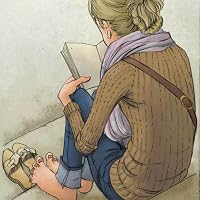
I love Kit Pearson’s writing. She’s so good at capturing the character and emotion of adolescents— reading her throws me right back into my 12-year-old brain. This was a very touching coming-of-age story dealing with grief and friendship and family and facing reality. Also, the cover artwork is such a mood. Perfection.
It was just an OK book for me. Not something that kept me hooked but I didn't dread picking it up. The characters were just so so. I did like the premise of the book though, it was something different.
I grew up loving books by Kit Pearson and hadn't read this one. This definitely brought nostalgia and the book itself is an interesting look at grief through a child's eyes.
A perfect Gentle Night by Kit Pearson. This book is about the 6 Bell children and how they cope after their mothers death. Even though 2 years have passed since she has died, The father- who the children call Fa- has locked him self into his one realm being sadly oblivious of his children. The eldest Sebastian has begun the game of knights of the round table, but soon every body becomes caught up with this game and lets go of reality, 11 year old Corrie has no friends, Sebastian is being bullied, the twins, Juliet and Orly, get into trouble on a regular bases, and the second oldest Roz is slipping from her family trying to get back her life. When Meridith comes- a new girl from Calgary- Corrie starts to see this game differently while every body- but Roz and especially Sebastian- just go on with the round table like they always did. When Sebastian falls in love with Jennifer everything changes. He becomes oblivious of everybody and everything, while Corrie and Meridith and sometimes Roz ban together to tie there family back together. Soon Sebastian is convinced that Jennifer is a recarnation of Gwenavier and when his heart is broken he goes into shock.
I think the best thing about this book is that it is so real it seems as if it could happen although I doubt it would. I like Roz and Corrie's characters both, I like Roz because when the book starts she's as into the game as everybody else but then she realizes 'Hey this isn't normal for a 13 year old girl to do this game is to young for me' So she becomes somebody else and I like how she grows. I like Corrie because she is so desparet to keep her family together and she knows she can't do it with out Fa although she is to scared to ask him for help.
I didn't like Sebastian. I think he becomes to obssessed with this and I think its kind of odd since he's 15 also he doesn't seem to care about his family much.
This entire review has been hidden because of spoilers.
I first read this book in 2009 when it was nominated for the OLA's Red Maple award. I remember loving it, but A Way Lies North was also nominated that year, and that was the one my friends and I voted for. However, I still think about it over the years, not quite remembering how the story went. The novel turned out to be about loss and grief and the things we do when we're looking for something to hold on to. This follows a family in the 50s who've lost their mother. They play a Knight of the Round Table game, but for Corrie's eldest sibling, Sebastian, it's more an anchor then a game. It follows Corrie as she, alongside her family, has to pick up and put the pieces back together after their mother's death. I'm not sure how well this would do now, there are a lot of references that kids now wouldn't understand without some help from parents (or grandparents) and some googling. I actually don't remember having any trouble with it myself, proof that the words many parents might deem too difficult for their child might jus be them underestimating them. Anyways, I loved it, but ironically like the Bell children discover within the novel, the magic and excitement was lost in this novel for me 9 years later. Instead, I read a book about sad children, which may have a hit a bit too close to home at times. 3.5/5 stars.
When I was younger I read Kit Pearson's Awake and Dreaming and practically abosrbed it I read it so fast. This is my second book of Pearson's and she had me hooked agian. Her characters are so real and I feel so much empathy for Corrie I could almost see it play out before me like a play. The dialoge was more mature for children I often forgot that this was a children's book.
What I love about this book is how it delves into the possiblity that imagination and pretending can hinder a person from facing reality. In this age we all encourage imagination but what happens when it becomes a persons world and real everyday life is neglected?
With looking after the family from the time of his mothers death, The Knights of the Round Table was a brillant idea for Sebastion, the eldest of 6 to get away from the reality of his mothers death. His younger siblings blindly follow; especially Corrie who idolizes her older brother. But when Sebastion starts becoming a recluse and insisting he is the reincarnation or Lancelot- things start to go out of hand.
Compelling, poignant, and heart-felt, it deals with very real psychological issues that many people face and boldly depicts the challenges of growing up.
I first read this book in Grade Six or Seven, which is what age this book should be read at. I remember crying and being all impacted and whatnot by this book. I have to say that it lost some of it "shocking-ness" now that I'm older, but that does not mean this isn't a great book!!
This book looks a lot of big issues, and a lot of deep stuff and keeps it simple. I guess that's what I like about it. Sometimes things can be complicated and not complicated at the same time. This is how life is for Corrie. Everything around her is confusing and stressful, but sometimes simple things like a great Christmas or a baseball glove make everything better. I think this is something all kids can do and a lot of adults forget.
I liked how Pearson didn't need big words or grand ideas to make her point known. I was captivated by the simpleness. The real (very real) characters. The sadness with the not sad.
I really think this should be a book middle grades should all rad. I think there is a lot more value to it then the crap they actually made us read.
Although I didn't cry this time around, I did when I was 12. This is a book from my childhood I'll always love :)
A good book, very sad. I felt SO sorry for poor little Corrie, trying so bravely to deal with way too much responsibility for an 11-year-old. The story covered a lot of deep issues like mental illness and coping with the death of a parent in an interesting and realistic way, and I loved the characters and the writing style.
However! I did have issues with two things.
1. I didn't think the 1950s setting added anything. In some ways it made sense, but in others it didn't really work. The book was too short to really establish the setting properly - I kept forgetting it was supposed to be set in the past and then being confused when Corrie referenced things like Elvis and saddle shoes. 2. I thought the ending was a bit TOO conveniently perfect and happily-ever-after. I suppose in a book aimed at kids 11 or younger you don't want it to be too miserable or grim, but then it's quite a mature book for that reading age anyway in terms of the issues and writing style, and Corrie's thoughts. I think a slightly less idyllic ending would've still worked.
This was one of Kit Pearson's grittier novels and one that I found uncomfortable but important. I loved her exploration of grief and I admire her ability to delve into topics that aren't commonly talked about. Sebastian's portrayal in particular pulled at my heart strings. I can't imagine what it would have been like to be Corrie who was desperately trying to be everything her family needed her to be.
Despite this story being told in Kit's familiar style, I found it hard to warm up to the characters. Maybe it was because the focus was on the development of the family as a whole. The resolution at the end felt unnatural and abrupt, as much as I love a "happy" ending, and I would have liked to see Sebastian's character explored a bit more. Unfortunately this book isn't one that I'll be reading frequently but I'll try it again in a few years to see how it sits with me then.
Une belle histoire de fatrie qui a choisi de se réfugier dans le jeu, les rêves et la lecture pour se consoler de la perte de leur maman. Pas de place pour la sensiblerie, et c'est tant mieux, même si la détresse de la famille Bell est évidente (elle sera, toutefois, traitée avec finesse, pour le bien de tous). L'auteur a vraiment réussi à décrire la notion de cocon, de refuge donc, au sein de cette grande maison, et on comprend la difficulté de vouloir en sortir alors que ce n'est pas la solution non plus. Nous baignons aussi dans une ambiance quotidienne délicieusement désuète, puisque nous sommes en 1958, un temps bien lointain pour les lecteurs d'aujourd'hui, mais l'atout charme est garanti !
What a lovely story. Pearson made these characters so real, so vulnerable I fell in love. I wanted to wash the twin's hands, talk boys with Roz, skate with Corrie, and joust with Sebastian. I also appreciated the tenderness Pearson used to handle the disabilitating nature the death of a mother can have on young children. I also liked the length. Too many YA authors feel they need to include every detail of every setting, character, etc that the story is bogged down. Pearson is a master at storytelling. Give this book your attention one long, quiet afternoon.