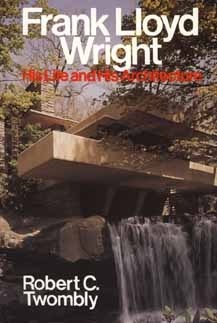
A complete biography based on a wide range of previously untapped primary sources, covering Wright's private life, architecture, and role in American society, culture, and politics. Views Wright's buildings as biographical as well as social statements, analyzing his work by type, category, and individual structure. Examines Wright's struggle to develop a new artistic statement, his dramatic personal life, and his political and economic ideas, including those on cities, energy conservation, cooperative home building, and environmental preservation. Includes over 150 illustrations (photographs, floor plans, and drawings--many never before published), extensive footnotes, and the most exhaustive bibliography of Wright's published work available.
It's an information-dense book, which means you can graze on it and still feel enriched. Or you can skip the book and watch Ken Burns' documentary, that I assume used this book to a large degree. Obviously YouTube has a plethora of content.
***
I wasn’t aware that Wright was a supporter of communism in Russia in the 1930s (as was Philip Johnson's Nazi connection in the 40s, and Corbusier's fascist leanings). But it's not an affiliation that is fundamentally political. In some sense, architects and political figures are the same because their lives are concerned with utopian visions.
I actually found this to be more about history than architecture in many ways. If you see Wright as having been a product of post-Civil War America, the architecture seems to emerge from it, or rather that history would have produced such a character and the timing was right.
Robert C. Twombly’s Frank Lloyd Wright: His Life and His Architecture is a dissection of the architecture and life of Frank Lloyd Wright, the greatest architect of the 20th century. It details the planning and backstory behind many of Wright’s most famous projects. In addition, it provides detailed analysis of the impact of these buildings on the evolution of modern architecture. This book is inspiring because it reveals the humanity behind a celebrity of architecture. It illustrates that many of the most noteworthy construction of the most noteworthy architect were not built by aliens but by a man with principals behind his designs. Secondly, this book is educational. One is able to learn much about architecture and what makes a building great from this study of a single man. The journey through a legend’s work exposes the reader to the crème de la crème of architectural content to be absorbed.