Jump to ratings and reviews
Rate this book

Travesty

Rate this book
Hawkes, Travesty. John Hawkes' most extreme vision of eroticism and comic terror.

128 pages, Paperback

First published December 12, 1976

7 people are currently reading
711 people want to read

About the author

John Hawkes

109 books191 followers
John Hawkes, born John Clendennin Talbot Burne Hawkes, Jr., was a postmodern American novelist, known for the intensity of his work, which suspended the traditional constraints of the narrative.

Born in Stamford, Connecticut, and educated at Harvard University, Hawkes taught at Brown University for thirty years. Although he published his first novel, The Cannibal, in 1949, it was The Lime Twig (1961) that first won him acclaim. Later, however, his second novel, The Beetle Leg, an intensely surrealistic western set in a Montana landscape that T. S. Eliot might have conjured, came to be viewed by many critics as one of the landmark novels of 20th Century American literature.

Hawkes died in Providence, Rhode Island.

Ratings & Reviews

What do you think?
Rate this book

Friends & Following

Create a free account to discover what your friends think of this book!

Community Reviews

5 stars
142 (28%)
4 stars
175 (34%)
3 stars
107 (21%)
2 stars
56 (11%)
1 star
24 (4%)
Displaying 1 - 30 of 70 reviews
Profile Image for Guille.
1,007 reviews3,284 followers
August 31, 2023

"Cuanto mayor es la incongruencia, mayor es la verdad."
Deslumbrado quedo por este inmenso libro de tan solo 119 páginas, por su belleza, por todo lo que encierra.

No es un libro fácil, es un relato críptico, uno de esos libros en los que se hace más verdad que nunca aquello de que una novela no está acabada hasta que no es leída. Por eso mismo, posiblemente, una buena parte de todo lo que diga aquí, y quizás diga demasiado, puede que no tenga sentido alguno para otros lectores del libro.

Esta novela, la que hice mía, me recordó mucho a otro escritor que ha pasado a ser uno de mis preferidos en los últimos años: Mircea Cărtărescu. Quizás todo radique en lo tremendamente sencillo que parece el estilo de ambos y los mundos tremendamente complejos que se llegan a percibir detrás de tan aparente sencillez. Uno nunca sabe a qué atenerse; la línea entre lo que puede ser una ficción realista y una auténtica melopea alucinatoria es extrañamente difusa.

¿Estamos ante un relato en presente de lo que está sucediendo? ¿Estamos ante la catarsis de un hombre engañado que fantasea con lo que cobardemente es incapaz de realizar? ¿Estamos ante un loco, un artista, un hombre desesperado?
“Confía en mí, pero no me creas”, “No hay nada más importante que la existencia de lo que no existe”, “La vida imaginada es más satisfactoria que la vida recordada.”
El relato es la carrera de un coche ocupado por dos hombres y la hija de uno de ellos que va aumentando la velocidad a medida que avanza; es un viaje pensado, diseñado, por el conductor pero en el que lo que al final ocurra (y esto me recordó a El ruletista, de Mircea) dependerá de la suerte, de que un coche pueda cruzarse en el camino, de que las ruedas resbalen en alguna curva, de que un peatón aparezca ante nosotros sin poder evitarlo. El conductor-narrador tendrá que salvar todos esos imprevistos hasta el final del viaje y conseguir el choque final, realizando así lo que para él sería una auténtica obra de arte, aunque solo una persona pueda abarcar el acto en toda su múltiple complejidad: la mujer del conductor, Honorine.

Nosotros, como los investigadores del accidente en el relato, asistimos perplejos al hecho narrado y barajamos múltiples posibilidades acerca de la intención del autor (“la inventiva desafía a la interpretación”). ¿Qué pretende, hacer real algo no real, salirse de la realidad, superarla o ponerse al lado en un plano paralelo en un acto loco, inexplicable? O todo esto no son más que pajas mentales y simplemente estamos ante el relato de un loco con un discurso incoherente y ambiguo. O quizás no es más que el monólogo desquiciado de un hombre trastornado por la traición de su mujer y su hija, amantes ambas del poeta que lleva o imagina que lleva en el asiento del copiloto, el poeta despreciado por su pliegue al mercado, a los honores, a su público. Y, por supuesto, inferirle un daño mortal a su mujer, matando todo aquello que es importante para ella, su marido, su amante y a su propia hija.

Qué más da, todo eso o nada y otra cosa; el propio relato es una gozada: la descripción que hace del resultado imaginado del accidente, el amor que desprende el retrato que hace de su mujer, la sensualidad de sus experiencias con su amante Monique o esos versos finales del libro:
“En algún lugar deben de seguir
El rostro no visto de ella, su voz no oída.”
Profile Image for Paul Bryant.
2,413 reviews12.6k followers
August 26, 2012
Nauseating. Also, insufferable. Also, bad. A pompous egomaniac finds out that his best friend has been shagging his 24 year old daughter. And same friend had a previous affair with this unnamed guy's wife. This recent discovery has incensed the unnamed husband and father to the point that he picks up friend Henri and daughter Chantal – they're all French - in his new car one evening then proceeds to drive through the countryside at increasingly alarming speeds and informs them in the transcendently tiresome monologue which is the whole novel that he intends to crash the car into a sturdy farm building he has already picked out, killing all three of them. Well, you know, that's bit strong isn't it? Bit of an over-reaction? Also bound to fail since after only about 50 pages we readers know that Chantal and Henri will be bored to death long before the crash. But this whole scenario is a little tough on poor Chantal don't you think? Would even an egomaniac think of murdering his own daughter in a fit of pique? I think not. The answer is that this novel is nothing to do with real life. It turns out that it's actually some kind of tribute/homage to Albert Camus. This may well be the truth. What I know about Albert Camus could be written on the back of a postage stamp and you would still have room for most of the New Testament. I was instead thinking it was some kind Crash ripoff – J G Ballard's masterpiece was written only three years before this thing. So as this novel prattled along (the speed the car was travelling being directly disproportionate to the slow grinding tedious sneery supercilious raised-French-eyebrow anecdotes, moral cheeseparings and elliptical crapness), I was fervently hoping that Chantal would rise up from her foetal position on the back seat, fetch out a length of chicken wire from her chichi handbag and garotte this old fucker a la Peter Clemente's treatment of Carlo Rizzi in The Godfather. Yes, that would probably have precipitated a fatal accident too, but maybe, just before it all went black, the droning noise would have stopped for a few blissful seconds.
Profile Image for Markus.
277 reviews94 followers
November 19, 2019
Obwohl ich keinerlei motorsportlichen Ambitionen hege, flattert mir etwa einmal pro Jahrzehnt eine Strafverfügung wegen Übertretung der erlaubten Höchstgeschwindigkeit ins Haus. Was lag also diesmal näher, als endlich Belohnung für schnelles Fahren bei Nacht aus dem Regal zu holen.

Das englische Original heisst Travesty, und auch die deutsche Erstausgabe von 1986 in der edition suhrkamp hiess Travestie. Erst die Taschenbuchausgabe von 1996 wurde - wahrscheinlich aus Marketinggründen - in Belohnung für schnelles Fahren bei Nacht umbenannt.

Die Bedeutung von Travestie im Zusammenhang mit dem Schauspiel war mir ein Begriff, aber erst jetzt weiss ich, dass eine literarische Travestie die (ironische) Bearbeitung eines bekannten Inhalts ist, wobei Form bzw. Stil übernommen werden. Damit ist die Travestie das Gegenteil der Parodie, bei der der Inhalt beibehalten wird und die Form verzerrt oder karikiert wird.

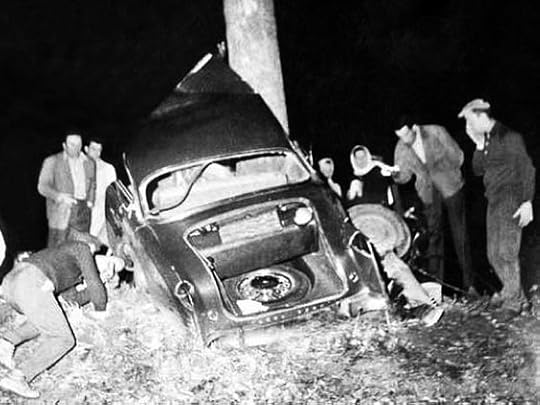
John Hawkes Travestie könnte man eine iterative oder auch Matroschka-Travestie nennen. Zuinnerst ist es eine Travestie auf den Roman La Chute/Der Fall von Camus, sodann eine Travestie auf den spektakulären Unfalltod von Camus und dem Neffen des Verlegers Gallimard 1960 im legendären Facel Vega FV3B und im weiteren Sinn auf Camus' philosophische Reflexionen, nicht zuletzt über den Selbstmord. Schaut man genau hin, könnte alles zusammen eine Travestie auf sich selbst sein, dann könnte man auch von einer rekursiven Travestie sprechen.


Das Wrack des Facel Vega, in dem Camus und Gallimard den Tod fanden.

Als ahnungsloser Leser, dem weder der Fachbegriff in diesem Zusammenhang, noch die Details zum Unfalltod Camus' geläufig waren, stellte ich zuerst mal fest, dass es sich um einen fiesen, ironischen und äußerst raffinierten Text mit auffallend philosophischem Tiefgang handelt. Erst der Hinweis von GR-Freund Michael auf den Unfall im Facel Vega führte mich zu weiteren Recherchen, was in der Folge eine Kaskade von Erkenntnissen auslöste, die, würde man sie weiter verfolgen, ausreichend Stoff für eine Diplomarbeit böten. Wort und Tat, Eros und Tod, Erlösung, Auflösung, Mord und Selbstmord sind nur einige der aufgeworfenen Themen.

Genauso wie Der Fall ist Hawkes' Roman ein Monolog von der ersten bis zur letzen Seite. Es ist der Monolog des Fahrers eines sportlichen Wagens, der gleichzeitig »in verteufelt frivoler Eskapade« mit 150 km/h durch die regnerische Nacht rast. Auf dem Rücksitz seine 24 Jahre alte Tochter Chantal und neben ihm der berühmte Poet Henri, sein bester Freund, der nicht nur zu Honorine, der Ehefrau des Fahrers, sondern auch noch zur Tochter ein erotisches Verhältnis unterhält. Ziel und Zweck des nächtlichen Rasens ist eine »private Apokalypse«, nämlich der Tod aller drei Insassen in einem geplanten Unfall an einer exakt berechneten Stelle, genau elf Kilometer nach dem Château von Honorine, in dem diese zur selben Zeit gerade wohlig schläft.

Die Methode des Monologs bewirkt, dass man die Einwände und Ängste der beiden Mitfahrer nie hört, man muss sie aus den Antworten des Sprechers nachträglich erahnen. Das erzeugt nicht nur eine beklemmende Atmosphäre, es verstärkt auch ganz stark das Gefühl der absoluten Aussichtslosigkeit: der Plan ist unwiderruflich, alle Einwände sind zwecklos, Argumente vergeblich, »derweil unsere Fahrt nur das Vorspiel zum letzten Herumreißen des Steuers ist. [...] Ich wage jetzt schon für seine heitere Gelassenheit einzustehen.«

In Der Fall gesteht Clamence, dass er einst auf einer Brücke Zeuge des Selbstmords einer jungen Frau wurde. Er ignorierte »den mehrfach wiederholten Schrei, der flussabwärts trieb.«, er war wie gelähmt, er benachrichtigte niemand. Diese Schuld verfolgt ihn sein Leben lang, und für ihn wird die Unterscheidung zwischen Gedanke und Tat absurd, sie spielt keine Rolle. Mit seinem Monolog, seinem Geständnis will er sich von seiner Schuld befreien.

In Hawkes Travestie erzählt der namenlose Fahrer von einem früheren Erlebnis. Mit seinem schnellen Wagen fuhr er - vielleicht - ein kleines Mädchen an. »Ich machte weder kehrt, noch schaute ich auch nur in den Rückspiegel. Ich gab einfach noch mehr Gas und fuhr weiter.« Er weiss nicht, ob er das Mädchen erwischt hat, er wird es nie wissen, trotzdem wird er das Gesicht des Kindes nie vergessen.

Der innere Gedankenstrom, der den ganzen Tag und die halbe Nacht im Geist von uns allen dahinplätschert, brodelt oder tobt, ist als solcher durchaus wirklich, nicht aber seine Objekte, schon weil er unserem Hier und Jetzt immer voraus oder hinterdrein ist. »Ich bin nie da wo ich bin. « sagt der Erzähler irgendwann. Wieder geht es um das Verhältnis des Gedankens zur Tat: »Aber der Optimismus dessen, der an die natürliche Welt glaubt, ist die allergrausamste List, eine Kindern würdige Infantilitätssentimentalität.« Der Aufprall auf die über einen Meter dicke Steinmauer einer alten Scheune wird die ersehnte und endgültige Verschmelzung der Idee mit der Tat bewirken. Fiktion und Wirklichkeit werden eins und für die Betroffenen zugleich ausgelöscht.

Schön wärs! Hawkes kann es natürlich nicht so weit kommen lassen. Er beendet den Text zwar mit dem Versprechen des Fahrers »Henri, es wird keine Überlebenden geben. Keine.« Trotzdem wäre es völlig unmöglich, dass der Erzähler den Unfall und seinen eigenen Tod in seinem Monolog kommentiert (Deshalb muss Broch im Tod des Vergil auch auf die dritte Person ausweichen...).

Hawkes travestiert seine eigene Erzählung somit selbst als eine unmögliche Erzählung. Als der Fahrer schon viele Seiten früher Überlegungen zu den Folgen des Unfalls anstellt, beschwert sich Henri anscheinend, dass »dieser Kerl, noch immer nicht zufrieden, [...] in seinem Kopf sogar die Weiterungen dieser Situation ausmalen und arrangieren muss, in der wir drei gar nicht mehr existieren« und erhält die Antwort, »dass es nichts Wichtigeres gibt, als das was es nicht gibt.«

John Hawkes, der geheime Vater der amerikanischen Nachmoderne, hat mit diesem kurzen Roman eine waghalsige Metakonstruktion errichtet, profunde philosophische Betrachtungen angestellt und im Ganzen eigentlich keine Travestie, sondern eine Hommage an einen der einflussreichsten Dichter und Denker dieser Zeit und zugleich an die Fiktion selbst geschaffen.
Profile Image for Cody.
996 reviews304 followers
August 27, 2017
This is fucking great. This is Ballard's Crash if he had a brain not slathered in cum. I do recommend reading them as sister-novels of a sort. Thematically they're not all that dissimilar and both just reek like Hai Karate in their 70s-oid, platform'd funkdom. To which, thank you Jesus and Eddie Hazel.

This monologue is one for the ages; a serpentine tour (lit/fig) through the mountains of madness that too-oft result from the complexities of swapping pee-pee's and wee-wee's with adults both consenting and unaware.

OR

Ooo la la: The Fucking French!

OR

Mais oui: The French, Fucking
Profile Image for Nate D.
1,654 reviews1,255 followers
July 21, 2014
A breakneck ride in the sinister hands of a familiar-yet-unique Hawkes narrator. Why we're in this car, and where it's going, are all a part of the array of narrative hooks that slide in from the first and carry this straight through in one breathless heaving of life, sex, and vitriol, even acknowledging Hawkes' love of circling the absent and inconclusive crux of his characters and plots, so that I really should say no more and let the hooks do their work. In any event, the voice in this incredible. I wonder how this would sound on tape -- or even better, recited -- while driving at excessive speeds.
Profile Image for Marc Nash.
Author 18 books468 followers
December 9, 2017
Think the movie "Speed" though instead of it blowing up if it dropped below a certain speed, this car is being driven at breakneck speed to prevent its two captives from escaping their certain fate, that of the driver stacking the car fatally against an abandoned farmhouse.

The driver therefore has a captive audience, his own 25 year old daughter and her lover, who also had cuckholded the driver. The beau is a poet, but the monologuing driver's voice is the grandiose imaginative one, the poet is pleading for his life.

The driver's wife was the poet's muse, but the driver is his critic. He seems intent on punishing him not so much for bedding his wife, but more for his presumption that he has a more creative soul than the driver. With this imminent threat of death, the driver waxes lyrical, the poet wheedles and asks for that most prosaic of things, to be allowed to continue to live.

What's less clear is why his own daughter has the same death sentence over her; maybe to pun ish his unfaithful wife, perhaps because of the daughter's own sexual being. But then since no one else gets a word into the text, perhaps this whole thing is in the mind of the driver rather than actually having two people captive in his car.

There are some excellent vignettes in this short text, mainly concerning sex and sexuality. The eroticism of the child is perhaps most brilliantly demonstrated concerning the driver's dead little boy, who entered the parental bed and in a pre-Oedipal but most Freudian way interacted with his mother. There's also a tension-wracking scene in which his daughter is first initiated into the erotic world.

The only reason I didn't give this the full 5 stars is the rhythm and the pace of the sentences. Too many long sentences and subordinate clauses for a car zooming at around 100mph. Like the movie "Speed", it needs to be more breathless. The pace could be varied between going round tight country corners and flying along straight stretches. Other than that, this was an excellent read.
Profile Image for Josh.
379 reviews263 followers
October 20, 2017
(2.5) Ironic and farcical. Psychological and sadistic. A mixture of these two is all I can come up with. Perhaps a bit suspenseful in bits and pieces, but an overall slog at times. I assume not his best, but I do love the presentation of cover and back. Good job to you New Directions, bravo indeed.
Profile Image for Álvaro Velasco.
276 reviews43 followers
April 14, 2021
Es un libro corto, pero no es un libro fácil. Uno tiene que estar abierto a diferentes interpretaciones.
Profile Image for Jimmy Cline.
150 reviews232 followers
September 14, 2008
A self declared "homage to Camus", this short novel by Hawkes is part of a triad of novels beginning with the Blood Oranges. The premise is simple enough, a man (who for clarity's sake, let's call him Papa because he isn't really given a name in the story) picks his younger daughter and her lover (Papa's closest friend, also a famous poet) up from dinner. As they begin their long drive through the French countryside, Papa informs them that his intention is to crash the car at a considerably high speed, thus killing them all. The entire book is one long monologue by Papa, delivered to both his daughter Chantal and the poet Henri.

Travesty is a fairly high concept novel. All of the characters in the story are French, and it is set in Paris. Stylistically, it reads like an English translation of a novel by Camus or Gide. Apparently, this is supposed to be Hawke's version of the Fall. This is certainly a book that suffers from formal restrictions, which seems to make it an accessible read in comparison with most of Hawke's books. At only a paragraph into the story, the reader already knows what is going to happen. Papa is the only character who's side of the story the reader hears. After realizing these two aspects of the story, it's really just a matter of listening to Papa explain why he has decided to commit such a psychopathic act. In fact, the exposition in the beginning is so immediate that one feels as if they are sitting in the back seat of the car with Chantal.

Papa spends most of the monologue attempting to paradoxically dance around definitions of murder, suicide, ethics, etc. He explains, very much in a Camusesque fashion, that the awareness that all of them have of their impending doom is a privilege, one that few mortal beings on this planet have. The problem with this is that there is no beating around the bush here; what he is doing is immoral, he is murdering his own daughter and his best friend. What are their respective crimes anyway? Well, not much really. Chantal sleeps around a lot, referred to early on as "our little porno-brat". Henri has had an affair with Honorine (Chantal's mother), and he is currently fucking Chantal. So they are sinful, but from what Papa tells us, his lifestyle isn't exactly pious. His outrage seems to stem from jealousy more than anything else. Yes, one does get the impression that he wants to fuck his own daughter.

However, this is a novel that can be interpreted in a number of ways. In a sense, I thought that Papa's character could be construed as god. He is judging these two people based on sinful acts. He is in control of their lives. His convictions seem very religious in ways, not to mention somewhat hypocritical. Yet another perspective I considered was that maybe Henri and Papa are the same character. Henri essentially acting as a metaphor for the main character's failures and sins.

It's an interesting concept, but it just seems to result in bland attempt at literary homage. Hawkes is talented at adjusting his style here, and there are some lovely descriptions of the French countryside. I like the juxtaposition between that and the essentially horrifying, rather hermetic environment of the automobile. Unfortunately, once the general premise is understood (which is immediately), and the homage is recognized, Travesty just becomes an insufferable rant by one character, who throughout the novel doesn't really seem to justify his actions with reasonable enough conviction. But maybe that is the point here?

Profile Image for Larou.
341 reviews57 followers
Read
October 3, 2022
This is a… strange little book. And I mean that in the best possible way.

The set-up seems simple enough – we’re inside a car for the whole duration of this short novel, together with its driver, his daughter Chantal and his friend, the poet Henri – who incidentally is the lover of not only the car driver’s daughter but also of his wife. Said driver is also the narrator of Travesty and he is one of the most deeply unlikeable characters to ever fill that function. And that is not just because he plans to kill himself as well as his passengers by driving the car against a barn but also because he is a mean-spirited, monstrously egotistical philistine with (so far as I could tell) no redeeming features whatsoever. Unlike comparable narrator-villains (Humbert Humbert comes to mind most strongly) the narrator of Travesty does not require to seduce his audience (seeing as it is already quite literally captive) nor does he feel the need to justify himself to anyone, as he is quite convinced of being absolutely in the right. It comes as no surprise then that the narrator tells us mostly about himself and what a great guy he is, with the other characters mere supporting cast hovering barely visible on the edge of the stage.

It is never quite made explicit what the “Travesty” of the novel’s title refers to – while the narrator does mention an event in his past, that is not really helpful (at least not with some interpretative effort), and it seems likely that this is left intentionally ambiguous for the reader to figure out. My own take on this is that it refers to the narrator’s recurring attempts to make his planned murder-cum-suicide as a work of art – in fact, one rather suspects that the purpose of this premeditated car crash is so that the narrator can present as a better artist than his friend the poet, and lacking any real talent now engages in a grotesque and bloody act of one-upmanship. Not that this would mean criticism of the narrator by way of implicit auctorial comment, and this brings us to the point where I think this small novel is really remarkable – because the author (and it does not really matter whether you consider that to be the John Hawkes whose name appears on the cover of the novel or another fictional character implied in its narrative) manages to turn this travesty into a work of art, in spite of the narrator and behind his back, so to speak. While the novel’s set-up is entirely possible and realistic, the narrator’s voice is decidedly not – nobody would actually talk like this while driving a car, much less one that is going at high speed on a nocturnal country road. The narrative voice is not realistic at all but highly artifical, it is controlled by the author rather than the narrator, and it is the author rather than the narrator who time and again introduces a trenchant observation or a scinillating bit of prose, slipping them in under the narrator’s radar, so to speak. Which makes for a weird, unsettling reading experience, the text apparently slipping out of focus repeatedly, only to snap into brilliant clarity at the most unexpected moments.
Profile Image for Heronimo Gieronymus.
489 reviews150 followers
October 18, 2016
It would be lovely if Travesty were somebody's last novel. Because it is a suicide note. Rather, a suicide screed. But a monologue. We are led to believe - in a manner that is not really credible, but in no way needs to be - that the text is being delivered verbally by the perpetrator of an imminent murder-suicide to one of his victims. A ghastly business, this. Undeniably. Business for which I am steadfastly in the market. I have read most of Hawkes' novels written up to the point of Travesty. And Travesty is a magnificent departure. His earlier books are extremely opiated, fuzzy, groggy, about as easy to get a grip on as water. Travesty is blunt. Bluntforce. You can grasp it like a cudgel. It is officially my favourite Hawkes (the previous favourite having been the underrated Death, Sleep, and the Traveler which is the one that perhaps-not-surprisingly came out right before this one and was, before this one, the least slippery I had read (although maybe my favourite remains The Cannibal, a book that feels like a whole career unto itself)). I have been fascinated by all the early Hawkes stuff. But this fascination has always been at least a little bit married to bafflement. I am not entirely sure how he produces the effects he produces. Or maybe even why he goes about it like he does. I have always been slightly mystified, but compulsively drawn to him. But Travesty is just so obviously just purely a dark and mean and wonderful little treasure. Every good suicide is a kind of apocalypse. And though Travesty is merely a microapocalypse, IT IS WILDLY APOCALYPTIC. And the narrator is wondrously vile. You kinda have to like that sort of thing. Also: probably needs to be read as an indictment of the French character. Heh.
Profile Image for Cooper Cooper.
Author 497 books401 followers
July 18, 2009
This book is a variation on the récit genre—that is, an extended monologue by a single narrator; it differs from the récit in that the narrative does not address the reader directly, but rather other (invisible and silent) characters in the story—in the tradition of Camus’ The Fall, to which Travesty owes one of its epigraphs and which it greatly resembles—whether in admiring emulation or in outright parody (“travesty”) I’m not quite sure, because I know almost nothing about Hawkes or his intentions as a writer. In any event, Hawkes writes very well line-for-line, and he employs an ingenious technique for sustaining suspense: the entire monologue takes place while the narrator is speeding recklessly through the French countryside at night, with his daughter in the back seat and his best friend beside him, a man who, in happy Gallic fashion (all are French), is the lover of the narrator’s wife and also of his daughter. Much of the narrative concerns itself with the reason the narrator intends to terminate their late-night excursion with a top-speed crash into an old stone barn. He makes it clear that this desperate-seeming action is driven not by anything as mundane as jealousy, but rather by purely existential motives—for example, since all must perish anyway, instead of hanging on only to die badly why not choose one’s time and go out joyously in one’s own way? Some of his other arguments, more convoluted, seem to me somewhat far-fetched (if I understand them at all). The back jacket capsules the book as …“an icily comic portrait of the poet as suicide and murderer.” Not exactly how I would describe it. But it’s a very good book.
A sample of the writing:

A trifle faster? Yes, you are quite right that we are now traveling a breath or two faster than we were. Now is the moment when I must make my ultimate demands. As you can see, my arms are stiffening, my fingers are flexing though I never remove my palms from the wheel, my concentrating face is abnormally white, and now, like many men destined for the pleasures and perils of high-speed driving, now my mouth is working in subtle consort with eyes, hands, feet, so that my silent lips are moving with the car itself, as if I am now talking as well as driving us to our destination. And we are approaching it, that final destination of ours. We are drawing near. Soon we shall be entering the perimeter of Honorine’s most puzzling and yet soothing dream. And now beneath the hood of the car our engine is glowing as red as an immense ruby. How unfortunate that to us it is invisible. How unfortunate that the rain is determined to keep pace with our journey.
Profile Image for Ferris.
1,505 reviews23 followers
August 11, 2014
What is the meaning of travesty? A travesty is literary or artistic composition so inferior in quality as to be merely a grotesque imitation of its model. John Hawkes' novella is a poetic travesty. The driver of a luxury sports car, an upper class intellectual, has decided to commit the ultimate poetic act. Is it because his wife is his poet best friend's mistress? Is it because his daughter is mistress to the same poet? You will have to join the threesome on this ride to death to determine the meaning of the driver's choice for yourself. I could feel the wind in my hair on this ride through a rainy night in southern France. Do you dare?
Profile Image for R..
1,022 reviews143 followers
August 6, 2008
Basic idea is that a guy goes mad - delivers a rambling monologue that's supposed to be an erotic revery of his wife - and drives through the night with hostages -his daughter, her lover - towards a crash, the explosion of which will awaken his wife from her sleep.

Robert Coover wrote a preface to one of the editions, so you know that at least you are in the hands of an expert driver.

Update:

Not bad, but not mindblowing. Robert Coover owed somebody a favor, I suppose.

Profile Image for Adam.
558 reviews437 followers
November 16, 2007
Another of Hawkes’ unbearable narrators. The monologue of poet as he drives his car containing him and his daughter and her lover to his aesthetically approved suicide/murder. Similar territory to Ballard’s Crash and Camus’ The Stranger.
Profile Image for Tobias.
Author 14 books199 followers
July 2, 2010
Quite liked this -- probably my favorite of the three Hawkes books I've read. Looking forward to checking out the Dalkey Archive reprint of "The Passion Artist" in the not-so-distant future.
Profile Image for Arturo.
82 reviews7 followers
July 4, 2023
Me rompió la cabeza y lo abandoné dos veces pero al final merece mucho la pena. Jamás había leído algo así. Te marea.
Profile Image for Sam.
308 reviews4 followers
August 25, 2024
“What does it matter that the choice is mine, not yours? That I am the driver and you the passenger? Can’t you see that your morality is no different from Chantal’s whimpering and that here, now, we are dealing with a question of choice rather than chaos?
I am no poet. And I am no murderer.”

“I am aware of a particular distance; these yellow headlights are the lights of my eyes; my mind is bound inside my memory of this curving road like a fist in glass.”

“The song and road are endless, or so we think. And yet they are not. The beauty of motion, musical or otherwise, is precisely this: that the so-called guarantee of timelessness is in fact the living tongue in the dark mouth of cessation. And cessation is what we seek, if only because it alone is utterly unbelievable.”

“You have spent your days, months, in confinement. We have only to see your name, or better still to see your photograph or even catch a glimpse of you in person, to find ourselves confronting the bright sun, endless vistas of hot, parched sand, the spectacle of a man who always conveys the impression of having been dead and then joylessly resurrected— but resurrected nonetheless. Of course your suffering is your masculinity, or rather it is that illusion of understanding earned through boundless suffering that obtrudes itself in every instance of your being and that inspires such fear of you and admiration. Another way of putting it, is to say that you have done very well with hairy arms and a bad mood. But I am not trying to rouse you with insults. At any rate you will not deny that in yourself you have achieved that brilliant anomaly: the poet as eroticist and pragmatist combined. Though you merely write poems, people admire you for your desperate courage. You are known for having discovered some kind of mythos of cruel detachment, which is another way of expressing the lion’s courage. And I too am one of your admirers. Just think of it.”

“The birds do not sing, clouds pass, the wreckage is warmed, the human remains are integral with the remains of rubber, glass, steel. A stone has lodged in the engine block, the process of rusting has begun. And then darkness, a cold wind, a shred of clothing fluttering where it is snagged on one of the doors which, quite unscathed, lies flat in the grass. And then daylight, changing temperature, a night of cold rain, the short-lived presence of a scavenging rodent. And despite all this chemistry of time, nothing has disturbed the essential integrity of our tableau of chaos, the point being that if design inevitably surrenders to debris, debris inevitably reveals its innate design.”

“You will agree that no one wants to find himself becoming nothing more than a familiar type created by a hasty and untalented pornographer. We do not like to think of ourselves as imaginary, salacious and merely one of the ciphers in the bestial horde.”

“There is nothing to be done about the sound. But you may well wish to close your eyes, or simply lean forward and bury your face in your hands. The entire deafening passage will last an eternity but also no time at all. Why see it? Why not leave the seeing as well as the driving to me? And you might amuse yourself by considering what the peasants will think when we shake their street and start them shuddering in their poor beds: that we are only an immoral man and his laughing mistress roaring through the rainy night on some devilish and frivolous escapade. Or consider what we shall leave in our wake: only an ominous trembling and a half dozen falling tiles.”

“If the invisible camera existed, and if it recorded this adventure of ours from beginning to end, and if the reel of film were salvaged and then late one night its images projected onto a tattered white screen in some movie house smelling of disinfectant and damp clothing and containing almost no audience at all, it is then that your malignant admirers would stand in those cold aisles and dismiss me as a silly coward and condemn you as a worthless soul. As if any coward could be silly, or any soul worthless.”
Profile Image for Sarah.
1,227 reviews32 followers
April 23, 2020
Wow, what a descent into a twisted mind! I feel like I have to take a shower. This unreliable narrator , a would-be murder suicide, tells a tale of sexual cuckoldry and perversion as his car with it's hapless occuppents speeds through the night. I'm not sure if I agree with the author's decision to end the story before the crash, letting the reader decide the ending. I wouldn't say i enjoyed this book, but it will stay with me for a long time.
Profile Image for Gideonleek.
244 reviews17 followers
May 15, 2025
Spending ten days alone in Vermont was a mistake
Profile Image for Lemma.
73 reviews6 followers
July 19, 2023
At least you are in the hands of an expert driver.

I read this as the third part of a Hawkes collection (the other parts being his most famous novel, The Lime Twig and his best, Second Skin), and while it's the weak link, it's still a fun and enjoyable little book. It's an uninterrupted monologue littered with Hawkes's trademark esoteric metaphors (I particularly liked describing a woman as a drop of honey on a sheet of glass) and frantic sexuality. It's a queer duck in that the protagonists of all his other books are powerless men, while in Travesty that man has taken action against the world before the story even starts.
You love it or you hate it, and odds are you know which you'll be before you pick this one up.
Profile Image for Zach.
24 reviews24 followers
January 5, 2011
at a little under 130 pp, still a very slow read for me. for a while i was wondering if hawkes's central idea was actually interesting. the narrator's flowery, exquisitely prepared monologue seemed odd within the confines of a speeding deathtrap, but I guess I've come to expect sparse prose in transgressive fiction (if you can call this transgressive), and i suppose it suits the (underdeveloped) precept of cataclysm-as-conceptual-art that the narrator upholds.

the book does, however, gain a lot of steam near the end when hawkes finally, sustainedly separates himself from concept repetition and gives the reader a torrent of intriguing, odd passages that justify its floridity.
430 reviews8 followers
April 30, 2011
Creepy but compelling. Can't help but wonder what made John Hawkes imagine a book with this premise: a man is driving in a car with his best friend and his daughter and the monologue is the narrator/driver listing out the many indignities he has suffered by his friend who has taken both his wife and his 20-year old daughter as his lovers. He is so hateful of everyone he loves. Short and not sweet.
Profile Image for Mac.
279 reviews33 followers
November 13, 2008
If you've ever wondered what it was like to ride around in a car with me, read this book.
Profile Image for Glenn.
Author 13 books117 followers
May 21, 2022
Good, short, punchy Hawkes postmodern discomfort. Guy can write. Check him out.
Profile Image for Domiron.
149 reviews2 followers
April 8, 2025
Features much of the worst elements of Hawkes, particularly the impenetrable nature of the writing, and the sexual insensitivities, with not so much of his best.
I do actually really like the concept of the book, being a monologue of a driver to his passengers over the course of a few night time hours, about why he is currently speeding the car and going to crash it and kill them. From the blurb's (not inaccurate) description of it, it made me think of overnight conversations, or nighttime radio programming and stuff, which would be an interesting thing to capture. However this just sort of reads like John Hawkes writing a shorter book without much to it.
As always, it's very wordy and descriptive, which, although I've not long finished reading and enjoying Second Skin by him (which was much the same in that regard), the idea of this being spoken aloud just clashes too much and I'm afraid this is the one book that pushes my suspension of disberlief too far, nobody would say all that in a car. Second Skin was also first person and I had no issue with that, so I think it really just is the context.
There is a respectable lack of "comic relief" in I think all the John Hawkes books I've read, in which they don't undermine themselves in that regard. It's not even just that there is nothing "comic", but that I don't think it ever provides anything that could be described as "relief". Which also probably works better in his other books.
As much as I respect, and want to read more by, authors who do their own thing with novels, and reject conventions, this premise would have worked so much better by someone who does not do so, or at least not in Hawkes' way.
Profile Image for Randy Rhody.
Author 1 book24 followers
April 1, 2022
I am left with two burning questions. Why has the American author placed his scenario in France, instead of say, Australia? And why does he feel the need to inform us that both driver and front-seat passenger are Leos?

As other reviewers summarize these 117 pages, an unreliable narrator speeds at 149 km/hr through the night (at “precisely” 1:18 am) on a quite empty road in his powerful beige sport touring car, with two passengers who never speak, intent on a spectacular final-destination-for-all car crash. (You’ll recall the 1978 hit “Warm Leatherette” by The Normal was released only two years after Travesty.)

The preceding is no spoiler, as the story itself, such as it is, is revealed during a tiresome and often philosophical monologue.

If I may suggest an upgrade while reading, imagine that our driver has already murdered his passengers and is delivering a one-sided lecture to their corpses. Entirely plausible, since following a high-speed turn the rear-seat passenger slides to the floor. Taking revenge on them a second time would be the real travesty.

Or… suppose he left their murdered bodies behind and is talking to himself while driving to his destination alone.

Or… as he drives alone, his wishful thinking articulates the murder he lacks the circumstances or nerve to carry out.

Or…
Profile Image for Troy S.
139 reviews42 followers
January 21, 2024
"I have two significant regrets. Only two. The first is that the crash soon to be reported as having occured near the little village of La Roche must result inevitably in fire; the second is that the remains of the crash must inevitably disappear."

"[I]f design inevitably surrenders to debris, debris inevitably reveals its innate design."

I was most struck by this sentiment, the lasting effect of our disappearance and the influence of destruction and decay of human edifice on the inorganic forms following, but I was pretty bored by the drama. I'd like to read another of his books someday.
Displaying 1 - 30 of 70 reviews

Can't find what you're looking for?

Get help and learn more about the design.