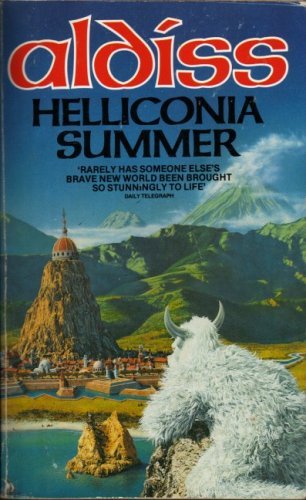
It is the summer of the Great Year on Helliconia. The humans are involved with their own affairs. Their old enemies, the phagors, are comparitively docile at this time of year; yet they can afford to wait, to take advantage of human weakness - and of the king's weakness. How they do so brings to a climax this powerfully compelling novel, in which the tortuous unwindings of circumstance enmesh royalty and commoners alike, and involve the three Helliconia continents.
Brian Wilson Aldiss was one of the most important voices in science fiction writing today. He wrote his first novel while working as a bookseller in Oxford. Shortly afterwards he wrote his first work of science fiction and soon gained international recognition. Adored for his innovative literary techniques, evocative plots and irresistible characters, he became a Grand Master of Science Fiction in 1999. Brian Aldiss died on August 19, 2017, just after celebrating his 92nd birthday with his family and closest friends.
A city on Helliconia holds much in common with a late medieval European city, as per this market scene depicted by 16th century Dutch artist Pieter Aertsen.
Helliconia Summer, second volume in the trilogy Helliconia by British author Brian Aldiss, is bookended by Helliconia Spring and Helliconia Winter.
Helliconia Summer follows Helliconia Spring chronologically and should definitely be read after one experiences Helliconia Spring. The SF Masterworks edition of Helliconia is the way to go, one key reason: maps and detailed Appendices will prove extremely helpful as you negotiate this magnificent, multifaceted planet.
Helliconia Summer features a detailed account of human society, only logical since, in scorching hundred degree summer heat, humans flourish and that other language speaking species, prime rival to humans, the shaggy fur phagors, will mostly hide in caves or in vast mountain caverns. And that's human society as in kings and queens, generals and admirals, priests and religion, scholars and tradespeople, weapons and warfare, language, writing and history.
Likewise, Helliconia Summer highlights the planet's natural world in exquisite detail: land formations, seas, coastal regions along with the entire range of flora and fauna, from plants to seaweed, from mammals and birds to reptiles, fish, insects and microorganisms. Hundreds of issues of National Geographic could be devoted to Helliconia, enough material to keep teams of animal biologists, botanists, biochemists, geographers and ecologists busy for a lifetime.
As readers, we're treated to the planet's grand expanse as we follow the travels and travails of many characters, all these women and men fully developed by master storyteller Brian Aldiss - to name several: queen, king, king's son, king's chancellor, king's general, ship captain. The novel's multiple plot lines crisscross and overlap in intriguing ways, providing insight into the entire social and cultural web of those living in the lands of Helliconia.
However, for me, the most fascinating aspect of Helliconia Summer is something new, something absent in Helliconia Spring: one of our kind, an Earthling, travels to the surface of Helliconia and interacts with the planet's inhabitants.
And there he is, Billy Xiao Pin, age 20, fresh from starship Avernus. Brian Aldiss provides the background: many centuries prior to the birth of Billy, Planet Earth sent the Avernus to orbit Helliconia in order to gather and transmit information on all aspects of the planet as well as other members of its solar system, including smaller sun Batalix and larger sun Freyer.
Billy is not the first Earthling to visit Helliconia. We learn a lottery has been in place for generations, a lottery held every ten years within the great Helliconia summer. The winner gets to travel via capsule down to the planet's surface. But, and this is a big but, winning the lottery is a mixed blessing since humans from Earth lack the necessary immune system to withstand Helliconia microbes; in other words, for those on Avernus, the Helliconian adventure amounts to a death sentence, the winner dying within weeks of their arrival on the planet.
No matter for Billy; our strapping young man is a red-blooded adventurer. Billy even sends the android that accompanied him to Helliconia (to serve as additional protection) back to the Avernus in the capsule. Billy prefers to handle solo whatever comes his way. That's the spirit, Billy!
As anyone might imagine, Billy enjoys a string of intriguing conversations and dealing with the Helliconians - men, women, even phagors. Well, some of those interactions prove less than enjoyable. What exactly transpires is for Brian Aldiss to chronicle. I'll segue to a trio of other fascinating aspects of this astonishing novel. Here goes:
Spellbound Spectators - Those on the Avernus, all 6000 men and women, follow Billy's every move on Helliconia. Billy's adventures are also big news back on Earth. "To the people of Earth, Helliconian events were news. The signals were received first of all on Charon, on the extreme fringes of the solar system. There again they were analyzed, classified, stored, transmitted. The most popular transmission went to Earth via the Eductainment Channel, which carried various continuous dramas from the binary system."
Other Intelligent Species - The king's son, a lad by the name of Robayday, runs away from court and joins a tribe of nomadic Madis. These human-like peoples never achieved full human consciousness; they have little understanding of time, they sing rather than speak their unique language. Madis spend their entire lifecycle on the move, back and forth across the lands of Helliconia. Occasionally humans will mate with a Madi to produce a child possessing a cross of human/madi qualities.
Queen of Queens - Queen MyrdemInggala is in unique communication via telepathy with dolphins. When ships out at sea are planning an invasion of her lands, dolphins come to her rescue. "A line of dolphins streamed from the bay and could be seen heading beyond the Good Hope as if summoned by something there. The sea convulsed." You bet it convulsed. The dolphins summoned two creatures from the deep having the appearance of enormous sea dragons. The dragons set the sea rocking around the ship, prompting the captain to abandon his attack. Good thinking, mate!
Don't lose out! Journey to Helliconia with Brian Aldiss. So worth a reader's time.
"Eventually, Billy and Abath appeared, holding hands. Billy's face was only just wide enough to accommodate his grin. They sat down at the table without speaking." Billy delights in a round of lovemaking with fetching Abath. This heartfelt encounter underscores two significant similarities between humans on Earth and humans on Helliconia: the capacity to behold great beauty in another person and also the emotional power to feel deep love for another.
This was a fantastic sequel to Helliconia Spring and featured incredible world-building. It did not address the cliff-hanger at the end of the previous book, but painted a pessimistic picture of a human-dominated Helliconia and the adventures of some fascinating characters. We get to travel with them and thus discover more of this planet and its crazy geography as well as the eternal battles between phagors and humans. I highly recommend this one.
Ostensibly following the fortunes of JandolAnganol, a Richard II-like king with Henry VIII-like marriage problems, the deeper theme of the book is the racial conflict (species conflict, technically) between humans and phagors.
Yes, the vile fuggies are still around despite all drumbles against them, and as the Great Year slides towards winter will come into their strength once more...
To his credit, Brian Aldiss does not adopt some simplistic ‘racism baaaad’ approach, as a contemporary mainstream novelist would (if they wanted to keep their contract), but portrays the threat from the phagors as very real, yet human attitudes to them as complex.
Having mostly enjoyed Helliconia Spring I thought I would continue on with the trilogy. (I purchased the omnibus edition.)
Events in this book take place several hundred years after the events in 'Spring'. The planet is now at it's closest approach the super giant star that it circles around once every 2,000 years and the temperature has increases so that people in the equatorial regions now live mostly underground. Different to the first book is that all the action takes place over a year or so, so it's a tiny time slice of the ecological changes of the planet. But, people have now been keeping accurate records and hence have a better understanding of what's happening.
Most of the story line is very political and SLOW. I had a hard time pushing through to the end, but there was an interesting revelation at the very end. It's also the longest of the three books so hopefully book three will pick up.
Helliconia basks in the glow of the Great Summer. The continent of Campannlat is now dominated by the Holy Empire, a loose religious affiliation between the three great kingdoms of Pannoval, Oldorando and Borlien. These nations find themselves threatened by the far less technologically-advanced but considerably more populous jungle and desert nations to the west and the even more savage tribes to the east. When King JandolAnganol suffers a humiliating defeat to tribesmen using firearms (bought at great cost from the progressive nations of Sibornal far to the north), he divorces his wife so he might seek a more favourable alliance by marrying a princess of Oldorando. However, the queen is a greatly popular figure in Borlien and by divorcing her the king enrages the native population, triggering political turmoil and military action that will have great ramifications for all of Helliconia.
Meanwhile, the crew of the Earth Observation Station Avernus have fallen into internal dissent and debate over the nature of reality and their own orders from distant Earth not to interfere with life on Helliconia. Rejecting this order from a world they can never see or return to, the crew hold a lottery with a grand prize: to allow the winner to visit Helliconia, so for the brief few months it will take for the planet's viruses and bacteria to kill him he can live under a real sky. The arrival of Billy Xiao Pin in Borlien's capital likewise triggers events that will have unforeseen consequences.
Helliconia Summer picks up the story of the world of Helliconia some 355 local years - more than 500 Earth years - after the conclusion of Helliconia Spring. The planet is not far from its time of closest approach to the supergiant star Freyr and humanity rules supreme over the planet, the phagor population reduced to slavery or forced to hide in remote mountain valleys. It is a time of great technological innovation, with firearms, gunpowder and cannons flowing south from Sibornal, but also of turmoil, with the doctrines of the Pannovalan Church stifling the advance of technology and science within Campannlat itself. Like its forebear, the novel mixes thematic elements such as the rise and fall of civilisations, the advance of science and the uneasy union of progress and religion, with a more traditional action and character-driven narrative.
Helliconia Summer, appropriately, sprawls luxuriantly where its forebear was more focused and constrained in narrative scope and geographical area. It is in this novel that Aldiss' achievement in creating Helliconia is best-realised, with lush descriptions of the world and its myriad animal life and human cultures in full flower. The main storyline is compelling, combining intriguing politics and well-realised (if not particularly likable) characters clashing over the fate of their kingdoms in the face of warfare, religious turmoil and arguments over the fate of the phagors, the dominant nonhuman species of Helliconia reduced by the heat into docile soldier-slaves. The relevance of having an observation station from Earth is also made clearer in this novel, with one of the Avernus crewmembers becoming an important character. There are also some intriguing mysteries, such as a murder mystery whose conclusion is ambiguous and a deeper one surrounding the changes in pauk, the bizarre ability of the Helliconian people to commune with the spirits of their ancestors after death, which provide much food-for-thought going into the third and final novel.
On the negative side, the book suffers slightly from its lack of focus compared to the first volume and also from a somewhat clumsy chronological structure, where the first several chapters take place in the present and then we rewind a year and move forward to where the first part began, then skip to after it. The story doesn't really require this structure and would perhaps have benefited from a more linear progression.
In Helliconia Summer (****½) Aldiss' grand ambition, nothing less than a history of an entire world and its peoples across vast chasms of time, becomes clearer and more impressive. The book is available now (albeit somewhat expensively) in the USA and will form part of the new UK Helliconia omnibus due on 12 August this year.
The first Helliconia novel took place over a long period of time and saw vast changes in the world it takes place in, with the snow melting and the civilization seeing its start. The third, I presume, will do much the same except in reverse. So this middle one is put in a bit of an awkward position: it has no calamities to tell us about, and can only talk about things that came before and things that will be again in the future. It can't cover too long of a timespan because there wouldn't be any point: it might as well just stick with the same few characters of the same couple generations, see how they live their lives in the heat of the midsummer.
It's still pretty good, as fantasy goes. Still well-written and well-plotted with a great alien science and ecology to back it up. It just lacks a little of what got me so hooked with the first book.
First, authors will find Helliconia Summer a goldmine of technique. Definitely read it for that. Aldiss frames exposition and narration through character viewpoint so it flows naturally rather than becoming an infodump. He also uses a technique I've encountered before but in the far past; he starts a chapter with what happens at the end of that chapter, has a break, then the rest of the chapter is what happened to cause the end. Interesting although confusing at first (and fifth and sixth). He also makes much more used of the the deux ex machina introduced approximately halfway through Helliconia Spring and for several chapters the deux ex machina becomes an active part of the story as well as a subplot (not in favor of doing this, only appreciate how it was done). Second, Helliconia Summer is not as strong a book as Helliconia Spring. Several things are introduced awkwardly and I got the feeling Aldiss wrote 50-100 pages further and realized "oh, crap! I need to foreshadow this," went back and backfilled. I'm not sure most readers would notice. There were also a few sections where it became obvious Aldiss was either distracted or lost interest briefly and kept writing because that's what professional authors do. It's also noteworthy that Aldiss wrote the Helliconia series some fifty years ago at this point. People's attention spans were longer back then and they were more willing to get immersed in a novel (or story of any kind). Some of the paragraphs could be shorter, some scenes shorter, ... It's far too easy now (especially when reading on a tablet) to check email, play a game of cards; basically distractions are too accessible. Back in Aldiss' time you might have music on in the background and it would be music, not a music video or stream of some kind. You watched TV because a specific show was on at a specific time and if you didn't watch it now you'd have to catch it in reruns, so there was a recognizable opportunity cost involved in deciding between "read now" and "read later" (and imagine the diminishing option curve as one goes back through history!). But is it still a good read? I thought so. Not as good as Helliconia Spring and still worth a go. I'm currently reading Helliconia Winter and am curious how Aldiss will wrap everything up, so my interest is still there (albeit waning, I'll admit). But that's for next month.
Some development from the first volume. The relationship between the natives and the human observers becomes clearer, and the theme of progress, challenging received wisdom and increasing knowledge is even stronger. It's still too long, though. Lots of murky political intrigue which was less than gripping.
En vieillissant, on change quand même pas mal. C'est la première réflexion qui m'est venue à l'esprit, une fois cet épais roman terminé. De là à dire qu'on devient ronchon, il n'y a qu'un pas ... que je ne franchirai pas ;-) Pour en revenir à ce roman, il raconte l'histoire du roi JandalAnganol, de la reine MirdemIngala, et de quelques autres personnages, dans cette époque torride qu'est l'Eté d'Helliconia. Parce qu'à cause de son système binaire, le temps est terriblement chaud en cette saison ... ou plutôt en cette période. Comme je l'ai dit pour le printemps d'helliconia, j'avais déja lu ces livres il y a une bonne quinzaine d'années et j'ena vais gardé un bon souvenir. Hélas, les années sont ravageuses, et les progrès de l'écriture en SF suffisants pour montrer les insuffisances assez pénibles de la prose d'Aldiss. En effet, si ce roman narre les aventures d'humains dans un monde étrange, les aspcets sensés crédibiliser le récit (comme par exemple les explications sur la formation du système double) n'arrivent pas d'une façon très fluide. Hélas, c'est aussi le cas lors des nombreuses phases d'introspection des personnages. Typicement, JandalAnganol a des espèces de dérapages sexxualisés que je trouve juste pénibles. Par exemple, il sort d'une séance de son assemblée locale qui le tanne parce que ses guerres se portent mal. Et paf, alors même qu'il pense à trouver une solution au problème, ils nous explique la beauté du corps de la reine, et ses courbes voluptueuses, ... Inintéressant, pas forcément utile, et franchement laborieux. A contrario, on assiste au début du récit à une rêverie sensuelle de la reine MirdemIngala qui dégage une ambiance de langueur et d'abandon très élégante, légèrement érotisée et en même temps pleine de retenue, bref, un très beau moment de littérature. Hélas, ces quelques pages sont les seules au milieu d'un scénario dont on devine assez rapidement la trame, même si le grand nombre de pages permet à l'auteur de glisser des rebondissements parfois inattendus. Pire encore, le terrien qui débarque et qui subit pas mal de mauvais sorts ressemble fort à une espèce de témoin servant à bien nous faire saisir l'altérité de ce monde, alors que franchement, on n'en a pas besoin. Tout ça fait de ce roman une oeuvre finallement médiocre, que je vais pouvoir revendre assez facilement.
Helliconia Summer, the second volume in the Helliconia trilogy, is superb old-school science fiction. The novel is superior to Helliconia Spring (1982), partly because the world it depicts is far richer in summer than it was in its emergent state in spring. The novel also contains much more detail about humanity's observational satellite - Avernus, in orbit around the planet, as well as Helliconia's stellar and biological history. The novel's world-building is splendidly detailed, fascinating and ultimately entirely satisfying. During summer the planet's human-like life forms are dominant and their civilization is akin to that of Earth's late middle ages. The planet's other intelligent inhabitants, the Phagors, are much more passive during summer, surviving and biding their time until winter returns. The Phagors are curiously compelling aliens, despite being mostly impassive and enigmatic. Although Phagor culture is less sophisticated than that of the 'humans' they make them seem childish and vain in comparison.
Part of what makes Helliconia Summer so satisfying is the weave of complex multiple plot strands that also feature well rounded and believable characters. The characters are generally dynamic and relatably human in both their motivations and flaws. I couldn't help but get caught up in the characters individual stories as they struggled to cope with the planet's continual cultural and geographical shifts. Like the first novel there are long sections detailing particular narrative threads, however there is much more dynamism to the narrative in general, making it far more compelling than the first novel. Despite being nearly 600 pages in length I really did not want Helliconia Summer to end, it was thoroughly enjoyable and I couldn't help but wonder why it has never been made into a series akin to something like Game of Thrones; it certainly has the complexity and scope to satisfy most modern viewers, even those who failed to understand Game of Thrones denouement.
In a strange way, it feels like the equally well-written Helliconia Spring was but the prolog to Helliconia Summer, a well-crafted, huge-canvass story of politics, warfare, and religion on this now well-established earth-like planet some one thousand lightyears from the one we call home.
Once Mr. Aldiss had created and set the Helliconia stage during its long Spring, he now proceeds during its longer Summer with a detailed and very absorbing tale of warring kingdoms, blind religious (and powerful) faiths, political scheming and a search for historical truth (as always, unwelcome amongst believers). While in some aspects this plot could have been set in any environment, Helliconia provides a multi-layered backdrop that tends to intensify the story’s movement.
It is a book to sink into and be engulfed by, and to enjoy. It was recognized as a masterpiece on its publication, and it has certainly stood the test of the thirty-five some years since.
As an aside, Mr. Aldiss has an amazingly broad vocabulary, and he uses it liberally—keep a dictionary handy. That said, highly recommended.
World-building to the maaaaxx!! The huge/varied ecosystem/peoples of Helliconia are portrayed in astonishing detail and at great length. However, the underlying story of political turmoil/manoeuverings doesn't really warrant being strung out to such great length. The strength of the first book (Helliconia Spring) was the changes over generations, whereas this is just one brief episode, and we get no real sense of Helliconia's "Great Year" advancing (it's just hotter everywhere). 3.5 stars, which should be rounded up to 4 for sheer writing achievement, but rounding down to 3 for disappointment after "Spring".
I liked this book more than Spring. This series is truly unlike anything I've ever read before. It's the most "realistic" in that chaos reigns and life is a struggle. Rarely do you read a story where you are introduced to what appear to be important characters and basically all of their desires and plans end up not working out.
Also I really like the idea of intelligent life being older on Helliconia but because the climate and other factors swing so heavily there are a smattering of higher intelligence beings instead of 1 like on Earth. They are so busy repressing each other and trying to survive when it's not their turn to have the preferred habitability that they aren't developing as fast as we did technologically.
9- Growing up I heard a lot about the Hilliconia-trilogy and how brilliant it was (because my father had read it and was a fan). Now I'm finally reading it. I had already read short stories by Aldiss and his 'Hothouse'. In that story already larger themes than individual stories prevail as the little human characters are dwarfed by the plant dominated world surrounding them. In this trilogy from twenty years later, and supported by the then recent Gaia-hypothesis (not that the ecosystem is alive, but that it is a system that is interconnected), Aldiss goes even deeper with this theme. This leads to excuisite worldbuilding (I think these are SF-novels that could be very readable to fantasyfans that love worldbuilding) where the ecosystem and the societal structures are all well thought out and integrated. I love the sections showing more of the world and how it functioned. But the human story, even if the stories of several humans fill most of the pages, takes second place behind the 'story of the world'. The trials and tribulations of a king, his queen, his rivals, his advisors and an ice merchant are described, but even though at the end all their seperate stories got interwoven, they were ultimately futile. This is underscored by the cyclical nature of this world - where due to the long seasons it is to the reader already clear that no real growth or development of humanity is possible, as winter will come and the Phagors will return to power, reducing huminity to a subsistence level. There is no real development and the stories of humans and even civilisations are futile and come to naught. I have the impression this is not the only example of the SF coming from the New Wave-movement of which Aldiss was a part that has this cynical take on humanity, influenced by the atmosphere of the 70's. And while I think there's something to say for this theme as a corrective to our human hubris - we are no superheroes and have less control of our circumstances than we think we have - it doesn't necessarily make for engaging stories. Also - in our age of climate change, these stories could all too easily lead to defeatism. But when the change is because of human activity we do have power as a society (and as individual in that society) to take collective action to at least reduce the amount of damage that results. We cannot abdicate our responsibility and say that all change (even if we are responsible for it ourselves) is inevitable. So, yes, this part of the theme struck me in the wrong way - but I think I would not have found it problematic had I read it in the 80's or 90's. Then the corrective to human hubris would still be a great message for the times. Now we need different books - that is my opinion at least. Oh, also the third person omniscient style reads a bit oldfashioned, constantly going from character to character. It took some getting used to, especially when a clear plot takes a long time to become clear (if at all). I don't know if I would recommend this to someone starting out reading SF now, but for people wanting to read influential classics of the SF-genre, especially those interested in worldbuilding, this will still give a lot of great idea's and stuff to think about.
Well, that was a surprise! I read the first book in this trilogy recently and decided as I own all three I must get round to reading them, but the first book (Helliconia Spring) didn't hit the spot. Helliconia Summer is epic! Game of Thrones-like politics, intrigue, world-building and rich authentic characters. We begin by meeting the Queen of Queens and move onto mysteries around her watery friends which get explained much later in the book. Her husband the King is soon a central character, as is his Chancellor who, although not sharing the King's religion sees himself as a seeker after truth - scientific truth which might shake up the planet! Again we follow the orbiting station's remote watching but in this book someone wins the Lottery to go down to the planet - but knowing it's fatal to them. The vastness of the novel allows us to meet species that are described so well, meet characters' lives, watch deaths, and travel the globe. A much better book that encourages me to persist to the third novel in the series where winter returns
Apparently it starts with a time jump from the first book so those threads still open are simply unresolved in this volume. Makes it hard to follow at first... and basically never recovers.
The shape of Brian Aldiss’s SF Masterwork Helliconia could be said to be parabolic. If Helliconia Spring is the slow, curving entry point, then Helliconia Summer, the middle volume, is the zenith story-wise. Or at least that’s the feel two-thirds of the way through the series. As Aldiss is trying to paint a historical and evolutionary picture of humanity’s existence on a distant planet, Helliconia Summer’s narrative does not pick up where the first volume left off, and instead focuses on a point in the society’s development loosely equivalent to the Baroque Era many centuries in the future from Helliconia Spring. Were the lives of the kings and queens the only focal points, some would say that the book is mere alternate universe fantasy. But as Aldiss juxtaposes the land dwellers’ lives with the crew of the space station orbiting Helliconia, focus changes from medieval drama to soft science fiction. Cementing this idea are the clashes of ideology — science vs. religion, for example — which seed the plot and create points of realistic contention for those inhabiting and orbiting the fantastika of Helliconia.
A more consistent offering than Helliconia Spring, the plot of Helliconia Summer, while unraveling in an atypical, almost backward timeline, forms a cohesive whole with a poignant resolution. The book opens with the king and queen of one of Helliconia’s many 16th century-esque kingdoms contemplating the divorce the king has organized so that he can marry another. Feeling shunned, the queen stands on a beach pondering her future when a corpse wearing a digital watch washes ashore. Stopping at this point, Aldiss jumps back in time to narrate the history of these circumstances and, at the conclusion, resolves the wave of cultural enmity and religious fervor that has built around the two and caused the schism. ...read the full review at FANTASY LITERATURE
On a planet with a complex orbit and centuries-long seasons, humans dominate the warmer times, only in some places living quietly with phagors and other sentient species. Their lives are observed remotely by Earth, via the Avernus, an orbital observation station. On the station, whose occupants have their own fascination with Helliconia's royal scandals, one resident has just won a lottery, offering him a ticket to the surface, and to certain death.
After the sweeping, Michenerian scope of the Spring volume, Aldiss tries hard to bring the story to a human scale in Helliconia Summer. He frames the story with an abandoned queen, pining for her cruel husband, and he comes back to her occasionally and toward the midpoint of the volume. But it's an artifice that is only partially successful. There's not enough foundation for the queen's situation to support the groaning, top-heavy mass of social and historical commentary that burdens the first half of the book.
More successful is the introduction of an outside observer. Billy Xiao-Pin, from the Avernus orbital station. His presence seemingly forces Aldiss to stick more close to a limited range of time and space, making the story both easier and more interesting to follow. Even when Billy is out of the picture, the story stays close to its other lead characters, and in particular King JangolAnganol, a tragic figure all of whose options are bad.
The result is a slow, but still much more intimate and entertaining book than its prequel. While first half is slow, the second begins to fulfill the promise that Aldiss must have hoped for with his reams of setup and background in the Spring volume. By the end, one feels somewhat satisfied - much the feeling of finally reaching "Of Beren and Luthien" after plowing through the duller bits of Tolkien's Quenta Silmarillion.
This, the second part of the Helliconia trilogy, is even more diffuse in it's focus as we follow a variety of characters whose stories are intertwined as the Helliconian year nears it's summer solstice. Things are hotting up in more ways than one.
I say characters and not protagonists as there are really no protagonists in the conventional sense. Some you may grow to care about as the story progresses but others you may grow to dislike. And there is no real beginning or end to the story; the reader may feel parachuted in (and snatched away again before long) to witness what feels like a small snippet of a much larger story.
But we learn more about the nature of Helliconia itself and the various creatures that inhabit it, as well as those aboard the orbiting observation station Avernus. We observe the human like peoples in their struggles with each other, with the phagors and the changing climate, along with the Avernus (and eventually those on Earth) that are also observing. And in that process there is a lot to learn about ourselves and our own place on the planet and in the universe.
Perhaps even more slow going than its predecessor but ultimately worth it I think as long as you keep in mind the bigger picture that Aldiss took great pains to carefully construct over the course of the trilogy.
So far, I’ve completed 2/3 of the Helliconia series by Brian Aldiss. They’re categorized as science fiction, and while they are most definitely fiction, you can’t count out the science part of it. Sometimes I felt like I needed a degree to follow Aldiss’ lengthy explanations of the hows and whys Helliconian ecology was the way it was. There was also such a psychological edge to the story that after a few chapters, there was no way you could ever doubt the reasons for the Queen of England awarding him for his services to British Literature. He is truly an all-encompassing author. He doesn’t just cover one aspect of Helliconian culture, nor just one species; he examines the phagors and humans and madis, their history and culture, their thought processes, and their motivations. He studies the evolutionary history of many of the animals of Helliconia. And he also integrates the lives of both the earthlings on Avernus, and the 1,000 year distant Earth.
A very dense book that creates an incredible new world / solar system. The two dominate life forms (and there are two or three others) are controlled by the fact that their planet has recently (8 million years) been captured by a red giant star. Aldiss creates a complex ecosystem but then doesn't do much with it. The author is more interested in telling us these neat ideas then really having a good story (so much wasted potential). The plot deals with a king (and lesser with his divorced queen) trying to do what he thinks is best for his kingdom. Some of the book talks of an orbiting space station sending captured information back to Earth.
In this second season on Helliconia, compared to the first book, the point of view is still somewhat fuzzy, but I think the characterization is a bit better. The hot season is now at its full and everybody becomes heated, so that this part is more about politics and wars, but still influenced by the weather, this time an extreme heat.
If you can get passed the sheer volume of this trilogy you'll find a well thought through universe that Aldiss has clearly put a lot of thought into. Sadly for me this didn't really get going until Winter, by which time I'd already felt like the first two thirds of the series had been something of a waste.
Me gustó. Es bastante complicado en cuanto a la diplomacia, por momentos me hacía acordar a Dune, pero con una narrativa no tan atrapante. Igual, sigue siendo bueno, y todavía me falta la parte 3 para terminar la trilogía y ver el final
2.5/5 ⭐️⭐️⭐️ ★ ★ W tej części jest zdecydowanie mniej opisów samej planety i funkcjonowania jej systemów, skupia się bardziej na ludziach, co dla mnie było mniej interesujące i bywało momentami nudne i monotonne.
Meh, very meh. I finished it, took around a week. I did not skim read.
In some ways an easier read than as Spring, Maybe because this is pure fantasy/ epic fantasy with no science. But I miss the science, which was what made in interminable 'Spring' interesting and having his one reads far more like an epic fantasy (complete with unpronounceable names everywhere btw) did not wow me. Spring had plenty of fantasy elements but still a fair bit of science; not 'hard science perhaps', it was botany, Zoology, Geology and palaeontology instead of astronomy, not much engineering/physics but, still, science.
I didn't the initial part of the book, which had sense of subdued, impending doom, as the orbit draws Helliconia inexorably closer to the hot star that will sear it entirely. As an Australian, who knows how inimical to life the sun and high heat can be – that was a great element. People living underground like in Coober Pedi, for the cool relief from the sun. This part was shown to us as part of a journey and journeys which show off the world building of Helliconia are definitely, but DEFINIETELY the best parts of this long, dull slog of a book.
It was not until around page 200 that I started to feel invested, even slightly, in the story and it started to go quickly
Again we have the inexplicable 'Ancipitals' and 'prognostics' neither of which make any sense, are used incessantly and frequently inconsistently. As when the Madis are Prognostic in one sentence and Ancipital in the next. The words... Brian Aldiss and vocabulary... ok, there are the ancipital and prognostics, as mentioned. Then we have words that are clearly invented for Helliconia by Aldiss like Edda and Phagors but lots of others that are never explained at all (especially anything to do with sex, more on that later). But then we have:
Enantiodromin [pg 368] Retromingant [pg 440]
Now, I have a decent vocab; I did not know what those were but I had a mild suspicion they were real words so I googled. They are real words... you YOU know what they mean? No? Well, unless you work on Hippos, Camels or raccoons you have no reason to know what retromingent means. If you care, you can google it but while doing so reflect that in the 80's, when this was published, there was no google. So I don't know if Aldiss was trying to be clever or what, but the language did not wow me.
The writing, was... workman-like? Nothing special, except occasionally Aldis apparently remembered this was meant to be a deathless work of literature or, whatever, and inserts some florid descriptions in the Hemingway/ Lawrence Durrell style as on [pg 453] “The waves with cucumber hearts...” I spend a lot of time on oceans, I have never found a cucumber in a wave I question Aldiss' relationship with salad, I do!
The absence of unique botany changes when Aldiss goes through a memory/flashback/dream sequence by the queen about sex with her husband. A tedious diversion in which “gwing-gwing” is a fruit, then a metaphor for the sun, then fruit then a metaphor for sex where a boar (because almost all animals are not Earth animals) eating a fruit is thus a metaphor for the King and Queen's se life. It was deeply unerotic and more than slightly juvenile. More Gwing-Gwings happen.
I think there is meant to be a bit of atheist vs religion debate, with the older unpronounceable chancellor (SartoriIrvrash), as the atheist. But that went nowhere. Also Aldiss might be trying to make a point about how religious cultures affected preindustrial wars and just possibly he thought he was exploring the military revolution that firearms introduced; but it totally fizzled out.
The characters continue to be a mystery to me. They are two dimensional, completely unbelievable as people with no inner life YET I have a really good sense of them as individuals, even with their utterly unpronounceable names. Despite knowing who the individuals are, I have not a fragment, shred or skerrick of interest in what happens to them. Nor I suspect did Aldiss. And indeed, none of them get any resolution, their stories just stop at some stage, probably (hopefully) never to be revisited, since the next book should be many years in the future, as Helliconia goes into winter.
So overall, much less interesting than Spring. I will read Helliconia Winter I feel committed. I do not have high hopes.
There will be a YouTube review on my channel in a day or two, when I get to it, with more detail and further complaints: https://www.youtube.com/channel/UCVsm...
Okay, so I finished Helliconia Summer. While it's part of the same trilogy, it is definitely a different experience than Helliconia Spring. If it were up to me, I would say that this second installment reached the objectives (I presume) it set for itself, but there are several aspects that have left me wondering.
I’ll start with the negatives:
For one, as rich as the world-building is in this universe (and it is), I do not find it realistic at all that Helliconia's inhabitants are also humans, like the Earthers. Why? How? Out of all the possible evolutionary scenarios and contexts, the exact same species evolved on this completely different planet in a completely different—binary, mind you—solar system?!
Also, the main other species is basically a bovine derivative. Which is something Earth-native. Again, why? I sort of understand that it provides a sense of familiarity for the readers and that it is easier to relate to something so similar to what we already know here, in real life. But at the same time, not only are we talking about a completely different planet and solar system, but the real humans, as we know them, also exist there, in that same cosmos. So this wasn't conceived as a parallel, imaginative existence but rather as a "what if" scenario, supposedly related to our own real world.
Continuing on this line of inspirations derived from the real world, blatantly used in the story, I also didn't understand why the word "decade" had been adopted and redefined here (or at least, that's what happened in the Romanian translation, which I read). Up until the end of the book, where an explanation was offered, it was a very confusing term, considering that it encompassed 6 or 7 weeks or so.
So, in short, some aspects of the Helliconia universe (because this also applies to the first book) seem to have been rashly or forcibly integrated into the story. Maybe some different choices could have elevated its worth more. But that's just my two cents.
Regarding the positives:
The story is complex. The world is well-developed, definitely better than in the first book. The idea of summer changing the entire planet, its cultures, and level of innovation was well implemented, if I can say so. At the same time, the parallels with our own human history are incredibly strong, as this basically seemed like a tale from the Middle Ages, but on another planet. Again, this is not necessarily a strong point, but at least the plot was captivating. The characters were different and unique enough in their ways to engross the reader in the tale. There were plot twists and reveals. The story stands strong as a continuation of the first part.
However, as a personal opinion, I must say that I enjoyed the first part more. It offered a bit more of a sci-fi/otherworldly feeling. This second one, as richly built and all, is simply too...familiar. Too human, too Earth-like.
That being said, I am looking forward to reading the third and last book and its associated return to winter, with its cultural changes, power-shifting dynamics, and, hopefully, a distancing from the all-too-familiar Earth-like stories, populations, and developments.
Let's go, Brian, here's to not being disappointed!
Growing up in Texas, summer (vacation) was long, hot and – aside from the initial joy of having no more school, and occasional events – boring. Not very much happened, and what did didn't really tie together. That's kind of a good summary of Helliconia Summer.
The Helliconia series is a fabulous Big Idea: A world like Earth, but whose "seasons" are hundreds of years (and many human lifetimes), a world shared between creatures of the cold and humans, creatures of the warmth. How does the biosphere change, how do people change, how do our institutions change with the weather?
Somewhat remarkably, I found that I disagree with almost all of the novel's writing decisions below the Big Idea. I don't understand (and it is not yet explained) why the humans of Helliconia are identical in appearance (and possibly genetics) to the humans of Earth. Which isn't a big deal; many stories have humans on not-Earth. Except that there are humans FROM Earth, in orbit, to observe and learn. There is a long subplot concerning one of these, whose purpose I still haven't figured out. The structure itself, of a novel with just a few subplots spanning (by necessity) just a few years across a sweep of thousands really makes it hard to see what's going on except through extreme authorial didacticism. And he gets too caught up in the subplots and the characters, so the focus is always switching between Helliconia's Great Year and the dynamics of each character's story.
This is where I will rave about another book with a similar concept and far better execution, John Brunner 's The Crucible of Time. It succeeds and executes where Helliconia falls short: as a single, it's eight or so stories simply capture important moments in the development of the species from early sapience to mastery of their own fate. It's characters are believable non-humans, with no random quasi-interference from our world. It successfully captures the sweep of thousands of years of history and events at a single book.
Read that instead, and wish that Helliconia was more.