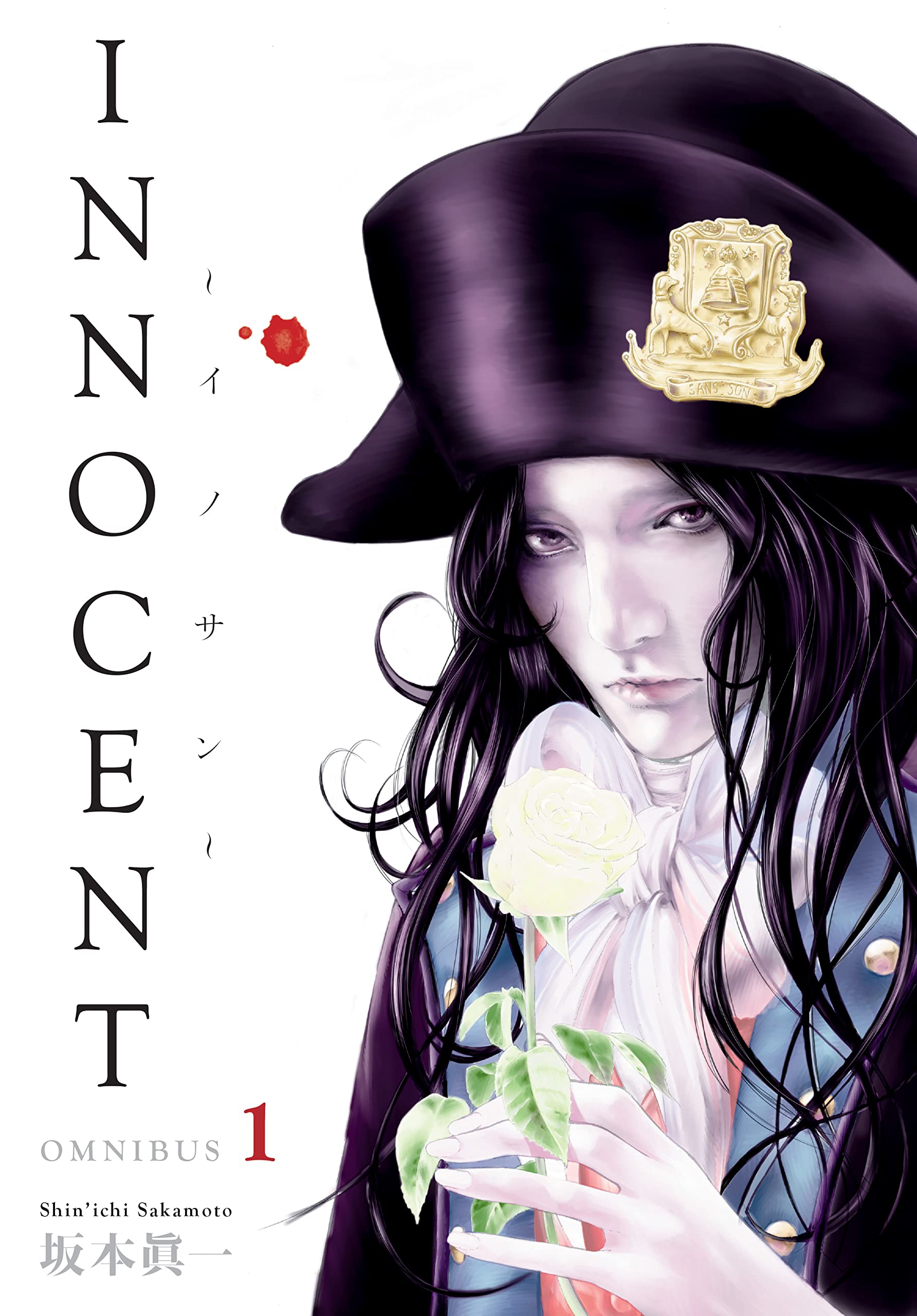
Blood, death, and duty—the title bequeathed to the heir of the royal executioner becomes a burden too heavy to bear.
In this omnibus edition collecting volumes 1-3 of the original manga series, Shin’ichi Sakamoto masterfully fictionalizes the true life of Charles-Henri Sanson, the "Gentleman of Paris," who performed nearly three thousand executions in 18th century France.
Born into a family of executioners, Charles-Henri Sanson must take up his father’s mantle as the Royal Executioner of Paris. Conflicted between his desire to honor the family name and rebelling against the longstanding practice, he chooses to follow tradition, but vows to be the last executioner—the last Sanson to spill blood in the name of justice.
Available in English for the first time and presented in a special omnibus edition collecting volumes 1-3 of the original Japanese manga series!
Sakamoto Shin'ichi (坂本眞一) is a Japanese mangaka. He is mostly famous for his series Innocent and Innocent Rouge. He is currently working on #DRCL midnight children based on the classic by Bram Stoker.
Yeah that's as freaky as I remember. Gorgeously illustrated and poignantly disturbing. Nice to start rereading this series with an official translation!
It is so twisted that I harbour the desire to protect someone, despite being equipped only with talons that are made to rend human flesh.
I've read from this mangaka before, his #DRCL series, and it's on the strength of loving that that I picked this series up. Innocent follows the life of Charles-Henri Sanson, who served as the executioner of Paris before, during and after the French Revolution. This first collected volume starts when he's just 14 years old, a boy who loathes his family legacy and has no desire to become an executioner.
Though this seems pretty well researched, a lot of it is obviously fictionalised. Or at least, I'm taking it that way. I know that some of these side characters were also real life people, but not all of them. Charles-Henri's negative feelings about being an executioner seem to be genuine, but I have no idea how to judge its portrayal, especially taking into account the family dynamics. But it makes for a really interesting narrative. A lot of perverse and complicated family dynamics here. Abuse, in childhood and adulthood, and how it impacts a person.
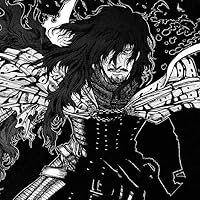
The art style is so incredible. I love it. Lush, really detailed and beautiful, but there's something also very uncanny and creepy about it. And I mean that in the best way! The way expressions are drawn are so vivid and arresting. And when you pair it with some of the weird and fucked up things happening in here... woof. It gets pretty explicit with the torture and violence; some really stomach-turning stuff. It's also fairly sexually explicit, with some weird oedipal stuff happening with side characters, lol.
It was really interesting to see all the bits of queerness; Sakamoto seems to be writing Charles-Henri as bisexual or gay. IDK if that's historically accurate, but it did lead to a lot of moments that I loved, and some stuff that made me sad. I REALLY liked Charles-Henri's hypothetical dance with Damiens. I'm also really interested in the character of his little sister, Marie-Joseph, who I think will play a larger role in coming volumes. That should be interesting.
Very much looking forward to continuing with this. Historical manga that I'm actually interested in are few and far between, so I'm glad I tried this. It would have been worth it only for the art, but I'm glad I'm enjoying the story too.
This is a hard one to rate. The art, for the charcater faces, clothing and backgrounds, is great. The characterization of Charles Henri is done well and his internal battle is highlighted. However, a lot of the scenes are absolutely horrific, which I did expect going into this with the synopsis. A dark story with well realized sets for sure, but not for the faint of heart!
First of all, the omnibus edition of this has resulted in very poor gutter loss when it comes to art over 2 pages. Which is a shame as Sakamoto's art is extremely detailed.
The story on the other hand? Like with #DRCL Midnight Children, I find it to be a bit all over the place? However this one just had some odd turns thrown in that left me saying "WTF".
Un manga que no fa presoners i una historia embellida per la seva brutalitat. Trobo, però, que el format i l'edició no li fa un favor a un dibuix que necessita de més espai per lluir moltíssim més del que ja ho fa.
5/5 artwork- seriously some of the best I've ever seen, ranking somewhere amongst the likes of the great Kentaro Miura 3/5 story and concept 2.5/5 storytelling
This volume was kneecapped by some very stunted, confusing storytelling. I often found myself going back a few pages to try to figure out when something was happening, or why. I have read that this improves somewhat in subsequent volumes, and given that this is one of the most beautiful graphic novels I've laid my eyes on, I'm willing to give it a chance.
I'm still not convinced about this series. Although after reading some reviews it's said to get better in the last 2 omnibus. I'll see how I get on with vol 2.
Charles-Henri Sanson remains a historical figure of significant mystique. Sanson served as the royal executioner of France during the reign of Louis XVI and administered over 3000 executions in his tenure. Infamous for his advocacy for the use of guillotines, Sanson would later go on to use the same instrument to execute Louis XVI himself. Shin'ichi Sakamoto deconstructs the mythos of Charles-Henri Sanson by crafting a dramatized story about the man, though much of Innocent is made with excess creative liberties.
The story across the three volumes collected in this omnibus focus primarily on Charles-Henri Sanson's early childhood leading up to his coming of age where he serves his father as an apprentice. Charles' father, his father's father, and his father's father's father were all executioners, so the practice remains a family business. Though Charles is compassionate and loathes the idea of killing, he meekly follows his father and grandmother as they push him hard into the career. The story is pretty perverse at times, depicting sexual abuse and violence rather freely. I personally don't take issue with this if it serves the story well, but here it comes off as oddly grotesque and even off-putting. Charles' and his siblings experience some incredibly vile bits of abuse, much of which kicks off the opening few chapters. It'd be understandable if some readers couldn't make it past this point because it is rather awkwardly written and depicted. Though the story does improve in the latter half of this omnibus, the lingering ick from certain portions never really dissipate.
Shin'ichi Sakamoto's artwork is breathtakingly great though. A fine line is used throughout, crafting some truly picturesque backgrounds. Sakamoto brings the historical setting to life easily, with grandiose depictions of the architecture, fabrics, weapons, etc. of the time. Though Sakamoto does draw some pretty gory segments, the artwork remains refined and alluring the entire time.
It’s a twist on Charles-Henri Sansón ( the royal executioner of Paris) and how he decapitated probably over 3,000 people. During the process of the French Revolution ( a little before and after) many key figures like King Louis XVI, Queen Marie Antoinette, Maximilien Robespierre, Louis Antoine De Saint Just, and George Danton just to name a few.
It really talking about Charles-Henri’s Inner turmoil with what he believes and what he’s forced to believe in.
This was such an interesting book. I didn't think reading about the executors of France would hold my interest but this really did just that. I read all 600+ pages of this in about 24 hours, I couldn't put it down. I will 100% be reading the rest of this series.
I've been wanting to read this one for a few years now and it didn't disappoint! I really enjoyed the art (truly gorgeous—especially how the shadows were played with) and the conflict within the main character and his family. going to get my hands on the 2nd omnibus asap 😭😭❤️
"Innocent" Omnibus Volume 1 collects volumes 1, 2, and 3 of the manga "Innocent" by Shin'ichi Sakamoto. The art is beautiful. The story itself is not.
The manga takes place in the 18th century in France. It follows a family of royal executioners, all of whom are fated to take up the job of executing people. The main character, Charles-Henri Sanson, is just fourteen years of age when it is decided that he will take over for his father. Charles-Henri does not want to become an executioner, though, as he believes that only God has the right to take the life of another human, even if that person has been found guilty of crime. His family sees him as weak, his own father torturing him for days on end until the teen finally submits.
Charles-Henri does eventually begin to execute prisoners, though it is shown that he is a sort of 'angel of death;' he tries to make the executions as painless as possible as often as he is able to. He aids people throughout France, serving a sort of doctor as well.
The story stops focusing just on Charles-Henri in order to focus more on the debate of the morality of executions. The story also explores the idea that those in power--the rich, nobility, etc.--often use their money and lineage to escape the noose more often than not, even thrusting unwanted members of their own family onto the executioner's block in their stead. The poor and outcast are often sent to die for petty crimes, as though to keep them in line while the wealthy do whatever they wish.
Sounds rather familiar.
Shin'ichi Sakamoto's art is beautiful. There are so many details in every panel, so many beautiful and grotesque scenes. There is a parallel in Sakamoto's art between the angelic and the disgusting, the gorgeous and the gory. It's really lovely, and I want to study it. The only real problem I have with the artwork is that a lot of the characters have the same face. Many of the other young, beautiful men in the story look almost exactly like Charles-Henri, save for their manner of dress or their hair color (It should be noted that Charles-Henri is the only character in the Omnibus to have dark hair, setting him apart from all of the blonde lookalikes.)
I would like to read the other volumes of this manga eventually, as volume three leaves off on a sort of cliffhanger, but it is a lot to take on emotionally. If you aren't good with a lot of gore, heavy topics, and sexually weird family dynamics, I would skip "Innocent." If you're into those things, then by all means, read it. It's available on Libby, which is how I found a copy.
Fascinating subject matter, nice art, and way more erotic than I expected (bordering on pornographic)
Innocent Omnibus Volume 1 by Shin-ichi Sakamoto is a manga depicting events leading up to the French Revolution.
First, let me just say the art does a good job of depicting the beauty and filth of France leading up to the reign of terror.
The story follows the struggles a young Charles-Henri Sanson, the heir to the position of the royal executioner of France (which has been handled by his family for generations). He comes to grips with the brutality and messiness of the role he will be expected to take over, while also displaying the horror of various forms of execution (but mainly focusing on beheading with a sword).
I actually enjoy this as most stories covering execution almost exclusively focus on the guillotine, but the writer here presents just how bad it was before that “humane” invention was created. In fact, Sanson unknowingly encouraged the creation of the final blade when the number of executions rose dramatically (as he only had two swords to use and they would eventually dull over time and become less effective).
Wonderfully blood and sexually graphic…I didn’t know I needed a manga about this subject matter, but it was kind of intriguing…
this one is really hard to rate. the artwork is superb (sumptuous and occasionally astonishingly brilliant; easily five stars), but the plot devolves quickly into literal torture porn (at which point your mileage may vary). just know what you're picking up before you dive into this because whole chapters are dedicated to the very detailed and explicit degradation of human bodies ~ and nothing is sacred. there's also a smattering of sexual violence just to keep you queasy and reeling.
without spoilers this is about a family in which children are tortured to prepare them to become executioners, so be aware there is an added level of serious squick on top of everything else. i am getting squeamish in my old age, so there were brutal panels i had to look away from. this book is an achievement, honestly, but i'm not sure in what other than its technical finesse. for the morbidly curious and those who want provocative, gorgeous visuals with their very degenerate storytelling.
How do you stay pure of heart in a world built on needless cruelty?
The art by itself is more than worth the price, but the story elevates it to something truly sublime. This is a story of otherness, of someone who is fundamentally unable to fit the roles society demands of him. But instead of becoming bitter and angry at how he is abused and mistreated he turns his suffering into compassion and a drive to use his unique position--no matter how much he hates it--to make the world a better place. It's a study in contrasts as well, containing both some of the most horrific images in the medium of comics and some of the most sublime, a dizzying blend of utter barbarity and breathtaking beauty.
Innocent is absolutely not for everyone. The graphic brutality of the subject matter and its unflinching depiction rules it out for many. But if you are in the right headspace for it, you're in for a transcendent experience.
Whew, this is not an easy book to read. Telling a fictionalized - and likely romanticized - version of the life of French executioner Charles-Henri Sanson, the book charts his discomfort with the family profession and the expectation that he'll join it and the beginnings of the French Revolution. Although this omnibus ends in 1757, well short of 1789, we can really see how things were already going sour, and Sakamoto draws some interesting parallels to how Sanson is important in that his role will help pave the way for a world where "executioner" is no longer a regular profession. The art is gorgeous (and the costumes luscious), but this is a book you want to really think about before just jumping in. Like Charles-Henri's horrible grandmother, it takes no prisoners.
Charles-Henri Sanson was born as the eldest son in a family of executioners in pre-revolution France. He doesn't want to kill anyone, but his family lets him know that if he doesn't follow his destiny as a royal executioner, he's useless and replaceable. He was born to follow the will of the family. Charles chooses to honor his family's tradition by becoming an executioner, but vows to never marry and stop the bloodline with him.
First of all, the artwork is beautiful, it's gorgeous, it's breathtaking. Which makes the death scenes all the more gruesome. This is definitely the furthest edge of my comfort zone, but still enjoyable to read. I'm very invested in Charles' story and his growth. It's truly heartbreaking seeing the injustice and the emotional trauma Charles goes through, but its necessary to show why France changed.
Holy fuck. This book proves that I can understand history. It just has to be an anime Twink form. I feel like this is the best book that I have actually read in my life. And I’ve had read a lot of manga in my life, but this one takes the cake. Why are all the characters fine as fuck? I’m going to lose my fucking mind. Like lemme crack Charles, lemme crack his uncle, lemme crack soubise (freaky mf). The characters are so fuckable. But apart from how attractive the characters are, sakamotos art style has to be studied by professionals. There has to be an organisation that donates monthly donations into the research to find out how this man can create such a beautiful illustrated book. I had no idea about the French revolution until I read book. I am going to cry knowing that I cannot read the English translate of innocent rogue yet.
This entire review has been hidden because of spoilers.
If I were rating this on art alone, it would be 5/5 no question. That’s why I picked it up. But manga or comics about historical figures will always have a sense of absurdity. Even the emotionally charged moments feel a little ridiculous. Thinking about how this REAL executioner, 300 years later, will be drawn as a pretty gay manga boy… it’s hilarious. There’s also a lot more sexual content than I expected, so it feels a liiitle like a torture fetish comic? There’s definitely plot, very oddly paced, but there’s a few too many pretty boys making orgasm faces while being tortured, half the time by family members.
Anyway, I won’t be reading more of this series but it’s SO beautifully drawn that I’ll likely reread this a few times.
Took me a while to get into this morbid historical graphic fiction but seeing the creative liberties the author takes with real events was worth the wait. Even a little bonus oedipal complex/BDSM mixed with grandma Anne, who doesn't look a day over fourty, mind you. There are some little moments that took me out even though they were enjoyable like the modern bishonen rendition of Charles-Henri and Damiens toward the end of Volume 1. Just felt like it didn't need that to get the cutesty homoeroticism sprinkles translated to the audience. Otherwise I came for the morbid and pretty art style but am reading on since the family dynamic is toxic and interesting and it's fun to see a mythos built behind something otherwise brushed under historical rugs.
What a beautiful manga. Innocent is an historical horror manga that focuses on the Sanson family of executioners in France, specifically Charles Henri-Sanson. This manga takes a unique approach to the terrible topic of execution and justice, giving detailed accounts of Charles’ thoughts and approach to such a burdensome job and title. Though he killed thousands of people in his lifetime, Charles-Henri Sanson is written with unexpected depth and humanity. As a fan of historical fiction, I found this manga to be mesmerizing and horrifying at the same time. The art style is intricate and soft while the topic is barbaric and horrifying, creating a rich dichotomy.