He was born in the swamps of the Eastern States, but he came of age on the frontier. Now, Jean LaFarge finds himself swept up in an epic battle in the wilds of Alaska, where a tyranical Russian has seized control of the fur trade-and the land. But Jean has never backed down from a fight, even one as bold and dangerous as this-a battle that will shape the future of America.
Louis Dearborn L'Amour was an American novelist and short story writer. His books consisted primarily of Western novels, though he called his work "frontier stories". His most widely known Western fiction works include Last of the Breed, Hondo, Shalako, and the Sackett series. L'Amour also wrote historical fiction (The Walking Drum), science fiction (The Haunted Mesa), non-fiction (Frontier), and poetry and short-story collections. Many of his stories were made into films. His books remain popular and most have gone through multiple printings. At the time of his death, almost all of his 105 existing works (89 novels, 14 short-story collections, and two full-length works of nonfiction) were still in print, and he was "one of the world's most popular writers".
An orphan lives in a swamp near the Susquehanna River, making a meager living selling herbs in the local village. His mother has died and the father becomes a mountain man, in the wilds of the Rockies. Jean La Barge, has only one friend Rob Walker, a shy little boy from a good family that of course doesn't want their son hanging around with a worthless kid , who the mother is rumored to have been a gypsy! A group of thieves return to the area planning to rob and kill Captain Hutchins, a wealthy merchant leaving soon for the West. The 14 -year -old Jean and Rob about a year older , follow a stranger into the spooky swamp, as the cold night falls. In a stone house the robbers enter, Jean sees three men inside the house through the window. He bravely but unwisely gets closer, in order to hear what they're saying. Captured by the gang, La Barge is lucky when the unknown to the thieves, Rob returns with Captain Hutchins and some villagers. Pennsylvania, before the Civil War was still not quite civilized. The very grateful captain, takes the willingly Jean out into the lawless West with him. After fur trading and crossing the U.S. many times, they become rich. And with the gold rush in California Jean travels to San Francisco, selling supplies to the appreciative miners. Then buying a schooner renamed the "Susquehanna" and heads north to Alaska. A childhood dream but a Russian colony then. Having met a Russian Princess and falling in love with her but this fairy tale has a big catch, she's married. Illegally buying pelts from the Indians and escaping the pursuing Russian warships. Eager to see Princess Helena again , he goes to Sitka the old capital of the huge territory, bringing much needed wheat. If only the beautiful niece of the Czar was single...but Jean is a patient young man, he can wait and maybe happy ending do happen outside of a book. A good read for fans of Louis L 'Amour or anyone else, those that take the plunge will not be disappointed.
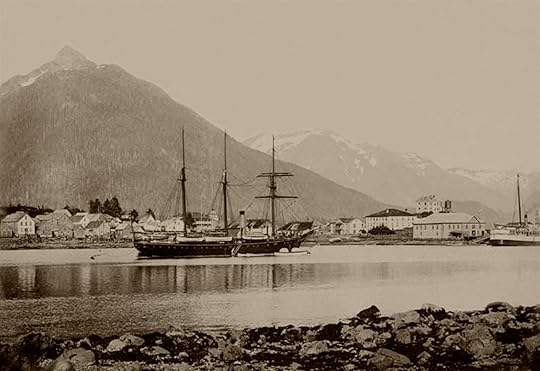
The United States purchased the land of Alaska in 1867, what some called Seward’s Folly. Western writer Louis L’Amour wrote his novel Sitka about events leading up to this purchase in 1957.
This is early L’Amour and his writing seems influenced by and reminiscent of Twain or Dickens. This is a bildungsroman about Jean LaBarge and his progression towards mastery in Alaska from very humble beginnings in the Susquehanna swamps.
LaBarge is an archetypal L’Amour protagonist: tough, resilient, capable, courageous, strong and tall. L’Amour describes him from a young orphan making his own way in the swamps of eastern Pennsylvania in the early parts of the 1800s to his journeyman years in the west, hunting and trapping, to time as a Shanghaied sailor to his comeuppance in San Francisco and then Alaska as a ship-owner and entrepreneur.
While most all of L’Amour’s prolific work could classify as historical fiction, there is a distinction between those that are clearly “westerns” from the 1850s to the 1890s involving cowboys and Indians, gunslingers and lawmen, and the “others” those set in and about western themes without necessarily having the Gene Autry / Roy Rogers look and feel. Sitka is in this second category, where we spend some time in San Francisco, Sitka and even Czarist Russia.
A lesser known gem from his extensive and impressive canon.
I launched into Sitka mere hours after finishing The Walking Drum, as I couldn't accept the idea that the adventure was over and immediately craved more of Louis L'Amour's unique blend of action, intrigue, and history. Having already gone into some depth on his style and ability as both a writer and storyteller in my review of The Walking Drum, I won't do so as much here; however, if any clarification is needed, I recommend checking out both the review and the book.
This novel brings the reader back to the most common setting and subject for L'Amour's novels: the westward expansion of the United States during the mid- to late-19th Century and the men of mettle whose unique abilities made surviving the frontier not only possible, but oftentimes even profitable. The story follows the adventures of Jean LaBarge, a young man who rises from humble beginnings as a swamp-dwelling orphan to become one of the most successful and well-respected merchants in the burgeoning young city of San Francisco during the years following the famous gold rush. It is through his travels and dealings there that he learns of and begins to obsess over the newest untamed land of interest: Alaska, also known as Russian America. Of course, his interest is further fueled by an encounter with a beautiful young woman who steals his heart and who just happens to also be a Russian princess, heavily involved in the political turmoil surrounding the territory and its future. The escapades that unfold involve ship chases, gunfights, a formal duel, a tour of St. Petersburg and meeting with the Czar, and an ongoing rivalry with a ruthless and vindictive Baron; only Jean's keen intellect and shrewd planning will see him through, if anything can. Little does he know, however, when he sets out with the intention of making a fortune by sneaking fur pelts past Russian patrol ships, that his actions and knowledge will help to shape the futures of two nations.
Once again, L'Amour's exceptional story-telling ability and stream-of-consciousness writing kept me turning the pages long after I intended to stop, and many an hour of sleep was lost to the desire to reach the end of the journey. I also learned more of the conditions surrounding the Alaska Purchase than I was ever taught in school; it's as though the man had the entire Wikipedia site available to him, decades before the internet was available for private use, not to mention geographical information on par with or better than that offered by Google Earth. I was yet again impressed with L'Amour's detailed research and flawless incorporation of fact into his riveting fiction, and even setting that aspect of the novel completely aside, I was quite entertained by the story. Mark Sitka down as another novel I would recommend to anyone, especially those who are fans of action / adventure, political intrigue, and historical fiction.
Basically, Sitka is an origin story for the state of Alaska.
I'm not even joking.
Jean LaBarge grows up in the swamps of Pennsylvania before heading off into the wilderness and ending up a young man on the California coast. He spends a lot of time on sailing ships. He gets big and tough and true-hearted, like all the best L'Amour heroes. He keeps in touch with his childhood best friend, who stays in the East and becomes an important politician.
And he obsesses over Alaska.
Now, having been obsessed with Alaska myself since I was 11 years old, I understand that last bit. I actually bought my copy of this book while in Alaska last August. It took me thirty-four years to get there -- quite a bit longer than it takes Jean LaBarge. He gets there while it still belongs to Russia and helps to open up to the possibility of Russia selling it to the United States. He also spends several months crossing Russia from the Pacific to the Atlantic. He falls in love with a Russian princess, with a sort of classic Medieval courtly love, since she's already married to a really great guy. He makes enemies and defeats them. Lots of really exciting stuff happens in the best style of L'Amour's sweeping epics.
It took me six months to read the first 60 pages of this book, and three days to read the last 250. Make of that whatever you want.
Δέκατο ένατο βιβλίο του Λουίς Λ' Αμούρ που διαβάζω, μόλις το τέταρτο που του βάζω πέντε αστεράκια. Ναι, μου άρεσε πάρα μα πάρα πολύ. Είναι μέχρι στιγμής από τα πιο χορταστικά μυθιστορήματα του συγγραφέα, μιας και ξεπερνάει τις τριακόσιες εβδομήντα σελίδες, με τις περισσότερες από αυτές να είναι γεμάτες δράση, αγωνία και ένταση. Δεν είναι καθαρόαιμο γουέστερν, θα έλεγα μάλλον ότι δεν είναι καν γουέστερν, μου φάνηκε πιο πολύ σαν συνδυασμός ιστορικού μυθιστορήματος και περιπέτειας, με αχνά στοιχεία γουέστερν. Όπως και να 'χει, πρόκειται για ένα απολαυστικό μυθιστόρημα (για τους λάτρεις του είδους πάντα), που σε ταξιδεύει μεταξύ άλλων στην Αλάσκα του 19ου αιώνα και σου χαρίζει δεκάδες δυνατές σκηνές και πολλές εικόνες άγριας ομορφιάς. Η γραφή είναι όπως πάντα πολύ καλή και γλαφυρή, με ακριβείς και ζωντανές περιγραφές, και οι χαρακτήρες έχουν ένα κάποιο βάθος, με αυτόν του πρωταγωνιστή να ξεχωρίζει και να είναι ο καλύτερα σκιαγραφημένος. Φυσικά, η ατμόσφαιρα είναι εξαιρετική. Πολύ το χάρηκα το βιβλίο, μου έμαθε και ορισμένα ενδιαφέροντα πραγματάκια για την Αλάσκα του 19ου αιώνα, και σίγουρα κατάφερε να με ταξιδέψει στον χρόνο και τον χώρο, μακριά από την πεζή πραγματικότητα. Υ.Γ. Καλή η μετάφραση για τα χρόνια της, αλλά με πολλά λαθάκια επιμέλειας. Περισσότερα από όσα συνήθως συναντάω στα βιπεράκια. Αλλά δεν πειράζει, εγώ το βιβλίο το απόλαυσα.
My first Louis L'Amour book and I mostly read it for the Russian Alaska angle and a supposedly alternative history angle (its there, but in a minor way IMO). The book started out OK, but the Mary Sue-ish main character who excels at everything and survives every challenge and injury thrown at him almost in stride, grew tiresome after a while. He's not unlikable, far from it, but with a protagonist like this there's never any real risk (to him anyway), and this frankly bores me. The author clearly did a lot of research and is well versed in the period and the American continent, but one thing bugged me; how is the protagonist able to communicate verbally in Russia? If he speaks Russian, that's never established and I have trouble believing that people in Siberia in the 1860s spoke a whole lot of English (perhaps his companions interpret, but again, never established as such).
All in all, decent enough, but what started out as a 3*, got downgraded to a 2* on contemplation.
I’ve read several other L’Amour books, and it never fails to surprise me just how good they are. The same goes for Sitka. The level of detail and historical accuracy is incredible to see. All the while telling a great story.
The writing is very immersive. You can picture the setting with ease. At the same time though, it is not overly flowery or descriptive. It is precise and concise, but never feels rushed.
I’ll undoubtedly go into more detail when I film my review, so be sure to look for that in the coming weeks.
Best writer of all time of frontier stories. Who wouldn't dream of a man such as Labarge. An honest man who helped bring in Alaska to the States. Louis Lamore writes as if he lived these stories. Loved it!
Jean Labarge, an orphan born in the swamps of the Susquehanna and a regular dabbler in adventures of all sorts, has long dreamed of the West, and especially the promise of the Alaskan wilderness. As his story unfolds, we get to watch him live out his dream, growing into a rugged fur trapper, merchant sea captain, and eventually becoming a pivotal force in the US’s purchase of Alaska from Russia in 1867. Along the way, he meets and falls in love with none other than the beautiful (but already married) niece of the Czar, himself. Talk about adventure!
I feel fortunate to have visited the unique and interesting town of Sitka, Alaska, and therefore looked forward to reading this novel with great anticipation. It’s a fairly early Louis L’Amour novel, written in 1957 and reflects his earlier writing style. It’s much more of a historical novel than the more typical western that we often think of when L’Amour’s name is mentioned. While most of the plot takes place in Alaska or in the surrounding seas, there are also lengthy sections in the American south as well as Siberia, and all the way to St. Petersburg.
The book itself is about fifty percent longer than the average L’Amour novel and while there were, indeed, more “events” occurring, it seemed the overall novel dragged a bit in places. That was easy to overlook though, given the inspiring nature of the “disadvantaged orphan makes good” plot. I wouldn’t necessarily recommend starting your L’Amour reading roster with this novel but at the same time, don’t leave it off the list all together. Sometimes a longer L’Amour novel like this one allows for more in depth characterization.
The story of how I pulled Sitka off the shelf is really not exciting. Audrey and I took our family to the library in the next town over and decided that it would be fun to go inside, find a random book, and take it home to read. Just like what we used to do when we were kids and before things like Goodreads decided what I read next.
Well, I'd been itching to read a western and Louis L'Amour is one of the most well known western authors. I headed his direction, found a book named after a town in Alaska, and decided that it would do.
It took me a while to finish Sitka. I got really into the first 60% or so, and then I slightly lost interest. It could be this specific book, or it could be L'Amour or the genre as a whole, but I felt like the fast-paced start, the political intrigue with many of the side characters, and allllll the sailing terminology (Marty Reeder would be proud) made for a really exciting setting.
But just after the midpoint in the book, I felt like the main conflict had been resolved. I wasn't sure what to expect, and there was no main conflict or interaction that I was interested in seeing out. I did end up finishing it in a couple of days, but I don't know if the last 100 pages were justified. The only confrontation that I was remotely looking forward to never happened and many other character arcs felt unearned and convenient. I'm probably reading too much into it and being too critical. It was my entry into the western genre, so I ought to give it more grace.
Sitka was a good read. I enjoyed our protagonist and his accomplices, I loved the barfights and narrow escapes on the ocean. Even the romance (however shallow) was less cringy than I expected. The ending left something to be desired, but I had a decent time in L'Amour's world.
I've never much cared for L'Amour's work, but having grown up in Alaska, and having found this book for 25 pennies, I was curious about this story of back home. It was a pretty good yarn, steeped in historic events, and his descriptions of the coasts and woodlands brought back memories. My only real complaint about this story was that it felt rushed. Entire passages that spanned months, and contained vital information for the plots, were given little more than a half page treatment.
Sitka is a western novel about the frontier and at its center is Jean LaBarge, a "tall, dark, and dangerous-looking man with [a] scar." We follow the story of Jean's life from Mississippi to Sitka as America expands its borders, culminating in the purchase of Alaska. Along the way, he rides horseback through hostile country, sails in the far north, and navigates more than a few fistfights.
I read Jean as a typical hero, the sort that can be found in many westerns. He comes of age in a cabin in Mississippi swamp, he has no parents, and he is "one of the untamed." He is clever enough to learn many trades, from sea craft to fur trading, and he is gritty enough to fight with fists and with duelling pistols. What a man!
He doesn't marry, though he does fall for a married woman, Helena, who is also attracted to him. Why hasn't Jean married? In Helena's words, it is because "you would lose your freedom, and a man like you should be free, free to fly far and high like an eagle. A wife would tie you down, she would hold you." When Jean implies that he would marry Helena, she disagrees, saying "I should think a man would always long for freedom. It is hard, I think, for a man who has known freedom to give it up." Jean is very capable, but he is free of responsibility, even though he runs a ship and is responsible for the well being of its crew. But he can dismiss those men if necessary, though of course he never would because he's a good guy. For much of Jean's childhood, he dreams of becoming a mountain man and taking his best friend, Robert, with him. In these moments, I couldn't help recalling Brokeback Mountain, which I re-read last spring, and Proulx's decision to use a western to explore homosexuality in America. The genre, especially when set in the 19th century, seems a natural choice for postmodern irony.
At first glance, this is an adventure novel about LaBarge bootstrapping his way to prosperity, independence, and freedom, but it is also historical fiction about the American purchase of Alaska from Russia. It is worth pausing to think about L'Amour's presentation of the land. There are two types of land here: the tamed country and the wild country, or the frontier. The tamed country, which we see especially in San Francisco, is full of intrigue and corrupt dealings. Jean is shanghaied into serving aboard a ship, though he ultimately overcomes this misadventure and becomes captain of his own schooner. The first hint of wild country is Jean's childhood Mississippi swamp. It is dangerous to outsiders because it is "lost, remote, unvisited," but it is untameable Jean's home. Alaska is a frontier, and Helena describes it as "young and free," even if it is "barbaric" in the words of her husband. Helena is attracted to the frontier for the same reasons she is attracted to Jean.
The Indigenous peoples, the Tlingit, are mostly presented as sympathetic to the Americans, who here treat them really well relative to the Russians. If they are given a political voice in the exchange of the land, I missed it.
There is something ironic in this novel's depiction of manifest destiny. The frontier is free but it is also clearly the object of Robert J. Walker, an American politician who is here given credit for setting the wheels in motion for the purchase of Alaska, to turn all of the frontier land into tamed American country. America is the land of the free, except in westerns. Jean, in aiding his country, is undermining what he loves most about it. But maybe it's also obvious that the masculine frontier freedom that Jean thrives within is an unattainable fantasy, the sort people, mostly guys I'd imagine, still engage in when they go hunting in a cabin in the woods to tell dirty jokes, eat too much, and fart with pride (and maybe a deer or birds will be taken). Perhaps westerns are better understood as a reminder to men to sow a few wild oats before settling down. Settling down may not be absolutely free, according to Sitka's depiction of freedom, but there is something warm and real in it. If so, the most "American" man L'Amour shows here is a local militia leader who enters the swamp to fight a band of outlaws before returning home to his family and his town.
A final note. I often thought of the Sharpe novels while reading Sitka. Both heroes have dubious romances, are caught in more than their fair share of fights, and they are both plucky heroes who adventurously carry the reader through history presented in broad strokes. For now, however, I prefer Sharpe to LaBarge. Sharpe has a way of scraping through every skirmish by the skin of his teeth, whereas LaBarge overcomes every obstacle with his American can-doism. Having said that, readers looking for adventure would do well to read Sitka.
This book could have been aptly titled "Shades of Anthony Hope". I'm not saying Louis stole the story from Hope's The Prisoner of Zenda because all stories that we tell have been told by someone before us. But I think Hope told it better. This book wasn't boring, hard to read, or a rip off. There were parts of it which I really enjoyed. More than likely, I'll be checking out some more L'Amour soon enough. But Sitka's characters didn't pop off the page, the story didn't drag me to the paper, and the plot always seemed like it was one page away from really getting started. All that said, the courthouse scene on the last couple of pages was fantastic. Three of five stars for good but not really good. Thanks for the read, L'Amour.
This was the first Louis Lamour book I ever read. I read it around the time I started high school and I’ve read it multiple times since. The author is known for writing western novels but this book, while set partly in the western US, is not a cowboy book in any way. As he said himself, he doesn’t write just westerns, he writes frontier novels. The protagonist is a well developed character and has many aspects in him that I would want in myself.
I read a lot of Louis L'Amour back in my teens, but this is the first time I've read Sitka. It is an early work of his, and I don't think it's his best. But protagonist Jean LaBarge is the typical L'Amour hero—tall and strong, a skilled outdoorsman and fighter, and a lover of books and knowledge.
Russia and the United States dispute Alaska prior to its purchase. Throw in are American ship captain, a Russian noble, and a beautiful Russian woman and you have the recipe for trouble. At stake is the lucrative Alaskan fur trade. Told in the masterful way of Louis L'Amour.
So much to like about this. I haven't read a L'Amour since high school—but if you've never read one, you're missing out. On the more quality side of pulp fiction—try Sitka or his Sackett series.
Reminded me a bit of Master + Commander. Some very fun "sea gimmick" moments, like decoy ships and portaging an entire schooner across a bivouac.
L'Amour isn't a flash writer—but he writes descriptions well and, like Agatha Christie, is able to encapsulate a type of person very quickly.
I liked the main character. I especially liked the historical setting (America on the verge of buying Alaska from the Russia in the 1800s) which I knew nothing about. (Wait, Russia used to own Alaska?!)
Only quibble was the chivalric romance between the main character and the married lady—distracting from all the other fun going on.
This book shows how even towards the beginning of his novel writing career Louis L’Amoir was an amazing writer and an amazingly talented storyteller. Unfortunately you have to be willing to put up with decent chunks of casual racism and sexism, and the rose lensed view of America to be able to enjoy the good stuff.
A solid L'Amour story but not his best; I begin to realize that there are maybe half a dozen really amazing L'Amour books and the rest are enjoyable but nothing special. I did really like the different setting of this one, and I learned a lot about Alaskan history. I hadn't realized that Russia had a colony in Sitka, Alaska for almost 70 years until the United States purchased the Alaskan territory from the Russians, for example.
Unrelated to the story, but the cover of this book makes me laugh. We've got a taller Peter Dinklage as LaBarge (not a criticism, just an observation), and the woman is clearly supposed to be Helena, but it looks for all the world like the artist just gave up on her. How do you draw a girl? I don't know, put a bunch of layers on her, nobody will know the difference. She could have four arms under there. Royally messed up her face? Eh, just put a scarf on, it's Alaska. Never mind that LaBarge looks like he's dressed for a 60-degree day with that open collar. The scarf was so obviously a cover-up for a mistake that I at first assumed my cover had been damaged.
L'Amour is such a great storyteller, and several of his books are "go-to" books that I have read several times apiece. This is one I hadn't read before, and I really enjoyed it. It's not a cowboy tale - much of the action take place at sea. Very good.
Liked it, did not know that Louis L Amour wrote historical novels about early explorers, I like his westerns about cowboys, gunfighters, Lawmen & ranchers better. His dime store novels are still the best. They never go out of style !
A fun and refreshingly clean read after several weeks of YA “romantacy” yuck. High adventure against the sweeping vista of 19th century Alaskan wilderness and rooted in a surprising depth of historical research and detail. Thoroughly enjoyable.
I enjoyed this book a lot more than I thought I would. I swing back and forth between a 3 and a 4. Given that I am not a big western/action reader, the pacing for this book was perfect, as situations resolved relatively quickly. Normally I would find the plot armor for the main character to be frustrating but it fit into the mythic feel of the narrative and L'Amour makes a point to emphasize how LeBarge came to be so good at what he does.
Ultimately I bought this book because I was in Sitka, it was mass market (small and portable), and I had never actually read a Louis L'Amour book before. Now I have. (I might read one more because someone who saw me reading it on the cruise said I should read The Walking Drum.)
Surprisingly well written for an early work of Lamour's. Historical fiction about Alaska being purchased from the Russians. Tad longer and more historical than the cowboy novels the author is known for. Nice book for a camping trip.
Book club selection for July. I'm trying to keep an open mind, but my expectations are quite low for an adventure novel written by the King of Pulp in 1957, when men were men and women were, well, mostly props.
UPDATE
I'm embarrassed about how grumpy I was when faced with reading this book. I certainly wouldn't have chosen it on my own, but I was pleasantly surprised by it, especially the second half, which focused more on the purchase of Alaska from Russia. This first half is more of a standard adventure story - not bad, but not really my cup of tea. Dialogue is not his strong suit, but he evokes the time and place quite vividly, with some passages that are quite lovely. Kudos to the female character too - I expected her to be just a prop, but she was a charming and decent woman, and quite respectfully represented. Overall, a fine book. Aside: I must admit, I thought of my father the whole time I was reading - he was a huge fan of L'Amour and probably read everything he wrote.