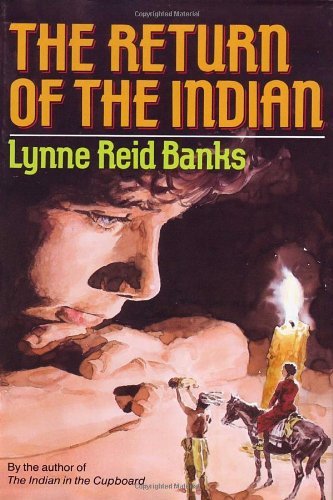
It's been over a year since Omri discovered in The Indian in the Cupboard that, with the turn of a key, he could magically bring to life the three-inch-high Indian figure he placed inside his cupboard. Omri and his Indian, Little Bear, create a fantastic world together until one day, Omri realizes the terrible consequences if Little Bear ever got trapped in his "giant" world. Reluctantly, Omri sends the Indian back through the cupboard, giving his mother the magic key to wear around her neck so that he will never be tempted to bring Little Bear back to life.
But one year later, full of exciting news, Omri gives way to temptation when he finds that his mother has left the magic key lying on the bathroom sink.
A whole new series of adventures awaits Omri as he discovers that his Indian has been critically wounded during the French and Indian Wars and desperately needs Omri's help.
Now, helplessly caught between his own life and his cupboard life of war and death, Omri must act decisively if he is to save Little Bear and his village from being completely destroyed. What began as a harmless game has tumed into a horrible nightmare, a nightmare in which Omri is irrevocably involved, and from which he may never escape.
Book Details:
Format: Hardcover
Publication Date: 10/3/1986
Pages: 192
Reading Level: Age 9 and Up
Lynne Reid Banks is a British author of books for children and adults. She has written forty books, including the best-selling children's novel The Indian in the Cupboard, which has sold over 10 million copies and been made into a film. Banks was born in London, the only child of James and Muriel Reid Banks. She was evacuated to Saskatoon, Saskatchewan, Canada during World War II but returned after the war was over. She attended St Teresa's School in Surrey. Prior to becoming a writer Banks was an actress, and also worked as a television journalist in Britain, one of the first women to do so. Her first novel, The L-Shaped Room, was published in 1960. In 1962 Banks emigrated to Israel, where she taught for eight years on an Israeli kibbutz Yasur. In 1965 she married Chaim Stephenson, with whom she had three sons. Although the family returned to England in 1971 and Banks now lives in Dorset, the influence of her time in Israel can be seen in some of her books which are set partially or mainly on kibbutzim.
I wanted to like this one more than I did! Dang it, Lynne! The first and fourth were great but this one was so so. It seemed like a sequel just to make a sequel. Little Bear, Bright Stars and Boone come back during an invasion by the Frenchmen in the 19th century. Little Bear is wounded while Bright Stars is obviously carrying a child in the womb.
There were new characters and more Indians. Patrick and Omri even go back in time to help the Iroquois. They decide to give them 20th century weapons! Lots of learning time for Omri.
I still appreciated the author's imagination and I have grown fond of the characters but this didn't excel in the storyline. Such a wonderful way to look at plastic toys and history.
I am not sure why Lynne Reid Banks feels the need to ruin these great books with coarse words. The Indian in the Cupboard series are great. Boys and girls both love them. There isn't much that could be more exciting to a child than their toys coming to life. But is it necessary to us a--, and other words similar to this in a child's book? I just finished reading this aloud to my children. They loved it. I edited out the words that weren't necessary as I was going.
"The Return of the Indian", the sequel to "The Indian in the Cupboard", is about a boy named Omri, a boy named Patrick, a miniature Native American brave called Little Bear, and a miniature Native American squaw called Bright Stars. When Omri opens his magic cupboard again (after keeping it closed for a year) he finds that his best friend Little Bear is now an Indian Chief and he has been wounded. Omri and Patrick must help the wounded Little Bear. As Little Bear recovers, he tells them of the French and Indian War between his people and the French. Omri and Patrick have other Indians that would be willing to train to help fight in the War.
I liked this book but it wasn't my favorite book ever. I liked it when Boone, the miniature cowboy, made his dead horse a grave because I like it when people respect horses.
Overall, the Return of the Indian was a good book, but not amazing. The Indian in the Cupboard, the first book of the series, was more exciting, yet this was a good enough sequel. It has more problems and drama when Little Bear demands "now-guns," his name for modern guns. However, him and his tribe have no training on how to use them, and trouble occurs... Banks doesn't explain the characters as well as the first book.
La película basada en el libro fue muy importante para mi en su día y el hecho de haber podido regresar a ese tiempo a través de este libro ha sido increíble 😊💜
In my humble little opinion this book is practically equal in its appeal to the first, which can be tricky for a sequel. The magic is still there and its still a charming story, with the added bonus of extra characters such as Matron and Corporal Fickits. I love the way the dialogue is written especially that of Little Bull and Boone, and the author has really made it very easy to fully imagine the personality of each little person. I've read descriptions of the remaining books in this series, and I'm concerned they may ruin my love of this story - however, I'll give book 3 a go and see what happens.
A decent sequel, but not better than the first. I don't recall how many books in this series I read as a kid, but I'm probably going to stop now after rereading these first two. Good stories!
The Return of the Indian is the second of the Indian in the Cupboard series. After a year of keeping the cupboard locked, Omri decides to see Little Bear again.
When Omri brings Little Bear back to life he learns first hand the brutality of war. In an effort to help Little Bear win the war, Omri and his friends interfere first by sending weapons back and then by going back themselves.
See, it's not the cupboard that's magic, it's actually the key. But what and who can go back isn't exactly explained in this sequel. Perhaps later books dig deeper in the magic behind the key.
I enjoyed the darker themes of The Return of the Indian but I still found Omri a rather dull lead character.
I can see why there is a giant fall-off in readership between the first book and its sequel. Wow, what a fall from grace. We leave behind one of the best kid adventures stories ever to plunge into **spoiler** skinheads, dead horses, and bullying. And the fun doesn't stop there! Yikes, Suckville. I still love the characters, and Cal wants to keep on with it, but I hope Lynne Reid Banks manages a huge rally in the third book. She must have been really going through something when she wrote this one.
I loved listening to this with my son. It still had valuable life lessons, sobering ones about the fragility of life. I didn't feel it was as strong as the first one.
In some ways, this sequel is even better than the first book. Omri is a year older, so he's dealing with more mature issues, specifically some skinhead bullies in his new neighborhood. Similarly, Patrick, who spends part of the book denying that the events of the first ever happened, also represents this oncoming maturity. The boys are nearing the end of childhood.
The first few chapters are entirely non-magical. Omri has won a writing contest for the story of the Indian. Even though that bit is a bit self-congratulatory on the part of the author, it also has some good insights into the writing process, which can be very useful to kids.
Then we get into what we were waiting for - yay! - the magic. Because of the needs of the plot, even more characters come to life than in the last book, which makes things lots of fun. But at the same time, the book takes a serious turn, addressing some moral questions about violence and war, and there's no statement that violence is always wrong or always right. The Indian battle is just a horror, but the skinhead battle is a glorious victory. So it's a very mixed message, but then, so is reality.
If you don't want your kids exposed to violence, this is not the book for you. But it can be used as a good springboard for discussion. Certainly the characters are entertaining, and you've gotta love Omri, who always tries to take responsibility for his choices with his "little people."
I am reading these aloud to my 8 yo daughter. She is really enjoying them & I recommend them. One caution: the second book is less light-hearted than the first. Boo-hoo Boone is still often funny and the idea of tiny beings drinking from toothpaste tops and doing other mini things is still fun, especially I think for kids who play pretend like that with their figures, but Omri, through, his little people, faces death and loss, and the heavy consequences of decisions they make. [SPOILER - - - - - - - - - - - - - - - - - - - - - - - - - - - - - - - - - - - - - - - - I'm going to tell you who dies, so don't read ahead if you don't want a spoiler! - - - - - - - - - - - - - - - - - - - - - - - - - - - Boone's horse is killed by Omri's cat, and Omri feels responsible for not being watchful and because it is his beloved cat. A number of Indians die in a battle. (They are nameless, but we still definitely feel for them through the suffering of Little Bear and the nurse who can't save them.) The Indian death is hard on Omri too because it is a consequence of his allowing Little Bear to have "now guns." That there are consequences to decisions we make & actions we take is a good topic for discussion, but do use judgement when sharing with a sensitive child.]
Set in NYC. 183 pp. I like how this extended the realizations that Omri had about his role in death and war by playing like a god in Little Bear's world. It really brought to mind the end of the Futurama episode where the God character says to Bender, "Bender, being God isn't easy... You have to use a light touch like a safecracker or a pickpocket... When you do things right, people won't be sure you've done anything at all."
Read to my children. We really liked the first book. This book was also good, but not as good as the first. There were still a few belly laugh moments when these "larger" than life characters got up to their antics.
A few warnings, due to the time it is written in, there are a few racial slurs and derogatory remarks about certain people groups. Just bare that in mind when reading to kids.
That said, well take a pause before finishing the series.
Charming and whimsical and, yes, completely believable. But I didn’t love that Banks used moving Omri and his family to the “bad part of town” as a plot device.
Dnfed early on as I didn’t like the authors voice. I liked Richard e grant narrating the first one and I can’t find any versions of him narrating the rest of the series
Not as good as the first book. It was still good, but the story lacked the nuance and depth of the first. Also, there were a couple times when Omri seemed to act extremely out of character and that bothered me. But still a pretty good sequel.