Eight classic stories by the master of horror, Edgar Allan Poe.
The Cask of Amontillado Hop-Frog MS. Found in a Bottle Ligeia The Fall of the House of Usher William Wilson The Mask of the Red Death The Imp of the Perverse
The name Poe brings to mind images of murderers and madmen, premature burials, and mysterious women who return from the dead. His works have been in print since 1827 and include such literary classics as The Tell-Tale Heart, The Raven, and The Fall of the House of Usher. This versatile writer’s oeuvre includes short stories, poetry, a novel, a textbook, a book of scientific theory, and hundreds of essays and book reviews. He is widely acknowledged as the inventor of the modern detective story and an innovator in the science fiction genre, but he made his living as America’s first great literary critic and theoretician. Poe’s reputation today rests primarily on his tales of terror as well as on his haunting lyric poetry.
Just as the bizarre characters in Poe’s stories have captured the public imagination so too has Poe himself. He is seen as a morbid, mysterious figure lurking in the shadows of moonlit cemeteries or crumbling castles. This is the Poe of legend. But much of what we know about Poe is wrong, the product of a biography written by one of his enemies in an attempt to defame the author’s name.
The real Poe was born to traveling actors in Boston on January 19, 1809. Edgar was the second of three children. His other brother William Henry Leonard Poe would also become a poet before his early death, and Poe’s sister Rosalie Poe would grow up to teach penmanship at a Richmond girls’ school. Within three years of Poe’s birth both of his parents had died, and he was taken in by the wealthy tobacco merchant John Allan and his wife Frances Valentine Allan in Richmond, Virginia while Poe’s siblings went to live with other families. Mr. Allan would rear Poe to be a businessman and a Virginia gentleman, but Poe had dreams of being a writer in emulation of his childhood hero the British poet Lord Byron. Early poetic verses found written in a young Poe’s handwriting on the backs of Allan’s ledger sheets reveal how little interest Poe had in the tobacco business.
I really did not like this book. It was boring and not interesting at all. It's probably because I don't really like poetry. This is what I thought of Eight Tales of Terror.
Masque of the Red Death: Prince Prospero invites nobles, aristocrats, political allies and other wealthy adversaries to his abbey to hide from the plague running rampant across the country. While the disease known as the Red Death mercilessly slaughters everything it touches, the rich folk happily throw a masquerade ball within the seven rooms of Prospero's abbey, dancing and celebrating all night long without a care in the world. When the clock strikes midnight, an unexpected guest arrives, secretly carrying the Red Death. The dark-robed figure glides through each of the rooms, showing everyone at the masquerade that death can be ignored, but it can never be escaped.
There are many ways this story can be interpreted, one of which I don't think is mentioned enough is an allegory between the rich and the poor. I personally interpreted the story as a criticism and a mockery of the rulers of society. Nobles, politicians, government workers, etc, not giving a damn about the people they're supposed to protect and care for until the problems of the lowly peasants start to effect them directly.
This has never been more evident than it is in modern times. While the poor and middle class struggle to get by and die from all manner of illnesses and misfortunes, the higher-ups can be found relaxing in their gated communities and gorgeous mansions with servants to tend to their every whim, willfully ignorant and out of touch with the common people. Like many corrupt figureheads, however, a problem can only be swept under the rug so many times before karma tends to catch up to them.
I enjoy the message of the narrative, even if the allegory is unintentional, but the lack of story, narrative and meaningful interactions between any of the characters does take away from its delivery a bit.
***
The Cask of Amontillado: Montresor seeks revenge on his former friend Fortunato after being horrifically insulted by the man. During carnival season, Montresor approaches his drunken, jester-garbed wrongdoer while wearing a black silk mask and pretending to still be his friend, promising him that he has a bottle of wine that could pass for Amontillado tucked away in his family vault in the catacombs. Being the exquisite connoisseur of wine he is, Fortunado sees no reason to turn down his friend's offer to confirm whether the wine is true Amontillado or not. Unknown to Fortunato, his cunning comrade is setting him up as the victim of the perfect crime. Intoxicated by wine. No witnesses in sight. Everyone distracted by the joy and beauty of carnival season. No one will come running when the catacombs are sealed.
Despite the horrific conclusion of the tale, it has an oddly jolly and deceiving tone. That's because Montresor is an unreliable narrator. He seems to be a narcissistic psychopath, taking the time to plot out an elaborate murder scheme to kill a man who trusts him for an offense that is never even confirmed to be true in the slightest. He laughs and jokes around with Fortunato as if it's any other fun day between friends while he leads the man into the abyss. Fortunato's innocent cluelessness seems to show that he isn't remotely aware of any wrongdoings or insults directed at Montresor.
It feels like Montresor is gaslighting Fortunato as a terrible abuser to rationalize his own selfish cruelty so he doesn't have to deal with the guilt of his crimes. While recounting the outcome of the tale, he seems incredibly pleased with himself. Then there's the tragic irony of the self-proclaimed hero of the tale being dressed like an ominous reaper of death and the not-so-fortunate Fortunato being dressed like a jester and being played like a clown for an offense he most likely never even committed.
It has a similar feel to the Tell-Tale Heart where the murderer makes insane accusations to justify his own monstrous desires against a victim that didn't do anything wrong.
***
The Fall of the House of Usher: A nameless narrator arrives to meet his childhood friend Roderick Usher in the hopes of cheering him up from his state of declining mental health. It's been many years since the narrator has seen his friend, and he begins to realize he doesn't know as much about him as he once thought other than Roderick is the descendant of a mysterious noble family. The landscape surrounding his home is a dreary wasteland that has been drained of life. The giant manor that Roderick inhabits appears to be a living creature that has sucked the spirit out of everything around it, including its accursed inhabitants.
Upon entering the house, the narrator steps into a vividly nightmarish setting with wonderful descriptions of gloomy horror. The house has absorbed the negative energy of the Usher family's dark and lonesome history. Not much is known about the story, characters or setting other than the house acts like a vampiric force of nature that has transformed its descendants into a state of ghoulish nonexistence.
"It was possible, I reflected, that a mere different arrangement of the particulars of the scene, of the details of the picture, would be sufficient to modify, or perhaps to annihilate its capacity for sorrowful impression; and, acting upon this idea, I reined my horse to the precipitous brink of blank and lurid tarn that lay in unruffled luster by the dwelling, and gazed down -- but with a shudder even more thrilling than before -- upon the remodeled and inverted images of the gray sedge, and the ghastly tree-stems, and the vacant and eye-like windows."
The prose and descriptions of the house are chilling, but there's not much else to the story than that. I also feel like it didn't leave as much up to interpretation or analyses as many of Poe's other works. This collections includes several other gothic tales such as The Cask of Amontillado, The Tell-Tale Heart and The Masque of the Red Death which I think are all better and more thought-provoking than this one.
Eight Tales of Terror by Edgar Allan Poe is an interesting and diverse collection of literature.
Eight Tales of Terror showcases the different ways that man can be defeated. Each story has a different version of terror imbedded in its lines.
None of the short stories are the same. The “terrors” vary between stories. I feel like this collection is a good demonstration of Poe’s writing talent and creativity.
Poe’s descriptions are very informative. They give the reader a clear, precise picture of the characters and their surroundings. Sometimes, Poe’s writing makes the surroundings seem like characters themselves.
My personal favorite story from this collection was “Hop-frog”.
Hop-frog is the story of a dwarf who gets revenge on a king and his ministers after they tantalize him for years.
Hop-frog is the king’s jester. His friend, Trippetta, is slightly more respected by the king and his minsters than Hop-Frog.
Trippetta and Hop-frog endure taunting and abuse for years. They turn to each other for comfort.
Hop-frog figures out a way to get revenge on the king and ministers for both Trippetta and himself.
He convinces the king and ministers to cover themselves in tar and flax seed during a masquerade ball.
Hop-frog connects the men with a chain and hangs them from a chain that supports a chandelier.
While the men are hanging, Hop-frog sets them on fire. The king and ministers die in front of thousands of people.
When I read this story, I felt like I was experiencing the chaos and commotion in person. The piece overwhelmed my senses, but it wasn’t over the top.
We also read “The Raven,” and listened to Poe Theater on the Air’s “The Tell-Tale Heart” and “The Black Cat.”
My family took a trip to the American Writers Museum recently. We looked for information about Poe. Poe had an influence over many writers who came after him. He created and/or popularized many writing styles such as Sci-fi, Horror, Gothic, and Mystery. Poe is best known for his creation of the Gothic style. The style includes Gothic elements such as arches, dungeons, ghosts, and castles. Each story included similar elements, but no two stories were the same.
I really enjoyed Poe’s work. The stories were intriguing and beautifully written. Poe’s writing was to-the-point, but it wasn’t dull or lacking in details. I recommend this collection to readers of all ages.
Happy Halloween! -Jocelyn Kuntz
This entire review has been hidden because of spoilers.
I don't feel like I can give this book a fair, unbiased rating. For that reason alone, I wouldn't give my star rating too much merit. I can honestly say that Poe is not of my taste within the spectrum of horror literature. I'm a little bit sad because I know his writing is classic. I'm just not into Gothic stories or books written in the 19th century. I find the language very hard to comprehend and boring. Therefore, as you can imagine, I zoned out many times while reading these stories. I tried reading the text myself as well as listening to audio versions of the stories and neither was beneficial for me. After reading the stories I did Google the plot summary of each to further understand what I had just read. Upon reading these summaries, I could see how these tales would be quite creepy and wicked to the right reader.
& eight short? tales on why I re-enjoyed reading this book for the books that made me love reading challenge. Reason number 1 This way, I don't have to rush myself to finish either Don Quixote or Also Sprach Zarathustra. Both of those take a whack of time to read, and while I do enjoy large windmills and Strauss, perhaps choosing to read both those books at the same time was a mistake. Toooooo much philosophy makes brain go something something.
Just like this:
The Simpson's have always had their Poe puns and parodies at the ready. I figured, why not get it out of the way right off the bat. The did some awesome Halloween specials centering around The Raven, and Poe makes regular appearances (in the writing of course) on the show.
The first story is The Cask of Amontillado and I have to say - not one of my favorites, but worth the re-read. Short stories are exceedingly difficult to review sometimes, however, Poe gives the reader lots to think about. This one is essentially a tale on 'getting even', there are catacombs, and it's a quick short read.
I think in each story's case, I was consistently surprised at how 'current' or alternatively 'timeless' each story really was. The human condition is actually surprisingly similar to the time frame of Poe's writing. I'd suggest that we're basically the same, but on a more global scale. Reason Number 2 The second reason I enjoyed this read was because of the prefaces to each story. At the beginning of each short, there is a paragraph or two about what the story is about, and what Poe was doing in his life at the time.
Hop Frogis another getting even story, but I honestly find it more endearing than The Cask of Amontillado. It strikes me as a bite-sized Princess Bride and is endearing even if it's also dark and dire.
The story appeared a few months before Poe's death, and was published in 1849. Clearly everyone needs a little bit of Poe trivia in their lives. Reason 3 Everyone needs a good ghost/ghost ship story every now and then.
MS. Found In a Bottle is a wonderful tale of just that. It's much more descriptive of scene than the other short stories, and I find it convenient that it was placed third in the book because honestly, I find that I can only read a little Poe at a time. This was a great break, and not nearly as dark or despair ridden as many of Poe's other short works.
It also happens to be an earlier work, written in 1833. Reason 4 Ligeia
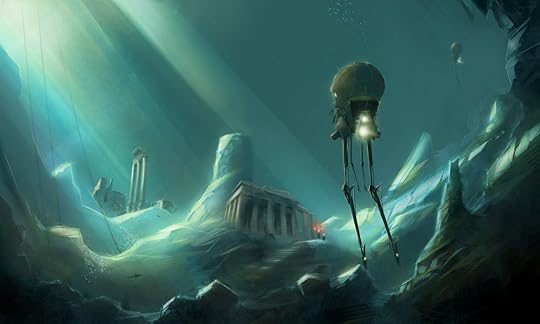
Ahhh, reincarnation. Need I say more. Many of us probably spent hours day-dreaming about who we could have been in the past. While the tale brought back all those memories, it also opens up a dark corridor to what might go wrong, betraying love, killing the 'new' woman, being trapped and so on.
When I think of who I might have been all those bad parts are left out (of course) Clearly I was also the medieval princess (and not the poor serf) and the roman goddess, and part of they mystical civilization of Atlantis. (Who wasn't?)
Have I mentioned I love just perusing DeviantArt sometimes?
The things I find, when I'm bored are amusing. I also quite like his rendition of Atlantis. I also enjoy this site. I'm not sure how anyone could dislike something called an unmuseum.
*note: The most interesting thing about Wikipedia pages is often the links at the bottom of articles. Interesting because whether you just want to kill time looking at more links, or want to decide just how 'accurate' wikipedia really is, it's useful. Useful is interesting to me.
The story is also sort of the downside of finding Atlantis. Poe writes such great dark fairytales. (I'm sorry if anyone hates me for that statement. I'm not jesting about Poe writing fairytales, but I am suggesting that he wrote with 'morals' in mind, cleverly disguised as horror). Reason 5 The whole reason I picked up the book was because I wanted to read The Fall of the House of Usher again.
It's the perfect creepy scene of dilapidation. I've always had a fascination with old houses and abandoned buildings.
This story is probably why. Is it wrong to be more than a little excited when your brother buys farmland with an abandoned farm house on it?
There's also the Criddle Vane farm which I've never been to, and would like to go take (or watch dexotaku take, more likely) photos under a full moon. (Now he has to do it? :P) Criddle Vane will be a post all its own, and I'm really glad it's so close to Brandon. There is appeal to going out late at night to take photography, but also visit a 'haunted' house. Morbid appeal, Poe-esque if I must.
I hate to leave it there, but you'll have to read the follow up post for more on The Fall of the House of Usher on Criddle Vane farm.
The purpose of that short caveat being I love the way Poe writes, as he makes it very easy to draw a picture or watch the movie in my mind while I'm reading the story. Reason 6, 7 and 8 The three stories are William Wilson, The Mask of the Red Death and The Imp of the Perverse. Each has a special meaning to me for it's own reasons, but the specifically fulfill this purpose:
The books that made me love reading, keeps me both reading and writing. I find while I'm writing my first novel that I'm constantly looking for distraction and/or inspiration to keep writing. While this may not be the novel itself, it does result in contemplation on my own writing. I choose the books I read on purpose, and I choose to do the things I do in real life (like Community Supported Agriculture and the #DigInChallenge for example) for similar reasons. (Reminder to self - update About page, and use badges.)
I'm terrible (or extremely proficient) at procrastination. However, doing things like the reading challenge, and the dig in challenge give me a good excuse to write, and increase my attention span for writing at the same time. I imagine if any of my old professors are reading this and depending on which degree they were from, I'm both shuddering and giggling at the thought.
I'm often up at dawn, though I'm not sure I took this picture. I have some sketchy memories from this time period. I miss not having a schedule. On the days I work, I'm also usually up at dawn, but laying in bed staring at the alarm clock with one eye because I HATE the alarm clock, and I also hate schedules.
I wish I could just enjoy this:
and never have to worry about reporting for work. Even if I do really like my job most days, and they let me do crafts... That's right, my office supply store lets me do crafts at work (cuz we sell them), and lets me do crafts at home that I can bring to work at people can see. I have an awesome job, I just like sunrise and spooky stories and houses better.
Eight Tales Of Terror only has eight stories, but we read 12 pieces by Poe. The stories we read/listened to are The Cask Of Amontillado, Hop-Frog, Ms. Found in a Bottle, Ligeia, The Fall of the House of Usher, William Wilson, The Masque of the Red Death, The Imp of the Perverse, The Pit and the Pendulum, The Black Cat, Morella and The Tell-Tale Heart.
I will list the in order of favourite to least favourite.
1. The Masque: This one is my favourite because it was the first Poe story I ever read of listened to. The first time I listened to this one I did not understand it, but as soon as I read it in a book, it became more clear. Words: Blood, corpse mask, vibrant colours, stained glass, more blood, courtiers, and a thousand friends.
2. The Pit: This one is the scariest in my opinion. It made me really think about being stuck in a room staring at the thing that could kill me. This one was also easy to understand. I only had to read it once to be scared. Words: Rats, low swooshing noises, burns, war, torture, wells, sewers, and darkness.
3. Hop-Frog: This story made me smile a little bit, especially when Hop-Frog climbed up the chandelier away from the burning bodies. This one was also easy to understand. It almost felt like we were helping Hop-Frog in his revenge. Words: Chandelier, dwarves, revenge, bad smell, seeds, and a daring escape.
4. The Cask: This made me feel a little claustrophobic. It has a lot of gothic horror aspects such as chains and winding staircases. Words: Secret masonry clubs, wealthy men, unseen characters, insults, sickness, and dead bodies.
5. The Black Cat: I liked this one in particular, because we have a black cat ourselves. It made me feel a little sick when the main character stabbed the eye of the cat. Words: Noose, brothel, menagerie of animals, axe, foiled murder, and animal cruelty.
6. MS. Found in a Bottle: I enjoyed this one because of how the entire story was written and put into a single bottle. I also like that the spirits on the ship could not see the main character but he could see them. Words: Whirlpool, crash, sole survivors, writing on board a boat, ghosts, and seeing things you are not supposed to see.
7. The Fall: I had a lot of fun reading this one, mostly because we made some jokes while reading it. It makes me think about living in a huge house with only two other people. Words: Wan expression, storms, buried alive, strange sickness, siblings, childhood friends, and not so sturdy foundation.
8. The Tell-Tale Heart: This one was not my favourite even though it is so popular. I didn't like that the main character would kill someone just because they were a little messy. Words: Sensitivity, messed-up eye, cleaning, scratched plates, floor boards, and police officers.
9. William Wilson: I think this one was more interesting than scary. I like the idea that someone would follow you around keeping you from doing bad things. Words: Costumes, killing yourself, childhood friends changed to enemies, cheating at cards, not listening to your parents, rich men, and stabbing somebody.
10. Morella: This story made me think about how reading a lot of books might not be a good thing. I also like how Morella is reincarnated as her daughter. Words: Reincarnation, magic words, priests, lots of books, talking, sickness, and burials gone wrong.
11. The Imp: All of these stories made me think about something, but this one especially made me wonder what it would be like to know I was going to die from other humans tomorrow. Words: Perfect murder, cell, reflecting on what you have done, waiting to die, candle, poison, and admitting to a crime.
12. Ligeia: I placed this one in last because I did not enjoy reading it. He was more obsessed with Ligeia than in love with her. Words: Unspeakable beauty, large house, remarry, a corpse comes alive, and pewy machine (censer).
I think that is all the stories we read. I enjoyed reading all of them. I recommend reading all of these stories. -Sam Kuntz.
This entire review has been hidden because of spoilers.
Some stories were tough to read on account of my small brain, but for the most part I enjoyed them. Wtf was Hop-Frog though? Haha that one was just a completely different tone from the rest.
5 stars if I was just reviewing the last 5 stories: Ligeia, The Fall of the House of Usher, William Wilson, The Mask of the Red Death, and The Imp of the Perverse. Those were bangers. My edition also has several typos, or "typographical errors", for anyone who fancies a bit of elevated diction.
The stories in this book are, "The Cask of Amontillado," "Hop-Frog," "MS. Found in a Bottle," "Ligeia," "The Fall of the House of Usher," "William Wilson," "The Mask of the Red Death," and "The Imp of the Perverse." We separately read, "The Raven," "The Tell-Tale Heart," "Morella," "The Black Cat," and "The Pit and the Pendulum." The multiple stories are all interesting to me. They all have lots of detail and meaning.
My favorite story was, "The Fall of the House of Usher." In this story, an unnamed character is going to visit a friend from childhood. His friend is Roderick Usher and is sick. He owns the House of Usher with his sister, Madeline Usher. Madeline is also sick, so it is not a surprise when she dies. Neither Roderick nor the unnamed character speak of her for several days. After not speaking of her, strange events start to happen.
Roderick starts murmuring odd things to himself like, "We put her living in the tomb." Turns out they put her living in the tomb. When she forces her way out of the tomb, she goes to them. It is a struggle for her to get there. When she gets there, the doors are closed, she pushes them open, stands there for a second, falls on her brother, and they both die. The unnamed character flees from "the House of Usher." As he leaves, the house crumbles and falls as the tarn absorbs it.
This is a great book and Poe is a great author. I recommend Poe's work to anyone who likes talking ravens, dwarves, coming back from the dead, and being saved by rats, because all of this is included in his short horror stories.
This entire review has been hidden because of spoilers.
It's an interesting mix of stories that range from murder for revenge, ghost stories, demonic possession, death personified, etc. The book has a very brief introduction that highlights various aspects of Poe's life and it is one of the rare times that I actually wished for a longer introduction. Also each of the eight stories has a paragraph or two of introduction that includes interesting tidbits like who first published the story and what was going on in the time of Poe's life when it was published. If you don't like spoilers, I suggest reading the introductory paragraphs AFTER you read the stories.
I can assuredly say that Poe is not for me. He takes 20 pages to describe something someone else can accomplish in two; it's logorrheic blather. One of his stories has the quote, "Let me hurry to a conclusion." Oh my God, yes, please.
The one star is for "The Fall of the House of Usher" which was the only true tale of terror here.
Edgar Allen Poe is a great writer, but I think he was a bit crazy. He writes so you really get into the heads of the main characters, however it isnt a place I would like to stay. These stories are classics for a good reason. Eerie, spooky and just a bit gross.
Edgar Allan Poe is a great writer. He seems to like getting inside the head of the characters in his works, which makes them unique. I thought that A Masque of Red Death was the best poem in this book. There is definitely a large variety of vocabulary throughout the book.
These never get old. I find that I love reading along with the text as I listen to a good actor narrate the stories. The spooky music is a bonus. Favorites in this group: Fall of the House of Usher, Masque of Red Death, and the Cask of Amontillado.
I liked most of the stories. Some of them were a little dry to start with and I found myself losing focus a few times. I’ve been influenced by Poe’s work since the 8th grade when we were assigned to read the tell-tale heart. He’s a genius... in a frightening way, an absolute genius.
Although the elaborate language seems strange today, it helps establish the mood. Poe, a master of the eerie, succeeds in titillating his readers with glimpses into the bizarre.
Call me uncultured but I found this extremely boring and difficult to get through. To top it off, once I reached the end of the stories I was pretty let down by the endings.
I vacillated between 3 and 4 stars here. Poe may have been the master of the “weird tale” a hundred years before Lovecraft took that mantle, but he lacks a certain ability to go “too far”. Almost one can hear him pulling back from writing truly shocking tales. His descriptions are too often ephemeral, rather than tangible. Consider The Masque of the Red Death, where the antagonist is entirely allegorical.
Deduct points also for the choice of tales in this collection. Missing are true horror classics such as The Telltale Heart. However add points back for introducing me to some obscurities that, while not gripping, did broaden my knowledge of Poe himself.
- the cask of amontillado: kind of a waste of time 3/5 - hop-frog: gross and weird 2.5/5 - MS. found in a bottle: is there a mr found in a bottle? 5/5 - ligeia: she edgar on my allen till i poe 3/5 - the fall of the house of usher: clinically insane 5/5 - william wilson: off a perc like 4/5 - the masque of the read death: your mask is making me uncomfortable 4.5/5 - the imp of the perverse: dreadful 2/5




 ]
]