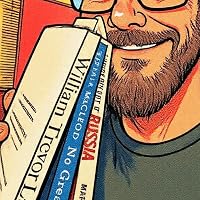
Artem Samsurov, a charismatic protege of Lenin and an ardent socialist, reaches sanctuary in Australia after escaping his Siberian labour camp and making a long, perilous journey via Japan. But Brisbane in 1911 turns out not to be quite the workers' paradise he was expecting, or the bickering local Russian emigres a model of brotherhood. As Artem helps organise a strike and gets dangerously entangled in the death of another exile, he discovers that corruption, repression and injustice are almost as prevalent in Brisbane as at home. Yet he finds fellow spirits in a fiery old suffragette and a distractingly attractive married lawyer, who undermines his belief that a revolutionary cannot spare the time for relationships. When the revolution dawns and he returns to Russia, will his ideals hold true? Based on a true story, The People's Train brings the past alive and makes it resonate in the present. With all the empathy and storytelling skills that he brought to bear in Schindler's Ark, Tom Keneally takes us to the heart of the Russian Revolution through the dramatic life of an unknown, inspiring figure. Like Schindler, Samsurov was no saint, but he was an individual who played a vital role in world-changing events.
Thomas Keneally was born in 1935 and his first novel was published in 1964. Since then he has written a considerable number of novels and non-fiction works. His novels include The Chant of Jimmie Blacksmith, Schindler's List and The People's Train. He has won the Miles Franklin Award, the Booker Prize, the Los Angeles Times Prize, the Mondello International Prize and has been made a Literary Lion of the New York Public Library, a Fellow of the American Academy, recipient of the University of California gold medal, and is now the subject of a 55 cent Australian stamp.
He has held various academic posts in the United States, but lives in Sydney.
I haven't read Schindler's Ark (or —— List, if you're American), so I can't comment on whether or not The People's Train is better or even the same kind of book; in fact, I didn't even know who Keneally was until after I bought it. I can tell you, however, that it's interesting to see a story about Russians that isn't about the aristocracy before the revolution(s) or the émigré community immediately after, or of the more cynical recent post-perestroika batch. Stories from the perspective of well-meaning Bolsheviks before the 1917 revolutions are hard to find outside of propaganda, and stories about Russian Bolsheviks fighting for worker rights in Australia are even rarer. Looking back, it's amazing how few rights workers really had, how very far we've come in barely a century, and how hard people had to fight to get here. The realisation that when we were little, we sat on the laps of people who had actually witnessed, or at least been contemporary with, cavalry charges on civilian protesters over basic minimum wage or rudimentary health regulations, in the civilised world, is an astonishingly surreal one.
This is basically what the first part of The People's Train is about. This part of the story takes place in Queensland right before and during the First World War, and centers around an escaped Russian prisoner and friend of Lenin, based on the real Fyodor Andreyevich Sergeyev (a.k.a. Artem or Artyom), who made his way from Siberia to Australia, and takes up the workers' cause there. It's an interesting insight into the mentality of earlyish labour rights proponents and the extent to which Australia was a horrible shithole (and the reasons for why it in many ways still is), and the worthiness and far-reaching effects of the socialist cause.
The second part concerns Artem's return to Russia after the February Revolution of 1917, and follows him through a parade of the usual protagonists (Lenin, Stalin, Trotsky, &c.) and the ridiculous violence culminating in the October Revolution. Here Keneally's point becomes rather more trite: the eponymic People's Train, a monorail initially introduced in the first part as a dream to serve as an counterpoint to the private tram of one of Australia's industry bosses, would actually be built as an experiment in newly communist Russia, and the real-life Artem would eventually die in it in an accident in 1921. This isn't a spoiler, because the story ends right after the fall of the Winter Palace, and Keneally goes out of his way not to make this explicit. Even the author's afterword only says he died "a hero's death". Perhaps this obnoxious coyness is an acknowledgment of the cheapness of his symbolism. Either way, it's made quite clear Keneally doesn't approve of revolutionary socialism, and he's quite right not to.
As usual with this kind of book, it isn't always easy to tell where history ends and fiction begins, and perhaps it would have been a better work if Keneally hadn't invented a fictional version of a historical figure, but adhered more to actual history instead. It's not like the real Artem was in any sense less interesting, or that there isn't enough uncertainty about large portions of his life that Keneally's imagination could have filled in with impunity. To say that the writing is wooden is perhaps to extend a metaphor too far, but there is definitely a cardboard quality to it, particularly early on. Still, I'd certainly recommend it to anyone who's interested in what life was like for people fighting for labour rights not that long ago, or who wants to learn a bit about the Russian Revolutions without actually bothering to open a history book.
Keeping up with Thomas Keneally’s output is a bit of a challenge for any reader, and if I were a “completist” I would have a long way to go before I could tick this author off my list. At last count he had 33 novels listed at Wikipedia and 18 works of non-fiction and a good many of those are chunksters too.
Although Balzac was master of the short story, there are good reasons why Keneally is sometimes referred to as the ‘Balzac’ of Australian life. He’s a great storyteller, and (of the nine of his novels I’ve read), I’ve seen him range across all sorts of characters and different periods of our history, most recently with Shame and the Captives (2014), The Daughters of Mars (2012) and The Widow and Her Hero (2007). In style these are a long way from his early Miles Franklin Award winners, Bring Larks and Heroes (1967), Three Cheers for the Paraclete (1968) and his debut novel The Place at Whitton (1964, but recently reissued). He seems to have abandoned modernism for a narrative style focussed more on story, as seen so successfully in The Chant of Jimmy Blacksmith (1972) and the Booker Prize winning Schindler’s Ark (1982).
The People’s Train (2009) is another splendid story, depicting a character perspective rarely offered. Artem Samsurov is a Russian dissident living in exile in Brisbane during the prelude to the two Russian Revolutions in 1917. He’s a communist, and more specifically a Bolshevik, and so he gets into strife with the Queensland authorities who are in a moral panic about dissent in general and communism in particular. The book is in two parts, Artem’s narrative in Brisbane, which includes his memories of imprisonment and escape from the Russian gulag; and then that of his journalist friend Paddy’s narrative which recounts the chaotic situation when Artem returns to Russia after the February Revolution.
Brisbanites with an interest in politics, particularly the events leading up to the Russian Revolution in 1917, will find this book engaging. If, like me, you feel that nothing much happens in Brisbane and all the important political events happen overseas, this book takes you on an interesting journey where you share the fortunes of Artem following his flight from Russia where he was persecuted by the Tsar as a student to life in Brisbane where he works to raise the people's consciousness, and then back to Russia where he works for Lenin and the revolution. Keneally has done a great job of splitting the narrative in the two halves of the book between Archem and his buddy, Paddy, which adds two perspectives on events instead of one. In the footsteps of Ten Days That Shook the World, Paddy's eye view account of events in Petersburg are credible and interesting (John Reed is, in fact, a character in the novel, along with Lenin and Stalin which added to the fascination for me). But in case readers think the book could be a little dry, there is romance, first hand accounts of torture, rape and suicide, and run-ins with the law to spice up the lives of both of the main characters and to make things interesting for the reader. Keneally has obviously researched his subject very well and the result is a credible tale which I found absorbing from start to finish. The audio book version colours the narrative with thick Russian accents which you will find bouncing around in your head for days after finishing the book.
An interesting and eye opening observational tale of Australia on the cusp of the Frist World War and its entry to it from the standpoint of a Russian political activist, Artem who is fleeing arrest in his homeland. The second half of the novel follows his return to Russia and his involvement in the Revolution as observed by his close friend and journalist from Australia, Paddy. Both parts of the novel are educational and well written but the second half of the novel really comes alive. The depiction of Russia at the point of revolution, the chaos, the smells and the characters (both good and bad) is well done. A feeling of pace runs through this part of the novel.
This novel may not suit all - especially if they are not interested in politics. That said it is not all about politics - interpersonal relationships form a great part of the novel but there is a very firm backdrop of politics.
Various scenes will stay with me. The scene of the young soldier with his family on the steps. The girl soldier and her fear at the end of the novel. The chaotic meetings with people getting up to speak - including Lenin, Trotsky and Stalin.
There must have been a tremendous amount of research by the author to create two believable worlds. I have read quite a bit by Thomas Keneally and his writing always surprises me - because each work is very different.
This was a hard book for me as it is not a subject I am interested in - politics. As it turns out it was hard for most in our book club to read, only one other person finished it, another got almost to the end when she gave up and the others only got as far as Chapter 6.
The story takes place initially in Brisbane then in Russia from about 1905 to 1917? Artiem (Tom) was a Russian,who had been a political prisoner of the Csar, when he escaped his prison and came to Australia over a period of 2 years. While in Australia he bacame a member of the Socialist Party and took part in marches with the unions, initially the Tramways Union. He met a woman Hope Mockeridge, who was unhappy in her marriage, she also agreed with Artiem's beliefs and for awhile they had a relationship of sorts. They had another friend Ameilia, who when she died, left some money for Artiem to be able to return to Russia - he returned to take part in the Russian Revolution where he was part of Lenin's group. He took with him an Austrlian Journalist Paddy Dykes.
The first half of the book was read with a Russian accent with Artiem telling the story and the second half was Australian with Paddy telling the story. I think listening to it on CD was better than reading it, I don't think I would have finished it if I had read it.
This book had all the ingredients to interest me; a revolutionary Russian escapes Tsarist Russia to ferment a radical movement in my supposedly sleepy home town Brisbane between 1911-1917. Aspects that I'm researching for my own forthcoming book.
Tom Keneally has good research assistants. Has he relied on him/her/them for the actual writing? Because this book is no 'Schindler's List' (excellent) or 'Chant of Jimmie Blacksmith' (ground breaking). His nonfiction tomes are worthy and useful references.
There is a token love affair with a married lawyer (surely progressive for 1911) but it is perfunctory. Things happen to the main character Artem Samsurov in passive voice: 'I was taken...I was tripped and kicked...I was taken'. The characters show little passion or warmth, or even raison d'être radicals. Parts 1 zips back and forth between Russia, the escape route through Siberia and Japan, to Australia then back to Russia, but it's often confusing when or where we are. To be fair, I skim read a lot so will not accuse of lack of clarity. Part 2 takes the action back to the Russian Revolution so warrants more attention than I gave the former section. Thus I will not rate it at this point.
I was a bit torn on what to give this book. I thought the first half of the book (where it was based in Brisbane) quite interesting. This was mostly because I live in Brisbane and it is a period of history that I was not aware of.
The second half of the book is based in Russia during the revolution. It kind of lost me there. The book seemed to drag on and at points I was wondering what the purpose was.
I also found the ending a bit unresolved. There was no real revelation other than human nature being what it is.
I made it to the end but wasn't especially satisfied with it. Found it interesting rather than compelling. I always find the historical aspects of these type of novels good but don't always get into the actual characters or even the story. So I faded in and out with this one. My interest waxed and waned. I guess I was a little disappointed because I really like Tom Kenneally generally.
Australia seems a strange place for a Russian revolutionary to reside as his homeland teeters on the brink of historic upheaval but that's the situation Artem Samsurov finds himself in at the start of this intriguing novel. A fugitive from the brutal tsarist regime, we learn of Artem's path to Brisbane in flashbacks as he sets about trying to further the revolutionary cause in his adopted country. But Artem, or Tom as he is known in Brisbane, soon finds Australia is not ready for a revolution as he becomes a key figure in the fight for trade union rights. He even finds himself distracted from the cause as he embarks on an affair with a well-heeled Australian woman whose left-wing politics estrange her further from a cold, distant, industrialist husband. But you always get the sense Artem is destined to return home and join the Bolshevik fight to overthrow the Russian government. That's exactly what transpires but the author pulls off a neat trick by switching narrators for the second part of the novel. Instead of seeing the Russian Revolution through Artem's eyes, we view it from the perspective of Paddy Dykes, an Australian journalist who had befriended Artem during the class struggle in Brisbane. This gives the novel fresh impetus as it offers us an outsider's view of the most tumultuous time in Russian history instead of focusing on the internal politics of the Bolshevik movement. The People's Train is a novel that's all about building anticipation and the excitement people feel as they hurtle towards an uncertain future. The actual revolution is only covered in a few pages at the end but Keneally expertly captures both the noble intentions of the Bolsheviks and the brutality that would sadly come to define their rule. Although based on the story of a real person who took the same path, the author makes clear in a note at the end that Artem and all the other main characters are fictional. He also outlines a desire to continue their story throughout the harrowing Russian Civil War and I can't wait to read the next instalment in the story of Artem, Paddy and their comrades.
For me, this was an audiobook. I suspect that, were it not for the great narration, I might not have finished it. Thanks also go to public libraries having audiobook collections. It was a big read, with lots of characters and was the most in-depth historical fiction that I have read. (Maybe I will move to something a little lighter now.)
The first part of this novel is about Russian Revolutionaries, exiled or escaped to Australia during the opening decade of the last century. Having helped organise the Aussie's and escaping a wrongful murder allegation, they set off home to Russia to help the Revolution which is related through the eys of a friendly Aussie journalist who accompanies them.
Artem Samsurov is a a dedicated socialist who has escaped imprisonment in Czarist Russia and manged to get to Brisbane in Australia. Unlikely as that sounds, it’s based on a true story.
The first half of The People’s Train is set in 1911 Brisbane and told from Artem’s POV. He’s remarkably credible, and as a Brisbanite myself I enjoyed his notes about the city as it was a century ago. The radical elements Brisbane’s history are seldom discussed in real life, so I also welcomed reading what Keneally has to say about them.
‘Tom is what they call a Bolshevik. You ought to listen to these Russians. They've got more brands of socialism than a lolly shop.’
The second half of the book is set in Russia at the time of the revolution, and is told by Artem’s friend from Brisbane, Paddy Dykes, as they each attempt to play a part in what they see as a welcome and inevitable change. This allows the author a clever change of perspective, including Artem as object as well as subject.
Would I recommend reading The People’s Train? To anyone interested in the Russian Revolution, early 20th Century Brisbane, or Keneally’s mastery of the narrative form, yes, I would. But I would caution anyone else to be willing to develop an interest in at least one of the three.
I really enjoyed the time with these characters, the story really changes when the second voice takes up the story. Very interesting period in history that I love. It follows the journey of Artem Samsurov based on an actual escaped prisoner of the time. He arrives in Australia and becomes caught up in the socialist movement in Brisbane. This part of the story is told through his eyes as an early Australian Migrant. When he returns to Russia he takes along a journalist from working class Broken Hill who is also involved in the socialist cause. This part is narrated through the voice of Paddy Dykes, who of course is unable to understand Russian and is left out of the loop. Artem is involved with Lenin in the formation of the Central Committee fighting for the Revolution, every thing is happening so quickly rushing here and there it definitely gives you a good representative of that time.
I am not actually interested in Russian history or the influence of the Russians in the early labour party so the subject of this book was never going to grip me. I found it described one event after another, introducing an enormous number of characters but there was no real climax (apart from the murder and the overthrow of the Winter Palace). The names were a bit confusing with Samsurov and Suvarov, Trofimova and Trofimov ... I sure there is no shortage of Russian names.
The People’s Train is a disjointed work whose digressions are sometimes frustrating. However, the novel succeeds in casting an uneasy spell. Artem’s faith in the Leninist cause is untainted by any knowledge of the excesses into which Lenin’s regime would soon degenerate. This impassioned idealism stands starkly at odds with our own knowledge of where the revolution led – a contrast that lends the novel a queasy power.
This was a great read especially for anyone who has an interest in the Russian revolution. Keneally tells us about the daily struggles of Russian emigres in Australia leading to the RR in 1917. Artem goes back to Russia to work with Lenin during the lead-up to the Bolshevik victory over the Mensheviks and Kerensky. The final few chapters are intense and wonderfully realized. Keneally s considering writing a sequel to follow the time up to the civil war in Russia.
Very hard going. The historic facts were interesting but the style of writing made it a chore to read and I could not relate to any of the characters. The lack of direct speech made the writing monotonous and factual. it's a shame because I've enjoyed other books by Keneally.