Take a trip - Pass through the shimmering curtain of the mind that conceals the eeriest of all telepathies... Leap over dimensions, crossways in time... Cast off for a barren reef ruled by a hierarchy of intelligent worms...
But take Theodore Sturgeon as a guide. For this is a trip into a phantasmagoric world where centuries hurtle past, where civilisations shudder to a stop, where reality shifts unpredictably. This is Theodore Sturgeon's own private universe.
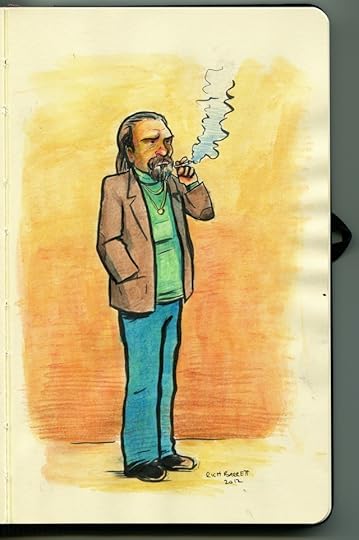
Theodore Sturgeon (1918–1985) is considered one of the godfathers of contemporary science fiction and dark fantasy. The author of numerous acclaimed short stories and novels, among them the classics More Than Human, Venus Plus X, and To Marry Medusa, Sturgeon also wrote for television and holds among his credits two episodes of the original 1960s Star Trek series, for which he created the Vulcan mating ritual and the expression "Live long and prosper." He is also credited as the inspiration for Kurt Vonnegut's recurring fictional character Kilgore Trout.
Sturgeon is the recipient of the Hugo Award, the Nebula Award, and the International Fantasy Award. In 2000, he was posthumously honored with a World Fantasy Award for Life Achievement.
I figured out why I like Theodore Sturgeon’s work – his is a blend of the poetic, nostalgic quality of Ray Bradbury and the quirky mumbo jumbo of Kurt Vonnegut and slapped together with a unique imagination that is his alone.
Kilgore Trout.
Beyond is a 1960 collection of short work mainly from the late 40s. Sturgeon was a true master of the speculative fiction genre (though he won Hugo and Nebula, he was never crowned a Grandmaster, perhaps because he was not prolific – though he is in the Science Fiction Hall of Fame).
“Need” is a brilliant, very Bradburyesque novella that anchors the anthology and proclaims Sturgeon’s ability. “Nightmare Island” may have influenced Life of Pi writer Yann Martel, and / or it may have been influenced by Joseph Conrad. “Bones” is an especially entertaining and thought provoking work and leaves the reader with much to consider.
All in all an outstanding collection of short work from an exceptionally talented craftsman and a more than adequate introduction to his work for a new reader hoping to gain an appreciation for one of speculative fiction’s most gifted writers.
Anthology of short stories by noted science fiction writers. Strangely enough, even though it's billed as sci-fi, all the stories actually involve some sort of magic, so they're really fantasy.
Still the stories are top notch, but not, I think, really science fiction.
Brilliant stories. Especially taken together where strengths shine overshadowing weaknesses.
I bought this copy serendipitously at The Strand bookstore in New York City when visiting with my nephew and friend who lives in Brooklyn who gave us a personal tour of some of his favorite Manhattan subway-related spots. We convinced him to walk along Broadway and detour into The Strand, a worthwhile pilgrimage.
It was the third sturgeon reference during that June 2025 trip, the first being a sturgeon-inspired kids play area along the Hudson River and the second being a silverware-styled sturgeon sculpture in the window of a jewelry store in Tribeca.
Back to Sturgeon, Theodore, for those who care not for the reviewer but for the reviewed.
I first encountered Sturgeon as the credited writer to the popular Star Trek episode, "Shore Leave," in which such a brilliant gem of a quote is uttered toward the otherwise very playful but seemingly inconsequential almost throwaway story: "The more complex the mind, the greater the need for the simplicity of play."
That led me to the audiobook of the incredible novel More Than Human (see previous review) and an appreciation for the man who inspired Kurt Vonnegut's fictional author Kilgore Trout.
Each of the stories in this collection live up to the 1970s cover billing as being by "the master at the top of his form."
They are like the best Twilight Zone episodes, but in words that impress more indelible images in the heartmind's eye, and rendered with a confident narrator's voice (whoever the particular narrator) that winks at you even as it presents story and character with an economy that never outstays its precisely landed welcome.
In that way, these stories remind me of R.A. Lafferty (see previous review). Sturgeon's tales are a bit more general audience accessible, however, and tend to gravitate around an everyman ethos if not an everyman character. These are stories of imagination that play with thought experiments and give us both darkness and light and delight in the contrast.
A common thread implicit -- whether practiced or believed by the characters or if not then held sacred by the reader -- is human dignity.
Another common element for several of the stories is a setting or a mood of post-apocalypse, not focusing on the apocalypse or the post-apocalyptic landscape but on characters for whom this is simply their history and experience.
Another common character type is the tinkerer or practiced maker, set in opposition or at least apart from the educated or monied elite.
To the stories themselves.
"Need": What if someone were remotely sensitive to the needs of others? Could this sensitivity be combined with others' gifts, motivations, and limitations to alter the wellbeing of a community?
"Abreaction": What if someone committed an act akin to genocide not out of malintent but fear and confusion? What kind of forgiveness or penance is just and right if memory of the infraction is removed?
"Nightmare Island": Where do the tendrils of addiction leave one altered after a learned lifetime of unfeeling to mute the pain? What is the role of violence in sanity? Where is the dignity in communication or activity that is alien or inhuman?
"Largo": A harsh meditation on the Hegelian triad of artmaking, extractive commercial gain, and inspirational beauty hollow beneath the fleeting surface yet somehow transcendent for how it ties together a sense of attention beyond individual need, to what extent is art and life able to be appreciated synesthetically?
"The Bones": If we could experience the experience of other beings or persons through living through their memories, would it fundamentally change anything about how we act? Or do jealousy, brutality, and amoral curiosity form the arc of their own justice beyond society?
"Like Young": If global pandemic killed most of us and rendered the scarce surviving minority of humans sterile but dedicated to passing along collective knowledge and wisdom to the next species to inherit the Earth, what after all is the point to living?
The preceding high-level questions are a bit contorted to fit the conceit in this review. Each of the stories is much lighter than the philosophical bent implied above, yet Sturgeon's wit and keen insight shine through in between the plot points with linking sentences that advance the logic of a dignified morality behind the curtain. These sharp and well-balanced sentences pop up naturally in these stories. They bear the imprint of individual story narrators but also are steeped with Sturgeon himself, in my view. They pass judgment, typically without cruelty but with a refreshing exactitude far less common in our post-post-modern era of fiction.
A collection of short stories from science fiction's Golden Age by a man whose name I first encountered as the writer of Star Trek episodes ("Amok Time" and "Shore Leave"). His science fiction often has a dark side and may veer more towards fantasy at times. A fairly interesting collection with two stories having mystery connections as well. I wasn't really taken by "Nighmare Island"--it needed to be more nightmarish or have a different title. My favorites are "Need" and "The Bones." ★★★
"Need": A man named Gorwing can "hear" the needs of his fellow men all around him. He does his best to attend to those needs and enlists the help of others in his quest. But it becomes difficult when two persons' needs conflict with one another....
"Abreaction": A bulldozer operator accidentally crosses through a tear in the fabric of the universe. Can he get back to his own reality? And will he remember who he is when he gets there?
"Nightmare Island": An island of intelligent, telepathic worms make a god of an alcoholic shipwrecked sailor.
"Largo": A musician composes his masterpiece--a largo meant to seek revenge on the man who ruined the perfect woman and to ensure that he (the musician) got her back and never lost her again. [three crushed to death] Who knew that you could murder through music?
"The Bones": An inventor (who reminds me for some reason of Doc in Back to the Future) creates a machine that can allow someone wearing headphones to experience the life connected to any bone used in the invention. The Sheriff ask him to use the machine to help get justice for a woman who died in a car accident. But what if the wearer stays connected to the point of the bone's owner's death? [two deaths]
"Like Young": The last remaining humans decide to leave behind lasting records of the sum of humanity's knowledge--a gift to those that will rise to take mankind's place. The animals most like to do so? Otters. But the otters have other ideas about what is important. A parable about man's arrogant view of humanity's importance
Nice early sci-fi collection... none of these stories are very far from reality.. there's just a small bit of sci fi in each that makes you thing about the main point, which is what I like in old school sci fi.
Need: Very Twilight Zone... about a man name Gorwing that might or might not be a guardian angel
Abbreaction: the runt of the bunch... totally fell out of my brain right after I read it
Nightmare Island: A good fish story from a drunken sailor.. very amusing
Largo: An obsessed musician writes his masterpiece around the end of the world.. very cool setting, and a surprising ending that after I read it made me realize I shouldn't be surprised by it.
The Bones: Revenge story with a Ouija Board type twist.. meh
Like Young: Otters look like the next dominant species after the apolcalpse.. so we should help them.. right?
Good stuff.. Sturgeon isn't my favorite, but it's rare for his stuff to be bad, so his story collections are always worth it.
I once went to a pop up science fiction museum in the Museum of Pop Culture, and you were able to take a little quiz to find out which sci-fi figure you are. I got Theodore Sturgeon and began collecting his paperbacks like crazy without ever have read him before. Now that I've finally connected to my sci-fi icon, I am flattered. I like Sturgeon's writing style a lot--very Bradbury in ways and reminiscent of a good Twilight Zone episode. Not all the stories in this collection are bangers; "Abreaction" is immediately forgettable. However, "The Bones" and "Like Young" are both pretty solid. The cover art of this, also, is something to write home about. For once, the whacko art IS referring to the content inside. I now have the Urge for Sturge, babey.
Incredibly imaginative. I love how he'll paint a picture of reality and then slowly work to expand your perception of that reality. Favorites: Need, Nightmare Island, and The Bones.
This book also reminded me how adorable otters are. Which I greatly appreciate.
Fantastic collection. "Need" is one of the best, most satisfying, short stories I have read in a long time. The others in this book are generally well written with interesting ideas.
This is a review of the 1970 Avon paperback edition, which has an ad at the back for "A commanding new voice in science fiction" -- Piers Anthony. My copy also has an ad for the two volume Treasury of Science Fiction for ten cents ... with your trial membership to the Science Fiction Book Club. (Anybody remember that?)
I've read about five Theodore Sturgeon anthologies, and this one is the best. A great short story not only entertains, but it also has a sublime quality. It doesn't have to teach a moral, but it does expand your brain or shake you up a bit ... in a good way. Most of these stories do.
Not all of these stories are strictly science fiction, but that's a pretty broad category, anyway. These were all originally published from 1943 - 1960, so some things like the emphasis on radio might seem pretty quaint. Also, back then, it was perfectly acceptable to refer to "mankind" and use male pronouns when referring to humanity as a whole.
Stories:
* "Need" This at first seems muddled, but soon straightens out. At the end, I was knocked out. It's one of the best stories by Sturgeon I've ever read. It's not exactly science fiction, it's not exactly horror -- but it is a great read. * "Abreaction" A construction worker is plagued by amnesia. * "Nightmare Island" This is the story that the cover picture of my edition is based on. A sailor already plagued by DTs finds even more horrors on an island of worms. * "Largo" The weakest story in the anthology, but still hypnotic. It's about a composer of the future. I think this story is in a couple other science fiction anthologies. * "The Bones" I love me a good ol' sci-fi revenge story. * "Like Young" Here we end on the sublime. A new strain of encephalitis has reduced humanity to 604 men. The remaining devote themselves to leaving the best of humanity's knowledge to the next species that will rise to prominence -- sea otters. Oh, if only ...
Another entry in my nostalgic journey through the sci-fi of my youth (apparently first published the year I was born: 1960), this collection provided some enjoyable trips into the decidedly quirky world of Sturgeon's everyday people responding to forces beyond their/our imagining (but not Sturgeon's). "Need" offered some interesting reflections on the difference between need and want, why we need people to need us, etc. and made me aware of the influence Sturgeon may have had on Stephen King. Another bulldozer story ("Abreaction")--was Ted a bulldozer operator at some point in his life?--I liked this one better than his more famous bulldozer story, "Killdozer." And you've probably heard that the cockroaches will probably inherit the earth when the light of humanity has dimmed...but otters? ("Like Young")...
Abreaction - I did not read this one because it is also in a to-be-read book.
Largo - I liked this one even though it is similar to other stories I've read. A man writes and performs the ultimate in music.
Like Young - Man has almost died out from a plague and the survivors cannot reproduce. They set about leaving their wisdom for the Next Ones sort of like the dinosaurs leaving their knowledge for the mammals. Suprise ending!
Need - Did not like this one - very long and I did not get the point. Man seems to have supernatural ability to know what other people need and how to give it to them.
Nightmare Island - This is the story that inspired the cover of the book. Man is stranded on an island.
The Bones - Man invents a mind-reading device while trying to invent a new kind of radio. Hilarity ensues.
Beyond Fantasy Fiction was a magazine that ran for 10 issues from 1953 to 1955. It has a short but honorable life, featuring stories from some of the best SF and fantasy writers then active.
This anthology has 10 short stories first published in Beyond. All are good and a number are great. The highlights for me include the clever and humorous tales "The Ghost Maker" (by Frederik Pohl), "Can Such Beauty Be?" (by jerome Bixby) and "I'd Give a Dollar" (by Winston Marks).
The super creepy "Talent" by Theodore Sturgeon is also superb. This story touches the same ground as Bixby's "It's a Good Life" about an omipotent child becoming a tyrant. Since both stories were originally published in 1953, it makes me wonder if Sturgeon and Bixby knew each other, discussed the idea and decided to see what each of them would do with it.
Sturgeon's writing was superlative to his chosen genre. I don't mean to bad-mouth SF but, as far as writing skill goes, Sturgeon outdoes the best of those, like Bradbury, that would escape genre trappings and become successful, so-called mainstream writers. He was definitely morecthan just an SF writer.
For the most part these stories are simple. The language used to elucidate events is not. If you enjoy the literary journey as much or more than the destination, you'll get a kick out of Sturgeon's work.
I found this book from a reviewer of Stephen Kings book Needful Things because of the story “Need,” which is better than Needful Things and 500 pages shorter. You can tell that King probably got SEVERAL of his ideas from Sturgeon. I love all the stories in here, and I don’t usually go for sci-fi but Sturgeon is a definite exception.
Not a single miss in this book. Every story leaves you wanting more; managing to make you pause to contemplate the meaning of each story while you marvel at the work done in so short a space.
“Ted Sturgeon has created a brand of science fiction all his own—a lifetime work of unique emotional power, beauty, and wonder. Nobody else could have written these stories:
Need – A man burdened with the talent to see what those around him really wanted. Nightmare Island – The hideous creatures he saw weren't vision of delirium... But his dearest friends. Largo – Music has charms... and curses. The Bones – The dead can't speak—but there are things they can show you.
This collection, including the famous "Abreaction" and "Like Young", shows Sturgeon at the peak of his mastery of mind—and heart-expanding storytelling.” –The Back Cover
Copyright 1960, this is a 1980 print. Six stories at 187 pages. $1.95 cover price.
Having vowed to give Sturgeon another shot, it was a pretty easy decision to pick up this collection of short stories based solely on the “floating skull with headphones” cover. I did enjoy Beyond more than The Dreaming Jewels, but could not shake the “poor man's Ray Bradbury” label I had given Sturgeon in the past.
The stories here are creative, but often lack any serious punch or “emotional power” as the back cover described. The opening story “Need” is the worst of the bunch, with bland characters and a mediocre plot device: a man with the extrasensory ability to sense other's strongest desires. “Nightmare Island” is a vast improvement: a washed up sailor going through delirium tremens while stranded on an island with giant telepathic worms was at least a bit different, if meandering at times. “The Bones” is also pretty cool, but so horror-lite that it ended up being forgettable in the end. I don't even want to get into detail with “Largo”, as music-oriented stories in Sci-Fi and Fantasy are often cringe worthy to say the least. I skimmed that one, I admit.
Beyond ended up being worth the $2.50 admission fee for its cover alone, and the two good stories in the bunch showed me a little of why Sturgeon is considered one of the “underrated greats,” but the package was weak as a whole and did little to assuage my doubts about Sturgeon's work.
The long Algis Budrys story ("The Real People") was almost a great one, but it came off a bit too analytical. Everything else was definitely from the same mold as Unknown magazine (a decade before).