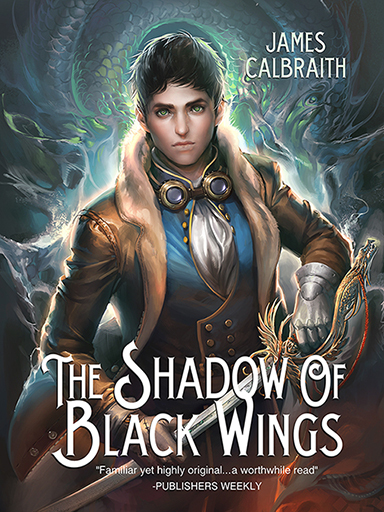
The divination clock is broken. The Year of the Dragon is coming.
In the midst of 19th century the world trembles before the might of the Dragon Throne’s ironclad navy and the dreaded Dragon Corps. A young dragon raider Bran joins a regiment of the Royal Marines, led by his estranged father, on a journey to the war-torn Orient.
In the lands of Yamato, sealed behind the Divine Winds, conspiracy to overthrow its military dictator grows stronger. A timid shrine apprentice Nagomi is haunted by the visions of dark future. Her only friend Sato, a tomboy samurai, strives for the right to learn and teach the art of western magic.
When Bran survives the sea disaster and gets separated from his bound-to–go-feral dragon, the paths of the East and West will cross in a way noone yet suspects...
James Calbraith is a Poland-born British writer, foodie and traveller.
Growing up in communist Poland on a diet of powdered milk, Lord of the Rings and soviet science-fiction, he had his first story published at the ripe age of eight. After years of bouncing around Polish universities, he moved to London in 2007 and started writing in English. His debut historical fantasy novel, "The Shadow of Black Wings", has reached ABNA semi-finals. It was published in July 2012 and hit the Historical Fantasy and Alternate History bestseller lists on Amazon US & UK.
Upfront disclaimer: I know the author slightly through interacting with him on Google+, which is why I bought the book. I paid full price and he hasn't given me any incentives to do a review or say nice things. I'm going to be critical in any case, not because I didn't like the book (I did), but because I think he can take it.
I'll start by saying that it's well-written, well-edited and (as far as I could tell, not being an expert on 19th-century Japan or Wales) well-researched. This already puts it ahead of 98% of indie-published books, and many traditionally-published ones.
The author is not a native English speaker, and it occasionally shows in an odd turn of phrase like "neared it to his eye". Mostly, though, the English is above average, better than most native speakers write.
This is the first book in a series, and it's not complete in itself. I don't love that, but it's a long-established fantasy-fiction tradition, and it's not as if the book just stops abruptly (I have read others that do). Given that, some of the criticisms I was going to make about setups with no punchline should probably be held back until I finish the series, which I intend to do. I'll note them here anyway so that I don't forget.
When I read the sample before buying the ebook, my first thought was that the worldbuilding was maybe a bit over-exhuberant. They're dragonriders? OK, fine, nothing new there, but it's cool. They can channel the magic of their dragons? Even cooler, and original as far as I know. Wait, they can also shapeshift into dragonlike beings? That may be just a little too cool. And in fact it never comes up again in the rest of this first volume - the first setup with no punchline (so far).
Then there are a couple of things that I would have done differently if it had been me, but there may be a reason that I haven't seen yet. There are a couple of linked reasons why I would have done these things differently: credibility and importance to the plot.
What I mean is, the history of this version of the world is very, very different. No Christianity, no fall of the Roman Empire, and quite a few other consequential changes (plus all the magic, of course). So it's highly unlikely that the same individuals, with the same names, would be born in the equivalent of the 19th century, given that very different history. (Victoria is on the throne, and Brunel is a prominent wizard.) It also, at least in this book, makes no difference to the plot, since these people, and several historical characters like Henry VII, are mentioned but don't appear on stage. Another setup with no punchline.
On the other hand, I would find it a lot more credible for many countries to retain similar names to the ones that they had in reality, and it would also have made it easier to figure out which countries were actually being talked about. I have a pretty good grasp of history and geography, so I could mostly follow the differences (and there's a map), but I did struggle, and I think a lot of people would have no idea. Even a few familiar names would have helped a lot.
About halfway through, the viewpoint character drops completely out of sight for several chapters and we meet several new people we haven't seen before. One has red hair, which is variously described as "amber" (which sounds dark blonde), "copper", "auburn" and "strawberry blonde". Those are very different hair colours, so I was left without a clear idea of what she actually looked like.
This shift in viewpoint, I think, contributed to the fact that I put the book down for a while and read other things. A clearer through-line focussed on telling just one story about just one person or group of people would have held my attention better.
Having said all that, this is a rich setting, the characters are appealing if so far not all that heroic, the writing is excellent and I will definitely be getting the next in the series, because I want to know what happens next (and also have been enjoying the ride).
I was asked by James Calbraith to read and review his debut novel "Shadows of Black Wings". It's the first book in the "Year of the Dragon Series". In terms of plot I can't tell you much (more on that later) but the gist of it comes in two parts: 1.) Bran is a boy fresh out of college and isn't sure what to do with his life. 2.) Conspiracies both mundane and supernatural brew in Yamato while the world outside it seeks entrance.
The book's strongest point is world building. I love world building; I love it when the author takes the time to paint the full picture. It shows attention to detail and a sense that the author put great thought and effort into creating their setting. In "Shadows of Black Wings" every scene and location is painted to perfection. Some books have characters moving in a void but that's never a problem here. I feel as though I could set foot on any location from Llambed Academy in Dracoland (The UK) to the Suwa Shrine in Yamato (Japan). This is not a 2-D painting either. Much exposition goes into the history Bran's homeland, its landscape and the ones he travels to, the local culture vs those nearby, differences between towns and cities, and, most interesting, the magical technology of the setting.
On another note, the languages. There are many languages in this setting and our protagonist, Bran, is not a linguist. Some other author would not bother with them and others would use a 'translation spell' or some other devices in a attempt to include many languages but avoid a language barrier. Not this author. The fact that Bran does not know the local language is a plot point and receives a chapter worth of attention.
A second strong point is character development. Mr. Calbraith has a knack for quickly developing characters. Just one scene and a name becomes a 3-D flesh and blood person. On TVtropes we call this "Establishing Character Moment" and it serves him well. My personal favorite is Nagomi's for being the most poignant and indulging in bait and switch to make me think she was something she was not. This added greater depth to her character right off the bat.
Another point in the characters' favor is that they dominant the plot. Every choice a character makes influences what happens to them and to others. One of my two biggest pet peeves concerning plots is the danger of them derailing characters to make themselves work. That's not a problem here.
The weakest point is the plot. As the saying goes, ' a stool stands on three legs' and the third leg of this stool is shaky. The premise states the focus is in Yamato yet it takes Bran 2/3 of the book just to reach the island.If Mr. Calbraith wanted to spend the book creating a world and characters, that's fine. I would have enjoyed that. However, there is a plot. He simply spends the whole book getting to it. It's a pretense of a plot that prevents from truly appreciating the setting.
I keep thinking 'is the plot starting now?' There are many plot threads that are brought up and then never appear again. At one point, a man in Yamato schemes in the manner of a Big Bad. At another Bran fights a dragon zombie. Wars his homeland is fighting are mentioned. None of them are developed. They do wonders for the flavor of the setting but nothing for the plot.
More importantly, failure to conclude the book's conflict is, in my opinion, the worst thing an author can do short of plot tumors. Yes, it is part of a series but there should be some kind of closure for the conflict exclusive to this book. This ending makes me think Mr. Calbraith cut the manuscript in half and published the first half as book one. Without a plot, the entire book becomes nothing more than world building and character introduction; a twinkie without the cream. Instead of resolving conflict it's the opposite. Conflict is only just beginning in the final pages. Thia turns me off from reading the second book because I suspect the ending was crafted this way solely for the 'left hanging' factor. In other words, a way to prod readers into buying the next book.
I give this book a C+. I like the characters and the world they live in but the conflict truly begins at the end and so the book itself feels more like a travel narrative than a novel. I am interested in reading the second book but, because of the ending, it's not high on my to-do list.
The Shadow of Black Wings is a thoroughly captivating read and I was extrememly surprised by how quickly I fell into it. I don't typically read historical fantasy, but James captured the eastern civilization with such ease, it was hard not to feel like I had been there myself.
It starts off following young Bran around as he graduates. He is a dragon rider who has skimmed by in all his classes and won't give up on his dragon Emrys who has yet to stray from him. His rebellion leads to the discovery of a family secret. He learns that his grandfather had once traveled to a far away, hidden land where he met a beautiful woman who was not his grandmother. This sparked Bran's interest.
His father, Dylan, who is a sort of a secret agent, decides to take him on a journey to Qin where the story's action begins. Bran is thrilled for the chance to not only learn who his father is, but more about what happened to his grandfather. When Bran is faced with the choice to use his seal in order to save himself, he is then sent to Yamato, a sacred and hidden land that has a prophecy in the works. The same land that his grandfather had once visited.
This is when James switches POV's and turns to Sato (a wizardess and Samurai) and Nagomi (an apprentice), who are the two girls who find Bran and offer him portection even though it is against the law. There are already underlying issues with Yamato's well-being going on as a struggle for power begins, so they are taking a chance on him. Nagomi has seen the prophecy and instantly knows when she gazes into Bran's green eyes that he is to be kept alive and safe. But Bran struggles to communicate with his caretakers and doesn't know if he can trust them or not.
I love how James has woven magic in with ancient history. There's a love story underlying with his grandfather that I feel will come out in the next book. I also think there may be a thing between Bran and Nagomi. Bran has only just begun his journey now that he is in Yamato, so time will tell. The story ends with a demonic evil searvhing for Bran and taking the life of one of the girl's fathers (I wont give it away).
This is where I feel the book ended a bit short. Maybe a little more could've been added. I only say this because I feel there was more that could've happened with Bran in the end. I was a bit upset only because I easily fell in love with his characters and wanted to know more. I wanted to see more happen to them. But this could very well be a clever tactic by James to keep us reading the next (which I definitely will be).
All in all, the book was a wonderful escape from the mundane. James is a very talented author with a knack for description. Every place he takes you, his words jump off of the page and create the world right before your eyes. He doesn't leave you guessing or wondering what he's talking about. This is something I feel is important for historical fantasy, especially if you aren't famaliar with the history (like me.)
I will admit – the steampunk potential of this story combined with some paranormal/fantasy had me intrigued. I was not disappointed in the least. The lush recreation of the Victorian Empire is presented with some familiar elements, yet imaginative details and additions, magic and dragons and a taste of elements similar to The Art of War by Sun Tzu, enrich and provide elements that demand notice. With a map provided to help readers follow and organize the story in their own mind, the multiple characters and complex political maneuvering is easier to follow but this is not a simple fly through read.
Calbraith has researched and incorporated actual historical detail, integrating it so neatly into the narration and story that it is a near seamless transition between familiar, actual and fantastical. This daunting yet necessary task could detract from the well-crafted world we are immersed in, yet the details only serve to further the story and character development. Multi-layered characters, with Bran particularly well balanced: cockiness and brashness of youth counterbalanced with his realization that he doesn’t have all the answers, and perhaps is not invincible. When he moves forward, despite his doubts, readers are left with the understanding that his decisions are well thought through, mostly.
The book is a terrific start for a series, giving us plenty of untouched upon elements early in the first that are not addressed again, and a bit of an open end for Bran. It has the flavor of other high-fantasy books that I have read, engaging and unique with characters that you can find likable and interesting, and just enough of a mysterious twist to keep you wondering what next. I’m curious (and excited) to see the next in the series.
I received an eBook copy from the author for purpose of honest review for Full Moon Bites tours. I was not compensated for this review: all conclusions are my own responsibility.
A fantastic melange of alternate history, fantasy, and steampunk, with a great mixture of Victoriana, Celtic mythology and samurai. Calbraith has created a wonderful world that hooked me right from the opening: Celtic dragon riders in the service of Empress Victoria on a mission to Japan. It's magnificently genre-busting, and well recommended for those who like Naomi Novik and such.
My only gripe is that I wanted the story to focus more on the Celtic characters and less on the Japanese, and I wanted to know more about other parts of the world, but it's only the beginning of the series, and I'm sure they'll develop more as the story develops.
I'm not an expert on Victorian Wales and my knowledge of Japan is based on less than three years of kendo. That being said, I thought this was a great debut novel about coming of age and clashing cultures - with steampunk, dragons and attention to historical detail. My critiques are mostly nitpicky - I thought it could get a little wordy at times, but the world felt foreign enough for me that I did need explanation to understand the context. The ending makes it feel like it's part of a series and I wanted more resolution, but I think as a standalone work, the author does a great job of making an almost familiar world alien.
This book was really great. It got my attention because of the cover, but it captivated me quickly after having read only a few pages. There are elements of Steampunk and Magic, but unlike so many other books of late, where Steampunk seems to be crammed into the book just because it's 'in', here the elements seem just right, as if there was no other way how it could be for the story. It's a book about great adventure, mysteries, intrigue and the change from adolescence to adulthood. I'm really excited about the next book and the developing of the story.
A very, very good book. Lots of varied characters, excellent use of history. This world was so real and so imaginative. I also appreciated positive views of people from non-European cultures.
This is an interesting tale of a young lad just fresh out of college and setting out in the world.
Its an alternate Victorian history story with magic and dragons and steampunk technology.
Let's start with the not so good:
- There are some occasions where the wrong words used. To be fair to the author, this book is written in English and he's from Poland and there are only a few (probably no more than half a dozen). It's a minor niggle really but it is one of the things that stopped this being a 5 star review. These sort of mistakes really pull me out of the story... so I had to mention it.
- There is a large break in the tale, or at least that's what it feels like to me, between the time something that occurs to the protagonist and him reappearing in the story. However, and this is the bit I didn't like, I get the impression that the gap between the event and his reappearance is meant to be instantaneous. It feels disjointed to me so I struggled with it for a spell.
- There are so many words to learn. I found myself repeating character and place names - a lot - to get them into my head. And that was every time I saw the words written.
What did I like:
Solid world building. I can relate to the world but I know its not where I am from, even though really it is. I can see where the inspiration for each country, and their associated populace came from.
Great characters that I could visualise every time they were focused upon in the story.
Intriguing take on a magic system with solid mechanics behind it.
Dragons! (that's all I'll say on the matter)
I really enjoyed reading this book and I have already recommended it to friends.
A massive fantasy series is not something I’d consider a perfect read for me. However, this time there were some things that got me hooked. First of all, one of the most exciting aspects of the series is the construction of the fantasy world and while many authors are too lazy to really make it something special, Calbraith certainly isn’t one of them. Also, he takes what’s best from a few genres – YA fiction, historical fiction, steampunk... One could say that it’s impossible to successfully mix all these genres without being superficial, especially since the author also combines elements from Western and Eastern cultures. However, thanks to his incredible knowledge, thorough research and subtlety, he somehow makes it work. Highly recommended!
Combo edition of "The Year of The Dragon" vol. 1-4 is available at OpenBooks.com, where you download and read first and then decide if and how much to pay. Price recommended by author is 9,99$, but you can contribute more if you wish. You may also copy and share the eBook with no restrictions. James Calbraight "The Year of The Dragon" vol. 1-4 at OpenBooks.com
This book has that feel of something epic about to happen. It is a superb first act with heroes and villains, intrigue and subterfuge.
As a writer I can feel that James has done a lot of good, solid world-building. The layer of magic and fantasy which he drapes over 'real world' fits seamlessly. It is at the same time familiar and wonderfully new.
It is paced perfectly, not rushed, letting you absorb each part of the story before being introduced to something new.
There were a few formatting issues with the version I had, with some of the more exotic font marks not translating to e-pub format. This sometimes broke me out the book, but it was not enough to detract from an overall good read. I believe the print version does not suffer from this bug, so possibly a better buy.
Well done to James on this effort. Since I borrowed an e-reader to read this book, I am now going to go shopping fo my own so I Can buy the second book in the series.
The Shadow of Black Wings is a brilliant debut novel by James Calbraith, which blends fantasy with alternate history to conjure a Victorian world full of dragons and magic and derring-do. With the vast majority of placenames altered dramatically, it can take a few moments to realise the places being described, but by keeping his story grounded in our (albeit altered) world, Calbraith is able to exploit the mythologies of several cultures for a much more layered and subtle fantasy environment than most authors manage with a completely blank canvas.
If there was one drawback to this exciting story of Bran the young dragon rider's first voyage to the East, it's that it ends on such a powerful cliffhanger. Fast-paced and fun, I can't wait to see how this story develops. Beg, steal or borrow a copy. Or, you know, download it. It's all good.
Imagine a really well written historical fiction, taking place in the mid 1800’s, focusing on the adventures and intrigues occurring in and around imperial Japan. Now add an element of alternative history: the Roman Empire was never vanquished and is vying with other European powers for access to the Orient. And then top that off with a rich layer of dragons, magic and other fantasy elements. That’s what you have with The Shadow of Black Wings. James Calbraith does a wonderful job at weaving fact and fantasy into an alternative but very realistic history that pulls the reader into its richness. I’m definitely going to be reading the next book in the series.
Not bad. Actually a little better than that. I'm looking forward to getting the second book from podiobooks.com when it is available. it felt like a really strange mash-up to me. It was part Rowling's Harry Potter, part Paolini's Eragon, and part Clavelle's Shogun. I'm not sure how the next part will go, but I'll figure that out when I read it.
I loved this book! It something new and different from all the other magic books I'v read. I like how it's a mix of steampunk and fantasy. This is one of those books that is a great read that you can't put down.
Wonderful fantasy and adventure. Loved the interaction between Bran, Sato and Nagomi. Read the first three I. One weekend and am looking forward to the 3 rd book.
You like alternate history You are a fan of well crafted, immersive worlds You like dragons in your steampunk
Worldbuilding:
Shadow of the Black Wings is an alternate history set in Victorian times, where magic and dragons are commonplace.
The burden of any writer daring to write alternate history is that the reader might ask why are things the way they are. As a reader, I try to think of what makes a fantasy world the way it is. If this is supposed to be Earth, and if there were dragons, imagine what the mongol hordes could have done riding them instead of horses! What about going farther back? Would Alexander have been felled by a disease at 33 if he had a decent magical healer? What would the world look like if the greatest conquerers in history had such power at their disposal? In Alan Moore's Tom Strong comic, the Earth was invaded by a parallel universe version of the Aztec empire. When Cortez came to the Americas, the Aztecs met them with machine guns. What would Columbus have said to the natives if they could command the tides and crush his ships?
The idea that the world is pretty much the same as it was in Victorian times except with magic and dragons added was a bit harder to swallow than if the world had been created from whole cloth. That said, Calbraith seemed at home writing in this world, and the setting had a sense of integrity because of it.
Characters:
I didn't really connect with the main character, Bran. He didn't really have anything about him that made him special, other than the fact he had trouble letting go of things from his childhood- namely his relationship with his dragon. The bond between him and the dragon seemed to be one of the strongest relationships in the book, but the dragon was still an animal- it could have been a horse or a wolf and would have been similar to other stories about young people bonding with their animal friends. I didn't really get why the relationship was special. Was it a symbol of Bran's inability to grow up? Was it telling that Bran bonded with something non-human more easily than his father? I didn't get that clearly.
I wasn't sure what to make of Bran's relationship with his father, nor did I quite get why Bran was so eager to join the navy. He seemed impulsive and rash, but that seems an odd contrast with his gentle bond with his dragon. There was a lot that could be explored there.
The characters in the Japanese (here called Yamato) sections were much more interesting, and it felt like Calbraith was having more fun writing this part. Too bad it was 2/3 the way through the book. He could have chopped half the book off and started in Yamato and it would have been just as good, if not better.
Plot:
I don't mind character-driven stories at all, and that's what this felt like, but at the same time, it also felt like it really wanted a plot.
This was a quasi-Victorian era, and I was expecting a lot more casual racism than I found, and this stretched my disbelief a bit. Here were a bunch of Europeans on one of their navy's finest, travelling around the world, and no hint of Imperial arrogance, despite the hints of control the west had forced on the Qin people- the opium trade, the bullet-marked houses along the river- the anti-western sentiments of the gang that nearly accosted Bran. But this is glossed over until the attack on their ship, which might have been payback for European meddling, but it wasn't clear.
It felt like there was a lot more going on in Yamato in the last third of the book than what happened in the first two thirds. Again, I think the author was in love with the Japanese side of things and it shows in the storytelling. The politics and intrigue in the Yamato section were interesting, but not given enough time to have any meaning, because the book ends fairly abruptly. The lack of resolution was disappointing.
Summary:
Pluses:
Great action sequences! World rich in potential Interesting steampunk / magic blend
Minuses:
Lukewarm protagonist Not enough Yamato Extraneous visits to other cultures seemed unnecessary to the story Too many unanswered alternate history questions No real ending
Doesn’t this book remind you of Stormdancer just the tiniest bit? Well I thought it did. At least I can say with this story is that the author did a lot more research for this. There are no strange names, suffixes are used correctly (-sama!), and there is no weeabo Japanese running rampant in the text or dialogue! Freaking hallelujah! That automatically gives it +100 points! So I’m not going to pick apart smaller things because I’m already too happy with these things to care now.
The world building for this book was actually pretty interesting when it managed to capture my interest but there’s a difference between having it being an immersive experience for your reader or over burdening the reader and I’m sorry to say it fell into the latter. There is so much attention being paid to the finer details of the world in this story that it’s detrimental to the pacing and plot. There is a long lengthy section in the middle of the book where the characters are doing nothing except sitting around on a boat. In it we get conversations about the political set up of the countries they’re visiting, the food, the clothing, the culture, and everything and anything! In fact there was a conversation where two characters just sat down and talked about this for paragraphs and paragraphs! Exciting? Definitely not!
Another problem which I harped on Stormdancer and Legacy for was that the prose tended to become overly detailed. Meaning that the author paid far too much attention to little things like describing clothing, buildings, people, and what not in his sentences that it becomes a chore to read. If these facts aren’t going to be needed for further use later than I don’t want to read about it! If it has no direct bearing on the plot than please don’t put it in! Otherwise it just becomes added noise that distracts me from the story.
This story also lacked a cohesive and structured plot. I constantly wondered where the story was going or what the point of certain scenes were as it seems to go in all different directions without a prominent focal point. This watered things down and made the events that were big and/or important weak. This in turn dragged down the pacing and I seriously contemplated putting down the book in the middle because I was struggling through that long middle sections. The long chapters weren’t that helpful, they made things even slower.
On the other hand, the first three chapters which set up the story were excellent! There was a great hook, tightly written, and had a good sense of pacing. I thought things were going to go very well after that. Of course it didn’t go the way I imagined it but there are other good points.
Things got much better when Bran finally reached Japan, which is the last quarter of the book thereabouts. A bit tighter writing and the new characters were fresh and lively, amping up the much needed tension for pacing. I loved the scenes Bran had with his dragon, I think they were the shining element of the story. It was very exciting and you could really sense the bond the two had with each other. You can’t really go wrong with dragons, you know?
Good research, good grammar, and a nice cover plus overall nice formatting (some of the Japanese words didn’t transfer well into the text though) make this a strong effort. I’m sure that if you like detailed prose this won’t bother you as it has a lot of elements that are exciting. This will find its niche of readers.
The Shadow of Black Wings is the first book in the series ‘The Year of the Dragon’, written by James Calbraith. It’s a young adult fantasy book, complete with dragon rides, magic, and demons. This series is an alternate history story set in Prydain, an alternate version of Brittain, Qin, an alternate China, and Yamato, an alternate Japan.
The novel follows the story of Bran, a young man who has just graduated as a dragon rider. He’s still not sure what he wants to do with his future and accompanies his high ranking naval officer father to the country of Qin. Bran never spent much time with his father as he was mostly away on duty and this is the perfect chance for them to reconnect. However, his father refuses to accept that his son is capable of not only making his own decisions but defend himself too.
In the second part of the book, the story focuses on what’s happening in Yamato. Two girls, Sato and Nagomi, are both working towards their respective futures: Sato, heir to dojo of her father, and Nagomi, in training to become a priestess. Sato knows how to wield a blade and is master of western magic. She passes on her knowledge of magic to the pupils of the dojo. Her father learned this style of magic from the Bataviaans, the only people who are allowed to trade with Yamato. They control who passes the magical barricade and which foreigners are present in Yamato at all times.
Nagomi, as a priestess in training, is learning about the mysticism of Yamato. The high priestess invites her to experience divination. The ominous vision of the apprentice is one of the oldest prophecies known to the Yamato scholars and one that would end the nation of Yamato as it is now. The high priestess asks her to keep this to herself.
Magic is fairly well explained in the first book. Sato teaches the basics of it to her pupils and in Bran’s story line his battle magic is explored as well. When writing, one of the most important rules when it comes to magic is that, in my opinion, its limitations need to be defined.. For example, one of Sato’s students asks if people can have an affinity with multiple elements. From previous actions, the boy is shown as greedy for knowledge and power, so Sato emphasises that using magic from all elements will shorten your lifespan. This helps define magic as a limited resource and not all-powerful, which makes the magic system all the more interesting to me.
On another personal note, one of the other things that impressed me is that all the Dutch was correct. I’ve often seen (and heard) ‘Dutch’ speech, while it actually was German or that the sentences were translated incorrectly.
The book ends quite abruptly. You know the story isn’t finished, but there are just no more pages. This is a perfect example of wanting to read faster and slower at the same time, because you want to know what’s going to happen next and, simultaneously you don’t want to finish the book. That’s why I’d recommend buying the bundle with the first four books , so you don’t have to wait at the end of one book before you start the next one.
The Shadow of Black Wings is a wonderful introduction in the alternate history where magic and dragons are real. It’s a fast paced adventure through a world where ancient mysteries are turning the world of three young adults upside down. The world as they know it is quickly changing and it’s up to them to adapt or perish.
The Shadow of Black Wings (The Year of the Dragon, #1)
The Shadow of Black Wings by James Calbraith, was a very interesting fantasy novel, the first book of the Year of the Dragon series. Overall, this was a very enjoyable read, full of interesting characters and excellent world building, although this book is rather a slow boil and takes some time for the plot to unfold and the story to quicken.
"The divination clock is broken. The Year of the Dragon is coming.
In the midst of 19th century the world trembles before the might of the Dragon Throne’s ironclad navy and the dreaded Dragon Corps. A young dragon raider Bran joins a regiment of the Royal Marines, led by his estranged father, on a journey to the war-torn Orient.
In the lands of Yamato, sealed behind the Divine Winds, conspiracy to overthrow its military dictator grows stronger. A timid shrine apprentice Nagomi is haunted by the visions of dark future. Her only friend Sato, a tomboy samurai, strives for the right to learn and teach the art of western magic.
When Bran survives the sea disaster and gets separated from his bound-to–go-feral dragon, the paths of the East and West will cross in a way noone yet suspects..." -Book Blurb
Bran, a young dragon rider, fresh out of Academia, ventures out into the eastern world of Yamato along side his father to the orient. I liked Bran as a character. He was interesting as were most of the characters in this book, who were all very vividly depicted and seemed all unique and realistic. Another thing to note was exceptional world building, immersive detail and colorful sceneries and cultures.
The Shadow of Black Wings was a very memorable book, however there were a few things that kept me from truly loving it. My only main qualm with this novel, which is a big one, was the snail-paced, incoherent and vague plot. While the story itself was very interesting, the pacing of the plot was almost too slow and therefore it was difficult to hold my attention. Even though I enjoyed it, I felt a constant reluctance to continue reading for the first quarter of the book. Also the abrupt ending felt jarring and frustrating, as if there was no resolve. The plot should not begin at the end of the novel. I don’t care if there are sequels, that tactic just feels low to me.
However, I digress...
Overall, apart from those qualms I mentioned previously, The Shadow of Black Wings was a fun read, if not a bit slow. I would recommend to fans of YA fantasy, with a unique alternate history twist. I was still glad to have given this one a chance, but do wish the pacing was a bit faster or more to the point and the ending had a better conclusion. Also the cover is pretty cool.
Overall I thought this book was fun to read, and I'm glad I read it, but I've got a lot of mixed emotions about it.
What if Earth was a fantasy world?
*The Shadow of Black Wings* takes place in a 19th century alternate history where our world's civilizations developed alongside magic, and cultural folklore is truth. People live alongside dragons and fae and djinn. The Arthurian Legends were true, for example, along with the "divine wind" that protects the isolated Yamato Empire (Japan). Aside from the folklore elements, there are also many references to real history, like mentioning the Battle of Bosworth and other famous moments in history.
Now I'm a really big fantasy nerd, and I'm also a really big history nerd, so I was really excited when I found out this book exists, and I didn't skip a beat ordering. I read through the book in about two days, and by the end I really felt like there should be more. I honestly feel as if James Calbraith could have made this book at least twice as long. With how small this book is, I don't know if it's really necessary to be part of a nine book series. He could have probably just made four or five longer books and it would have been way more convenient.
I feel like almost 90% of this book is just world building and setting the reader up for the main plot, and by the end of the book I felt a little empty, like the story didn't really kick off. Don't get me wrong, the world itself that Calbraith created is really awesome, and I enjoyed learning about it, but I didn't really want to wait until book 2 for the plot.
There are three main protagonists that the story follows. Bran, a teenage boy from Celtic inspired England who just graduated a college of dragon riders, and embarks with his father on a journey to the far away Qin Empire (China). Nagomi, a young acolyte priestess who lives in a temple in Yamato and has the power to heal other's wounds, and sees prophetic visions. And lastly, Sato, a young girl who pretends to be a boy so she can inherit her father's school of magic. The characters themselves I thought were pretty cool, though I didn't exactly fall in love with any of them, since like I mentioned earlier, there wasn't much plot for them to get involved in since the book was mainly world building.
Maybe I could have given this book a 3 star, but there's a lot of cool stuff going on in this book, and I can tell that a lot of work, research, and love went into making this book, and for what it's worth, it's pretty cool. I don't know if I would spend 90 dollars to buy the whole series when each book is so small, but once I get my kindle I will jump back into this series. Now that the world is established, I look forward to seeing where Bran, Nagomi and Sato are headed.
A young boy struggles with taking the steps toward his future. Not yet a man, yet not a child anymore he goes on an adventure that will change his life. The Shadow of Black Wings is a riveting tale of adventure, growth, and discovering the truth.
The story is not fast paced but not too slow, either. It keeps the reader engaged even when the slower, descriptive sections of the book are read. The action is captivating as is the storyline. As the story progresses, other storylines merge into the main one giving the entire story depth. Characters come alive as they struggle within themselves and with others around them.
I loved the many different stories and the characters with their intricate histories. They are all tied together as they move forward in their lives. Each one is described vividly in ways that show an excellent writing talent. The writer does not just tell the reader what the characters are like. He shows them through their actions and through their dialogues.
This story has magic, mythological creatures, and many other fantasy aspects. I did love the fact that it is not a different world. It is our world but in a time long ago. Many names and locations are similar and help the reader relate as it can be hard to understand everything in the beginning with the new words for places, weapons, and such.
The Shadow of Black Wings is an excellent read that will keep you glued to the pages. Check it out.
Note: I received this book from participating in a book tour with no expectation of a positive review.
The first half of The Shadow of Black Wings was a bit hard to read. It's not that it was boring, or anything. I just had to spend a lot of time trying to figure out how all of the names were pronounced - I'm terrible with Celtic names. Things got much easier in the second half of the book, which took place in future/not-quite-past Japan. I find it a bit sad that I had better luck figuring out the Japanese names than I did the Celtic and Norse ones.
The story itself is part fantasy, part alternate history, and part steampunk. It takes place in the future of a past where the Roman Empire never fell. Which is only really mentioned once or twice, and then the focus of the story moves away from that aspect entirely.
It was an okay read. I didn't really start getting interested until the second half of the book.
The ending leaves you with a bit of a cliffhanger, and doesn't answer very many questions. The one I couldn't stop thinking about though was, "Why don't more people turn into weredragons?" It's mentioned that one time, and then never gets brought up again. Is it a special power that only certain people can use, or can anyone turn into a dragon monster? It seems to me that fighting giant wars would be easier if you had dragon monsters on your side. It just doesn't seem fair to introduce a power like that if you're not going to utilize it.
Seriously, though.
I couldn't put the book down towards the end. I'll definitely be checking out the rest of the series.
"This manuscript is full of highly crafted detail that will make readers shiver at times with fear and delight ... a familiar yet highly original fantasy that is a worthwhile read." — Publisher's Weekly.
"I project a hit ...the writing itself is great." — ABNA Expert Reviewers.
Young aspiring heroes in a rough world. The world building is probably the best part as it uses the real world with an alternative timeline and different names. Probably the geography is different too but in large parts the East vs West exists. As does Rome in a time with gunpowder.
The dragons aren't used a lot but they're fairly cleverly used. Except, of course, stables for dragons are ridiculous.
The characters are mostly young and naive but with promise. There's no romance so far.
for me this book was just ok. I normally don't read this type of book. It contains historical/fantasy and the story was ok but not my cup of tea. the writing was good so that was not the issue I had with the book.
enjoyed this. good characters, interesting perspective but only got 3 stars as its not really a stand alone and yes I knew it is part of a trilogy but was expecting each book to be a complete section