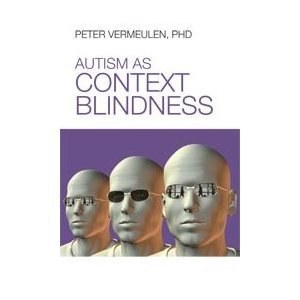
Dr. Vermeulen has produced a brilliant work that demands attention. Autism as Context Blindness provides a unique glance into the minds of individuals with autism. A Mom’s Choice Award winner, Autism as Context Blindness provides a unique glance into the minds of individuals with autism. It is simple but groundbreaking. Application of Vermeulen’s insights will help autistic people to better understand what causes their challenges. While we have become increasingly familiar with the term autistic thinking, how the autistic brain works is still misunderstood. In this book, inspired by the ideas of Uta Frith, the internationally known psychologist and a pioneer in theory of mind as it relates to autism, Vermeulen explains in everyday terms how the autistic brain functions and highlights the impact of not using context spontaneously. Full of often humorous examples, the book examines context as it relates to perception, social interaction, communication and knowledge. The book concludes with a section on how to address contextual sensitivity—a skill vital for successful functioning. Due to the far-reaching consequences of context blindness, this book is a must-read for those living and working with somebody with autism. Dr. Vermeulen’s insights regarding context blindness deliver fresh perspective on how individuals with autism spectrum disorder (ASD) perceive and respond to their environment.
A very useful book for anyone educating, parenting, befriending or living with someone with ASD. Having worked in the field of ASD for many years much of Vermeluen's comments and observations were familiar to me but the book really helped me personally to reflect on why high functioning people with ASDs continue struggle so much in social situations even though they may "know" what is expected and at times can speak and act in empathic ways.
Vermeulen argues strongly for a change to the way we set about teaching social skills and writing goals for these emphasising the need to build in flexibility of response as context changes. He recommends using much more role play for example. Vermeulen explains that we need to offer social support by explaining and clarifying context in much greater detail.
Vermeulen explains that in fact no concept or idea is fixed but continuously is adapted and modified in the neuro-typical brain by our experiences and our observations and by the context we are in. However in the autistic mind it seems that concepts form as rigid ideas. The idea itself may be in fact literal or non-literal but the person struggles to connect up ideas. Thus a child with ASD told to "pull their socks up" may learn that as a literal OR non-literal concept. They will however struggle to choose between meanings even if they know both meanings because they do not instinctively and subconsciously consider the context.
Vermeulen talks about how, in certain circumstances or professions context blindness may be an ADVANTAGE because the person is able to disregard all context and focus simply on analysis and the skills of people like Turing or Newton could be seen in this way. The context does not distract from their single-purposeful approach. However as soon as the person is in a social situation the inability to read context and respond in expected ways can become disabling.
Interesting theory. The book being 12 or more years old, I don't know how well it has held up, though. But it's nice to come across a book on autism that isn't 1) strictly about children and 2) complete, offensive bullshit.
In Autisme als contextblindheid presenteert Peter Vermeulen een paradigmaverschuiving in hoe we naar het autistisch brein kijken. Waar eerdere theorieën vaak bleven steken bij het beschrijven van gedragssymptomen, graaft Vermeulen naar het cognitieve fundament: de verwerking van context. Dit boek is een "uit de hand gelopen update" van zijn eerdere werk over het autistische denken, en die verdieping is merkbaar.
Vermeulens centrale stelling is dat het autistische brein informatie verwerkt als losstaande fragmenten. Voor een neurotypisch persoon bepaalt de omgeving (de context) onbewust de betekenis van een prikkel. Een traan op een wang kan verdriet betekenen, maar ook opluchting of een allergische reactie. Een knipoog op de trein is soms waardering, soms een verlegen verzoek.
Vermeulen legt uit dat mensen met autisme vaak beschikken over een enorme feitenkennis, maar moeite hebben om die kennis flexibel in te zetten. Hij noemt dit contextblindheid. Dit verklaart waarom iemand met ASS in een rollenspel perfect sociaal kan reageren, maar in de onvoorspelbaarheid van het echte leven vastloopt.
Een van de meest treffende inzichten in het boek is de metafoor van het hersenorkest. Bij een contextgevoelig brein spelen alle muzikanten mooi op elkaar in onder leiding van een dirigent; prikkels worden relatief verwerkt. In het autistische brein zitten vaak briljante muzikanten (de 'eilandjes' van intelligentie of splintervaardigheden), maar ze spelen niet samen. Er is geen dirigent die de losse tonen smeedt tot een symfonie. Hierdoor worden prikkels 'absoluut' waargenomen, wat leidt tot een wereld die vaak als een verwarrende puzzel aanvoelt.
in dit boek herken ik dat een goede taalvaardigheid vaak contextblindheid maskeert. Taal begrijpen is immers "één grote oefening in context lezen". Wie verbaal vlot is, wordt vaak overschat, terwijl het betekenisverlies in sociale interactie enorm kan zijn.
Een ander herkenbaar stuk is dat over de sociale vaardigheidstraining (SoVa). Vermeulen bekritiseert trainingen die enkel op gedrag focussen. Het aanleren van regeltjes helpt weinig als de persoon niet aanvoelt wanneer welke regel van toepassing is. Spontaniteit laat zich niet in scripts vangen.
Interessant is volgens mij ook de waarschuwing voor de contextblindheid van de omgeving zelf. Hulpverleners die star vasthouden aan één methode zonder naar de specifieke context van de persoon te kijken, maken zich paradoxaal genoeg schuldig aan hetzelfde probleem.
Autisme als contextblindheid is een essentieel, zij het lijvig, standaardwerk. Het houdt het midden tussen een medische analyse van informatieverwerking en een sociaal pleidooi voor een autismevriendelijke omgeving. Het is een aanrader voor de "gevorderde" lezer die wil begrijpen waarom de wereld voor mensen met autisme soms aanvoelt als een film waarvan de ondertitels niet synchroon lopen.
Interesting, informative and eye-opening (not literally in a way that pathologist might do)
Jokes aside, this Book describes the challenges many autistic individuals face every day in the most unexpected moments, and the thought process behind the confusing moments. I sometimes myself fall into this trap and take things literally (no worries there’s no trap <3)
I see sometimes it’s hard to see what’s right in front of you or what we just talked about, or that the Sea tastes like salt and… definitely not pepper.
Categorization, conceptualizing and solely perceptive differences and how the brain (mirror cells etc) process information, put pieces together and see the forest from the trees.
Peter Vermeulen offers an absolutely brilliant and refreshing perspective on how autistic thinking is different from neurotypical thinking. He distilled immensely practical advice I use daily to connect better with the autistic people I love and coach. His work paves the way to embracing neurodiversity in our lives.
As someone who has autism i dint know what context was until i read this book. Was hard to read becousse context is hard to understand for those who have autism. But did learn what one of my main problems in life is.
Sooo good! Well worth the read, and a great resource for additional information on the connection between autism and reading/using context in socially expected ways....and all explained in an approachable and easy to read manner.
Ik vond dit erg droge kost. Ik was blij dat de laatste 30 bladzijdes bronnen waren en dat het achter de rug was. Dat zegt wel genoeg. Ik herken het geschetste beeld ook niet (helemaal) bij de volwassen mensen met ASS die ik ken. De voorbeelden die worden genoemd vind ik af en toe echt bizar