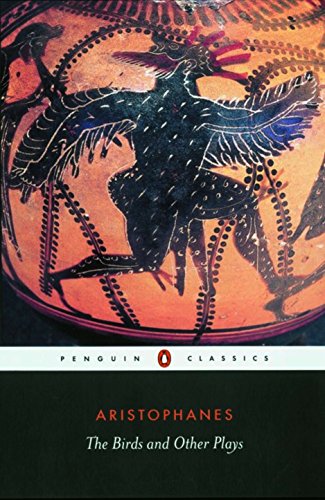
Offering a window into the world of ordinary Athenians, Aristophanes' The Birds and Other Plays is a timeless set of comedies, combining witty satire and raucous slapstick to wonderful effect. This Penguin Classics edition is translated from the Greek by David Barrett and Alan H. Sommerstein.
The plays in this volume all contain Aristophanes' trademark bawdy comedy and dazzling verbal agility. In The Birds, two cunning Athenians persuade the birds to build the utopian city of 'Much Cuckoo in the Clouds' in the sky, blockading the Olympian gods and installing themselves as new deities. The Knights is a venomous satire on Cleon, a prominent Athenian demagogue, who vies with a humble sausage-seller for the approval of the people; while The Assembly-Women deals with the battle of the sexes as the women of Athens infiltrate the all-male Assembly in disguise. The lengthy conflict with Sparta is the subject of Peace, inspired by the hope of a settlement in 421 BC, and Wealth reflects on the economic catastrophe that hit Athens after the war.
These lively translations by David Barrett and Alan H. Sommerstein capture the full humour of the plays. The introduction examines Aristophanes' life and times, and the comedy and poetry of his works. This volume also includes an introductory note for each play.
Aristophanes (c.445-386 BC) was probably born in Athens. Little is known about his life, but there is a portrait of him in Plato's Symposium. He was twice threatened with prosecution in the 420s for his outspoken attacks on the prominent politician Cleon, but in 405 he was publicly honoured and crowned for promoting Athenian civic unity in The Frogs. Aristophanes had his first comedy produced when he was about twenty-one, and wrote forty plays in all. The eleven surviving plays of Aristophanes are published in the Penguin Classics series as The Birds and Other Plays, Lysistrata and Other Plays, The Wasps and Other Plays and The Frogs and Other Plays.
If you enjoyed The Birds and Other Plays, you might like Aristophanes' The Frogs and Other Plays, also available in Penguin Classics.
Aristophanes (Greek: Αριστοφάνης; c. 446 – c. 386 BC) was an Ancient Greek comic playwright from Athens and a poet of Old Attic Comedy. He wrote in total forty plays, of which eleven survive virtually complete today. These provide the most valuable examples of a genre of comic drama known as Old Comedy and are used to define it, along with fragments from dozens of lost plays by Aristophanes and his contemporaries. Also known as "The Father of Comedy" and "the Prince of Ancient Comedy", Aristophanes has been said to recreate the life of ancient Athens more convincingly than any other author. His powers of ridicule were feared and acknowledged by influential contemporaries; Plato singled out Aristophanes' play The Clouds as slander that contributed to the trial and subsequent condemning to death of Socrates, although other satirical playwrights had also caricatured the philosopher. Aristophanes' second play, The Babylonians (now lost), was denounced by Cleon as a slander against the Athenian polis. It is possible that the case was argued in court, but details of the trial are not recorded and Aristophanes caricatured Cleon mercilessly in his subsequent plays, especially The Knights, the first of many plays that he directed himself. "In my opinion," he says through that play's Chorus, "the author-director of comedies has the hardest job of all."
Some people pride themselves on finding fart jokes and cock jokes unfunny. "It's the lowest form of humor!" they scoff, then try to direct you to something more sophisticated and mature. Well, it is refreshing to learn that fart jokes and cock jokes are precisely where Western humor began, and were good enough, indeed the specialty of, one of the greatest comic playwrights who ever lived. If elevated wit mixed with incisive social criticism are what you want, go read Bernard Shaw. If you want complex exploration of human motivation and vice, read Shakespeare. If you want extremely broad and larger-than-life characters engaging in utterly insane plots while throwing cock and vagina and tit and ass and fart jokes and insults back and forth faster than you can keep track, than Aristophanes is the man for you. You'll also get more than your share of female-bashing, old person-bashing, government official-bashing, celebrity-bashing, and every other kind of bashing you can imagine. This is comedy of the throw-everything-at-the-wall-and-see-what-sticks variety, and if you can get into that over-the-top mindset, you'll have a great time with this.
The Birds is a genuine fantasy, something I was surprised to see (I had thought that all supernatural elements in Ancient Greek literature came from myth). It's about a disgruntled Athenian who convinces a bunch of birds to build a magic city in the sky (called Cloudcuckooland) in order to separate the humans from the gods and help the birds regain their supposedly natural bird-ascendency over the universe. The birds fall for it, choosing the disgruntled Athenian as their leader, and the protagonist's rise to power over the world of birds, humans, and eventually gods is portrayed with flair and comic intensity. The play is almost epic in its ludicrousness. Lysistrata is the famous play where the women take over the city and refuse to offer sex to the men unless they promise to end the war on Sparta. Don't kid yourself - this is not necessarily a feminist play, at least not by modern standards, but it is a very funny one, and a very good one. The Assemblywomen is another "women" play of Aristophanes', this time about the women taking over the government. They want to replace the current male system with a socialist state (the joke being, I suppose, that women are more compassionate and eager to share.) The results are predictably disastrous, and the play's comical swipes at socialism are entertaining, but the climax, involving three old ladies, a young man, and the laws regarding sex, is a masterpiece of offensive craziness, both hilarious and shocking, even to a modern audience. The final play, Wealth, is the weakest of the lot, by quite a margin, but it's worth reading for a nicely considered, if flawed, argument against the distribution of wealth exclusively to the good and the just. It doesn't have the "reckless abandon" approach to comedy of the earlier plays - it's more dogmatic and controlled (it's a precursor to what the historians call "New Comedy") - so those used to the broader tone of the others may find this one on the dull side. It is very short, though, so you might want to read it anyway.
In any case, anyone interested in the roots of comedy should read this. I can't speak to the accuracy of this translation, not being fluent in Ancient Greek, but I can speak to its wonderful readability - it sounds like it was written yesterday. The footnotes in this edition were also very helpful, and not overpowering. All in all, this was, to me, a surprisingly lively and entertaining reading experience.
Several years ago I resolved to read all existing ancient Greek drama. I have read all the surviving plays of Aeschylus and Sophocles. Now I have read all of Aristophanes too. Only Euripides and Menander to go and my pledge will be fulfilled.
These five plays are all very good. The Birds is utterly tremendous, perhaps my favourite of Aristophanes' plays with the exception of The Frogs. The outcome of this work is rather shocking, no less than the overthrow of the gods, but the individual scenes are mostly delightful, sometimes grotesque, exuberant and fantastical.
I also enjoyed Peace (very absurd) and The Assemblywomen (although regarded as one of Aristophanes' weaker plays I found it genuinely hilarious). Wealth began strongly but had a disappointing climax.
I am now in a position to list my three favourites of his plays as follows: (1) The Frogs (2) The Birds (3) Lysistrata
Menander next! I have a copy of his Plays and Fragments waiting for me.
I stumbled upon this as I was browsing the plays section and went into it completely blind. As a result I was caught off guard by the crude and vulgar humour which isnt exactly my taste ( though I will admit some jokes did get a giggle here and there). But I can always appreciate an excellent translation. Sommerstein and Barret did an incredible job translating it with a modern air,making it incredibly easy to understand with common slang,making the characters seem like exaggerated versions of people today(if we had different laws and refernced greek gods) and their introductory note and well as the references notes towards the end were greatly helpful. So the 4 stars essentially are for them and not necessarily Aristophanes.
Well, that was enlightening. If you're someone who is concerned that Ancient Greece was all Oedipal complexes and gouged out eyeballs and such you'll be very relieved to read the plays of Aristophanes. Aristophanes isn't afraid of a dirty joke or scatological references or employing enormous fake phalluses as stage props. I know more about the personal grooming habits of the Ancient Greek women than I probably *needed* to know. I almost typed WANTED to know but then I realized that if someone had dangled that information just out of my reach I probably would have reached out a hand and made at least a half-hearted snatch (sorry) for it. So, on some level I WANTED to know. But I didn't NEED to.
I understand that the work of Aristophanes represents and important element of Greek life and I'm glad I read this but I don't need to read any of his other plays. I get it.
As regards this particular translation, I would recommend it even though the translator's notes are a bit dense and he does love to use a long, complicated word where a concise one would do the job. I liked that this collection was designed to show the progression from Old Comedy to Middle Comedy. I could have done without the many references to plays and characters outside of this collection but ultimately I didn't feel like I was missing the point by just skimming over those.
The old vicious adder is back, puffed-up with gall and flatulence. Once again I'm struck by how sturdily the bedrock of Western comedy was laid more than two thousand years ago: in Aristophanes, we have sex and fart jokes, political satire, fourth-wall breakings, meta quips, blasphemy, surrealism, parody, dialectal ridicule, musical humour, wordplay-infused harangues, straight-up slander and memes galore (poor Cleonymus must have rued the day he allegedly dropped his shield). His plays are a veritable cornucopia, delivered with incomparable gusto and genuine mordancy.
In this collection, we have "Knights", "Peace", "Birds", "Assemblywomen" and "Wealth". The sandwiching plays were rather weak in comparison: the former relied heavily on topical allusions, which become rather tedious after a while, and the latter was simply dull in that the banter felt weak and the whole premise around which the play revolved was uninspiring waffle about what happens if everyone was wealthy. Needless to say, both of these plays were also all over the place when it came to the structure – but with Aristophanes, this generally isn't a bad thing, as long as other things hold up.
In comedy, the most important thing is to keep up a proper atmosphere of levity, which serves as the fecund soil for all kinds of merriment. Aristophanes definitely knows how to make this come about: in "Peace", the then-contemporary audience was treated to fantasies about ending the then-raging Peloponnesian War, and once the incarnation of Peace is enthroned halfway through the play, the rest is simply jokes at the expense of warmongers and crappy politicians; in "Birds", the titular avians are fantastically capable, and thanks to one rogue, they manage to usurp the gods by building a huge vault whereby the sacrificial odours cannot reach the divine heights – and the all-powerful gods have nothing against the feathered assembly or their cunning leader; and in "Assemblywomen", you have a silly infiltration into the assembly of Athens, where masked women vote that all power should be relinquished to them, after which they establish a mock-Republic by Plato. The premisses are bloody ridiculous and there is nothing, no divine or profane power that can upset the balance.
The three last-mentioned plays are not also as encumbered by the faults of "Knights" and "Wealth", even if all of them rather dissolve into a comic hodgepodge at some point. But the key thing is that these three plays keep the fun coming in droves. For instance, "Peace" has hilarious commentary on gung-ho politicians and people (during the rescue scene of the statue), "Birds" is brilliant throughout yet does shine especially when various mountebanks and scumbags begin to flock the freshly-founded "More Cuckoo in Clouds" city, and "Assemblywomen" cracked me up with its puerile poo scene.
At the same time, I am not a huge fan of the way wordplay is presented in Aristophanes. It is made really obvious, and the wordplay isn't really all that good. Of course the English translators had to take a lot of liberties and came up with stuff that Aristophanes definitely did not include, but the sheer manner of the delivery alone would most definitely ensure that I wouldn't enjoy the cracks even in the original. I was also not a huge fan of the musical humour: with the exception of the surprisingly beautiful, pastoral songs of "Birds", I rarely got a chuckle out of those.
But even when the plays would fall into pieces, the characters would get on my nerves and the allusions would go above my head (not being all that keen to check every single pedantic footnote, I'm not), the bravado of Aristophanes is nonetheless irresistible. Truly a big-bollocked stallion sire of comedy, he.
A political satire on the imperialistic dreams that had led the Athenians to undertake their ill-fated expedition of 415 bce to conquer Syracuse in Sicily. Peisthetaerus is so disgusted with his city’s bureaucracy that he persuades the birds to join him in building a new city that will be suspended in between heaven and earth; it is named Nephelokokkygia, translatable as “Cloud-cuckoo-land.” The city is built, and Peisthetaerus and his bird comrades must then fend off the undesirable humans who want to join them in their new utopia. He and the birds finally even starve the Olympian gods into cooperating with them. Birds is Aristophanes’ most fantastical play, but its escapist mood possibly echoes the dramatist’s sense of Athens’ impending decline.
Birds: 2.75 stars. It was fine. I’m neutral on this play. It was interesting, but not funny. Lysistrata: 2.75. I liked the like,,, power that this play gave to the women, but too vulgar for my tastes. Assembly-Women: 3.5. I liked this play! It took Lysistrata and made it better! Much less sexual jokes! Unfortunately there were a few poop jokes, which weren’t funny, but I can ignore them for the fact that the women of Athens are now in power. Wealth: 2. It was fine, but was worse with Birds. In Birds I was at least a bit entertained, but I was just confused with this one. Idk I just didn’t really like it.
Besides The Birds, the plays in this book (also The Knights, The Assemblywomen, Peace, and Wealth) are not Aristophanes' best works.
The Birds: This play is a work of ancient fictional genius. The summary is that two guys with tongue-twisting names (Peisthetaerus and Euelpides), sick of the litigious atmosphere of Athens, head out to find "a land without lawsuits". They seek out and find Tereus, a man who was transformed into a Hoopoe and is now king of the birds, with the intention of asking him where a good place to settle down would be ("he must do quite a lot of flying around, he may have come across the kind of place we’re looking for"). Tereus lives a relatively modest life in a home hidden in a cliff with his wife Procne, who was transformed into a Nightingale. (The usual version of their myth is extremely bloody and terrible, but in this play they are a happily married and honorable couple). While chatting with Tereus, Peisthetaerus has a brilliant idea: "My goodness, the possibilities I can see for you birds – and power too, if you’ll let yourselves be guided by me. ... In the first place, give up this habit of flying stupidly around all day; it’s getting you a bad name. Stay in one place and found a city." Where? "The sky: the great vault of heaven. Revolving on its axis – to which only the birds have access. Build a wall around it, turn this vast immensity into a vast, immense city, and then – you’ll rule over man as you now rule over the insects; and as for the gods, they’ll starve to death, like the Melians." (Athens had recently besieged and destroyed Melos). Tereus thinks that that is a terrific idea, so he calls the birds to assemble by waking up Procne and having her sing for the birds to assemble. Tereus sings along with her. The lyrics are wonderful: "Epo popo popo popo, popo popo poi! Ió, ió, itó, itó, itó, itó! Come along, come along, birds of my own feather, Birds who live in the farmers’ well-sown fields, Eaters of seed and of barley, myriad flocks Of a hundred species, fluttering quickly, Uttering gentle calls, Twittering together on the furrowed soil In a pleased voice, tió, tió, tió! ... Toro toro toro torotix! Kikkabau! Kikkabau! Toro toro toro toro lililix!" Peisthetaerus marvels at the assembly: "Look at them all! Jay, turtledove, crested lark, reed warbler, wheatear, pigeon, merlin, sparrowhawk, ringdove, cuckoo, stockdove, firecrest, rail, kestrel and – oh look, a dabchick! Waxwing – vulture – woodpecker – and that seems to be the lot." As the introduction mentions, it is notable that Aristophanes knows the names of so many bird species, and that he is familiar with their general habitats and lifestyles. At first the birds attack the two human "intruders" in their midst, resulting in a ridiculous scene where Peisthetaerus and Euelpides arm themselves with implements from Tereus's kitchen. But soon enough Peisthetaerus has their attention and narrates a remarkable bird-oriented origin story: "In the beginning there existed only Chaos, Night, Black Erebus and Dreary Tartarus: there was no Earth, no Air, no Sky. It was in the boundless womb of Erebus that the first egg was laid by black–winged Night; and from this egg, in due season, sprang Eros the deeply–desired, Eros the bright, the golden–winged. And it was he, mingling in Tartarus with murky Chaos, who begot our race and hatched us out and led us up to the light. There was no race of immortal gods till Eros brought the elements together in love: only then did the Sky, the Ocean and the Earth come into being, and the deathless race of all the blessed gods. So you see we are much older than any of the gods."
They decide to name their city "Nephelococcygia", which this book translates to "Much Cuckoo in the Clouds", but I prefer the typical translation "Cloud Cuckoo Land."
This play is so sacrilegious that it makes me think that Aristophanes' accusations of Socrates' sacreligiousness in The Clouds must have been a compliment. The scene where the birds dedicate the foundation of their city is pretty amusing: PRIEST [as they march round the altar]: Pray to the birds’ equivalent of Hestia, to the Stork who guards your hearth, and to all the Olympian cock gods and hen gods – PEISTHETAERUS: O Stork who stalkest over Sunium, all hail! PRIEST: – and to the Pythian and Delian Swan, and Leto the Quail–Mother; Artemis and Bunting – PEISTHETAERUS: I think she’s gone a–hunting. PRIEST: – and to the Phrygian Finch, and Ostrich the great Mother of gods and men – PEISTHETAERUS: Ostrich the mother of Cleocritus! [He imitates the walk of a well-known citizen.] PRIEST: – to grant health and safety to the people of Much Cuckoo in the Clouds, and likewise to their faithful allies in Chios.
The birds seem to construct their city in a matter of hours. FIRST MESSENGER: Birds, just birds. No outside help. No Egyptian bricklayers, no masons, no carpenters: just the birds, with their own hands. I was amazed. Thirty thousand cranes arrived from Libya, with foundation stones in their crops. The corncrakes shaped the stones with their beaks. Ten thousand storks carried the bricks, and the water was brought up by the plovers, and other river birds. PEISTHETAERUS: Who carried the mortar for them? FIRST MESSENGER: The herons brought it, in pans. PEISTHETAERUS: How did they get the mortar into the pans? FIRST MESSENGER: Oh, that was most ingenious: the geese put it in for them. They used their feet as shovels. PEISTHETAERUS: Quite a feat! FIRST MESSENGER: The ducks had their aprons, of course, so they did the bricklaying; and the swallows fluttered above, with their little trowels behind them, carrying the mud in their beaks.
Next, we have a violation of bird airspace that sounds like it could have come from a Madagascar spin-off: SECOND MESSENGER: Oh, sir, terrible news. One of the gods has just violated our air space: flew in through one of the gates. One of Zeus’s lot. The jackdaws were on guard but he slipped through, sir. PEISTHETAERUS: The dirty dog! How dare he? Which of the gods was it? SECOND MESSENGER: We don't know, sir. But he’s got wings, we do know that. PEISTHETAERUS: You should have sent out a pursuit force straight away. SECOND MESSENGER: We have, sir: thirty thousand mobile archers of the Hover and Swoop corps: every bird with curved talons is on the wing – kestrels, buzzards, vultures, owls and eagles. Listen, you can hear the whirring of their wings, filling the air with thunder – he must be somewhere quite near. In no time at all they apprehend the intruder - Iris, the messenger of the gods. Iris and Peisthetaerus have a heated exchange that ends in a virtual declaration of war: PEISTHETAERUS: Off with you now! Quickly! shoo! beat it! IRIS [dissolving into tears]: Just wait till my father [Zeus] hears about this: he’ll soon put a stop to your insults. PEISTHETAERUS: Oh, for pity’s sake, fly away. Go and incinerate someone a bit younger.
Meanwhile back on earth, Cloud Cuckoo Land has gone viral: MESSENGER: You see, until you founded Much Cuckoo, Sparta was all the rage. People grew their hair long, they starved themselves, they stopped having baths (like Socrates), they all carried walking sticks. But now there’s been a complete change, they’re all bird-mad. ... [REBELLIOUS YOUTH enters, singing.] REBELLIOUS YOUTH [sings]: Gonna fly high! Gonna fly high! Gonna spread them wings and sweep, sweep, sweep Over the waves of the boundless deep, Gonna fly like an eagle in the sky! PEISTHETAERUS: Looks as if that messenger was right: there’s someone arriving already and he's singing about eagles. (the rebellious youth is promptly sent into the war against the gods).
The play ends with basically complete capitulation by the gods, who have been starved of the smells of their earthly offerings. Peisthetaerus demands "Sovereignty" as bride, and a delegation of gods (Poseidon, Heracles, and a "Triballian" god, representing the barbarian gods) agree, basically making Peisthetaerus the sovereign of the world.
It's a silly play, but as Peisthetaerus tells an informer: PEISTHETAERUS: Words can give everybody wings. INFORMER: Everybody? PEISTHETAERUS: Wings to their spirit, their imagination.
I can confirm that the words of this play sent me to Cloud Cuckoo Land while I was reading it.
Peace: This play was written in 422 BC in the aftermath of the Siege of Amphipolis, in which Brasidas, a Spartan warmonger, and Cleon, an Athenian demagogue and warmonger, were both killed. Aristophanes was clearly anti-war, and this play was a celebration of the death of the warmongers and an advertisement for the benefits that peace would bring. I love the way the play starts off, in which two slaves are feeding a ravenous... beetle. What I love so much is that I would never in a million years have been able to guess what was going on with the beetle. One of the slaves eventually explains, "yesterday [my master] went out some damn place, I don’t know where, and brought home this beetle, an enormous one bred on Mount Etna, and told me, if you please, to keep it here in the stable. And he, he rubbed the creature down like a thoroughbred colt and he said to it, ‘Well, my little Pegasus, my noble winged steed, soon you’ll be flying up to Zeus with me on your back.’" So basically it's a horse-sized dung beetle that will fly the master, Trygaeus, up to Mount Olympus. "DAUGHTER: But what is in thy heart that thou shouldst ride / Up to the gods upon a beetle, daddy? TRYGAEUS: In Aesop’s fable will you find it writ / ’Tis the sole creature that to heaven has flown." As Trygaeus ascends towards heaven, he shouts down, "Please, everybody – I’m doing all this for your sake – could you possibly abstain from shitting and farting for the next three days? If pegasus here gets a whiff, he’ll chuck me head over heels and swoop down for a meal!" After a rough ride, Trygaeus reaches Olympus, where he receives and unfriendly welcome: "TRYGAEUS: Whew! Ah, this must be Zeus’s house. [Knocks.] Anyone at home? Here, can’t somebody open the door? HERMES [coming to the door]: Whence comes this mortal’s – [Opens the door and gapes at the beetle.] Heracles save us, what is that monstrosity? TRYGAEUS: Why, a hippobeetle. HERMES: Why, you foul, shameless, desperate, good-for-nothing villain! How dare you come here, you villainest of villains?" Trygaeus eventually learns from Hermes that the other gods have left Greece for a different part of heaven: "They were fed up with you Greeks. So here where they used to live, they got War to move in, and said he could do as he pleased with you; and then they set up house as high in heaven as they could get, so they couldn’t either see you fighting each other or hear you praying to them... Because they’d tried to make peace over and over again, and still you insisted on carrying on with the war." Moreover, it turns out that War has taken Peace "and thrown her into a deep dark cave" and covered the opening with heavy rocks. War soon comes out with a pestle and mortar that he will use to "pound every city in Greece into a pulp"... and make a salad: "WAR [adding garlic]: Aaaah! Megara, Megara, city of garlic, I shall pound you to pieces and mix you in my salad! TRYGAEUS [tears in his eyes from the garlic]: Megara will weep today all right! [Rubs his eyes.] WAR [adding cheese]: Aaaah! Sicily, Sicily, land of cheese, you will perish too! TRYGAEUS: Poor island, all grated up!" But it turns out that War doesn't have a pestle to grind with - he sends his boy Havoc to Athens to get a pestle, but they don't have one (Cleon had just died) - he then sends Havoc to Sparta, but Sparta also doesn't have one (Brasidas was dead). Thwarted, War leaves to go make his own pestle. Trygaeus takes the opportunity to somehow summon a bunch of farmers from all over Greece to liberate Peace. Hermes attempts to intervene, but Trygaeus bribes him with meat, some gold, and the promise of lots of festivals and games dedicated to Hermes. They eventually pull off all of the rocks blocking Peace's cave and liberate her, along with Harvest and Festival. While celebrating, the chorus say something intriguing: "What joy to see my vines again, what joy to say hello / To the fig-trees that I planted in my youth so long ago!" The mention of vines and fig trees is intriguing to me because it's very biblical (Micah 4:4 But they shall sit every man under his vine and under his fig-tree; And none shall make them afraid; For the mouth of the LORD of hosts hath spoken.). Makes me wonder if the vine and fig tree imagery was a pan-eastern-Mediterranean thing. Hermes gives Harvest to Trygaeus as a bride, and everyone lives happily every after.
The Knights This play was written in 424 BC (2 years earlier than Peace), after Cleon had risen to power by capturing the Spartans trapped at Pylos (in reality, Cleon wasn't responsible at all for capturing the Spartans but came at just the right moment to claim all the credit). As the translator notes, the play is a savage attack on both Cleon and the Athenian political system that produced him. In the play, "Cleon" is represented by "the Paphlagonian", and he meets his match in the form of the "Sausage-Seller", who is even more unscrupulous than he is. The play mostly consists of the Sausage-Seller outdoing Cleon in every form of bribery, demagoguery, and lying. One of the more memorable scenes is where the two characters exchange insults and threats for a surprisingly long time. P: When you’re a General, I’ll accuse and try you! S: I’ll chop yer back in tiny bits and fry you! P: My lying talk will catch you by the heels. S: I’ll cut yer footsies up for ’igh-class meals. P: Just look me in the eye now, if you dare! S: I’m also a son of Athens’ Market square! P: Another word and I’ll cut up your hide! S: Come on, you shit, I gotter chuck you ahtside! P: What impudence! I’m a real thief ’ are you? S: Yerss, and if caught, a first-rate liar too! P [breaking free]: That’s trespassing on my territory! ... S: I’ll stuff up your arsehole like a sausage-skin! P: I’ll grab you by the backside and throw you out of town! D: If you do, you’ll have me to reckon with as well! P: I’ll shove you in the stocks unless you yield! S: I’ll charge you with desertion in the field! P: I’ll stretch your hide, I’ll give you no relief! S: I’ll make your skin a wallet for a thief! P: I’ll pin you to the ground with iron pegs! S: I’ll make bad mincemeat of your arms and legs! P: I’ll pluck your eyelashes from out each eye! S: I’ll slit your crop, and like a fowl you’ll die!
The Assemblywomen: This play was written in 393-391 BC, about 10 years after Athens' defeat in the Peloponnesian war. But at this time, Athens was still in a state of war with Sparta, but greatly reduced from its former level of wealth and power. In this play, the women of Athens seize power over the government at the Assembly and pass a series of measures meant to create a society similar to that of Plato's Republic, including things like communal sharing of spouses and children, and communal dwelling and eating areas. The introduction notes that the play is oddly disjointed, with one particular side plot from the first half of the play (a citizen who has found a way to get around the new communal rules) being forgotten about in the second half of the play. One of the more memorable scenes is when Blepyrus, the husband of Praxagora, the ringleader of the women, is constipated: BLEPYRUS: Well, it’s certainly holding things up. What am I going to do? This is bad enough, but what’s going to happen when I eat another meal? How’s that going to get out, with this big fellow in the way, barring the exit? I need an operation. Question is, who’ll perform it? [To the audience] Hey, anyone out there with any experience of bottoms? My God, dozens of them. Amynon? No, I won’t ask him; he’s choosy these days, he might say no. Fetch Antisthenes, somebody, for goodness’ sake; he’s always grunting and groaning himself, he’ll understand. Oh, Goddess of Childbirth, can you look on unmoved as I crouch here, bulging, but bunged up? It’s just like a scene in some low comedy. [It is now light, CHREMES enters, coming from left.] CHREMES: Hullo, what are you doing? Having a shit? BLEPYRUS: What, me? Just finished, actually. CHREMES: Is that your wife’s dress you’re wearing? BLEPYRUS: It was the only thing I could find, in the dark. [Praxagora had taken his cloak to disguise herself as a man in the assembly]. That morning, all of the women of Athens attended the assembly dressed as men and voted to hand over control of the government to the women. Chremes tells Blepyrus, "They voted to hand over control to the women. The general feeling was, that as this was the only method that hadn’t yet been tried, they might as well try it." Praxagora decides to establish communism: "everyone is to have an equal share in everything and live on that; we won’t have one man rich while another lives in penury, one man farming hundreds of acres while another hasn’t enough land to get buried in; one man with dozens of slaves and another with none at all. There will be one common stock of necessities for everybody, and these will be shared equally... I’m making girls common property too. Any man who wants to can sleep with them and have children by them... The plain unattractive girls will sit with the pretty ones; anyone who wants a pretty girl will have to lay one of the plain ones first... I shall have all the party-walls pulled down between houses: the whole city will be just one big communal residence. You’ll be able to walk in and out where you like... I shall have all the lawcourts and arcades converted into dining-halls." This sets the stage for really interesting consequences, but the play mainly explores it by having a young man attempt to liaise with a younger women only to be thwarted by old crones who drag him to their house to have sex with him.
Wealth: This is the last known play by Aristophanes. The premise is that Wealth is blind, which is why so many bad people become wealthy. Chremylus restores Wealth's sight, causing Poverty and Chremylus to have an interesting debate where Poverty explains: "Every craftsman feels that he is my slave: that I sit behind him, compelling him by sheer need to seek a way of earning a livelihood... You don’t realize that I give you better men than Wealth ever can, better in body and better in mind. He gives you all sorts of cripples: gout here, pot bellies there, dropsy in the calves, obesity beyond all bounds, while I give you lean, wiry, wasplike men, who are deadly to their enemies." Later Hermes comes and complains that no one is sacrificing anymore, and he accepts a job as a "Divine Servant."
Was hoping, but not truly expecting, these would be funny plays. "The Birds" exceeded my hopes. Sitting outside by a swimming pool in Florida, surrounded by young adults on hedonism pilgrimages and even younger Spring Break'ers, I was the one laughing out loud. Oxford Classics editor Stephen Halliwell used different translators' versions of the four plays in this volume; this "Birds" was by Nan Dunbar, from 1995, and it made the play read as though it had been written two weeks ago.
I read "Lysistrata" long, long ago, like any young American schoolboy with a geeky streak, to see what the sex talk would be about. But I do not recall this degree of casual, impish humor. In "The Birds," characters address the audience, the judges, and anyone else Aristophanes feels like bringing into the action. It starts like "Waiting for Godot" -- two older men, sad sacks, who seem to be lost and wondering what to do next. Turns out they are renegades from classical Athens and all its taxation, lawsuit-craziness, and general irritations. They want some relief; a new place where they can live more peacefully. (It was a valuable reminder of some of the flaws of Periclean and post-Periclean Athens.)
"You want a greater city than Athens?" a hoopoe asks them. One answers: "A place where in the street I'd be rebuked By some good-looking boy's indignant father: 'Well, what a spendid way to treat my son! You saw him as he left the gymnasium, But didn't kiss, or speak, or try to touch him. A family friend, and you didn't squeeze his balls!' "
That's the general tone. The comedians had great license during the festivals, and Aristophanes took full advantage of it. Of course, just as they are succeeding in a wonderfully absurd project to make the birds create their paradise, CloudCuckooland, all the priests, oracle-mongers, and other rent-seeking creeps of Athens start to appear -- even (shudder) a poet. Aristophanes mocks them all wonderfully. His fantasies about what one could do if blessed with a pair of wings make for earthy humor, too.
On to the others.... "Lysistrata," "Assembly-Women," and "Wealth."
This volume contains translations of Birds, Lysistrata, Assembly-women and Wealth, by Stephen Halliwell. Below follows my discussion of one of the four plays, Lysistrata.
Lysistrata is one of the most well-known of the Greek comedies by Aristophanes, written in the spring of 411 BC - in the twentieth year of the Peloponnesian War. In the same year in Athens aristocrats overthrew the radical democratic government in a coup. Lysistrata is the third of Aristophanes' pacifist anti-war pieces, the story of a female sex-strike to force the men to stop running off to yet another war or battleground.
The piece addresses the fact that men are the cause of war and the suffering that goes with it, and the struggle of women against that. Lysistrata is an extraordinary woman with a large sense of individual and social responsibility. She has convened a meeting of women from various Greek city-states that are at war with each other. With support from the Spartan Lampito, Lysistrata persuades the other women to sexually deny their husbands as a means of forcing them to conclude the Peloponnesian War. The women are very reluctant, for obvious reasons, but the deal is sealed with a solemn oath. Soon after that, a cry of triumph is heard from the nearby Acropolis - the old women of Athens have seized control of it at Lysistrata's instigation, since it holds the state treasury, without which the men cannot continue to fund their wars. Lampito goes off to spread the word of revolt, and the other women retreat behind the barred gates of the Acropolis to await the men's response.
A chorus of old men arrives, carrying heavy timbers, intent on burning down the gate of the Acropolis if the women do not open up. From the other side, a chorus of old women arrives, bearing pitchers of water. Threats are exchanged, water beats fire, and the old men get a soaking. The magistrate then arrives with Scythian Archers (the Athenian version of police constables), blaming the men for poor supervision of their womenfolk. He has come for silver from the state treasury to buy oars for the fleet, but his Scythians are quickly overwhelmed by groups of determined women.
Lysistrata explains the frustrations that women feel at a time of war when the men make stupid decisions that affect everyone, without listening to the opinions of their wives. She drapes her headdress over the magistrate, gives him a basket of wool and tells him that war will be a woman's business from now on. Outraged at these indignities, he storms off.
Now Lysistrata has to restore discipline among the women, for her comrades are themselves so desperate for sex that they are beginning to desert on the silliest pretexts. But the condition of the husbands is even worse. The women play with them - enticing them and then again pushing them away.
A Spartan herald (in a very bad state) then appears requesting peace talks, and these indeed commence. Lysistrata introduces the Spartan and Athenian delegates to a gorgeous young woman called Reconciliation. The delegates cannot take their eyes off the young woman; meanwhile, Lysistrata scolds both sides for past errors of judgment. The delegates briefly squabble over the peace terms, but with Reconciliation before them and the burden of sexual deprivation still heavy upon them, they quickly overcome their differences and retire to the Acropolis for celebrations. The war is ended!
Over the centuries, Lysistrata has been frequently adapted: as a play (The Woman's Prize by John Fletcher, 1611); as a musical (The Greatest Sex, 1956; The Happiest Girl in the World, 1961); as an opera (by Mark Adamo, 2005); as an operetta (Paul Lincke, 1902); as ballet (1941), and it has inspired (sub-)plots of various films.
Lysistrata is notable for being an early exposé of gender relations in a male-dominated society. It was produced in the same year as Women at the Thesmophoria, another play with a focus on the subversive role of women in a male-dominated society, just two years after Athens' catastrophic defeat in the Sicilian Expedition. And in Assembly-women of 391 BCE Aristophanes invented a scenario where the women of Athens assume control of the government and instate reforms that ban private wealth and enforce sexual equity for the old and unattractive. Modern adaptations of Lysistrata are often feminist and/or pacifist in their aim (although dramatic poets in classical Athens were neither unreservedly pacifist not feminist in the modern sense).
Finally a few words about Aristophanes (c. 446 – c. 386 BCE), who has been dubbed "The Father of Comedy." Eleven of his forty plays survive virtually complete. Like the work of Aeschylus, Sophocles and Euripides, his plays were written for production at the great dramatic festivals of Athens, the Lenaia and City Dionysia, where they were judged and awarded prizes in competition with the works of other comic dramatists. His plays were highly political, addressing topical concerns by mentioning real individuals and local issues - "topicality" and "political theater" are the keywords here. The plays have a significance that goes beyond their artistic function, as historical documents that open the window on life and politics in classical Athens, in which respect they are perhaps as important as the writings of Thucydides. The artistic influence of the plays is immeasurable. They have greatly contributed to the history of European theater.
Of Aristophanes’ intact plays, here survive the two worst. First, The Assemblywomen, which begins as an improved riff upon Women at the Thesmophoria and Lysistrata before abruptly – past the middle section – shifting into a different, hardly related collection of vaguely inspired ‘gags’. Some are funny; none complete the comic drama so carefully aligned in the play’s beginning. There is something sad about it. A kind of disintegration. The chorus were, at this period, fading from the Greek stage (for reasons of misery before those of art); this play seems a representative of an artform in decline. A shift from the grand Old Comedy to the miserly New; only without whatever fine-spun talent or detail that might glory the latter. It is instead a compromised work. The translator implies the second part might be the hand of another, the elder Aristophanes uninterested in completing the play. I cannot speak to the linguistic plausibility of this, but it is a tempting proposal. The Knights is the other weak play of the set, although its circumstances are wholly different. It hails not from the flailing end but the skyscraper beginnings of Aristophanes’ career. And it is defined not by compromise; rather its opposite. The issue is one of breadth: it is, in essence, a play-long diatribe against a particularly dreadful demagogue in Athenian politics (the infamous Cleon, populist urtext). This drama is not built upon nor shifted in any way. It is a continuous piling of insults, a vast work opprobrium that drives on relentlessly. Being removed from its original context, I cannot help but be removed from its effect. It is, more than The Assemblywomen in general, funny, but perhaps ragging on the same bit for much too long. A similar takedown on a slightly less abstract politician would, no doubt, be somewhat more cathartic. (Though: crude, gauche? Those elements are probably inherent.) Leaving the rough works aside, there remain some of Aristophanes’ gleaming artefacts. Peace begins with the kind of genius image Hieronymus Bosch might dream: a man flying to heaven atop a dung beetle, to entreat the gods. The drama is quickly resolved: here is a play more concerned with farcical situation and revelry than plot; this preference succeeds. The Birds might well be Aristophanes’ best play: at the least, it is the easiest for a modern reader to parse without wondering how many jokes he’s missing, and how many footnotes lie ahead. It builds in the way of a Gilbert & Sullivan – an absurd premise is established, and then escalated to the extreme of absurdities. The base suggestion – past the talking birds – is that these birds ought to wall off the sky and take tribute from the offerings meant for the gods. An extremely literal interpretation of godly position versus that of man (ignoring, dutifully, those gods who supposedly dwell beneath); this idea is compounded upon the revelation that there exists another pantheon above the familiar Greek set. Aristophanes does not take it so far, but like in Euripides’ Helen one could envisage infinite heavens above one another, and perhaps infinite below, an endlessly repeating absurdity kept in check only by the continued faith in things remaining as they are. Aristophanes throws the balance off, and in his outward ridicule reveals so many exposed sinews. He jabs at them, not in search of revolution (it seems Aristophanes is of the reactionary class in several respects), but rather to see how they squirm. Wealth is then a fine epilogue to the Penguin series on Aristophanes: it is of the ‘new’ style but, unlike The Assemblywomen, it does not seem caught up in the old, nor does it collapse upon its own conceit. Instead it is a long and strung-out metaphor, one that both enjoys a certain wish fulfilment (makes its noble characters rich; its ignoble poor) while acknowledging the fundamental problem of this wish. It is not unlike a variation on Psalm 73, here imagining the ‘alternate world’ where the good prosper and (by a kind of necessity) God is shown to be cruel, and his cruelty is overthrown. But that short agon with Poverty, which seems stabbed in the midst of this play with no provocation nor resolution, complicates matters. It reminds us that wealth and poverty are, in wheel-form, motivators; that without motivation human hands grow idle, and industry fails. Today we may aspire to fully-automated luxury communism; the olden Greeks still relied upon genuine toil as a fact of life. If we all have everything in great quantities, what would propel human society? Of course, this is Aristophanes at his most wily and most conservative; he is the wealthy poet musing upon the ‘idle poor’, should the poor be rendered idly wealthy. But he strings this bow with expected poise; the truth of its aim matters little.
After reading the three great tragedians, Aristophanes was a pleasant change of pace. Similar to the writings of Aeschylus and Euripides, I found myself thoroughly entertained and laughing at moments through these comedies. The differences in genre between tragedy and comedy have given me a more balanced perspective on Greek life; this text has taught me that despite the serious attitudes of Greek epics and philosophy, the Greeks also had a down-to-earth sense of life’s absurdity. The four plays included in this volume cover a wide range of themes. The Lysistrata would be my favorite, and Wealth my least favorite. Unfortunately, some of his other more famous plays like Clouds and Frogs are not included, but this introduction motivates me to read more of Aristophanes. While I am not qualified to judge the technical aspects of the translation, the text does real well while preserving some sense of meter. There are endnotes included which explain some historical references or wordplays in Greek. While I would prefer footnotes instead, the explanations are satisfactory. The introductions to each play assume some knowledge of the plays’ content, so I would suggest reading the play first before reading the introduction for more analysis. Overall, it is a pretty good book for the price and an excellent introduction to Aristophanes for the first time reader.
Fart jokes, philandering, sharp political satire, and the battle of the sexes circa 500 B.C. Aristophanes’ plays are all very witty and even quite brave considering how relentlessly he attacked Athens’ politicians and power players during this time, of which he was liable for slander. The common targets of Aristophanes’ irreverent lampooning are the city leaders, gluttons, soothsayers, priests, and notably the Gods. Some plays are better than others, with The Birds being the crowd favorite. The Knights was agonizing for me and seemed to wander quite a bit in the dialogue and Chorus. Peace and the Assemblywomen were my favorites; through Aristophanes, you can feel the Athenian’s legitimate anxiety over their impending doom as they were losing the war with the Spartans (similar to his other famous work, Lysistrata) and facing destruction of their democracy and untold horrors. Much like gallows humor. Comprehending this backdrop of the internecine Peloponnesian War and pairing it with the heavy dose of Aristophanes’ satiric barbs in these plays, one gains an appreciation for the ancient Athenian’s yearning for good governance, prosperity, peace, and happiness—things most of us can identify with today. That and fart jokes.
Stephen Halliwell crafts accessible translations to Aristophanes' comedies, he is so skilled that he was able to make me laugh out loud to 2000 year old plays. In terms of my Classical Civillisation A-level and its topic on Greek drama, the introduction was extremely useful as it acted as both a revision guide and a source of new information. His explanatory notes are indispensable and gave the crucial context to each play simply. This book has provided me with my new favourite Ancient Greek play, The Assembly-Women, and I know that Halliwell's version of it will remain my favourite. To conclude, this book does exactly what it says it will, gives simple and funny translations to four examples of old comedy whilst also providing the reader with extensive context.
I read this one straight after Halliwell's more scholarly translation of Clouds, Women of Themosphoria and Frogs. Whereas that focused on the verse and beauty of Artisophanes, Barratt and Somerstein have produced something designed to be performed: the rapid-fire comedy hits in a very modern way, helpful staging is included, and the translations are significantly briefer than Halliwell's. The loss is not insignificant - the plays are bawdy and light, with less gravitas and poetry, but on the other hand, they are very funny, which is somewhat the point. The historical notes are excellent, and I appreciated the chronological glimpse into the transition from lavish to impoverished and how that connected to the demise of Old Comedy.
This is my first time reading Aristophanes in a non-academic setting, and I was really able to engage and enjoy it in a different way. Reading ancient literature can often feel distant, but my biggest takeaway is how pertinent the themes, interactions, and depictions of social life in ancient Athens feel. Aristophanes writes comedy in its purest form — my best description is a 5th century BC version of South Park. Both combine vulgarity, exceptional wit, and silliness to write thematic satire in a way that can resonate with anyone.
Here’s how I would rank the plays in this collection:
1. The Birds 2. Peace 3. The Assemblywomen 4. The Knights 5. Wealth
My copy has Birds, Lysistrata, Assembly Women and Wealth. I have read Birds 2 or 3 times now, Lysistrata twice, and the others only once just now. I might say that Wealth was my favorite during this read through of them all. They are all quite funny and I just find it fascinating that we have access to these works from so long ago, yet the themes remain so relatable. Birds I love because of Cloudcuckooland, Lysistrata I love because of the boner jokes, Assembly women I love because like Lysistrata because it has women main characters, and Wealth I love for being hilarious but also having an interesting commentary on what drives us to be who we are
Some Favorite Quotes: From the introduction to the Project Gutenberg version I read: the play appeals perhaps more than any other of our Author's productions to the modern reader. Sparkling wit, whimsical fancy, poetic charm, are of all ages, and can be appreciated as readily by ourselves as by an Athenian audience of two thousand years ago.
Undoubtedly; words give wings to the mind and make a man soar to heaven.
This comedy ridicules the disastrous Greek expedition to Sicily in 413 BC. More generally, The Birds is a rollicking commentary on man's eternal dissatisfaction with his lot; his habit of ignoring the divinities which shape his ends; is crowded, evil-breading cities; and his tendency to disturb the equilibrium of the universe, Pisthetaerus, with his irresistible rhetoric, is a forebear of the men who sell salvation or the world's goods with equal glibness and ease.
I throughly enjoyed this collection of plays. The introductions (at the beginning of the book and then one for each play) we interesting and mercifully short (usually, the scholars who compile these collections feel the need to write nearly as many pages explaining the works as the original author wrote for the works themselves). The humor is enjoyably crude and farcical and the metaphors highlighting problems with Athenian politics and economics are delightfully sarcastic.
It was really interesting, but also super weird. I feel bad rating it 4 stars because it's pretty impressive to have been written thousands of years ago and translated into English. But just because something is old doesn't mean it's necessarily the pinnacle of human achievement. I feel like some of the ancient literature we hail and worship was really just preserved by luck, and wasn't necessarily the best work of the civilization it came from...just me?