When a neighbor asks Nancy Drew to accompany her to an old uninhabited mansion, a new mystery opens ups, and danger lurks on the second floor. Nancy finds a witch tree symbol that leads her to Pennsylvania Dutch country in pursuit of a cunning and ruthless thief.
The friendly welcome the young detective and her friends receive from the Amish people soon changes to hostility when it is rumored that Nancy is a witch! Superstition helps her adversary in his attempt to get her off his trail, but Nancy does not give up. Persistently she uncovers one clue after another. Nancy’s intelligence and sleuthing ability finally lead to the fascinating solution of this puzzling case.
Carolyn Keene is a writer pen name that was used by many different people- both men and women- over the years. The company that was the creator of the Nancy Drew series, the Stratemeyer Syndicate, hired a variety of writers. For Nancy Drew, the writers used the pseudonym Carolyn Keene to assure anonymity of the creator.
Edna and Harriet Stratemeyer inherited the company from their father Edward Stratemeyer. Edna contributed 10 plot outlines before passing the reins to her sister Harriet. It was Mildred Benson (aka: Mildred A. Wirt), who breathed such a feisty spirit into Nancy's character. Mildred wrote 23 of the original 30 Nancy Drew Mystery Stories®, including the first three. It was her characterization that helped make Nancy an instant hit. The Stratemeyer Syndicate's devotion to the series over the years under the reins of Harriet Stratemeyer Adams helped to keep the series alive and on store shelves for each succeeding generation of girls and boys. In 1959, Harriet, along with several writers, began a 25-year project to revise the earlier Carolyn Keene novels. The Nancy Drew books were condensed, racial stereotypes were removed, and the language was updated. In a few cases, outdated plots were completely rewritten.
Other writers of Nancy Drew volumes include Harriet herself, she wrote most of the series after Mildred quit writing for the Syndicate and in 1959 began a revision of the first 34 texts. The role of the writer of "Carolyn Keene" passed temporarily to Walter Karig who wrote three novels during the Great Depression. Also contributing to Nancy Drew's prolific existence were Leslie McFarlane, James Duncan Lawrence, Nancy Axelrod, Priscilla Doll, Charles Strong, Alma Sasse, Wilhelmina Rankin, George Waller Jr., and Margaret Scherf.
So, basically, the best thing ever just happened to me.
My daughter fell in love with Nancy Drew.
I didn't think it would ever happen. I have spent the last three years “introducing” my middle child to the first book in the Nancy Drew series, The Secret of the Old Clock, only to watch her face crunch up in boredom and confusion. She actually said to me, at one point while I was reading, “Mom, it's like I don't even understand what anyone's saying.”
*Wither*
I called my therapist, and together we came to terms with the fact that none of my children were going to have a relationship with the woman who taught me to love reading (you may think I'm referring to my mother here, but I actually mean Carolyn Keene). But, then, a few weeks ago, this same daughter watched a 2019 movie called Nancy Drew and the Hidden Staircase.
And she fell in love.
She loved the movie SO much, I had an epiphany. . . maybe I'm reading her the wrong Nancy Drew book? Turns out, book #2, The Hidden Staircase, was just creepy and weird enough to finally pull her in as a devotee.
There's been no stopping us now.
We've read five Nancy Drew mysteries in the past three weeks, but just when I thought it couldn't get better. . . my daughter said, “Mom, almost every Nancy Drew book takes place in a different state, and we're reading all over the U.S. Why don't we do a Reading Road Trip for kids my age, from every state?”
Hey, what a great idea, honey! Why don't I add 50 more books to the 50 books I'm already reading this year, have a health crisis, AND move across the country to a new state, four months from now?
Naturally, I agreed to do it. Because: clearly insane.
So, here we are. Nancy Drew #33, The Witch Tree Symbol, takes place in the state of Pennsylvania, and offers a mystery that involves Amish people who, in Carolyn Keene's whitewashed world of 1955 talk like this:
“Ya, but I go by the old ideas. This girl makes trouble, ain't?”
Also, new vocabulary words for mother and daughter:
fasnachts: super fattening German doughnuts schnitzing: not to be confused with the more popular shvitzing, but more like shvitzing with apples
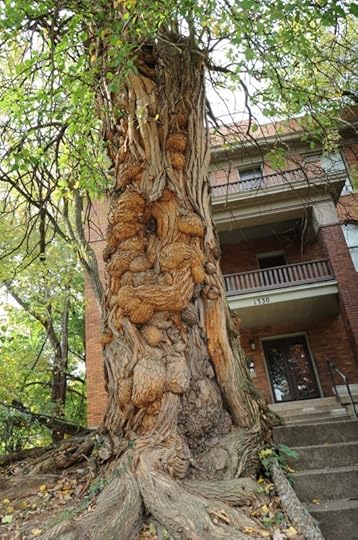
And. . . witch trees! Have you ever looked up “witch trees?” You should!
Whenever I feel completely overwhelmed- I fall back on Nancy Drew.
With my adult brain- she seems kind of silly and outdated...but still a comfort- because when I was reading her as a girl- things seemed so uncomplicated.
I often wished to be the daughter of Carson Drew- sorry Dad- but I did. How many dads are there out there that would let their daughters be kidnapped and threatened 100s of times and still welcome the next mystery? Not many. Carson is the dad I always wished for- and in THE WITCH TREE SYMBOL he didn't disappoint.
Go ahead- put yourself in danger. No one will stop you. Not even Hannah Gruen.
When neighbor, Mrs. Tenney asks Nancy to find her stolen antiques- Nancy jumps at the chance to solve her next mystery.
...and she calls on her best friends Bess and George to help her. No threats are going to keep her from the task at hand.
Finding the stolen antiques- sends them to Amish country- and Nancy will not let rude questions and condescending opinions get in her way.
Ahhhh Nancy- I knew there was a reason I loved you.
when i was like 10 years old, i took a bunch of these vintage editions of nancy drew books from what had been my mom's room in my grandmother's house.
you read that correctly. i stole from an innocent old woman.
and honestly i have not regretted it for a second. one, she never noticed, and two, look at that amazing spooky cover.
it was a win win for me, and a win for my grandma too, kind of.
who's to say where the line is between thievery and decluttering?
part of a series i'm doing in which i review books i read a long time ago, but sometimes just treat myself to basically writing a journal entry instead
1 thing that I always loved about the Nancy drew books is that they taught you things that you may not have ever known. This book was no exception, except it failed to explain 2 different things. I will explain them now in a pretend conversation.
The young Amish girl was sitting at the dinner table with her mother and father. She had been served Moon pie. She took a bite out of it and then ask Mom, what kind of meat is in here? Her mom stated, VEAL. Mom, you know I won't eat VEAL. Is this Zacharias calf? Yes, said her mother. The girl said I saw how Zachariah treated that calf. He had him in a real tiny pin where he couldn't move around. He could not even lay down. All of his life he stayed like that for 5 months. This is cruel. Her mom said, yes, I know, but that is why the meat is tender. That is just a fact of life. By the way you are going to marry Zachariah's son. The girl looked at her and shock. I hate his son. I never want him to touch me. Her mother said. Well, you will have to get used to it. If you don't marry him we and the community will never speak to you again. You know our laws. Yes, I know your laws, stated the girl. I'm going to run away from home. You wait and see.? ??
Back in river heights, Nancy and her friends learn that some valuable furniture has been stolen and taken to the Pennsylvania Dutch community. They arrive there and stay with a family. They learned that their daughter has run away from home and they hope that Nancy can find her. In the mean time they are served shoofly pie. End if some of you do not know what shoofly pie is I will tell you. It is a pie made with shoofly molasses and Eggs. Shoo fly was named after a boxing mule whose name was Shoo fly.
Honestly, this one's a bit of a dud. Nancy and her friends are tracking a thief of antiques, and the girls find themselves in an Amish community in Lancaster, Pennsylvania. So it makes sense that this nugget of the Nancy series is less fun than the rest. No one goes to Lancaster to have "fun." You go for the food and the quilts, and to experience silent Amish judgment leveled at you. I mean, hey, they'll let you visit their homes, and you can sashay around in your pants-suits (like an unmarried loose woman, shame on you!). But nonetheless, the families will let you borrow their horses and buggies (even though you crash the vehicle on the side of the road, you witch). But, yes, just be aware that most likely you'll be accused of witchcraft along the way, and the locals won't help you solve your case.
One fun ironic moment occurs near the beginning, however! One Amish man, who casts aspersion upon Nancy and her "liberated" friends, who refuses their assistance to locate his own beloved missing daughter, is generally one of those "toxic" menfolk who borders on abusive . . . well, as soon as he is finished lecturing the girls, he immediately gets trampled by a bull. :-D
Well! Nancy's #33 I think might just about be one I could call "favorite" - There are more descriptions of the community in which she is mixing and mingling.
This one takes place in Pennsylvania, among the Dutch Amish community. Time is taken to explain the differences between the Church Amish ("who are comparatively modern and own automobiles and electrical appliances" - pg 27) and the House Amish ("who are very strict and do not believe in using any of these 'fancy' things - they feel that hard work with the hands is much better for the health and the soul."). Interesting figures of speech are noted, too - I don't remember anything like that in any previous ND. . . she's pretty self-absorbed, culturewise, so these at-length observations of the cultural practices of others outside of her day-to-day life feels very exotic for an Nancy Drew adventure.
Heavy, hearty tasty food is mentioned often and consumed often - more than I can recall being featured in any previous ND book - food and how it was prepared, everything just short of a recipe! On page 116 I believe Ned offers one of the most oblique proposals I have ever read (she pretends not to understand and threatens him with an Amish girl as bride). In addition to these treats, No. 33 has a plethora of hexes, painted, planted and implied all over the countryside and people. Curses seem to abound, and Nancy, of course, is branded a witch. The witch who solves the case!
So, for the changes from the usual road, and the dash of gypsy thrown in, 4 stars. Deep fried and sprinkled with powdered sugar.
I thoroughly enjoyed this peek into the Amish community, and it gave a slightly different flavour to the whole story, as if it's set even more in the past than it actually was. The story begins when a new neighbour of Nancy's asks her to help with finding some missing furniture. As Nancy begins to follow the trail, it leads her directly to the Pennsylvania Dutch community.
Someone is spreading the rumour that Nancy is a witch and many in the community seem to believe it. As Nancy and her friends get evicted from one host home after another, she redoubles her effort to catch the thief, who seems to be hidden among this community. Nancy also simultaneously tries to help a young Amish woman who has been disowned by her parents for being ... human.
The book brushes lightly over the abusive cultural practices, like a toxic patriarchal man practicing ostracisation of his own daughter. And apparently, he is the one who is hurt. I would much have preferred Nancy helps her get away to a shelter. But I guess the narrative is also a reflection of it's time.
In between all this drama, Nancy and her friends also found time to enjoy parties, feasts, and other enjoyments. Fun book!
In this 33rd Nancy Drew mystery, Mrs. Tenney has inherited half of a houseful of valuable antiques.When she takes Nancy to see the beautiful tables that once belonged to George Washington, she's dismayed to find that many of the valuable pieces--including the tables--have disappeared. Mrs. Tenney is sure that her cousin (co-heir) has taken the most valuable pieces ahead of the division of the inheritance, but Nancy isn't so sure. A piece of paper found in the corner of the library has a mysterious hex symbol on it which leads Nancy to Pennsylvania Dutch country and a man by the name of Roger Hoelt who may be the culprit.
When Nancy, Bess, and George arrive in Pennsylvania, they meet Manda Kreutz who had run away from home but is now looking to return. After briefly reuniting with her family, Manda disappears again and now Nancy has two mysteries to solve. As the girls get closer to finding both the furniture and Manda, the warm welcome they received turns to hostility when rumors that Nancy is a witch start circulating and they are forced to change their accommodations a few times. But Nancy won't be beaten by ugly rumors and her courageous rescue of two Amish children helps restore her good character. It isn't long before she tracks down the missing antiques as well as Manda Kreutz.
While I enjoyed all of the Nancy Drew books when I was young, this one was never a particular favorite. Some books I read repeatedly but this one I read twice--at most--and I'm not certain that I did read it a second time. I think part of the reason must be that there is even less mystery in this one than is usual in a vintage children's/young adult detective series. There is really only one suspect for the antiques theft, so it's not a major surprise when that person is duly identified as the culprit. The motive behind the theft of the Washington tables is more interesting and it was fun to watch Nancy figure out where the hidden message was. Overall a middle-of-the-road Nancy Drew story.
Rounded up from 2.5 for nostalgia sake. This was read to fulfill a book challenge and it was a Nancy Drew installment (#33) that just did not hold up for me. It took place among the Amish in Lancaster, which was interesting because of my familiarity with the area but overall not a believable adventure.
The last time I read this I was about 8, so had managed to forget virtually all of this book.
Nancy is asked to help a woman get to a house of a late relative where she has inherited half of the antiques in it (it's full of antiques), but when they get there, the antiques are gone. Then Nancy sees someone leaving the attic! Soon she has been asked to solve this case and she and her two 17 year old (I seem to remember her being 17 when I was a kid, but I could be wrong) friends have permission to drive to Amish country in Pennsylvania to work on this. There are lots of adventures and some dangerous narrow escapes! There are false leads and new clues, plus a missing Amish girl who has run away from a very strict father.
One of the things I do want to mention that was done better than in many of the Amish fiction books I have read is the way whoever was writing this under the Carolyn Keene name was the Amish dialogue. If any Amish fiction authors manage to read this review (not very likely, but how can I predict?) read this book. For one thing, the word order is correctly misplaced by some of the speakers. Having grown up around German speakers and having heard the old line "Throw the horse over the fence some hay" many times (this makes sense in German if the articles are correct and means that you throw the hay over the fence), but in English it's just plain funny. For another thing, they don't randomly just throw in the odd PA "Dutch" words in odd ways, but use them for names of foods, etc, and then the author says "chust" for just but doesn't overdo this stuff.
Whoever the ghostwriter was for this did a terrible job. I love mysteries, but I was so bored by the lack of plot twists. It’s established from the beginning that the thief was Roger Hoelt, so it was pretty much a matter of waiting around for Nancy to catch the guy. In general, the plot was just so dull. It seemed like the author’s sole goal was to stick in as many facts about Amish people as possible. The bulk of the story was Nancy vaguely wandering around in search of this lady’s stolen furniture. But she never actually ends up really getting anywhere. I swear, she spent more time eating pies and going to quilting circles than actually trying to solve the mystery. Also, there were a lot of filler events that added absolutely nothing to the plotline, such as Nancy . I felt parts like these should have been cut out, so that the author could have developed the actual mystery aspect better.
Overall, I was fairly disappointed by this. The writing seemed lazy and I thought that the ending was anti-climactic as well. The scene where Mr. Hoelt came off as really cheesy. Maybe back in the day this was considered suspenseful, but I couldn’t stop myself from cracking up.
Ok, so this one was a bit odd. It wants to touch on the supernatural, but it doesn't. Nancy's a witch, no she's not. There are hexes and curses, no there's not.
This story is a bit of a stretch. A lot of lead up and a rather pat ending. Blah blah blah.
A couple things I noticed. There is a clear case of animal abuse - the criminal deliberately hits Togo with his car, but yet nothing is done about it. He even admits he did it out of spite. He steals Nancy's car, and we don't hear any charges being brought against him on that crime either. These criminals can commit lots of crimes, but only get arrested for the first one. Wow.
Dave and Burt make a quick appearance and Ned once again makes a comment about marriage. Nancy chooses to ignore the comment and changes the subject. Come on Nancy - you're not in school, you don't work, what are you waiting for?
I hear in the latest ND series, Nancy has more romances - poor Ned - I guess he gets tired of playing second to a mystery. Well, it's on to number 34.
Even though I am a collector of Hardy Boys, I have picked up some Nancy Drews over the years, and I found this copy of of the original, longer 1950s version of The Witch Tree Symbol at a used book store. Nancy and her friends Bess and George head into Amish country in Pennsylvania, seeking to solve the mystery of some stolen antiques and a runaway Amish girl. This story is actually pretty good and still plausible despite its age, but this older version of the book includes a lot of German and Amish words and expressions that I am guessing were edited out of the more modern shorter edition as well some politically incorrect characters such as a deaf-mute boy caracictured as "dumb." The story line is interesting, action-paced and still plausible even after more than 60 years. I think any fan of Nancy Drew will enjoy this book. While in many cases the older more original, longer books are better than the "modernized" shorter later titles I suspect in this case the more recent edition might be the better story and I plan to obtain it and find out!
4 stars & 4/10 hearts. It was fascinating to see the Amish from an 1960s/1970s point of view. I really appreciated how the author added the Amish dialect & language. The mystery itself was fun, especially with the added challenge of everyone fearing Nancy. I really liked Marta & her storyline and how it fit in, too. Although the book kept refuting the idea that witches existed and that bad luck could come from hexes, I still took off 1 star just for the fact that all that is mentioned. I would have enjoyed it more without that.
I really enjoyed the Pennsylvania Dutch components of this story. As a whole, there wasn’t much action to speak of. I also expected way more confrontation to come from Nancy being a “witch.”
I’d be curious to read the original to see if any more of the details were included.
My family was recently in Lancaster, and this story made me want to go back 🐴.
This was not the typical Nancy Drew. We know who the "bad guy" is from the get-go, so any sense of suspense from that is lost. Mostly this book seems like it was written solely to give the author an excuse to talk about the Amish people and show off their knowledge about the subject. I will say some of the terminology used to discuss the different sects was incorrect nowadays in 2024, but it's possible they did use House Amish and Church Amish back when this book was written. There's also some use of the word "gypsy" so do keep that in mind as well. I liked this one, but it wasn't a favorite by any means.
Mrs. Tenney just arrived in River Heights. She liked the town and its people, and even more than that, she had a vested interest in the area. She was, after all, half owner in a River Heights landmark property, more specifically, a Victorian mansion named Follett Mansion.
She chose not to live in the mansion, instead favoring a smaller, more cozy home located just up the street.
The grand house had been unoccupied for a number of years, but a basic maintenance effort kept it from becoming derelict, if not a full reflection of its former glory. Still, it stood as a handsome home, one of the most prominent in town.
But the real value of Follet Mansion went much deeper than its light green façade, for inside were the true treasures, most of which were situated in the sprawling library. When I read this, I assumed that the treasure was in the book collection held there, and while it was impressive, the furniture, I learned, was much more so. For example, there were two matching cherry tables that had been authenticated as those once owned by none other than George Washington himself! And those were just two of the many fine pieces in the mansion.
Mrs. Tenney was bequeathed the mansion and it’s contents by her late, great aunt Sara. The other half was willed to Mrs. Tenney’s second Cousin Alpha Zinn, (quite an unforgettable name, I thought).
Shortly after settling into her new home, Mrs. Tenney decided that it was time to take a thorough and complete inventory of the collection of furnishings. She faced a dilemma however…she didn’t want to enter the storied old house on her own. Simply put, she admired the place, but was deathly afraid of it at the same time.
Fortunately for her, soon after arriving in River heights, she learned that one of the town’s residents was a courageous, levelheaded young woman who might be able to assist her.
This impressive young woman was Nancy Drew.
Mrs. Tenney soon met Nancy, and it was at that first meeting that the older woman asked her if she would be willing to accompany her to the mansion so that she could take the inventory. Nancy, for her part, had been intrigued by the storied old property, and as a result, enthusiastically agreed to keep company with her for this exciting excursion.
And so it was, on the appointed day, Nancy picked up Mrs. Tenney in her convertible, and they drove to Follett Mansion. They’d parked, but remained in their seats, both staring at the imposing frontage of a house that one never really got used to looking at.
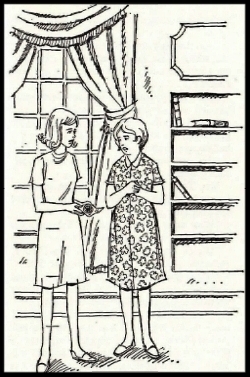
Suddenly, Mrs. Tenney spoke, “I wouldn’t go into that spooky old house alone for anything.”
Nancy turned to her and smiled in an attempt to assure the nervous woman, “Why, Mrs. Tenney, your great aunt lived here alone for many years and was safe.”
“She was just lucky not to have had burglars,” Mrs. Tenney replied, while glancing doubtfully between Nancy and the old house. She then went on, “Aunt Sara was so absent minded that most of the time she didn’t know what was going on. But one thing she did keep track of was the beautiful antique furniture in her library. She never used the room but wouldn’t part with any of its contents.”
After another short period of reflection, Nancy finally said, “Everything looks peaceful, shall we go in?”
Mrs. Tenney sighed, then said, “I suppose we must. After all, that’s why I asked you to come.”
Then Nancy and her companion alighted. The older woman unlocked the front door, then snapped on a light. She then led Nancy down a large hallway, on each side were arched entrances to various rooms. Nancy followed her to an archway on the right that led to the library. That’s when Mrs. Tenney stopped abruptly, gasping!
“What’s the matter?” Nancy implored.
“They’re gone! All the valuable antiques!” Mrs. Tenney was apoplectic.
With that, she frantically hurried into the library, pausing and pointing, “That’s where a fine old sofa stood, and at each end was one of the priceless tables I told you about!”
Then she stopped as a sudden thought struck her, “Well, he won’t get away with this! My second Cousin Alpha Zinn, he came here and took the best pieces before I had the chance to decide which ones I wanted for myself.”
Nancy asked thoughtfully, “Was Mr. Zinn bequeathed the other half of the contents of this house?”
“Yes,” Mrs. Tenney replied, a strong tinge of annoyance in her tone of voice, “We’ve never been friends, and I don’t trust him. He’s an antique dealer and a sharp trader.”
Nancy wasn’t comfortable with an immediate declaration of Mr. Zion’s guilt. She kept that thought to herself, but did gently suggest, “Perhaps it was someone else, lets look for a clue to the burglar.”
Nancy began searching carefully, and in the corner of the room found a small, crumpled piece of paper. Drawn on it was a white rimmed circle with a red center in which was a black star. Printed underneath the circle were these words:
WITCH TREE SYMBOL
“How very strange!” Nancy exclaimed as she showed it to Mrs. Tenney, “Do you know what this is?” She asked.
The woman glanced at the drawing, then said, “Of course, it’s a Pennsylvania Dutch hex sign. Well, I guess that’s all the proof we need, Alpha Zinn lives in that part of Pennsylvania. I just know he was here and took every stick of good furniture. Not only his, but mine!”
Nancy thought that under the circumstances, Mr. Zinn was a logical suspect, but she was not completely convinced of his guilt, “What does the witch tree symbol mean?” She asked.
“I don’t know,” Mrs. Tenney replied, “But what difference does it make when I know Alpha is guilty?”
Nancy thought that the hex sign might be a clue to solving the mystery but didn’t say so. She thought that whether it was Mrs. Tenney’s cousin, or someone else was the culprit, they were more than likely from the area where hex designs originated in the days of witchcraft.
Nancy then asked Mrs. Tenney when she was last in the house, to which she replied that it was one week before, and that she’d come with one of the executors who’d given her the key to the house before he’d left.
She then mentioned an antique dealer who’d arrived at the house, just as the executor was driving away. The man informed her that he had read about Aunt Sara’s antiques in the newspaper, and that he happened to be in River Heights on other business but wanted to take a look at the antiques as he thought he might be interested in purchasing some of them.
“Did you lock the door after showing the antique dealer the furniture?” Nancy asked.
Mrs. Tenney thought for a moment, then explained, “I’m sure he locked the door after us.” She then went on to say that he was a nice-looking man and that she’d handed him the key so he could lock up before they both left.
Nancy listened to the older woman’s account, keeping in mind that this man had obviously charmed Mrs. Tenney and that it would’ve been easy for him to make it look as though he’d locked the door.
“Was he a local dealer?” Nancy asked.
“No, I hadn’t seen him before,” Mrs. Tenney admitted.
“Then we don’t know where he’s from,” Nancy commented thoughtfully, then asked, “Did you get his name, or the name of the hotel he was staying at?”
Mrs. Tenney flushed with embarrassment admitting that she couldn’t remember his name, or the hotel he was staying at.
Suddenly, they both heard light footsteps coming from overhead, someone was treading lightly on the second floor!
Nancy dashed to the stairway to see who it was, just as the steps were becoming louder.
She looked back, and much to her dismay, Mrs. Tenney had fainted. She wanted to get a good look at the intruder but decided that it would be prudent to render first aid to Mrs. Tenney instead. Soon, the older woman eyes flickered open, and once satisfied that she was revived, Nancy ran to pursue the intruder.
But the lost time proved to be costly.
When Nancy reached the back of the old mansion, she found the kitchen door open. Looking out, she caught a glimpse of a tall, slender man, just as he was disappearing through a hedge at the rear of the property.
He was too far away, and Nancy knew she couldn’t possibly pursue him as she had lost too much ground.
She made her way back to the ailing Mrs. Tenney and asked if she could drive her home, which the older woman agreed was a good idea. On the way, Nancy got a full description of the antique dealer, and when they arrived at Mrs. Tenney’s house, the older woman was just about to make her way to the door when she turned around to face Nancy, “Would you take this case for me?” She’d asked, then added, “Please. You’re a good detective. Go see Alpha Zinn and find out whether or not he took the antiques.”
Nancy promised she would think it over and let the woman know. Right now, she then told her, she would drive downtown to find out about the mysterious antique dealer who’d been staying in River Heights.
“By the way,” Nancy asked, “What does your second cousin look like?”
“Oh, he’s short and plump,” Mrs. Tenney answered with a frown.
With that, Nancy drove away, intent on checking all the local hotels for a man who presented himself as an antique dealer and matched the description of the man she saw a glimpse of in the back yard.
Finally, after coming up empty at a number of lodging establishments, she reached the Pickwick Arms asking after the man in question. The clerk smiled and said, “I guess you mean Roger Hoelt, I’m sorry Miss, but you’re too late. He rushed in here, packed up in a hurry, and checked out about fifteen minutes ago!”
And with that came the end of the chapter, and the beginning of my intrigue!
I was asking myself who was the antique furniture thief. What was the thief’s connection to the hex sign, and how did the Witch Tree Symbol fit into all this?
I looked forward to finding the answers to these questions, and as I progressed through the story, I encountered a number of mysterious occurrences, and unforgettable characters, including, an imposter Amish couple, a unique approach to dealing with a mad charging bull, a storied piece of furniture with a secret compartment containing a great secret, the rather outlandish idea of Amish carriage racing, sleuthing on horseback, an accident with a boy’s slingshot and a stolen convertible.
And with all Nancy Drew stories, there were the tales of delicious sounding foods, including Shoofly Pie and Moon Pie.
But unique to this story was the accusation that Nancy was a thief, and even more amazing, the occasion when she was accused of being a practicing witch.
I adored the compassionate, wise and independent thinking Mrs. Glick, and the fact that George Fayne was especially quick witted in this story. I always liked George as a character, and it was good to see her have a chance to really shine!
The one area I thought could’ve been better was how quickly this particular story ended. Usually there’s a “post climax” wrapping of things that ties the story neatly in a bow. In this case, the part of the story felt more hastily finished than other Nancy Drew tales. One of my main motivations for wanting this was to read that the people who thought poorly of Nancy’s motivations would right their thinking about their unfair treatment of the young woman whose intentions were only good.
And that leads to my final thought about this story. Nancy was accused of doing some terrible deeds while all she was really doing was trying to help the very people accusing her. And while Nancy sometimes became exasperated or heated about the situations, she never outwardly showed her frustrations to the people involved, instead she treated everyone with respect and understanding. And that aspect of Nancy Drew’s character is, more than anything else, what makes her an amazing heroine.
This was probably the most half-assed book I've read so far in this series. I'd hoped for a treasure hunt or a lost inheritance or a mystery of some sort. What I got was a travelogue for the Pennsylvania Dutch and a few random words of German. No mystery, since the thief is known from the very beginning of the book. It's purely a pursuit, with no denouement, even.
Nancy heads up to Pennsylvania Dutch country (where Amish people apparently believe in hexes?) to find stolen furniture. The Amish people don't know why Nancy and B&G haven't started working on their dowry trunks yet; they've got the word "leddich" for a single person but I don't think there's a word for Lesbian. Ned suggests to Nancy that they wed because married Amish people ride in covered carriages. She plays dumb. I'm sure a modern translation would have some sort of "beard" punchline. ;-)
Bess gets knocked out in a minor car crash (after hitting her head on the rearview mirror). Nancy gets knocked out cold and is out of commission for a day after a kid hits her with a slingshot (the foreshadowing is like an eighteen-wheeler on that one). In return she saves his life during a barn raising.
I can't keep doing this bruh there needs to be a murder in at least one of these. it's crazy how much I do not care about george washington's stolen furniture.
This was fun - but, y'know - not all that fulfilling and electrifying for a 55 year old bookworm who decided not to expire before reading at least one Nancy Drew Mystery. I was finally filing the Hardy Boys reads from my childhood, at Goodreads, picked a random number to help me select which ND book to gamble on, did not like the looks of #8 or whatever it was, tried a different one, then tried #33 and saw a creepy cover and a witchy title (I never did read the witchy-titled Hardy Boys offering).
When the boys showed up quite suddenly quite late in the proceedings, and Nancy - who seemed more than capable for hanging a series on - said "I can sure use a man's help....", I was a bit pissed off, I must say. Interpret what happened next however you will, but I did find it interesting that after the three boyfriends for Nancy, Bess, and George (female - but you knew that long before I did, didn't you, ladies) seemed to pop out of a box, these guys didn't do much of anything. They went away again after Ned Nickerson couldn't even handle a horse and buggy safely (not totally his fault, I suppose), and I was glad to see them go. I'm going to assume that in this series the boyfriends don't make a habit of showing up and getting all Hardy Boy, boysplaining and solving the cases. Anyway, thankfully it was a quick and generally useless visit; no, Nancy, you don't need any male help.
This story takes place in Amish country. I didn't know that going in, but the last time a Crime story buggy'd me into Amish country was the excellent film Witness. Ironically, it was during the communal barn-raising ceremony in Witness that I felt the least sense of impending danger...very cheery. In the Nancy Drew book, during a similar ceremony, two people are almost killed. Crews can vary in quality, I guess - marks off for nearly flattening people. Meanwhile, as death unexpectedly loomed in a book that I knew would not center on a homicide, I was actually quite, well, impressed. It was as I was shelving Hardy Boy books that I thought "all these Crime & Mystery novels I adored as a pre-teen, and yet I lived off of virtually no murders...and yet these days, it's hard to do without, in a Mystery novel!". And later, when one of Nancy's friends yells "He's left us here to die!", I thought "well good for you...I wasn't sure if the words death or die were even used in Nancy Drew or Hardy Boy books (memories of actual HB text way way gone from my head), but at least young people reading this stuff would realize that facing criminals in the real world could mean death.
So there's my first Nancy Drew Mystery - honestly, maybe my last, though I have filed a circus-y one for future consideration. I'm not gonna get much from a full-on leap into this series, at my age. But most of the messages implicit in the story, and in Nancy Drew's character and handling of things, seemed great for girl readers to absorb. But none of this "I need a man" business, Nance. I'll settle for "Now that you're here, get off that skinny (I saw Ned's picture), stringbean butt of yours, and do something useful for a change.".
I have loved Nancy Drew growing up. This one caught me eye because it mentioned witches on the back cover.
What i liked: > Action packed > A simple robbery turned dangerous mystery with a family history > A mix bag of characters > A peep into Amish culture and food. So much food!
What cost the stars: > The food. So much food. > Fat-shaming Bess. The book was published in the 90s, so I get it. But the poor girl was just enjoying meals. > The story dragged on at times with the thief hell-bent on hurting Nancy > The story diverges from the plot multiple times
Overall, good for Nancy Drew fans, and if you're looking for a quick read!
Maybe it’s just my mood since the election, but multiple times while reading this to my daughter I said aloud “why is everyone so stupid in this book?” She continues to love the series though.