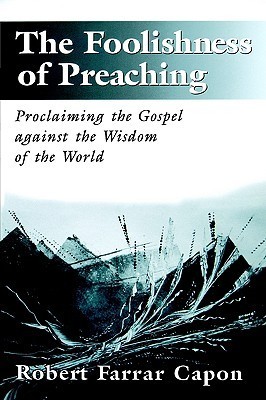
Preachers, are you preaching authentically and effectively to your congregation? Those who sit in the pews, are you truly expecting and receiving genuine Gospel preaching? In The Foolishness of Preaching Robert Farrar Capon challenges preachers to preach faithfully and effectively to their congregations and challenges congregants to expect and demand genuine preaching. "A passion for the Passion" is the necessary ingredient for authentic preaching, declares Capon. A preacher must believe passionately in the Good News of salvation in Christ. Preachers often experience stumbling blocks preventing them from authentic preaching. In Part One, "The Bedrock of Preaching," Capon discusses these stumbling blocks and ways to overcome them. In Part Two, "The Practice of Preaching," Capon offers practical advice and insight into the mechanics of effective preaching. The Foolishness of Preaching is not simply a nuts-and-bolts exercise in preaching, but a lively and challenging lesson that never loses touch with the center of preaching and belief-the astonishing grace of Jesus Christ.
Robert Farrar Capon was a lifelong New Yorker and served for almost 30 years as a parish priest in the Episcopal Church. His first book, Bed and Board, was published in 1965 and by 1977 left full-time ministry to devote more time to writing books, though he continued to serve the church in various capacities such as assisting priest and Canon Theologian. He has written twenty books on theology, cooking and family life.
His lifelong interest in food intersected with his writing and led to his becoming food columnist for Newsday and The New York Times and also teaching cooking classes.
The late Robert F. Capon lived an interesting, chock-full life, a divorced, Episcopal priest, gourmet chef and food writer. I don't think many from my conservative, evangelical, biblicist camp would understand, let alone identify, with Capon's take on things like the Bible, the Church, Christianity, and (as the subject of "The Foolishness of Preaching...") this book. There are two aspects to the book that I comment on:
1. As a homiletic text, it is only fairly helpful to me. Capon's instruction, for example, on how to develop the sermon and pulpit notes is somewhat less than useful to me, as I suspect that Capon preached shorter sermons that I routinely do, and therefore (in particular) his template for pulpit notes, while taking up several pages in his sermon, would have taken up over 15 in mine (I tried it out, and honestly tried to be as succinct as possible). His study approach seems more supportive of whatever creative thinking and free-association with the text that he used, and not to a strictly exegetical consideration of it. That latter part of that (the exegetical consideration) is important to me, but I really need to understand some of the creative, Spirit-led work that Capon put into his sermon prep.
2. Capon's quotes, particularly on the subject of grace in preaching--are astounding. Memorable, concise, imaginative, soul-stirring, and worth the price of the book:
"If you can make up your mind, when you go into the pulpit, to forget everything except Jesus Christ and him crucified, you'll have nothing to give them BUT Good News."
"The church, by and large, has drugged itself into thinking that proper human behavior is the key to its relationship with God. What preachers need to do is force it to go cold turkey with nothing but the word of the cross--and then be brave enough to stick around while it goes through the inevitable withdraw symptoms. But preachers can't be that naughty or brave unless they're free of their own need for the dope of ACCEPTANCE."
And finally, as if the above weren't enough: "Let me say it straight out. I think the reason why there's so much poor preaching in the church is that preachers, by and large, are as addicted to religion as their congregations are. I don't exclude myself, either. I can invent a new religion (or lapse back into an old one)as fast as the next Christian. We're all druggies."
Capon knows how to play. He cares without being pretentious, he laughs without being frivolous. His angle is almost always fresh air, a cold drink. He is anything but a wet blanket or a blowhard.
That said, he gives away too much in this book for me to dance and sing. Capon not only writes with allowance for lady preachers/priests, he writes with ambivalence on He or She for God's pronouns. It is not clear that he isn't a Universalist. He says he is liberal, I believe him.
As for preaching, studying to preach, and reading to study, he says he loves it, and I believe him. For all the practicals (i.e., less adverbs, except for the ones that make it conversational in tone, etc.), they are fine. Most importantly, he does get to the real foolishness of the message and task, the thing we don't want to hear or do: die. Our preaching is vain unless Jesus died, and rose again. We must die in Him and, after that, like Him. It's either complete foolishness or the power of God to salvation.
I can't recommend this book, but I wouldn't tell you to stop reading if you were. It will never make my required list for homiletics class, and yet his joy in the task and his joy in preachers may be for your joy.
Much of this book was weird, but in a quirky and whimsical way. His practical tips for preaching aren't much more than "here's what I usually do. Do with that what you will." But the meat of the book is in the imaginative way the author invites the reader to be inspired by the good news. The book modulates between two keys, namely the major key of the love of God and the minor key of the death of Christ and shows that they both lead to the tonic center of life and resurrection. The love of God is revealed in the death of Christ, and that means that death is where we encounter God, where we must pass through on the path to life. Sometimes the author plays around the edges of orthodoxy, and sometimes his use of jews and pharisees as foils annoyed me, but overall I appreciated the book and it inspired my imagination.
(Thanks again Riker for getting this in my hands!)
Robert big shot bob capon should probably be in the same category as wendell berry, Barbara Brown Taylor, and Gene Peterson. Here's an individual who writes with both wit and academic insight. Beyond that I pay Bobby the rarest of the compliments for a theological writer. He's interesting. this is a practitioner book, but it's a fun one written in an engaging manner ready to help the untraditional preacher feel @ home.
Capon is on point once again regarding the importance of grace saturating all of ones preaching. He makes me uncomfortable and free at all the same time. He does not ignore the deaths I must go through, yet always has a better word of gospel to follow that up. I only wish the preachers I sit under listened to 1/10 of what he has to say.
Rating this book is difficult. Some sections seemed to deserve 1 star, while others merit 5 stars. Capon's homiletic advice seemed almost useless to me due to differences in our training, theology, and traditions.
However, his reflections on grace, hermeneutics, people, pastoring, and prayer were worth every hour I spent reading.
I wouldn’t recommend it to a new preacher. I might not recommend it to anyone. But I’ll assuredly read it again. That’s how reading Capon typical goes for me.
More niche than the other books I've read of his, but still has his characteristic wit and exuberance. I was much keener on the first half (theory) than the second (practice), but that's no shock to me.
Whenever I begin a new Capon book I make the same mistake. One, maybe two, chapters in I realize this desperate need for a pen. Not only to mark a delightful sentence (or entire paragraph) but also so I can snap the pen in half and never write another word myself.
I really like this book even though I'm not a pastor. It has some excellent practical advice for pastors, but there are so many nuggets of wisdom here that its worth your time even if are never going to preach a sermon. This is at least my second time through the book, and while I don't love everything here the parts that resonate are just fantastic. Here are two of my favorite things in the book:
1. Capon gives a presentation of the Christian gospel in this book that is one of the most shocking and moving stories that I've read. It's at the very beginning of the book, but it conveys just how different the gospel is from other stories in very few words. I won't ruin it by trying to explain here, but it's something that I have quoted from many times over the years. Worth picking up just for this.
2. Capon's writing advice in this book is some of the best and most helpful that I have ever found. One small bit that stands out and has really helped me: if you are in the middle of a writing project, never stop at a chapter for the day, or a paragraph, or even a sentence. End your writing in the middle of a sentence, and when you come back the next day, you will immediately be able to pick it up and go and waste no time trying to prime the pump again.
This book is chock-full of wisdom and witty prose; I want to give this book five stars. Capon works through the gospel in part one, "The Bedrock of Preaching", in a fresh and punchy way, and the knitty gritty of preaching--from prep to reflection--in part two. He also undermines the ethical requirements for preachers, marital fidelity for one. Still, one of the best books on preaching, just carve the fly out.
Robert Capon is witty, funny, and straight to the point about rescuing what preaching the faith is about from your typical religious box. I wish every theologian had Capon's sense of humor.