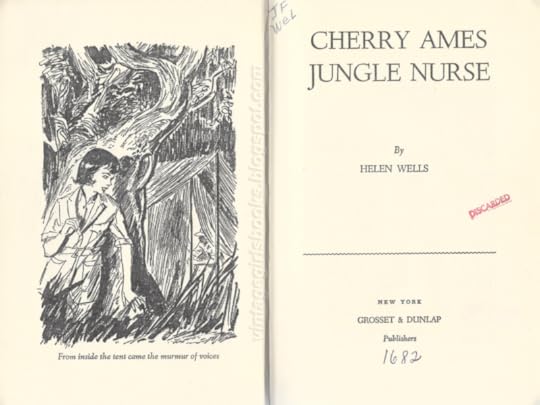
I suppose I should first explain why I was even reading Cherry Ames, Jungle Nurse. I am a nurse and early on in my career discovered that many romance novels and others in the generally silly, light genres featured nurses in the titles and stories. I started to pick them up in used bookstores and, to name a few, I own Dude Ranch Nurse; Nurse April; Arlene Perry, Special Nurse; Crusading Nurse; Journey of Enchantment; Nurse With A Dream; A Nurse Called Happy and Apollo Nurse. Don't ask me what the plots of most of these are; I have no idea. I suspect in many that the "journey of enchantment" involves heaving bosoms and doctors. Not my idea of a good time, but to each their own.
In any case, Cherry Ames, Jungle Nurse is one in a nearly infinite series of Cherry Ames books in which the eponymous nurse goes about doing good and solving crimes. She isn't a detective, mind you, she's just an astute thinker with a sharp eye who catches things all of the others (including the inevitable young, attractive physician) miss.
This particular book belonged to my late mother-in-law, who was also a nurse. In her honor, I thought I should give it a go. It goes without saying that the writing is simplistic and formulaic. These are books meant to be churned out for a mass audience of young women in the 50s and 60s. They were not too picky, probably, about plot or nuance. They certainly didn't want any heaving bosoms and they will find none here.
In fact, Cherry Ames is almost entirely asexual. Not that men don't notice her charms and she theirs, but they express themselves obliquely, if at all, and are always cool and reserved about it. This reflects the society in which this book was written, in which nurses could, in general, either be nurses or be married but not both. It is also worth remembering that outside the home most women were restricted to two professions, nursing and teaching. Of course, some were entrepreneurs, lawyers, physicians and in other male-dominated professions, but the easy road led to these two. This is also why both were so grossly underpaid for years. Only when the nursing shortage struck in the last 30 years or so did the salaries of nurses come up to a professional standard, entirely because we could demand these wages, though nurses were almost too polite to make those demands; thank goodness for the bold few who dragged the rest of us into the 20th century. Teachers, as far as I can tell, are still earning far less than they should. This is a direct result of the sexism inherent in our culture for those many years in which women were predominant in both fields.
This book takes place in Africa, in a sanitized and simplified version of that continent. Written in 1965, it nods to the end of colonialism in Africa, but does so with trepidation and a heavy dose of paternalism. The "savages" will do fine on their own, we white folks think, as long as they have us to guide them as to how its done. We must also, as Dr. Bob and our gal Cherry do, help them eliminate the diseases and vectors that plague them. Without us, these childlike people would be at a loss. (Never mind that they managed for a few hundred thousand years before we came and were at that time largely dying from diseases we brought). Only once in the book (and I found this a rather surprising inclusion) does a character say that "perhaps they would have been better off if the white man had never come here". But this comment elicits only a knowing nod and a murmured "perhaps" before we move on to more important things.
Oh, and there is a diamond-smuggling operation that Cherry single-handedly (with a late assist from our hero, Jeff) thwarts. Ho hum.
As you can tell, the book itself is hardly worth reviewing. But as a portrait of all the worst post-war, pro-American, paternalistic, sexist, racist, ethnocentric, provincial stereotypes of the Great White Incursion it is fascinating. In the midst of a jungle teeming with color and life (none of which seems to intrude on her consciousness), Cherry even plants zinnias around the native huts, importing a nonnative species into the midst of tropical lushness. To me this serves as a metaphor for the whole enterprise of colonialism, the blueprint of Western European culture being forced to fit an entirely different milieu. This not only is inevitably unsuccessful, but also inevitably leads to disaster for both parties. Cherry Ames, Jungle Nurse does not portend any such destructive potential. But from the remove of the 21st Century, it is easy to see that the seeds of something far uglier than zinnias have been planted.