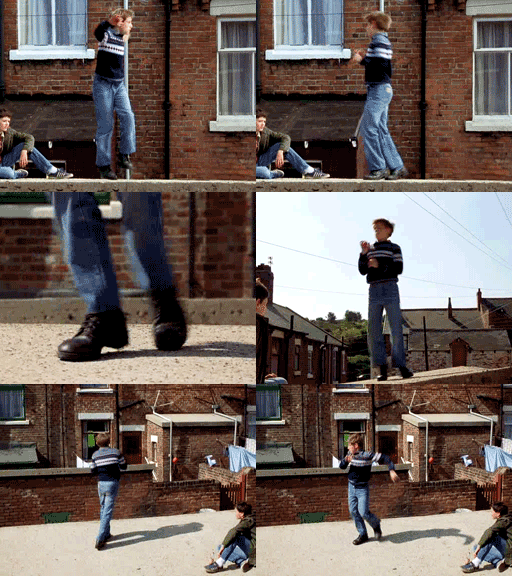
Billy's mother is dead, and his father and brother are fiercely involved in the bitter miners' strike. Billy's father wants his son to learn to box, but Billy becomes fascinated by the grace and magic of ballet.
Melvin Burgess is a British author of children's fiction. His first book, The Cry of the Wolf, was published in 1990. He gained a certain amount of notoriety in 1996 with the publication of Junk, which was published in the shadow of the film of Irvine Welsh's Trainspotting, and dealt with the trendy and controversial idea of heroin-addicted teenagers. Junk soon became, at least in Britain, one of the best-known children's books of the decade.
Burgess again courted predictable controversy in 2003, with the publication of Doing It, which dealt with underage sex. America created a show based on the book, Life As We Know It. In his other books, such as Bloodtide and The Ghost Behind the Wall, Burgess has dealt with less realist and sometimes fantastic themes. In 2001 Burgess wrote the novelisation of the film Billy Elliot, based on Lee Hall's screenplay. Polyphony is typical for his most famous novels.
(Popsugar #14: Libro que puedes terminar en un día)
You can’t give up being just yourself
Con el escenario de fondo de una de las mayores huelgas de mineros en Inglaterra en los años 80's tenemos esta historia acerca de un niño y su familia persiguiendo sus sueños: unos por conseguir mejores condiciones de vida para los mineros del carbón, y el otro descubriendo dentro de él una habilidad que le puede llevar muy lejos , viviendo una vida totalmente diferente.
Hay 2 narradores principales: Billy y Jackie Elliot (el papá).
Billy es un chico de 11 años que es algo diferente. Prefiere las zapatillas de ballet a los guantes de boxeo. Su voz es franca e implacable , esta en esa etapa que cree que todo puede ser y no ser. Remembering and missing aren’t exactly the same thing, but they’re pretty close, and you can’t do one without the other.
Y dejenme decirles que Jackie Elliot es uno de esos padres ficticios que todos quisieramos tener:
‘Listen, man.’ Jackie leaned forward, and I knew I’d said the wrong thing. ‘I don’t care what he is, he’s our Billy, and that’s good enough for me. I don’t care what he does. He can stuff badgers if he likes, he’s still our Billy.’ ‘Right, OK, message received. Well, Jackie, I’ll tell you, Sarah’d be proud of you, that’s all I can say.’ And I wished I hadn’t said that as well, because he sat there in front of me and his eyes filled up with tears.
Porque el pobre tipo es viudo, cesante por más de un año, un hijo mayor que esta en la misma situación (y lleno de odio), la suegra con alzeimer, ¿y el hijo menor que quiere bailar ballet? Prejuicios y problemas sociales se suceden en las pocas páginas del libro.
El final es agridulce. There’s coal behind everything in this country. It’s still down there. We’re not.
Yo con este tipo de cosas es que soy incapaz de ser objetivo, es que es idéntico a la película, y he llorado, he sufrido y me he maravillado con la historia y los personajes exactamente igual que en la peli.
I am also into reading novelized movies aside from watching adapted movies. I tend not to be content with watching movies with my mouth agape; I want to understand the whole story completely, for there are times that I can’t follow the dialogues because I’m not much familiar with accent with which characters speak.
Billy Elliot is the only movie that comes to my mind when someone asks me what my favorite movie is. It is a British dance drama film about an eleven-year-old boy desiring to be a professional ballet dancer. However, both his father and brother are inculcated in the negative stereotype of the male ballet dancer. Males into this kind of art in western society in the early 19th century were said to be weak, effeminate, or homosexual. In short, all boys in his countryside are supposed to do things only for males. So, it is a big decision for Billy, especially both his father and brother are miners struggling against the government’s plan to close all coal mines.
Reading the novelized movie has made me love the movie more. The novel and the movie have the same scenes. The dialogues became crystal-clear to me. The characters’ voices were even echoing through my head except Billy’s famous lines when a tutor asks him what he feels when he’s dancing. In the book, it goes, “When I dance, my body is full of fire, and I forget everything.”, but in the movie:
“Don't know. Sorta feels good. Sorta stiff and that, but once I get going... then I like, forget everything. And... sorta disappear. Sorta disappear. Like I feel a change in my whole body. And I've got this fire in my body. I'm just there. Flyin' like a bird. Like electricity. Yeah, like electricity.”
Also, it seems that the novel has been expurgated for the F-words steeped in the film. In the movie, I could almost hear quite a few bad words which seem to be a common way of communication among early Irish people. No doubt the movie has been censored for young audience as far as I know.
On the other hand, I have proven that Billy is not gay at all. Count me in those people who have the negative stereotype of the male ballet dancer. I deserve to be pilloried in public or put to the sword.(laughs)
The story is narrated by the main characters: Billy, Jack , his father; Tony, his older brother, and Michael, his gay best friend. So, I did not have a hard time reading it. In fact, the sequence of the plot is almost similar to the movie.
After reading it, I watched my favorite scenes in the movie again: when Billy dances to his father’s presence, when he auditions at the ballet school (definitely one of the unforgettable scenes) when one of the school tutors asks him what he feels when he dances, when he opens the letter whether he is in or not, when his father and brother go watch his major ballet concert and come across his gay best friend Michael- the leave-me-in-the-air finale.
My favorite scene in the movie when Billy dances to his dad's presence The major moral lesson of the story which is why it is one of my most favorite movies is that follow your dream no matter how harsh the culture you conform to. Such dilemma is still typical of our culture nowadays. There are still different traditional norms women and men should follow.
Aside from the novelized movies Billy Elliot and Brokeback Mountain, I also want to read the novelizations of Eclipse and Beach(2000) in which both starred by Hollywood actor Leonardo Dicaprio, Braveheart directed by and starring Mel Gibson, 3 Idiots (1999,India). I also wish that there are some available for my favorite pink movies such as Love of Siam (2007, Thailand), Boys Love 1 (Bōizu Rabu) (2006, Japan), and Prayer for Bobby ( 2009, USA), to name a few. :)
Billy ha un sogno: vuole diventare un ballerino, perché solo quando balla e la musica lo avvolge si sente vivo e felice. Sua madre lo avrebbe incoraggiato, ma lei non c’è più. Vive con il padre e il fratello che dovranno vincere molti pregiudizi per aiutarlo a prendere la sua strada. La narrazione si alterna in due parti: prima si ha il racconto di Billy dal suo punto di vista e poi si ha il racconto da parte del padre Jackie. Capitolo dopo capitolo e intreccio dopo intreccio scopriamo che nonostante i pregiudizi, il padre considera Billy un tipo originale e essendo una delle poche figure di riferimento, deve stare sempre dalla sua parte. Adoro quando si alterna la narrazione perché mi piace leggere i diversi punti di vista della stessa storia, per scoprire le diverse sfumature. Ma sarà davvero così? Il padre sarà sempre dalla parte del figlio? Billy dopo mille peripezie, avrà la sua vittoria e solo così si sentirà vivo e grato alla sua famiglia, soprattutto alla sua mamma. Non vedo l’ora di recuperare il film!
The reason why I picked up this book is that Billy Elliot is one of my all time favourite films and I was really intrigued by the fact that it’s been released as a novel. Since it’s related to my thesis work I’ll have to start working on in the next few weeks and it’s been a while since I’ve seen the film, I decided to combine work with pleasure and read Melvin Burgess’s novel. To be honest, I found Billy’s narration quite strange at first and I thought it wouldn’t live up to my expectations after all – but I couldn’t be further from the truth. Burgess’s novel is just as good, if not better, than the film and I was in tears all the way to the end.
What I loved about it the most is the fact that it’s narrated by several different people. Most of the time it’s Billy who’s speaking but there are chapters that are told by either Billy’s father, brother, or his friend Michael. I loved the contrast between these chapters, especially those of the father’s and his two children. The way we see things from a twelve-year-old’s point of view at first and then from an adult’s is just brilliant. Billy’s father was definitely my favourite character and I really enjoyed reading the story from his perspective as well. It was actually one of the reasons why I eventually found the book even more touching than the film. The way he describes what he feels about his wife, how poverty-stricken they are and how he can’t do anything to build a better future for his sons, how he’s ready to sacrifice himself and give up everything just to make at least one of their dreams come true is very touching.
However, there are two things I should mention – rather as an advice than something negative- in connection with the book. The first one is that even though it’s a young adult book, it contains strong language therefore it might not be suitable for everyone. The other thing is that, I think, you really need to have some sort of background information about Thatcher’s reign and this era in order to fully understand what Billy and his family are going through, what the strike is about and what state their town is in at the time.
All in all, Melvin Burgess’s novel is a fantastic read you don’t want to miss, whether or not you’ve seen the film before. It’s a tear-jerking tale about hope, sacrifice, love and devotion and I can guarantee that you’ll fall in love with it even if you’re not familiar with the story yet. It’s a definite must-read.
The novella, based on the movie, is told from several points of view. Set with the backdrop of the miners strike of 1984-85, Billy finds himself being drawn to ballet dancing and not boxing.
Billy grows up with dad and older brother Tony. His mum passed away before the story started, resulting in some conflict at home.
Whilst reading the book, I found myself picturing both the movie and the stage play in my mind. A very moving story set a time of turmoil in the UK, highlighting the fact that people can achieve anything they want.
Billy Elliot was a nice and quick read, but I was hoping so much more from it. I definitely liked how the story went on and the fact that it was easy to read. I enjoyed how it handled family and kind of LGBT issues, how it proved stereotypes wrong. On the downside, nothing was explained. I understand that it was originally a musical and the book was adapted, but it was rather poorly done. All the point of view changes were jumpy and I wanted to get to know the characters better. I did enjoy the book though, but it was kinda meh for me.
Billy Elliot è un romanzo intenso e ispirante che racconta la forza dei sogni in un contesto ostile, esplorando temi come identità, coraggio e libertà personale. Ambientato nell’Inghilterra mineraria degli anni ’80, il libro segue la crescita di Billy, un ragazzo che scopre una passione inaspettata per la danza classica, sfidando le rigide aspettative sociali, familiari e culturali che lo circondano. Melvin Burgess costruisce una narrazione coinvolgente, capace di fondere realismo sociale ed emozione autentica. Lo stile è diretto e incisivo, ma allo stesso tempo sensibile, rendendo i personaggi profondamente umani e credibili. Billy emerge come una figura simbolica: rappresenta chiunque abbia il coraggio di inseguire il proprio talento nonostante il giudizio e la paura del rifiuto. Uno dei punti di forza del romanzo è la rappresentazione del conflitto tra tradizione e cambiamento. La durezza del contesto familiare e della comunità contrasta con la delicatezza dell’arte, creando una tensione narrativa che rende la storia potente e memorabile. Il libro invita il lettore a riflettere su stereotipi di genere, aspettative sociali e sul valore dell’autenticità. Billy Elliot non è soltanto una storia di successo personale, ma un vero e proprio inno alla determinazione e alla libertà di essere se stessi. È una lettura consigliata a chi ama i romanzi di formazione, le storie di riscatto e i racconti capaci di emozionare senza perdere profondità.
Un romanzo toccante, motivante e culturalmente significativo.
Le recomendé la película a mi abuela. Le fascinó. Antes de recomendarle el libro, lo releí yo y me fascinó de nuevo. Qué hermosa historia y personajes. Es de esos libros que estás feliz de que la escuela te haya obligado a leer.
Billy Elliot is a novel written by Melvin Burgees. Billy Elliot is also a really famous play that was written by Lee Hall. It is about a boy who likes to dance especially ballet dance. Billy's father made Billy box but Billy's passion was dancing. Billy lives with his brother called Tony Elliot and his dad called Jackie Elliot. His mum died a long time ago.
Billy would go to Mrs Wilkinson for ballet lesson for 50 pence. He would go home and practice like doing the spin. When his father asked him what he was doing he would lie to his father and say that it was for boxing.
My favourite part of the story is when Billy and his dad went to London for Billy's audition. He did the position for the audition well but when he needed to do a solo dance the song was halfway through instead he just stood there and stared at the judges. He remembered what Mrs Wilkinson told him which was “Billy you’re not concentrating! When you’re up there in front of an audience, you have to concentrate, no matter what’s going on. So go on - just do it!”, so Billy danced(135). When he finished his audition he ran to the changing room and there was a boy who tried to comfort Billy but Billy didn’t need comfort and so Billy punched him. Billy was in a lot of trouble and he thought that he would never ever will get into this school.
At the end of the story Billy succeeded in getting a place at the dance school. When he performed he had to do a spin. When his brother shouted Billy’s name and he did a spin and another spin for his family(155).
I recommend this book to 13 years old and up because there is some bad language in this book. I would also recommend this book to people who like to dance and also to people who strives for something but they are not allowed to do but are determined to follow their dreams.
I rated this book 5 stars because the author described the book in full detail. I could really understand what was happening and I thought it was a really great book.
“Billy Elliot“ was written by Melvin Burgess and based on the motion picture screenplay by Lee Hall. It's a novel about a boy, who wants to become a ballet dancer. The book is for ages 11 and above.
Billy lives in a poor family and has to take care of his grandmother. He takes boxing lessons, but instead of boxing, he likes dancing around the ring. That behaviour makes Billy's father Jackie angry, because of the fact that Jackie and Tony, Billy's brother, don't earn much money and the boxing lessons are expensive. However, Billy is interested in Mrs Wilkinson's ballet class and soon he learns some moves. Weeks later, Jackie finds out Billy had not taken his boxing classes and noticed him taking ballet lessons. They have an argument and Billy runs away from home to Mrs Wilkinson's house. She tells him that Billy should audition for the Royal Ballet School and that she will teach him. But Billy misses the audition and Mrs Wilkinson tells the family what has happened. Jackie wants to aid Billy in his audition and he knows he needs a lot of money, but Billy's boxing teacher organises a raffle to raise money.
Will Billy get the chance to study at the Royal Ballet School?
This book is about gender roles and expectations of society and I think it's good to read such a book, because it shows that a boy could also be a ballet dancer or general that you can be whoever you want to be. I think in this time it's very important to accept and tolerate that. I like the story and recommend the book!
There isn't actually all that much to say about this story. The entire story should serve as a reminder that everyone should stay themselves and life isn't about living the way others want you to, but the way you want to. The ending is a bit predictable even though I anticipated a slightly different one for a few chapters.
There are several POV-s and each adds something to the story. Billy's POV was my favourite and Tony's my least favourite.
The season this book reminds me of? Strike season. :) The year is 1984. Miners are striking and one miner's son discovers that he isn't interested in boxing or any of that. He wants to dance. Ballet, to be specific. A dance that most considered unmanly at that time. There are some setbacks and in the end ... ;)
3. coal, ballet, boxing, strike, hard, accept, professional
4. I like this story very much. Billy who is a main character does what he wants even if other people say anything. He wanted to ballet though he is a boy. I was encouraged by that part.
5. I thought that to do something what I like or I should continuously is important. I noticed again that if I continue something it would get better. I thought I should exert all possible efforts.
1. Penguin level 3 2. 11/15 20min 11/19 65min 3. ballet, boxing, mother, piano, father, London, dancer 4. a) I'm not a gay. b) When I read this scene, I thought Billy is gay. But ballet isn't only for girls, but also for boys. My thinking is discrimination based on gender. 5. At first, father opposed Billy going to a dance school in London and become a ballet dancer. However, finally he cheered and understood his son. And he was proud of his son. In my opinion, love between parents and children is so deep.
1,Penguin level 3 2,6/15 60min 6/16 30min 3,dance,boy,family,life,study,sport,like 4,The main charactor is Elliot. Elliot is 11 years old. His family are poor, so they want Elliot to be rich. Elliot learn boxing to get a lot of money,but he doesn't like boxing. One day, he looked the lesson of dance. He became want to be a dancer, but his family oppose to be dancer.In the future, he became a famous dancer overcame family's opposition. 5,I have little interest in this book. This book is fun, but I think that this story is little monotonous.
Been a while since I saw this film but this book has really inspired me to watch it again. Coming-of-age story which is poignant and funny at times. Elements of gender and sexual identity, diversity, poverty set in the background of the miner's strikes and violence of the 1980s. Nice to hear local dialects as well - this certainly would not have worked as an audio if the narrators were not all native to the North East.
Conmovedor libro sobre el apoyo de la familia y los medios que influyen en tus metas, basado en una película, la cual recomiendo mas, sin embargo se puede disfrutar mucho, reir, llorar y reflexionar con este libro ligero y aunque sin mucho profesionalismo, me parece que cualquiera puede sentirse identificado
The message and theme of this book is great. Its just that the writing bothers me. Its un structured. Otherwise it was good, it just didn't draw me in. It was good but the writing ruined indoor me.
I read this book for a class and had to analyze different elements of the book for a paper. While I enjoyed the book, it isn't what I usually read and even though I liked the story, the novel is just all right for me. Nothing special.
Billy Elliot is a shy 12-year old boy who randomly discovers his love for ballet one day. A boy dancing ballet is unheard of in his community but Billy shows maturity and open-mindedness when considering why the working class does not accept of boys dancing. “Ballet isn’t what boys do. It’s not football and boxing and being hard. And it’s not going on strike and standing up for yourself and sticking it out with your mates and hanging in together. (…) It’s not what we do. (…) Why isn’t it what we do? Just because no one’s ever done it before, that’s all. Well, once I’ve done it, it is what we do, because I’m one of us too. It doesn’t have to be like him or not at all. Just because I like dancing doesn’t mean I’m turning into someone else (p. 49).” Billy understands the social norms and conventions in his neighborhood but he also sees that there is room for improvement and development in the mindset of the working class. While the quote depicts sensibility from Billy, it also portrays his naïve and juvenile thinking. His views on the gender-roles and issues coming along them are construed by the fact that he is still a child and has not yet encountered and comprehended the world and the harsh realities within it in a way his father and older brother have. His mother’s death is unresolved and Billy has not dealt properly with the emotional repercussions he has met – this is obvious in his relationship with Miss Wilkinson, which at times, almost acts as a mother-son relationship. His friendship with his best friend, who later reveals that he is gay, is another example of Billy’s friendliness, his tolerance and his happy nature. While Billy does have his reservations about homosexuals they are minor and only relate to the fact that he does not want Michael to think he is gay as well, but he is still completely accepting of Michael and his choices. Billy’s development in novel is evident in the last chapters of the book – he is more confident and he has found a common goal he shares with his family and a talent he enjoys developing.
The book is written in a 1st person narrative containing multiple perspectives – focusing mainly on Billy and his father, Jackie, but also containing chapters from the point-of-view of side characters Tony, George, Michael and a pawnbroker. This usage of several viewpoints makes the characters more complex, round and reliable as they are all seen in different situations by different people. As the narrative is in 1st person, one character might keep things hidden only to be revealed later in a new chapter by another character. It makes the story flow and keeps the pace steady as well as making the reader understand the intentions and opinions behind a character’s statements and situations better as they are viewed by multiple people.
Billy Elliot, his family and neighborhood belong in the working class. Ever since his father and the rest of the miners went on a strike, they have been low on money. The extend of their poverty shines through at the end of the novel, with Jackie having to pawn Sarah’s ring to pay for tickets for Billy’s audition. When the ring does not provide enough money, they host a fundraiser, invite most of the neighborhood and sell them raffle tickets – however, since almost no one in the community has any income, they are not able to earn money for the ticket this way. To keep warm inside the house, Jackie Elliot is forced to carve up Sarah’s old piano and burn the wood. The neighborhood is a tight-knit community where everybody knows everybody. The working class has a close-minded view on gender-roles and the activities and jobs males and females should partake in. It takes a long time before Jackie and Tony accept Billy and his fondness of ballet because according to the working class dancing is not considered manly and should be reserved for girls only. On the contrary, the middle and upper class do not seem to have issues with boys doing ballet. Miss Wilkinson, belonging in the middle class, encourages Billy to keep dancing and becomes his private dance teacher before his audition. The upper class is present at the audition and there seems to be a lot of boys auditioning, which shows the upper class’ views on gender-roles.
The working class is not particular fond of the middle or upper class. Billy and his father encounter the upper class for the first time in London at Billy’s audition. “… All those other kids, they had every advantage you could think of. You could tell. Rich parents, good homes, first-class schools. The schools they go to probably cost more than I earn in a year. (…) And then London and their big houses and their posh kids and rich schools. All we ever had in the northeast was our mines and our jobs and a hard life, and now they were even taking those from us (p. 141).” In the quoted passage, Jackie reflects and complains about the upper class and all the privileges and money they have, which Jackie and his family never had. Billy also expresses his dislike toward the upper class, he finds their accent weird and he feels uncomfortable around them at the audition. The working class interacts with the middle class all throughout the book – the coppers trying to control the demonstrating miners and Billy and his family’s meetings with Miss Wilkinson. The working and middle class are more familiar with each other than then working class and upper class, but the Billy’s neighborhood still think lowly of the middle class and especially Tony has issues with Miss Wilkinson because he thinks that she is trying to act more knowledgeable than him and his family.
This entire review has been hidden because of spoilers.
Normalmente no veo películas después de leer un libro porque siento que quedo siempre insatisfecha. Esta vez, hice el ejercicio contrario. Había visto esta película hace tiempo y recibí como regalo este libro así que lo leí. Es exactamente igual a la película, y aunque no es mi favorita siento que tiene su encanto. Súper sencillo de leer y muy entretenido, para leer en un par de horas sin problema.
No puedo ser totalmente parcial con este libro!!! Lo siento, amo la historia de Billy. El libro es casi idéntico a la película, nos brinda un poco más la perspectiva del papá de Billy y su hermano. Fue algo que agradezco muchísimo, intensificó más la forma de ser de esos personajes en concreto.
Una lectura sencilla y que te adentra de una forma maravillosa a esta bella historia.