

What do you think?

The Street of Crocodiles and Other Stories
The collected fiction of "one of the most original imaginations in modern Europe" (Cynthia Ozick)
Bruno Schulz's untimely death at the hands of a Nazi stands as one of the great losses to modern literature. During his lifetime, his work found little critical regard, but word of his remarkable talents gradually won him an international readership. This volume brings together his complete fiction, including three short stories and his final surviving work, Sanatorium Under the Sign of the Hourglass. Illustrated with Schulz's original drawings, this edition beautifully showcases the distinctive surrealist vision of one of the twentieth century's most gifted and influential writers.
Bruno Schulz's untimely death at the hands of a Nazi stands as one of the great losses to modern literature. During his lifetime, his work found little critical regard, but word of his remarkable talents gradually won him an international readership. This volume brings together his complete fiction, including three short stories and his final surviving work, Sanatorium Under the Sign of the Hourglass. Illustrated with Schulz's original drawings, this edition beautifully showcases the distinctive surrealist vision of one of the twentieth century's most gifted and influential writers.
368 pages, Paperback
First published January 1, 1989
About the author
Bruno Schulz
125 books764 followersBruno Schulz was a Polish writer, fine artist, literary critic and art teacher of Jewish descent. He was regarded as one of the great Polish-language prose stylists of the 20th century.
At a very early age, Schulz developed an interest in the arts. He studied at a gymnasium in Drohobycz from 1902 to 1910, and proceeded to study architecture at Lwów University. In 1917 he briefly studied architecture in Vienna. After World War I, the region of Galicia which included Drohobycz became a Polish territory. In the postwar period, Schulz came to teach drawing in a Polish gymnasium, from 1924 to 1941. His employment kept him in his hometown, although he disliked his profession as a schoolteacher, apparently maintaining it only because it was his sole means of income.
The author nurtured his extraordinary imagination in a swarm of identities and nationalities: a Jew who thought and wrote in Polish, was fluent in German, and immersed in Jewish culture though unfamiliar with the Yiddish language. Yet there was nothing cosmopolitan about him; his genius fed in solitude on specific local and ethnic sources. He preferred not to leave his provincial hometown, which over the course of his life belonged to four countries. His adult life was often perceived by outsiders as that of a hermit: uneventful and enclosed.
Schulz seems to have become a writer by chance, as he was discouraged by influential colleagues from publishing his first short stories. His aspirations were refreshed, however, when several letters that he wrote to a friend, in which he gave highly original accounts of his solitary life and the details of the lives of his fellow citizens, were brought to the attention of the novelist Zofia Nałkowska. She encouraged Schulz to have them published as short fiction, and The Cinnamon Shops (Sklepy Cynamonowe) was published in 1934; in English-speaking countries, it is most often referred to as The Street of Crocodiles, a title derived from one of the chapters. This novel-memoir was followed three years later by Sanatorium Under the Sign of the Hourglass (Sanatorium Pod Klepsydrą). The original publications were fully illustrated by Schulz himself; in later editions of his works, however, these illustrations are often left out or are poorly reproduced. He also helped his fiancée translate Franz Kafka's The Trial into Polish, in 1936. In 1938, he was awarded the Polish Academy of Literature's prestigious Golden Laurel award.
The outbreak of World War II in 1939 caught Schulz living in Drohobycz, which was occupied by the Soviet Union. There are reports that he worked on a novel called The Messiah, but no trace of this manuscript survived his death. Following the German invasion of the Soviet Union, as a Jew he was forced to live in the ghetto of Drohobycz, but he was temporarily protected by Felix Landau, a Gestapo officer who admired his drawings. During the last weeks of his life, Schulz painted a mural in Landau's home in Drohobycz, in the style with which he is identified. Shortly after completing the work, Schulz was bringing home a loaf of bread when he was shot and killed by a German officer, Karl Günther, a rival of his protector (Landau had killed Günther's "personal Jew," a dentist). Over the years his mural was covered with paint and forgotten.
Source: wikipedia.com
At a very early age, Schulz developed an interest in the arts. He studied at a gymnasium in Drohobycz from 1902 to 1910, and proceeded to study architecture at Lwów University. In 1917 he briefly studied architecture in Vienna. After World War I, the region of Galicia which included Drohobycz became a Polish territory. In the postwar period, Schulz came to teach drawing in a Polish gymnasium, from 1924 to 1941. His employment kept him in his hometown, although he disliked his profession as a schoolteacher, apparently maintaining it only because it was his sole means of income.
The author nurtured his extraordinary imagination in a swarm of identities and nationalities: a Jew who thought and wrote in Polish, was fluent in German, and immersed in Jewish culture though unfamiliar with the Yiddish language. Yet there was nothing cosmopolitan about him; his genius fed in solitude on specific local and ethnic sources. He preferred not to leave his provincial hometown, which over the course of his life belonged to four countries. His adult life was often perceived by outsiders as that of a hermit: uneventful and enclosed.
Schulz seems to have become a writer by chance, as he was discouraged by influential colleagues from publishing his first short stories. His aspirations were refreshed, however, when several letters that he wrote to a friend, in which he gave highly original accounts of his solitary life and the details of the lives of his fellow citizens, were brought to the attention of the novelist Zofia Nałkowska. She encouraged Schulz to have them published as short fiction, and The Cinnamon Shops (Sklepy Cynamonowe) was published in 1934; in English-speaking countries, it is most often referred to as The Street of Crocodiles, a title derived from one of the chapters. This novel-memoir was followed three years later by Sanatorium Under the Sign of the Hourglass (Sanatorium Pod Klepsydrą). The original publications were fully illustrated by Schulz himself; in later editions of his works, however, these illustrations are often left out or are poorly reproduced. He also helped his fiancée translate Franz Kafka's The Trial into Polish, in 1936. In 1938, he was awarded the Polish Academy of Literature's prestigious Golden Laurel award.
The outbreak of World War II in 1939 caught Schulz living in Drohobycz, which was occupied by the Soviet Union. There are reports that he worked on a novel called The Messiah, but no trace of this manuscript survived his death. Following the German invasion of the Soviet Union, as a Jew he was forced to live in the ghetto of Drohobycz, but he was temporarily protected by Felix Landau, a Gestapo officer who admired his drawings. During the last weeks of his life, Schulz painted a mural in Landau's home in Drohobycz, in the style with which he is identified. Shortly after completing the work, Schulz was bringing home a loaf of bread when he was shot and killed by a German officer, Karl Günther, a rival of his protector (Landau had killed Günther's "personal Jew," a dentist). Over the years his mural was covered with paint and forgotten.
Source: wikipedia.com
Ratings & Reviews
Friends & Following
Create a free account to discover what your friends think of this book!
Community Reviews
Displaying 1 - 30 of 507 reviews

Read
February 7, 2016Review composed of A Chorus of Voices
1.00 March 3rd 2016 — voice of The Reviewer
As I was reading through this book, a great many thoughts and impressions formed in my mind, and there they have lain since, each waiting for a chance to push itself into a prime position in this review space. So, for the moment, I'm just sitting on them, frantically trying to hold them down as I think how to shape them in a way that will be vaguely comprehensible to someone who hasn't read this book or doesn't live inside my head.
But the task will certainly involve excluding some of those many impressions, and I can sense already that I'll have a rebellion on my hands as stray thoughts I had discarded steal into the review while I'm asleep. I will have to be very vigilant, perhaps enter into some kind of contract with the review space so that it will refuse entry to thoughts that don't carry a pass signed by me personally.
I'll be watching this space.
................................................................
3.30 March 3rd — voices of The Reviewer's Stray Thoughts
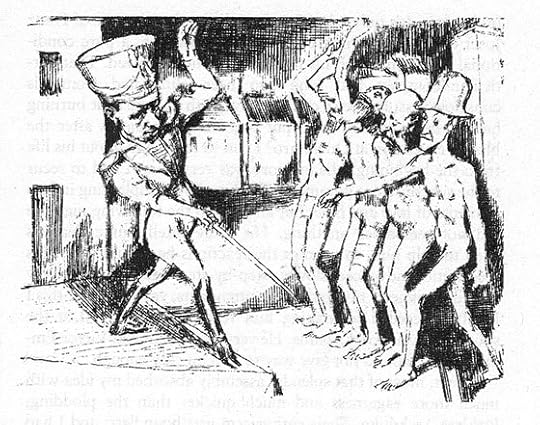
We are the tandeta, the reviewer's stray thoughts, and though we have no clothes as yet, we are determined to camp in this review space. Bruno Schulz himself has given us permission and we defy anyone to remove us.
...............................................................
13.00 March 4th — voice of The Reviewer
I had to look up the word 'tandeta' which has just appeared in the review space (see above and comment #4), and I discovered that it is an almost untranslatable Polish word which Schulz uses regularly, a word that means variously: 'trash', 'shoddy', 'cast-off'. It also means the kind of market where such second-rate goods can be found, a flea-market, for example.
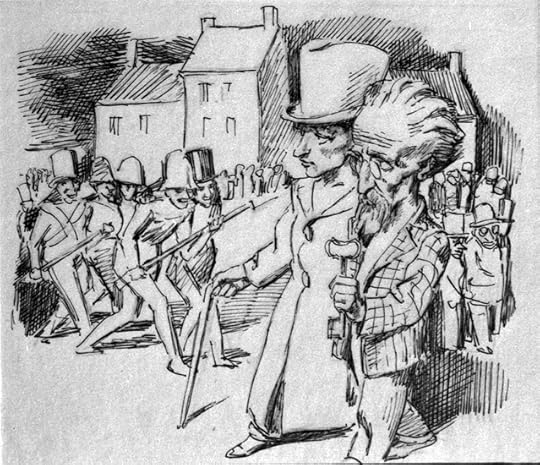
And now I see that the group of decrepit military wax-figures which the narrator frees from a wax museum in the story called 'Spring', and which you can see in the Bruno Schulz drawing above, are declaring themselves in support of the stray thoughts I had decided weren't fit for purpose.
I had marshaled what I thought of as the more worthy thoughts into a coherent paragraph earlier this morning and was quite pleased with the result. Now I'm not so sure—but I refuse to be intimidated by a bunch of moth-eaten ex-generals so I'll post the paragraph anyway:
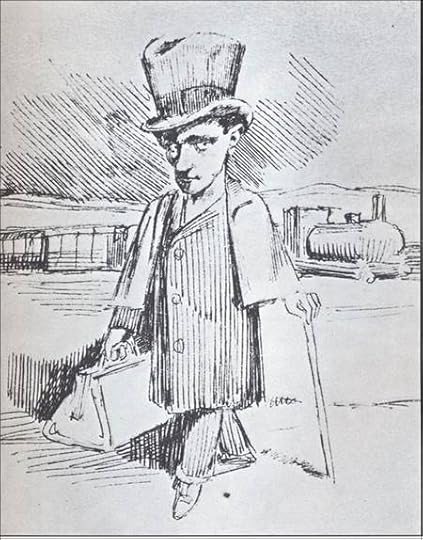
Schulz is a magician. From the blank interior of his top-hat, he pulls streams and streams of multi-hued words, words that separate and reform into pink doves, blue buzzards, red storks, yellow pelicans, each with long ribbons of syllables dangling from their beaks. And when the ribbons break off, they float away on the breeze, looping and dipping in arabesques across a papery sky, spelling out stories, one stranger than the next, stories for then, stories for now, stories for ever...
...........................................................
15.00 March 5th — voices of The Reviewer's Stray Thoughts
We feel the Reviewer is unfairly relegating the concept of ‘tandeta’ which is central to Schulz’s stories. His narrator shines a bright light on things the world generally considers as only fit for the rubbish heap.
One story, for example, focuses on an old almanac the narrator loved to look through as a child and which he later comes across when most of its pages have been torn out to serve some domestic purpose, perhaps to light the fire in the stove. He endows the ragged remains of this old catalogue of ancient dates and obsolete advertisements with the properties of every book that ever existed. It becomes 'The Book of Books'. And so we realise that from ‘tandeta’ or rubbish, the narrator believes something truly beautiful can be created.
This experience is repeated again and again throughout the stories as the things people generally seek to discard become instead things of beauty. A faded curtain stiff with dust, dead flies on a windowpane, moss covered paths, old tree roots, such things are constantly celebrated.
Bruno Schulz writes 'Under The Sign of the Rubbish Heap'.
..............................................................
15.55 March 5th — voice of The Penguin Classics Edition
Since it seems that anything can happen on this review page, the book itself surely has a right to speak. Yes, this edition of Bruno Schulz’s collected stories is claiming space to announce that what the reader gets inside the covers of this book is nothing less than magical: thirty stories and novellas plus thirty illustrations by Schulz himself.
The stories are drawn from the two collections published in the author’s lifetime, 'Cinnamon Shops' from 1933

and 'Sanatorium Under the Sign of the Hourglass',
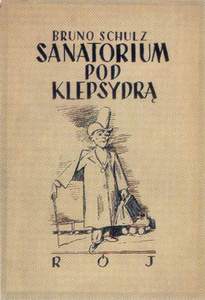
from 1937 (though written earlier than the stories in Cinnamon Shops) plus a few other stories that had appeared in periodicals and journals around that time.
Not all of the stories are illustrated but where they occur, the fantastical nature of the drawings complements the hallucinatory narratives perfectly, introducing a further layer of eccentricity to the work. However, even when there are no illustrations, the words cast surreal images onto the screen of the reader’s mind:
Father was listening. In the silence of the night his ear seemed to grow larger and to reach out beyond the window: a fantastic coral, a red polypus watching the chaos of the night.
The translation in this edition was done by Celina Wieniewska, and the rich and exciting language of the stories is the proof of the success of her work, which was not an easy task as David A. Goldfarb points out in the introduction. According to Goldfarb, Bruno Schulz uses a number of words that are so obscure even in Polish that Wieniewska was obliged to be very creative in order to render them in English. This Penguin Classics edition, standing in for the author who would certainly have been exceedingly grateful to her, bows before Wieniewska’s talent and would kiss her feet.

..........................................................
20.50 March 5th — voices of The Reviewer's Stray Thoughts
The peacock-feather eye peeping through the keyhole, the pattern on wallpaper shifting to echo the father’s frowns, the squares of a parquet floor endlessly counting themselves in horizontal creaks and vertical cracks, chimney smoke weaving to avoid the wind, lamps with arms akimbo, mirrors that appear elderly—everything in a Schulz story, even the shadow on the wall, is personified, so that the reader should not be at all surprised when the book the stories inhabit itself speaks aloud as it has done above.
Have you ever noticed swallows rising in flocks from between the lines of certain books? One should read the flight of these birds..
..........................................................
2.00 am March 6th — voices of The Review-Edit Box
How many services we provide, we, the humble Edit-Boxes of this Goodreads world! We offer a luminous space where a winking curser waits patiently to receive the reviewer's words, words which may be written in a thousand different ways depending on the reviewer in question, sometimes baldly, sometimes boldly, sometimes in hints and ellipses, dashes and dots. The gaps in comprehension that result have to be filled by the vague guesses and suppositions of review readers, and we always offer our sympathy for the predicament they find themselves in, especially if they feel called upon to comment after reading.
At other times we, the review boxes, are packed tight with dense blocks of text, and not a paragraph break occurs to offer a breathing space. Our sighs are then as audible as the readers’ who attempt to decipher the text, bless their dedicated souls. Please let some air in, we entreat them, and when occasionally an obliging reader selects a phrase, a sentence, or on a good day, an entire paragraph, to copy into a comment box, how we cheer and applaud! It relieves the tedium.
When we're very bored we call in Madame Autocorrect and let her loose on the text. Afterwords we sit patiently like spiders in a web, waiting for an unsuspecting reader to come along, and when they do, we roll about laughing as they scroll back and forth scanning the autocorrected words in a state of the greatest perplexity. Such fun—especially if the referees are posturing from a ballsy scream and can't feck back easily to see how the next has appalled.
Our favourite reviewers are those who use html to vary our presentation by means of italics, spoilers, links and images. Imagine the sport as we take bets on which links will refuse to work and which images will fail in the days that follow. The truth is, it's very easy to interfere with html code; if we breathe out in a vigorous way, a vital element can fly off like a button from an overcoat. That can be an amusing exercise.
Needless to add, our favourite readers are those who pause to press the Like button with a good firm touch (no light, tickly ones, please). Then, the utter thrill—there is nothing to compare with it!
........................................................
12.12 March 6th — voices of The End of the Review Committee
Speaking in our capacity as members of the final section of this review, we have voted to set it in place here and now, and to block any further delays and prevarications in the finalisation of this review. Three days is more than enough time for a review to be ‘ongoing’; there is a limit to everything.
And while we are aware that certain topics have not been covered or only very sketchily, we don’t support the idea that any review should ever seek to be totally comprehensive. The shorter the better is our motto, especially as such a policy allows 'The End of the Review' to be reached more speedily.
As to the length of 'The End of the Review', we are more flexible on that point since everyone agrees that 'the ending' is the most important part of any piece of writing.
We deem it relevant to note here also that this particular review is more playful than we might like, a fact we tolerate in this case because it underlines that Bruno Schulz tells most of his stories from the point of view of a child with a very vivid imagination and a very extravagant taste in metaphor, at least in our opinion.
As in this review, Schulz’s stories are filled with distortions of time and space, both being given life and agency over their surroundings, something we are also less than comfortable with, let it be noted. The result of such manipulation is a certain warped effect, as if viewing an event through the glass of a very old window where sometimes the view is completley clear and at other times completely fuzzy, not an ideal outcome in our considered opinion.
Furthermore, as in the sections of this review which, in spite of their differences in style and tone, are nevertheless part of a whole, Schulz’s stories share characters and locations so that instead of reading as individual pieces, they rather build into one long novel, a fact which may offer satisfaction to the reader who prefers novels to short stories.
Knowing that Schulz was born quite a few years after his brother and sister, and when his father had begun to grow old, encourages us to postulate that these stories contain many autobiographical elements since they mostly feature an elderly father and his young son. The mother and a servant called Adela also roam from story to story and provide some entertainment, Adela in particular, who, with her broom constantly to hand, sweeps away entire heaps of ‘tandeta’ whenever she gets the chance, something we would have enjoyed doing in this review had we but a broom.
We quite liked Adela.
1.00 March 3rd 2016 — voice of The Reviewer
As I was reading through this book, a great many thoughts and impressions formed in my mind, and there they have lain since, each waiting for a chance to push itself into a prime position in this review space. So, for the moment, I'm just sitting on them, frantically trying to hold them down as I think how to shape them in a way that will be vaguely comprehensible to someone who hasn't read this book or doesn't live inside my head.
But the task will certainly involve excluding some of those many impressions, and I can sense already that I'll have a rebellion on my hands as stray thoughts I had discarded steal into the review while I'm asleep. I will have to be very vigilant, perhaps enter into some kind of contract with the review space so that it will refuse entry to thoughts that don't carry a pass signed by me personally.
I'll be watching this space.
................................................................
3.30 March 3rd — voices of The Reviewer's Stray Thoughts
We are the tandeta, the reviewer's stray thoughts, and though we have no clothes as yet, we are determined to camp in this review space. Bruno Schulz himself has given us permission and we defy anyone to remove us.
...............................................................
13.00 March 4th — voice of The Reviewer
I had to look up the word 'tandeta' which has just appeared in the review space (see above and comment #4), and I discovered that it is an almost untranslatable Polish word which Schulz uses regularly, a word that means variously: 'trash', 'shoddy', 'cast-off'. It also means the kind of market where such second-rate goods can be found, a flea-market, for example.
And now I see that the group of decrepit military wax-figures which the narrator frees from a wax museum in the story called 'Spring', and which you can see in the Bruno Schulz drawing above, are declaring themselves in support of the stray thoughts I had decided weren't fit for purpose.
I had marshaled what I thought of as the more worthy thoughts into a coherent paragraph earlier this morning and was quite pleased with the result. Now I'm not so sure—but I refuse to be intimidated by a bunch of moth-eaten ex-generals so I'll post the paragraph anyway:
Schulz is a magician. From the blank interior of his top-hat, he pulls streams and streams of multi-hued words, words that separate and reform into pink doves, blue buzzards, red storks, yellow pelicans, each with long ribbons of syllables dangling from their beaks. And when the ribbons break off, they float away on the breeze, looping and dipping in arabesques across a papery sky, spelling out stories, one stranger than the next, stories for then, stories for now, stories for ever...
...........................................................
15.00 March 5th — voices of The Reviewer's Stray Thoughts
We feel the Reviewer is unfairly relegating the concept of ‘tandeta’ which is central to Schulz’s stories. His narrator shines a bright light on things the world generally considers as only fit for the rubbish heap.
One story, for example, focuses on an old almanac the narrator loved to look through as a child and which he later comes across when most of its pages have been torn out to serve some domestic purpose, perhaps to light the fire in the stove. He endows the ragged remains of this old catalogue of ancient dates and obsolete advertisements with the properties of every book that ever existed. It becomes 'The Book of Books'. And so we realise that from ‘tandeta’ or rubbish, the narrator believes something truly beautiful can be created.
This experience is repeated again and again throughout the stories as the things people generally seek to discard become instead things of beauty. A faded curtain stiff with dust, dead flies on a windowpane, moss covered paths, old tree roots, such things are constantly celebrated.
Bruno Schulz writes 'Under The Sign of the Rubbish Heap'.
..............................................................
15.55 March 5th — voice of The Penguin Classics Edition
Since it seems that anything can happen on this review page, the book itself surely has a right to speak. Yes, this edition of Bruno Schulz’s collected stories is claiming space to announce that what the reader gets inside the covers of this book is nothing less than magical: thirty stories and novellas plus thirty illustrations by Schulz himself.
The stories are drawn from the two collections published in the author’s lifetime, 'Cinnamon Shops' from 1933
and 'Sanatorium Under the Sign of the Hourglass',
from 1937 (though written earlier than the stories in Cinnamon Shops) plus a few other stories that had appeared in periodicals and journals around that time.
Not all of the stories are illustrated but where they occur, the fantastical nature of the drawings complements the hallucinatory narratives perfectly, introducing a further layer of eccentricity to the work. However, even when there are no illustrations, the words cast surreal images onto the screen of the reader’s mind:
Father was listening. In the silence of the night his ear seemed to grow larger and to reach out beyond the window: a fantastic coral, a red polypus watching the chaos of the night.
The translation in this edition was done by Celina Wieniewska, and the rich and exciting language of the stories is the proof of the success of her work, which was not an easy task as David A. Goldfarb points out in the introduction. According to Goldfarb, Bruno Schulz uses a number of words that are so obscure even in Polish that Wieniewska was obliged to be very creative in order to render them in English. This Penguin Classics edition, standing in for the author who would certainly have been exceedingly grateful to her, bows before Wieniewska’s talent and would kiss her feet.
..........................................................
20.50 March 5th — voices of The Reviewer's Stray Thoughts
The peacock-feather eye peeping through the keyhole, the pattern on wallpaper shifting to echo the father’s frowns, the squares of a parquet floor endlessly counting themselves in horizontal creaks and vertical cracks, chimney smoke weaving to avoid the wind, lamps with arms akimbo, mirrors that appear elderly—everything in a Schulz story, even the shadow on the wall, is personified, so that the reader should not be at all surprised when the book the stories inhabit itself speaks aloud as it has done above.
Have you ever noticed swallows rising in flocks from between the lines of certain books? One should read the flight of these birds..
..........................................................
2.00 am March 6th — voices of The Review-Edit Box
How many services we provide, we, the humble Edit-Boxes of this Goodreads world! We offer a luminous space where a winking curser waits patiently to receive the reviewer's words, words which may be written in a thousand different ways depending on the reviewer in question, sometimes baldly, sometimes boldly, sometimes in hints and ellipses, dashes and dots. The gaps in comprehension that result have to be filled by the vague guesses and suppositions of review readers, and we always offer our sympathy for the predicament they find themselves in, especially if they feel called upon to comment after reading.
At other times we, the review boxes, are packed tight with dense blocks of text, and not a paragraph break occurs to offer a breathing space. Our sighs are then as audible as the readers’ who attempt to decipher the text, bless their dedicated souls. Please let some air in, we entreat them, and when occasionally an obliging reader selects a phrase, a sentence, or on a good day, an entire paragraph, to copy into a comment box, how we cheer and applaud! It relieves the tedium.
When we're very bored we call in Madame Autocorrect and let her loose on the text. Afterwords we sit patiently like spiders in a web, waiting for an unsuspecting reader to come along, and when they do, we roll about laughing as they scroll back and forth scanning the autocorrected words in a state of the greatest perplexity. Such fun—especially if the referees are posturing from a ballsy scream and can't feck back easily to see how the next has appalled.
Our favourite reviewers are those who use html to vary our presentation by means of italics, spoilers, links and images. Imagine the sport as we take bets on which links will refuse to work and which images will fail in the days that follow. The truth is, it's very easy to interfere with html code; if we breathe out in a vigorous way, a vital element can fly off like a button from an overcoat. That can be an amusing exercise.
Needless to add, our favourite readers are those who pause to press the Like button with a good firm touch (no light, tickly ones, please). Then, the utter thrill—there is nothing to compare with it!
........................................................
12.12 March 6th — voices of The End of the Review Committee
Speaking in our capacity as members of the final section of this review, we have voted to set it in place here and now, and to block any further delays and prevarications in the finalisation of this review. Three days is more than enough time for a review to be ‘ongoing’; there is a limit to everything.
And while we are aware that certain topics have not been covered or only very sketchily, we don’t support the idea that any review should ever seek to be totally comprehensive. The shorter the better is our motto, especially as such a policy allows 'The End of the Review' to be reached more speedily.
As to the length of 'The End of the Review', we are more flexible on that point since everyone agrees that 'the ending' is the most important part of any piece of writing.
We deem it relevant to note here also that this particular review is more playful than we might like, a fact we tolerate in this case because it underlines that Bruno Schulz tells most of his stories from the point of view of a child with a very vivid imagination and a very extravagant taste in metaphor, at least in our opinion.
As in this review, Schulz’s stories are filled with distortions of time and space, both being given life and agency over their surroundings, something we are also less than comfortable with, let it be noted. The result of such manipulation is a certain warped effect, as if viewing an event through the glass of a very old window where sometimes the view is completley clear and at other times completely fuzzy, not an ideal outcome in our considered opinion.
Furthermore, as in the sections of this review which, in spite of their differences in style and tone, are nevertheless part of a whole, Schulz’s stories share characters and locations so that instead of reading as individual pieces, they rather build into one long novel, a fact which may offer satisfaction to the reader who prefers novels to short stories.
Knowing that Schulz was born quite a few years after his brother and sister, and when his father had begun to grow old, encourages us to postulate that these stories contain many autobiographical elements since they mostly feature an elderly father and his young son. The mother and a servant called Adela also roam from story to story and provide some entertainment, Adela in particular, who, with her broom constantly to hand, sweeps away entire heaps of ‘tandeta’ whenever she gets the chance, something we would have enjoyed doing in this review had we but a broom.
We quite liked Adela.

August 2, 2016
“The books we read in childhood don't exist anymore; they sailed off with the wind, leaving bare skeletons behind. Whoever still has in him the memory and marrow of childhood should rewrite these books as he experienced them”―Bruno Schulz
“My ideal goal is to 'mature' into childhood. That would be genuine maturity"―Schulz
Bruno Schulz was a high school art teacher, an artist and a short story writer who was killed by the Gestapo when he was 50 for straying into a non-Jewish or Aryan area of his hometown of Drohobych, Poland. He was unmarried, had no children, and lived all of his life in Drohobych. He had a pretty long term friendship with the poet Deborah Vogel, whose parents disapproved of their relationship, but his stories in The Street of Crocodiles had their beginnings in a series of letters to Vogel.
“On Saturday afternoons I used to go for a walk with my mother. From the dusk of the hallway, we stepped at once into the brightness of the day. The passerby, bathed in melting gold, had their eyes half-closed against the glare, as if they were drenched with honey, upper lips were drawn back, exposing the teeth. Everyone in this golden day wore that grimace of heat–-as if the sun had forced his worshippers to wear identical masks of gold. The old and the young, women and children, greeted each other with these masks, painted on their faces with thick gold paint; they smiled at each other's pagan faces–-the barbaric smiles of Bacchus”―The Street of Crocodiles
Urban, Polish, Jewish, dark laughter, lust. Roth, Malamud, Stuart Dybek’s Polish Chicago in Childhood and Other Neighborhoods. Thomas Mann, Kafka, Isaac Bashevis Singer’s The Spinoza of Market Street. Poe’s Tales of Mystery and Imagination. Baudelaire. Blake.
“Dizzy with light, we dipped into the enormous book of holidays, its pages blazing with sunshine and scented with the sweet melting pulp of golden pears”―Crocodiles
Matter matters to Schulz. He especially loves rot, fecundity, fermentation, trash, old things, antiques, things imbued through experience and ripening with memory. The memory in objects. “A cabinet of curiosities.” Each item, each object, painted alive with magic. Extra rooms emerge in houses, extra streets appear in the night. The mythicization of reality. Like Mann’s imbuing stories with classical truths/references. Or Eliot’s objective correlative. But also surrealist transformations, like Kafka’s metamorphosis. Cockroaches figure in as equally as birds. Darkness overcomes the light, finally.
“Poetry happens when short circuits of sense occur between words”―Schulz
“Nimrod began to understand that what he was experiencing was, in spite of its appearance of novelty, something which had existed before–many times before. His body began to recognize situations, impressions, and objects. In reality, none of these astonished him very much. Faced with new circumstances, he would dip into the fount of his memory, the deep-seated memory of the body, would search blindly and feverishly, and often find ready made within himself a suitable reaction: the wisdom of generations, deposited in his plasma, in his nerves. He found actions and decisions of which he had not been aware but which had been lying in wait, ready to emerge”―Crocodiles
Magic matters to Schulz. Matter is made of magic, at its best. Mirages, fata morgana. Surrealism, magical realism, mesmerism, a kind of early Steam Punk fascination that modernism had with science, with physics and its possible relationship to metaphysics. A fascination with “essence” and the ability of the artist to “capture” the “nature of reality”. Ecstasy in the every day. And invention. The role of the demiurge in the forging of reality. Manifestations of the Unknown. Joy and pain issues forth from this magic. Horror emerges out of fantasy. It can go either way, into light or darkness, but it is magic, either way.
“My father was slowly fading, wilting before our eyes"―Crocodiles
The father in this story as mad, crazy genius, but mad, surely. Ornithologist. Comic madness alternating with despair, a kind of bipolar alteration, story to story. “August” is ecstasy, “Visitation:” despair. Dark laughter.
“The days hardened with cold and boredom like last year's loaves of bread. One began to cut them with blunt knives without appetite, with a lazy indifference”―Crocodiles
“Even in the depths of sleep, in which he had to satisfy his need for protection and love by curling himself up into a trembling ball, he could not rid himself of the feeling of loneliness and homelessness”―Crocodiles
Odd vignettes, ephemera, anecdotes. Uneven? Yes. Enigmatic. No sense of "wholeness" or "the well-shaped Freytag's Pyramid" as in The Art of the Short Story. There’s almost no dialogue in any of the stories. Except when Father pontificates his views of the world. The stories are all narrated, reported, instead of enacted. Not much happens. Animals talk. Birds are everywhere. Father becomes one of his birds. But it’s not about plot; it’s about magic.
"The sun-dried thistles shout, the plantains swell and boast their shameless flesh, the weeds salivate with glistening poison. . . "―Crocodiles
A fascination with maps, labyrinths, but not as sense-making tools. Patterns ending in wonder, not an articulation of order. It's more important to get lost than find your way.
The best stories for my taste are “Birds,” “Cinnamon Shops,” “The Street of Crocodiles,” “The Night of the Great Season,” and “The Comet.”
Here's an excerpt of the Quay Brothers's The Street of Crocodiles stop action film:
https://www.youtube.com/watch?v=fNOfs...
“My ideal goal is to 'mature' into childhood. That would be genuine maturity"―Schulz
Bruno Schulz was a high school art teacher, an artist and a short story writer who was killed by the Gestapo when he was 50 for straying into a non-Jewish or Aryan area of his hometown of Drohobych, Poland. He was unmarried, had no children, and lived all of his life in Drohobych. He had a pretty long term friendship with the poet Deborah Vogel, whose parents disapproved of their relationship, but his stories in The Street of Crocodiles had their beginnings in a series of letters to Vogel.
“On Saturday afternoons I used to go for a walk with my mother. From the dusk of the hallway, we stepped at once into the brightness of the day. The passerby, bathed in melting gold, had their eyes half-closed against the glare, as if they were drenched with honey, upper lips were drawn back, exposing the teeth. Everyone in this golden day wore that grimace of heat–-as if the sun had forced his worshippers to wear identical masks of gold. The old and the young, women and children, greeted each other with these masks, painted on their faces with thick gold paint; they smiled at each other's pagan faces–-the barbaric smiles of Bacchus”―The Street of Crocodiles
Urban, Polish, Jewish, dark laughter, lust. Roth, Malamud, Stuart Dybek’s Polish Chicago in Childhood and Other Neighborhoods. Thomas Mann, Kafka, Isaac Bashevis Singer’s The Spinoza of Market Street. Poe’s Tales of Mystery and Imagination. Baudelaire. Blake.
“Dizzy with light, we dipped into the enormous book of holidays, its pages blazing with sunshine and scented with the sweet melting pulp of golden pears”―Crocodiles
Matter matters to Schulz. He especially loves rot, fecundity, fermentation, trash, old things, antiques, things imbued through experience and ripening with memory. The memory in objects. “A cabinet of curiosities.” Each item, each object, painted alive with magic. Extra rooms emerge in houses, extra streets appear in the night. The mythicization of reality. Like Mann’s imbuing stories with classical truths/references. Or Eliot’s objective correlative. But also surrealist transformations, like Kafka’s metamorphosis. Cockroaches figure in as equally as birds. Darkness overcomes the light, finally.
“Poetry happens when short circuits of sense occur between words”―Schulz
“Nimrod began to understand that what he was experiencing was, in spite of its appearance of novelty, something which had existed before–many times before. His body began to recognize situations, impressions, and objects. In reality, none of these astonished him very much. Faced with new circumstances, he would dip into the fount of his memory, the deep-seated memory of the body, would search blindly and feverishly, and often find ready made within himself a suitable reaction: the wisdom of generations, deposited in his plasma, in his nerves. He found actions and decisions of which he had not been aware but which had been lying in wait, ready to emerge”―Crocodiles
Magic matters to Schulz. Matter is made of magic, at its best. Mirages, fata morgana. Surrealism, magical realism, mesmerism, a kind of early Steam Punk fascination that modernism had with science, with physics and its possible relationship to metaphysics. A fascination with “essence” and the ability of the artist to “capture” the “nature of reality”. Ecstasy in the every day. And invention. The role of the demiurge in the forging of reality. Manifestations of the Unknown. Joy and pain issues forth from this magic. Horror emerges out of fantasy. It can go either way, into light or darkness, but it is magic, either way.
“My father was slowly fading, wilting before our eyes"―Crocodiles
The father in this story as mad, crazy genius, but mad, surely. Ornithologist. Comic madness alternating with despair, a kind of bipolar alteration, story to story. “August” is ecstasy, “Visitation:” despair. Dark laughter.
“The days hardened with cold and boredom like last year's loaves of bread. One began to cut them with blunt knives without appetite, with a lazy indifference”―Crocodiles
“Even in the depths of sleep, in which he had to satisfy his need for protection and love by curling himself up into a trembling ball, he could not rid himself of the feeling of loneliness and homelessness”―Crocodiles
Odd vignettes, ephemera, anecdotes. Uneven? Yes. Enigmatic. No sense of "wholeness" or "the well-shaped Freytag's Pyramid" as in The Art of the Short Story. There’s almost no dialogue in any of the stories. Except when Father pontificates his views of the world. The stories are all narrated, reported, instead of enacted. Not much happens. Animals talk. Birds are everywhere. Father becomes one of his birds. But it’s not about plot; it’s about magic.
"The sun-dried thistles shout, the plantains swell and boast their shameless flesh, the weeds salivate with glistening poison. . . "―Crocodiles
A fascination with maps, labyrinths, but not as sense-making tools. Patterns ending in wonder, not an articulation of order. It's more important to get lost than find your way.
The best stories for my taste are “Birds,” “Cinnamon Shops,” “The Street of Crocodiles,” “The Night of the Great Season,” and “The Comet.”
Here's an excerpt of the Quay Brothers's The Street of Crocodiles stop action film:
https://www.youtube.com/watch?v=fNOfs...

December 3, 2021
For the most part I want an author to tell me a riveting story in the most inventive and eloquent way possible. I'm not so keen on authors who want to showcase the riches of imagination or string together abstract ideas on chains. That said my favourite book is Virginia Woolf's The Waves which belongs to the latter variety. And every time I read a writer who wants to find poetic meaning in the passing moment and thus arrest it, who tries to forge abstract ideas into architecture I marvel anew at how supremely accomplished Virginia's book is.
Just as there are only a limited number of cigarettes you can smoke in a day if you want to sustain the pleasure of the act I found there was a limited number of pages I could read of this every day before I felt surfeited. But now I've finished it I miss it. I miss the thrill of coming across sentences that were like sudden dramatic shifts in the weather. I fully understand why Schulz has influenced so many writers. They gravitate to the best of him which is often spectacular and exhilarating and overlook the excesses when he seems on the brink of outthinking his own mind which can make him difficult to follow at times.
It's easy to think of Schulz as perched high on an imaginary watchtower like a bird looking down at the absurd efforts of human beings to give a semblance of meaning to what if they stopped to think about it would be senseless. This makes the nature of his death - his murder by an SS man as part of some petty tit for tat squabble with a fellow monster - still more grotesque. His wings were of no avail when he most needed them.
Just as there are only a limited number of cigarettes you can smoke in a day if you want to sustain the pleasure of the act I found there was a limited number of pages I could read of this every day before I felt surfeited. But now I've finished it I miss it. I miss the thrill of coming across sentences that were like sudden dramatic shifts in the weather. I fully understand why Schulz has influenced so many writers. They gravitate to the best of him which is often spectacular and exhilarating and overlook the excesses when he seems on the brink of outthinking his own mind which can make him difficult to follow at times.
It's easy to think of Schulz as perched high on an imaginary watchtower like a bird looking down at the absurd efforts of human beings to give a semblance of meaning to what if they stopped to think about it would be senseless. This makes the nature of his death - his murder by an SS man as part of some petty tit for tat squabble with a fellow monster - still more grotesque. His wings were of no avail when he most needed them.

April 28, 2016
4.75
This is like nothing I’ve read before. Take Franz Kafka, Marcel Proust and Jorge Luis Borges; shake them up; rearrange the splinters into a collage of expressionism; and still this is like nothing I’ve read before.
A father becomes a cockroach, a large bird, a crustacean; an aunt burns in a fit of anger into a pile of ashes. The young narrator remembers a book, the Book of all Books, from when he was even younger and despairs at his family’s cavalier attitude when he discovers its fate. A postage-stamp album is the entryway into a life of love, war, jealousy, and sacrifice. Death exists at the same time it is delayed. Mirrors don’t merely reflect: They hint at the other worlds they contain. Old men soar above the ground as if they are in a Chagall painting.
The stories do not stop when the characters fall asleep, only to pick up again when they awake. Instead, the rooms of the house expand; the walls, curtains, and furniture pulsate; the minds of the sleepers reach out to one another or across the city, except when they don’t. In many cases the active sleeping is the eventful climax of a story.
Above all, it is the language that delights. Within an elegant structure of sentences, the imagery invokes all the senses so plentifully that every yellow horizon, every crack between buildings, every single thing, is alive.
To quote the old-age pensioner:
This is like nothing I’ve read before. Take Franz Kafka, Marcel Proust and Jorge Luis Borges; shake them up; rearrange the splinters into a collage of expressionism; and still this is like nothing I’ve read before.
A father becomes a cockroach, a large bird, a crustacean; an aunt burns in a fit of anger into a pile of ashes. The young narrator remembers a book, the Book of all Books, from when he was even younger and despairs at his family’s cavalier attitude when he discovers its fate. A postage-stamp album is the entryway into a life of love, war, jealousy, and sacrifice. Death exists at the same time it is delayed. Mirrors don’t merely reflect: They hint at the other worlds they contain. Old men soar above the ground as if they are in a Chagall painting.
The stories do not stop when the characters fall asleep, only to pick up again when they awake. Instead, the rooms of the house expand; the walls, curtains, and furniture pulsate; the minds of the sleepers reach out to one another or across the city, except when they don’t. In many cases the active sleeping is the eventful climax of a story.
Above all, it is the language that delights. Within an elegant structure of sentences, the imagery invokes all the senses so plentifully that every yellow horizon, every crack between buildings, every single thing, is alive.
To quote the old-age pensioner:
It is part of my existence to be the parasite of metaphors, so easily am I carried away by the first simile that comes along. Having been carried away, I have to find my difficult way back, and slowly return to my senses.Always with full use of his senses, Schulz may at times drop the similes, but never the metaphors.

Read
January 23, 2018DNF. A family of four lived in a dark, shaded apartment with wallpaper yellowed from the excessive summer heat. The dimly lit apartment, above their dressmaking business, was in a state of neglect. The father's health deteriorated as he experienced loss of his mental faculties. He conversed with himself, was often agitated and sometimes became glazed over like an automaton. The metaphors, although excellent, were not enough to help maintain my interest level in continuing to read and fairly assess this tome. It would be unfair to rate "Collected Stories" by Bruno Schulz, a book I did not finish.
Thank you Northwestern University Press and Net Galley for the opportunity to read and review "Collected Stories".
Thank you Northwestern University Press and Net Galley for the opportunity to read and review "Collected Stories".

March 7, 2018
These stories are a fabulous blend of romantic animism partaking of all the senses, fantastical tall tales, and wacky philosophies, all usually rendered from a precocious child’s perspective. His writing is distinctive and unique, but I appreciate how others reach for some kind of hybrid of Kafka, Calvino, and Borges to forge a comparative description. And I have no trouble imagining likely influences on the ornate gothic fantasies of Lovecraft, the fractured fairy tales of Angela Carter, and the alternative realities of China Mieville. I was already sensitized to the wonders of Schulz from references to his “Street of Crocodiles” in Nicole Kraus’ “History of Love” and an epigram from it in Mieville’s “The City and the City,” but it took a wonderful review from Goodreads’ friend Fionnuala to really make me hunger to read this author. Her extra attention to his eerie and comic drawings is definitely worth a side trip or revisit : The Street of Crocodiles and Other Stories.
My sense of the collection is best described in this late 19th century drawing by Heinrich Kley:

The author was a Polish-speaking Jew who lived his whole life in a small town in the Galicia region formerly of the Polish Kingdom, then of the Austrian Empire, and then, after 1939, Ukraine. He worked as a school teacher and illustrator and took up writing as an extension of skills developed as a storyteller to tame his unruly students. He published but two slim volumes of stories in a life cut short by getting gunned down in the street by a Nazi in 1942, supposedly over a difference with another officer who kept him out of the local ghetto roundup for the camps in exchange for painting him a mural (see David Grossman’s Age of Genius: The Legend of Bruno Schulz, The New Yorker, 2009). This edition of his work is a complete set of his collected stories and a few other pieces in a new translation by Univ. of North Carolina professor Medline Levine, who has previously tackled Czeslaw Milosz and two other Polish writers. This volume lacks the illustrations available in earlier editions of his work.
Schulz tales often feature an imaginative boy growing up in this small town with parents who ran a cloth store on the floor below their apartment, a family which resembles that of the author’s. The father Jakub inspires the boy with his odd hobbies and obsessions with alternative visions of reality. The boom and bust of his business often leans to the latter, so the family is often close to poverty. But the boy has the world of books and the creative outlet of fantasy play with his friends in the neighborhood.
In the face of boring schoolwork and the grim, gray weather of fall and winter, young Bruno finds escape by applying his fertile imagination to everything he experiences. Windstorms can come off as monstrously malevolent or apocalyptic in nature. The advance of nightfall in seasons of short days can come off as an invasion like an epidemic of death:
The pestilence of dusk spread everywhere treacherously and poisonously, moved from one thing to another, and whatever it touched decayed instantly, turned black, disintegrated into rotten wood. People fled from the dusk in quiet panic and suddenly leprosy was catching up with them, spilling onto their foreheads as a dark rash; they lost their faces, which fell off in great, shapeless patches ….
The mad dance of spring can be a delight to the boy, but sometimes its riot and pansexuality seems ominously out of control. The family garden has one end open to the sun and “full of the milk of the heavens and the airs”, while at the other, darker end:
it turned surly and careless, letting itself go wild and unkempt, grew fierce with nettles, bustled with thistles, turned mangy with all sort of weeds …
There it was no longer an orchard but a paroxysm of madness, an explosion of fury, a cynical shamelessness and debauchery. There, completely out of control, the barren burdock cabbage heads proliferated, opening the floodgates of their poison—enormous witches, disrobing in broad daylight, shedding their ample skirts, flinging them off one after another, until their puffed-up, rustling, tattered rags buried under themselves with their frantic layers the rambunctious bastard tribe.
Notice his technique of piling on one metaphor after another until your brain brims over trying to hold onto the vision. I got a lot of pleasure from the similar way Schulz elaborates some of the boy’s fantasies one step at a time until, like with a rollercoaster, you go over the top into absurdity. For example, the boy tries to construct a conception of the world through study of his friend Rudolph’s stamp collection:
Dark, ardent, full of festering love, I took in a parade of creation, marching land, shining processions that I saw in intervals through purple eclipses, deafened by the blows of the blood beating in my heart in time to this universal march of all nations.
He wonders about the nobility and refinement of the mind of Franz Josef I, Emperor of Austria-Hungary, basks in the exotic colors of the flora and fauna in stamps from tropical paradises, and imagines intrigue behind the emperor’s brother Maximillian getting posted to Mexico by Bonaparte as royal governor and later execution by the revolutionaries. At age 10, the boy is developing a crush on a mysterious rich girl his age, Bianka, and projects all kinds of virtue behind her apparently surly reserve. An encounter with her at a wax museum display featuring the royal brothers leads him to imagine her as a bastard child of Maximillian by a Mexican mistress and in need of a brave intervention on his part worthy of Victor Hugo. I had lots of fun with this ornate tale whipped up out of the boy’s and Schulz’s fantasies.
The several tales about the obsessions of boy’s father Jakub were the source of my greatest pleasure, almost Thurberesque in their little surprises and charm. His joining the fire brigade hobby leads Jakub to bringing his buddies home to hang out, and much drinking and horseplay ensues. The housekeeper Adela always finds a way to curb Jakub’s excesses, such as driving him to retreat by threatening to tickle him. In the case of his father’s hatching of a diverse collection of bird eggs and turning his attic into a bizarre aviary the boy initially gives his exuberant support. He trips out on the exotic colors and life that the birds bring to their grey lives in fall and winter. But soon his father begins compulsively to mimic his charges, such as flapping his virtual wings and croaking at the dinner table before catching himself in embarrassment. The apparent slippage of his father toward madness gets a reprieve when Adela manages to let the birds escape. Similarly, the son is captivated by his father’s forays into weird philosophy, which is described as an attempt at “the grafting of mesmerism on the body of modern physics.” Although their Jewishness is not much on display, I got the impression of the hazards of dwelling on the Kabbala and myths of golem creation in his goal for “the second generation of creatures that was to stand in open opposition to the present era. …our creations will be provisional as it were, constructed for a single use”. The boy is easily seduced by this riff of his father’s:
“The Demiurge,” said my father, “had no monopoly on creation; creation is a privilege of all spirits. Matter has infinite fecundity, an inexhaustible vital force, and, at the same time, a seductive power of temptation that entices us to create forms. In the depths of matter indistinct smiles take shape, tensions are reinforced, experimental shapes solidify. All matter flows from the infinite possibilities passing through it in faint shivers. All matter flows awaiting the life-giving breath of the spirit, it overflows endlessly within itself, temps with a thousand sweet curves and the softness it hallucinates in its blind imaginings.
There is no dead matter …lifelessness is only one eternal appearance behind which unknown forms of life are hiding.
…
He was fascinated with boundary forms, uncertain and problematic, like the ectoplasm of somnambulists, pseudomatter; the cataleptic emanation of the brain that in certain instances grew out of the mouth of a sleeping person into an entire table and filled an entire room, like a lushly expanding tissue, an astral dough on the border between body and soul.
Delightful nonsense. His father’s mental reach in his conception of reviving the Age of Genius begins to look like Schulz dream behind the stories themselves, as eloquently described in the David Grossman piece mentioned above as “a period of perfect childhood, feral and filled with light, which even if it lasted for only a brief moment in a person’s life would be missed for the rest of his years”. In Jakub’s language:
Here occurs the phenomenon of representation and vicarious life. Some event, perhaps minor and modest with regard to its provenance and its own means, may, when brought close to the eye, reveal in its interior an infinite, radiant perspective thanks to the higher being attempting to express itself and fiercely blazing within it.
And so we will gather those allusions, those earthly approximations, those stations and stages on the roads of our life, like the shards of a shattered mirror. We will gather piece by piece that which is whole and indivisible, our great age, the age of genius of our life.
Even at a toddler age the son suspects his father is keeping from his purview a special book, “The Book”, which contains the secrets of “magnificence beyond reckoning.” He finds at one point the remnants of a catalog of fashion, huckster schemes, and miraculous medical schemes and treatments which he believes to be fragments of this book. This frame of view leads him in his decoding efforts to quite a few odd and touching inferences in the form of life lessons and perspectives on the reality run by adults. Things turn darker when his father’s horror of cockroaches sends him around the bend. We witness a bit of an alternative to Kafka’s Metamorphosis, where the conversion (once to a cockroach and in another piece into a crab) is rendered from the perspective of the neglectful family instead of an interior view. Quite a masterpiece of comic horror.
His father’s brilliant madness achieves an apotheosis in the story with the catchy title “The Sanatorium Under the Sign of the Hourglass.” The grown-up son visits him there where it seems that one version of his father is thriving and cheating death. The doctor in change explains:
The entire trick depends … on the fact that we have turned back time. …Here, your father’s death, the death that already reached him in your fatherland, has simply not taken effect.
Schulz’s most well-known story, “The Street of Crocodiles,” was not a favorite for me. It’s an extended conception of a large city with a quarter taken over by rampant American-style commercialism and corruption. It appears rather featureless on maps and contains streets somehow devoid of most color (which I didn’t get given an expectation of crass advertising). Those who wander there at first experience a special freedom, but eventually the unreal logic of the place sinks in with a Twilight Zone gothcha:
...the fatal flaw in this quarter is that nothing in it is ever realized, nothing reaches its definitivum, all movements that are initiated are exhausted prematurely and cannot proceed beyond a certain dead end. …The Street of Crocodiles was our city’s concession to modernity and metropolitan depravity.
Over 90% of the collection was outstanding to me, so I urge most readers to give this master a chance to spin your head around. The book was provided for review by the publisher through the Netgalley program.
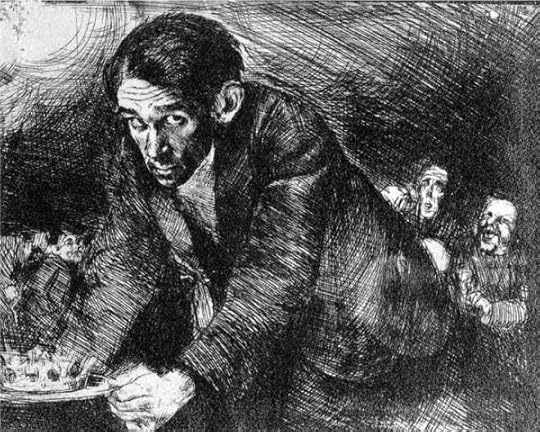
Self portrait
My sense of the collection is best described in this late 19th century drawing by Heinrich Kley:
The author was a Polish-speaking Jew who lived his whole life in a small town in the Galicia region formerly of the Polish Kingdom, then of the Austrian Empire, and then, after 1939, Ukraine. He worked as a school teacher and illustrator and took up writing as an extension of skills developed as a storyteller to tame his unruly students. He published but two slim volumes of stories in a life cut short by getting gunned down in the street by a Nazi in 1942, supposedly over a difference with another officer who kept him out of the local ghetto roundup for the camps in exchange for painting him a mural (see David Grossman’s Age of Genius: The Legend of Bruno Schulz, The New Yorker, 2009). This edition of his work is a complete set of his collected stories and a few other pieces in a new translation by Univ. of North Carolina professor Medline Levine, who has previously tackled Czeslaw Milosz and two other Polish writers. This volume lacks the illustrations available in earlier editions of his work.
Schulz tales often feature an imaginative boy growing up in this small town with parents who ran a cloth store on the floor below their apartment, a family which resembles that of the author’s. The father Jakub inspires the boy with his odd hobbies and obsessions with alternative visions of reality. The boom and bust of his business often leans to the latter, so the family is often close to poverty. But the boy has the world of books and the creative outlet of fantasy play with his friends in the neighborhood.
In the face of boring schoolwork and the grim, gray weather of fall and winter, young Bruno finds escape by applying his fertile imagination to everything he experiences. Windstorms can come off as monstrously malevolent or apocalyptic in nature. The advance of nightfall in seasons of short days can come off as an invasion like an epidemic of death:
The pestilence of dusk spread everywhere treacherously and poisonously, moved from one thing to another, and whatever it touched decayed instantly, turned black, disintegrated into rotten wood. People fled from the dusk in quiet panic and suddenly leprosy was catching up with them, spilling onto their foreheads as a dark rash; they lost their faces, which fell off in great, shapeless patches ….
The mad dance of spring can be a delight to the boy, but sometimes its riot and pansexuality seems ominously out of control. The family garden has one end open to the sun and “full of the milk of the heavens and the airs”, while at the other, darker end:
it turned surly and careless, letting itself go wild and unkempt, grew fierce with nettles, bustled with thistles, turned mangy with all sort of weeds …
There it was no longer an orchard but a paroxysm of madness, an explosion of fury, a cynical shamelessness and debauchery. There, completely out of control, the barren burdock cabbage heads proliferated, opening the floodgates of their poison—enormous witches, disrobing in broad daylight, shedding their ample skirts, flinging them off one after another, until their puffed-up, rustling, tattered rags buried under themselves with their frantic layers the rambunctious bastard tribe.
Notice his technique of piling on one metaphor after another until your brain brims over trying to hold onto the vision. I got a lot of pleasure from the similar way Schulz elaborates some of the boy’s fantasies one step at a time until, like with a rollercoaster, you go over the top into absurdity. For example, the boy tries to construct a conception of the world through study of his friend Rudolph’s stamp collection:
Dark, ardent, full of festering love, I took in a parade of creation, marching land, shining processions that I saw in intervals through purple eclipses, deafened by the blows of the blood beating in my heart in time to this universal march of all nations.
He wonders about the nobility and refinement of the mind of Franz Josef I, Emperor of Austria-Hungary, basks in the exotic colors of the flora and fauna in stamps from tropical paradises, and imagines intrigue behind the emperor’s brother Maximillian getting posted to Mexico by Bonaparte as royal governor and later execution by the revolutionaries. At age 10, the boy is developing a crush on a mysterious rich girl his age, Bianka, and projects all kinds of virtue behind her apparently surly reserve. An encounter with her at a wax museum display featuring the royal brothers leads him to imagine her as a bastard child of Maximillian by a Mexican mistress and in need of a brave intervention on his part worthy of Victor Hugo. I had lots of fun with this ornate tale whipped up out of the boy’s and Schulz’s fantasies.
The several tales about the obsessions of boy’s father Jakub were the source of my greatest pleasure, almost Thurberesque in their little surprises and charm. His joining the fire brigade hobby leads Jakub to bringing his buddies home to hang out, and much drinking and horseplay ensues. The housekeeper Adela always finds a way to curb Jakub’s excesses, such as driving him to retreat by threatening to tickle him. In the case of his father’s hatching of a diverse collection of bird eggs and turning his attic into a bizarre aviary the boy initially gives his exuberant support. He trips out on the exotic colors and life that the birds bring to their grey lives in fall and winter. But soon his father begins compulsively to mimic his charges, such as flapping his virtual wings and croaking at the dinner table before catching himself in embarrassment. The apparent slippage of his father toward madness gets a reprieve when Adela manages to let the birds escape. Similarly, the son is captivated by his father’s forays into weird philosophy, which is described as an attempt at “the grafting of mesmerism on the body of modern physics.” Although their Jewishness is not much on display, I got the impression of the hazards of dwelling on the Kabbala and myths of golem creation in his goal for “the second generation of creatures that was to stand in open opposition to the present era. …our creations will be provisional as it were, constructed for a single use”. The boy is easily seduced by this riff of his father’s:
“The Demiurge,” said my father, “had no monopoly on creation; creation is a privilege of all spirits. Matter has infinite fecundity, an inexhaustible vital force, and, at the same time, a seductive power of temptation that entices us to create forms. In the depths of matter indistinct smiles take shape, tensions are reinforced, experimental shapes solidify. All matter flows from the infinite possibilities passing through it in faint shivers. All matter flows awaiting the life-giving breath of the spirit, it overflows endlessly within itself, temps with a thousand sweet curves and the softness it hallucinates in its blind imaginings.
There is no dead matter …lifelessness is only one eternal appearance behind which unknown forms of life are hiding.
…
He was fascinated with boundary forms, uncertain and problematic, like the ectoplasm of somnambulists, pseudomatter; the cataleptic emanation of the brain that in certain instances grew out of the mouth of a sleeping person into an entire table and filled an entire room, like a lushly expanding tissue, an astral dough on the border between body and soul.
Delightful nonsense. His father’s mental reach in his conception of reviving the Age of Genius begins to look like Schulz dream behind the stories themselves, as eloquently described in the David Grossman piece mentioned above as “a period of perfect childhood, feral and filled with light, which even if it lasted for only a brief moment in a person’s life would be missed for the rest of his years”. In Jakub’s language:
Here occurs the phenomenon of representation and vicarious life. Some event, perhaps minor and modest with regard to its provenance and its own means, may, when brought close to the eye, reveal in its interior an infinite, radiant perspective thanks to the higher being attempting to express itself and fiercely blazing within it.
And so we will gather those allusions, those earthly approximations, those stations and stages on the roads of our life, like the shards of a shattered mirror. We will gather piece by piece that which is whole and indivisible, our great age, the age of genius of our life.
Even at a toddler age the son suspects his father is keeping from his purview a special book, “The Book”, which contains the secrets of “magnificence beyond reckoning.” He finds at one point the remnants of a catalog of fashion, huckster schemes, and miraculous medical schemes and treatments which he believes to be fragments of this book. This frame of view leads him in his decoding efforts to quite a few odd and touching inferences in the form of life lessons and perspectives on the reality run by adults. Things turn darker when his father’s horror of cockroaches sends him around the bend. We witness a bit of an alternative to Kafka’s Metamorphosis, where the conversion (once to a cockroach and in another piece into a crab) is rendered from the perspective of the neglectful family instead of an interior view. Quite a masterpiece of comic horror.
His father’s brilliant madness achieves an apotheosis in the story with the catchy title “The Sanatorium Under the Sign of the Hourglass.” The grown-up son visits him there where it seems that one version of his father is thriving and cheating death. The doctor in change explains:
The entire trick depends … on the fact that we have turned back time. …Here, your father’s death, the death that already reached him in your fatherland, has simply not taken effect.
Schulz’s most well-known story, “The Street of Crocodiles,” was not a favorite for me. It’s an extended conception of a large city with a quarter taken over by rampant American-style commercialism and corruption. It appears rather featureless on maps and contains streets somehow devoid of most color (which I didn’t get given an expectation of crass advertising). Those who wander there at first experience a special freedom, but eventually the unreal logic of the place sinks in with a Twilight Zone gothcha:
...the fatal flaw in this quarter is that nothing in it is ever realized, nothing reaches its definitivum, all movements that are initiated are exhausted prematurely and cannot proceed beyond a certain dead end. …The Street of Crocodiles was our city’s concession to modernity and metropolitan depravity.
Over 90% of the collection was outstanding to me, so I urge most readers to give this master a chance to spin your head around. The book was provided for review by the publisher through the Netgalley program.
Self portrait

June 24, 2015
Listen:
"And while the children's games became increasingly noisier and more complicated, while the city's flushes darkened into purple, the whole world suddenly began to wilt and blacken and exude an uncertain dusk which contaminated everything. Treacherous and poisonous, the plague of dusk spread, passed from one object to another, and everything it touched became black and rotten and scattered into dust. People fled before it in silent panic, but the disease always caught up with them and spread in a dark rash on their foreheads. Their faces disappeared under large, shapeless spots. They continued on their way, now featureless, without eyes, shedding as they walked one mask after another, so that the dusk became filled with the discarded larvae dropped in their flight." --from "The Night of the Great Season"
That's Bruno Schulz's description of nightfall. Brilliant. Normally I'm not one who looks for fancy prose in my fiction, though I am of course capable of appreciating it. I'm more interested in story. And in weird fiction, I'm interested in that otherworldly frisson I experience when reality and unreality come together for brief moments. With Schulz, his prose is just as much a catalyst into his fantastical worlds as the "story." In his tales, it's not night outside the window, but "black night, saturated with dreams and complications." A shop's interior can slowly transform into a mountainous landscape. Inanimate objects are given human-like emotions. They can be morose, contemplative, and can even whisper to each other. But not like in children's fairy tales, but more like the real world seen through the eyes of a child (possibly while on LSD). The real world, only more so. More "alive."
Colors are described not in shades, but "octaves," which is fitting considering Schulz's writing has a sort of poetic quality to it. It can be hard to read at times if you're not in the proper mood, however. When I try to read these stories during the day, I can spend several minutes on each page, desperate to not miss a single clever turn of phrase. At night, it can put me to sleep if I'm not careful. But real late at night, when I'm past the point of tired and back to wide awake, only punch-drunk, then I can become fully enveloped in this world. It may still take me several minutes per page, but now it's because I have to periodically sit back in wonder and amazement at the pure genius of certain passages.
Reality and fantasy (or unleashed imagination) are in constant flux here, continuously getting in each other's way. But it's not all whimsical. Some stories, such as the novelette-length "Sanatorium Under the Sign of the Hourglass," have an eerie, almost Ligottian or Kafka-esque atmosphere to them. Most of the stories deal in some way with Schulz's (or the narrator's) father. He can die in one story, then be fine in the next, only smaller. It all may seem rather nonsensical, but once you get into a groove with these tales, it all has a perfect dream logic, in a way.
This book (or rather two books*) never gets old with me. I can re-read these stories countless times and they’ll never lose their magic. It’s a tragedy that Bruno Schulz's life was cut short, as these tales may have been a mere prelude of even greater things to come.
But it's hard to imagine.
5 Stars
*This Penguin classics edition contains both his first collection, The Street of Crocodiles, and his followup, Sanitorium Under the Sign of the Hourglass, the latter of which has many of Schulz's illustrations interspersed throughout, such as the one up top.

January 18, 2017
This book has been waiting on my shelf for nearly a year, and in retrospect reading two thirds of it in a day was probably a bad idea, as it is dense, allusive and sometimes difficult to follow. For all that, it has moments of brilliance that made me understand why Schulz is revered in Poland, not least by Olga Tokarczuk, author of the wonderful Flights.
Schulz was a Polish Jew shot by the Nazis in 1941. His hometown Drohobycz has a complicated history and a mixed population - in Schulz's lifetime it moved from the Austro-Hungarian empire to independent Poland to Russian and then German occupation, since then it has become part of Western Ukraine via the USSR. This collection brings together his two published collections of fiction and three other stories.
Many of the stories concern his alter ego Joseph, who lives with his parents in a rambling apartment in the same building as his father's tailors' shop. The father is something of a dreamer, and in Schulz's surreal dreamworld undergoes Kafkaesque transformations into insects (so it didn't surprise me that Schulz translated Kafka into Polish) and several deaths. The servant girl Adela plays a part in many of the stories and seems to have more influence in the household than the mother.
The stories are full of symbolism, allusions and surreal dream logic, and I enjoyed the wildest flights of fancy most. I suspect that this is a book that would reveal more on rereading.
Schulz was a Polish Jew shot by the Nazis in 1941. His hometown Drohobycz has a complicated history and a mixed population - in Schulz's lifetime it moved from the Austro-Hungarian empire to independent Poland to Russian and then German occupation, since then it has become part of Western Ukraine via the USSR. This collection brings together his two published collections of fiction and three other stories.
Many of the stories concern his alter ego Joseph, who lives with his parents in a rambling apartment in the same building as his father's tailors' shop. The father is something of a dreamer, and in Schulz's surreal dreamworld undergoes Kafkaesque transformations into insects (so it didn't surprise me that Schulz translated Kafka into Polish) and several deaths. The servant girl Adela plays a part in many of the stories and seems to have more influence in the household than the mother.
The stories are full of symbolism, allusions and surreal dream logic, and I enjoyed the wildest flights of fancy most. I suspect that this is a book that would reveal more on rereading.
April 27, 2021
"My essence is parasite feeding on metaphors - the fact is I let myself be caught so easily by the first appropriate metaphor. Then flying very far, I have to use all my strength to struggle my way back, slowly returning to my present conscience."
Bruno Schulz
Bruno Schulz

November 15, 2009
Just intermittently rereading one of my absolute favorites... if you haven't read this collection (which includes Sanatorium Under the Sign of the Hourglass) do yourself a favor and read one of the great books. Schulz's sketches are equally great. Here is a lovely website dedicated to his art & writing:
http://www.brunoschulzart.org/
...and if you don't know Schulz's fate, read his wiki-biography or whatever, but be prepared for some genuine 20th century tragedy.
The first recorded Polish sentence translates to something like "Let me grind, and you take a rest"... prophetic seeing the way the country was epically ground into the earth by the forces of history. But when you look at the astounding output of literature and art that survived and still today is finding a growing audience(Milosz, Gombrowicz, Wat, Herbert, Stanislaw Lem, Stanislaw Jerzy Lec, Szymborska, Jerzy Pilch, on & on), it is just another affirmation of the true heroism of the artist, and the life-sustaining nature of creative works.
http://www.brunoschulzart.org/
...and if you don't know Schulz's fate, read his wiki-biography or whatever, but be prepared for some genuine 20th century tragedy.
The first recorded Polish sentence translates to something like "Let me grind, and you take a rest"... prophetic seeing the way the country was epically ground into the earth by the forces of history. But when you look at the astounding output of literature and art that survived and still today is finding a growing audience(Milosz, Gombrowicz, Wat, Herbert, Stanislaw Lem, Stanislaw Jerzy Lec, Szymborska, Jerzy Pilch, on & on), it is just another affirmation of the true heroism of the artist, and the life-sustaining nature of creative works.

October 22, 2010
Even in this volume's overture, "August", an insatiable suction into the hallucinatory blind-bright swarming-dark fetid verdant depths of summer, even then at the very start the sheer overcrowded prose-intensity of this "Polish Kafka" seemed to be surpassing anything I'd encountered from the primary Czech Kafka. And then it just goes from there, and goes and goes, through automatons and comets, labyrinths and stork-swarms. I've seen this sort of reeling mythic recollection attempted many times, but never so purely, so vividly, so hauntingly. This is astounding writing.
Some quotes from the first bit, which is basically all one notable quote of dimly perfect fever-nostalgia at the hidden cusp of adolescence*:
This is a review of just the stories first published as Street of Crocodiles; though I look forward to continuing shortly with his only other published book, also published here, Sanatorium Under the Sign of the Hourglass.
*do you ever find yourself trying to describe something in a pale shadow of its own terms? I can barely help it. Forgive my critical excesses here, they seem to be the irresistible aftereffect of a brush with Schulz's words.
Some quotes from the first bit, which is basically all one notable quote of dimly perfect fever-nostalgia at the hidden cusp of adolescence*:
The dark second-floor appartment of the house in Market Square was shot through each day by the naked heat of summer: the silence of the shimmering streaks of air, the squares of brightness dreaming their intense dreams on the floor; the sound of a barrel organ rising from the deepest golden vein of day; two or three bars of a chorus, played on a distant piano over and over again, melting in the sun on the white pavement, lost in the fire of high noon. (p.3)
But on the other side of the fence, behind that jungle of summer in which the stupidity of weeds reigned unchecked, there was a rubbish heap on which thistles grew in wild profusion. No one knew that there, on that refuse dump, the month of August had chosen to hold that year its pagan orgies. There pushed against the fence and hidden by the elders, stood the bed of the half-wit girl, Touya, as we all called her. On a heap of discarded junk of old saucepans, abandoned single shoes, and chunks of plaster, stood a bed, painted green, propped up on two bricks where one leg was missing. The air over that midden, wild with the heat, cut through by the lightning of shiny horseflies, driven mad by the sun, crackled as if filled with invisible rattles, exciting one to a frenzy. (p.6)
In a straw-filled chest lay the foolish Maria, white as a wafer and motionless like a glove from which a hand had been withdrawn. And, as if taking advantage of her sleep, the silence talked, the yellow, bright, evil silence delivered its monolgue, argued, and loudly spoke its vulgar maniacal soliloquy. Maria's time -- the time imprisoned in her soul -- had left her and -- terribly real -- filled the room, vociferous and hellish in the bright silence of the morning, rising from the noisy mill of the clock like a cloud of bad flour, powdery flour, the stupid flour of madmen. (p.7)
This is a review of just the stories first published as Street of Crocodiles; though I look forward to continuing shortly with his only other published book, also published here, Sanatorium Under the Sign of the Hourglass.
*do you ever find yourself trying to describe something in a pale shadow of its own terms? I can barely help it. Forgive my critical excesses here, they seem to be the irresistible aftereffect of a brush with Schulz's words.

October 22, 2022
Kocham to, chociaż niekoniecznie wiem, o czym to było.

September 26, 2016
"Today those remote dreams come back, and not without reason. The possibility suggests itself that no dreams, however absurd or senseless, are wasted in the universe. Embedded in the dream is a hunger for its own reification, a demand that imposes an obligation on reality and that grows imperceptibly into a bona fide claim, an IOU clamoring for payment. We have long since abandoned our dreams of that fortress, but here, years later, someone turns up who picks them up and takes them seriously, someone ingenuous and true of heart who understood them literally, took them for coin of the realm, and treated them as things that were plain, unproblematic. I have seen this person, I have spoken with him." (320)
5 stars for Cinnamon Shops (The Street of Crocodiles), 3 stars for the rest.
In the justly celebrated Crocodiles, the evocation of a fabulist somnolence is of the highest order. I really can't say more or less. I have grown into someone less ingenuous, (though I hope not less true of heart) and so felt the textured-pavers-musical-notation as night writing, obscuring symbols.
Schulz's later stuff, which was actually written first, seems less polished by contrast, yet is certainly worth reading, if even as a process of grieving for what might have been. Sum=fever dream I relish in retrospect.
5 stars for Cinnamon Shops (The Street of Crocodiles), 3 stars for the rest.
In the justly celebrated Crocodiles, the evocation of a fabulist somnolence is of the highest order. I really can't say more or less. I have grown into someone less ingenuous, (though I hope not less true of heart) and so felt the textured-pavers-musical-notation as night writing, obscuring symbols.
Schulz's later stuff, which was actually written first, seems less polished by contrast, yet is certainly worth reading, if even as a process of grieving for what might have been. Sum=fever dream I relish in retrospect.

June 16, 2018
Even though I found The Street of Crocodiles nearly impossible when I first read it, I now find myself thinking of this book often. As we enter my favorite season, the target of Schulz's fevered obsession, I can no longer think of summer as anything other than a season of torpor. Slowly curling vines and dense, overripe underbrush pair with images of Schulz's father's many metamorphoses and descent into madness. His words haunt my daydreams.
As I was walking through the forest near my parents' home, I happened upon an abandoned building. Sitting here, the air still warm from the sun already set, my memories of the crumbling house surrounded in vines triggered my memory of Schulz's summers: decaying overabundance, imposing, mysterious buildings, a sense of foreboding. I hope this overripe summer continues to spark memories of this remarkable book.
As I was walking through the forest near my parents' home, I happened upon an abandoned building. Sitting here, the air still warm from the sun already set, my memories of the crumbling house surrounded in vines triggered my memory of Schulz's summers: decaying overabundance, imposing, mysterious buildings, a sense of foreboding. I hope this overripe summer continues to spark memories of this remarkable book.

June 2, 2015
“On Saturday afternoons I used to go for a walk with my mother. From the dusk of the hallway, we stepped at once into the brightness of the day. The passerby, bathed in melting gold, had their eyes half-closed against the glare, as if they were drenched with honey, upper lips were drawn back, exposing the teeth. Everyone in this golden day wore that grimace of heat–as if the sun had forced his worshippers to wear identical masks of gold. The old and the young, women and children, greeted each other with these masks, painted on their faces with thick gold paint; they smiled at each other's pagan faces–the barbaric smiles of Bacchus.”
A collection of Polish writer and artist Bruno Schulz' complete surviving fiction (two volumes, for which he provided his own illustrations). Sadly, a large portion of his work and correspondence (among which what was to be his masterpiece "The Messiah") has been declared lost since his execution by the Gestapo in 1942. What we do have however, is something rather wonderful.
Schulz' rich, lyrical, florid prose gives shape to a half-real, half-imagined childhood, imbued with a strong flavour of the fantastic and absurd. Schulz draws from various creation myths, legends and figures from religion, mythology and literature to craft a dreamworld that is wholly unique. Transformation, chaos, a sudden change from reality to unreality are frequently recurring themes. Strong associations with Kafka and Borges crop up.
His debut, the novella "The Street of Crocodiles" (1933) is my favourite, and it's certainly narrative-wise the more consistent one of the two. Just fantastic. Do read it in summer though. It will add tremendously to the experience, trust me.
"Sanatorium under the Sign of the Hourglass" retains the former's exemplary prose style but doesn't quite reach the same heights as a whole. Some of the stories in it date from even before 1930, so it has a very loose, slighty uneven feel. Still very much worth it though, when you're in the right frame of mind.
With Schulz, I've learned it is best to just let the words flow over you, let him entrance you. Disregard any desire or need for plot. If you're fine with this, do seek it out.
A collection of Polish writer and artist Bruno Schulz' complete surviving fiction (two volumes, for which he provided his own illustrations). Sadly, a large portion of his work and correspondence (among which what was to be his masterpiece "The Messiah") has been declared lost since his execution by the Gestapo in 1942. What we do have however, is something rather wonderful.
Schulz' rich, lyrical, florid prose gives shape to a half-real, half-imagined childhood, imbued with a strong flavour of the fantastic and absurd. Schulz draws from various creation myths, legends and figures from religion, mythology and literature to craft a dreamworld that is wholly unique. Transformation, chaos, a sudden change from reality to unreality are frequently recurring themes. Strong associations with Kafka and Borges crop up.
His debut, the novella "The Street of Crocodiles" (1933) is my favourite, and it's certainly narrative-wise the more consistent one of the two. Just fantastic. Do read it in summer though. It will add tremendously to the experience, trust me.
"Sanatorium under the Sign of the Hourglass" retains the former's exemplary prose style but doesn't quite reach the same heights as a whole. Some of the stories in it date from even before 1930, so it has a very loose, slighty uneven feel. Still very much worth it though, when you're in the right frame of mind.
With Schulz, I've learned it is best to just let the words flow over you, let him entrance you. Disregard any desire or need for plot. If you're fine with this, do seek it out.

May 20, 2013
Third time reading, first time with the new translation which I would certainly recommend over the old. As always some of the stories (generally those without the Father in) don’t particularly do much for me, but the entirety of Crocodiles in particular (esp if you see it as essentially a novel) is just breathtaking.

January 16, 2017
Po przeczytaniu drugi raz, bez presji ze strony szkoły, uwielbiam Sklepy... jeszcze bardziej.

April 7, 2024
chciałabym przeżyć kiedyś chociaż w połowie tak dobry odlot jak Schulz kiedy pisał, bo ewidentnie świetnie się bawił
June 16, 2020
If Borges and Kafka had a baby, and this baby was turned into a movie it would probably look a bit like a mix of Buñuel and Marx Brothers added a splash of Woody Allan.
Here everything is turned, upside down, sideways and in a few other directions.
The stories are moving forward set free of time and space - childhood memories seen through a grown-up´s eyes, overanalyzed in a way that would make Jung and Freud start holding hands and exchange joyful kisses.
And then we return to a totally new perspective, from a new starting point in time and space.
The translation from the original Polish has received a lot of - I suppose, without any knowledge of Polish - well deserved praise, in the English edition the language is floating, flying, jumping and dancing in a enjoyable way.
Would Bruno Schulz have been Nobel material? We will never know, eternal fame only belongs to the dead, and while the stories certainly had their moments they are easily forgotten again.
Here everything is turned, upside down, sideways and in a few other directions.
The stories are moving forward set free of time and space - childhood memories seen through a grown-up´s eyes, overanalyzed in a way that would make Jung and Freud start holding hands and exchange joyful kisses.
And then we return to a totally new perspective, from a new starting point in time and space.
The translation from the original Polish has received a lot of - I suppose, without any knowledge of Polish - well deserved praise, in the English edition the language is floating, flying, jumping and dancing in a enjoyable way.
Would Bruno Schulz have been Nobel material? We will never know, eternal fame only belongs to the dead, and while the stories certainly had their moments they are easily forgotten again.

July 26, 2014
Duplicate streets, doppelganger streets, lying and deceptive streets, so to speak, reveal themselves in the depths of the city.
from The Cinnamon Shops
Fans of China Mieville's The City and The City (I'm not one! - see https://www.goodreads.com/review/show...) will recognise that quote, in a slightly different translation by John Curran Davis, as the epigraph and perhaps the inspiration of that novel.
And Mieville joins a long list of authors with an acknowledged debt to Bruno Schulz in their work, borrowing quotations, characters, aspects of his life (in addition to the undoubted many on whom his influence is less explicitly noted) such as:
- 2017 MBI winning David Grossman - whose See Under: Love is based around the story of Schulz's death (under the protection of one Gestapo officer in occupied Poland, he was shot in the street by a rival officer), except in his novel the narrator helps him escape his fate by turning him into a salmom
- the legendary Roberto Bolaño: the narrator of his Distant Star reads Schulz's work during the story
- Booker of Booker winning Salman Rushdie, whose Moor's Last Sigh recreates Schulz's Street of Crocodiles but in Andalucia:
I felt as if I were in some sort of interregnum, in some timeless zone under the sign of an hourglass in which the sand stood motionless, or a clepsydra whose quicksilver had ceased to flow. […] I wandered down sausage-festooned streets of bakeries and cinnamon shops, smelling, instead, the sweet scents of meat and pastries and fresh-baked bread, and surrendered myself to the cryptic laws of the town.
(Rushdie: The Moor's Last Sigh)
- Danilo Kiš whose "family trilogy" owes a large debt to Schulz (“Schulz is my God” he told John Updike): e.g. the title of the last of the trilogy Hourglass rather echoes Schulz's Sanatorium Under the Sign of the Hourglass and his Treatise on the Potato therein Schulz' Treatise on Tailors' Dummies
- Jonathan Safran Foer whose Tree of Codes is formed from cutting up his favourite book of all - Schulz's Street of Crocodiles (the words Tree of Codes can be made from a subset of the letters in Street of Crocodiles)
as well as others such as Cynthia Ozick (The Messiah of Stockholm), Philip Roth (the Czech author in The Prague Orgy is essentially Schulz) and Nicole Krauss (The History of Love).
(see http://jewishquarterly.org/2011/06/ap... for a more detailed survey)
Several of those books are based on the legend of Schulz's lost work, The Messiah, a work some scholars believe perhaps never existed. But what we have hear is the work that Schulz did complete in his brief lifetime - the two story collections The Cinnamon Streets & Other Stories (the original English language publisher chose to present it under the title of another story, The Street of Crocodiles, against the translator's wishes) and Sanatorium Under the Sign of the Hourglass, as well as some miscellania.
The lazy reviewers guide to Bruno Schulz would be Witold Gombrowicz meets Franz Kafka, and it is not hard to apparently see the influence of the latter, particularly in The Cinnamon Shops collection:
Many of the stories concern his increasingly eccentric father, who first develops a mania for birds which starts with collecting and incubating rare eggs, but ends with him taking on avian-like characteristics himself, then becomes obsessed with cockroaches, again starting to resemble one himself (my father was turning into a cockroach). Querying his father's absence, the narrator asks his mother whether his father is now one of the cockroaches in the house, or perhaps instead the stuffed condor, the last remnant of his avian obsession, although his mother retorts: I already told you that father is travelling about the country as a travelling salesman.
Or in the labyrinth corridors of the family home, rooms that disappear or come literally alive, and also the confusion of the city's streets (see the opening quotes) or houses:
Having entered the wrong vestibule and the wrong stairwell, one usually wound up in a veritable labyrinth of unfamiliar apartments and passageways, unexpected exits into unfamiliar courtyards, and one forgot the original goal of the expedition, until, many days later, while returning on some grey dawn from the uncharted territories of strange, matted adventures, one remembered amid pangs of conscience one's family home.
But to spoil the story, while Schulz was to translate Kafka into Polish, he apparently only read Kafka after he was sent a copy to review following the publication of The Cinnamon Shops. One can instead perhaps, equally lazily, suggest they drew on the same (post) Austro-Hungarian empire world of bureaucracy breaking down and mitteleuropean melancholia.
The reality is that Schulz has a surreal style all of his own - one that I can admire sometimes more than appreciate. The narrator's of Distant Star (see above) sums the effect up well: “The words went scuttling past like beetles, busy at incomprehensible tasks.”
I read Schulz's works in 2004, and again a few years later. The reason for revisiting them now is the publication of a new translation by Madeline Levine, the original works having been brought into English in the 1960-1970s by Celina Wieniewska.
I'm not, as a rule, a massive fan of retranslations of classic works. There is far too much great but untranslated literature that would better command an enthusiastic translator's attention, and much retranslation does seem to be nitpicking with the original - the occasional case where the original was badly flawed tends to be the exception rather than the rule.
Here I was pleased to see that Levine praises the 'undeniable magic of Wieniewska's English version.' She justifies retranslation generally on the grounds that "the richer the original, the more interpretations it can sustain. Translation is both a scholarly art and a performance,' which is fair enough but still leaves my concern with efficient use of translation resources.
Specifically, she argues that while her predecessor 'intended to convey the visual images and bizarre events that distinguish Schulz's stories,' she did this by 'taming his prose.' Levine's aim is to 'get closer to the texture of Schulz's prose by stretching English syntax to make it accommodate the sinousity of Schulz's longer sentences rather than reigning them in,' and also to closer mirror Schulz's repetition and alliteration and the use, as much as possible, of the prefix dis- (mirroring an equivalent Polish term).
I must admit I struggled, comparing the translations side by side, to detect such a significant difference, other perhaps than Levine drawing on a richer English vocabulary. Compare for example the literally labyrinthine sentence above to Wieniewska's version.
For, once you had entered the wrong doorway and set foot on the wrong staircase, you were liable to find oneself in a real labyrinth of unfamiliar apartments and balconies, and unexpected doors opening onto strange empty courtyards, and you forgot the initial object of the expedition, only to recall it days later after numerous strange and complicated adventures, on regaining the family home in the grey light of dawn.
See this for a further discussion: https://www.asymptotejournal.com/blog...
And see also Curran Davis on the reason he did a retranslation http://weirdfictionreview.com/2012/01...
So overall Schulz is an author one ought to read if only for his profound influence on others. This translation will likely become the new standard, but I wouldn't particularly recommend it as a vital choice over the existing one.
Thanks to the publisher via Netgalley for the ARC.
from The Cinnamon Shops
Fans of China Mieville's The City and The City (I'm not one! - see https://www.goodreads.com/review/show...) will recognise that quote, in a slightly different translation by John Curran Davis, as the epigraph and perhaps the inspiration of that novel.
And Mieville joins a long list of authors with an acknowledged debt to Bruno Schulz in their work, borrowing quotations, characters, aspects of his life (in addition to the undoubted many on whom his influence is less explicitly noted) such as:
- 2017 MBI winning David Grossman - whose See Under: Love is based around the story of Schulz's death (under the protection of one Gestapo officer in occupied Poland, he was shot in the street by a rival officer), except in his novel the narrator helps him escape his fate by turning him into a salmom
- the legendary Roberto Bolaño: the narrator of his Distant Star reads Schulz's work during the story
- Booker of Booker winning Salman Rushdie, whose Moor's Last Sigh recreates Schulz's Street of Crocodiles but in Andalucia:
I felt as if I were in some sort of interregnum, in some timeless zone under the sign of an hourglass in which the sand stood motionless, or a clepsydra whose quicksilver had ceased to flow. […] I wandered down sausage-festooned streets of bakeries and cinnamon shops, smelling, instead, the sweet scents of meat and pastries and fresh-baked bread, and surrendered myself to the cryptic laws of the town.
(Rushdie: The Moor's Last Sigh)
- Danilo Kiš whose "family trilogy" owes a large debt to Schulz (“Schulz is my God” he told John Updike): e.g. the title of the last of the trilogy Hourglass rather echoes Schulz's Sanatorium Under the Sign of the Hourglass and his Treatise on the Potato therein Schulz' Treatise on Tailors' Dummies
- Jonathan Safran Foer whose Tree of Codes is formed from cutting up his favourite book of all - Schulz's Street of Crocodiles (the words Tree of Codes can be made from a subset of the letters in Street of Crocodiles)
as well as others such as Cynthia Ozick (The Messiah of Stockholm), Philip Roth (the Czech author in The Prague Orgy is essentially Schulz) and Nicole Krauss (The History of Love).
(see http://jewishquarterly.org/2011/06/ap... for a more detailed survey)
Several of those books are based on the legend of Schulz's lost work, The Messiah, a work some scholars believe perhaps never existed. But what we have hear is the work that Schulz did complete in his brief lifetime - the two story collections The Cinnamon Streets & Other Stories (the original English language publisher chose to present it under the title of another story, The Street of Crocodiles, against the translator's wishes) and Sanatorium Under the Sign of the Hourglass, as well as some miscellania.
The lazy reviewers guide to Bruno Schulz would be Witold Gombrowicz meets Franz Kafka, and it is not hard to apparently see the influence of the latter, particularly in The Cinnamon Shops collection:
Many of the stories concern his increasingly eccentric father, who first develops a mania for birds which starts with collecting and incubating rare eggs, but ends with him taking on avian-like characteristics himself, then becomes obsessed with cockroaches, again starting to resemble one himself (my father was turning into a cockroach). Querying his father's absence, the narrator asks his mother whether his father is now one of the cockroaches in the house, or perhaps instead the stuffed condor, the last remnant of his avian obsession, although his mother retorts: I already told you that father is travelling about the country as a travelling salesman.
Or in the labyrinth corridors of the family home, rooms that disappear or come literally alive, and also the confusion of the city's streets (see the opening quotes) or houses:
Having entered the wrong vestibule and the wrong stairwell, one usually wound up in a veritable labyrinth of unfamiliar apartments and passageways, unexpected exits into unfamiliar courtyards, and one forgot the original goal of the expedition, until, many days later, while returning on some grey dawn from the uncharted territories of strange, matted adventures, one remembered amid pangs of conscience one's family home.
But to spoil the story, while Schulz was to translate Kafka into Polish, he apparently only read Kafka after he was sent a copy to review following the publication of The Cinnamon Shops. One can instead perhaps, equally lazily, suggest they drew on the same (post) Austro-Hungarian empire world of bureaucracy breaking down and mitteleuropean melancholia.
The reality is that Schulz has a surreal style all of his own - one that I can admire sometimes more than appreciate. The narrator's of Distant Star (see above) sums the effect up well: “The words went scuttling past like beetles, busy at incomprehensible tasks.”
I read Schulz's works in 2004, and again a few years later. The reason for revisiting them now is the publication of a new translation by Madeline Levine, the original works having been brought into English in the 1960-1970s by Celina Wieniewska.
I'm not, as a rule, a massive fan of retranslations of classic works. There is far too much great but untranslated literature that would better command an enthusiastic translator's attention, and much retranslation does seem to be nitpicking with the original - the occasional case where the original was badly flawed tends to be the exception rather than the rule.
Here I was pleased to see that Levine praises the 'undeniable magic of Wieniewska's English version.' She justifies retranslation generally on the grounds that "the richer the original, the more interpretations it can sustain. Translation is both a scholarly art and a performance,' which is fair enough but still leaves my concern with efficient use of translation resources.
Specifically, she argues that while her predecessor 'intended to convey the visual images and bizarre events that distinguish Schulz's stories,' she did this by 'taming his prose.' Levine's aim is to 'get closer to the texture of Schulz's prose by stretching English syntax to make it accommodate the sinousity of Schulz's longer sentences rather than reigning them in,' and also to closer mirror Schulz's repetition and alliteration and the use, as much as possible, of the prefix dis- (mirroring an equivalent Polish term).
I must admit I struggled, comparing the translations side by side, to detect such a significant difference, other perhaps than Levine drawing on a richer English vocabulary. Compare for example the literally labyrinthine sentence above to Wieniewska's version.
For, once you had entered the wrong doorway and set foot on the wrong staircase, you were liable to find oneself in a real labyrinth of unfamiliar apartments and balconies, and unexpected doors opening onto strange empty courtyards, and you forgot the initial object of the expedition, only to recall it days later after numerous strange and complicated adventures, on regaining the family home in the grey light of dawn.
See this for a further discussion: https://www.asymptotejournal.com/blog...
And see also Curran Davis on the reason he did a retranslation http://weirdfictionreview.com/2012/01...
So overall Schulz is an author one ought to read if only for his profound influence on others. This translation will likely become the new standard, but I wouldn't particularly recommend it as a vital choice over the existing one.
Thanks to the publisher via Netgalley for the ARC.

September 22, 2019
A gyermekkor olyan alapanyag, ami minden írónak rendelkezésére áll. A kérdés, hogy mit hoz ki belőle. Amit Schulz alkotott, az semmi máshoz nem fogható: metaforák fullasztó dzsungele, mágikus, abszurd szféra, ahol az apa hol megszállott madárbolond, hol deli tűzoltó, hol szegény haldokló (sőt időnként és újra meg újra: halott). Itt az utcák és terek képlékenyek, mint a gyurma, a színek tapinthatóak, az idő pedig kifolyik az ujjaink közül. És mindez minden látszólagos idegenségével együtt mégis lüktetően személyes. Egy külön világ: varázslatos, groteszk és elviselhetetlen. Épp ezért ellenáll annak, hogy a szokásos módon olvassuk – ebbe a könyvbe bele kell költözni.
És ha arra gondolok, hogy 1942-ben jött egy árja senki, és egy lövéssel kioltotta ezt a páratlan világot, ordítani támad kedvem. Ez az árja senki talán éppen arra gondolt, miközben hadonászott a pisztolyával, hogy ő most a kultúrát őrzi. Azt a kultúrát, ami bolha betört lábkörme ahhoz képest, amit Schulz a reggeli kávé előtt a kisujjából ki tudott rázni. Azt a kultúrát, amit azért kellett szögesdróttal körbezárni jó alaposan, mert különben mindenki látta volna, hogy egy málladozó, penészes betonkocka csak az egész, telefirkálva agybeteg jelszavakkal. Azt a kultúrát, ami valójában csak a kultúra hiánya – ennélfogva hamisítatlan, vegytiszta frusztráció.
És ha arra gondolok, hogy 1942-ben jött egy árja senki, és egy lövéssel kioltotta ezt a páratlan világot, ordítani támad kedvem. Ez az árja senki talán éppen arra gondolt, miközben hadonászott a pisztolyával, hogy ő most a kultúrát őrzi. Azt a kultúrát, ami bolha betört lábkörme ahhoz képest, amit Schulz a reggeli kávé előtt a kisujjából ki tudott rázni. Azt a kultúrát, amit azért kellett szögesdróttal körbezárni jó alaposan, mert különben mindenki látta volna, hogy egy málladozó, penészes betonkocka csak az egész, telefirkálva agybeteg jelszavakkal. Azt a kultúrát, ami valójában csak a kultúra hiánya – ennélfogva hamisítatlan, vegytiszta frusztráció.

July 6, 2007
I became aware of Bruno Schultz while reading The Messiah of Stokholm by Cynthia Ozik and decided to read the works of this seemingly obscure author. Schultz's work contains some of the most beautiful prose I have ever read. I don't understand why this author is not more widely known. I read it slowly, savoring the language and enjoying the stories as told by this exceptional Jewish holocaust victim. Thank goodness for writers like Cynthia Ozik whose goal it is to expose great but little-known authors!

July 24, 2010
(This review is only for The Street of Crocodiles - the remaining four stories will be added when read.)
Schulz has penned an utterly gorgeous collection of disjointed set pieces here, placed in his native Galician city in a chromagnostic variation of the world, one wherein colour and sensation come alive and stain organic beings with their prismatic hues; where inanimate objects, especially home furnishings like wallpaper and cupboards, doors and closets, have been soaked with the memories of life that once existed both around them and within them: the former human ghosts of rendered actions, the latter vibrations set off by the infinite varieties of life inherent to all matter. The magical flush and saturating the everyday, a world guided by the laws of dream, inchoate and astounding, of papier-mâché trains and alluringly stockinged salesgirls, of wicked desire constrained by impish smiles and coy glances, of family members who blend into the scenery and golem servants who silently direct, whose environ-modeling moods and forms change daily like a routinely shuffled deck of cards; a world wherein an apocalyptic and fetal-positioned anthropomorphic comet strike is avoided by having current fashion outpace the threat and thus render it irrelevant. The actual act of reading Schulz's vivid, visceral creation is one of great pleasure and marvelous mental imagery.
In The Street of Crocodiles is found a surrealistic depiction of Gnostic* revelations, rainbow hues and sepia tones that shade an imagining of the wonders (and agonies) of the multiplicities of form-bearing life, a paean that serves not only as homage to the Demiurge who created us, but to the demiurge locked within our souls, the creative spirit that knows the rituals and words to access matter-moulding energies, but has forgotten these incantations in the machine-tool, automotive world that hatches products in lieu of exiled tribes of chromatic birds, belches forth charcoal smoke into a once nebulae-dancing and mathematically shimmering sky. In a tireless, wide-awake world, how would it be possible to believe your father had transformed himself into a cockroach, or now lived within the eyeless, Buddha-serene condor stuffed and perched atop a living room shelf?
I would have preferred a somewhat more contained novel, a touch more overall cohesiveness to the chapter-length stories conjoined within, as I feel that Schulz might have achieved something truly unique and mind-blowing if he had just tightened a few bolts here and there - though I'll still happily take that which he put to the page in its brief-but-lush glory for us all to enjoy.
* Victoria Nelson persuasively makes the argument that Schulz has crafted his tale within a Hermetic Gnostic framework, as it is all matter - organic and inorganic - that is trapped within the cosmos and alienated from the divine spirit, rather than merely humanity's pneuma. So there.
Schulz has penned an utterly gorgeous collection of disjointed set pieces here, placed in his native Galician city in a chromagnostic variation of the world, one wherein colour and sensation come alive and stain organic beings with their prismatic hues; where inanimate objects, especially home furnishings like wallpaper and cupboards, doors and closets, have been soaked with the memories of life that once existed both around them and within them: the former human ghosts of rendered actions, the latter vibrations set off by the infinite varieties of life inherent to all matter. The magical flush and saturating the everyday, a world guided by the laws of dream, inchoate and astounding, of papier-mâché trains and alluringly stockinged salesgirls, of wicked desire constrained by impish smiles and coy glances, of family members who blend into the scenery and golem servants who silently direct, whose environ-modeling moods and forms change daily like a routinely shuffled deck of cards; a world wherein an apocalyptic and fetal-positioned anthropomorphic comet strike is avoided by having current fashion outpace the threat and thus render it irrelevant. The actual act of reading Schulz's vivid, visceral creation is one of great pleasure and marvelous mental imagery.
In The Street of Crocodiles is found a surrealistic depiction of Gnostic* revelations, rainbow hues and sepia tones that shade an imagining of the wonders (and agonies) of the multiplicities of form-bearing life, a paean that serves not only as homage to the Demiurge who created us, but to the demiurge locked within our souls, the creative spirit that knows the rituals and words to access matter-moulding energies, but has forgotten these incantations in the machine-tool, automotive world that hatches products in lieu of exiled tribes of chromatic birds, belches forth charcoal smoke into a once nebulae-dancing and mathematically shimmering sky. In a tireless, wide-awake world, how would it be possible to believe your father had transformed himself into a cockroach, or now lived within the eyeless, Buddha-serene condor stuffed and perched atop a living room shelf?
I would have preferred a somewhat more contained novel, a touch more overall cohesiveness to the chapter-length stories conjoined within, as I feel that Schulz might have achieved something truly unique and mind-blowing if he had just tightened a few bolts here and there - though I'll still happily take that which he put to the page in its brief-but-lush glory for us all to enjoy.
* Victoria Nelson persuasively makes the argument that Schulz has crafted his tale within a Hermetic Gnostic framework, as it is all matter - organic and inorganic - that is trapped within the cosmos and alienated from the divine spirit, rather than merely humanity's pneuma. So there.

September 10, 2017
Just as there is a notorious paucity of words to describe scent, so too with the total effects of prose: so here it is Schulzian. Objects, sensations, obligations, dreams, banal detritus and all their customary regimes of verbs, nouns, and adjectives are smeared, elided, osmosed. There is a coy sagacity, however, that saturates the pages; call it “flirting with the ineffable.” One feels in the fingertips the intimation of a shattering secret between the lines, as if the Name of the Father/God must only be alluded to, encircled repeatedly, metamorphosed by a clear-sighted curiosity that knows better than to touch the object of its repulsion/fascination or to utter the forbidden Name. From a certain vantage, Schulz could be seen as the literary incarnation of Walter Benjamin’s messianic-Marxoid consciousness that feels every moment to be the narrow gate through which salvation may enter.
In its descriptive animism, there is no plot at all for there are no points one could isolate. Inasmuch as “character is fate,” description is action. I struggle with the tedium of relentless imagery the way one struggles to relate to the sense of dread someone else feels with regard to their dreams, a readerly feeling I noticed with some of Ducornet. But Schulz’s garish, oneiric vividness word by word demonstrates that usual descriptiveness is itself inexcusably vague, linguistically lazy, and philosophically false; what we see is not merely a field of objects “out there” but is constitutively invested with our own subjective errata. The language is utterly, irrevocably free, or if you prefer, abandoned to its undercurrents, unmoored. Scene is symbolism; how could you know what any of it means until The End, while knowing we’ll never know when or where The End is because, by definition, it is The End?
In its descriptive animism, there is no plot at all for there are no points one could isolate. Inasmuch as “character is fate,” description is action. I struggle with the tedium of relentless imagery the way one struggles to relate to the sense of dread someone else feels with regard to their dreams, a readerly feeling I noticed with some of Ducornet. But Schulz’s garish, oneiric vividness word by word demonstrates that usual descriptiveness is itself inexcusably vague, linguistically lazy, and philosophically false; what we see is not merely a field of objects “out there” but is constitutively invested with our own subjective errata. The language is utterly, irrevocably free, or if you prefer, abandoned to its undercurrents, unmoored. Scene is symbolism; how could you know what any of it means until The End, while knowing we’ll never know when or where The End is because, by definition, it is The End?

March 8, 2020
Warto często wracać do Schulza - jego książki to zawsze wspaniała odskocznia od rzeczywistości.

December 28, 2011
Street of Crocodiles:
This text feels so sensually evocative, my imagination seems transported into a suspended realm, a moment where all actions seem inconsequential (epochē). I immerse myself in this other world where I feel deeply nostalgic while at the same time removed at a distance, estranged from any kind of human sentiment. It’s a temporality of dreamlike reflection, getting lost at moments such as in “Pan” or in “Cinnamon Shops,” where the space segues in such a way that I forget how it flowed from the spaces preceding it. When I stop reading, I feel as if I’m waking from a deep slumber, turning back to “reality” so to speak. Like a dream, only a few disappointingly minuscule fragments of my reading experience stick out to me as most memorable. I could not provide an adequate recounting if I tried.
But this solipsistic absorption only covers part of my reading experience. Unlike a dream, I find myself constantly referring back to the world outside the text with Schulz’s use of metaphors and allusions to other sources such as Jewish mythology and Polish paganism. Overall, a complex and intriguing work, though it requires some patience to fully enjoy: dedication to the details, the inter-textual relationships, perhaps a few re-readings. In this respect, I’m left with a sense that there is much more to ponder upon.
Street of Crocodiles is a series of loosely interrelated vignettes, mostly reflections of the narrator’s past, though it sometimes strays off into the other areas of the diegesis not clearly observed by the narrator. It sometimes seems ambiguous what part of his life he’s describing, though it really does not matter. The narrative flows in a wandering somnambulant manner, with not much of a “plot” where events (actions, interactions, reactions, etc.) unfold, but rather a series of poetic descriptions that give the reader a sense of the space. The time is overwhelmingly kairotic, though periodically certain indicators of life’s passage suggest an underlying chronological timeline (the last two sections, “The Night of the Great Season” and “The Comet” actually begin with references to chronology)—most notably, the way the father figures into the narrative: in “Visitation,” father slowly falls into physical illness, suffering from madness and eventually becomes the eccentric, antisocial, artistic genius whose hidden secrets remain forever shrouded from the rest of society. By the time we read “Cockroaches” we find the father no longer living, but only after a long series of vignettes that hardly mention him, almost as if his passing is merely an afterthought. But then the narrative quickly sinks back into memories of the father. The narrator occasionally expresses his mixture of admiration, fascination, and disappointment in his neglectful father. Though the father stands as perhaps the most pronounced character in the book, he still remains more of a backdrop than a character. The real focal point in Street of Crocodiles is the setting, the city of Drogobych, and the way it affects the narrator. In fact the father serves more as a protean reference point than a cohesive character: an aloof figure who suffers bouts of insanity, a storeowner slaving over mounds of paperwork (14-5, 84), a stolid condor (22, 74-5), a scuttling cockroach (74-6), an amateur ornithologist (21-3, 28-9), an alchemist or lab technician (13, 40, 77, 99), a heretic (30-40), prophet or wise man (99-111), a psychoanalyst (103-4), etcetera.
Goldfarb’s introduction explains a few of the motifs recurring throughout the text, but he could have included several other major motifs, e.g. grayness, boredom, whiteness, sleep, etc. The two underlying themes in Street of Crocodiles I find most fascinating are materiality and sexuality.
The personification of material objects really highlights what Goldfarb describes as the “reality asylum” or “a concentrated and heightened sense of the material of life.” My favorite example is the description of the seamstresses’ dummy: “Standing motionless in her corner, she supervised the [seamstresses’] advances and wooing as they knelt before her, fitting fragments of a dress marked with white basting thread. They waited with attention and patience on the silent idol, which was difficult to please.” (28).
Material form, morphology, anthropomorphism, transformation, and deformity also frequently figure into the text. Ornithology serves as a taxonomic categorization of the body in is various manifestations of form, “displaying richness of complexity in thousand kaleidescopic possibilities, each of them brought to some curious end.” (42). The father often compares human beings to birds, “How delightful and happy is the form of existence which you ladies have chosen.” (29-30), but later it imposes a hierarchy when species of birds are viewed as “nonsense of second-rate anatomy” (93), comparable to the narrator’s disdain for the those who live in the slums—“that inferior species of human being which is born in such ephemeral communities.” (65). Mind you, detritus (“tandeta”), or the use-value of materials serves as a central concern throughout the entire text.
Matter is described later as a woman (not particularly feminist, but an archetypal metaphor): “Matter has been given infinite fertility, inexhaustible vitality, and, at the same time, a seductive power of temptation which invites us to create as well. In the depth of matter, indistinct smiles are shaped, tensions build up, attempts at form appear. The whole of matter pulsates with infinite possibilities that send dull shivers through it. Waiting for life-giving breath of the spirit, it is endlessly in motion. It entices us with a thousand sweet, soft, round shapes which it blindly dreams up within itself. Deprived of all initiative, indulgently acquiescent, pliable, like a woman, submissive to every impulse, it is a territory outside any law, open to all kinds of charlatans and dilettanti, a domain of abuses and of dubious demiurgical manipulations.” (31). The characterization of matter as an enticing yet submissive substance continues to pervade throughout the rest of the book: e.g. “The chairs all had antimacassars; all the objects had submitted to the iron discipline which Adela exercised over them.” (74).
It is this dominance/submission theme that brings us to the sexual aspect of the book. Viragos, demon women, “naughty schoolgirls,” and submissive men, castration, male impotence, voyeurism, are littered throughout the book: the narrator’s incessant fear of coquettish women and the way they transform men into powerless animals, the father’s quasi-sexual relationship to his domineering housekeeper Adela, who turns him into a lowly cockroach (74-6). Human sexuality is not portrayed in a positive light as and affirmation of love or social bond. It’s more the feeling one finds in a Hans Bellmer fetish “poupee”: dark, mysterious, latent sexuality lurking behind all façades of innocence, alienating, infantile, repulsion suppressing attraction. It’s the awkward discomfort one feels with prepubescent conceptions of sexuality. Always the beautiful women control the men, and the men gawk like buffoons (the father as the only exception, though his “true” relation to Adela remains ambiguous to say the least). Schulz’s narrative world is as strange, complex, confusing, intriguing, and erotically charged as his etchings and illustrations.
This text feels so sensually evocative, my imagination seems transported into a suspended realm, a moment where all actions seem inconsequential (epochē). I immerse myself in this other world where I feel deeply nostalgic while at the same time removed at a distance, estranged from any kind of human sentiment. It’s a temporality of dreamlike reflection, getting lost at moments such as in “Pan” or in “Cinnamon Shops,” where the space segues in such a way that I forget how it flowed from the spaces preceding it. When I stop reading, I feel as if I’m waking from a deep slumber, turning back to “reality” so to speak. Like a dream, only a few disappointingly minuscule fragments of my reading experience stick out to me as most memorable. I could not provide an adequate recounting if I tried.
But this solipsistic absorption only covers part of my reading experience. Unlike a dream, I find myself constantly referring back to the world outside the text with Schulz’s use of metaphors and allusions to other sources such as Jewish mythology and Polish paganism. Overall, a complex and intriguing work, though it requires some patience to fully enjoy: dedication to the details, the inter-textual relationships, perhaps a few re-readings. In this respect, I’m left with a sense that there is much more to ponder upon.
Street of Crocodiles is a series of loosely interrelated vignettes, mostly reflections of the narrator’s past, though it sometimes strays off into the other areas of the diegesis not clearly observed by the narrator. It sometimes seems ambiguous what part of his life he’s describing, though it really does not matter. The narrative flows in a wandering somnambulant manner, with not much of a “plot” where events (actions, interactions, reactions, etc.) unfold, but rather a series of poetic descriptions that give the reader a sense of the space. The time is overwhelmingly kairotic, though periodically certain indicators of life’s passage suggest an underlying chronological timeline (the last two sections, “The Night of the Great Season” and “The Comet” actually begin with references to chronology)—most notably, the way the father figures into the narrative: in “Visitation,” father slowly falls into physical illness, suffering from madness and eventually becomes the eccentric, antisocial, artistic genius whose hidden secrets remain forever shrouded from the rest of society. By the time we read “Cockroaches” we find the father no longer living, but only after a long series of vignettes that hardly mention him, almost as if his passing is merely an afterthought. But then the narrative quickly sinks back into memories of the father. The narrator occasionally expresses his mixture of admiration, fascination, and disappointment in his neglectful father. Though the father stands as perhaps the most pronounced character in the book, he still remains more of a backdrop than a character. The real focal point in Street of Crocodiles is the setting, the city of Drogobych, and the way it affects the narrator. In fact the father serves more as a protean reference point than a cohesive character: an aloof figure who suffers bouts of insanity, a storeowner slaving over mounds of paperwork (14-5, 84), a stolid condor (22, 74-5), a scuttling cockroach (74-6), an amateur ornithologist (21-3, 28-9), an alchemist or lab technician (13, 40, 77, 99), a heretic (30-40), prophet or wise man (99-111), a psychoanalyst (103-4), etcetera.
Goldfarb’s introduction explains a few of the motifs recurring throughout the text, but he could have included several other major motifs, e.g. grayness, boredom, whiteness, sleep, etc. The two underlying themes in Street of Crocodiles I find most fascinating are materiality and sexuality.
The personification of material objects really highlights what Goldfarb describes as the “reality asylum” or “a concentrated and heightened sense of the material of life.” My favorite example is the description of the seamstresses’ dummy: “Standing motionless in her corner, she supervised the [seamstresses’] advances and wooing as they knelt before her, fitting fragments of a dress marked with white basting thread. They waited with attention and patience on the silent idol, which was difficult to please.” (28).
Material form, morphology, anthropomorphism, transformation, and deformity also frequently figure into the text. Ornithology serves as a taxonomic categorization of the body in is various manifestations of form, “displaying richness of complexity in thousand kaleidescopic possibilities, each of them brought to some curious end.” (42). The father often compares human beings to birds, “How delightful and happy is the form of existence which you ladies have chosen.” (29-30), but later it imposes a hierarchy when species of birds are viewed as “nonsense of second-rate anatomy” (93), comparable to the narrator’s disdain for the those who live in the slums—“that inferior species of human being which is born in such ephemeral communities.” (65). Mind you, detritus (“tandeta”), or the use-value of materials serves as a central concern throughout the entire text.
Matter is described later as a woman (not particularly feminist, but an archetypal metaphor): “Matter has been given infinite fertility, inexhaustible vitality, and, at the same time, a seductive power of temptation which invites us to create as well. In the depth of matter, indistinct smiles are shaped, tensions build up, attempts at form appear. The whole of matter pulsates with infinite possibilities that send dull shivers through it. Waiting for life-giving breath of the spirit, it is endlessly in motion. It entices us with a thousand sweet, soft, round shapes which it blindly dreams up within itself. Deprived of all initiative, indulgently acquiescent, pliable, like a woman, submissive to every impulse, it is a territory outside any law, open to all kinds of charlatans and dilettanti, a domain of abuses and of dubious demiurgical manipulations.” (31). The characterization of matter as an enticing yet submissive substance continues to pervade throughout the rest of the book: e.g. “The chairs all had antimacassars; all the objects had submitted to the iron discipline which Adela exercised over them.” (74).
It is this dominance/submission theme that brings us to the sexual aspect of the book. Viragos, demon women, “naughty schoolgirls,” and submissive men, castration, male impotence, voyeurism, are littered throughout the book: the narrator’s incessant fear of coquettish women and the way they transform men into powerless animals, the father’s quasi-sexual relationship to his domineering housekeeper Adela, who turns him into a lowly cockroach (74-6). Human sexuality is not portrayed in a positive light as and affirmation of love or social bond. It’s more the feeling one finds in a Hans Bellmer fetish “poupee”: dark, mysterious, latent sexuality lurking behind all façades of innocence, alienating, infantile, repulsion suppressing attraction. It’s the awkward discomfort one feels with prepubescent conceptions of sexuality. Always the beautiful women control the men, and the men gawk like buffoons (the father as the only exception, though his “true” relation to Adela remains ambiguous to say the least). Schulz’s narrative world is as strange, complex, confusing, intriguing, and erotically charged as his etchings and illustrations.

August 19, 2012
Here are two remarkable collections of stories from the interwar period by the increasingly admired if politically appropriated Bruno Schulz, a Galician Jew murdered by a Nazi during the occupation.
The introduction is worth reading and it stops me having to deal here with the issue of cultural appropriation for political purposes - the sad fate of many dead East Europeans.
Poland between the wars had a rich literary and cultural life which always was part of the European mainstream.
Schulz himself periodically reminds us of the sclerotic Austro-Hungarian background to the Galician component of this culture.
But these stories are not interesting because of interwar literary ambition, the movements of the day and certainly not for the overlaying of subsequent history on his work.
They are interesting for his remarkable ability to evoke altered states of consciousness. This is not the fantasy world, however, of latter day visionaries, all Ayahuasca and chemicals.
Schulz offers deep introspective investigation of states of consciousness available to all but usually dismissed – the imaginative, the hypnagogic, imagined memory, dream states, fantasy …
Schulz is hard to pin down (as are dreams). His is a rich and evocative language but one grounded in the detritus of the world
We see his literary precursors in dialectic with an esoteric Jewish perspective on the world and an amazing ability to build narratives out of imaginative memory and dream states.
He is not flawless. Sometimes, his writing is too obviously crafted for the salons and literary magazines of Warsaw. Sometimes he is a little boring. Sometimes a little rhetorical.
But at his best, which is the bulk of the work, the man is a genius
Whether exploring the same phenomena as Sartre did in ‘Nausea’ or Kafka did in ‘Metamorphosis' or creating half-dreamed narratives in which you lose yourself as if you were present
... or exploring family dynamics elliptically and magically. Family dynamics are not unimportant.
He creates a small closed mythos from memory around the archetypal figure (to him) of an all-present absurd incomprehensible but clearly loved Father.
There is a cast of minor characters who recur in different forms in a comfortable but unstable bourgeois milieu.
In many ways, he might be called the fantastic poet of the middle classes in troubled times with nowhere to go but inwards as the world moves quickly around them.
He is not a gloomy but a thoughtful writer. I would not even say that he is tormented – this torment is imposed on him, I think, by historical accident.
He is just a man who sees the value of an imagined memory, and of fantasy and the imagination as separate but equal partners in existence.
The imagination is thus not a mechanism for denial but one related to survival and to psychological development.
There is a story of perfect happy wish fulfillment and one of mad, passionate adolescent love with every romantic trope thrown up to the point of heroic sacrifice.
The most remarkable and anthologized of all the stories is ‘Sanatorium Under The Sign of the Hour Glass’.
This particular masterpiece bears re-reading more than once because it is a dream state about death and the father that is filled with a quiet love.
It is about grieving too – and about the impositions of the world and fear on the process. It is complex and beautiful. A great book like this moves neurons around.
Schulz found a unique means not of expressing anxiety but of expressing a broader range of emotional undertones to ‘ordinary life’ that exist in most of us and which are always understood tangentially.
The writing process is a rational one of textual compilation so literature often works against true expression of a liminal zone between consciousness and loss of consciousness.
It is often presented in esoteric, magical, spiritual, neurotic, irrational or instinctual terms. Poetry, ritual, art and music have often been more effective vehicles than narrative literature.
Schulz found a narrative language for that liminal state and it has influenced weird and fantasy fiction for that reason ever since. I see Ligotti’s puppet humanity fully outlined in Schulz’s tailors’ dummies.
The murder of Schulz was a tragedy at many levels but the work he left behind, with his accompanying somewhat sinister and vital illustrations, show a final flowering of Middle European Symbolism.
This Penguin Edition is highly recommended.
The introduction is worth reading and it stops me having to deal here with the issue of cultural appropriation for political purposes - the sad fate of many dead East Europeans.
Poland between the wars had a rich literary and cultural life which always was part of the European mainstream.
Schulz himself periodically reminds us of the sclerotic Austro-Hungarian background to the Galician component of this culture.
But these stories are not interesting because of interwar literary ambition, the movements of the day and certainly not for the overlaying of subsequent history on his work.
They are interesting for his remarkable ability to evoke altered states of consciousness. This is not the fantasy world, however, of latter day visionaries, all Ayahuasca and chemicals.
Schulz offers deep introspective investigation of states of consciousness available to all but usually dismissed – the imaginative, the hypnagogic, imagined memory, dream states, fantasy …
Schulz is hard to pin down (as are dreams). His is a rich and evocative language but one grounded in the detritus of the world
We see his literary precursors in dialectic with an esoteric Jewish perspective on the world and an amazing ability to build narratives out of imaginative memory and dream states.
He is not flawless. Sometimes, his writing is too obviously crafted for the salons and literary magazines of Warsaw. Sometimes he is a little boring. Sometimes a little rhetorical.
But at his best, which is the bulk of the work, the man is a genius
Whether exploring the same phenomena as Sartre did in ‘Nausea’ or Kafka did in ‘Metamorphosis' or creating half-dreamed narratives in which you lose yourself as if you were present
... or exploring family dynamics elliptically and magically. Family dynamics are not unimportant.
He creates a small closed mythos from memory around the archetypal figure (to him) of an all-present absurd incomprehensible but clearly loved Father.
There is a cast of minor characters who recur in different forms in a comfortable but unstable bourgeois milieu.
In many ways, he might be called the fantastic poet of the middle classes in troubled times with nowhere to go but inwards as the world moves quickly around them.
He is not a gloomy but a thoughtful writer. I would not even say that he is tormented – this torment is imposed on him, I think, by historical accident.
He is just a man who sees the value of an imagined memory, and of fantasy and the imagination as separate but equal partners in existence.
The imagination is thus not a mechanism for denial but one related to survival and to psychological development.
There is a story of perfect happy wish fulfillment and one of mad, passionate adolescent love with every romantic trope thrown up to the point of heroic sacrifice.
The most remarkable and anthologized of all the stories is ‘Sanatorium Under The Sign of the Hour Glass’.
This particular masterpiece bears re-reading more than once because it is a dream state about death and the father that is filled with a quiet love.
It is about grieving too – and about the impositions of the world and fear on the process. It is complex and beautiful. A great book like this moves neurons around.
Schulz found a unique means not of expressing anxiety but of expressing a broader range of emotional undertones to ‘ordinary life’ that exist in most of us and which are always understood tangentially.
The writing process is a rational one of textual compilation so literature often works against true expression of a liminal zone between consciousness and loss of consciousness.
It is often presented in esoteric, magical, spiritual, neurotic, irrational or instinctual terms. Poetry, ritual, art and music have often been more effective vehicles than narrative literature.
Schulz found a narrative language for that liminal state and it has influenced weird and fantasy fiction for that reason ever since. I see Ligotti’s puppet humanity fully outlined in Schulz’s tailors’ dummies.
The murder of Schulz was a tragedy at many levels but the work he left behind, with his accompanying somewhat sinister and vital illustrations, show a final flowering of Middle European Symbolism.
This Penguin Edition is highly recommended.

July 27, 2014
The Poles like to think of Bruno Schulz as the Polish Kafka. There is more than a little justification to this. Both men were Jews born in the Austrian empire, one in Prague and the other 600 miles to the east in Drohobych near Lvow. Schulz admired Kafka greatly and translated the Trial into Polish.
The atmosphere in the Street of Crocodiles is for lack of better words Kafkesque. Strange events occur with no obvious reason. Conversations are strange and at times sinister. The difference between Kafka's world and the world of Schulz in the Street of Crocodiles is that with Schulz no one seems to believe there is any method to the madness. K in the Trial is convinced of his innocence and constantly demands justice. The surveyor makes endless efforts to establish contact with the Castle.
In comparison, the protagonist is passive in the Street of Crocodiles. He waits for the strange figures to arrive in his family home and execute their strange actions. He does not seek to break the cycle or make contact with any higher authority who will be able to put matters right.
The Street of Crocodiles is a very fascinating read for anyone interested in the Zeitgeist of Central Europe following the collapse of the Austro-Hungarian empire.
The atmosphere in the Street of Crocodiles is for lack of better words Kafkesque. Strange events occur with no obvious reason. Conversations are strange and at times sinister. The difference between Kafka's world and the world of Schulz in the Street of Crocodiles is that with Schulz no one seems to believe there is any method to the madness. K in the Trial is convinced of his innocence and constantly demands justice. The surveyor makes endless efforts to establish contact with the Castle.
In comparison, the protagonist is passive in the Street of Crocodiles. He waits for the strange figures to arrive in his family home and execute their strange actions. He does not seek to break the cycle or make contact with any higher authority who will be able to put matters right.
The Street of Crocodiles is a very fascinating read for anyone interested in the Zeitgeist of Central Europe following the collapse of the Austro-Hungarian empire.

May 16, 2024
I am a big sucker for outlandish metaphor. Even unsuccessful ones, soaked with melodrama and absurd in their context, if sold well enough and with enough heart, make me happy. It goes without saying that Schulz and I got along very well.
This edition was an assembly of two different collections, of which The Street of Crocodiles was the superior. Almost every story in both collections, however successful or unsuccessful as a whole, contained at least one staggeringly beautiful paragraph or passage of metaphorical writing, usually in enchanting descriptions of nature. There are many times I was absolutely floored, and not a little jealous at the talent he has for figurative language and absurdist storytelling.
I only take a star off because by the end of the collections, there was a lot of reuse of the same concepts and even exact phrases, which got a bit tedious at times. But this was a wonderful collection, and Schulz was a rare talent lost too soon.
This edition was an assembly of two different collections, of which The Street of Crocodiles was the superior. Almost every story in both collections, however successful or unsuccessful as a whole, contained at least one staggeringly beautiful paragraph or passage of metaphorical writing, usually in enchanting descriptions of nature. There are many times I was absolutely floored, and not a little jealous at the talent he has for figurative language and absurdist storytelling.
I only take a star off because by the end of the collections, there was a lot of reuse of the same concepts and even exact phrases, which got a bit tedious at times. But this was a wonderful collection, and Schulz was a rare talent lost too soon.

June 6, 2024
oniryczne doznanie. czułam się jakbym była w przytulnym sklepie cynamonowym i popijała kawę z płatkami róży. przepiękne kafkowskie spojrzenie na świat. kiedyś tutaj wrócę.
Displaying 1 - 30 of 507 reviews