

What do you think?

Leyte 1944
When General Douglas MacArthur arrived in Australia in March 1942, having successfully left the Philippines to organize a new American army, he vowed, "I shall return!" More than two years later he did return, at the head of a large U.S. army to retake the Philippines from the Japanese. The place of his re-invasion was the central Philippine Island of Leyte. Much has been written about the naval Battle of Leyte Gulf that his return provoked, but almost nothing has been written about the three-month long battle to seize Leyte itself.
Originally intending to delay the advancing Americans, the Japanese high command decided to make Leyte the "Decisive Battle" for the western Pacific and rushed crack Imperial Army units from Manchuria, Korea, and Japan itself to halt and then overwhelm the Americans on Leyte. As were most battles in the Pacific, it was a long, bloody, and brutal fight. As did the Japanese, the Americans were forced to rush in reinforcements to compensate for the rapid increase in Japanese forces on Leyte.
This unique battle also saw a major Japanese counterattack—not a banzai charge, but a carefully thought-out counteroffensive designed to push the Americans off the island and capture the elusive General MacArthur. Both American and Japanese battalions spent days surrounded by the enemy, often until relieved or overwhelmed. Under General Yamashita’s guidance it also saw a rare deployment of Japanese paratroopers in conjunction with the ground assault offensive.
Finally there were more naval and air battles, all designed to protect or cover landing operations of friendly forces. Leyte was a three-dimensional battle, fought with the best both sides had to offer, and did indeed decide the fate of the Philippines in World War II.
Table of Contents
Introduction
1. Decision For The Philippines
2. I Have Returned”
3. Into The Valleys
4. Into The Mountains—Breakneck Ridge
5. Into The Mountains—Kilay Ridge
6. Into The Mountains—Shoestring Ridge
7. The “Old Bastards” Land
8. The Last Valley
9. The Japanese Retreat
10. The Bitter End
Appendix 1: U.S. Forces Order Of Battle, Leyte, 1944
Appendix 2: Japanese Order Of Battle, Leyte, 1944
Appendix 3: U.S. Army Battle Casualties, Leyte, 20 Oct 1944 – 8 May 1945
Notes
Bibliographical Note
Index
Originally intending to delay the advancing Americans, the Japanese high command decided to make Leyte the "Decisive Battle" for the western Pacific and rushed crack Imperial Army units from Manchuria, Korea, and Japan itself to halt and then overwhelm the Americans on Leyte. As were most battles in the Pacific, it was a long, bloody, and brutal fight. As did the Japanese, the Americans were forced to rush in reinforcements to compensate for the rapid increase in Japanese forces on Leyte.
This unique battle also saw a major Japanese counterattack—not a banzai charge, but a carefully thought-out counteroffensive designed to push the Americans off the island and capture the elusive General MacArthur. Both American and Japanese battalions spent days surrounded by the enemy, often until relieved or overwhelmed. Under General Yamashita’s guidance it also saw a rare deployment of Japanese paratroopers in conjunction with the ground assault offensive.
Finally there were more naval and air battles, all designed to protect or cover landing operations of friendly forces. Leyte was a three-dimensional battle, fought with the best both sides had to offer, and did indeed decide the fate of the Philippines in World War II.
Table of Contents
Introduction
1. Decision For The Philippines
2. I Have Returned”
3. Into The Valleys
4. Into The Mountains—Breakneck Ridge
5. Into The Mountains—Kilay Ridge
6. Into The Mountains—Shoestring Ridge
7. The “Old Bastards” Land
8. The Last Valley
9. The Japanese Retreat
10. The Bitter End
Appendix 1: U.S. Forces Order Of Battle, Leyte, 1944
Appendix 2: Japanese Order Of Battle, Leyte, 1944
Appendix 3: U.S. Army Battle Casualties, Leyte, 20 Oct 1944 – 8 May 1945
Notes
Bibliographical Note
Index
394 pages, Hardcover
First published October 1, 2012
About the author
Nathan N. Prefer
10 books2 followersNathan N. Prefer’s lifelong study of the Second World War has resulted in three prior military studies including MacArthur’s New Guinea Campaign; Patton’s Ghost Corps; and Vinegar Joe’s War. His interest in the Tinian Campaign began when he served in the US Marine Corps Reserve as part of the 4th Marine Division. Now retired with graduate degrees in Military History, Prefer’s next work will concern the US Army’s campaign on Leyte in the Philippines. He currently resides in Fort Myers, Florida.
Ratings & Reviews
Friends & Following
Create a free account to discover what your friends think of this book!
Community Reviews
Displaying 1 - 12 of 12 reviews

December 22, 2020
While I enjoy war history and think it is important to pass down stories of WWII to our follow on generations, the manner in which this book was written is tough to read. The text seems to be a rehash of after-action reports, both American and Japanese, award citations and command histories with very little other human element or direct quotes from soldiers that were there. While I was excited to pick up this story I was left a little wanting at the end,

October 2, 2021
This book gives you almost a personal view into the battle for Leyte. It’s written in a fast pace, giving you all of the blood, sweat and agony of warfare against the Japanese.
Prefer skillfully gives you all the numbers, of the dead, the wounded and all the acts of valor and medals. Truly giving you the image that war is Hell.
History buffs definitely pick this up, it’s a battle not many know about because of the naval victories in the waters around it.
Highly recommended.
Prefer skillfully gives you all the numbers, of the dead, the wounded and all the acts of valor and medals. Truly giving you the image that war is Hell.
History buffs definitely pick this up, it’s a battle not many know about because of the naval victories in the waters around it.
Highly recommended.

November 26, 2022
In World War II history, the Battle of Leyte usually refers to the naval battle, more specifically the Battle of Leyte Gulf, which took place in October 1944. This was the Imperial Japanese Navy's last and final attempt at a "great decisive battle" which had been part of Japanese military doctrine for decades, in which they would throw everything they had into one big battle to destroy the enemy's forces.
By this stage in the war, Japan was running out of literally everything, from ships to oil to men. The Battle of Leyte Gulf was their last hurrah, an all-or-nothing roll of the dice. They were crushed.
If Midway is widely regarded as the turning point in the Pacific theater, Leyte Gulf was the knockout blow. After Leyte, there were still brutal months of fighting ahead, but it was just an inevitable grinding away of the stubborn remnants of Japan's forces.
But this book is not about Leyte Gulf. It's about the Battle of Leyte itself, the amphibious assault on the Philippine island of Leyte. This was General MacArthur's promised return to the Philippines, and the first stage in cutting off Japan's access to the Pacific and laying the groundwork (literally) for an eventual Allied assault on the Japanese home islands. While not as famous as the naval battle (which by some accounts was the largest naval battle in history), the ground battle echoed the sea battle. As at sea, the Japanese decided that stopping the Americans at Leyte was worth an all-or-nothing effort, and poured their best remaining troops in the theater into Leyte. The resulting three months of combat, from October to December of 1944, were as harsh as any seen during the Pacific campaign. While the Japanese, inevitably, were outmanned and outsupplied, they fought ferociously and without surrender. The first American units into Leyte were often poorly supplied themselves, and soldiers on both sides spent weeks foraging for coconuts and roots and hiking through jungles practically naked at times.
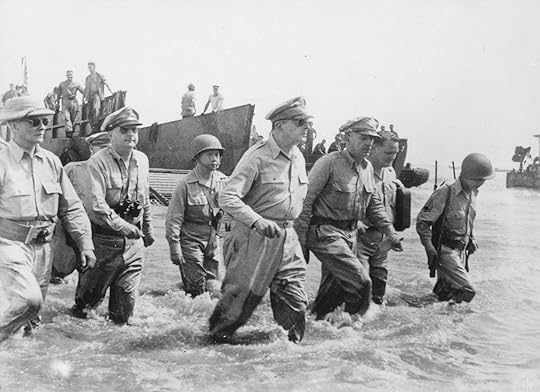
By the end of the campaign, this changed: the Japanese were still starving, naked, and without any supplies or relief in sight, while the U.S. was landing fresh troops every day with plentiful supplies and vast stores of ammo. But the Japanese still didn't surrender, and as the author relates, American GIs became used to General MacArthur or other higher-ups publicly declaring that a battle was "over" or in the "mopping up" phase even while they were still digging Japanese fighters out of the jungles at considerable cost in American lives.
Leyte: The Soldier's Battle, as described by Nathan Prefer, is really many soldiers' battles. This book is a painstaking blow-by-blow, battle-by-battle account of the taking of Leyte, with some of the more famous ones being the Battle of Breakneck Ridge and the Battle of Shoestring Ridge. We get accounts of many, many individual encounters, and the names of men who engaged in acts of heroism, often at the cost of their own lives. Unfortunately, while often thrilling individually, the entire narrative at times felt like the author basically collected all the Silver Crosses and Medals of Honor awarded during the campaign and pasted their descriptions into the narrative one by one, so we get a seemingly endless list of men who fought and died and did valorous things to take a hill or destroy a Japanese machine gun or save a platoon from ambush or cross a river or defend a position, etc. Prefer claims that many larger battles came down to the actions of one man. It seems that many encounters were turned by the initiative of one decisive leader, or by a single hero/lunatic who charged Japanese positions by himself, jumped into their trenches, and started killing people.
After a while, these stories do just seem like reading out a list of medal winners, and there is more of this than analysis of the larger campaign. The reality is that regardless of how well any individual unit or soldier fought, the Japanese on Leyte were doomed from the beginning, as they simply had no more supplies or reinforcements coming, while the Americans had effectively infinite resources to bring in.
Interestingly, this was predicted in the beginning by General Shigenori Kuroda, who was military governor of the Japanese-occupied Philippines. When told of the plan to fight off the approaching Americans, his (accurate) assessment of the situation was that Japan couldn't win, the Americans would inevitably prevail by sheer weight of numbers, and that therefore they should dig in and fight a delaying action while trying to negotiate peace. He was removed from his post for being "defeatist" and recalled to Japan in disgrace.
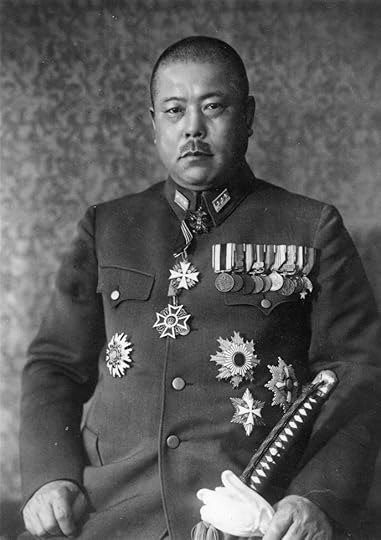
After the war, he fared better than his replacement, General Tomoyuki Yamashita. Both men were arrested and tried for war crimes, but Kuroda, after spending several years in a Philippine prison, was pardoned by the President of the Philippines and allowed to return to Japan. General Yamashita, who had overseen the real fighting in Leyte, was sentenced to death for the atrocities committed by Japanese soldiers, under what is now called the "Yamashita standard," which basically established that even if a commander didn't directly order his men to commit war crimes, he's still responsible if he chose to remain "willfully ignorant" of them.
Prefer does not write very much about the commanders on either side until the end. He talks a bit about MacArther and his gloryhounding, and about General Walter Krueger, whom he considers underrated. Krueger was born in Prussia to a military family and but for an accident of fate - his family emigrating to America when he was a child - he likely would have wound up serving in the Wehrmacht. Instead, he became an American officer in charge of the Sixth Army. MacArther spoke very highly of him, even though he was regarded as "plodding" and cautious by his peers. He had a high regard for his troops, and was known to inspect the feet of solders in the field, and demote or remove from command any COs who'd allowed their men to have inadequate footwear.
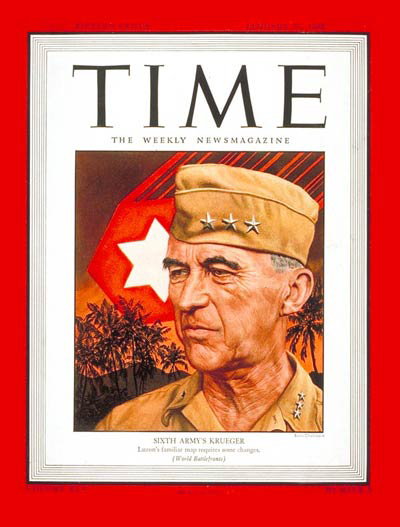
After the war, Krueger suffered one tragedy after another. He was poor and in debt, his wife died of cancer, his son was kicked out of the Army for alcoholism, and his daughter became a mentally ill alcoholic and stabbed her officer husband to death.
He did get a middle school in Texas named after him, though.
Leyte: The Soldier's Battle was a thorough but sometimes repetitive account of an often overlooked aspect of the Pacific campaign, the doughboys fighting in the jungles while the ships and planes got all the glory. It didn't really add much to my knowledge of the Pacific campaign, though the accounts of hard fighting in horrific conditions reinforced just how miserable and ugly the war was for all participants.
By this stage in the war, Japan was running out of literally everything, from ships to oil to men. The Battle of Leyte Gulf was their last hurrah, an all-or-nothing roll of the dice. They were crushed.
If Midway is widely regarded as the turning point in the Pacific theater, Leyte Gulf was the knockout blow. After Leyte, there were still brutal months of fighting ahead, but it was just an inevitable grinding away of the stubborn remnants of Japan's forces.
But this book is not about Leyte Gulf. It's about the Battle of Leyte itself, the amphibious assault on the Philippine island of Leyte. This was General MacArthur's promised return to the Philippines, and the first stage in cutting off Japan's access to the Pacific and laying the groundwork (literally) for an eventual Allied assault on the Japanese home islands. While not as famous as the naval battle (which by some accounts was the largest naval battle in history), the ground battle echoed the sea battle. As at sea, the Japanese decided that stopping the Americans at Leyte was worth an all-or-nothing effort, and poured their best remaining troops in the theater into Leyte. The resulting three months of combat, from October to December of 1944, were as harsh as any seen during the Pacific campaign. While the Japanese, inevitably, were outmanned and outsupplied, they fought ferociously and without surrender. The first American units into Leyte were often poorly supplied themselves, and soldiers on both sides spent weeks foraging for coconuts and roots and hiking through jungles practically naked at times.
By the end of the campaign, this changed: the Japanese were still starving, naked, and without any supplies or relief in sight, while the U.S. was landing fresh troops every day with plentiful supplies and vast stores of ammo. But the Japanese still didn't surrender, and as the author relates, American GIs became used to General MacArthur or other higher-ups publicly declaring that a battle was "over" or in the "mopping up" phase even while they were still digging Japanese fighters out of the jungles at considerable cost in American lives.
Leyte: The Soldier's Battle, as described by Nathan Prefer, is really many soldiers' battles. This book is a painstaking blow-by-blow, battle-by-battle account of the taking of Leyte, with some of the more famous ones being the Battle of Breakneck Ridge and the Battle of Shoestring Ridge. We get accounts of many, many individual encounters, and the names of men who engaged in acts of heroism, often at the cost of their own lives. Unfortunately, while often thrilling individually, the entire narrative at times felt like the author basically collected all the Silver Crosses and Medals of Honor awarded during the campaign and pasted their descriptions into the narrative one by one, so we get a seemingly endless list of men who fought and died and did valorous things to take a hill or destroy a Japanese machine gun or save a platoon from ambush or cross a river or defend a position, etc. Prefer claims that many larger battles came down to the actions of one man. It seems that many encounters were turned by the initiative of one decisive leader, or by a single hero/lunatic who charged Japanese positions by himself, jumped into their trenches, and started killing people.
After a while, these stories do just seem like reading out a list of medal winners, and there is more of this than analysis of the larger campaign. The reality is that regardless of how well any individual unit or soldier fought, the Japanese on Leyte were doomed from the beginning, as they simply had no more supplies or reinforcements coming, while the Americans had effectively infinite resources to bring in.
Interestingly, this was predicted in the beginning by General Shigenori Kuroda, who was military governor of the Japanese-occupied Philippines. When told of the plan to fight off the approaching Americans, his (accurate) assessment of the situation was that Japan couldn't win, the Americans would inevitably prevail by sheer weight of numbers, and that therefore they should dig in and fight a delaying action while trying to negotiate peace. He was removed from his post for being "defeatist" and recalled to Japan in disgrace.
After the war, he fared better than his replacement, General Tomoyuki Yamashita. Both men were arrested and tried for war crimes, but Kuroda, after spending several years in a Philippine prison, was pardoned by the President of the Philippines and allowed to return to Japan. General Yamashita, who had overseen the real fighting in Leyte, was sentenced to death for the atrocities committed by Japanese soldiers, under what is now called the "Yamashita standard," which basically established that even if a commander didn't directly order his men to commit war crimes, he's still responsible if he chose to remain "willfully ignorant" of them.
Prefer does not write very much about the commanders on either side until the end. He talks a bit about MacArther and his gloryhounding, and about General Walter Krueger, whom he considers underrated. Krueger was born in Prussia to a military family and but for an accident of fate - his family emigrating to America when he was a child - he likely would have wound up serving in the Wehrmacht. Instead, he became an American officer in charge of the Sixth Army. MacArther spoke very highly of him, even though he was regarded as "plodding" and cautious by his peers. He had a high regard for his troops, and was known to inspect the feet of solders in the field, and demote or remove from command any COs who'd allowed their men to have inadequate footwear.
After the war, Krueger suffered one tragedy after another. He was poor and in debt, his wife died of cancer, his son was kicked out of the Army for alcoholism, and his daughter became a mentally ill alcoholic and stabbed her officer husband to death.
He did get a middle school in Texas named after him, though.
Leyte: The Soldier's Battle was a thorough but sometimes repetitive account of an often overlooked aspect of the Pacific campaign, the doughboys fighting in the jungles while the ships and planes got all the glory. It didn't really add much to my knowledge of the Pacific campaign, though the accounts of hard fighting in horrific conditions reinforced just how miserable and ugly the war was for all participants.
March 4, 2023
This was a very good book. As I understand it, it is one of the few detailed studies of the Leyte Land Campaign. The land battle for Leyte is often overshadowed by the sea battle and the battles for Manila and Corregidor. Prefer does a great job recounting the battle and describing the individual acts of many of the men who fought in the battle.
I highly recommend this book to anyone who is looking for a solid overview of the Leyte campaign, the re-conquest of the Philippines, or the WWII Pacific Theater.
I highly recommend this book to anyone who is looking for a solid overview of the Leyte campaign, the re-conquest of the Philippines, or the WWII Pacific Theater.

July 20, 2013
Very long on facts about one of the lesser discussed battlefields of the Pacific War, this book is a book for the historian. I did like that the author threw in personal stories about the distinguished soldiers and personal acts of bravery, but this is still a pretty dry book. I would have liked more maps as well, as this battle had quite a few interesting phases and I found myself looking at the larger maps and trying to focus the area they were discussing.

December 20, 2020
The first detailed history I've read of the Leyte campaign, which my father fought in. Typical of the genre, there are lots of small stories that fit together to form the total. When reading these histories it can be easy to lose context as the author skips around in time, place, and action. Prefer does a better job than most in keeping the connections clear, which makes this volume a better read than many of its ilk. Reading it allowed me to trace my father's unit in some detail. I knew much of the story, now I know more.
The Japanese declared Leyte to be the decisive battle and point to its loss as the final fulcrum on which the war's outcome turned. Generally, the U.S. Army gets low marks from historians as compared to the Marines, but that is not the case in this telling. Which is correct? Who knows. I suspect the Marines of Guadalcanal and Iwo Jima will differ that Leyte was the big show, but it was a significant one at least and deserves the treatment it gets here.
The author does not put General Douglas McArthur in favorable light, generally. He is not alone in that, repeatedly holding McArthur accountable for glory seeking and his treatment of subordinate staff. In contrast, General Kreuger, whom McArthur essentially abused, is elevated as a man of courage, principle, integrity, and high competence. Who is correct on this count? Again, we can only surmise, depending upon which telling carries the most weight with us.
This is a solid work which adds to the body of knowledge on an important campaign in the war, about which too little has been written. For the fan of WWII history, the time spent here will be a good investment.
The Japanese declared Leyte to be the decisive battle and point to its loss as the final fulcrum on which the war's outcome turned. Generally, the U.S. Army gets low marks from historians as compared to the Marines, but that is not the case in this telling. Which is correct? Who knows. I suspect the Marines of Guadalcanal and Iwo Jima will differ that Leyte was the big show, but it was a significant one at least and deserves the treatment it gets here.
The author does not put General Douglas McArthur in favorable light, generally. He is not alone in that, repeatedly holding McArthur accountable for glory seeking and his treatment of subordinate staff. In contrast, General Kreuger, whom McArthur essentially abused, is elevated as a man of courage, principle, integrity, and high competence. Who is correct on this count? Again, we can only surmise, depending upon which telling carries the most weight with us.
This is a solid work which adds to the body of knowledge on an important campaign in the war, about which too little has been written. For the fan of WWII history, the time spent here will be a good investment.
August 13, 2017
I discovered that my father was in the 96th Infantry Division "Deadeyes" and was part of the 1944 Leyte "D-Day". I rated this book very high but not everyone may have the same opinion. The book is very detailed regarding Medal of Honor winners and unless you have a specific interest in this and are interested in an account of our struggles to take the Philippines back from the Japanese, you might find the book tedious. I enjoyed reading this account and was also focused on the mention of the 96th Infantry Division. General MacArthur said he would return and he did. In addition to relating our success in this battle, the conditions under which the soldiers fought is described. My father never talked about his time in the Philippines and I was able to get an idea of what he went through.

June 21, 2023
I listened to the audiobook version of this work. This made tracking the overland actions of the units impossible without maps that would be included in the physical or digital book. I went online and found only one that was marginally useful.
A digression: In doing the above I came across a website that had heavily plagiarized this book.
Early on Prefer gives an account of the actions of
Medal of Honor winner Captain Francis B. Wai. He repeatedly describes his ancestry as Japanese, and suffered the mistrust and prejudices attending such a heritage. Yet Wai was Chinese/Hawaiian. He had no Japanese heritage. This seemed so sloppy an error that I found I couldn’t trust the rest of the book for accuracy.
The battle accounts of individual soldiers were impressive, but seemed to be salted in from a list of citations from awards for valor.
A digression: In doing the above I came across a website that had heavily plagiarized this book.
Early on Prefer gives an account of the actions of
Medal of Honor winner Captain Francis B. Wai. He repeatedly describes his ancestry as Japanese, and suffered the mistrust and prejudices attending such a heritage. Yet Wai was Chinese/Hawaiian. He had no Japanese heritage. This seemed so sloppy an error that I found I couldn’t trust the rest of the book for accuracy.
The battle accounts of individual soldiers were impressive, but seemed to be salted in from a list of citations from awards for valor.
October 15, 2023
Good story on the battle on land when most others cover the battle at sea during Leyte.
This entire review has been hidden because of spoilers.
April 18, 2014
Lots of very interesting information on a land battle I knew little about. Fast pace and held my attention. But I was completely without a view and story of the big picture (or larger picture) as the book progressed. If I had read more about this operation I would not have had the problem I did keeping all the small unit operations within a larger frame work. I did enjoy the book
June 2, 2013
Not a bad book about a campaign that should get far more attention then it does. Biggest problem that I had was not nearly enough maps. Author would detail troop movements and locations but the reader often has no map to reference to follow the battle or movenment being written about.

December 2, 2014
An excellent no frills books about Leyte.
Displaying 1 - 12 of 12 reviews