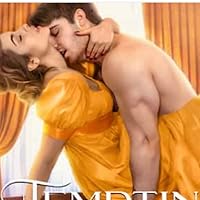
When her fiancT dies, Miss Faith Linden is forced to marry the new Viscount Dewhurst or relinquish her inheritance, and as they embark on a marriage of convenience, love and passion blossoms between them. Original.
Between stints as a corporate financial analyst, marketing consultant and public librarian, Adrienne Basso has parlayed her vivid imagination and desire to tell romantic stories into a twenty-four-year writing career. She has published contemporary, Regency, Victorian, vampire, and Scottish medieval romance novels. She enjoys the challenge of creating stories that emphasize the everlasting power of love and is truly delighted that her characters always achieve the fantasy of living happily ever after. A native New Yorker, Adrienne, her husband, and their incomparable dog now live in New Jersey.
3.5* The writing is pretty decent but this book goes through a bit of an identity crisis - from a piratical bodice-ripper beginning (H and a lush woman indulging in lusty bed-sport) to a tame ton MOC trope to adversarial kitchen politics at home (between two very catty females - the h and his sister) to everyday marital and household routine etc. and more etc. And it's very difficult to picture a satisfactory hea with an alpha hot looking guy and a very plain lookin h. Especially as her gloriously beautiful bff is always in the vicinity. Yes, she's a snarky smart-mouth but still...
In my library loan spreadsheet, where I am free to use subtle fractions, this is rated 2.75 (code for "meh, an inoffensive book I'll never re-read").
The core of the romance is a marriage of convenience in which a second son who has recently inherited his brother's title marries the woman who had been contracted in marriage to the original heir because he misunderstands her declaration that his dead brother "ruined" her (she means financially, because she now cannot meet the terms of her father's will; he -- being something of a manwhore -- assumes she means she is no longer a virgin).
The problem for me is that too many angst-provoking issues are raised without being explored or satisfyingly resolved.
1) The beautiful best friend. When the hero chases to London after the "ruined" heroine, he scours social events looking for her. At one soirée, he is drawn like a magnet to "the most exquisite female creature" he had ever seen, an enchanting blue-eyed blonde. Only after he is addressed by the tiny, brown-haired creature at her side does he realize that the heroine is standing right next to her. As the book progresses, I'm waiting for some kind of undoing of this initial attraction. Instead, the hero taunts the heroine for being jealous when he acknowledges in a later conversation that the best friend is "stunningly beautiful." Then the heroine has to fight her jealousy when guests at their ball comment on what a stunning couple her husband and best friend make on the dance floor.
To be clear, the best friend isn't doing anything but being beautiful and the hero -- upon first meeting her and realizing who she is -- immediately categorizes her as off-limits. But I expect him to make the heroine feel as lovely and desirable. I expect the heroine to gain the confidence not to be jealous AGAIN after the ball when the hero praises the best friend as a "wholly unique woman" for managing her own fortune. What is the point of all of this envy, other than to set up the best friend as the heroine in the next book?
2) The bitter sister-in-law. The elder of the hero's two (younger) sisters is a pill who resents the heroine for having been spoiled and coddled by her wealthy father. She thought the family was well rid of the heroine when the eldest brother died without marrying her, so she is rude and combative from the moment her brother brings the heroine home, challenging the heroine's authority over any domestic arrangements (but particularly those to do with the hero's motherless son). The only response we see from the hero is his occasionally chiding the heroine about the need for domestic harmony. Basically, he doesn't have his wife's back in this battle.
I get it. The book was published in 2001, and heroines are supposed to rescue themselves, not be saved by the patriarchy. But when the heroine argues that she is, after all, the boy's mother, the hero makes a deadly correction that she is his stepmother. He insinuates that, if their marriage fails and he sends her back to her own estate to live, his sister will continue to be responsible for the boy. (Ouch. Don't get attached, heroine.) So I am, again, expecting some future gesture indicating the hero is now firmly on his wife's side on domestic issues. And again, I get nothing.
3) The illegitimate son. The final blow-up between the protagonists comes when the heroine learns from a gossiping villager that her husband's son is a bastard. The heroine is outraged that he hadn't told her the truth, humiliated that his sisters knew when she did not, and hurt by the implication that he hadn't told her because he hadn't trusted her (to...what? not to gossip about the boy? to continue to treat him affectionately?). The lack of clarity around his concerns is part of the problem, because without knowing how badly he thought of the heroine, he can't -- and doesn't -- properly apologize for mistrusting her.
So the hurt and angry heroine returns to her neighboring estate for some alone time and the hero woos her back with a mere 7 days' courtship and a declaration that though he didn't love her when they wed-- didn't even want to be married to her at all (always something you want to hear during a declaration of love) -- he loves her now.
While I liked the premise of the book, it fell kind of flat to me. I liked the hero and heroine well enough but the hero disappointed me a few times and I don't like that in my heroes. I enjoyed the second half of the book better than the first, so I was glad I kept reading until the end. The Hero made his way back into my good opinion.
I really didn’t like the hero in this one. The conflict felt forced. Probably the only one in the series I didn’t love. Also Harriet has become such an unlikeable character that I don’t want to read her story.
I love a marriage of convenience and then they accidentally fall in love theme! But this had too many downers about it that took the fluff and good feels right out of it for me.
First, I understand that the heroine does not always need to be a gorgeous bombshell. But to constantly repeat how plain-looking and undesirable the heroine is, while the hero is a Greek god reincarnated... in feels like an uneven match. So instead of feeling hopeful for a HEA, I end up feeling pity for our heroine that she must stand next to her beautiful friend and hubby and always feel to be sorely lacking.
Secondly, the hero's sister Harriet. What a piece of work. She was nasty from the get-go and she didn't let up. There are enough nasty wenches in our daily lives, and I don't enjoy reading about them.
So the more I read, the less I felt like picking the book back up to start reading again. Bummer.
This was a promising story which the author chose not to develop. She chose instead to pad the pages and word count with explicit sex. Amazon should have a separate section for Recency pornography, or, at the very least, require the author to advise whether the book contains explicit sex.
Not predictable except the happy ending! Memorable characters. Great conflict and interesting setting with wonderful ancillary characters. Can't t wait to read Merry's story!
Griffin is a 2nd son so he made it on his own with a shipping company he built. He finds himself a Viscount after his father and brother die but he does not plan on returning to England to claim it until he brought a young lad and told that it is his son and the mother has died.
Faith was to marry Neville, Griffin's older brother. After a seven year engagement it never happened and then Neville died. Faith's father made a specific will though and if she did not marry the Viscount she would lose her home.
Fairly good start but then it all went downhill quickly once they married. The hero was insufferable and unkind and there were far too romantic interactions for too long that reading became a slog.