

What do you think?
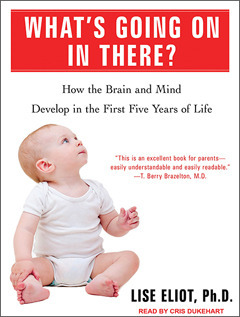
What's Going on in There? How the Brain and Mind Develop in the First Five Years of Life
As a research neuroscientist, Lise Eliot has made the study of the human brain her life's work. But it wasn't until she was pregnant with her first child that she became intrigued with the study of brain development. She wanted to know precisely how the baby's brain is formed, and when and how each sense, skill, and cognitive ability is developed. And most importantly, she was interested in finding out how her role as a nurturer can affect this complex process. How much of her baby's development is genetically ordained—and how much is determined by environment? Is there anything parents can do to make their babies' brains work better—to help them become smarter, happier people? Drawing upon the exploding research in this field as well as the stories of real children, What's Going On in There? is a lively and thought-provoking book that charts the brain's development from conception through the critical first five years. In examining the many factors that play crucial roles in that process, What's Going On in There? explores the evolution of the senses, motor skills, social and emotional behaviors, and mental functions such as attention, language, memory, reasoning, and intelligence. This remarkable book also discusses:
how a baby's brain is "assembled" from scratch
the critical prenatal factors that shape brain development
how the birthing process itself affects the brain
which forms of stimulation are most effective at promoting cognitive development
how boys' and girls' brains develop differently
how nutrition, stress, and other physical and social factors can permanently affect a child's brain
Brilliantly blending cutting-edge science with a mother's wisdom and insight, What's Going On in There? is an invaluable contribution to the nature versus nurture debate. Children's development is determined both by the genes they are born with and the richness of their early environment. This timely and important book shows parents the innumerable ways in which they can actually help their children grow better brains.
how a baby's brain is "assembled" from scratch
the critical prenatal factors that shape brain development
how the birthing process itself affects the brain
which forms of stimulation are most effective at promoting cognitive development
how boys' and girls' brains develop differently
how nutrition, stress, and other physical and social factors can permanently affect a child's brain
Brilliantly blending cutting-edge science with a mother's wisdom and insight, What's Going On in There? is an invaluable contribution to the nature versus nurture debate. Children's development is determined both by the genes they are born with and the richness of their early environment. This timely and important book shows parents the innumerable ways in which they can actually help their children grow better brains.
Audiobook
First published January 1, 1999
About the author
Lise Eliot
4 books22 followersLise Eliot is a mother of three, and the Associate Professor of Neuroscience at The Chicago Medical School of Rosalind Franklin University. She is the author of What’s Going On In There? How the Brain and Mind Develop in the First Five Years of Life.
Ratings & Reviews
Friends & Following
Create a free account to discover what your friends think of this book!
Community Reviews
Displaying 1 - 30 of 270 reviews

January 20, 2009
Fascinating read! A few interesting things I learned:
* The flavor of your breast milk changes depending on what you eat.
* For optimal language development, it's important to have conversations with even young infants. You can do this with face-to-face contact and taking turns so your child gets to hear you speak but also gets a chance to practice herself. Even babies need to know that they are being addressed *and* that they are being heard.
* Sensitive parenting can improve a child's temperament. This means being aware of a baby's signals and responding promptly to her needs. And no matter how busy you are, they should feel that you are available and not ignoring them.
* Babies prefer novelty--new places, toys, experiences. It helps their brains grow.
* Daily infant massage improves a baby's motor skills development.
I like how the author structures each chapter--starting with the biology up front and then ending with how you can encourage that particular area of development, whether it's a sense, motor skills, social-emotional growth, memory, language, or intelligence. (I have to admit that I skipped over some of the biological details, and that structure made it easy for me to do that!
The book did leave me with a few unanswered questions. For example, I wanted to know what impact baby sign language has on overall language development. And the author mentions that children in bilingual homes start talking later, but she didn't talk about the optimal age for starting to introduce a second language.
But I would highly recommend this book to any parent interested in how their child's mind is developing.
* The flavor of your breast milk changes depending on what you eat.
* For optimal language development, it's important to have conversations with even young infants. You can do this with face-to-face contact and taking turns so your child gets to hear you speak but also gets a chance to practice herself. Even babies need to know that they are being addressed *and* that they are being heard.
* Sensitive parenting can improve a child's temperament. This means being aware of a baby's signals and responding promptly to her needs. And no matter how busy you are, they should feel that you are available and not ignoring them.
* Babies prefer novelty--new places, toys, experiences. It helps their brains grow.
* Daily infant massage improves a baby's motor skills development.
I like how the author structures each chapter--starting with the biology up front and then ending with how you can encourage that particular area of development, whether it's a sense, motor skills, social-emotional growth, memory, language, or intelligence. (I have to admit that I skipped over some of the biological details, and that structure made it easy for me to do that!
The book did leave me with a few unanswered questions. For example, I wanted to know what impact baby sign language has on overall language development. And the author mentions that children in bilingual homes start talking later, but she didn't talk about the optimal age for starting to introduce a second language.
But I would highly recommend this book to any parent interested in how their child's mind is developing.

September 11, 2008
I thought the idea of this book sounded great--learn how to be a better parent based on the science of brain development. However, I would argue there is not much science here. Yes, the stuff about sensory development is fine and well-supported, but the rest of the stuff (about intelligence and emotional development, for example) is total bunk. Much of it is based on behavioral psychology experiments in infants, which I find very unconvincing. I know this is the best that can be done in such young children, but any conclusions based on these experiments seem way too speculative to believe.
Another caveat: if you happen to have a preemie, don't read this book. According to the author, your child will forever be behind other children his/her age without having had full time in the womb. Having a preemie is heartbreaking, and it is even worse being told--based on questionable studies--that your child will never live up to his/her full potential.
Also, this book--the title--says it is about the first 5 years of life, but it really is focused on prenatal development and the first year or two, so if you think you're going to learn a lot about your 4 year old, forget it.
I gave it 2 stars (instead of 1) because I did think the author did a good job of making a pretty dry subject come to life. Still, it took me a while to get through this. Read a fun novel instead.
Another caveat: if you happen to have a preemie, don't read this book. According to the author, your child will forever be behind other children his/her age without having had full time in the womb. Having a preemie is heartbreaking, and it is even worse being told--based on questionable studies--that your child will never live up to his/her full potential.
Also, this book--the title--says it is about the first 5 years of life, but it really is focused on prenatal development and the first year or two, so if you think you're going to learn a lot about your 4 year old, forget it.
I gave it 2 stars (instead of 1) because I did think the author did a good job of making a pretty dry subject come to life. Still, it took me a while to get through this. Read a fun novel instead.

March 17, 2011
(4.5) Great stuff, going to try to condense it a bit so it's actually accessible/actionable
Very well presented book covering mental development from conception to pre-school age. She breaks development down into several tracks: each of the senses, as well as motor, social/emotional, language, memory and "intelligence" development. She frequently cites studies in humans and animals to back her arguments, and I actually plan to track down a few of them to see if there have been more recent publications. Definitely more appropriate for the nerdier parents-to-be out there....
In each of these developmental 'tracks', she begins with neural development, explains how these results in functional development, and finally makes recommendations for parents on how to best encourage their child's proper development. These are often very specific and helpful recommendations, though once or twice she says "doing X is good, but don't do too much", leaving it up to us to decide just how much is too much. But on the whole, her recommendations are quite actionable.
Finally, she ends with a chapter on how to make your baby smarter, which is what we're all reading this for, right? It's a much higher level chapter than the previous chapters, and tries to sum it all up a bit. It's good motivation, but the earlier chapters are much more practical and specific, so I'll be referring back to those more often.
Now that I've read the full text, I plan to try to reduce the results and suggestions to a more concise form for reference (I recommend you take notes as you go; it's quite a hefty text). I can refer back to the neural development bits if I need to, though that seems a little less relevant to child-rearing when it's actually happening. I do like the way she separated development into tracks, but I'd like to find a way to depict development chronologically as well as functionally...showing each track over time and show which developmental steps overlap chronologically. But even if I don't get to this, I feel much better prepared for being a nurturing, responsive, involved and demanding parent (see pp. 452-455).
Very well presented book covering mental development from conception to pre-school age. She breaks development down into several tracks: each of the senses, as well as motor, social/emotional, language, memory and "intelligence" development. She frequently cites studies in humans and animals to back her arguments, and I actually plan to track down a few of them to see if there have been more recent publications. Definitely more appropriate for the nerdier parents-to-be out there....
In each of these developmental 'tracks', she begins with neural development, explains how these results in functional development, and finally makes recommendations for parents on how to best encourage their child's proper development. These are often very specific and helpful recommendations, though once or twice she says "doing X is good, but don't do too much", leaving it up to us to decide just how much is too much. But on the whole, her recommendations are quite actionable.
Finally, she ends with a chapter on how to make your baby smarter, which is what we're all reading this for, right? It's a much higher level chapter than the previous chapters, and tries to sum it all up a bit. It's good motivation, but the earlier chapters are much more practical and specific, so I'll be referring back to those more often.
Now that I've read the full text, I plan to try to reduce the results and suggestions to a more concise form for reference (I recommend you take notes as you go; it's quite a hefty text). I can refer back to the neural development bits if I need to, though that seems a little less relevant to child-rearing when it's actually happening. I do like the way she separated development into tracks, but I'd like to find a way to depict development chronologically as well as functionally...showing each track over time and show which developmental steps overlap chronologically. But even if I don't get to this, I feel much better prepared for being a nurturing, responsive, involved and demanding parent (see pp. 452-455).
September 15, 2012
I'll start off by saying that I loved this book! It's been by my bedside since before my son was born, and from hereon since his birth I'll continue to refer back to it. But, it's precisely because I found it such a useful read that it's short-comings seem to stand out so prominently for me.
I didn't mind the textbook nature of this book, which I found useful for jumping to and fro reading up on sections about certain developmental aspects of babies, but I did have a few gripes with the book:
1. There is no chronological listing of a baby's development; I think this would have strengthened the book as a one-stop shop on all things to do with a baby's development that the reader could readily refer to and it would have softened all the detailed neurological and biological descriptions (which is somewhat hard going at times).
2. There are some notable absences in this book: The so-called "fencing" pose (tonic neck reflex) is barely touched on and not directly mentioned -- which is something I wanted to know more about as a parent watching my 4-month old strike these curious Usain Bolt-like victory poses; and I can't find any references to blowing bubbles (a sign babies are taking their first steps to attempt to talk).
3. As someone who doesn't worry day and night whether my son will grow to be at the top of his class at school, I found the emphasis on IQ and intelligence a little tiresome. Of course, I was interested in the various experiments carried out with young children of different ages that help shed light on what I can expect my son to go through. But if you've made it to Chapter 17 on how to raise a smarter kid, I'm inclined to think that you're already a parent who values the importance of reading books and education, and that will matter a whole lot more than your child's performance on IQ tests. (Is this aspect of the book a reflection of present-day paranoia parents have towards their kids' schooling that I'm unaware of?)
I didn't mind the textbook nature of this book, which I found useful for jumping to and fro reading up on sections about certain developmental aspects of babies, but I did have a few gripes with the book:
1. There is no chronological listing of a baby's development; I think this would have strengthened the book as a one-stop shop on all things to do with a baby's development that the reader could readily refer to and it would have softened all the detailed neurological and biological descriptions (which is somewhat hard going at times).
2. There are some notable absences in this book: The so-called "fencing" pose (tonic neck reflex) is barely touched on and not directly mentioned -- which is something I wanted to know more about as a parent watching my 4-month old strike these curious Usain Bolt-like victory poses; and I can't find any references to blowing bubbles (a sign babies are taking their first steps to attempt to talk).
3. As someone who doesn't worry day and night whether my son will grow to be at the top of his class at school, I found the emphasis on IQ and intelligence a little tiresome. Of course, I was interested in the various experiments carried out with young children of different ages that help shed light on what I can expect my son to go through. But if you've made it to Chapter 17 on how to raise a smarter kid, I'm inclined to think that you're already a parent who values the importance of reading books and education, and that will matter a whole lot more than your child's performance on IQ tests. (Is this aspect of the book a reflection of present-day paranoia parents have towards their kids' schooling that I'm unaware of?)
January 4, 2012
Four-month olds who are physically reactive (pumping limbs) but not irritable to new stimuli (like smiling or vocalizing) are likelier to end up on the bolder end of the spectrum. -What's going on in there, p. 321
Challenging memory is good for them. Get them to recall the important facts - the who, what , when, where, how, and why. -p. 350
Infants' ability to distinguish foreign speech sounds starts to diminish by 6 months - p.368
Try to limit saying "no"
Talk to and read to baby A LOT
Language explodes once a child knows about 50 words. Then they learn as much as 8 new words a day - p 373
Don't correct too many grammatical mistakes - they'll figure it out on their own
Fowler method of enhancing verbal skills: preview each stage of verbal development before baby has entered it. (from birth: Vocalization play - phonemes, syllables, and syllable combos. 3 months: labeling play - name objects, then start including prepositions, adj, adv, pronouns. 9 months: phrase and sentence play, using substitution and expansion of sentences. 14 months: Theme play - engage in conversations
Keep language simple, clear and positive when talking to your baby
use repetitive phrases, rhymes, etc, but use substitution and expansion to make a game out of it and prevent it from getting boring
LISTEn to your child, have conversations. Babies like to be imitated.
Eight month olds have trouble inhibiting(due to immaturity of prefrontal cortex). For example, when a hidden prize is switched from the left to right option, the baby knows it's in the right (looks there) but arm still reaches for the left where it was previously (procedural memory). This changes by 11-12 months. p. 409
Piaget - same amount of water, two different glasses. Four year olds can't understand, eight year olds have no problem. This is because reasoning beings to occur around age 6. p415
Best parenting: highly nurturing (physically affectionate, emotionally supportive), very involved (spending time in shared activities), responsive (accepting individuality, consulting them to help solve problems), but also rather demanding (expeciting mature behavior and independence, setting clear standards and rules and enforcing them)
Challenging memory is good for them. Get them to recall the important facts - the who, what , when, where, how, and why. -p. 350
Infants' ability to distinguish foreign speech sounds starts to diminish by 6 months - p.368
Try to limit saying "no"
Talk to and read to baby A LOT
Language explodes once a child knows about 50 words. Then they learn as much as 8 new words a day - p 373
Don't correct too many grammatical mistakes - they'll figure it out on their own
Fowler method of enhancing verbal skills: preview each stage of verbal development before baby has entered it. (from birth: Vocalization play - phonemes, syllables, and syllable combos. 3 months: labeling play - name objects, then start including prepositions, adj, adv, pronouns. 9 months: phrase and sentence play, using substitution and expansion of sentences. 14 months: Theme play - engage in conversations
Keep language simple, clear and positive when talking to your baby
use repetitive phrases, rhymes, etc, but use substitution and expansion to make a game out of it and prevent it from getting boring
LISTEn to your child, have conversations. Babies like to be imitated.
Eight month olds have trouble inhibiting(due to immaturity of prefrontal cortex). For example, when a hidden prize is switched from the left to right option, the baby knows it's in the right (looks there) but arm still reaches for the left where it was previously (procedural memory). This changes by 11-12 months. p. 409
Piaget - same amount of water, two different glasses. Four year olds can't understand, eight year olds have no problem. This is because reasoning beings to occur around age 6. p415
Best parenting: highly nurturing (physically affectionate, emotionally supportive), very involved (spending time in shared activities), responsive (accepting individuality, consulting them to help solve problems), but also rather demanding (expeciting mature behavior and independence, setting clear standards and rules and enforcing them)
November 27, 2010
Pfew! I started this book around 3 weeks after my baby was born and finally finished it now as she is reaching 3.5 months.
Still, I thought it was a wonderfully written and highly informative book. I recommend it to anyone over, say, a parenting style book.
The only thing I felt was left out was any mention of sleep pattern. Since our little lady loves to fight sleep with every bit of strength I'm left wondering how sleep patterns develop and what effects sleep have on the brain, especially in infancy.
Still, I thought it was a wonderfully written and highly informative book. I recommend it to anyone over, say, a parenting style book.
The only thing I felt was left out was any mention of sleep pattern. Since our little lady loves to fight sleep with every bit of strength I'm left wondering how sleep patterns develop and what effects sleep have on the brain, especially in infancy.

December 8, 2021
Lots of info, but quite dated at this point, making it hard to tell what info you should actually trust. I took it as a good basic look at things, but not much more. Also, it is excessively long.

March 15, 2008
This book breaks down how the brain develops in babies and small children into chapters on the 5 senses, movement and balance, social and emotional development, language, conscience and a sense of right/wrong and consequences, and intelligence. It details where in the brain these elements of consciousness reside and how the mature, both neurologically and developmentally. It's fascinating subject matter, whether or not you have a baby, and the author makes it accessible to a lay-person without too much dumbing down. Eliot also sheds light on what happens when parts of the brain are not working properly, as with a brain injury or stroke. Bonus information I picked up from the book: If you do have a baby, and you have sworn loudly or lost your temper in front of the baby, you can rest easy knowing that THEY WON'T REMEMBER IT until they're two years old or so -- the part of their brain that stores memories doesn't develop enough to hold onto them before then. If I had to make a one word summary of the most important thing in the book: Breastfeed.

December 20, 2024
I loved this book- much more detailed than anything I’ve read about childrens’ development. I learned a lot and it made me think about things to focus on with our kids. Mostly I feel comforted that our kids have a great place in life- they are loved and have what they need. They will not be geniuses but that isn’t the purpose of life anyway.
I liked that the author goes through what’s good plus what’s missing about the research
I disliked the frequent reference to “our primate relatives” and “our hunter gatherer ancestors”. Why not stick to the known facts?
Fun facts:
Exercise reduces cortisol levels
Women who exercise during pregnancy had half the length of pushing stage as those who didn’t (27m vs 59m) and perceive labor as less painful. Shorter labors are better for the baby
Babies can’t hear very well
Tummy time because babies who sleep on their backs have delayed motor milestones
Stepping reflex goes away simply because the legs become too heavy
Nature creates a different kind of nurture
Language is an instinct as innate and inevitable as sleeping and eating
Kids are best able to learn language by age 4, and this decreases until age 17. Grammar is particularly affected when learning a language later
Typically a 5 month lag between understanding and speaking a word
Children intuitively learn grammar and don’t have to be taught (because they are designed that way)
Smarter people burn less glucose in their brain while completing the same task than dumber people
Fraternal twins have a more similar IQ than siblings, the womb is a very important place!
I liked that the author goes through what’s good plus what’s missing about the research
I disliked the frequent reference to “our primate relatives” and “our hunter gatherer ancestors”. Why not stick to the known facts?
Fun facts:
Exercise reduces cortisol levels
Women who exercise during pregnancy had half the length of pushing stage as those who didn’t (27m vs 59m) and perceive labor as less painful. Shorter labors are better for the baby
Babies can’t hear very well
Tummy time because babies who sleep on their backs have delayed motor milestones
Stepping reflex goes away simply because the legs become too heavy
Nature creates a different kind of nurture
Language is an instinct as innate and inevitable as sleeping and eating
Kids are best able to learn language by age 4, and this decreases until age 17. Grammar is particularly affected when learning a language later
Typically a 5 month lag between understanding and speaking a word
Children intuitively learn grammar and don’t have to be taught (because they are designed that way)
Smarter people burn less glucose in their brain while completing the same task than dumber people
Fraternal twins have a more similar IQ than siblings, the womb is a very important place!

March 1, 2024
The good: clear, detailed discussion of both physical and cognitive developmental milestones and their neurological underpinnings, with thoughtful discussion of genetic vs. environmental influences.
The bad: gets very dense/dry on some of the discussion of actual brain physiology/chemistry in ways that don’t add much for the book’s ostensible audience (parents with greater than normal curiosity about the science behind their kids’ development). No longer quite up to date in a variety of ways, in 2024. Uncharacteristic sections that feel much more editorial and have less supporting evidence in the text (especially re: breastfeeding’s benefits).
I have a hard time skimming books, but I think that’s what I’d recommend with this one, since it is a good resource but also a bit of a slog.
The bad: gets very dense/dry on some of the discussion of actual brain physiology/chemistry in ways that don’t add much for the book’s ostensible audience (parents with greater than normal curiosity about the science behind their kids’ development). No longer quite up to date in a variety of ways, in 2024. Uncharacteristic sections that feel much more editorial and have less supporting evidence in the text (especially re: breastfeeding’s benefits).
I have a hard time skimming books, but I think that’s what I’d recommend with this one, since it is a good resource but also a bit of a slog.
September 27, 2022
Excellent read as a new parent wanting to go a level deeper on the why behind a lot of common recommendations. Language section was a highlight - a great analysis of the anatomy/neuroscience and it’s practical implications.
I think the best way to read this book is to focus on the sections most interesting to you. Skim the rest.
Disagreed on author’s take on breastfeeding studies.
I think the best way to read this book is to focus on the sections most interesting to you. Skim the rest.
Disagreed on author’s take on breastfeeding studies.
December 3, 2022
While this book is an amazing overview of a child’s developmental stages and gives plenty of insight to its main topic, it is fundamentally marred by some uses of data that are flawed at best and dangerous at worst - eg breastmilk linked to higher IQ (debunked by Emily Oster), or higher socio economic status parents having genetically superior functioning brains.

January 30, 2020
In an effort to find something a little more scientific than the myriad parenting books full of author opinion, I found this gem that discusses the brain development of babies and kids. It was honestly more scientific than my mommy brain can fully absorb, but it was super interesting.
July 7, 2025
Good primer on brain development and basic brain function. Coupled with practical parenting implications. Well-written and clear. Biggest takeaways are critical periods for optimal acquisition of certain types of skills and knowledge and cumulative nature of learning.
April 9, 2021
Nice review of studies on baby development. Not a how to but more how it works. I wish it had been organized by age rather than by types of development.

March 31, 2024
Really interesting. The last few chapters, about IQ, feel to me like they are out of date, so I just didn’t read them. Problem solved.
September 24, 2019
Very science-y, but written in a way that a non scientist can access. Was expecting more parenting tips, but only a tiny bit about that at the end.

July 2, 2026
Me pareció un libro extraordinario, tanto por la amplitud de temas cubiertos como por la sencillez en su explicación, apta para una audiencia sin educación médica o psicológica. Leí este libro porque me interesaba aprender sobre el desarrollo cognitivo de los bebés, y el libro superó mis expectativas con creces. El libro contiene capítulos que explican cómo funciona el cerebro humano (no es más que neuronas transmitiendo pulsos eléctricos), cómo se desarrolla cada uno de nuestros cinco sentidos y qué es la inteligencia, entre otros. Cada uno de estos capítulos explica cómo se desarrollan nuestras facultades desde la etapa prenatal hasta los 5 años, y las diferencias entre los dos sexos durante este desarrollo. Me pareció fascinante y aprendí muchas cosas que espero me ayuden a ser mejor papá.

February 8, 2022
I learned a lot from this read but it was a bit of a slog for me, especially in the first half. I didn’t find this writing as accessible as I had hoped but I don’t fault the author - she had to lay some important but dry ground work. I’d love to see an updated version with more recent studies and research. But I will be taking a lot of what I learned into my own parenting journey!

March 6, 2014
When I became pregnant with my first (and probably only) child, I wanted to know everything - and then became frustrated at the quality and oft-contradictory advice given to pregnant women. Most books or their online version were patronizing, if not downright condescending (*cough* What to Expect When You're Expecting *cough*), and the more literary, science-based guides were either awash in technical lingo or a mere blurb of the study in question. I wish I'd found this book then, but I'm glad I found it now (7+ months into this life-changing experiment known as parenthood).
Eliot, who is a scientist by trade, manages to convey large chunks of information without getting too bogged down in technical jargon or otherwise carried away by individual studies, which makes the science inherent in this book very accessible. She also minimizes the anecdotal segments, which I prefer for this type of a book. If I want to learn, I prefer hard data, not someone's sister's experience (and then I question whether the person named is even really a person, or a complete fiction dreamt up to illustrate a specific point or bias). There's a LOT of useful information in this book, but it is not all-inclusive - nor do I think it was intended to be. This is a good book for a layperson, albeit one who is not completely sleep-deprived and struggling to concentrate on basic tasks.
I think most people who are inclined to read books about early childhood development won't be surprised at Eliot's takeaways, but I think the science and studies behind those findings are interesting. That being said, the biggest takeaway is something we've all heard before, but it bears repeating: "The fact is that children pick up much more than mere cognitive skills from their parents and other caregivers. They also learn how to work, share, love, nurture, juggle, and enjoy life. Once again, it is the model we set, rather than the specific teaching we attempt, that is going to have the biggest impact on a child's cognitive abilities and success in life."
Eliot, who is a scientist by trade, manages to convey large chunks of information without getting too bogged down in technical jargon or otherwise carried away by individual studies, which makes the science inherent in this book very accessible. She also minimizes the anecdotal segments, which I prefer for this type of a book. If I want to learn, I prefer hard data, not someone's sister's experience (and then I question whether the person named is even really a person, or a complete fiction dreamt up to illustrate a specific point or bias). There's a LOT of useful information in this book, but it is not all-inclusive - nor do I think it was intended to be. This is a good book for a layperson, albeit one who is not completely sleep-deprived and struggling to concentrate on basic tasks.
I think most people who are inclined to read books about early childhood development won't be surprised at Eliot's takeaways, but I think the science and studies behind those findings are interesting. That being said, the biggest takeaway is something we've all heard before, but it bears repeating: "The fact is that children pick up much more than mere cognitive skills from their parents and other caregivers. They also learn how to work, share, love, nurture, juggle, and enjoy life. Once again, it is the model we set, rather than the specific teaching we attempt, that is going to have the biggest impact on a child's cognitive abilities and success in life."
June 25, 2014
There is a lot to like about this book, but there are also some drawbacks. First, it covers a wider span of time than a lot of books, going from conception until five years (though really, except for a bit at the end, it doesn't go much past three). Some of the information was quite interesting, particularly the things that were directly related to the author's focus on neuroscience. There were a lot of behavioral studies used that seemed somewhat flimsy. Additionally, particularly when the topic of gender differences came up, a lot of the ideas built upon one another without clearly establishing the validity of the statements first. One particularly egregious part mentioned that studies might show that something could be true, then went on to treat that statement as fact. Quite a lot of "It is known" statements came up, which do little to help the author's credibility. Still, I did appreciate that the author emphasized that the differences between genders are smaller than the differences within genders. In addition to that, this book is about fifteen years old, so neuroscience has most likely made significant advances since then. Still, it's rather well written, and at least tries to make an effort at gender inclusion, which is particularly significant for the time, and it does a good job of explaining how the nervous system works and develops to a general audience. In addition, the narration was much better done than some other baby-related audiobooks I have recently heard. Overall, this is probably a good companion to other books on pregnancy and child development.
March 28, 2011
This book is a fantastic review of information re neurological/psychological developoment of infants and young children. It covers everything from sensory and motor development to emotional development and gives useful, research-driven tips about how to foster development across all areas.
Eliot has a great style that makes the research accessible without dumbing it down too much for the general audience. She mixes stories about hypothetical kids and tidbits from her own experience as a mother with descriptions of research studies and what the literature currently indicates. The information about emotional and intellectual development were somewhat familiar to me and I found all the information consistent with what I recall learning in bygone years.
I only wish I had read this book prior to getting pregnant since a fair fraction of the factors influencing development happen during gestation, but at least I got through it relatively early in my kid's life.
Eliot has a great style that makes the research accessible without dumbing it down too much for the general audience. She mixes stories about hypothetical kids and tidbits from her own experience as a mother with descriptions of research studies and what the literature currently indicates. The information about emotional and intellectual development were somewhat familiar to me and I found all the information consistent with what I recall learning in bygone years.
I only wish I had read this book prior to getting pregnant since a fair fraction of the factors influencing development happen during gestation, but at least I got through it relatively early in my kid's life.
November 13, 2009
This book struck a good balance between presenting the science of brain development and practical matters that parents should think about with respect to the developing brains in their children. In particular, Eliot does a great job of describing the studies and how researchers were able to determine preferences in children. For instance, they've learned things about newborns by hooking up a pacifier to a machine that plays a tape of mom's voice if the baby sucks at one rate, and a stranger's voice if the baby sucks at another rate. And they find that the baby will suck at the rate that keeps mom's voice playing! I also liked that there were moments when Eliot perfectly captured the feelings I have towards my baby.

Did Not Finish
July 14, 2019It started out with a very interesting premise - a neuroscience nerd has a kid and decides to investigate how that kid's brain develops, which sh then decides to share with the reader using layman's terms. Then the laymen part disappeared and all that was left was a lot of science - which is great - if you want to be or are a scientist, ideally one in the field of neurology. For a non-neurologist/neuro scientist, this book is a plod. There are a few very interesting studies and insights that can be gleaned, but then they become farther and fewer between. At one point I was skimming through a detailed description of how the brain processes some input or other, looking for that "so what" part, but there wasn't any. Guess she decided to skip those as well in the later parts.

September 11, 2013
I read this a few years ago, out of pure curiosity of the brain and how it works. I might not be a parent, but have spent a huge majority of my life around children.
It was a fascinating read, I loved that it was written to the "normal" person. You do not have to be incredibly scientific to understand.
I loved being able to take my observations from childcare and realizing why young ones do the things they do. Even putting things in their mouth is for the purpose of figuring things out.
I wouldn't say this is a parenting book by any means, but if you like cognitive science or are a parent or work with kids, this book is very informative.
It was a fascinating read, I loved that it was written to the "normal" person. You do not have to be incredibly scientific to understand.
I loved being able to take my observations from childcare and realizing why young ones do the things they do. Even putting things in their mouth is for the purpose of figuring things out.
I wouldn't say this is a parenting book by any means, but if you like cognitive science or are a parent or work with kids, this book is very informative.

February 1, 2020
It was a good review of some older studies. And I also did learn a lot.I love studying children's brains but if you are a parent or teacher looking for ways to understand how children's brains work, this book, while it has a lot of valuable information, is slightly outdated since neuroscience has evolved so much in the last 20-30 years. (for example, it never mentions what we now know about how damaging television is to a baby's brain development and it even almost encourages it)
There are more modern books by great neuroscientists like John Medina or Daniel J. Siegel for a more up to date view.
There are more modern books by great neuroscientists like John Medina or Daniel J. Siegel for a more up to date view.

January 16, 2013
This is a must read for all parents! My doula/good friend gave it to me the day I came home from the hospital and it was my bedside companion for the first few months of being a mother. It helped get me thinking about the baby as a person that would some day speak to me! It helped me to understand many of the developmental stages he was going through and I now use it often as a go to reference. I skimmed some of the lengthy parts that detailed studies I wasn't interested in but most information was universally useful & applicable. So good!

January 21, 2010
Fascinating. A scientific take on the nature/nurture debate, as well as an intricate explanation of how the major parts of the brain develop from conception on. Easy to follow, even for someone whose last science class was about ten years ago, and so interesting. Cool factoid: humans are actually getting smarter -- each generation has scored better on IQ tests (an admittedly fallible and questionable measure of intelligence) than the previous generation.

December 12, 2019
This book does try to be accessible but it does it through weird narratives that at least in the audio version come off as cheesy and out of place. Other reviewers have mentioned, I thought there would be a lot more information about after infancy but it pretty much stops there. I gave it 3 stars because it does provide a lot of good information for prenatal and first 2 years. It backs up the information with studies and talks about the significance of the data which is helpful.

October 7, 2012
I read this a few years ago and really liked learning about how the brain develops during pregnancy and shortly afterwards. A lot of fascinating, complicated processes really! I wasn't too keen on her referring to numerous animal studies---so I skimmed quickly over those. The biology is super interesting and at the end she gives some suggestions to parents about maximizing brain development.
Displaying 1 - 30 of 270 reviews