

What do you think?

Nancy: The Story of Lady Astor
A new biography of Nancy Astor, American socialite and social crusader who blazed a trail through British society amid two World Wars In 1919, Nancy Astor became the first female Member of Parliament elected to the House of Commons―she was not what had been expected. Far from a virago who had suffered for the cause of female suffrage, Lady Astor was already near the center of the ruling society that had for so long resisted the political upheavals of the early twentieth century, having married into one of the richest families in the world. She wasn't even British, but the daughter of a famous Virginian family, and fiercely proud of her expatriate ancestry. But her moral drive was strong, and she would utilize her position of privilege and influence to blow a bracing American wind into what she regarded as the stuffy corners of British politics. This account charts Nancy Astor's incredible story, from relative penury in the American South to a world of enormous countryside estates and townhouses, and the most lavish entertainments, peopled by the great figures of the day―Churchill, Chamberlain, FDR, Charlie Chapin, J. M. Barrie, and Lawrence of Arabia were all part of her social circle. But hers was not to be an easy life of power and pure glamour; it was also defined by principles and bravery, war and sacrifice, love, and the most embittered disputes. With glorious, page-turning brio, Adrian Fort brings to life this restless, controversial American dynamo, an unforgettable woman who left a deep and lasting imprint on the political life of a nation.
400 pages, Hardcover
First published October 1, 2012
About the author
Adrian Fort
5 books3 followersAdrian Fort was educated at Oxford, where he was a Clarendon Fellow. He practiced as a lawyer and became involved with politics before pursuing a financial career.
Ratings & Reviews
Friends & Following
Create a free account to discover what your friends think of this book!
Community Reviews
Displaying 1 - 30 of 48 reviews

October 21, 2012
Nancy was one of the many Americans whose family desired that they have a title. Most of the girls who married into aristocracy had family money, she did too, but not the endless riches that made them so attractive to the Dukes and Lords of the day. Nonetheless, she was shipped off to England after having made a pretty bad first marriage and she duly married into fame, fortune and a title.
In some ways she was a great lady who achieved much as the first female Member of Parliament, but the book was soured by my knowledge of her prejudices. Today we would have found her quite vile but people are always saying, 'well you have to excuse her, it was the times'. Really? People have always known in their hearts that there but for the grace of God go I and that getting born White, Christian, American and Rich was just an accident of birth, nothing that they did for themselves.
She absolutely loathed Jews and, but not quite to the same extent, Catholics. She didn't like 'foreigners' (except the English) much, told African-Americans they should be grateful for slavery as it introduced them to Christianity and that they should aspire to be like the good Black servants she remembered from her youth. On a visit to Africa said she was proud to be the daughter of a slave owner. She very much supported the Nazi party (as did Joseph Kennedy) maintaining, "Nazism would solve the problems associated with Communism and the Jews."
Good book though, good read. Vile woman.
In some ways she was a great lady who achieved much as the first female Member of Parliament, but the book was soured by my knowledge of her prejudices. Today we would have found her quite vile but people are always saying, 'well you have to excuse her, it was the times'. Really? People have always known in their hearts that there but for the grace of God go I and that getting born White, Christian, American and Rich was just an accident of birth, nothing that they did for themselves.
She absolutely loathed Jews and, but not quite to the same extent, Catholics. She didn't like 'foreigners' (except the English) much, told African-Americans they should be grateful for slavery as it introduced them to Christianity and that they should aspire to be like the good Black servants she remembered from her youth. On a visit to Africa said she was proud to be the daughter of a slave owner. She very much supported the Nazi party (as did Joseph Kennedy) maintaining, "Nazism would solve the problems associated with Communism and the Jews."
Good book though, good read. Vile woman.

February 18, 2013
What a wonderful book. I came to this book with only scant knowledge of Nancy aka Lady Astor. The main source of my knowledge was a book I'd read by her loyal maid Rosina Harrison called "Gentlemen's Gentlemen" which focussed on British butlers and which extensively featured Edwin Lee who was Lady Astor's head butler for most of her life in England. From that book all I had gleaned was that she was an American, who had relocated to England, and become an aristocratic woman of power and social significance.
Her story is so interesting and compelling, and her personality so powerful, that the book is a real page-turner. Adrain Fort appears to be in thrall to Nancy, and with good reason. Born in 1879, her earliest years were mired in economic uncertainty before her father finally managed to come good and provide significant wealth and prosperity to his family. From there she married into one of the world's richest families, and became the first female MP to enter the British Parliament after winning the tough and economically deprived constituency of Plymouth where she became a local legend. This biography provides an excellent historical context to her life whilst never losing focus on its core subject. She lived through extraordinary times: the aftermath of the US Civil War, two world wars, the depression, female emancipation, and massive social change. Her energy and charisma shine through every chapter and yet the writer remains clear eyed about her many mistakes and personality flaws too. A book about an extraordinary woman that does full justice to its subject. At the end of the book I felt genuinely sad to have finished her story which inevitably concludes with the end of her remarkable life.
Her story is so interesting and compelling, and her personality so powerful, that the book is a real page-turner. Adrain Fort appears to be in thrall to Nancy, and with good reason. Born in 1879, her earliest years were mired in economic uncertainty before her father finally managed to come good and provide significant wealth and prosperity to his family. From there she married into one of the world's richest families, and became the first female MP to enter the British Parliament after winning the tough and economically deprived constituency of Plymouth where she became a local legend. This biography provides an excellent historical context to her life whilst never losing focus on its core subject. She lived through extraordinary times: the aftermath of the US Civil War, two world wars, the depression, female emancipation, and massive social change. Her energy and charisma shine through every chapter and yet the writer remains clear eyed about her many mistakes and personality flaws too. A book about an extraordinary woman that does full justice to its subject. At the end of the book I felt genuinely sad to have finished her story which inevitably concludes with the end of her remarkable life.

October 14, 2012


 BOTW
BOTWBBC blurb: The first of five extracts from a new biography of Nancy Astor, the first woman to take a seat in the British Parliament. Born in 1879, hers was a fascinating life: from straitened beginnings in the Civil War-ravaged Deep South of America, to marriage into one of the world's richest families, to a straight-talking campaign conducted door-to-door in one of the most deprived areas of Plymouth which brought her a political career that lasted more than two decades (from 1919 - until 1945).
Far from being a hardened campaigner who had suffered for the cause of female suffrage, she was already near the centre of ruling society, having married one of the richest men in the world. She was not even British, yet she became a trailblazer and beacon for the generations of women who would follow her into Parliament.
Reader: Anna Maxwell Martin.
Abridger: Alison Joseph.
Producer: Kirsteen Cameron.
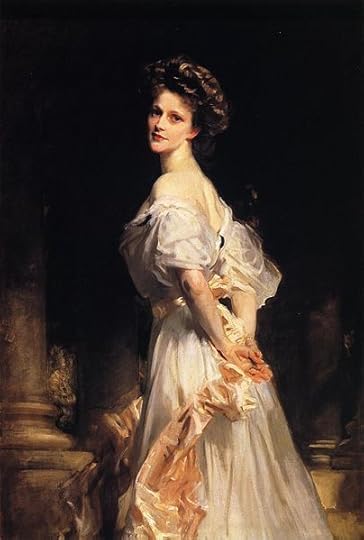 Nancy Viscountess Astor by John Singer Sargent
October 15, 2012
Inspiring biography of the first woman to take a seat in the British Parliament. I listened to an abridged audio adaptation in five parts read by Anna Maxwell Martin, and abridged by Alison Joseph.

Born in 1879, hers was a fascinating life: from straitened beginnings in the Civil War-ravaged Deep South of America, to marriage into one of the world's richest families, to a straight-talking campaign conducted door-to-door in one of the most deprived areas of Plymouth which brought her a political career that lasted more than two decades (from 1919 - until 1945).
Far from being a hardened campaigner who had suffered for the cause of female suffrage, she was already near the centre of ruling society, having married one of the richest men in the world. She was not even British, yet she became a trailblazer and beacon for the generations of women who would follow her into Parliament.

Born in 1879, hers was a fascinating life: from straitened beginnings in the Civil War-ravaged Deep South of America, to marriage into one of the world's richest families, to a straight-talking campaign conducted door-to-door in one of the most deprived areas of Plymouth which brought her a political career that lasted more than two decades (from 1919 - until 1945).
Far from being a hardened campaigner who had suffered for the cause of female suffrage, she was already near the centre of ruling society, having married one of the richest men in the world. She was not even British, yet she became a trailblazer and beacon for the generations of women who would follow her into Parliament.

October 4, 2017
From BBC radio 4 - Book of the week:
The first of five extracts from a new biography of Nancy Astor, the first woman to take a seat in the British Parliament. Born in 1879, hers was a fascinating life: from straitened beginnings in the Civil War-ravaged Deep South of America, to marriage into one of the world's richest families, to a straight-talking campaign conducted door-to-door in one of the most deprived areas of Plymouth which brought her a political career that lasted more than two decades (from 1919 - until 1945).
Far from being a hardened campaigner who had suffered for the cause of female suffrage, she was already near the centre of ruling society, having married one of the richest men in the world. She was not even British, yet she became a trailblazer and beacon for the generations of women who would follow her into Parliament.
Reader: Anna Maxwell Martin.
Abridger: Alison Joseph.
Producer: Kirsteen Cameron.
http://www.bbc.co.uk/programmes/b01n9wzp
The first of five extracts from a new biography of Nancy Astor, the first woman to take a seat in the British Parliament. Born in 1879, hers was a fascinating life: from straitened beginnings in the Civil War-ravaged Deep South of America, to marriage into one of the world's richest families, to a straight-talking campaign conducted door-to-door in one of the most deprived areas of Plymouth which brought her a political career that lasted more than two decades (from 1919 - until 1945).
Far from being a hardened campaigner who had suffered for the cause of female suffrage, she was already near the centre of ruling society, having married one of the richest men in the world. She was not even British, yet she became a trailblazer and beacon for the generations of women who would follow her into Parliament.
Reader: Anna Maxwell Martin.
Abridger: Alison Joseph.
Producer: Kirsteen Cameron.
http://www.bbc.co.uk/programmes/b01n9wzp

December 31, 2015
It is a curiously little-known fact that the first female MP in the Houses of Parliament was not in fact British at all but American. She was not a feminist or a suffragette, not a born radical bent on upsetting societal norms or conventions. Far from it, she was wealthy in her own right and married to yet more immense wealth in the shape of her husband, an heir of the Astor millions, mixing in the highest circles of British social life. Her position as a trailblazer in feminist politics came about solely because her husband had to give up his seat in the Commons on inheriting his father's title, and Nancy stepped into the breech.
A single solitary woman in a hostile House of some 600 gentlemen MPs could not have been an easy experience, and yet perhaps only someone like Nancy Astor could have done it. Her independent wealth, her forthright outspoken ways and vivacious American charm meant she often escaped the veritable straitjacket of convention that so constrained English women of her class and station in life. Far from being cowed by the disapproval of her fellow MPs, she thrived on it, her combative nature rising to the challenge.
Her home at Cliveden became renowned for its hospitality, for her parties that combined men and women from all walks of life, rich and poor, politics and the arts. She was a champion for closer Anglo-American co-operation, a tireless campaigner for legislative improvements for women and children, a lifelong teetotaller. After the trauma of the First World War and the loss of many friends, she was steadfastly opposed to further war, leading many to ascribe fascist or pro-Nazi tendencies to her and the 'Cliveden set' becoming a shorthand for Nazi apologists. Once war was declared, however, she worked exhaustively for her constituency of Plymouth and was a tower of strength and courage during the Blitz.
Nancy comes across as a fascinating character in this book, albeit not always a sympathetic one. She had the headstrong and confident individual's tendency to bully, and in her later years she became more and more intolerant and conservative in her ways. She was very much the archetypal 'bull in a china shop', a trait which often worked both for and against her. Living with Nancy must have been very much like living in the eye of a hurricane, and her husband Waldorf Astor must have had the patience of a saint. She was a remarkable woman, who led a remarkable life - but perhaps not always a comfortable one for those around her!
A single solitary woman in a hostile House of some 600 gentlemen MPs could not have been an easy experience, and yet perhaps only someone like Nancy Astor could have done it. Her independent wealth, her forthright outspoken ways and vivacious American charm meant she often escaped the veritable straitjacket of convention that so constrained English women of her class and station in life. Far from being cowed by the disapproval of her fellow MPs, she thrived on it, her combative nature rising to the challenge.
Her home at Cliveden became renowned for its hospitality, for her parties that combined men and women from all walks of life, rich and poor, politics and the arts. She was a champion for closer Anglo-American co-operation, a tireless campaigner for legislative improvements for women and children, a lifelong teetotaller. After the trauma of the First World War and the loss of many friends, she was steadfastly opposed to further war, leading many to ascribe fascist or pro-Nazi tendencies to her and the 'Cliveden set' becoming a shorthand for Nazi apologists. Once war was declared, however, she worked exhaustively for her constituency of Plymouth and was a tower of strength and courage during the Blitz.
Nancy comes across as a fascinating character in this book, albeit not always a sympathetic one. She had the headstrong and confident individual's tendency to bully, and in her later years she became more and more intolerant and conservative in her ways. She was very much the archetypal 'bull in a china shop', a trait which often worked both for and against her. Living with Nancy must have been very much like living in the eye of a hurricane, and her husband Waldorf Astor must have had the patience of a saint. She was a remarkable woman, who led a remarkable life - but perhaps not always a comfortable one for those around her!

February 27, 2013
This book deserves three and a half stars in my opinion. I really wasn't sure about it until halfway through when the personality of Nancy completely drew me in. She was far from perfect – she had a tendency to bully people (her children in particular suffered for this), she had strident views on sex, drink and religion, and her tongue could be as sharp as a knife. But she also had a tremendous wit, the ability to say what she liked without fear of repercussion, and outstanding courage. She was the first woman to become an MP and gain a seat in Parliament which was a tremendous achievement, and her strategies for getting elected were second to none and purely inspiring:
“Listen,” she began as she smiled on them, “you’ve got the choice of three candidates. You can’t get a fighting man out of the other two. So you’d best take a fighting woman. That’s me.”
Being the only woman MP in a “man’s world” was a tough job, but Nancy pulled it off. It was amazing to read about the men’s chauvinistic reactions to a woman, some would completely ignore her, others would jeer and begin inappropriate conversations (about venereal diseases!) to try and embarrass her. Even the media were shameful years down the line when other women began to be elected, describing them as “eight little peaches on eight little perches.” Nancy herself became somewhat 0f a trailblazer for women’s rights and did an awful lot to help the poor and destitute which really made me warm to her. Also, her efforts during the war, which involved helping wounded soldiers in a hospital in the grounds of her house and assisting the re-build of Plymouth after the devastation of multiple bombings. A modern day Florence Nightingale with a bit more bite? Most definitely! I think the author did an amazing job with this biography of a very complex character who has a lot to say for herself but I’ll let Gandhi have the final word – “I have been warned to beware of Lady Astor – perhaps she is a wild woman of God.”
Please see my full review at http://www.bibliobeth.wordpress.com
“Listen,” she began as she smiled on them, “you’ve got the choice of three candidates. You can’t get a fighting man out of the other two. So you’d best take a fighting woman. That’s me.”
Being the only woman MP in a “man’s world” was a tough job, but Nancy pulled it off. It was amazing to read about the men’s chauvinistic reactions to a woman, some would completely ignore her, others would jeer and begin inappropriate conversations (about venereal diseases!) to try and embarrass her. Even the media were shameful years down the line when other women began to be elected, describing them as “eight little peaches on eight little perches.” Nancy herself became somewhat 0f a trailblazer for women’s rights and did an awful lot to help the poor and destitute which really made me warm to her. Also, her efforts during the war, which involved helping wounded soldiers in a hospital in the grounds of her house and assisting the re-build of Plymouth after the devastation of multiple bombings. A modern day Florence Nightingale with a bit more bite? Most definitely! I think the author did an amazing job with this biography of a very complex character who has a lot to say for herself but I’ll let Gandhi have the final word – “I have been warned to beware of Lady Astor – perhaps she is a wild woman of God.”
Please see my full review at http://www.bibliobeth.wordpress.com

March 4, 2013
There are earlier biographies of Nancy Astor, although they seem to have all gone out of print. This is a new one (released October 2012 and January 2013).
Nancy was an interesting, lively and energetic woman and deserves to have a biography in print. This one introduces no new material and skirts quickly past her least attractive opinions, although it is not a complete hagiography. Adrian Fort does not seem to have made any attempt to understand her or her politics. In fact politics is almost completely missing from this biography of a politician; she must have done something in her twenty five years in parliament other than reduce licencing hours. A more considered treatment would have served her better.
If you can get hold of one of these earlier ones, read it instead.
Nancy: The Life of Lady Astor
Nancy Astor: A Lady Unashamed
Nancy Astor, a Biography
The Christopher Sykes biography above is a very sympathetic one, but is also a much better researched, complete biography. It considers her political opinions and prejudices and attempts to explain the background behind them. He had access to her political and family papers and Nancy's own abandoned memoir which covered her early years in Virginia.
Nancy was an interesting, lively and energetic woman and deserves to have a biography in print. This one introduces no new material and skirts quickly past her least attractive opinions, although it is not a complete hagiography. Adrian Fort does not seem to have made any attempt to understand her or her politics. In fact politics is almost completely missing from this biography of a politician; she must have done something in her twenty five years in parliament other than reduce licencing hours. A more considered treatment would have served her better.
If you can get hold of one of these earlier ones, read it instead.
Nancy: The Life of Lady Astor
Nancy Astor: A Lady Unashamed
Nancy Astor, a Biography
The Christopher Sykes biography above is a very sympathetic one, but is also a much better researched, complete biography. It considers her political opinions and prejudices and attempts to explain the background behind them. He had access to her political and family papers and Nancy's own abandoned memoir which covered her early years in Virginia.
March 6, 2023
This was a very enjoyable biography of the American-born Nancy Astor who became the first woman elected to Parliament in 1919. She lived a life of luxury, entertained the best in society, politics and literature, and equally delighted and angered people her entire life. As with many great people, she was a bundle of contradictions and quirks, yet she spent her entire life trying to make life better for everyone, and make life fairer for women. Not surprisingly, her parenting skills were somewhat wanting, and, while faithful to her husband Waldorf Astor, was not always able to satisfy his need for more time alone with her. The pace of the biography is good, the writing is quite good, and the anecdotes provide some of the spice that crowns the stew. She was an immensely important person in both Britain and the US during that period just before World War I until the end of World War II. As with so many people, time and progress eclipsed her courage and energy, and her fame became less relevant to the post-World War II era. As a student of history or as an interested observer in early 20th century culture, you'll find this a most satisfying and enlightening read.

January 23, 2020
Sigh.... This failure has more to do with me than with the book. The book was interesting. It wasn't tedious or boring. But what I think happened are that the margins are too small. The font is too small. There's too many words per page. I was somehow overwhelmed and after reading only 3 pages, would promptly fall asleep. So after spending 2 months reading this book and only progressing to page 59, I give up. From now on, I'll stick with the "Who was" series if I want to read a biography.

March 25, 2013
This is a fascinating book about a fascinating woman. I knew of Nancy Astor of course, she was the
first woman MP to take her seat in the House of Commons, but I didn't know anything of her life beyond this. I had assumed that she had always been rich, but in fact her childhood had periods where her parents struggled for money. She was born into the Langhorne family of Virginia, who had been wealthy, but the Civil War wrecked their fortunes. Nancy's father, Chillie Langhorne, had to virtually start from scratch. He was eventually very successful, but there were some hard times along the way.
There were also times of struggle in Nancy's adult life. There was an early, unhappy marriage to a man who turned out to be a drinker. She also suffered from periods of ill health which no doctor seemed to be able to effectively diagnose or treat.
There were consolations however. In order to recover from the aftermath of her first marriage she came to England where she met and married Waldorf Astor. Waldorf's father gave them Cliveden as a wedding gift. These were good years;
"For this was the Edwardian Age, and the surroundings in which Waldorf and Nancy lived contained the quintessence of that era: opulence; hedonism; sunlit summers; long days and nights of fashion and society. Peace reigned at home and in the Empire, trade was good and life inexpensive, as Britain, at the apex of her military and financial power, benignly ruled a quarter of the world. Underlying all was an almost palpable sense of satisfaction that the state of the country was, if not perfect, then as near to that as God could make it."
Waldorf became MP for Plymouth, but he was forced to give this up when his father (who had been raised to the peerage) died, and Waldorf inherited his title. Nancy put herself forward and was duly elected to the same Plymouth seat.
She was a very tough character, but some of the opposition she faced as the only woman MP in the House of Commons daunted even her. She was ignored, talked over, physically barred from reaching her place on the benches. The male MPs would loudly discuss subjects designed to embarrass her. She found it distressing, but soldiered on.
There is a lot more in this book than I can cover here. Nancy Astor was such a complex character and lived in such interesting times. I can thoroughly recommend this book.
first woman MP to take her seat in the House of Commons, but I didn't know anything of her life beyond this. I had assumed that she had always been rich, but in fact her childhood had periods where her parents struggled for money. She was born into the Langhorne family of Virginia, who had been wealthy, but the Civil War wrecked their fortunes. Nancy's father, Chillie Langhorne, had to virtually start from scratch. He was eventually very successful, but there were some hard times along the way.
There were also times of struggle in Nancy's adult life. There was an early, unhappy marriage to a man who turned out to be a drinker. She also suffered from periods of ill health which no doctor seemed to be able to effectively diagnose or treat.
There were consolations however. In order to recover from the aftermath of her first marriage she came to England where she met and married Waldorf Astor. Waldorf's father gave them Cliveden as a wedding gift. These were good years;
"For this was the Edwardian Age, and the surroundings in which Waldorf and Nancy lived contained the quintessence of that era: opulence; hedonism; sunlit summers; long days and nights of fashion and society. Peace reigned at home and in the Empire, trade was good and life inexpensive, as Britain, at the apex of her military and financial power, benignly ruled a quarter of the world. Underlying all was an almost palpable sense of satisfaction that the state of the country was, if not perfect, then as near to that as God could make it."
Waldorf became MP for Plymouth, but he was forced to give this up when his father (who had been raised to the peerage) died, and Waldorf inherited his title. Nancy put herself forward and was duly elected to the same Plymouth seat.
She was a very tough character, but some of the opposition she faced as the only woman MP in the House of Commons daunted even her. She was ignored, talked over, physically barred from reaching her place on the benches. The male MPs would loudly discuss subjects designed to embarrass her. She found it distressing, but soldiered on.
There is a lot more in this book than I can cover here. Nancy Astor was such a complex character and lived in such interesting times. I can thoroughly recommend this book.
September 26, 2013
Some say with figures from the past it is wise not to put 21st century values on people from the 19th to early 20th centuries. Well I was born in the late 20th century. Lady Astor as the author likes to mention, if not coming right out and saying so, was a modern woman. What kind of modern woman was she? She was apparently a control freak, she was manipulative, domineering, selfish, inconsiderate, callous, harsh, rude, but somewhere in her "slight, frail" body a kind heart and a sharp wit. The examples of the latter was not used frequently, the reader was on more than one occasion assured she had a sharp wit, and a kind heart. The reading seemed more like an apologist than much else. This southern belle with her deep rooted old southern ways took the British world by storm. What was Britain of this time? In truth it was not full of morals, high fibre and the only good living was those that had money to throw around. Of course Lord and Lady Astor were a part of this clique. Not the Cliveden set of the Second World War fame but the Cliveden set that never knew hardship and want, who had servants ( in her father's day slaves), furs and everything they could possibly ever want while doing "good deeds" for the less fortunate, which amounted to softening the blows of the harsh every day life rather than eliminating the harshness of everyday life. Nancy Astor can be admired for being one of the first women into parliament, she can be admired for the Bills that were past that were of real benefit to people. But can she be admired as a person, an individual? For me I believe not. I have no expectations that the pioneering women should be angels, diplomatic, kind, considerate and worthy of admiration. Indeed they could swear a blue streak, put wifeliness and family first and be quite religious, however, it is hard to appreciate some when they are hypocritical and two-faced.
December 2, 2019
Lady Nancy Astor, first women to be elected to the British Parliament. Following the suffrage movement winning women the right to vote in Great Britain, She served first in the House of Lords in 1919. After 25 years winning seats in both houses for 25 years. She and her husband ran her campaigns together while he served the government through both World Wars. A wonderful read about a courageous and wealthy American women who became the spokesperson for health care and women’s and children’s legislation in 20th century UK. I don’t think I could have been able to put up with the verbal abuse she got from her 600 men in Parliament. Nancy Astor was always a Lady and like Nancy Pelosi, speaker of the United States House of Representatives, she spared as an equal with her colleagues and without showing fear.

April 9, 2020
I visited Cliveden for the first time last year and it was on the guided tour where I first learned about Nancy Astor and was inspired to read about her. She was quite an extraordinary woman by this account and while I'm not sure that I particularly liked her, Adrian Fort does a fantastic job of painting a picture of her lifestyle, passions and those that she loved and spent time with. I knew she was the first female MP but I had no idea about her work in Plymouth (her constituency) or what a wonderful partnership she had with husband Waldorf for most of her life. A fascinating read about a fascinating and complex woman. I thoroughly enjoyed it. 4 stars.

January 29, 2018
This book has taken me a month and more to read although I have put it aside for chapters of other books during that time. I was keen to learn more of the life of the first woman MP who had set up the Virginia House Settlement in Plymouth, in whose buildings I now live. I found the book turgid and Nancy Astor irritating. She did so much of worth but her bullying behaviour of other people, including her own children, and the hurt she caused did not endear her to me. I’m glad to have read it but would have preferred to have read something a little more digestible.

January 29, 2018
A woman of contradictory ideologies, feelings, and ambitions...but also a woman determined to be unstoppable, and liver her life as the most unique individual she could possibly be...no matter how insufferable this might be to those around her. In this age of resurgent gender politics, the story of Nancy Astor make for fascinating reading...and Adrian Fort's biography tells her story in a very engrossing manner. Nancy Astor's story deserves to be remembered far more than it is today, and this book goes a considerable distance in addressing this oversight.

August 3, 2023
I absolutely adored Nancy which I feel was well-written, engaging and fascinating however I have two complaints. Firstly some of the terminology used by the author is now out of date and secondly, the author glossed over some of Nancy's prejudices which makes the book appear somewhat biased. All things considered, I believe that this biography is an excellent place to start for those looking to learn more about the first woman to take her seat in the House of Commons and paved the way for so many other women.

July 23, 2020
An unexpected history lesson
Overall well an interesting book I was not impressed by the style it read like a history book. And was a bit difficult to finish. It led me to some interesting research about the times especially about World War II but it was hard for me to like the main character
Overall well an interesting book I was not impressed by the style it read like a history book. And was a bit difficult to finish. It led me to some interesting research about the times especially about World War II but it was hard for me to like the main character
June 1, 2019
I would have given this 3 and 1/2 stars, but that is not an option on Goodreads. Interesting story about Lady Astor, but it bogged down a little with too much description of Parliament and politics. She was certainly an interesting character.
October 25, 2017
I never knew that this outspoken American was the first woman to serve in Parliament. She worked ceaselessly on war efforts during both world wars, and also for women's rights. What a character!

June 22, 2018
I have no doubt Nancy Astor's life was fascinating and worth reading about, but this writer's work did not excite me or draw me in. Too bad.

December 3, 2019
I have always known of Nancy Astor, but not of her story and in this book it is well written and in a way that makes it both readable and informative.

September 26, 2020
Not well written
Read
April 9, 2021Could not get in to it

June 24, 2021
I thought she would have had a more interesting life.
The style was an older character study without many citations which felt out of place reading it now.
The style was an older character study without many citations which felt out of place reading it now.

July 3, 2026
Found this a little boring and hard going
February 23, 2013
Nancy Astor turns up in my reading all the time. Her name comes up in almost any discussion of wartime England. This is the first chance I’ve had to read a full scale biography. Astor is often erroneously identified as the first woman elected to the British Parliament. She was indeed the first woman to sit in Parliament but not the first elected.
That honor belongs to a Sinn Fein candidate, Constance Markiewicz, a well-born Irish woman who married a Polish count and became a revolutionary (Not necessarily in that order) Markiewicz never sat in Parliament because she refused to take the oath of allegiance to the British crown.
Nancy had a disastrous first marriage and then married Waldorf Astor. When he decides to stand for Parliament, she campaigns actively for him and he wins. Mr. Astor is unaware that his elderly father is actively seeking a peerage and is furious when his father is given one. Why? Because when his father dies, he will be forced to become a peer and will no longer be able to serve in the House of Commons. After his father’s death, Nancy stands for his seat and wins.
Mrs. Astor was known for her wit, her wealth, and her embrace of Christian Science. Her youth had been marked by ill health and she credited CS with ending that. She is also known as a member of “The Cliveden Set” a phrase she found distasteful. Mrs. Astor, her husband and many of their closest friends were known for what many saw as their willingness to “get along” with Mussolini and Hitler rather than engage them in war.
Cliveden, given to Nancy and Waldorf Astor by Waldorf’s father, was a setting for much entertaining of all sorts of people. Nancy Astor felt that bringing people with different points of view together was a way for them to hear each other out and so be able to solve problems. (Would that someone in Washington believed this today). Adrian Fort also has wonderful, informative footnotes (some of us are avid footnote readers) In one he talks about a conversation between Margot Tennant (later to marry Herbert Asquith, the Liberal Prime Minister) and Prime Minister David Balfour. Notes the author “His [Balfour’s] warm heart and amused outlook on life lay beneath a rather cool and unemotional surface.” Asquith said to him: ‘You’re quite cold; I don’t believe you would care if we all died’ After a pause for reflection, Balfour graciously conceded, ‘I would care if you all died on the same day.’
I became a bit bored toward the end of the book but I think this has more to do with Mrs. Astor than the author’s prose style. I’d been happy to read anything else Mr. Fort writes.

September 23, 2016
A remarkable life although not always the best judgment shown in some ways. But a great desire to serve and to make a difference in public affairs.

March 1, 2013
Chapters seemed somewhat disjointed. One minute, you're reading about what she's doing in Parliament, the next, she's having a personal spat with someone or traveling here or there. Suddenly, a death is mentioned, and if the reader is unfamiliar with who's who in her life, they're left scratching their head as to who this person even was and how the loss personally affected her.
This biography didn't really flesh Nancy Astor out enough for me.
She was such a multifaceted, complex woman and I feel the people who were closest to and influenced her the most in life (other than Waldorf)were for the most part missing. Without them, you don't truly have her.
Nancy's forceful, often harmful personality floats in and out of focus and we lose so much without the well documented, detailed exchanges between her and her children - especially Bobby - her sisters and her closest friends.
This biography didn't really flesh Nancy Astor out enough for me.
She was such a multifaceted, complex woman and I feel the people who were closest to and influenced her the most in life (other than Waldorf)were for the most part missing. Without them, you don't truly have her.
Nancy's forceful, often harmful personality floats in and out of focus and we lose so much without the well documented, detailed exchanges between her and her children - especially Bobby - her sisters and her closest friends.

March 30, 2013
Upon reading about Winston Churchill, the name of Nancy Astor came up from time time as a parliamentarian. When I saw this book on display, I then recalled the name but was a bit askance at reading about someone whom oft was at odds with Winston Churchill notably as an appeaser of Hitler pre-WWII. But bought it I did and it was an interesting read as to how an American woman from a southern family struggling from the effects of the Civil War became the first woman to sit in the House of Commons representing Plymouth of Great Britain. Also of interest is that her life is similar to the grand luxury (achieved via marriage) as depicted in Downton Abbey with similar glory and struggles over the course of the years. Not sure that it was written the best (a bit uneven) but generally it gave good coverage of a dynamic if sometimes difficult woman.
Displaying 1 - 30 of 48 reviews