

What do you think?

The Uninvited
A seven-year-old girl puts a nail gun to her grandmother's neck and fires. An isolated incident, say the experts. The experts are wrong. Across the world, children are killing their families. Is violence contagious? As chilling murders by children grip the country, anthropologist Hesketh Lock has his own mystery to a bizarre scandal in the Taiwan timber industry. Hesketh has never been good at Asperger's Syndrome has seen to that. But he does have a talent for spotting behavioral patterns and an outsider's fascination with group dynamics. Nothing obvious connects Hesketh's Asian case with the atrocities back home. Or with the increasingly odd behavior of his beloved stepson, Freddy. But when Hesketh's Taiwan contact dies shockingly and more acts of sabotage and child violence sweep the globe, he is forced to acknowledge possibilities that defy the rational principles on which he has staked his life, his career, and, most devastatingly of all, his role as a father. Part psychological thriller, part dystopian nightmare, The Uninvited is a powerful and viscerally unsettling portrait of apocalypse in embryo.
303 pages, Hardcover
First published July 5, 2012
About the author
Liz Jensen
26 books231 followersLiz Jensen was born in Oxfordshire, the daughter of a Danish father and an Anglo-Moroccan mother. She spent two years as a journalist in the Far East before joining the BBC, first as a journalist, then as a TV and radio producer. She then moved to France where she worked as a sculptor began her first novel, Egg Dancing, which was published in 1995. Back in London she wrote Ark Baby (1998) which was shortlisted for the Guardian Fiction Award, The Paper Eater (2000), and War Crimes for the Home (2002) which was longlisted for the Orange Prize for Fiction. She has two children and shares her life with the Danish essayist, travel writer and novelist Carsten Jensen.
Ratings & Reviews
Friends & Following
Create a free account to discover what your friends think of this book!
Community Reviews
Displaying 1 - 30 of 460 reviews

November 2, 2012
liz. jensen.
so super-psyched that i was able to get a netgalley pre-u.s release of this book. not that many of you care, because so few people read liz jensen. which is, i think, the cause of most of the world's ills. floundering economy? probably because not enough people are reading liz jensen. hurricane sandy?? happened 'cuz not enough people have read liz jensen. rihanna and katy perry are fighting?? all of this could have been avoided by just one or two more of you reading some liz jensen. so get out there and take back the world. go ahead and start with this book, because it is pretty sweet.
and i mean "sweet" in the darkest and most horrifying definition of the word. this book centers around hesketh lock, whose asperger's syndrome prevents him from making emotional attachments to the people in his life, but makes him very good at his job as an anthropologist, employed to discover patterns of behavior across populations.
'When it comes to gauging human behaviour, it's an asset. It's like colour-blind people being deployed by the military to detect camouflage,'I reply. 'They look for the shapes rather than the colours.'
and he is very good at pattern-recognition. also numbers, colors, and origami. less-good at remembering the faces of women with whom he has had sex, but what does that get you, at the end of the day?
the world is in need of a hesketh to make sense of some disturbing recurring instances of extreme violence: children all over the world are lashing out at their family members, attacking and killing them with no memory of their actions afterward, and unwilling to discuss or even acknowledge the events. concurrently, acts of corporate sabotage are occurring across the globe, whose perpetrators claim to have seen strange things, and shortly thereafter, commit suicide.
how are these phenomena connected? can hasketh, the "robot made of meat" get to the bottom of it with venn diagrams and ozuru?? sure he can, but sometimes the answers are more horrifying than anyone could have anticipated.
this is an incredibly satisfying book, emotionally, intellectually, and philosophically.it is liz jensen at her finest, and i think i am going to go ahead and up this to the full five stars. why not?
i am encouraging you to read this.
heed me, please.
there is a little problem with the netgalley edition, though, one in which every word that uses the letter-combinations "ff", "fi", or "fl" will just have those letters omitted completely, so it was a little annoying, but you would be surprised at how quickly your reader-eyes adjust to it. and also surprising how many words use these letter combinations. eye-opening all around.
 come to my blog!
so super-psyched that i was able to get a netgalley pre-u.s release of this book. not that many of you care, because so few people read liz jensen. which is, i think, the cause of most of the world's ills. floundering economy? probably because not enough people are reading liz jensen. hurricane sandy?? happened 'cuz not enough people have read liz jensen. rihanna and katy perry are fighting?? all of this could have been avoided by just one or two more of you reading some liz jensen. so get out there and take back the world. go ahead and start with this book, because it is pretty sweet.
and i mean "sweet" in the darkest and most horrifying definition of the word. this book centers around hesketh lock, whose asperger's syndrome prevents him from making emotional attachments to the people in his life, but makes him very good at his job as an anthropologist, employed to discover patterns of behavior across populations.
'When it comes to gauging human behaviour, it's an asset. It's like colour-blind people being deployed by the military to detect camouflage,'I reply. 'They look for the shapes rather than the colours.'
and he is very good at pattern-recognition. also numbers, colors, and origami. less-good at remembering the faces of women with whom he has had sex, but what does that get you, at the end of the day?
the world is in need of a hesketh to make sense of some disturbing recurring instances of extreme violence: children all over the world are lashing out at their family members, attacking and killing them with no memory of their actions afterward, and unwilling to discuss or even acknowledge the events. concurrently, acts of corporate sabotage are occurring across the globe, whose perpetrators claim to have seen strange things, and shortly thereafter, commit suicide.
how are these phenomena connected? can hasketh, the "robot made of meat" get to the bottom of it with venn diagrams and ozuru?? sure he can, but sometimes the answers are more horrifying than anyone could have anticipated.
this is an incredibly satisfying book, emotionally, intellectually, and philosophically.it is liz jensen at her finest, and i think i am going to go ahead and up this to the full five stars. why not?
i am encouraging you to read this.
heed me, please.
there is a little problem with the netgalley edition, though, one in which every word that uses the letter-combinations "ff", "fi", or "fl" will just have those letters omitted completely, so it was a little annoying, but you would be surprised at how quickly your reader-eyes adjust to it. and also surprising how many words use these letter combinations. eye-opening all around.
come to my blog!
March 26, 2013
I'm going to tell you two things that made me want to read this book:
1) The cover - I mean, c'mon...how kick-ass creepy is this?
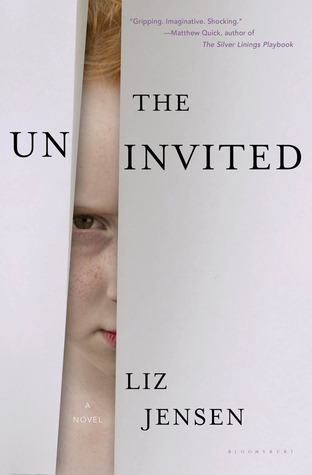
2) The first sentence of the book jacket description: "A seven-year-old girl puts a nail gun to her grandmother's neck and fires."
Creepy, evil kids doing creepy evil things is usually a win for me. So it was a foregone conclusion that I would dive into this book with abandon.
First of all -- it isn't horror, despite the cover and the book jacket description. It's more a mash-up of mystery sci-fi with a philosophical bent to it. There are creepy parts, but those are almost incidental to the book's defined purpose. And what is that purpose?
The writing is great. Liz Jensen knows what to do with words. Hesketh Lock is a remarkable character study of a person living with Asperger's Syndrome. I'm no expert by any means (and maybe it's a terribly erroneous portrait), nevertheless I appreciated the attention to detail. I found Hesketh's way of looking at the world and interacting with it endlessly fascinating.
The book opens with Hesketh being sent to different countries on various continents to investigate cases of industrial sabotage. It's not entirely clear how these financially devastating actions by valued employees are even related to the other disturbing cases occurring at the same time of children murdering their caregivers. Hence the mystery. But Hesketh is on the case and with his very unusual brain and the aid of Venn diagrams moves closer to the truth with each passing day.
Even up to the three-quarter mark I was still chomping at the bit to uncover what the hell was really going on. I needed to know. Things were going from bad to worse. What could be behind it all? Demons? Aliens? Time-traveling scientists? So many cryptic clues, hinting at something universally "big" in a space-time-evolutionary way.
I was ready for it. I believed in the author. It felt like she had a plan. I trusted her. Even with a mere 10 pages left and no definitive climax or resolution in sight, I was only slightly worried and concerned.
Ever watch an overwrought, existential and confused piece of French cinema replete with embedded themes and imagery and allegory that you were supposed to "get" but didn't, and then the end title comes up and looks like this:
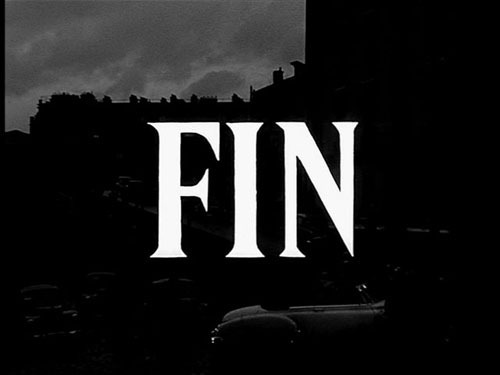
And then you shout at the screen and shake your fist: What the bleep?! You fume and even cry real tears. Because you realize no one's going to tell you the answer. Oh no. You will have to guess, extrapolate, surmise and theorize, with your friends, or worse still, with the obnoxious douche you have to work with every day.
Well piss on that. If that's what I wanted to spend my time doing I would have gotten my PhD in goddam philosophy. I can tolerate some ambiguity, but by and large I don't like it. It aggravates me. I'm reading for answers and resolution, not for more questions and uncertainty. Ambiguity stinks. Ambiguity is not my friend. Which is also probably why David Lynch movies make me want to stab somebody, him mostly.
So for a horror novel, that turned out to be a mysterious sci-fi piece that turned out to be an exercise in pointless philosophy showcasing an excruciatingly ambiguous ending -- two stars.

October 17, 2020
Hesketh Lock is a global insurance investigator who is sent to look into the unexplained, unaccountable acts of sabotage by company insiders, ultimately ending in their gruesome suicides. There is, at the same time, a parallel pandemic whereby children are committing grisly attacks on adults, and usually, their parents. The children all appear to have the same symptoms of detachment of the deed, in addition to abnormal cravings for salt, eye infection problems, an inherent tribal barbarism, their own language, and sometime of telepathic communication; think Lord of the Flies from hell. The creepiness and ghastliness of this group of children eventually descends into the barbarity of cannibalism. As Hesketh is an anthropologist with Asperger's Syndrome, we see the events through his beautiful and ordered mind, resulting in an elegant prose and logical thought process, without the panic but yet with a lot of poignancy. His relationship with his stepson Freddy helps us see his humanity and also provides a glimpse of the terror of whatever has invaded the adults (causing their destruction), and invaded the children into these acts of depravity. When Hesketh realizes that Freddy has been taken over by whatever this is, it upends his logic and forces him to look at the world beyond the two dimensional.
I will absolutely be reading more of Liz Jensen. I had to slow myself down while reading this as it is so much more than just a sci-fi, horror, psychological, dystopian thriller. I have so many highlights from the book, I have enjoyed just going back to them for retrospection.
I will absolutely be reading more of Liz Jensen. I had to slow myself down while reading this as it is so much more than just a sci-fi, horror, psychological, dystopian thriller. I have so many highlights from the book, I have enjoyed just going back to them for retrospection.

December 18, 2013
The blurb to this LIES, don't believe it!
I picked up this book because of the first line of the blurb, 'A seven-year-old girl puts a nail-gun to her grandmothers neck and fires.' Interesting, eh? I was hooked from that alone, and then I heard that this book had kids that were cannibals! I was instantly amazed and had to have it! So you can imagine my disappointment when instead of getting some kick-ass horror book featuring feral cannibal children, I get some very light mystery where the killer kids are kind of ignored to focus on the relationship of a guy with aspergers and his step son.
This novel is not all bad, the writing is actually really good and some of the scenes that do feature the killer kids are actually quite haunting. Sadly though, there's just not enough. This book is billed as 'horror', but the horror amounts to probably a total of two or three scenes in the ENTIRE book. The rest is filled with business talk as the main character travels the world looking and talking to people have come into contact with these killer kids. It also went everywhere you expected it to, it was predictable to a T, and it's also one of those books where they set up a big mystery and then never actually reveal why anything happened...well they sort of do, it's just so vague that it's not satisfying.
Overall, I really don't have much to say about this book. 'Disappointed' pretty much sums it up.
I picked up this book because of the first line of the blurb, 'A seven-year-old girl puts a nail-gun to her grandmothers neck and fires.' Interesting, eh? I was hooked from that alone, and then I heard that this book had kids that were cannibals! I was instantly amazed and had to have it! So you can imagine my disappointment when instead of getting some kick-ass horror book featuring feral cannibal children, I get some very light mystery where the killer kids are kind of ignored to focus on the relationship of a guy with aspergers and his step son.
This novel is not all bad, the writing is actually really good and some of the scenes that do feature the killer kids are actually quite haunting. Sadly though, there's just not enough. This book is billed as 'horror', but the horror amounts to probably a total of two or three scenes in the ENTIRE book. The rest is filled with business talk as the main character travels the world looking and talking to people have come into contact with these killer kids. It also went everywhere you expected it to, it was predictable to a T, and it's also one of those books where they set up a big mystery and then never actually reveal why anything happened...well they sort of do, it's just so vague that it's not satisfying.
Overall, I really don't have much to say about this book. 'Disappointed' pretty much sums it up.

November 8, 2012
[I received this book as an ARC through a Goodreads give-away.]
The narrator of this book, Hesketh Lock, has a PhD in Anthropology and now works as a special kind of trouble-shooter for the firm of Phipps and Wexman. What does this firm do? It’s never exactly clarified. As Hesketh says, it regularly treads “the space between sharp practice and corporate fraud. ‘After a catastrophic PR shock, our job is to ensure nothing like that ever happens again anywhere on your global team, because it won’t need to’.” They give companies ‘profile makeovers.’ So this firm is the kind of second-order enterprise so characteristic of today’s global capitalism. It doesn’t produce, or sell, or provide services to the public at large. It services companies that engage in those first-order activities. It’s the parasite that lives on the fleas that live on the dog. It is, in other words, the perfect synecdoche of what is identified in the novel as “the adult world.”
The book is about this adult world, and what it means for children and, by extension, future generations. And the book does not present a rosy assessment of its track-record in this respect.
The book opens with the identification of two trends. First, children begin to attack their adult care-givers and family members, for no apparent reason, and then, at least at first, lapse into dissociative states. Secondly, there are cases of industrial sabotage done by adults. Hesketh is assigned by his company to do some sorting out in these cases of “catastrophic PR shocks.” Gradually, inevitably, the phenomena spread and become inter-connected. Events ensue.
For some reason, there has been a rash, over the last fifteen years or so, of books with narrators who have some kind or other of mental illness. Hesketh, we learn early on, has Asperger’s Syndrome. I suppose it’s obvious what the appeal is to authors of such narrators. Any book with a narrator, especially those in which the narrator appears in the action of the book – hence those narrated in the first person – opens up to the author the space to create parallax. Unreliable narrators are just one point, perhaps the most easily recognized, in this space. Narrators with identifiable mental idiosyncrasies encompass a whole sub-space of it. The author can use what we know about these conditions, and what the narrators themselves choose to tell us about then, to effect. In Hesketh’s case, unlike the case of the autistic narrator of The Curious Incident of the Dog in the Night-Time, the result is not cute at all. Although we understand his limitations, he sometimes comes across as a bit of a bully, and, in his behavior to some of the women, as creepy and unpleasant. But most of all, he emphasizes, both as his own perception and as what others value in him, his ability to spot patterns, and not to be clouded by emotion and superstition. (The latter, at least, turns out to be a double-edged sword indeed.) So, on the one hand, his ineptness in the world of interpersonal relations renders him somewhat childlike; while on the other, his ruthless logicality has allied him with the impersonal forces of capitalism. He embodies in himself the predominant theme of the novel: the relation of adults to children, insofar as these represent the future.
There is an obvious comparison to be made between this book and Doris Lessing’s The Fifth Child, though Jensen’s intent in her creation of monstrous children is a lot clearer than Lessing’s. (Lessing, on the other hand, wins for sheer creepiness.) I’m sure it also bears comparison with Ian McEwan’s very strange The Child in Time, but since I don’t remember McEwan’s book well enough, I must leave that unpursued.
Jensen is a great writer. Atmosphere, dialogue, pacing, all are superbly executed. I just wish she hadn’t misused “begging the question,” twice. And once each in the mouths of the two most erudite people in the book. Still, that is a small complaint to make about a wonderful book.
The narrator of this book, Hesketh Lock, has a PhD in Anthropology and now works as a special kind of trouble-shooter for the firm of Phipps and Wexman. What does this firm do? It’s never exactly clarified. As Hesketh says, it regularly treads “the space between sharp practice and corporate fraud. ‘After a catastrophic PR shock, our job is to ensure nothing like that ever happens again anywhere on your global team, because it won’t need to’.” They give companies ‘profile makeovers.’ So this firm is the kind of second-order enterprise so characteristic of today’s global capitalism. It doesn’t produce, or sell, or provide services to the public at large. It services companies that engage in those first-order activities. It’s the parasite that lives on the fleas that live on the dog. It is, in other words, the perfect synecdoche of what is identified in the novel as “the adult world.”
The book is about this adult world, and what it means for children and, by extension, future generations. And the book does not present a rosy assessment of its track-record in this respect.
The book opens with the identification of two trends. First, children begin to attack their adult care-givers and family members, for no apparent reason, and then, at least at first, lapse into dissociative states. Secondly, there are cases of industrial sabotage done by adults. Hesketh is assigned by his company to do some sorting out in these cases of “catastrophic PR shocks.” Gradually, inevitably, the phenomena spread and become inter-connected. Events ensue.
For some reason, there has been a rash, over the last fifteen years or so, of books with narrators who have some kind or other of mental illness. Hesketh, we learn early on, has Asperger’s Syndrome. I suppose it’s obvious what the appeal is to authors of such narrators. Any book with a narrator, especially those in which the narrator appears in the action of the book – hence those narrated in the first person – opens up to the author the space to create parallax. Unreliable narrators are just one point, perhaps the most easily recognized, in this space. Narrators with identifiable mental idiosyncrasies encompass a whole sub-space of it. The author can use what we know about these conditions, and what the narrators themselves choose to tell us about then, to effect. In Hesketh’s case, unlike the case of the autistic narrator of The Curious Incident of the Dog in the Night-Time, the result is not cute at all. Although we understand his limitations, he sometimes comes across as a bit of a bully, and, in his behavior to some of the women, as creepy and unpleasant. But most of all, he emphasizes, both as his own perception and as what others value in him, his ability to spot patterns, and not to be clouded by emotion and superstition. (The latter, at least, turns out to be a double-edged sword indeed.) So, on the one hand, his ineptness in the world of interpersonal relations renders him somewhat childlike; while on the other, his ruthless logicality has allied him with the impersonal forces of capitalism. He embodies in himself the predominant theme of the novel: the relation of adults to children, insofar as these represent the future.
There is an obvious comparison to be made between this book and Doris Lessing’s The Fifth Child, though Jensen’s intent in her creation of monstrous children is a lot clearer than Lessing’s. (Lessing, on the other hand, wins for sheer creepiness.) I’m sure it also bears comparison with Ian McEwan’s very strange The Child in Time, but since I don’t remember McEwan’s book well enough, I must leave that unpursued.
Jensen is a great writer. Atmosphere, dialogue, pacing, all are superbly executed. I just wish she hadn’t misused “begging the question,” twice. And once each in the mouths of the two most erudite people in the book. Still, that is a small complaint to make about a wonderful book.

January 9, 2013
This is the first book I’ve read in a long time that defies easy categorizing. Some may call it a dystopian sci-fi fable; others may believe it is a psychological cautionary tale; still others may view it as an anthropological-based literary thriller. In fact, it is all of these and none of these. It is a truly original piece of work.
The main character, Hesketh Lock, is a handsome, intelligent anthropologist with Asperger’s syndrome. He excels at this work because he can eliminate all the messy emotional debris and focus squarely on the facts. Called “a robot made of meat” by his former significant other, he specializes in corporate sabotage troubleshooting.
Yet soon, the consistently rational Hesketh is floored by a pattern of deaths involving indigenous superstitions. Formerly conscientious workers in three different countries – Taiwan, Sweden and Dubai – are involved in sabotage and self-destruction. A collective subconscious seems to be at play, through the evocation of ghostly ancestors, trolls and djinns. The question is: “If it’s a shared narrative, are they collectively re-enacting an old myth, or creating a new one?”
There is something else amiss in the world as well. Young children are suddenly turning feral; a seven-year-old girl puts a nail gun to her grandmother’s neck and fires…other children are murdering their families ruthlessly. Hesketh has a personal stake in these atrocities. He has a strong bond with his young stepson, Freddy, which brings these events home to a personal level.
Men attacking institutions they love…children turning on families…two overlapping circles, with irrational violence at the intersection. What connects them? And how will Lock, a logic-based narrator with an obsession for origami and compulsion to match skin tones and clothes to a Dulux paint chart, unravel what is at the core of all this?
This is a thinking person’s book that’s not afraid to tackle the multiple explanations humans give to ascribe meaning to existence with wisps of the legacy we are leaving behind. I found it to be brilliant – a little slow to get into and then absolutely page turning. One thing’s for certain: some of these images may inhabit your dreams and that’s the mark of a really good writer.
The main character, Hesketh Lock, is a handsome, intelligent anthropologist with Asperger’s syndrome. He excels at this work because he can eliminate all the messy emotional debris and focus squarely on the facts. Called “a robot made of meat” by his former significant other, he specializes in corporate sabotage troubleshooting.
Yet soon, the consistently rational Hesketh is floored by a pattern of deaths involving indigenous superstitions. Formerly conscientious workers in three different countries – Taiwan, Sweden and Dubai – are involved in sabotage and self-destruction. A collective subconscious seems to be at play, through the evocation of ghostly ancestors, trolls and djinns. The question is: “If it’s a shared narrative, are they collectively re-enacting an old myth, or creating a new one?”
There is something else amiss in the world as well. Young children are suddenly turning feral; a seven-year-old girl puts a nail gun to her grandmother’s neck and fires…other children are murdering their families ruthlessly. Hesketh has a personal stake in these atrocities. He has a strong bond with his young stepson, Freddy, which brings these events home to a personal level.
Men attacking institutions they love…children turning on families…two overlapping circles, with irrational violence at the intersection. What connects them? And how will Lock, a logic-based narrator with an obsession for origami and compulsion to match skin tones and clothes to a Dulux paint chart, unravel what is at the core of all this?
This is a thinking person’s book that’s not afraid to tackle the multiple explanations humans give to ascribe meaning to existence with wisps of the legacy we are leaving behind. I found it to be brilliant – a little slow to get into and then absolutely page turning. One thing’s for certain: some of these images may inhabit your dreams and that’s the mark of a really good writer.

June 10, 2012
When a seven year old kills her grandmother and blinds her father with a nail-gun, it is considered a tragic, yet isolated incident. Hesketh Lock works for a company that investigates corporate sabotage and is sent to Taiwan to unearth a whistle-blower at a timber plant. The man in question is a loyal employee and claims he was forced into it. His behaviour is bizarre and he speaks of the Hungry Ghosts and starving children. A few days later he commits suicide. But Sunny Chen is only the first, as Hesketh continues his work, a pattern starts to emerge, and if there’s one thing he’s good at, it’s finding patterns in human behaviour.
Hesketh has Asperger’s and it was refreshing to see this in an adult character. It has become a bit of a literary device to allow child narrators to be a bit cleverer and more interesting than the more average child. His lack of social skills are shown in his failed relationship with Kaitlin, his resulting one-night stands and even that his closest relationship is with his young stepson, Freddy. His logical manner of thinking and lack of deceit, make him the perfect candidate for his job and his tendency to go off on a tangent helps, rather than hinders, the narrative. One of his coping mechanisms is to fold origami, both focussing his mind but also in awkward situations, a small gift of origami seems to be the perfect gesture.
The concept of children turning again their parents may be a shocking one but it does raise a lot of questions. Children are never seen as a threat. What would you do in such circumstances, if you couldn’t sleep in your own home for fear of your child? Hesketh is desperate to be a father figure for Freddy even though they are not related and despite everything, he doesn’t want to give up on him. I began to find the children genuinely creepy.
The ending seems to tail off a bit but I loved the character of Hesketh, I could have kept on reading whatever else was going on. I’m not sure there will be enough of an explanation for some readers but I’m not going to give you any clues! As with The Rapture, Liz Jensen explores the factors that could lead to the end of our world as we know it.
Hesketh has Asperger’s and it was refreshing to see this in an adult character. It has become a bit of a literary device to allow child narrators to be a bit cleverer and more interesting than the more average child. His lack of social skills are shown in his failed relationship with Kaitlin, his resulting one-night stands and even that his closest relationship is with his young stepson, Freddy. His logical manner of thinking and lack of deceit, make him the perfect candidate for his job and his tendency to go off on a tangent helps, rather than hinders, the narrative. One of his coping mechanisms is to fold origami, both focussing his mind but also in awkward situations, a small gift of origami seems to be the perfect gesture.
The concept of children turning again their parents may be a shocking one but it does raise a lot of questions. Children are never seen as a threat. What would you do in such circumstances, if you couldn’t sleep in your own home for fear of your child? Hesketh is desperate to be a father figure for Freddy even though they are not related and despite everything, he doesn’t want to give up on him. I began to find the children genuinely creepy.
The ending seems to tail off a bit but I loved the character of Hesketh, I could have kept on reading whatever else was going on. I’m not sure there will be enough of an explanation for some readers but I’m not going to give you any clues! As with The Rapture, Liz Jensen explores the factors that could lead to the end of our world as we know it.

July 18, 2014
What a strange read.
I enjoyed it, but it's difficult to describe beyond the hook in the description. A wave of violence perpetrated by children sweeps the globe, and a man tasked to investigate corporate saboteurs is lured into investigating the cause, partly due to his love for the little boy he had to leave behind when he split with his girlfriend.
It's not nearly that simple though. The protagonist, Hesketh, feels a limited emotional connection with people due to Asperger's. He is rather brilliant, however, at making connections between seemingly disparate cultural and behavioral patterns. Elements of the plot felt quite scattered to me at times, and I found myself constructing my own Venn diagrams wondering if the story would ever come together into some sort of reasonable explanation. At the same time, I felt very little emotional connection with the characters. I could see where I should, especially when Hesketh was dealing with Freddy, but the real emotion of it was just out of reach...
... and is that the genius of this book? That as a reader, my experience effectively mirrored that of the protagonist, Hesketh? Whoa.
Like I said, strange read. But I liked it. I will read more Jensen.
Also, please go read Karen's review, which prompted me to pick this up in the first place. :)
I enjoyed it, but it's difficult to describe beyond the hook in the description. A wave of violence perpetrated by children sweeps the globe, and a man tasked to investigate corporate saboteurs is lured into investigating the cause, partly due to his love for the little boy he had to leave behind when he split with his girlfriend.
It's not nearly that simple though. The protagonist, Hesketh, feels a limited emotional connection with people due to Asperger's. He is rather brilliant, however, at making connections between seemingly disparate cultural and behavioral patterns. Elements of the plot felt quite scattered to me at times, and I found myself constructing my own Venn diagrams wondering if the story would ever come together into some sort of reasonable explanation. At the same time, I felt very little emotional connection with the characters. I could see where I should, especially when Hesketh was dealing with Freddy, but the real emotion of it was just out of reach...
... and is that the genius of this book? That as a reader, my experience effectively mirrored that of the protagonist, Hesketh? Whoa.
Like I said, strange read. But I liked it. I will read more Jensen.
Also, please go read Karen's review, which prompted me to pick this up in the first place. :)

October 12, 2013
First Impression:
I am thorn between my star rating... The book until the end is near perfect... But the ending...
What a hell Liz?? :\
Second Impression:
This tale follows two linked stories. Hesketh, a man with a Asperger syndrome is an investigator for an insurance company. He travels from place to place to investigate several sabotages on some companies. First he go to China, then Sweden, Dubai and then he travels back to England. Since this book was written on a first perspective we learn a lot about his mind and it's interesting to see a person's mind work. This particular mind is quite interesting because everytime something important is happening is mind drifts off. And in the midst of his conversations with other peoples, if they are female, he drifts off to his blouse and body. Its quite good because we behave like that. When someone is talking to us, our ears may be hearing it but part of our mind drifts off... to someone appearance or its surroundings. Its not usually a first person narrative to have this attention.
At the same time we have a mystery novel mixed with an apocalpytic scenario. It's quite interesting, because as the book advances we leave the mystery part to a apocalpytic survival scenario.
Hesketh, our main character, has lost his partner to someone else (a girl if you want to know) and at the same time he lost a boy... a boy he is not the father but he treats him as if. It's a theme not usually dwell upon. A man who joins a woman that has a boy he becomes his stepfather. As the relation grows so the role of step-father/step-son. But if they got separated what rights has a stepfather? None. It's a fulcral point to this novel this relation. I really enjoy the relation of Hesketh and the other characters and of himself. The reasons he isolated himself and the reasons he is what he is.
The horror, that supposedly it has - it's almost not-existent. There are a couple scenes that make you irk but afraid? I think it depends on the sensibility of a person.
It's quite interesting the children scenario. Why are they behaving like that, why are they killind persons and making man sabotage their works and kill themselves? What's the reason behind?
The step-son, freddy, is one of those children and sometimes he behaves rather normal and other times he behaves like is was a part of a big group. A new evolution of children. Why they are behaving like that? What's happening? It's reveal that it has something to do with CERN's experiments and time travel/multi paralel dimensions. But no explication is given. No real ending (either bad or good). Its just ends , and you get, so.... now what? There is a sequel? No??? So, what happens to the world? And the children? And mankind? Why didn't they kill all children to start again?
This book deals with father/son relation (in this stepfather/stepson), ex's relations, the Asperger situation, the relations between a Asperger and other people and probably the biggest picture of our World Economy. It's good to be able to buy products from Japan, Nordic countries or USA with a click of a button... but at the same time you are dependent from technology and companies that if they stop for a day or so, repurcutions would exist. What happens if a country that is fully dependable on oil had a problem with receiving it? Or wheat or meat? For better or worse, we are a techonological global village. We depenend on everyone.
Advisable?
Yes. Undoubtatly yes. It's a nice short story, with barely 300 pages, and we get a good setting, good characters and good plot. But be prepared to have a french ending for this book. It's not that kind of open ending that make you think and it feels nicely - it's a kind of ending that is so open that you feel cheated. It doesn't give you some short posibilities... it gives endless possibilities of endings.
I am thorn between my star rating... The book until the end is near perfect... But the ending...
What a hell Liz?? :\
Second Impression:
This tale follows two linked stories. Hesketh, a man with a Asperger syndrome is an investigator for an insurance company. He travels from place to place to investigate several sabotages on some companies. First he go to China, then Sweden, Dubai and then he travels back to England. Since this book was written on a first perspective we learn a lot about his mind and it's interesting to see a person's mind work. This particular mind is quite interesting because everytime something important is happening is mind drifts off. And in the midst of his conversations with other peoples, if they are female, he drifts off to his blouse and body. Its quite good because we behave like that. When someone is talking to us, our ears may be hearing it but part of our mind drifts off... to someone appearance or its surroundings. Its not usually a first person narrative to have this attention.
At the same time we have a mystery novel mixed with an apocalpytic scenario. It's quite interesting, because as the book advances we leave the mystery part to a apocalpytic survival scenario.
Hesketh, our main character, has lost his partner to someone else (a girl if you want to know) and at the same time he lost a boy... a boy he is not the father but he treats him as if. It's a theme not usually dwell upon. A man who joins a woman that has a boy he becomes his stepfather. As the relation grows so the role of step-father/step-son. But if they got separated what rights has a stepfather? None. It's a fulcral point to this novel this relation. I really enjoy the relation of Hesketh and the other characters and of himself. The reasons he isolated himself and the reasons he is what he is.
The horror, that supposedly it has - it's almost not-existent. There are a couple scenes that make you irk but afraid? I think it depends on the sensibility of a person.
It's quite interesting the children scenario. Why are they behaving like that, why are they killind persons and making man sabotage their works and kill themselves? What's the reason behind?
The step-son, freddy, is one of those children and sometimes he behaves rather normal and other times he behaves like is was a part of a big group. A new evolution of children. Why they are behaving like that? What's happening? It's reveal that it has something to do with CERN's experiments and time travel/multi paralel dimensions. But no explication is given. No real ending (either bad or good). Its just ends , and you get, so.... now what? There is a sequel? No??? So, what happens to the world? And the children? And mankind? Why didn't they kill all children to start again?
This book deals with father/son relation (in this stepfather/stepson), ex's relations, the Asperger situation, the relations between a Asperger and other people and probably the biggest picture of our World Economy. It's good to be able to buy products from Japan, Nordic countries or USA with a click of a button... but at the same time you are dependent from technology and companies that if they stop for a day or so, repurcutions would exist. What happens if a country that is fully dependable on oil had a problem with receiving it? Or wheat or meat? For better or worse, we are a techonological global village. We depenend on everyone.
Advisable?
Yes. Undoubtatly yes. It's a nice short story, with barely 300 pages, and we get a good setting, good characters and good plot. But be prepared to have a french ending for this book. It's not that kind of open ending that make you think and it feels nicely - it's a kind of ending that is so open that you feel cheated. It doesn't give you some short posibilities... it gives endless possibilities of endings.

August 25, 2026
3.5 stars
’The Uninvited’ was a bold take on the end of the world as we know it, both in terms of the nature of the apocalypse and the description of its progress. Liz Jensen gave me an insider’s view of the rapid, uncontrolable slide from “I need to analyse a few incidents of anomalous behaviour”, through “This looks like a global pandemic of violence that we need to contain and then neutralise" on to “The world I knew has been fundentally and irrevocably changed and there’s nothing I can o about it. I may not even be able to explain it”, finishing with counting the personal cost of living with the new normal.
That description may make this sound like a conventional techno thriller. Liz Jensen’s decision to tell the story from the point of view of Hesketh Lock, an investigator whose brilliance at seeing patterns that others miss is partly a function of his neurodivergence. Filtering events through Hesketh's perspective was like refracting light or echoing sound; it created nonlinear associations and stimulated a form of emotional dissonance as I read.
At the start of the book, although the events Hesketh was investigating were bizarre, the world he was moving through felt familiar and real, which served both to ground the story and to highlight some of Hesketh’s atypical responses and behaviours.
As the scale and pace of the crisis increased, it was Hesketh’s personal situation, especially his relationship with his common-law stepson, that kept me engaged.
As the pieces of the apocalypse-in-progress puzzle came together, I was fascinated to see that Hesketh’s analytical strengths - reviewing factual data to establish causal links- created blind spots that hindered his understanding. His unwillingess/inability to fabulate meant that some patterns were effectively invisible to him.
I enjoyed this book for the boldness of its ideas and the clarity of the protagonist’s world view but, for me, it never became a page-turning I-have-to-know-what-happens-next thriller. It reminded me of listening to 1970s high-concept rock albums: I admired what they were doing and the ideas lit up my mind, but nothing got my foot tapping.
’The Uninvited’ was a bold take on the end of the world as we know it, both in terms of the nature of the apocalypse and the description of its progress. Liz Jensen gave me an insider’s view of the rapid, uncontrolable slide from “I need to analyse a few incidents of anomalous behaviour”, through “This looks like a global pandemic of violence that we need to contain and then neutralise" on to “The world I knew has been fundentally and irrevocably changed and there’s nothing I can o about it. I may not even be able to explain it”, finishing with counting the personal cost of living with the new normal.
That description may make this sound like a conventional techno thriller. Liz Jensen’s decision to tell the story from the point of view of Hesketh Lock, an investigator whose brilliance at seeing patterns that others miss is partly a function of his neurodivergence. Filtering events through Hesketh's perspective was like refracting light or echoing sound; it created nonlinear associations and stimulated a form of emotional dissonance as I read.
At the start of the book, although the events Hesketh was investigating were bizarre, the world he was moving through felt familiar and real, which served both to ground the story and to highlight some of Hesketh’s atypical responses and behaviours.
As the scale and pace of the crisis increased, it was Hesketh’s personal situation, especially his relationship with his common-law stepson, that kept me engaged.
As the pieces of the apocalypse-in-progress puzzle came together, I was fascinated to see that Hesketh’s analytical strengths - reviewing factual data to establish causal links- created blind spots that hindered his understanding. His unwillingess/inability to fabulate meant that some patterns were effectively invisible to him.
I enjoyed this book for the boldness of its ideas and the clarity of the protagonist’s world view but, for me, it never became a page-turning I-have-to-know-what-happens-next thriller. It reminded me of listening to 1970s high-concept rock albums: I admired what they were doing and the ideas lit up my mind, but nothing got my foot tapping.

January 2, 2019
The Uninvited is een spannend post-apocalyptisch verhaal met een psychologische twist. Het start allemaal wanneer jonge kinderen vol agressie hun familieleden beginnen te vermoorden. Aan het hoofdpersonage antropoloog Hesketh de taak om de verbanden te zien. Wat is er gaande? Is er een pandemie?
Dit boek zit ontzettend goed in elkaar. Hesketh is een geweldig interessant hoofdpersonage. Ondanks het feit dat hij Asperger heeft, functioneert hij heel goed als antropoloog. Hij ontdekt verbanden als geen ander, maar mist hier en daar wat sociale skills. Tegelijkertijd was ik onder de indruk van zijn liefde voor stiefzoon Freddy.
Met The Uninvited heeft Liz Jensen een spannende thriller geschreven, met een diepere wetenschappelijke laag. Ook religie, mythologie en bijgeloof spelen een belangrijke rol in het verhaal. Interessant en spannend gaan hand in hand. Af en toe wordt het zelfs een beetje luguber.
Helaas wist het einde me niet 100% te overtuigen. Misschien is dit omdat ik op een ander einde hoopte..
Mijn complete recensie lees je op Oog op de Toekomst.
Dit boek zit ontzettend goed in elkaar. Hesketh is een geweldig interessant hoofdpersonage. Ondanks het feit dat hij Asperger heeft, functioneert hij heel goed als antropoloog. Hij ontdekt verbanden als geen ander, maar mist hier en daar wat sociale skills. Tegelijkertijd was ik onder de indruk van zijn liefde voor stiefzoon Freddy.
Met The Uninvited heeft Liz Jensen een spannende thriller geschreven, met een diepere wetenschappelijke laag. Ook religie, mythologie en bijgeloof spelen een belangrijke rol in het verhaal. Interessant en spannend gaan hand in hand. Af en toe wordt het zelfs een beetje luguber.
Helaas wist het einde me niet 100% te overtuigen. Misschien is dit omdat ik op een ander einde hoopte..
Mijn complete recensie lees je op Oog op de Toekomst.

January 30, 2013
There are parts of this book that are great. Jensen has invented something so sinister that even as I was laughing at myself, I still had to sidle to bed after staying up way too late reading, hurrying to the bathroom in the dark so I could whirl around & make sure nothing was behind me. What exactly was I afraid of? Kids? Kids are short & they have small hands. The element of surprise is the only reason that you should be attacked by them, unless they're in a great big pack. I've only got the one in my house & he was in his crib the last time I'd seen him that night, so I was reasonably sure he wasn't behind me with a nail gun - but yet I was still so freaked out, I couldn't turn my back on the bedroom door as I fell asleep.
But in many ways this book just does not get it done. At the end of the day, there's just no capitalization on all the wonderful dread that’s created.
But in many ways this book just does not get it done. At the end of the day, there's just no capitalization on all the wonderful dread that’s created.

February 15, 2016
When I first saw this book I was very intrigued by it. The cover and the back summary of the book. Yes, please. I had to read this book to find out what was causing all of these children to go psycho and kill people. I agree with others that this book is not a horror story. Even though the front cover would lead you to think it is.
The opening scene of this book had me hooked. I could not wait to dig deeper into the story to learn the truth. After this the story just went flatline. It was a struggle for me to read the next few chapters. Even to call this book a psychological thriller would be a stretch. It was pretty evident soon that I had lost interest in the story and learning the truth. I guess I will never learn the truth.
The opening scene of this book had me hooked. I could not wait to dig deeper into the story to learn the truth. After this the story just went flatline. It was a struggle for me to read the next few chapters. Even to call this book a psychological thriller would be a stretch. It was pretty evident soon that I had lost interest in the story and learning the truth. I guess I will never learn the truth.

February 5, 2017
I think I could've liked the book more. The idea was quite fascinating and unusual. And I liked Hesketh, the main character and the narrator. And his story with his stepson Freddy was touching. But I don't know. It was kinda slow? Boring? I was thinking of DNFing it several times but I wanted the answers and then some moments touched me emotionally. But all in all... I think I just prefer much more dynamic books. And then the ending - huh? I didn't feel it at all. But it's an individual reaction, I think, I can see some liked it and some didn't.

August 13, 2015
WTF!!!
So not what I thought this was suppose to be about. This sucked. You should have stuck to the storyline of children killing. Just say'in.
So not what I thought this was suppose to be about. This sucked. You should have stuck to the storyline of children killing. Just say'in.

August 9, 2019
I'm not sure on what to think of this one. It's a dystopian story and the idea is intreguing, but I've got the feeling that I missed something.
The main character is Hesketh and he has Asperger. You get a view into how someone with Asperger thinks and this add a plus to the story, but also a bit of depth of the main character is missing.
The end of the story, it felt that it was a bit to rushed and it was an open ending.
But, if this isn't already made into a serie/movie, this could be a hit.
The main character is Hesketh and he has Asperger. You get a view into how someone with Asperger thinks and this add a plus to the story, but also a bit of depth of the main character is missing.
The end of the story, it felt that it was a bit to rushed and it was an open ending.
But, if this isn't already made into a serie/movie, this could be a hit.

September 17, 2012
Copy received from Bloomsbury through Book Geeks.
It starts with one child, a young girl, taking a nail gun and killing her grandmother before injuring her father for no apparent reason. It seems to be a random occurrence, a one-off event, tragic and shocking but unique. Hesketh Lock hears about this murder while on his way to the airport. He is travelling from England to Taiwan to investigate a bizarre corporate scandal.
Hesketh Lock has Asperger’s Syndrome and isn’t good at relationships or reading people. He is however very good at spotting and reading behaviour patterns which explains his job as trouble shooter for a company specialising in investigating corporate fraud, exposing it and eliminating it forever. However, his investigation in Taiwan doesn’t provide him with any useful or logical answers. If anything, his meeting with the man who exposed the scandal leaves Hesketh with more questions than answers. When his Taiwanese contact subsequently commits suicide the case becomes even murkier. Then things quickly escalate. More bizarre cases of corporate fraud are exposed, all apparently conducted by the most unlikely suspects who tend to be confused after their fraudulent acts and end up dying shortly afterwards. And at the same time more children, all over the world, are attacking and killing adults. With no apparent reasons for these murders and the children going through a dramatic change immediately before and after the violence, authorities are at a loss to explain what is happening. But the violence is spreading and panic, as well as all sorts of (conspiracy) theories are becoming rampant. When Hesketh establishes a link between the disruptions in the corporate world and the crimes committed by the children it appears to be an impossible proposition. With his stepson starting to exhibit troubling behaviour, Hesketh finds himself in a situation that could as easily overwhelm him as bring him to the realisation of what exactly is happening.
This story is shocking on several levels. First there is all the violence committed by children. It is never easy to read about children as the perpetrators of violent crime and since that is the central story-line in this book it is hard not to get emotionally involved. What makes the story even more disturbing is that it is written in such a way that you end up feeling that something like this could actually happen. Yes, it is a fantastical story line, but one based on enough fact to make it just about plausible. While reading this book I felt my heart breaking on several occasions; how could a parent, family, the world ever hope to deal with children turning against the adults in their lives? And would we really react in the way as described in this book?
In Hesketh Lock the author has created a fascinating protagonist. Because of his Asperger’s he is logical to a fault. This makes him the perfect narrator for this story in which the events taking place are so horrific that non-sentimental descriptions are necessary if the reader is going to stick with the story. Hesketh has a linear way of thinking which is brutally honest and at times heartbreaking. He is very aware of his shortcomings and completely unable to do anything about them. That is not to say he should be pitied; Hesketh is very secure in the knowledge that there are certain things he can do better than most people because his special make-up means he’s better equipped to do them. He is, for example very quick to observe patterns where others see none.
“Perhaps she pities me. It’s a frequent mistake. People misunderstand who I am, and assume I want to be like them. I don’t.”
Hesketh’s former partner and the mother of his stepson used to call him “A robot made of meat.” And although he doesn’t think he is such a robot there comes a time when Hesketh thinks that being just that might be what he needs.
This book is very well written and almost too easy to read. A story like this should be read slowly, but Liz Jensen’s writing is so fluid that I found myself turning the pages at a quick pace regardless of the horrors that were taking place on them. And maybe that is exactly what is needed with a story as shocking as this one. I think I might have put the book aside if I had allowed myself too much time to linger on exactly what was happening. That would have been such a waste though. Combining several genres – mystery, psychological thriller, and dystopian-apocalyptical nightmare - this is a highly original, thought-provoking, very well written and intriguing story.
It starts with one child, a young girl, taking a nail gun and killing her grandmother before injuring her father for no apparent reason. It seems to be a random occurrence, a one-off event, tragic and shocking but unique. Hesketh Lock hears about this murder while on his way to the airport. He is travelling from England to Taiwan to investigate a bizarre corporate scandal.
Hesketh Lock has Asperger’s Syndrome and isn’t good at relationships or reading people. He is however very good at spotting and reading behaviour patterns which explains his job as trouble shooter for a company specialising in investigating corporate fraud, exposing it and eliminating it forever. However, his investigation in Taiwan doesn’t provide him with any useful or logical answers. If anything, his meeting with the man who exposed the scandal leaves Hesketh with more questions than answers. When his Taiwanese contact subsequently commits suicide the case becomes even murkier. Then things quickly escalate. More bizarre cases of corporate fraud are exposed, all apparently conducted by the most unlikely suspects who tend to be confused after their fraudulent acts and end up dying shortly afterwards. And at the same time more children, all over the world, are attacking and killing adults. With no apparent reasons for these murders and the children going through a dramatic change immediately before and after the violence, authorities are at a loss to explain what is happening. But the violence is spreading and panic, as well as all sorts of (conspiracy) theories are becoming rampant. When Hesketh establishes a link between the disruptions in the corporate world and the crimes committed by the children it appears to be an impossible proposition. With his stepson starting to exhibit troubling behaviour, Hesketh finds himself in a situation that could as easily overwhelm him as bring him to the realisation of what exactly is happening.
This story is shocking on several levels. First there is all the violence committed by children. It is never easy to read about children as the perpetrators of violent crime and since that is the central story-line in this book it is hard not to get emotionally involved. What makes the story even more disturbing is that it is written in such a way that you end up feeling that something like this could actually happen. Yes, it is a fantastical story line, but one based on enough fact to make it just about plausible. While reading this book I felt my heart breaking on several occasions; how could a parent, family, the world ever hope to deal with children turning against the adults in their lives? And would we really react in the way as described in this book?
In Hesketh Lock the author has created a fascinating protagonist. Because of his Asperger’s he is logical to a fault. This makes him the perfect narrator for this story in which the events taking place are so horrific that non-sentimental descriptions are necessary if the reader is going to stick with the story. Hesketh has a linear way of thinking which is brutally honest and at times heartbreaking. He is very aware of his shortcomings and completely unable to do anything about them. That is not to say he should be pitied; Hesketh is very secure in the knowledge that there are certain things he can do better than most people because his special make-up means he’s better equipped to do them. He is, for example very quick to observe patterns where others see none.
“Perhaps she pities me. It’s a frequent mistake. People misunderstand who I am, and assume I want to be like them. I don’t.”
Hesketh’s former partner and the mother of his stepson used to call him “A robot made of meat.” And although he doesn’t think he is such a robot there comes a time when Hesketh thinks that being just that might be what he needs.
This book is very well written and almost too easy to read. A story like this should be read slowly, but Liz Jensen’s writing is so fluid that I found myself turning the pages at a quick pace regardless of the horrors that were taking place on them. And maybe that is exactly what is needed with a story as shocking as this one. I think I might have put the book aside if I had allowed myself too much time to linger on exactly what was happening. That would have been such a waste though. Combining several genres – mystery, psychological thriller, and dystopian-apocalyptical nightmare - this is a highly original, thought-provoking, very well written and intriguing story.
November 8, 2012
Not my sort of book, usually, this one is a kind of scifi/monster/detective mashup, a bit different from the 'dirty realism' I normally read. But Karen's review was persuasive. I'm not sure we would have world peace if everyone read Liz Jensen, but she can write: crystal clear prose.
The story is fascinating, children turning on and murdering their elders, industrial sabotage, talk of possession by djinns, trolls etc. Is there a connection? The narrator Hesketh Lock is an anthropologist/troubleshooter employed by corporations to look for patterns, and he employs his considerable gifts to trying to solve this. Why are children running riot and industry chiefs committing suicide? Lock has Aspergers syndrome and while he is good at spotting patterns (using Venn diagrams mostly) he's not so good at emotional intelligence, and is splitting with his partner during the novel and trying to cope with his step son. There were some problems here for me, because although he isn't in tune with feelings (eg his idea of chatting up women is to ask if they want sex in around the second sentence) he does seem to develop some with the son. I suppose that's the point. And he occasionally uses metaphors - would that happen? I suppose it depends on how far along the 'spectrum' you were.
Anyway it is gripping and well written, and enjoyable. Thanks Karen. (again).
The story is fascinating, children turning on and murdering their elders, industrial sabotage, talk of possession by djinns, trolls etc. Is there a connection? The narrator Hesketh Lock is an anthropologist/troubleshooter employed by corporations to look for patterns, and he employs his considerable gifts to trying to solve this. Why are children running riot and industry chiefs committing suicide? Lock has Aspergers syndrome and while he is good at spotting patterns (using Venn diagrams mostly) he's not so good at emotional intelligence, and is splitting with his partner during the novel and trying to cope with his step son. There were some problems here for me, because although he isn't in tune with feelings (eg his idea of chatting up women is to ask if they want sex in around the second sentence) he does seem to develop some with the son. I suppose that's the point. And he occasionally uses metaphors - would that happen? I suppose it depends on how far along the 'spectrum' you were.
Anyway it is gripping and well written, and enjoyable. Thanks Karen. (again).
January 23, 2013
The zippy premise (not that the premise is zippy, per se, but that I am going to state the premise in a zippy manner): Hot anthropologist dude with Asperger's tries to figure out why the world's children are suddenly attacking their parents and going into dissociative states while adults are sabotaging their companies and killing themselves.
Jensen's first-person narrator is aces and always interesting. I admire how she fully commits to the messy big idea of the premise, even if the ending doesn't fully work. Points deducted for the shakily handling (to be kind) of asian and arab characters (comparing the grimace of one to angry chimpanzee).
Jensen's first-person narrator is aces and always interesting. I admire how she fully commits to the messy big idea of the premise, even if the ending doesn't fully work. Points deducted for the shakily handling (to be kind) of asian and arab characters (comparing the grimace of one to angry chimpanzee).

September 7, 2016
I feel a bit dirty after reading this. The author set out to make her audience feel ashamed. It worked for me, but not the way she probably hoped.
This book describes the ideal life that remains after taking extreme measures, which is, to kill off the planet in order to save it.
The author leads readers to the goodness of the abolishment of wealth. Similar to "gun control laws" which blame the guns rather than the shooters, she blames the pursuit of wealth for the destruction of mankind. She promotes the unscientific computer projections of the imaginary Catastrophic Anthropogenic Global Warming (CAGW) philosophy as well as the other fears of the United Nations, including that within a generation or two we will be forced into cannibalism to survive as a species (P. Ehrlich, I believe).
In other words, the author is a radical who feels obligated to show only evil in a free market economy. This book is propaganda for world socialism, as in, anti-capitalism. All of the medical and technical advances we enjoy (and despite recent resistance to cheap energy we hope to continue sharing with the world), along with shelter and clean water, are not really improving our lives (after all we haven't conquered death or greed or...). We produce books, we have time to read them, we have lighting to read by, pens and paper and computers to write with, and all of this is suicide in the long (long, long) run. We do not live short, hard lives, which is the "natural" way. (Who gets to define "nature"?) The author is from the UK but the beliefs she disguised as a novel closely resemble those of other European socialists (who, incidentally, have failed economically and environmentally) and other powerful international anti-wealth, pro-primitive advocates.
Even though the author finds it ideal in her created world that humans are forced into behaving and thinking a certain way about wealth and the environment, they should remain "free" to live however they feel in every other way. How can this self-centered behavior and lack of concern for the emotional well-being of others in your life coexist with a supposedly "moral" desire to create a better and sustainable future for imaginary people? Is there a difference between the pursuit of personal satisfaction in relationships, regardless of the feelings of others or the consequences, and a disregard for the consequences of dishonest commerce and ignorance about scientifically valid environmental impact?
By the way, the author never addresses real environmental concerns. She chose not to use her literary platform to inspire her readers by mentioning realistic steps taken, especially in the United States for several decades, that have kept our air and water cleaner than it is in Communist and Socialist nations (like China, Russia, and Portugal). The bulk of her background information seems strictly political, and then only the politics that agrees with her personal opinions.
Not a word of her narrative is devoted to those reading her book who would oppose her dire outlook, her indication that no opinion but hers is valid. This lack of balance further reduces any credibility she hopes to achieve. Her character, Ashok, represents her opinion of capitalists as "jerks." He gets what he "deserves" in the end. I suppose Jensen would fare best if only people who agree with her survive the pandemic, and thus forever live in hunter-gatherer utopia.
I have to give the author a bit of credit for briefly mentioning one positive "solution": old-fashioned farming. However, in the story, this practice was forced on humanity after the destruction of all industry and massive human death, rather than being shown to exist alongside industry, as a positive. One sentence or maybe two is dedicated to it, post-apocalypse, with no connection to the real-life current problem of chemically-induced crops and livestock. Her entire focus was on attacking industry and human population.
I also have to give the author a bit of credit for the authentic voice of her male protagonist, who has Asperger's. I am not sure how those unfamiliar with this arm of the autism spectrum will understand the character and respond to his quirks compared with someone who has a great deal of personal experience with it. For me, my curiosity about the issue was the deciding factor for me to borrow the book off the library shelf.
I want to make a point for others who may be misled into thinking that "Asperger's" is synonymous with "genius." In fact, we currently discard the old term for the condition and replace it with "high-functioning autism." Many people on the spectrum are incapable of speech let alone reading, and those who learn to read may be of average intelligence otherwise. Just because you can speak or read does not make you a genius, or a master at complicated abstract pattern finding like Hesketh. There are a few individuals whose brains have high intelligence combined with HFA, and they can become gifted in their field of interest, just like any bright neurotypical. The difference in their successes (or the lack) might be that those with HFA have an extreme focusing capability, a sustained deeper functioning than a neurotypical is capable of. However, this selective strength compromises the part of their brain that serves social skills or processes sensations.
Ironically, Hesketh's ability to contemplate raw facts without emotion is considered a weakness because he cannot accept a religious, non-scientific view of the future. Thus, the author portrays religion (i.e., CAGW) as science, and science as being true regardless of facts and proof. So, we should agree with her and others like her because "she said so." We should be more like children: egocentric; believing everything bad that happens is "all our fault"; and that what we know is everything there is to know.
I ponder how many times and to what extent the author has been personally disappointed by other people in her life, to drive her to such hatred and bitterness towards all humanity.
As far as the plot, I could tell by the third page that this novel was going to be less of a story and more of a religious philosophy: humans are powerful enough to both take and give eternal life, as represented by unscientific beliefs about the natural world, presented as facts in this novel, just as you might expect from a fanatic.
This book describes the ideal life that remains after taking extreme measures, which is, to kill off the planet in order to save it.
The author leads readers to the goodness of the abolishment of wealth. Similar to "gun control laws" which blame the guns rather than the shooters, she blames the pursuit of wealth for the destruction of mankind. She promotes the unscientific computer projections of the imaginary Catastrophic Anthropogenic Global Warming (CAGW) philosophy as well as the other fears of the United Nations, including that within a generation or two we will be forced into cannibalism to survive as a species (P. Ehrlich, I believe).
In other words, the author is a radical who feels obligated to show only evil in a free market economy. This book is propaganda for world socialism, as in, anti-capitalism. All of the medical and technical advances we enjoy (and despite recent resistance to cheap energy we hope to continue sharing with the world), along with shelter and clean water, are not really improving our lives (after all we haven't conquered death or greed or...). We produce books, we have time to read them, we have lighting to read by, pens and paper and computers to write with, and all of this is suicide in the long (long, long) run. We do not live short, hard lives, which is the "natural" way. (Who gets to define "nature"?) The author is from the UK but the beliefs she disguised as a novel closely resemble those of other European socialists (who, incidentally, have failed economically and environmentally) and other powerful international anti-wealth, pro-primitive advocates.
Even though the author finds it ideal in her created world that humans are forced into behaving and thinking a certain way about wealth and the environment, they should remain "free" to live however they feel in every other way. How can this self-centered behavior and lack of concern for the emotional well-being of others in your life coexist with a supposedly "moral" desire to create a better and sustainable future for imaginary people? Is there a difference between the pursuit of personal satisfaction in relationships, regardless of the feelings of others or the consequences, and a disregard for the consequences of dishonest commerce and ignorance about scientifically valid environmental impact?
By the way, the author never addresses real environmental concerns. She chose not to use her literary platform to inspire her readers by mentioning realistic steps taken, especially in the United States for several decades, that have kept our air and water cleaner than it is in Communist and Socialist nations (like China, Russia, and Portugal). The bulk of her background information seems strictly political, and then only the politics that agrees with her personal opinions.
Not a word of her narrative is devoted to those reading her book who would oppose her dire outlook, her indication that no opinion but hers is valid. This lack of balance further reduces any credibility she hopes to achieve. Her character, Ashok, represents her opinion of capitalists as "jerks." He gets what he "deserves" in the end. I suppose Jensen would fare best if only people who agree with her survive the pandemic, and thus forever live in hunter-gatherer utopia.
I have to give the author a bit of credit for briefly mentioning one positive "solution": old-fashioned farming. However, in the story, this practice was forced on humanity after the destruction of all industry and massive human death, rather than being shown to exist alongside industry, as a positive. One sentence or maybe two is dedicated to it, post-apocalypse, with no connection to the real-life current problem of chemically-induced crops and livestock. Her entire focus was on attacking industry and human population.
I also have to give the author a bit of credit for the authentic voice of her male protagonist, who has Asperger's. I am not sure how those unfamiliar with this arm of the autism spectrum will understand the character and respond to his quirks compared with someone who has a great deal of personal experience with it. For me, my curiosity about the issue was the deciding factor for me to borrow the book off the library shelf.
I want to make a point for others who may be misled into thinking that "Asperger's" is synonymous with "genius." In fact, we currently discard the old term for the condition and replace it with "high-functioning autism." Many people on the spectrum are incapable of speech let alone reading, and those who learn to read may be of average intelligence otherwise. Just because you can speak or read does not make you a genius, or a master at complicated abstract pattern finding like Hesketh. There are a few individuals whose brains have high intelligence combined with HFA, and they can become gifted in their field of interest, just like any bright neurotypical. The difference in their successes (or the lack) might be that those with HFA have an extreme focusing capability, a sustained deeper functioning than a neurotypical is capable of. However, this selective strength compromises the part of their brain that serves social skills or processes sensations.
Ironically, Hesketh's ability to contemplate raw facts without emotion is considered a weakness because he cannot accept a religious, non-scientific view of the future. Thus, the author portrays religion (i.e., CAGW) as science, and science as being true regardless of facts and proof. So, we should agree with her and others like her because "she said so." We should be more like children: egocentric; believing everything bad that happens is "all our fault"; and that what we know is everything there is to know.
I ponder how many times and to what extent the author has been personally disappointed by other people in her life, to drive her to such hatred and bitterness towards all humanity.
As far as the plot, I could tell by the third page that this novel was going to be less of a story and more of a religious philosophy: humans are powerful enough to both take and give eternal life, as represented by unscientific beliefs about the natural world, presented as facts in this novel, just as you might expect from a fanatic.

November 15, 2017
Children are turning murderous, and adults are committing acts of random sabotage and then committing suicide. Could the two phenomena be related, and if so how? It's up to a borderline Autistic anthropologist named Hesketh Lock to try and work out what's going on, leveraging the unique perspective of someone who doesn't make assumptions because he doesn't really understand what it means to be a normal human being to start with.
The novel meanders between horror, supernatural suspense, science fiction, and comedy; it reminded me of the genre pileup of Michael Marshall Smith's "Only Forward". Contrary to what some of the other reviews on Goodreads say, there *is* an ending and a resolution. It doesn't spell out every detail, but the information is there for those willing to join the dots.
The writing is succinct and the characterization is good; at no point did I feel the pace was dragging, and indeed I was tempted to stay awake until the small hours to finish the book, so I'm going to give it five stars as that's a rare thing.
The novel meanders between horror, supernatural suspense, science fiction, and comedy; it reminded me of the genre pileup of Michael Marshall Smith's "Only Forward". Contrary to what some of the other reviews on Goodreads say, there *is* an ending and a resolution. It doesn't spell out every detail, but the information is there for those willing to join the dots.
The writing is succinct and the characterization is good; at no point did I feel the pace was dragging, and indeed I was tempted to stay awake until the small hours to finish the book, so I'm going to give it five stars as that's a rare thing.
October 9, 2020
3.5 stars. A very gripping psychological dystopian horror novel that is incredibly unique. One of the most unsettling books I've ever read.

April 22, 2013
The Uninvited opens with a scene of intense horror, as a young child slaughters her grandmother with a nail-gun to the neck. “No reason, no warning.” Everyone’s immediate reaction is that there has been a terrible accident, especially as the girl is found staring at the wall, as if in shock; but then she comes to herself, grabs the nail gun, and puts it to her father’s face and fires again. “One murder, one blinding. Two minutes. No accident.” The girl had just turned seven.
The narrator of the tale that begins with this incident is Hesketh, a man who lives in a stone cottage on the island of Arran in Scotland, an isolated place that suits a man who prefers solitude and has a job that doesn’t require him to appear at the Head Office with any great frequency. Hesketh is separated from Kaitlin, which necessarily separates him from her son, Freddy, who is the same age as the girl who shot her grandmother; Hesketh feels the loss of Freddy much more than he does the loss of Kaitlin. Hesketh uses his training in anthropology to find and celebrate whistleblowers in corporations. He does so at the behest of those corporations, who wish to manage the whistleblowers for their own advantage, to show that they are good corporate citizens and avoid bad publicity. It’s a little surprising that Hesketh is able to be so effective at his work, as he has Asperger’s Syndrome. As it applies to him, Asperger’s makes it difficult for him to understand how people will react emotionally to any given set of circumstances, because he does not experience most emotions as the bulk of humanity does.
But Hesketh is, in fact, good at his work, which has him traveling throughout the world. An assignment in Taiwan, at a timber factory, reveals a situation fully as strange as the child who killed her grandmother with a nail gun. Hesketh finds the whistleblower quickly, but the man behaves very oddly. It is plain that he loves the organization that employs him; his father, grandfather and uncles all worked there, and he believes it to be a good company. He also clearly finds whistleblowing to be shameful. Hesketh notes that his movements are “jerky and puppet-like,” and that he has a “hectic look.” It’s almost as if the man acted against his own conscience and his own will in doing as he did. But more mysteriously, the man points to evidence — genuine evidence, not something manufactured — that seems to indicate someone else, in fact, a child, was involved.
The mysteries compound from there, and Hesketh is right in the middle of them. All over the world, people are betraying corporations they love. All over the world, children are killing the adults who care for them. It seems that some sort of apocalypse is underway, but one never foreseen and with no discernible shape. Who or what is the uninvited? And what are they, or it, doing to the world? What is their purpose, their plan? And how do ordinary people figure it out, and what do they do about it?
The story is told entirely in the first person by Hesketh, which makes the narrative mostly seem cold, analytical, emotionless. Consequently, when Hesketh does show emotion, it is all the more powerful. He has an especially interesting voice; seeing through his eyes, watching his habits, his means of coping, is fascinating. His emotional distance makes him able to observe and relate what is happening around him as familiar institutions start to collapse. It’s a great use of character to make an unusual story even more unusual.
And the story is unusual, imaginative, excitingly different. I’ve read nothing like The Uninvited before. It is very different from the average horror or science fiction novel, imagining events that seem unimaginable in exquisite detail. Despite the veritable arms race among thriller writers to make their viewpoint characters in some way “other,” giving them a disease or disorder that sets them apart from the mass of humanity, Jensen’s novel is the most skillful use of such a technique I’ve seen. It is a bleak tale, telling of an end to the world that seems entirely meaningless, an end that humans are helpless to prevent at any level. Yet there is a beauty to it, too, and an odd note that perhaps what is happening is not an ending, but merely a change. This is not an easy novel, but it is eminently worthwhile.
Originally published at http://www.fantasyliterature.com/revi... 4.5 stars rounded up to 5.
The narrator of the tale that begins with this incident is Hesketh, a man who lives in a stone cottage on the island of Arran in Scotland, an isolated place that suits a man who prefers solitude and has a job that doesn’t require him to appear at the Head Office with any great frequency. Hesketh is separated from Kaitlin, which necessarily separates him from her son, Freddy, who is the same age as the girl who shot her grandmother; Hesketh feels the loss of Freddy much more than he does the loss of Kaitlin. Hesketh uses his training in anthropology to find and celebrate whistleblowers in corporations. He does so at the behest of those corporations, who wish to manage the whistleblowers for their own advantage, to show that they are good corporate citizens and avoid bad publicity. It’s a little surprising that Hesketh is able to be so effective at his work, as he has Asperger’s Syndrome. As it applies to him, Asperger’s makes it difficult for him to understand how people will react emotionally to any given set of circumstances, because he does not experience most emotions as the bulk of humanity does.
But Hesketh is, in fact, good at his work, which has him traveling throughout the world. An assignment in Taiwan, at a timber factory, reveals a situation fully as strange as the child who killed her grandmother with a nail gun. Hesketh finds the whistleblower quickly, but the man behaves very oddly. It is plain that he loves the organization that employs him; his father, grandfather and uncles all worked there, and he believes it to be a good company. He also clearly finds whistleblowing to be shameful. Hesketh notes that his movements are “jerky and puppet-like,” and that he has a “hectic look.” It’s almost as if the man acted against his own conscience and his own will in doing as he did. But more mysteriously, the man points to evidence — genuine evidence, not something manufactured — that seems to indicate someone else, in fact, a child, was involved.
The mysteries compound from there, and Hesketh is right in the middle of them. All over the world, people are betraying corporations they love. All over the world, children are killing the adults who care for them. It seems that some sort of apocalypse is underway, but one never foreseen and with no discernible shape. Who or what is the uninvited? And what are they, or it, doing to the world? What is their purpose, their plan? And how do ordinary people figure it out, and what do they do about it?
The story is told entirely in the first person by Hesketh, which makes the narrative mostly seem cold, analytical, emotionless. Consequently, when Hesketh does show emotion, it is all the more powerful. He has an especially interesting voice; seeing through his eyes, watching his habits, his means of coping, is fascinating. His emotional distance makes him able to observe and relate what is happening around him as familiar institutions start to collapse. It’s a great use of character to make an unusual story even more unusual.
And the story is unusual, imaginative, excitingly different. I’ve read nothing like The Uninvited before. It is very different from the average horror or science fiction novel, imagining events that seem unimaginable in exquisite detail. Despite the veritable arms race among thriller writers to make their viewpoint characters in some way “other,” giving them a disease or disorder that sets them apart from the mass of humanity, Jensen’s novel is the most skillful use of such a technique I’ve seen. It is a bleak tale, telling of an end to the world that seems entirely meaningless, an end that humans are helpless to prevent at any level. Yet there is a beauty to it, too, and an odd note that perhaps what is happening is not an ending, but merely a change. This is not an easy novel, but it is eminently worthwhile.
Originally published at http://www.fantasyliterature.com/revi... 4.5 stars rounded up to 5.

December 9, 2012
Liz Jensen is an extraordinary writer.
I can count eight, wonderfully diverse, novels now. She has taken in so many subjects – from ecology to time travel; from fertility to social history – mixing so many different ideas in different, and unexpected, ways. And though her subject matter wouldn’t always draw me I always find her writing intriguing.
The Uninvited is, I think, as good as anything she’s done.
I was pulled in from the very first paragraph.
Mass hysterical outbreaks rarely have identifiable inceptions, but the date I recall most vividly is Sunday 16th September, when a young child in butterfly pyjamas slaughtered her grand-mother with a nail-gun to the neck. The attack took place in a family living room in a leafy Harrogate cul-de-sac, the kind where no-one drops litter, and where you can hear bird-song…”
The seemingly isolated incident that proved to be the first in a wave seemed to set an obvious course for the story to take. But it didn’t, it went somewhere rather different, leaving those extraordinary events on the back-burner.
Hesketh Lock was an anthropologist, employed by a large corporation to investigate and analyse instances of industrial sabotage. It was a role that suited him very well. Because Hesketh has Asperger’s Syndrome and his emotional detachment, his lack of empathy with the people he studied, meant that he could study the facts and the patterns that fascinated him completely objectively.
I was a little worried when I saw the first reference to Asperger’s Syndrome – it’s been used by rather too many novelists lately, and few handle it well – but here it worked very well. The character worked, as a believable character and as exactly the right protagonist for this particular story.
Another pattern began to emerge: a contact is found dead by his own hand; a subject runs into the path of a moving train; an interviewee leaps from a high building.
Hesketh can’t explain, but he begins to wonder …
"Men attacking institutions they love.
Children turning on their families.
Two overlapping circles, with irrational violence at the intersection.
What else connects them?”
Hesketh observes details – fascinating details, opening up all manner of possibilities – but his work is pushed aside when he is affected by an incident close to home. An incident involving Freddie, the son of his estranged partner, with whom Hesketh had always had a strong bond.
The contrast between the cool, professional Hesketh, and the caring, involved step-father was striking. And the contrasts between a chilling back-story, a fascinating investigation, and a family drama – all held together by some very clever plotting – made reading chilling, thought-provoking, and utterly compelling.
It was fiction, but it felt horribly possible, and completely relevant.
Everything – the writing, the characterisation, the structure – worked.
Most of all it was the characters and their relationships, so very real and so very well drawn, that made a story full of big ideas utterly accessible.
And everywhere the devil was in the details – it would be wrong to mention specifics – so I’ll just say they made me think, they made me feel, and they made me ask questions.
A resolution seemed impossible, and indeed it was. There were some answers but not a complete solution. And a departure rather than an ending.
That was right, but it meant that the ending was less compelling that what had gone before.
Not a bad thing at all because it left room to think about what had happened, what might happen next, and what really could happen.
A fitting ending to a fascinating book.
I can count eight, wonderfully diverse, novels now. She has taken in so many subjects – from ecology to time travel; from fertility to social history – mixing so many different ideas in different, and unexpected, ways. And though her subject matter wouldn’t always draw me I always find her writing intriguing.
The Uninvited is, I think, as good as anything she’s done.
I was pulled in from the very first paragraph.
Mass hysterical outbreaks rarely have identifiable inceptions, but the date I recall most vividly is Sunday 16th September, when a young child in butterfly pyjamas slaughtered her grand-mother with a nail-gun to the neck. The attack took place in a family living room in a leafy Harrogate cul-de-sac, the kind where no-one drops litter, and where you can hear bird-song…”
The seemingly isolated incident that proved to be the first in a wave seemed to set an obvious course for the story to take. But it didn’t, it went somewhere rather different, leaving those extraordinary events on the back-burner.
Hesketh Lock was an anthropologist, employed by a large corporation to investigate and analyse instances of industrial sabotage. It was a role that suited him very well. Because Hesketh has Asperger’s Syndrome and his emotional detachment, his lack of empathy with the people he studied, meant that he could study the facts and the patterns that fascinated him completely objectively.
I was a little worried when I saw the first reference to Asperger’s Syndrome – it’s been used by rather too many novelists lately, and few handle it well – but here it worked very well. The character worked, as a believable character and as exactly the right protagonist for this particular story.
Another pattern began to emerge: a contact is found dead by his own hand; a subject runs into the path of a moving train; an interviewee leaps from a high building.
Hesketh can’t explain, but he begins to wonder …
"Men attacking institutions they love.
Children turning on their families.
Two overlapping circles, with irrational violence at the intersection.
What else connects them?”
Hesketh observes details – fascinating details, opening up all manner of possibilities – but his work is pushed aside when he is affected by an incident close to home. An incident involving Freddie, the son of his estranged partner, with whom Hesketh had always had a strong bond.
The contrast between the cool, professional Hesketh, and the caring, involved step-father was striking. And the contrasts between a chilling back-story, a fascinating investigation, and a family drama – all held together by some very clever plotting – made reading chilling, thought-provoking, and utterly compelling.
It was fiction, but it felt horribly possible, and completely relevant.
Everything – the writing, the characterisation, the structure – worked.
Most of all it was the characters and their relationships, so very real and so very well drawn, that made a story full of big ideas utterly accessible.
And everywhere the devil was in the details – it would be wrong to mention specifics – so I’ll just say they made me think, they made me feel, and they made me ask questions.
A resolution seemed impossible, and indeed it was. There were some answers but not a complete solution. And a departure rather than an ending.
That was right, but it meant that the ending was less compelling that what had gone before.
Not a bad thing at all because it left room to think about what had happened, what might happen next, and what really could happen.
A fitting ending to a fascinating book.

December 6, 2012
See this review and others like it at BadassBookReviews.com!.
I enjoy a good horror book now and then and I do have to give it to Liz Jensen on that account, she wrote one unsettling book. The imagery was super creepy and my favorite part of the book. I love a good read that can get your heart pounding and this one definitely had moments of that. Unfortunately, the plot just didn’t come together as a whole for me and I was actually very disappointed by the ending.
Hesketh Lock is our narrative voice throughout this book. He is a very intelligent man but has trouble connecting on a personal level because of his Asperger’s. I didn’t really connect to him, and possibly wasn’t quite supposed to, except in the moments where he was interacting with his ex-girlfriend’s son Freddy K. During these times, Hesketh became a real character and you were able to start caring about what he was going through. Most of the time though, he felt very detached and I think it pulled the reader out of the story a little bit.
The strangeness of the plot really crept up slowly. It started with a young girl killing her grandmother with a nail gun. It then moved into corporate sabotage issues where the men involved claimed to be control by another entity and then committed suicide. I liked the use of cultural mythologies in this part — the ancestor spirits in Japan, trolls in Sweden, djinn in the Middle East. The tension increased throughout the novel with more instances of sabotage/suicide and more and more children killing their family members in violent, gruesome way with no remorse. The tension reached a crescendo when the next child affected was none other than Freddy K.
After Hesketh moves in to take care of Freddy K, it becomes a very intimate look at what one man will do to try and help the child he loves to survive. While society is in an uproar and people are starting to take the law (with regards to children) into their own hands, Hesketh just wants to keep Freddy K safe. As Freddy K starts to devolve more and more, the book began to unravel for me. It was still creepy to have our narrator living with one of the supposed psychopaths, but the eventual reveal of the “possessions – aka the uninvited” just didn’t work for me. In order to not spoil this for anyone, I will have to be vague but hopefully you can still get the general idea.
The big reveal involves time-traveled based around quantum physics and relativity theory. Okay, on one hand I could get behind this. I can see the thought process behind the corporate sabotage because those companies are polluting our Earth, but I don’t understand the actions behind the children. The reasons for killing the adults and the subsequent ways the affected children behave just don’t really seem to fit with what were are told about “the uninvited.” I just didn’t buy it and I feel like the novel faltered by trying to include these more science-fiction elements. They just weren’t incorporated very well and the children’s actions within the plot weren’t actually explained by them. I think if Ms. Jensen had stuck with the scary killer children vibe she cultivated throughout the story instead of trying to package in a “message via sci-fi,” this book would have ended on a more cohesive note.
Based on the writing and the way Ms. Jensen developed the tension throughout this book, I wouldn’t hesitate to try another novel by her. This particular book fell apart for me at the end, but I have hopes for her other books in the future.
Thank you to Netgalley and Bloomsbury USA for providing an ARC copy of this book!
I enjoy a good horror book now and then and I do have to give it to Liz Jensen on that account, she wrote one unsettling book. The imagery was super creepy and my favorite part of the book. I love a good read that can get your heart pounding and this one definitely had moments of that. Unfortunately, the plot just didn’t come together as a whole for me and I was actually very disappointed by the ending.
Hesketh Lock is our narrative voice throughout this book. He is a very intelligent man but has trouble connecting on a personal level because of his Asperger’s. I didn’t really connect to him, and possibly wasn’t quite supposed to, except in the moments where he was interacting with his ex-girlfriend’s son Freddy K. During these times, Hesketh became a real character and you were able to start caring about what he was going through. Most of the time though, he felt very detached and I think it pulled the reader out of the story a little bit.
The strangeness of the plot really crept up slowly. It started with a young girl killing her grandmother with a nail gun. It then moved into corporate sabotage issues where the men involved claimed to be control by another entity and then committed suicide. I liked the use of cultural mythologies in this part — the ancestor spirits in Japan, trolls in Sweden, djinn in the Middle East. The tension increased throughout the novel with more instances of sabotage/suicide and more and more children killing their family members in violent, gruesome way with no remorse. The tension reached a crescendo when the next child affected was none other than Freddy K.
After Hesketh moves in to take care of Freddy K, it becomes a very intimate look at what one man will do to try and help the child he loves to survive. While society is in an uproar and people are starting to take the law (with regards to children) into their own hands, Hesketh just wants to keep Freddy K safe. As Freddy K starts to devolve more and more, the book began to unravel for me. It was still creepy to have our narrator living with one of the supposed psychopaths, but the eventual reveal of the “possessions – aka the uninvited” just didn’t work for me. In order to not spoil this for anyone, I will have to be vague but hopefully you can still get the general idea.
The big reveal involves time-traveled based around quantum physics and relativity theory. Okay, on one hand I could get behind this. I can see the thought process behind the corporate sabotage because those companies are polluting our Earth, but I don’t understand the actions behind the children. The reasons for killing the adults and the subsequent ways the affected children behave just don’t really seem to fit with what were are told about “the uninvited.” I just didn’t buy it and I feel like the novel faltered by trying to include these more science-fiction elements. They just weren’t incorporated very well and the children’s actions within the plot weren’t actually explained by them. I think if Ms. Jensen had stuck with the scary killer children vibe she cultivated throughout the story instead of trying to package in a “message via sci-fi,” this book would have ended on a more cohesive note.
Based on the writing and the way Ms. Jensen developed the tension throughout this book, I wouldn’t hesitate to try another novel by her. This particular book fell apart for me at the end, but I have hopes for her other books in the future.
Thank you to Netgalley and Bloomsbury USA for providing an ARC copy of this book!

October 31, 2012
**Review copy received via Netgalley**
For me, this novel was such a slow-burner I wasn’t sure I would be able to get into it at all. After a surprisingly graphic, attention-grabbing opening chapter the pace settles down rather too drastically for my liking and I have to confess that I found my attention wandering a bit. Following the obligatory introduction of protagonists and a new story-thread however, I was immediately pulled back into the plot- and I’m glad I stuck with it, as ultimately I was rewarded with a pretty gripping story. This is the first Liz Jensen book I have read, but I can guarantee it won’t be my last.
This story takes creepy, violent children and some strange suicidal occurrences around the globe and successfully crafts them into an interconnecting story, all narrated from the viewpoint of Hesketh Lock, a patterns analyst with Aspergers Syndrome who seems able to join the dots a lot more quickly than his counterparts can. Through Hesketh’s eyes, the reader is able to witness some very unsettling events, as well as what may be the start of a terrifying dystopian nightmare...
As an aside, I have to say that the Netgalley formatting of this novel did it absolutely no favours. With missing letters within the narrative, trying to puzzle out some of the words made this story’s plot more complex than even I had expected! Discounting that however, I genuinely loved meeting Hesketh and his co-workers and reading about the completely changing world that as a rational, logical person he struggled to explain.
The Uninvited is a great story with a brilliant premise and some excellent characters throughout. Hesketh is crafted remarkably well and his struggles with both people and relationships and some of his ‘cringe worthy’ encounters add some much light-hearted humour to what is an otherwise complex, dark story. Because of the traits that come hand in hand with his aspergers, he is unable to be anything but brutally honest, and as a consequence is a wholly reliable narrator, which makes a change in this sort of psychological thriller.
Aspects of this novel were chilling and made for some uncomfortable reading, yet I found myself completely engrossed in what was going on and unable to stop turning the pages. The writing is intense, the scene-setting vivid. Tapping into the premise of scary children is always going to be a winner as it is achieved so successfully within horror movies; yet reading it in black and white is admittedly no less frightening or suspenseful. If as a reader you can get past the clunky, slow beginning then you are definitely in for a real ride with this book....
For me, this novel was such a slow-burner I wasn’t sure I would be able to get into it at all. After a surprisingly graphic, attention-grabbing opening chapter the pace settles down rather too drastically for my liking and I have to confess that I found my attention wandering a bit. Following the obligatory introduction of protagonists and a new story-thread however, I was immediately pulled back into the plot- and I’m glad I stuck with it, as ultimately I was rewarded with a pretty gripping story. This is the first Liz Jensen book I have read, but I can guarantee it won’t be my last.
This story takes creepy, violent children and some strange suicidal occurrences around the globe and successfully crafts them into an interconnecting story, all narrated from the viewpoint of Hesketh Lock, a patterns analyst with Aspergers Syndrome who seems able to join the dots a lot more quickly than his counterparts can. Through Hesketh’s eyes, the reader is able to witness some very unsettling events, as well as what may be the start of a terrifying dystopian nightmare...
As an aside, I have to say that the Netgalley formatting of this novel did it absolutely no favours. With missing letters within the narrative, trying to puzzle out some of the words made this story’s plot more complex than even I had expected! Discounting that however, I genuinely loved meeting Hesketh and his co-workers and reading about the completely changing world that as a rational, logical person he struggled to explain.
The Uninvited is a great story with a brilliant premise and some excellent characters throughout. Hesketh is crafted remarkably well and his struggles with both people and relationships and some of his ‘cringe worthy’ encounters add some much light-hearted humour to what is an otherwise complex, dark story. Because of the traits that come hand in hand with his aspergers, he is unable to be anything but brutally honest, and as a consequence is a wholly reliable narrator, which makes a change in this sort of psychological thriller.
Aspects of this novel were chilling and made for some uncomfortable reading, yet I found myself completely engrossed in what was going on and unable to stop turning the pages. The writing is intense, the scene-setting vivid. Tapping into the premise of scary children is always going to be a winner as it is achieved so successfully within horror movies; yet reading it in black and white is admittedly no less frightening or suspenseful. If as a reader you can get past the clunky, slow beginning then you are definitely in for a real ride with this book....

November 13, 2012
Originally published on Bookluvrs Haven.
Though I am not one that usually judges books by their covers, I do admit that this one caught my eye on NetGalley. It's very simple, yet there is something so undeniably creepy about a child that has that look. A look of evil intent, one could say, and deadly calculation. There is no denying that this novel in its entirety was also meticulously calculated.
I was very excited to begin this read and though I have quite a few that were ahead on my list, I couldn't resist it.
I had some conflicting thoughts as I read through the first half of this book. The incidents of the child killings is what fascinated me the most about the blurb of this novel, yet as the incidents happened in real time, they seemed to be an afterthought as our main character carried on with his investigations into corporate incidents. They were almost dismissed as strange anomalies of little significance, with most of the focus on Hesketh's strange behaviour, fascinations and thoughts. And I did begin to get a little frustrated, even though the corporate incidents were in themselves intriguing with dark elements that I knew were going to be meaningful in this novel.
Needless to say, I am very glad that I stuck this story out. The child attacks begin to become so frequent that they can no longer be denied, and Hesketh begins to form a theory that every investigation of sabotage that he has been involved in, and these strange killings by children are connected. Once his stepson, Freddy, who he is very attached to, begins to behave strangely, I was pulled in and invested 100%.
And it is in this last half of the novel, once it all starts to unravel for our main character, that all the preparation of the first half of the novel becomes crystal clear to me and very much appreciated. Because Hesketh is not your typical 'normal' human being. He has a condition where his behaviour patterns are very different, his reactions to tragedy and violence are not quite the 'norm'. It was at that moment that I was totally appreciative of the, what seemed almost tedious and repetitive, insights into Hesketh, the man. Without it, I would not have fully understood Hesketh's actions once the world began to change. A world where the children that lived in it became strangers and monsters to their loving families, a danger to the world that had been so familiar to the adults inhabiting it. The rules, all of a sudden, change dramatically, and so do the players.
** Arc received from publisher through Netgalley for review **
Though I am not one that usually judges books by their covers, I do admit that this one caught my eye on NetGalley. It's very simple, yet there is something so undeniably creepy about a child that has that look. A look of evil intent, one could say, and deadly calculation. There is no denying that this novel in its entirety was also meticulously calculated.
I was very excited to begin this read and though I have quite a few that were ahead on my list, I couldn't resist it.
I had some conflicting thoughts as I read through the first half of this book. The incidents of the child killings is what fascinated me the most about the blurb of this novel, yet as the incidents happened in real time, they seemed to be an afterthought as our main character carried on with his investigations into corporate incidents. They were almost dismissed as strange anomalies of little significance, with most of the focus on Hesketh's strange behaviour, fascinations and thoughts. And I did begin to get a little frustrated, even though the corporate incidents were in themselves intriguing with dark elements that I knew were going to be meaningful in this novel.
Needless to say, I am very glad that I stuck this story out. The child attacks begin to become so frequent that they can no longer be denied, and Hesketh begins to form a theory that every investigation of sabotage that he has been involved in, and these strange killings by children are connected. Once his stepson, Freddy, who he is very attached to, begins to behave strangely, I was pulled in and invested 100%.
And it is in this last half of the novel, once it all starts to unravel for our main character, that all the preparation of the first half of the novel becomes crystal clear to me and very much appreciated. Because Hesketh is not your typical 'normal' human being. He has a condition where his behaviour patterns are very different, his reactions to tragedy and violence are not quite the 'norm'. It was at that moment that I was totally appreciative of the, what seemed almost tedious and repetitive, insights into Hesketh, the man. Without it, I would not have fully understood Hesketh's actions once the world began to change. A world where the children that lived in it became strangers and monsters to their loving families, a danger to the world that had been so familiar to the adults inhabiting it. The rules, all of a sudden, change dramatically, and so do the players.
** Arc received from publisher through Netgalley for review **

October 8, 2012
I had a rough start with Uninvited. I had a NetGalley publisher distributed e-galley, and there was a problem with the formatting, particularly with the letter 'f'. Every time I came upon a word with that letter, I'd stumble over it and it would suck me out of the narrative. This isn't anything having to do with the book; rather it is a plea for publishers distributing electronic advanced copies to pay a little more attention to the files. I probably would have never made it through this book if I hadn't picked up a finished copy. And I'm really glad that's what I did.
The Uninvited is a slow build, but has real horror payoffs. Hesketh, a trained anthropologist who works for a contractor, is sent out to investigate cases of whistleblowing for companies. Hesketh is particularly well-suited for this kind of work because of where he is on the autism spectrum: Hesketh is clinical in his thoughts and dealings with other people, so he is able to spot emotional and anthropological patterns that others cannot. A pattern emerges of employees of major companies blowing the whistle on questionable practices or purposefully sabotaging operations, then committing suicide. At the same time, children around the world are murdering adults, mainly members of their own family. Hesketh suspects that there is something larger going on, but will not allow himself to admit that it might be something supernatural at work.
While I couldn't connect with Hesketh at the beginning, as the story progresses we are shown how human he really is, although he sees the world through a different lens than non-autistic individuals. The story also builds to a very satisfying and dark climax, complete with cannibalism and murder! (I am all about this.) This is a great book for anybody who loves stories involving very creepy children, as well as those who love to ponder the larger significance of the singularity, the Higgs boson, the coming apocalypse, or the zen of origami as the world is irrevocably changed around you.
The Uninvited is a slow build, but has real horror payoffs. Hesketh, a trained anthropologist who works for a contractor, is sent out to investigate cases of whistleblowing for companies. Hesketh is particularly well-suited for this kind of work because of where he is on the autism spectrum: Hesketh is clinical in his thoughts and dealings with other people, so he is able to spot emotional and anthropological patterns that others cannot. A pattern emerges of employees of major companies blowing the whistle on questionable practices or purposefully sabotaging operations, then committing suicide. At the same time, children around the world are murdering adults, mainly members of their own family. Hesketh suspects that there is something larger going on, but will not allow himself to admit that it might be something supernatural at work.
While I couldn't connect with Hesketh at the beginning, as the story progresses we are shown how human he really is, although he sees the world through a different lens than non-autistic individuals. The story also builds to a very satisfying and dark climax, complete with cannibalism and murder! (I am all about this.) This is a great book for anybody who loves stories involving very creepy children, as well as those who love to ponder the larger significance of the singularity, the Higgs boson, the coming apocalypse, or the zen of origami as the world is irrevocably changed around you.

September 14, 2012
A seven-year-old girl puts a nail gun to her grandmother’s neck and fires. An isolated incident, say the experts. The experts are wrong. Across the world, children are killing their families. Is violence contagious? As chilling murders by children grip the country, anthropologist Hesketh Lock has his own mystery to solve: a bizarre scandal in the Taiwan timber industry.
Hesketh has never been good at relationships: Asperger’s Syndrome has seen to that. But he does have a talent for spotting behavioural patterns and an outsider’s fascination with group dynamics. Nothing obvious connects Hesketh’s Asian case with the atrocities back home. Or with the increasingly odd behavior of his beloved stepson, Freddy. But when Hesketh’s Taiwan contact dies shockingly and more acts of sabotage and child violence sweep the globe, he is forced to acknowledge possibilities that defy the rational principles on which he has staked his life, his career, and, most devastatingly of all, his role as a father. Part psychological thriller, part dystopian nightmare, The Uninvited is a powerful and viscerally unsettling portrait of apocalypse in embryo.
Another entry under ‘dystopian’, my current favourite genre, this seriously creepy novel had me talking and thinking about it for days after I had finished it. Anthropologist Hesketh’s narrative voice is perfect for this. He is good at spotting patterns, calm and detached from all the hysteria and when it does get too much he indulges in a bit of mental origami. Perfect
The use of cultural mythologies (the ancestor spirits in Japan, trolls in Sweden, djinn in the Middle East) in the story was very well done and really intrigued me in the build-up when nobody really knows what is going on.
The ending has come in for some criticism but I thought it was perfect, I knew enough already to kow it would be bad!
Hesketh has never been good at relationships: Asperger’s Syndrome has seen to that. But he does have a talent for spotting behavioural patterns and an outsider’s fascination with group dynamics. Nothing obvious connects Hesketh’s Asian case with the atrocities back home. Or with the increasingly odd behavior of his beloved stepson, Freddy. But when Hesketh’s Taiwan contact dies shockingly and more acts of sabotage and child violence sweep the globe, he is forced to acknowledge possibilities that defy the rational principles on which he has staked his life, his career, and, most devastatingly of all, his role as a father. Part psychological thriller, part dystopian nightmare, The Uninvited is a powerful and viscerally unsettling portrait of apocalypse in embryo.
Another entry under ‘dystopian’, my current favourite genre, this seriously creepy novel had me talking and thinking about it for days after I had finished it. Anthropologist Hesketh’s narrative voice is perfect for this. He is good at spotting patterns, calm and detached from all the hysteria and when it does get too much he indulges in a bit of mental origami. Perfect
The use of cultural mythologies (the ancestor spirits in Japan, trolls in Sweden, djinn in the Middle East) in the story was very well done and really intrigued me in the build-up when nobody really knows what is going on.
The ending has come in for some criticism but I thought it was perfect, I knew enough already to kow it would be bad!

October 25, 2012
Two little boys murder their father with a knife, which would be shocking at any other time -- but all over the world, very young children are killing the people they love best, and remember nothing afterward. Odder still, they show no emotion about the death. Also on a global scale, established, successful, loyal business people commit senseless acts of sabotage at their companies and then commit suicide raving about being harassed by small creatures -- djinn, or elves, or similar.
Sometimes the witnesses actually see the child who hounds the adult to suicide, but they won't admit it and they can't prove it: no sign of the small being, anywhere.
Into all this comes a corporate consultant, anthropologist Hesketh Lock who is sent out to fix things that go wrong. Part of the reason he's so good at his job is that he has a genius for spotting patterns which is especially striking in someone like Hesketh, who has Asperger's Syndrome. He sees what's happening, but he can't participate because he's never been able to insert himself into group dynamics.
The global disaster does become unavoidably personal when his stepson Freddy -- the one human being he can and does connect to -- starts to change in not-so-subtle ways.
Hesketh finds that the rational world view he has always depended on is simply gone, but he is determined to save Freddy, at whatever cost.
This is a tremendously unsettling and -- I don't use this world lightly -- creepy novel, unrelentingly dark and very sad. It's not easy watching as Hesketh's life-long strategies for dealing with social anxiety begin to fail him, and it's harder still to watch him watching Freddy as the little boy is drawn into the new world order.
But this novel is very much worth reading, if you've got the gumption for it.
Sometimes the witnesses actually see the child who hounds the adult to suicide, but they won't admit it and they can't prove it: no sign of the small being, anywhere.
Into all this comes a corporate consultant, anthropologist Hesketh Lock who is sent out to fix things that go wrong. Part of the reason he's so good at his job is that he has a genius for spotting patterns which is especially striking in someone like Hesketh, who has Asperger's Syndrome. He sees what's happening, but he can't participate because he's never been able to insert himself into group dynamics.
The global disaster does become unavoidably personal when his stepson Freddy -- the one human being he can and does connect to -- starts to change in not-so-subtle ways.
Hesketh finds that the rational world view he has always depended on is simply gone, but he is determined to save Freddy, at whatever cost.
This is a tremendously unsettling and -- I don't use this world lightly -- creepy novel, unrelentingly dark and very sad. It's not easy watching as Hesketh's life-long strategies for dealing with social anxiety begin to fail him, and it's harder still to watch him watching Freddy as the little boy is drawn into the new world order.
But this novel is very much worth reading, if you've got the gumption for it.
Displaying 1 - 30 of 460 reviews