Jump to ratings and reviews
Rate this book

Harvest

Rate this book
Estamos no final do verão. Uma aldeia está sob ameaça. Um trio de forasteiros – dois homens e uma mulher perigosamente magnética – chegam ao limite da floresta e instalam aí um acampamento improvisado. Nessa mesma noite, a casa senhorial local é incendiada. No decurso de sete dias, Walter Thirsk vê a sua terra em processo de destruição. A colheita enegrecida pelo fumo e pelo medo, os recém-chegados cruelmente punidos, e os seus vizinhos feitos prisioneiros sob suspeita de bruxaria. Mas existe algo ainda mais obscuro no coração desta história, e Walter é o último homem que resta para a contar... Colheita é o romance que colocou Jim Crace, autor multipremiado de vários romances e considerado uma das vozes mais originais de Inglaterra, como um dos favoritos e finalista do Booker Prize de 2013. Colheita foi ainda considerado, pelo The Guardian, como o «Melhor Livro de Ficção 2013».

208 pages, Hardcover

First published February 12, 2013

552 people are currently reading
11263 people want to read

About the author

Jim Crace

22 books417 followers
James "Jim" Crace is an award-winning English writer. His novel Quarantine, won the Whitbread Novel award and was shortlisted for the Man Booker Prize. Harvest won the International Impac Dublin Literary Award, James Tait Black Memorial Prize and was also shortlisted for the Man Booker Prize.

Crace grew up in Forty Hill, an area at the far northern point of Greater London, close to Enfield where Crace attended Enfield Grammar School. He studied for a degree at the Birmingham College of Commerce (now part of Birmingham City University), where he was enrolled as an external student of the University of London. After securing a BA (Hons) in English Literature in 1968, he travelled overseas with the UK organization Voluntary Services Overseas (VSO), working in Sudan. Two years later he returned to the UK, and worked with the BBC, writing educational programmes. From 1976 to 1987 he worked as a freelance journalist for The Daily Telegraph and other newspapers.

In 1986 Crace published Continent. Continent won the Whitbread First Novel of the Year Award, the David Higham Prize for Fiction and the Guardian Fiction Prize. This work was followed by The Gift of Stones, Arcadia, Signals of Distress, Quarantine, Being Dead and Six. His most recent novel, The Pesthouse, was published in the UK in March 2007.

Despite living in Britain, Crace is more successful in the United States, as evidenced by the award of the National Book Critics Circle Award in 1999.

Ratings & Reviews

What do you think?
Rate this book

Friends & Following

Create a free account to discover what your friends think of this book!

Community Reviews

5 stars
1,836 (19%)
4 stars
3,507 (36%)
3 stars
2,860 (30%)
2 stars
996 (10%)
1 star
316 (3%)
Displaying 1 - 30 of 1,204 reviews
Profile Image for Annet.
570 reviews943 followers
September 28, 2019
I read one book of Jim Crace, the Pesthouse, a gloomy but intriguing book. This one, Harvest, I had on my wishlist when I read the outline of the story. Decided to buy the hardcover even, after waiting for some time for the paperback in Europe.
A weird, absurdistic story, there are similarities to the Pesthouse. Yes, you can read it as an allegory or fable and make a comparison to current society and how people can turn into their worst behaviour.... you can also read it as just the story of a village turning from a quiet rural place into a place of turmoil, because of the arrival of three strangers and a new 'master' who has different plans with the village than their origins. Then things start going downhill...Beautiful writing and a book that you can and should read slow, page by page, taking it all in. I liked this praise: Terrible, lyrical, beauty.....' (Spectator)
Profile Image for Wolf.
127 reviews4 followers
April 5, 2013
This book seemed right up my street. I enjoy historical fiction and here the story of a village facing sudden new threats - enclosure of the land, which threatens their whole way of life, the arrival of strangers, both poor and powerless and wealthy and powerful, and the whisper of witchery - sounds extremely promising. The writing is, at its best, plain, poetic and beautiful. It should have been great.

It actually starts very well - the writing is at its best here. It is easy to read. The historical world, the time period never clearly specified, is drawn in swift deft strokes. The life of the village seems real and concrete, from the banter of the harvesters to the harvest festivities that follow. Sadly, this is not kept up and flaws that are present right from the start become more obvious and troubling as the story progresses.

Part of the problem is the narrator and his voice. Walter Thirsk is an incomer to the village, who arrived with the new lord of the manor, Master Kent, but became a villager when he married a local. The idea is that this allows the author to play with concepts of belonging, of what being a villager means and of loyalties. It doesn't quite work because Walter Thirsk never fully emerges as a person. He had been Master Kent's 'man' apparently but roles or functions he performed for him are unclear. It gives the impression that this was never worked out and so an important part of Thirsk's life is undeveloped.

Also, Thirsk somehow manages to be absent during many of the most important events that take place. We get his secondhand account of events told to him by others for no obvious gain. These secondary characters never really take on any life of their own. None of them ever gain any depth or solidity.

More grating, for me, is the way that Crace constantly works in rural and agricultural similes, metaphors and conceits into Thirsk's way of talking. Of course people do use the things they are familiar with to express themselves, but the extent to which Thirsk refers to himself and fellow villagers in terms that recall the earth, the land, seeds germinating and animals grazing means that it begins to be a very obvious stylistic tick. The more he does it, the more it grates. English students might discuss at length the use of these symbols in essays but they just appear too heavy handed in their use for me.

Perhaps because of these problems, I found myself not fully engaging with the story. As a result, other issues begin to raise their head. The time period when this is set is kept deliberately vague. That, I suspect, is part of Crace's point. The way of life destroyed by enclosure was one that had endured for centuries. To some extent, it is a story that could be set at any point between and during the thirteenth and the seventeeth centuries. Early on we might well suspect the setting is in the medieval period. It comes as something of a shock when three quarters of the way through we discover references to puritans and pipe smoking and realise that this must be set in the seventeenth century. But this vagueness is a problem. Life was not utterly unchanging - even in rural England - during this period. Did the religious upheavals have no effect on life at all, even if they do lack any formal church? When vagabonds come to their village (escaping enclosure elsewhere) why does not the lord of the manor appear to be aware that vagrants should be put in the stocks for no other reason than being vagabonds? Why does no-one have a firearm if the setting is so late? The more we think about it, the less sense it makes.

There are some major plot problems too. I have no wish to spoil the book for those reading but when accusations of witchcraft are made the finger is finally pointed at a character who, one might think, would not be a scapegoat those in power would be so happy to see done away with. This is, of course, to ignore the problem that the reaction to such accusations appears to owe more to watching the film 'Witchfinder General' than the reality of how such allegations tended to be dealt with in England, where a ducking was more likely than a burning.

The ending makes little sense. It is as if even the author has lost interest in plausibly resolving the plot threads and simply wraps things up as quickly as possible.

A quote on the cover calls the writing 'hallucinatory'. That is a very apt description; 'dream-like' might also describe it. It is at times astonishing, clear and beautiful; it is also insubstantial, a gossamer thin artful confection that falls apart as you look at it.

I am sorry that it really did not work for me. Obviously, others have enjoyed this book much more than I did and I am in a minority of reviewers here. It may be that it will be more successful for you than. Personally, however, I cannot recommend this book.
Profile Image for Guille.
1,004 reviews3,272 followers
May 3, 2021
En “Cosecha”, ganadora del premio IMPAC y una novela tan maravillosa como me pareció “Y amanece la muerte”, Jim Crace nos dibuja la trágica barrera que separa el “nosotros” del “ellos” y por la que estos últimos dejan de ser considerados semejantes y, por tanto, fácil y satisfactorio objetivo de nuestra indiferencia y hasta de nuestra violencia sin que ello provoque al individuo conflicto ético alguno.
“Pero esta recién llegada —esta forastera— era diferente, no era mejor que cualquier porción de terruño ignorado y sin dueño en tierras comunales. Y como cualquier pichón o liebre en un coto, era una espléndida pieza de caza.”
Tal barrera es levantada por el autor en un escenario en el que no se especifica época ni lugar, aunque las características feudales y agrarias de la aldea nos remonten a una dura edad media en la que abundan los motivos de temor y desconfianza. Unos motivos que son alentados provechosamente por los señores feudales como útil forma de dominación. Unos motivos que se multiplican en épocas de escasez y que son más intensos contra aquellos con los que no se comparte una cultura o un origen y para los que su propia miseria juega en su contra.

Como ven, un relato de plena actualidad.

Jim Crace elige para contarnos esta historia en primera persona a Walter Thirsk, un hombre que ocupa una posición intermedia entre el “nosotros” y el “ellos” en los dos conflictos que plantea la novela: la llegada de unos forasteros a las tierras comunales y el cambio económico que el relevo en la propiedad de estas va a causar. Un hombre que intenta mantenerse al margen de los problemas, siervo obediente de su amo, correcto con sus vecinos aunque no totalmente aceptado por ellos, y siempre predispuesto a excusar su comportamiento mezquino y cobarde.
“—Tú no amas realmente la cebada, Walt —solían decir, algo terrible y que dejaba aún más en evidencia mi cobardía—. A ti no hay quien te haga fermentar.”
El hecho de haberse criado con el amo le ha proporcionado una cultura que le ha inclinado a la reflexión, que le ha dotado de un rico vocabulario y una elegante prosa que no le ha procurado precisamente grandes simpatías entre los habitantes de la aldea pero que sí valoramos debidamente sus lectores.
“Esta tierra no permite que dudemos o descansemos. No quiere que nos hagamos a un lado para comentar su belleza o componer canciones en su honor, pues no tiene tiempo para escucharlas. Lo único que quiere es que no nos agotemos para poder seguir adelante con nuestro duro trabajo. Quiere ver callos en nuestras manos, quiere ver nuestros cuellos y antebrazos negros como el roble en la chimenea; nos quiere flacos y nervudos a causa del trabajo. Nos somete bajo su yugo desde el amanecer hasta que las últimas luces se extinguen, sólo para después atormentarnos durante la noche. Esas son las rentas que hacían graznar al zorzal. Nuestra gran tarea año tras año es defendernos del hambre y derrotarlo con nuestros aperos y herramientas. El clamor es ensordecedor. Pero así es como hemos de vivir nuestras vidas.”
Y con la misma belleza con la que nos describe los ambivalentes lazos que los une a la tierra nos describe las relaciones que mantienen con sus escasas pertenencias, con los vecinos, con Dios, al que guardan un cierto resentimiento por las duras condiciones de vida que les ha impuesto y para el que no han construido una iglesia pero sí levantado una cruz de madera frente a la que oficiar matrimonios, bautismos, pompas fúnebres, consagrar el maíz, dar gracias por las cosechas, bendecir los arados, y usar de picota con espacio suficiente para atar a dos hombres.
En este contexto, la llegada de tres forasteros va a despertar todos los miedos y recelos que contra lo extranjero y los extranjeros ha propiciado el amo para su conveniencia, reforzando así la tendencia natural de todo ser humano. Da igual que ellos mismos hayan sido forasteros en su día, que sufran las mismas estrecheces y fatigas, que no hayan sido testigos ni conocido víctima alguna de esos terribles desmanes que el amo les atribuye, que para mantener esa animadversión tengan que retorcer la realidad hasta límites inverosímiles. Todo vale para defender el mísero cachito de mundo que por derecho divino creen que les corresponde.

Toda esa aversión hacia el débil, hacia el que como ellos busca un sitio donde echar raíces, se trastoca en sumisión y cobardía cuando se trata del poderoso, frente al que ellos mismos no significan más que cualquier otra propiedad, y que utilizará todas las malas artes a su alcance para expulsarles de sus tierras en aras de un progreso que solo a él beneficia, un amo del que prefieren huir antes que enfrentarse y luchar por lo que consideran suyo.

Como les digo, un relato de plena actualidad narrado de una forma bella y lúcida. Léanlo.
Profile Image for Cecily.
1,320 reviews5,327 followers
June 16, 2024
What starts with fire will end with ash.
This is a beautifully-written meditation on belonging, set over a short but shocking week, in an isolated English village a few hundred years ago. Life is lived by the seasons. Nothing else changes.

Almost every paragraph in the first few pages speaks of community, continuity, and beauty, but silently suggests doom. It opens:
Two twists of smoke at a time of year too warm for cottage fires surprise us at first light… Our land is topped and tailed with flames. Beyond the frontier ditches of our fields and in the shelter of our woods, on common ground, where yesterday there wasn’t anyone who could give rise to smoke, some newcomers… Their first smoke has given them the right to stay. We’ll see.

There is a fire in the Master’s stables. Maybe arson.

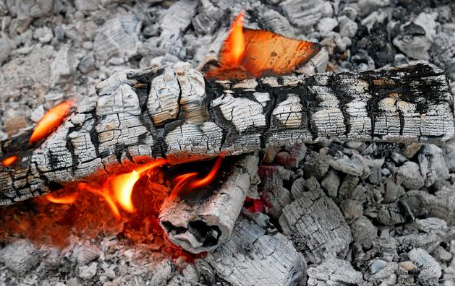
Image: Smouldering wood and ash (Source)

Next morning:
The village is aflame, but not with fire.
Suspicion and rumour fan the flames. Everything changes, dramatically and irrevocably. Mistress Bedlam seems aptly nicknamed.

It is evocative, warm, sad, and spookily unsettling, without anything supernatural - despite rumours of witchery. The ending perfectly balances tragedy and triumph, justice and injustice, laced with tentative hope.

Maps

I love maps and aerial views, but I sometimes take them for granted. Imagine the shock of seeing your first map as an adult, when you’d never been higher than a couple of storeys!

Master Kent has invited Philip Earle, nicknamed Mr Quill, to map the estate. The cottagers are slightly suspicious, but Walter is entranced:
I’ve never before had a true sense of how our estate is shaped… or what those hawks and kestrels see.

He’s also unsettled and critical:
He’s coloured and he’s flattened us. No shadows and no shade… There are no climbs or slopes. The land is effortless: a lie. He hasn’t captured time: how long a walk might take… They complicate to simplify. I have translated them.

Maps use - or assign - labels and names. The village doesn’t have a name, and Mr Quill is disappointed by how prosaic the other names are: West Field, The Warren etc.


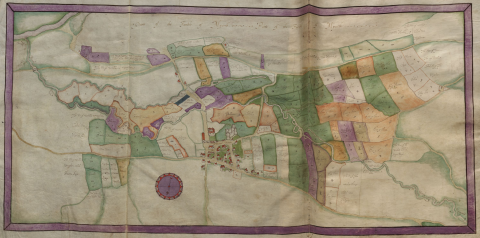
Image: Badminton Estate map from 1587, only a few years before this is probably set (Source)

Boundaries

Maps delineate and define boundaries in literal and deeper ways. They signify and cement change. Many boundaries are mentioned in these pages. There’s the annual tradition of villagers Beating the bounds to confirm and embed their sense of place and belonging. There are also people who cross geographical and behavioural boundaries.

I have reached our village bounds… It has always seemed too precarious a place; on our side of the stone there can be no trespassing… One further step beyond, however, and everything you have is left behind. You are disowned.

Reflection

Walter Thirsk, the narrator, came to the village a dozen years ago, when the current Master inherited. He married a cottager, Cecily, and is now a bereft widower. He has a little education and has experienced other places, which gives him a broader perspective for telling the story - including many aspects he reports as hearsay: “As I imagine it…”. But he is a shrewd judge of character

None of the cottagers have a mirror:
We in this village walk around in blinded ignorance… We know our hands and knees but not our eyes and teeth.
Mistress Kent had one, but when she died, her husband smashed it and buried it with her, in accordance with local custom.

The events of the week expose divided loyalties:
There isn’t one of us - no, them - who’s safe.
Pronouns can be powerful.
I’m not a product of these commons, but just a visitor who stayed.

Ripples become waves, dominoes fall, there are more fires, and metaphors in this sentence are not the only things that become mixed.


Image: Dominoes falling (Source)

Folk religion

We are a heathen company, more devoted to the customs and the Holy days than to the Holiness itself.
The churchyard is filled with the dead, but there’s no church, let alone a priest. There’s just a cross that’s occasionally used as a pillory and as the place where Master Kent conducts ceremonies, such as marriages. There is a deep sense of spirituality, but not so much of religion.The land is the true master, so they thank the soil, more than God:
You do not eat before you cook… Ploughing is our sacrament.

Walter references mummers’ shows as well as Eden, and you don’t need much Bible knowledge to know the depth of symbolism embedded in:
The sheaf is giving way to the sheep.

Quotes

• “Each darkling cloud reminded us how nothing in our fields was guaranteed.”

• “The harvest teamwork allows us to be lewd. Our humour ripens as the barley falls.”

• “These newcomers, these funguses that seek to feed on us” will discover “how thin - and dangerous - our welcome is.”

• “Secrets are like pregnancies hereabouts. You can hide them for a while but then they will start screaming.”

• “We continue not irreligiously, but independent, choosing not to remind ourselves too frequently that there’s a Heaven and a Hell and that much of what we count as everyday is indeed a Sin.”

• “The mood has changed… We were liquid; now we’re stones. The night is closing on a broken note.”

• “Midnight rain, the sort that in the darkness has no form until it reaches you, until it strikes with the cold and keen insistence of a silver-worker’s mallet.”

• “Despite the sweating soil and the enamelling of puddles from the midnight storm, the land itself is harvest-worn.”

• “There is a silent ripeness to the air, so mellow and sappy that we want to breathe it shallowly, to sip it richly like a cordial.”

• “This was precisely what I most liked about this village life, the way we had to press our cheeks and chests against a living, fickle world.”

• “I have the sense my cousin is taking pleasure from sowing these anxieties, in the same way we take pleasure in the sowing of our seed… I fear his harvesting. I think he means to shear us all, then turn us into mutton.”

• “This land… has always been much older than ourselves… Not any more.”

• “Our fields are medicine. All days prove good to those that love the open air.”

See also

• The mystic air of a small rural community reminded me of Max Porter’s Lanny, which has a contemporary setting. See my review HERE.

• Maps can be realistic: Reif Larsen’s The Selected Works of TS Spivet is about a boy obsessed with map-making. See my review HERE.

• Maps can be almost magical: see Alix E Harrow’s The Autobiography of a Traitor and a Half-Savage, which I reviewed HERE.
Profile Image for Clare.
63 reviews144 followers
March 28, 2013
Perhaps the most evocative and realistic depiction of the Enclosure Act and it's effect on the labouring country classes that you will ever read. The narrator, an outsider in the village in which he lives, reports the terrifying ordeal of the villagers as their common land is parceled up and they are driven from the hamlet. Add a dash of Witchfinder General, a soupcon of moral guilt (although this novel seemed preoccupied with sins of ommission rather than the more obvious sins of commission) and shake together with the strangly haunting mixture of free indirect speech and first person narrative and you have modern day classic.

Splendid descriptive passages that seemed utterly of their time and the experience of the narrator as well - such as his description of seeing a land surveyance map of his village for the first time "as viewed by kites, swifts and stars". Or the scratch of the surveyers quill against parchment which they suspect (quite rightly) will end up scratching them.

Rather wonderful.
Profile Image for Jill.
Author 2 books2,056 followers
May 19, 2013
Jim Crace’s HARVEST reads like a simple moral fable of a tiny and remote medieval English village, destroyed externally and internally by the conversion of farms into sheep pastures, but wait! There is far more to it than meets the eye.

Mr. Crace is particularly interested in pairings: everything comes in twos, right from the opening pages.. Two signals of smoke rise up: one signaling the arrival of new neighbors who are announcing their right to stay…the second, a blaze that indicates the master Kent’s dovecote is gone and his doves taken.

Both subplots radiate from these two twinned smoke signals. The stories, narrated by Walter – the manservant of Kent who was paired with him from the start by sharing the same milk – is both an insider and an outsider (yet another pairing). He is not of the village although he has become part of it.

Yet the kind Kent is soon paired with someone else: his pragmatic and heartless cousin, who has come to declare his right to the farm. He has plans for the peaceful agrarian village: *’’’this village, far from everywhere, which has always been a place for horn, corn and trotter and little else, is destined to become a provisioner of wool.” The cousin arrives at a particularly fortuitous time: despite evidence to the contrary, the town has wrongly blamed and pillored the outsiders, an older and younger man, and has placed them in gruesome confinement. The woman who was with them has had her head shorn – much like the sheep to come – and is now in hiding, ready for revenge.

Mr. Crace writes like a dream. His prose is rich and rhapsodic. One example: “The glinting spider’s thread will turn in a little while to glinting frost. It’s time for you to fill your pieces with fruit, because quite soon the winds will strip the livings from the trees and the thunder through the orchards to give the plums and apples there a rough and ready pruning, and you will have to wait indoors throughout the season of suspense while the weather roars and bends inside. “ Pure poetry.

And he pairs THAT – the beauty of his prose – with some substantial themes that resonate for today’s times our close-minded distrust and demonization of outsiders. Our disregard for the true “tillers of the land” in the pursuit of the almighty profit motivation. Our fall from innocence into mistrust and exile. A munificent harvest that reaps nothing but dollars.

“The plowing’s done. The seed is spread. The weather is reminding me that rain or shine, the earth abides, the land endures, the soil will persevere forever and a day. Its seed is pungent and high-seasoned. This is happiness,” Walter reflects. Magnificently evoked, unsettling, and at times painful to read as the village life implodes, HARVEST is yet another testimony to Mr. Crace’s vast talents. For me, it is an undeniable 5-star novel.
Profile Image for Ian.
982 reviews60 followers
October 5, 2015
A historical novel set in England. The time and place are unspecified, but it is the pre-industrial era, and a remote village, "two days by post horse, three days by chariot, before you find a market square". This lack of a wider context takes us within the world view of the inbred villagers, who live as their ancestors have always done, and whose horizons extend no further than their parish boundaries. Parents beat their children's heads against the parish boundary stones, so the children will remember the locations, and not wander beyond them. The life of the village is regulated by custom, and failing that by the local landowner in his manor house. Anything else is too remote to be of any interest.

It is harvest time and the outside world suddenly arrives in the village in the shape of four strangers; a surveyor from town, come to map the village fields; and a group of three outsiders, refugees driven from their own village by enclosure. When the 3 outsiders are unjustly blamed and punished for a crime, a terrible chain of events is set in motion.

The book contains a moral message about consequences, and a political one about the tendency of the rich and powerful to take decisions without regard for their impact on ordinary people. Is the village also an allegory for modern day England/Britain and our attitude towards immigrants? Whichever, this is a well written novel, laconic in style, but atmospheric.
Profile Image for Teresa.
Author 9 books1,031 followers
June 21, 2016
In much the same way The Crucible is an allegory of McCarthyism, this novel too is a political allegory: mainly, of isolationism and the effects of panic due to a perceived threat.

The blurb on the inner flap of the book posits that this idyll is unraveling due to economic progress; and, yes, there is that, but it is the confrontation of the 'immigrants' by the community that comes first and shows the easy moral collapse after a rush to judgment so 'their own' will not get in trouble.

It's told from the first-person point-of-view of a villager who is both insider and outsider, affording us explanations (mostly rationalizations) we wouldn't get from the other villagers; and because of that, at times I was expecting the devastating events to lead to an even more devastating ending, but I try not to penalize a book for my expectations.

The descriptions of the land, in both its dangerous and benign states, are beautiful.
Profile Image for Karen·.
682 reviews900 followers
January 12, 2014

Brilliant

A tale with the cold horrific inevitability of a tsunami bearing down on tiny human figures whose ineffectual scrabblings move at the slow pace of nightmare.

Timeless, mythical drama. An Olympian god, in a mood of resentful restlessness, drops havoc down into an English village in the form of three strangers. What ensues is the collapse of everything that held that village together, a dissolving of morals, customs, homes and families on a monumental scale. Breathtaking.
Profile Image for Cheryl.
330 reviews327 followers
August 10, 2013
Halfway through this novel it dawned on me that this could be interpreted as a deeply allegorical story (I'm slow on the uptake). Despite being set in olde England, when witchery and pillorys were believed in (when convenient), it could be a story of politics and class in America today. Behaviours don't change over the centuries - every generation starts afresh and tries to figure it out on their own. The one thing we are remarkably adept at is rationalising away our moral shortcomings--a skill quickly evidenced by the first-person narrator in this story. It's a remarkable tale of the emotions, behaviours and dependent interactions of the inhabitants of a small village, their fates foretold by their class and economic status.
Cruelty and power are the ways of entropy to which life naturally drifts.

This is longlisted for the Booker, and will be a good contender for the shortlist.
Profile Image for Gumble's Yard - Golden Reviewer.
2,189 reviews1,794 followers
February 27, 2018
The story has a symbolic setting: a peasant village in deep country evocative of 15th-16th Century England. The events of the work take place over one week which includes the harvest festival.

Incredibly evocative book – the writing drips with the atmosphere of Harvest, of the rhythm of seasons and the timelessness of the villagers’ life, of the land and nature as an unceasing master. Key themes are: clearly the Enclosure and the abrupt change it engendered in an almost ageless bucolic lifestyle; creation and the fall – with ideas of labour, banishment, boundary stones, seven days, punishment visited on the innocent; belonging/kinship and exclusion.
Profile Image for Katie.
508 reviews337 followers
December 27, 2013
This is an easy book to appreciate and a difficult book to love.

It is really excellent in terms of setting a scene and creating a sense of atmosphere. Broadly, it's a story about a small English village - date unprovided, though it seems likely sometime in the 17th century - that's teetering on the verge of being thrust into modernity, as the arrival of a new landowner and the English enclosure acts mean that their land, which grew wheat and barley for countless generations, is about to be razed and replaced by hedges and sheep.

There's such a wonderful evocation of landscape in the story, a reality to it, how it's so enormous even though geographically it's pretty small. It feels like a real and specific place, even though it's intentionally generic. The arrival of sheep, which sounds rather practical and mundane from a distance, is elevated to the genuinely tragic when it starts to play out on the ground. There's the sense that by altering the landscape, by enclosing the commons, the past and all its people and customs are getting wiped away. Crace captures the scale of that in a really remarkable way.

His language is also very beautiful. It's mostly unadorned, but that makes the lyrical passages more powerful. There are ten-page sections here where nothing really happens - someone plows a field, or goes for a walk - that are given shape and momentum simply by the way Crace formulates his phrases. There is one particular passage, when our narrator looks at a newly-created map of the land and sees it from above for the first time, that's genuinely beautiful.

That said, the story itself doesn't always work very well. I think, on occasion, characters exist more to amplify a particular mood than because they actually exist within the story as people. This is especially true of one woman within the story, who seems to exist as a generalized source of unease, a generalized force of destruction, and a generalized fantasy for all the men in the story. The plot itself also peters out:

It's worth reading for a the language and the atmosphere. But the potential that these attributes present are not always capitalized upon by Croce, and the substance sometimes falters. It's a feeling more than a story - that's not necessarily a bad thing, but I think it would have been better if it had managed to be both.
Profile Image for Jake Goretzki.
752 reviews155 followers
February 22, 2013
All stylistically very well executed as a picture of a moment in history – date unspecific. It brings the ‘enclosures’ movement in UK history to life, but I'm not sure what it tells me today. It's like looking at a Jean Francois Millet painting in 2013: evocative, rustic, but now what?

And I really struggled to buy into many of the novel's propositions.

First of all, the protagonist and narrator: a curious choice. He's got village rap down to a tee, I'll give him that. Walter is not a local and he's only been there for 12 years, yet he’s our rustic poet and our guide. He isn't, we are told, 'one of us'. Yet he's forever talking about the 'we' and the 'us' (lines like 'The soil is our bread' – at which I wanted to barge in with a pitchfork and yell 'No, mate: you be from Lunnen'). For me this took a lot of the force away from what he was saying and diminished the credibility of that voice. I kept thinking of fox hunting enthusiasts who’ve moved to Berkshire from West London, telling me I don’t understand ‘our country ways’.


I also didn't really know where to place Walter: on the one hand he's a sort of thoughtful outsider (a halfway house between the romantic Mr Quill and the yokel); on the other he's a total klutz. What was he doing, for instance, climbing up to the uppermost room of the manor looking for 'the Beldams'? Or searching out their company, the day after one of them has just been released from torture at his neighbours’ hands?

I also struggled with the way 'Mistress Beldam' became this established, portentous presence in the novel, even though we'd only once fleetingly seen her gobbing on a horse. The elevation of the character didn't really stack up for me and felt quite hammy - like calling the postman 'The Gentleman in Vestments of Night Blue'. I’m not even sure a character like ours would call her 'Mistress Beldam' either - he'd call her 'the shorn woman'. I guess it’s because he had the hots for her (which is also odd, considering she’d just been beaten and shorn).

The weakness of the fixed first person narrator was also an issue for me: other characters didn't really come to life. The ‘Master’ – though a kind of nursery brother of Walter's - is just some bloke in a hat. And despite getting to sympathise with the surveyor, Walter persists in calling him 'Mr Quill’ - which I just didn't find convincing.

I also struggled to believe in some key turns of the plot. Why would the new guvnor and his retinue clear out, just after a massive village conflagration and a change of power? Wouldn't you want to stick around, just in case someone torched your house? And would villagers really head down to a cesspit on the other side of the settlement to do their number twos (what of chamber pots and lobbing it out of the window)? Would a witch hunt really break out like that? And would the villagers really be so refreshingly uninterested in religion? I found it all rather hard to place for this: the only date marker is the sheep enclosure, but apart from that I couldn’t tell if it was 1400 or 1800.


So, a lyrical miniature of a moment in history, but it didn't really go anywhere or reveal anything much for me. If you're looking for a rustic novel that absolutely does deliver - and does history with remarkable skill – look ye no further than yon Adam Thorpe's recently reissued 'Ulverton', which really is dynamite.
This entire review has been hidden because of spoilers.
Profile Image for Trudie.
650 reviews753 followers
December 3, 2022
This is a strange little novel, that I enjoyed but remain largely perplexed by ...

According to the 2013 Guardian review:
Harvest dramatises one of the great under-told narratives of English history: the forced enclosure of open fields and common land from the late medieval era on

This doesn’t exactly sound riveting but there is something quite dreamlike and compelling about this that really surprised me. Plus it’s rather droll which I always enjoy.

the village, far from everywhere, which has always been a place for horn, corn and trotter and little else, is destined to become a provisioner of wool. The word that he and no one dares to whisper let alone cry out is 𝘚𝘩𝘦𝘦𝘱

I think this Jim Crace guy is worth a closer look.
Profile Image for Elaine.
963 reviews488 followers
August 15, 2013
What I loved about this book was the atmosphere, the overwhelming sense of foreboding and isolation, of being surrounded by slightly menacing nature (flesh eating pigs, downpours) and a sense of primordial earthy power. And being utterly alone, at the mercy of whatever happens there. I read the last sections breathless, page turning and heart pounding - sadly, the plot did not fulfill the rich sense of wrongness and dread built up by the atmosphere.

I also liked the fable-like timelessness. At one point we learn that the new master has worn a stiff quilted doublet, and I guess this is the best clue we have that this is more likely to be a Tudor-era enclosure than a later one, but really this is anything but a historical novel. It's a fable of a pre-lapsarian community with pre-Christian communal rituals (the Gleaning Queen)and of the moment when everything suddenly goes wrong, when Eve bites the apple, when modernity creeps around the corner.

And finally, I liked our passive unreliable narrator. The guy who always means to do something, but never quite does and is always too late or too timid. It's an interesting perspective - he'd like to position himself as moral and one of the community, but he's really always looking out for himself, and willing to exploit his outsider status when it's to his advantage.

But there were significantly, things I didn't like. A book that ostensibly relates to enclosures and the coming of the modern era ends up being much more about an older, frankly more banal story: The seductive female sower of discord, the untamed woman who is both object of desire and object of hatred. And that's dull, especially as Crace doesn't do much with the archetypal enchantress other than set her up and leave her there to wreak her havoc. The real villain is not the proto-capitalist new master, nor sheep (which are wonderfully demonized here), but a sexy older woman. Yawn!

And the end is limp. I kept thinking I missed something - and I won't go into more detail for fear of spoilerdom, but I really thought all that wonderfully suggestive brooding and menace was going somewhere more interesting than it did.
Profile Image for Kinga.
528 reviews2,724 followers
March 20, 2013
“What starts with fire will end with fire, I’ve heard it said.”
And so starts and ends ‘Harvest’, Jim Crace’s latest novel (and supposedly his last, as he will be retiring from writing). The fire in ‘Harvest’ is not the kind that has sky reaching blazing flames. It reminded me more of dying embers, gently fizzling out.

During our book club discussion it became apparent that the book touches on a multitude of themes and subjects but it all seemed rather understated. It was as if Crace took on to paint this great epic scene but then delivered only a rough shadowy sketch rather claustrophobic in nature.
It’s a story of a small village which comes apart with a surprising speed following a chain of events initiated by the arrival of three strangers. The time and place of action are not spelled out but it could be a 15th or 16th century England. In the end, it doesn’t really matter because the story is more of a timeless allegory about change and modern ways. Its main character is that wretched community which finds out that, despite decades of history, its foundations are precarious.

Much like Barry Unsworth, Jim Crace is not much into drawing individual portraits of his characters, instead offering us a generic ‘peasant’ and a generic ‘landowner’. Only the narrator, Walter, has something resembling a personality and he suffers an internal squibble when he tries to figure out where he should place his loyalties (to say it was an internal battle would be an overstatement).

Even though I wouldn’t describe this book epic or ‘tour de force’, it has its undeniable charm. The language is beautiful; you can smell the soil and hear the trees; and it does make you lament the fact that things just won’t stay the same, the change will always come and destroy the old ways no matter how much you cry. And eventually the new will become the old and in due course will be lamented when something even newer comes along. I suppose it’s human nature to always oppose change. If you don’t believe me, just go to facebook and see how each time they introduce something new, half of the people scream ‘Bring the old facebook back’, as if completely unaware that the ‘old facebook’ they’re defending now is exactly that facebook they were opposing the last time. Ah, humans, creatures of habit, you’re so cute.
Profile Image for Paul Fulcher.
Author 2 books1,952 followers
April 3, 2018
An impressive return to form by Jim Crace, in what he expected to be his last novel.

Ostensibly a historical novel - about the enclosure of common land in the UK - Crace consciously rejects the usual rules of historical fiction. He is careful not to state where the book is set - even the villagers have no name for their dwelling other than "The Village" - or when in time it is set with no reference to external events by which is could be dated. Potential signposts - such as the mention of mauve, a colour which was only named in 1856, long after one would have otherwise dated the book - are more likely to be misleading - possibly even intentionally - than useful.

The writing style in the book is very powerful - simultaneously simple but also lyrical language, which perfectly evokes the life of the villagers. A friend described it as "Magnus Mills meets Andrei Makine" - a combination which I thought couldn't work until I read the book.

However I have two significant reservations:

- the book is told via the first person narrator, Walter Thirsk, and the character doesn't always come across as convincing as his prose is sometimes too sophisticated for his station.

- the tension in the story ,that was built up in the opening pages and in various portentous comments of the narrator, ends us dissipating rather than reaching a satisfying conclusion.

Overall, a worthwhile read and deserving of its place on the Booker shortlist.
Profile Image for Fiona.
982 reviews526 followers
May 7, 2019
I just didn’t have patience for this book. I can appreciate the care Crace has taken to describe the social conditions of the time and the fear of change experienced by people with no leverage to resist. It was very Thomas Hardy-esque in that respect but reached nowhere near those dizzy heights of excellence. I got bored and life is too short to waste on books that leave me cold.
Profile Image for Antonomasia.
986 reviews1,490 followers
August 24, 2013
[4.5] Full of gorgeous writing about the landscape and a semi-mythical past. The entire book takes place in one week at harvest-time, so this and the next month or so is the perfect season to read it. (Rather a lot of Booker books, from this and earlier years, are set in the summer, I've noticed.)

What sky is blue is more thinly so this afternoon. The woodland canopies, viewed from this sloping field, are sere or just a little pinched with rust, the first signs of the approaching slumber of the trees. Come maids and sons of summer, get ready for the winter ice. The air is nipping at your cheek, the cold is tugging at your wrist. The glinting spider's thread will turn in a little while to glinting frost. It's time for you to fill your pies with fruit, because quite soon the winds will strip the livings from the trees... and you will have to wait indoors through the season of suspense while weather roars and bends outside.

Harvest is set in a remote village, leniently ruled and where the spiritual attachment to the land is far greater than that to an imported monotheistic god. The costumes, the technology and political preoccupations are those of early-modern England, but this is also an allegorical land outside time. The country is never named and details appear from other ages such as a chariot as a likely mode of transport, the apparent absence of printing, and later-dated details as mentioned here by Philip Hensher (who seems to misunderstand the timelessness but does at least appreciate the book). Fantastical ones too: alongside wolves and bears, another local predator not seen just lately is a 'dragoncat'. Harvest's original world bears much resemblance to my daydreams of retreat into the past, many technologies de-invented, working on the land and eating what is grown. (In practice, this is indulged mostly by watching Tales from the Green Valley, going barefoot on lawns, doing a lot of cooking and perhaps listening to the Levellers).

Harvest, though, is not so much about an idyll as its ruin. The dread which permeates the book, along with its almost-abstract setting, are very much like Coetzee's Waiting for the Barbarians (whose forces are also too strong to fight). The wonderful description and scattering of archaic and rural words are always present but it is not a happy book. Authoritarianism arrives in the form of a gentleman who has inherited lordship of the village, bringing enclosures for sheep farming and the attendant deracinating of humanity, and other brutal characteristics of the Tudor era.

Like another 2013 Booker-longlister, Unexploded, more so, in fact, this is a historical novel which comments on the present as well as the past. Both Crace and MacLeod highlight increasingly authoritarian and intrusive aspects of society: the latter the acceptance of giving up liberty for a little temporary safety; the former, here, its foundation in economic gain and the wish to have power over aspects of life that were previously, at least for a while, benignly neglected by government or not considered its business.

This is such wonderful writing. At least as far as I'm concerned, Crace has always been under the radar - for as long as I can remember I'd struggled not to conflate him with Jim Dodge, and he was a name only seen on the shelves of libraries and bookshops, not in recommendations or lists of best contemporary novels. His words are much lovelier and preoccupations, at least here, more understandable to me than more ostentatiously lauded authors like Ian McEwan and it's a shame nothing had spurred me to read him before. (I also like that, having been to a technical college and living in Birmingham, he is not quite typical of the British literary set.) Before I read this book, I'd thought Crace was a fuddy-duddy choice to back as Booker winner, but Harvest itself is fully deserving (not just an excuse for a "lifetime achievement" win) ... though books I like this much rarely win.
Profile Image for Diane S ☔.
4,901 reviews14.6k followers
January 28, 2013
Had a very hard time rating this book. The writing is outstanding, time and place one can imagine what living here is like. and an unreliable narrator. The tone is foreboding, a little like children of the corn, but much better prose. My problem is partly the pacing, which moves so slowly, also one can only read so much about grain harvest, chaff and pigs also I am not sure I liked the ending. Anyway very atmospheric, story is good once it gets going and I loved the prose.
Profile Image for Lee.
381 reviews7 followers
March 8, 2017
Grows in stature in the mind in the days after reading, and scenes from the book have lingered sharply. And if it doesn't win the Booker Prize I'll eat my copy. Put your money down!
Profile Image for Kuszma.
2,849 reviews285 followers
September 25, 2019
Bizonyos történelmi regényeknél a történelmi közeg csak eszköz, amivel az író távol tartja magától a demagógia vádját – nos, ez tipikusan egy ilyen történelmi regény. Maga a hely és az idő nagyjából körülhatárolható – az ipari forradalom Angliájában vagyunk, valahol vidéken –, de alig hiszem, hogy akad ember ezen a szűkre szabott bolygón, akinek a szöveg olvasásakor nem az itt és most pulzál az agyában. Adott ugye ez a kis földművelő közösség, aki retteg mindentől, ami idegen: retteg azoktól, akik „nem a helyi földdel a körmük alatt születtek”, és retteg magától a változástól is, attól, hogy jól ismert világa megszűnik, és a terhes, de legalább megszokott mezőgazdasági munkákat egyszer csak felváltja a birkatenyésztés, amit a textilipar robbanásszerűen megnövekedett gyapjúigénye tesz szükségessé*. És az ember, ha retteg, minden szörnyűségre képes. Bizony ám. Crace világában tulajdonképpen senki sem jó**: a faluközösség tudatlan, uraik vagy befolyásolhatóak, vagy számító dögök, és hát – szögezzük le – az idegenek sem bűntelenek. Persze a kataklizma, amit végül okoznak, tekinthető igazságos bosszúnak, de mondhatjuk rá azt is, hogy maga a kataklizma utólagosan is igazol mindent, amit ellenük elkövettek… persze csak ha összekeverjük az okot az okozattal. Mert senki sincs bűntelen. Nem bűntelen az elbeszélő sem, pedig voltaképp nem rossz ember ő, csak épp nem tesz semmit. Tudja, mi helyes, mi helytelen, de cselekedni rest vagy gyáva – hogy nagyobb bűnös-e ő ezért, mint aki tudatlanul teszi a rosszat… nos, azt hiszem, pont ez a kérdés ennek a regénynek a tengelye, amin valójában forog.

* Ezt én teszem hozzá tudálékosan – természetesen a közösség eddig a felismerésig nem jut el.
** Kivéve „Lúdtoll uraság” figuráját – de hát ő is hová jut a jóságával? Oda, ahová gondoljátok, igen.
Profile Image for Doug H.
286 reviews
September 14, 2014
Possibly Crace's best novel since 'Quarantine'. It's not a long novel, but it's definitely not a quick read. Every word is carefully placed. This is lyric writing by a master storyteller in full control of his craft and the story he tells is dense with allegory and archetypes. (I had to reread entire paragraphs as I went along in order to absorb a lot of it.) If I'm making this sound like the sort of novel you had to read for a school assignment, it is. But It also happens to be a very compelling and entertaining story full of paranoia and suspense. Set at a period in history with a big cultural shift (the introduction of England's Enclosure Act), I noticed a lot of thematic similarities with Crace's first novel 'The Gift of Stones'. If you liked this novel, I'd highly recommend reading that one too.

As is always the case with a Crace novel, Nature rules!
Profile Image for Dee.
460 reviews151 followers
November 29, 2023
After enjoying Jim Crace's book Being Dead i was very much looking forward to starting something else by this Author.
This in comparison has a completely different feel/take to the other but with slight similar meanings within.
It is amazing the variation in style. This story really takes us right into the moment again as 'Being Dead' also does.

Crace really has an amazing way of explaining a situation and building a world around a story. Great imagery. This time transporting us to a different era where we are introduced to some interesting characters. Who is to blame? What has actually happened here? This story takes us down a path of loneliness and survival for this main character which was rich in dark and almost mystical undertones.
Profile Image for Carla.
285 reviews85 followers
November 1, 2016
O dia chegou ao fim e a luz foi apagada. Avanço a custo pela noite final sem ninguém para entrelaçar a sua mão molhada na minha. E sem ninguém para me tirar o chapéu, como a nossa tradição manda que se faça, quando, por causa do folhelho e da humidade, não consigo evitar um espirro, uma bênção não intencional ao campo. Mas mentiria se dissesse que me sinto tão escuro e tão sombrio como as nuvens. Acho que estou entusiasmado, de certa forma estranha. O campo está lavrado. A semente espalhada. O tempo está a recordar-me que, chova ou faça sol, a terra se mantém, a terra persiste, o solo perseverará para sempre e mais um dia. O seu cheiro é pungente e forte. Isto é a felicidade.
Profile Image for Robert Wechsler.
Author 9 books146 followers
May 23, 2017
Jim Crace goes out in his “last” novel showing that he is the great master of rhythm in English prose. Just reading the novel for this is enough to make it a great reading experience. Add to that the protagonist’s singular (and calmly repulsive) first-person voice and the violent story of a world on the cusp of radical change, and you have a truly great novel. And an important one, considering that we too are on the cusp of a period of radical change, and most of us, like the narrator, are doing very little about it.
Profile Image for Eric Anderson.
716 reviews3,919 followers
January 12, 2015
Have you ever finished a book and you know it’s affected you on some deep subliminal level because you have very vivid dreams that evening? This has happened to me before when I read the fantastic nightmarish graphic novel Lost Girls by Alan Moore and Melinda Gebbie. I think with that book the dreams were instigated by Gebbie’s powerful drawings. It’s happened again with Harvest and in this case I think it’s because of Crace’s masterful use of language and his subject matter.

Read my full review on LonesomeReader review of Harvest by Jim Crace
Profile Image for Steve.
962 reviews112 followers
November 4, 2015
Harvest is a poetic, beautiful read. This book is dense with alluring prose sprinkled with very little dialogue. It feels like a much longer read that it really is, and I can't say it's an easy read, but it is definitely gorgeous.

The storyline is a relatively simple one: The calm order of a remote, pre-industrial English village and the estate upon which it depends is disrupted by a number of events, including the arrival of four mysterious strangers who come into conflict with the villagers. The estate's precarious equilibrium is also threatened by a new owner, whose entrance is a result of history and economic development. This unfolds through the eyes of Walter Thirsk, himself an interloper in the village, having arrived 12 years earlier. His is an ironic perspective, one narrated at once through the eyes of an outsider and through the eyes of a friend. (Much of rural Britain is still like this. I have a missionary friend that serves in rural southwest England, and is still viewed as an outsider after having lived there almost 20 years.)

Crace weaves the characters and the events into the text effortlessly, encouraging the reader to explore fundamental questions about our world is perceived. In this, Harvest could be viewed as an allegory, as the Tudors moved England into a tariff protection regime in order to build the wool industry, laying the foundation for Britain’s wealth for centuries. This move, while economically sound, had a huge negative impact on the people of the land. The storyline shows this impact on a handful of rural people that get caught up in momentous events outside of their control. A blank portrait of the manor and village serves as a metaphor at both the beginning and end of the tale.

Crace's description of the low land of the estate, known among the locals as the “Turd and Turf”, is simply outstanding. Through Thirsk's eyes, we see the village's natural latrine through bawdy vision juxtaposed with the beauty of the plants that grow in and around the marshland. Throughout the book, the description of the rural life, the details of the natural world, and the relationships between the villagers are depicted in rich, poetic prose.

The only drawback is the ending, which leaves the reader with many unanswered questions. The ending wasn’t a conclusion; it just sort of trailed off, like watching a fire slowly burn itself out. It was very anticlimactic, but somehow even that worked with the overall atmosphere of the book.
Profile Image for Lou.
887 reviews924 followers
February 13, 2013
A story set in bygone days of a English village, the characters in this story go through hard times some involving that of arson and death.
The story is told with some great prose with metaphors and careful sentencing. I felt a great sense of place and time in this story which is slow paced and successfully kept me reading on . A memorable story to be consumed in a few readings.


"As I've said, we are not a hurtful people. We are, though, fearful, proud and dutiful. We do what must be done."

"But, as I've said, these fields are far from anywhere, two days by post horse, three days by chariot, before you find a market square; we have no magistrate or constable; and Master Kent, our landowner, is just. And he is timid when it comes to laws and punishments."

"..they took the castling lane beside the manor house and strode with devilry in their steps-the kind that can flourish only on a day when there's no other work to do-toward the one remaining twist of smoke."

"Secrets are like pregnancies hereabouts. You can hide them for a while but then they will start screaming."

"I am holding my breath, not to he discovered. How silent it has become, beyond the pelting rain. I fear there's no one living anywhere. The night is ponderous. No owl or fox is keen to interrupt the darkness. It seems that even the trees have stopped their stretching and their creaking, their making wishes in the wind, to hold their breaths and stare like me toward the pillory."

"A mighty storm of reckoning was on its way, if there was any justice in the world. The air was cracking with the retribution and damnations that, in my hearts of hearts, I knew that some of us deserved. I prayed that this was just a dream and that soon the couldn't-care-less clamour of the sunrise birds would rouse me to another day, a better day, a bloodless one, one in which, despite my hand, I'd do my common duty and drag up a log or stone to make that short man tall. I prayed that time would turn back on its heels and surprise us with a sudden billowing of breath beneath the baling cloth."


Review also @ http://more2read.com/review/harvest-by-jim-crace/
Profile Image for Mientras Leo.
1,730 reviews203 followers
August 8, 2017
Toda una sorpresa, muy por encima de loq ue yo esperaba, la verdad
Displaying 1 - 30 of 1,204 reviews

Can't find what you're looking for?

Get help and learn more about the design.