

What do you think?

The Red House
An dazzlingly inventive novel about modern family, from the author of
The Curious Incident of the Dog in the Night-time
The set-up of Mark Haddon's brilliant new novel is simple: Richard, a wealthy doctor, invites his estranged sister Angela and her family to join his for a week at a vacation home in the English countryside. Richard has just re-married and inherited a willful stepdaughter in the process; Angela has a feckless husband and three children who sometimes seem alien to her. The stage is set for seven days of resentment and guilt, a staple of family gatherings the world over.
But because of Haddon's extraordinary narrative technique, the stories of these eight people are anything but simple. Told through the alternating viewpoints of each character, The Red House becomes a symphony of long-held grudges, fading dreams and rising hopes, tightly-guarded secrets and illicit desires, all adding up to a portrait of contemporary family life that is bittersweet, comic, and deeply felt. As we come to know each character they become profoundly real to us. We understand them, even as we come to realize they will never fully understand each other, which is the tragicomedy of every family.
The Red House is a literary tour-de-force that illuminates the puzzle of family in a profoundly empathetic manner -- a novel sure to entrance the millions of readers of The Curious Incident of the Dog in the Night-Time.
The set-up of Mark Haddon's brilliant new novel is simple: Richard, a wealthy doctor, invites his estranged sister Angela and her family to join his for a week at a vacation home in the English countryside. Richard has just re-married and inherited a willful stepdaughter in the process; Angela has a feckless husband and three children who sometimes seem alien to her. The stage is set for seven days of resentment and guilt, a staple of family gatherings the world over.
But because of Haddon's extraordinary narrative technique, the stories of these eight people are anything but simple. Told through the alternating viewpoints of each character, The Red House becomes a symphony of long-held grudges, fading dreams and rising hopes, tightly-guarded secrets and illicit desires, all adding up to a portrait of contemporary family life that is bittersweet, comic, and deeply felt. As we come to know each character they become profoundly real to us. We understand them, even as we come to realize they will never fully understand each other, which is the tragicomedy of every family.
The Red House is a literary tour-de-force that illuminates the puzzle of family in a profoundly empathetic manner -- a novel sure to entrance the millions of readers of The Curious Incident of the Dog in the Night-Time.
273 pages, Paperback
First published May 10, 2012
About the author
Mark Haddon
86 books4,199 followersMark Haddon is an English novelist, best known for The Curious Incident of the Dog in the Night-Time (2003). He won the Whitbread Award, the Dolly Gray Children's Literature Award, the Guardian Prize, and a Commonwealth Writers Prize for his work.
Ratings & Reviews
Friends & Following
Create a free account to discover what your friends think of this book!
Community Reviews
Displaying 1 - 30 of 2,612 reviews

June 19, 2012
I loved The Curious Incident of the Dog in the Night Time and A Spot of Bother, so I was very excited once I heard about this novel, and then became utterly disappointed with what a chore this one is to read. It's told in a stream of consciousness style when eight people get together -- an estranged brother and sister and their two families for a week of vacation after the brother and sister's mother died. The point of view shifts from one person's interior thoughts to the next from one paragraph to another, but often the switch occurs within a paragraph. Countless times throughout the book you have to re-read sections to figure out whose point of view it is, and a several times it's impossible to guess. Often there are passages when we get excerpts of what someone is reading -- and you can't always be sure which character it is. While this may be interesting the first few times, it quickly becomes tedious. Then there are riffs like this one:
Marja, Helmand. The sniper far back enough from the window to stop sun flaring on the rifle sight. Crack and kickback. A marine stumbles under the weight of his red buttonhole. Dawn light on wile horses in the Kentii Mountains. Huddershfield, brown sugar bubbling in a tarnished spoon. Turtles drown in oil. The purr of binary, a trillion ones and zeroes. The swill of bonds and futures. Reckitt Benckiser, Smith and Nephew. Rifts and magma chambers. Eyjafjallajokull smoking like a witch's cauldron.
It goes on like this for many more lines -- I'm not sure what it's supposed to be -- descriptions of all that's going on in the world, while these 8 people try to make sense of their lives?
Late in the book, we just get a long list of every item in a novelty shop the characters visit. It was fun when Tim O'Brien used that trick in The Things They Carried because each person's possessions revealed their personality, but I'm not sure what knowing all the curios in this paritcular curio shop does for me or any of the characters.
It's too bad because the characters' dilemmas -- the sister is going crazy over memories of her deformed stillborn baby, her ambition-less husband is having an affair, the brother is learning his wife has secrets and he has to be a better husband -- are all very interesting, not to mention the children's various problems -- the most interesting of which is a teenage girl coming to a slow realization of her sexual orientation. There was enough tension and character development in the book to make it somewhat worthwhile, but you have to have a lot of patience for artsy, fartsy writerly technigues to get through it. (Some readers might like the experimentation, but I obviously am not one of them.)
Marja, Helmand. The sniper far back enough from the window to stop sun flaring on the rifle sight. Crack and kickback. A marine stumbles under the weight of his red buttonhole. Dawn light on wile horses in the Kentii Mountains. Huddershfield, brown sugar bubbling in a tarnished spoon. Turtles drown in oil. The purr of binary, a trillion ones and zeroes. The swill of bonds and futures. Reckitt Benckiser, Smith and Nephew. Rifts and magma chambers. Eyjafjallajokull smoking like a witch's cauldron.
It goes on like this for many more lines -- I'm not sure what it's supposed to be -- descriptions of all that's going on in the world, while these 8 people try to make sense of their lives?
Late in the book, we just get a long list of every item in a novelty shop the characters visit. It was fun when Tim O'Brien used that trick in The Things They Carried because each person's possessions revealed their personality, but I'm not sure what knowing all the curios in this paritcular curio shop does for me or any of the characters.
It's too bad because the characters' dilemmas -- the sister is going crazy over memories of her deformed stillborn baby, her ambition-less husband is having an affair, the brother is learning his wife has secrets and he has to be a better husband -- are all very interesting, not to mention the children's various problems -- the most interesting of which is a teenage girl coming to a slow realization of her sexual orientation. There was enough tension and character development in the book to make it somewhat worthwhile, but you have to have a lot of patience for artsy, fartsy writerly technigues to get through it. (Some readers might like the experimentation, but I obviously am not one of them.)

May 14, 2019
What this book is about, is about incidents and dogs in the night-time! No sorry, it's ... now time for something completely different!
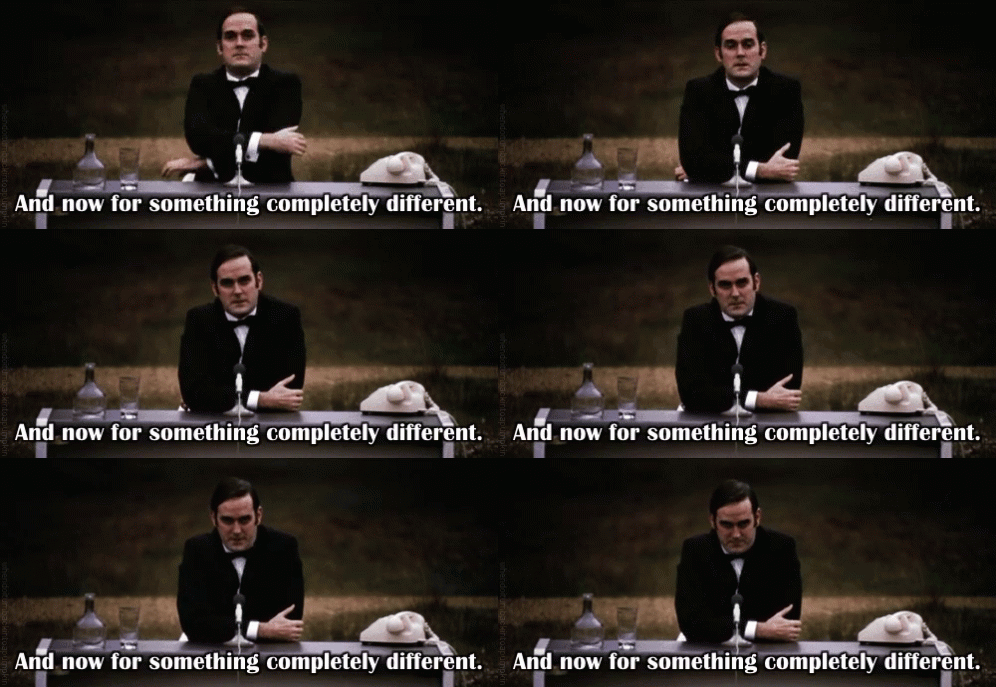
A wonderfully low-key but very good read, after over 20 years apart a brother and sister reunite, taking their families on a combined holiday, sharing a rented house on the Welsh border. What ensues is a delicately and wonderful created comedy of manners, secrets and lies; the Welsh country air itself and the remoteness of the holiday seems to have the family members reevaluating who they are, who
It's not innovative or ground breaking like the book Mark Haddon is most famous for ...but what it is, is is a wonderful day by day break down of two families so conventional on the outside, yet highly dysfunctional once you remove the veneer. Terrific read - 9 out of 12.

2019 read
A wonderfully low-key but very good read, after over 20 years apart a brother and sister reunite, taking their families on a combined holiday, sharing a rented house on the Welsh border. What ensues is a delicately and wonderful created comedy of manners, secrets and lies; the Welsh country air itself and the remoteness of the holiday seems to have the family members reevaluating who they are, who
It's not innovative or ground breaking like the book Mark Haddon is most famous for ...but what it is, is is a wonderful day by day break down of two families so conventional on the outside, yet highly dysfunctional once you remove the veneer. Terrific read - 9 out of 12.
2019 read

May 19, 2012
After attending several writing workshops in recent months, I've noted the popularity of fragmented, stream-of-consciousness writing among men of a certain demographic. White, aged somewhere between skinny hipster and the first thickening of the waistline, well-educated, enamored of morose, Sisyphean humor à la David Sedaris or, oh, let's say Mark Haddon. They write to a beat, disguising punchlines of angst in scattered phrases that connect like poetry but which strive to convey plot and character. It sounds really cool when read aloud; you get lost in the riffs and the rhythms of postmodern paragraphs. But I'm not convinced it makes for good story.
When a writer of Mark Haddon's skill approaches a story using similar techniques, you can count on something pretty remarkable. For within the randomness of phrases, the phrases that fall away to ellipses, the ellipses that join ever changing points of view, you are presented with warm, nutty, tortured and scarily familiar characters.
And the characters are what I adore about The Red House. In his latest take on Tolstoy's famous "Happy families are all alike; every unhappy family is unhappy in its own way" Haddon reunites a mildly-estranged sister and brother in a house hidden in a remote Welsh valley. For the week's holiday at "The Red House," the siblings bring their spouses and children. Everyone's emotional baggage is packed tight with hang-ups, hurts, secrets and silliness.
The children sparkle with complexity and empathy. Their individual storylines and the prickly and sweet ways the author brings the characters together and plays them against each other rings true. I'm far less enamored of the relationships between the spouses, but the interactions between siblings- and spouses-in-law are hilarious and painful - hilariously painful - because they are so real. How awkward and anxious we are with those whom we are forced by blood or marriage to spend time. How often they are people we would never choose to befriend, but we have to figure out a way to love them, all the same. Haddon is a master of making readers fall in love with his characters, despite our better judgment.
There is no central protagonist or narrator of The Red House. The points of view shift rapidly between the four adults, three teenagers and an eight year old boy. Haddon explores their thoughts and in doing so, reveals their characters. It's not difficult to keep up or make the switch between voices; rather, it's a thrill being on the Haddon emotional rollercoaster.
But honestly, the fragmented paragraphs, the jittery sentences, the lists, book excerpts, the contents of a second-hand shop just don't work for me. Fortunately, Haddon eases up on the clutch as the book continues, and the jerky ride smoothes out, but I admit to a fair amount of skimming through these bits. They're boring. They read like those "Now, let's share our work with the class," moments when the bespectacled software designer wearing threadbare checked Vans spins out his clever three hundred word response to a writing prompt. It sounds just awesome, but is utterly incomprehensible and bears no resemblance to a story.
I'd go for 3 1/2 stars here. It's a good read. You can sift out the pretentious parts if you'd like. They aren't my thing, but they may be yours. The rest, we'll probably agree, is purt near pitch perfect.
When a writer of Mark Haddon's skill approaches a story using similar techniques, you can count on something pretty remarkable. For within the randomness of phrases, the phrases that fall away to ellipses, the ellipses that join ever changing points of view, you are presented with warm, nutty, tortured and scarily familiar characters.
And the characters are what I adore about The Red House. In his latest take on Tolstoy's famous "Happy families are all alike; every unhappy family is unhappy in its own way" Haddon reunites a mildly-estranged sister and brother in a house hidden in a remote Welsh valley. For the week's holiday at "The Red House," the siblings bring their spouses and children. Everyone's emotional baggage is packed tight with hang-ups, hurts, secrets and silliness.
The children sparkle with complexity and empathy. Their individual storylines and the prickly and sweet ways the author brings the characters together and plays them against each other rings true. I'm far less enamored of the relationships between the spouses, but the interactions between siblings- and spouses-in-law are hilarious and painful - hilariously painful - because they are so real. How awkward and anxious we are with those whom we are forced by blood or marriage to spend time. How often they are people we would never choose to befriend, but we have to figure out a way to love them, all the same. Haddon is a master of making readers fall in love with his characters, despite our better judgment.
There is no central protagonist or narrator of The Red House. The points of view shift rapidly between the four adults, three teenagers and an eight year old boy. Haddon explores their thoughts and in doing so, reveals their characters. It's not difficult to keep up or make the switch between voices; rather, it's a thrill being on the Haddon emotional rollercoaster.
But honestly, the fragmented paragraphs, the jittery sentences, the lists, book excerpts, the contents of a second-hand shop just don't work for me. Fortunately, Haddon eases up on the clutch as the book continues, and the jerky ride smoothes out, but I admit to a fair amount of skimming through these bits. They're boring. They read like those "Now, let's share our work with the class," moments when the bespectacled software designer wearing threadbare checked Vans spins out his clever three hundred word response to a writing prompt. It sounds just awesome, but is utterly incomprehensible and bears no resemblance to a story.
I'd go for 3 1/2 stars here. It's a good read. You can sift out the pretentious parts if you'd like. They aren't my thing, but they may be yours. The rest, we'll probably agree, is purt near pitch perfect.

September 9, 2026
Acompanhados e Sós: A Ilusão das Relações Familiares
Em A Casa Vermelha, Mark Haddon explora a solidão partilhada e a desconexão emocional ao reunir dois irmãos afastados e as suas famílias numa casa de campo. Através da perspetiva de oito personagens, o romance expõe lutos e frustrações, evidenciando que a proximidade física não assegura a ligação entre pessoas.
Cada personagem carrega o seu próprio abismo particular. Estão todos na mesma sala, partilham as mesmas refeições, mas habitam planetas inteiramente distintos.
A Casa Vermelha é um retrato brilhante sobre a claustrofobia dos laços de sangue. É um livro que nos deixa a pensar sobre a ironia das relações modernas: a dolorosa e universal experiência de estarmos, ao mesmo tempo, profundamente sós e permanentemente acompanhados.
—————————————
Together, Yet Surrounded: The Illusion of Family Ties
In The Red House, Mark Haddon explores shared loneliness and emotional disconnection by gathering two estranged siblings and their families in a country house. Through the perspective of eight characters, the novel exposes grief and frustrations, proving that physical proximity does not guarantee a connection between people.
Each character carries their own private abyss. They are all in the same room, sharing the same meals, yet inhabiting entirely different planets.
The Red House is a brilliant portrait of the claustrophobia of blood ties. It is a book that leaves us reflecting on the irony of modern relationships: the painful and universal experience of being, at once, profoundly alone and perpetually surrounded
.
Em A Casa Vermelha, Mark Haddon explora a solidão partilhada e a desconexão emocional ao reunir dois irmãos afastados e as suas famílias numa casa de campo. Através da perspetiva de oito personagens, o romance expõe lutos e frustrações, evidenciando que a proximidade física não assegura a ligação entre pessoas.
Cada personagem carrega o seu próprio abismo particular. Estão todos na mesma sala, partilham as mesmas refeições, mas habitam planetas inteiramente distintos.
A Casa Vermelha é um retrato brilhante sobre a claustrofobia dos laços de sangue. É um livro que nos deixa a pensar sobre a ironia das relações modernas: a dolorosa e universal experiência de estarmos, ao mesmo tempo, profundamente sós e permanentemente acompanhados.
—————————————
Together, Yet Surrounded: The Illusion of Family Ties
In The Red House, Mark Haddon explores shared loneliness and emotional disconnection by gathering two estranged siblings and their families in a country house. Through the perspective of eight characters, the novel exposes grief and frustrations, proving that physical proximity does not guarantee a connection between people.
Each character carries their own private abyss. They are all in the same room, sharing the same meals, yet inhabiting entirely different planets.
The Red House is a brilliant portrait of the claustrophobia of blood ties. It is a book that leaves us reflecting on the irony of modern relationships: the painful and universal experience of being, at once, profoundly alone and perpetually surrounded
.

September 12, 2012
I liked the ride on this one a lot, though I can’t easily predict which friends would be equally pleased. There is a lot to be said about trusting a good chef to know what to serve. So one should release expectations before cracking this book. There is no wondrous Asperger savant kid in this one nor hapless and resilient man with a humorous Walter Mitty-like interior monologue. Here we get an extended dysfunctional English family (actually the families of two siblings) thrown together on a holiday in rural Wales and a lot of stream-of-consciousness among the 4 adults, three teenagers, and an 8-year old. There is little in the way of humor. Maybe this doesn’t seem a promising premise to many readers, but I felt it was quite a powerful slice of life with a lot of heart, wisdom, and interesting character development.
The magic for me lies in Haddon’s use of nearly equal perspectives from the minds of eight characters. Before you object to stream-of-consciousness writing based on your fill from so many masters of decades gone by, you have to admit that if a writer really wants to portray the life of a person, they have to at some level emulate the way their mind works. And if your inquiry reaches toward what a family means, then a book bent on recreation of the symphony of minds could have some attractions for you. But where is the grounding in this approach? The raw and personalized perceptions, the private hurts, the poisonous thoughts, and the secret desires in this ensemble quickly looks like it will spin this world out of control. Yet, even though each character is flawed and variously messed up with emotions of jealousy, grief, guilt, lust, religious yearnings, or despair (you name it, the whole human nine yards), each takes steps either to improve their situation or to vouchsafe a path to continue bumbling along, helped along through strife or cooperation with each other. It feels a little like development in a terrarium, a fertile microcosm of the human race.
I appreciated Kingsolver’s use of different family voices, young and old, to tell a tale from different perspectives in her “Poisonwood Bible”. There is some of that same pleasure in this book for me. In both books, when dark private realities come to light, there is eventually a surprising broad convergence on mutual understanding. For example, a mother obsesses over a stillborn child from 18 years ago and how it drives her to imagine the daughter alive and growing in the present. Her living daughter struggles to come to terms with her lesbian leanings and the undermining of her fundamentalist faith. Despite the tenuous nature of the family bonds and their limited doses of moral courage, the secrets are digested by the family and taken in stride. Haddon seems to be revealing how a family as a whole can be more than the sum of its parts.
I understand how some readers can be frustrated with a bit of a game Haddon plays when he doesn’t always identify the character who lies behind a particular thought process he unfurls. In Woolf’s “Mrs. Dalloway” or Joyce’s “Ulysses” you didn’t have such challenges. And sometimes an omniscient observer breaks through, which some might judge to detract from the realism of the immersion. I think these devices lighten the load a bit in the same way the Wizard of Oz did when he punctured Dorothy’s desperate bubble. Here are a couple of examples (or maybe they are from the mind of one of the characters; some scholar could enlighten me):
“One person looks around and sees a universe created by God who watches over its long unfurling, marking the fall of sparrows and listening to the prayers of his finest creation. Another person believes that life, in all its baroque complexity, is a chemical aberration that will briefly decorate the surface of a ball of rock spinning someone among a billion galaxies. And the two of them could talk for hours and find no great difference between each other, for neither set of beliefs makes us kinder or wiser.”
“Time speeds up….A day becomes an hour, becomes a minute, becomes a second. …Buildings inhabit the earth, growing like spores, sending out tubers, seeding new towns, new villages, new cities till they all are drowned in sand or jungle.”
The magic for me lies in Haddon’s use of nearly equal perspectives from the minds of eight characters. Before you object to stream-of-consciousness writing based on your fill from so many masters of decades gone by, you have to admit that if a writer really wants to portray the life of a person, they have to at some level emulate the way their mind works. And if your inquiry reaches toward what a family means, then a book bent on recreation of the symphony of minds could have some attractions for you. But where is the grounding in this approach? The raw and personalized perceptions, the private hurts, the poisonous thoughts, and the secret desires in this ensemble quickly looks like it will spin this world out of control. Yet, even though each character is flawed and variously messed up with emotions of jealousy, grief, guilt, lust, religious yearnings, or despair (you name it, the whole human nine yards), each takes steps either to improve their situation or to vouchsafe a path to continue bumbling along, helped along through strife or cooperation with each other. It feels a little like development in a terrarium, a fertile microcosm of the human race.
I appreciated Kingsolver’s use of different family voices, young and old, to tell a tale from different perspectives in her “Poisonwood Bible”. There is some of that same pleasure in this book for me. In both books, when dark private realities come to light, there is eventually a surprising broad convergence on mutual understanding. For example, a mother obsesses over a stillborn child from 18 years ago and how it drives her to imagine the daughter alive and growing in the present. Her living daughter struggles to come to terms with her lesbian leanings and the undermining of her fundamentalist faith. Despite the tenuous nature of the family bonds and their limited doses of moral courage, the secrets are digested by the family and taken in stride. Haddon seems to be revealing how a family as a whole can be more than the sum of its parts.
I understand how some readers can be frustrated with a bit of a game Haddon plays when he doesn’t always identify the character who lies behind a particular thought process he unfurls. In Woolf’s “Mrs. Dalloway” or Joyce’s “Ulysses” you didn’t have such challenges. And sometimes an omniscient observer breaks through, which some might judge to detract from the realism of the immersion. I think these devices lighten the load a bit in the same way the Wizard of Oz did when he punctured Dorothy’s desperate bubble. Here are a couple of examples (or maybe they are from the mind of one of the characters; some scholar could enlighten me):
“One person looks around and sees a universe created by God who watches over its long unfurling, marking the fall of sparrows and listening to the prayers of his finest creation. Another person believes that life, in all its baroque complexity, is a chemical aberration that will briefly decorate the surface of a ball of rock spinning someone among a billion galaxies. And the two of them could talk for hours and find no great difference between each other, for neither set of beliefs makes us kinder or wiser.”
“Time speeds up….A day becomes an hour, becomes a minute, becomes a second. …Buildings inhabit the earth, growing like spores, sending out tubers, seeding new towns, new villages, new cities till they all are drowned in sand or jungle.”

September 21, 2015
This "Sound and the Fury" wannabe actually really truly signifies... nothing. But it's not wholly without merits. The prose is immersive, as "everyone in their little worlds" start to fall apart just as they barely begin to come together.
February 15, 2013
Extreme speed dating
What’s on your iPod right now?
PING!
If you were a book title, what would you be?
PING!
What’s your worst memory from childhood?
PING!
Do you have any memories from childhood?
PING!
If you could own an owl, like Harry Potter’s Hedwig, what would you call it?
PING!
Why are you vegetarian? Why aren’t you vegetarian?
PING!
Is there anyone here who hasn’t tried to kiss Melissa?
PING!
What was the last message on your phone?
PING!
Can you make a rocket out of vinegar and bicarbonate of soda?
PING!
Is Karen haunting you?
PING!
Don’t worry, that’s a different Karen, I’m still alive.
Like democracy, the family is the worst form of living together, except for all the others. Putting a highly dysfunctional family into the hothouse of a week’s holiday in Herefordshire sounds like a toxic brew, and I thought this was going to be dire. Family members who barely know one another, the in-laws (can be such a tricky relationship), stepchildren, demon teenagers, ghosts from the past, insecurity, resentment: what is to be expected but a series of slanging matches and tantrums? But astonishingly, the manic flitting from one character’s point of view to another’s, like speed-dating on crack, actually works, and works so brilliantly that each one sneaks under the skin and into the heart. Every one is a fully realised figure with a credible back story, and there’s nary a one who’s unlikeable, even if most of them are shits and arseholes. The incredible part is the concentration of problems within eight people, and the way that Herefordshire works a bit like the Betty Ford clinic, ridding the inmates of their toxic habits, or at least nudging them to health. Go on, it’s a story, not a case study. It’ll do, and very nicely, thank you.

May 10, 2012
It’s hard to review a book like this; Mark Haddon is a very talented writer and he has some brilliant techniques employed into this novel. However, I can’t help comparing this book to The Curious Incident of the Dog in the Night-Time and ultimately I think this book lacked something to make this book great. With the huge success of The Curious Incident of the Dog in the Night-Time, I can’t help but think that Mark Haddon has gotten overly confident with his writing. While it was refreshing and enjoyable to read a book with so many interesting writing techniques; I never really connected with the plot or the characters. I was so excited about reading another book by this author and I feel I made a rookie mistake by going into a book with such high expectations.
The Red House is the story about a well off physician, Richard, and his new family (recently married a woman with a sixteen year old daughter) taking a vacation. Richard invites his sister Angela and family to join them as they hadn’t seen each other since the funeral of their mother, fifteen years ago. Angela’s husband Dominic and three children are not as well off as Richard and took advantage of the offer as they wouldn’t be able to afford a vacation any other way. Together for a week in a rented cottage in Wales starts to show the cracks in everyone’s relationship and exposes just how dysfunctional the family really is.
Mark Haddon is contently switching between narrators in this book, I think I counted eight different points of views throughout this book (might be more) and one of those was an all-seeing third person narrative. With the narrative always changing and each character only giving a glimpse of an insight, this book started off a little confusing and hard to keep track of all of the main characters. One thing I’ve found that Haddon did in this book as well as The Curious Incident of the Dog in the Night-Time that I really liked was that he wasn’t afraid to expose the inner voice of each character and allowing the reader an insight into the flaws and thoughts of each one of the characters. There were also a lot of references to pop-culture within this book that was quite enjoyable to read; especially all the references to each book the main characters were reading.
The Red House was actually a nice easy read and I was surprised how fast I got through this book; this could have been all the blank pages throughout the book. While I never really connected with this book the writing styles used throughout this book were interesting and almost experimental at times. Some of it worked and some of didn’t, I think Mark Haddon was overly confident when he wrote this book and it seemed to come through in the novel. I’m sure many people will love and enjoy this book and don’t let my opinion stop you from reading it. For me I struggled making that connection and I tried and tried to enjoy this book but it just didn’t quite get there.
This review was originally posted on my blog;
http://literary-exploration.com/2012/...
The Red House is the story about a well off physician, Richard, and his new family (recently married a woman with a sixteen year old daughter) taking a vacation. Richard invites his sister Angela and family to join them as they hadn’t seen each other since the funeral of their mother, fifteen years ago. Angela’s husband Dominic and three children are not as well off as Richard and took advantage of the offer as they wouldn’t be able to afford a vacation any other way. Together for a week in a rented cottage in Wales starts to show the cracks in everyone’s relationship and exposes just how dysfunctional the family really is.
Mark Haddon is contently switching between narrators in this book, I think I counted eight different points of views throughout this book (might be more) and one of those was an all-seeing third person narrative. With the narrative always changing and each character only giving a glimpse of an insight, this book started off a little confusing and hard to keep track of all of the main characters. One thing I’ve found that Haddon did in this book as well as The Curious Incident of the Dog in the Night-Time that I really liked was that he wasn’t afraid to expose the inner voice of each character and allowing the reader an insight into the flaws and thoughts of each one of the characters. There were also a lot of references to pop-culture within this book that was quite enjoyable to read; especially all the references to each book the main characters were reading.
The Red House was actually a nice easy read and I was surprised how fast I got through this book; this could have been all the blank pages throughout the book. While I never really connected with this book the writing styles used throughout this book were interesting and almost experimental at times. Some of it worked and some of didn’t, I think Mark Haddon was overly confident when he wrote this book and it seemed to come through in the novel. I’m sure many people will love and enjoy this book and don’t let my opinion stop you from reading it. For me I struggled making that connection and I tried and tried to enjoy this book but it just didn’t quite get there.
This review was originally posted on my blog;
http://literary-exploration.com/2012/...

June 24, 2012
The first 40 pages were tedious and the next 60 were not much better, but after that the author seems to find a workable rhythm and attempts to figure out a novel's form for his ideas. One of the main problems is that Haddon seems to have graduated from the Bronte school of fiction and his use of descriptive adjectives is way beyond my ability to tolerate. I could have done without phrases like "The swill and chatter of water" on page 144 or "Bruised purple sky, wind like a train, the landscape suddenly alive, trees bent and struggling, swaths of alternating color racing through the long grass, the sky being hauled over the valley like a blanket.." Page 177. If you are young you might think that is good writing, the truth is that it is not.
There is also a weakness in the characterizations. Most of the characters spend the length of the book as one-dimensional beings; making the story flat. The words that spew from their mouths made me feel the pretention of the author. This is not a smart novel, it is not a fluid novel and by no means is it an interesting novel. Toward the end of the novel the character of Angela almost steps up and becomes believable, yet, in the end she settles back to be uninteresting.
This is a book about death, it begins with a death, but nowhere is the struggle with this most human of problems made effective. The author provides lip service to a concept of death, but he falls short and it is my opinion that the subject matter was beyond him. Perhaps he should have remained with children books.
There is also a weakness in the characterizations. Most of the characters spend the length of the book as one-dimensional beings; making the story flat. The words that spew from their mouths made me feel the pretention of the author. This is not a smart novel, it is not a fluid novel and by no means is it an interesting novel. Toward the end of the novel the character of Angela almost steps up and becomes believable, yet, in the end she settles back to be uninteresting.
This is a book about death, it begins with a death, but nowhere is the struggle with this most human of problems made effective. The author provides lip service to a concept of death, but he falls short and it is my opinion that the subject matter was beyond him. Perhaps he should have remained with children books.

March 17, 2012
I was genuinely thrilled to have the opportunity to read the new novel by Mark Haddon. Like millions I loved The Curious Incident of the Dog in the Night-time. I really enjoyed A Spot of Bother too.
I liked the idea behind this book. A brother and sister holiday together after their mother’s death, taking their children with them to spend a week in a rented holiday cottage on the Welsh border near Hay-on-Wye. The siblings, Angela and Richard, aren’t at all close, so we realise that this may be an uncomfortable week, and sit back with some relish to discover the clashes and confrontations that may occur in amongst the attempts at forced friendliness. There are eight characters in all, and the narrative brings together the thoughts and conversations of all eight of them. Angela and husband Dominic, and their three children, teenagers Alex and Daisy, and young Benjy, and Richard, and his new wife Louisa and her teenage daughter Melissa. There is also the additional character who features prominently in Angela’s thoughts, her stillborn daughter Karen.
In one sense the author’s use of so many different voices is a wonderful approach as it gives us eight different perspectives on things, eight very individual characters, all with their different anxieties and concerns for us to discover. We see how each of them interacts with the other family members when all suddenly thrust together at such close quarters for a week. For all of them, the time away sees them thinking about what is really happening in their lives, and exposes the realities of their lives, the shortcomings in their friendships and relationships; the truths behind things that are normally shelved away at the back of the mind during daily life come creeping to the fore here. There are some keen insights into how the generations view each other; there is one moment where teenager Daisy actually realises her mother is a human being, but only for a moment – she soon becomes just her mother again. And when Melissa, the same age as Daisy, realises that she hates something her father has suggested to her about her life, predominantly because she sees that it may well be true, and that is unbearable.
On the other hand, this number of perspectives makes for rather a disjointed narrative, jumping from one person to another sometimes every page or even more often. Additionally, the author has added in excerpts from books the characters are reading, mentions of the music they are listening to, aspects of the house’s history, which does add another dimension to the characters and the setting, but again halts the flow of the narrative significantly. Further, we have the character’s random thoughts about past events and people in their lives. There are also passages where there are various thoughts or ideas expressed in a ‘quick-fire’ way, a barrage of words hitting us.
It felt like the presiding view was a rather gloomy outlook on life and the world overall, which actually felt realistic and accurate to me; at the end of the day, this is what people are like, full of insecurities, regrets, anxieties, and the author captures that so well here.
It is a thought-provoking read, and it is perceptive, at times poignant and certainly insightful. I felt from reading the premise that I would love this story, and I jumped in eagerly. I very much admire anyone who can write a novel and I always hesitate to say I didn't love a book but somehow this one wasn’t quite a favourite for me despite many aspects of it which I admired.
I liked the idea behind this book. A brother and sister holiday together after their mother’s death, taking their children with them to spend a week in a rented holiday cottage on the Welsh border near Hay-on-Wye. The siblings, Angela and Richard, aren’t at all close, so we realise that this may be an uncomfortable week, and sit back with some relish to discover the clashes and confrontations that may occur in amongst the attempts at forced friendliness. There are eight characters in all, and the narrative brings together the thoughts and conversations of all eight of them. Angela and husband Dominic, and their three children, teenagers Alex and Daisy, and young Benjy, and Richard, and his new wife Louisa and her teenage daughter Melissa. There is also the additional character who features prominently in Angela’s thoughts, her stillborn daughter Karen.
In one sense the author’s use of so many different voices is a wonderful approach as it gives us eight different perspectives on things, eight very individual characters, all with their different anxieties and concerns for us to discover. We see how each of them interacts with the other family members when all suddenly thrust together at such close quarters for a week. For all of them, the time away sees them thinking about what is really happening in their lives, and exposes the realities of their lives, the shortcomings in their friendships and relationships; the truths behind things that are normally shelved away at the back of the mind during daily life come creeping to the fore here. There are some keen insights into how the generations view each other; there is one moment where teenager Daisy actually realises her mother is a human being, but only for a moment – she soon becomes just her mother again. And when Melissa, the same age as Daisy, realises that she hates something her father has suggested to her about her life, predominantly because she sees that it may well be true, and that is unbearable.
On the other hand, this number of perspectives makes for rather a disjointed narrative, jumping from one person to another sometimes every page or even more often. Additionally, the author has added in excerpts from books the characters are reading, mentions of the music they are listening to, aspects of the house’s history, which does add another dimension to the characters and the setting, but again halts the flow of the narrative significantly. Further, we have the character’s random thoughts about past events and people in their lives. There are also passages where there are various thoughts or ideas expressed in a ‘quick-fire’ way, a barrage of words hitting us.
It felt like the presiding view was a rather gloomy outlook on life and the world overall, which actually felt realistic and accurate to me; at the end of the day, this is what people are like, full of insecurities, regrets, anxieties, and the author captures that so well here.
It is a thought-provoking read, and it is perceptive, at times poignant and certainly insightful. I felt from reading the premise that I would love this story, and I jumped in eagerly. I very much admire anyone who can write a novel and I always hesitate to say I didn't love a book but somehow this one wasn’t quite a favourite for me despite many aspects of it which I admired.

July 18, 2012
Once again Mark Haddon demonstrates his remarkable ability to hone tight, true and fascinating glimpses of humanity through the simplest and most mundane of situations. The Red House is enjoyably engaging, with a deep dark undercurrent, a beautiful blend of the mundane and esoteric in the most everyday of circumstances.
An extended family spend a first holiday together in a rural cottage. Estranged for 15 years, Richard and his sister Angela meet again at their mother's funeral, then Richard invites Angela and her family to share a family holiday near Hay on Wye. The Red House is a ship of fools story in which not very much happens on the outside, inside the heads of the characters lies a whole other world; everyone - of course - has a secret, a trauma, everyone has their own demons to exorcise and to say more about any one of them would be to spoil.
As so often with Haddon's work, it's the child who has all the best lines. 8 year old Benji - 'a kind of boy-liquid which had been poured into whatever space he happened to be occupying' - is the most engaging and likeable character. Refreshingly honest, Benji serves as the Voice of naïve Truth amidst the secrets, lies and double-dealings of the adults' interactions. An omniscient point-of-view takes us into the minds of each character as an individual, and Haddon's trademark misunderstandings - each individual never truly sees the motivation of any of the others - run like a dark thread through the intricate tapestry of the whole, emphasising the solitude of each human existence.
Everything is graced by Haddon's astonishing writing. The detail of a week in a Welsh cottage, blighted by rain and unrelieved boredom, is exquisitely described: 'Scrabble, a tatty box in some drawer, a pack of fifty-one playing cards, a pamphlet from a goat farm.'
`Cooling towers and sewage farms... Seventy miles per hour, the train unzips the fields. Two gun-grey lines beside the river's meander. Flashes of sun on the hammered metal. Something of steam about it, even now. Hogwarts and Adelstrop. The night mail crossing the border... That train smell, burning dust, hot brakes, the dull reek of the toilets.'
'The bandage on the vicar's hand, that woman chasing her windblown hat between the headstones, the dog that belonged to no one.'
Nathaniel Parker's narration is wonderfully understated, each character comes through clearly defined without the need for 'voices', or over-dramatised characterisation. Sublime.
An extended family spend a first holiday together in a rural cottage. Estranged for 15 years, Richard and his sister Angela meet again at their mother's funeral, then Richard invites Angela and her family to share a family holiday near Hay on Wye. The Red House is a ship of fools story in which not very much happens on the outside, inside the heads of the characters lies a whole other world; everyone - of course - has a secret, a trauma, everyone has their own demons to exorcise and to say more about any one of them would be to spoil.
As so often with Haddon's work, it's the child who has all the best lines. 8 year old Benji - 'a kind of boy-liquid which had been poured into whatever space he happened to be occupying' - is the most engaging and likeable character. Refreshingly honest, Benji serves as the Voice of naïve Truth amidst the secrets, lies and double-dealings of the adults' interactions. An omniscient point-of-view takes us into the minds of each character as an individual, and Haddon's trademark misunderstandings - each individual never truly sees the motivation of any of the others - run like a dark thread through the intricate tapestry of the whole, emphasising the solitude of each human existence.
Everything is graced by Haddon's astonishing writing. The detail of a week in a Welsh cottage, blighted by rain and unrelieved boredom, is exquisitely described: 'Scrabble, a tatty box in some drawer, a pack of fifty-one playing cards, a pamphlet from a goat farm.'
`Cooling towers and sewage farms... Seventy miles per hour, the train unzips the fields. Two gun-grey lines beside the river's meander. Flashes of sun on the hammered metal. Something of steam about it, even now. Hogwarts and Adelstrop. The night mail crossing the border... That train smell, burning dust, hot brakes, the dull reek of the toilets.'
'The bandage on the vicar's hand, that woman chasing her windblown hat between the headstones, the dog that belonged to no one.'
Nathaniel Parker's narration is wonderfully understated, each character comes through clearly defined without the need for 'voices', or over-dramatised characterisation. Sublime.

August 12, 2012
I now have a new book that I can say is the worst book I have ever read. I say "read", but actually only got to page 84 before I started scanning, hoping there was something worthy of merit about this book. I scanned to the end and was thoroughly disappointed that I'd spent good money to buy this awful bit of literature. The cover boasts "author of The Curious Incident of the Dog in the Night-Time", and that is why I bought it. It seems Haddon was riding on the success of that previous wonderful book to get this published.
I really liked the frankness and uniqueness of "The Curious Incident of the Dog in the Night-Time". It was clever, intelligent and decent. I gave it 5 stars. This book is slimy, dirty, raw and boring. AHHH!
I never like seeing the f-bomb in writing. Mark Haddon seems to think he's a grown-up now--so he has some pathetic license to use it and other 4 letter swear words like adjectives. I could identify with none of his characters except Angela. She has guilt/sorrow over her baby born with an abnormality and had died 18 years previously. He makes Daisy out to be a religious fanatic because she has chosen to be a Christian. Dominic is a cheating husband. Richard, a rich doctor, is a pompous creep with the values of an alley cat. Melissa is a pothead and a bully who nearly caused a girl to commit suicide. Alex is a teenage rapist and sex addict.
I forced myself through the first part of the book hoping the plot or the characters would capture me enough to wade through it. He uses fragmented sentences, loosely connected descriptions in endless paragraphs. He seems to think the use of quotation marks to denote speakers is unnecessary, because he relies on italics for quotes, or thoughts, or book passages.
I will end with a quote from Julie Luekenga who also reviewed this book. She quoted Pat Conroy, prolific author of many books including the Prince of Tides and The Great Santini:
"I was born into the century in which novels lost their stories, poems their rhymes, paintings their form, and music its beauty, but that does not mean I had to like that trend or go along with it. I fight against these movements with every book I write." (from "My Reading Life")
Amen Pat. The emperor really was naked and trendy writing styles with little story line doesn't make a book good.
I really liked the frankness and uniqueness of "The Curious Incident of the Dog in the Night-Time". It was clever, intelligent and decent. I gave it 5 stars. This book is slimy, dirty, raw and boring. AHHH!
I never like seeing the f-bomb in writing. Mark Haddon seems to think he's a grown-up now--so he has some pathetic license to use it and other 4 letter swear words like adjectives. I could identify with none of his characters except Angela. She has guilt/sorrow over her baby born with an abnormality and had died 18 years previously. He makes Daisy out to be a religious fanatic because she has chosen to be a Christian. Dominic is a cheating husband. Richard, a rich doctor, is a pompous creep with the values of an alley cat. Melissa is a pothead and a bully who nearly caused a girl to commit suicide. Alex is a teenage rapist and sex addict.
I forced myself through the first part of the book hoping the plot or the characters would capture me enough to wade through it. He uses fragmented sentences, loosely connected descriptions in endless paragraphs. He seems to think the use of quotation marks to denote speakers is unnecessary, because he relies on italics for quotes, or thoughts, or book passages.
I will end with a quote from Julie Luekenga who also reviewed this book. She quoted Pat Conroy, prolific author of many books including the Prince of Tides and The Great Santini:
"I was born into the century in which novels lost their stories, poems their rhymes, paintings their form, and music its beauty, but that does not mean I had to like that trend or go along with it. I fight against these movements with every book I write." (from "My Reading Life")
Amen Pat. The emperor really was naked and trendy writing styles with little story line doesn't make a book good.

September 6, 2012
The best way for me to review this book is to write the review like Haddon wrote this book – sort of a stream of consciousness flowing from the minds of the eight people in the house (of course, mine will just be from my mind, but I think you will get the idea):
“Taking your estranged relatives on a weeklong vacation in an isolated house is never a good idea; I can’t even imagine a week with my not-estranged relatives in this manner, and with only one car for all 8 people?!….Does every 18 year-old boy think about sex this much? Oh God, I live with a teenage boy! Can’t even go there….Who is Hadrian exactly? Why does he have landscapes in Wales named after him? Why didn’t I pay attention in World History?....The ghost of my better self floated into the room and saw me reading “The Red House” and tried to wrest it from my grip. No, no, ghost of myself, I need to get through this and see what happens, if anything.…..Love some of the imagery in this book – Haddon has a wonderful descriptive gift, and in between the lame plotting, there are some gems I want to stop and write down….Why can’t two teen-age girls just go on a walk in a novel nowadays without the issue of lesbianism coming up?.....Need to make a grocery list as soon as I finish this chapter. Should I get the farfalle pasta or the campanelle? Maybe get penne as it cooks faster….Wait a minute, Richard lives in Edinburgh? Why does he have an English accent on the CD? Are these people English or Scottish? Why are they in Wales, again exactly?....Red Solo Cup, I fill you up, let’s have a party, let’s start to party….Clearly, in the British Isles, there is a lot of extra-marital sex going on, or do I just not know what is going on in my neighborhood?....
If you enjoyed this review, then you will love this book. If my review bothered you by jumping around too much, for Pete’s sake, don’t go to “The Red House.”
“Taking your estranged relatives on a weeklong vacation in an isolated house is never a good idea; I can’t even imagine a week with my not-estranged relatives in this manner, and with only one car for all 8 people?!….Does every 18 year-old boy think about sex this much? Oh God, I live with a teenage boy! Can’t even go there….Who is Hadrian exactly? Why does he have landscapes in Wales named after him? Why didn’t I pay attention in World History?....The ghost of my better self floated into the room and saw me reading “The Red House” and tried to wrest it from my grip. No, no, ghost of myself, I need to get through this and see what happens, if anything.…..Love some of the imagery in this book – Haddon has a wonderful descriptive gift, and in between the lame plotting, there are some gems I want to stop and write down….Why can’t two teen-age girls just go on a walk in a novel nowadays without the issue of lesbianism coming up?.....Need to make a grocery list as soon as I finish this chapter. Should I get the farfalle pasta or the campanelle? Maybe get penne as it cooks faster….Wait a minute, Richard lives in Edinburgh? Why does he have an English accent on the CD? Are these people English or Scottish? Why are they in Wales, again exactly?....Red Solo Cup, I fill you up, let’s have a party, let’s start to party….Clearly, in the British Isles, there is a lot of extra-marital sex going on, or do I just not know what is going on in my neighborhood?....
If you enjoyed this review, then you will love this book. If my review bothered you by jumping around too much, for Pete’s sake, don’t go to “The Red House.”

April 28, 2012
It would be very easy to dismiss The Red House as just another book about dysfunctional families. The premise is familiar: Angela, her husband Dominick, and her three children (two teenagers, one eight year old) set off to spend a week in the English countryside with Angela’s brother Richard, a well-off doctor, his new wife Louisa and her spiteful teenage daughter Melissa. The goal is to reconnect after the death of Angela and Richard’s mother.
What elevates this book above the standard dysfunctional family novel is a surprisingly amount of insight and an innovative narrative thread. It is, quite frankly, a bit confusing in the first 50 pages or so; points of view change frequently, characters jolt against each other to take their turn in the spotlight, and a sort of cacophony results. At first, I was fearful that the innovative format would overshadow the plot, themes, and character development.
But as the “noise” clears, the composition takes the shape of a symphony, hitting all the right notes of a harmonious work that focuses on this theme: “All those presumptions you carry with you your while life about what a family should be. What a husband should be. What a father should be.” And, needless to say, what a mother and daughter should be as well.
Gradually, we begin to know these characters and their private aches and pains. Angela is haunted by the death of her firstborn daughter on the eve of what would have been her 18th birthday. Her surviving daughter, Daisy, is involved with an unfeeling Christian sect, which is keeping her from discovering the truth of who she really is. Richard and Louisa are vying to understand each other and create more intimacy. And Angela and Richard? Like many “adult children”, both harbor resentments from the past.
As this symphony reaches a crescendo, we see true growth in each character; each realizes an important truth about living to take forward, in a real, not manipulative way. Mark Haddon has taken chances with his illumination of the trials of this family and for the most part, his risk pays off.
What elevates this book above the standard dysfunctional family novel is a surprisingly amount of insight and an innovative narrative thread. It is, quite frankly, a bit confusing in the first 50 pages or so; points of view change frequently, characters jolt against each other to take their turn in the spotlight, and a sort of cacophony results. At first, I was fearful that the innovative format would overshadow the plot, themes, and character development.
But as the “noise” clears, the composition takes the shape of a symphony, hitting all the right notes of a harmonious work that focuses on this theme: “All those presumptions you carry with you your while life about what a family should be. What a husband should be. What a father should be.” And, needless to say, what a mother and daughter should be as well.
Gradually, we begin to know these characters and their private aches and pains. Angela is haunted by the death of her firstborn daughter on the eve of what would have been her 18th birthday. Her surviving daughter, Daisy, is involved with an unfeeling Christian sect, which is keeping her from discovering the truth of who she really is. Richard and Louisa are vying to understand each other and create more intimacy. And Angela and Richard? Like many “adult children”, both harbor resentments from the past.
As this symphony reaches a crescendo, we see true growth in each character; each realizes an important truth about living to take forward, in a real, not manipulative way. Mark Haddon has taken chances with his illumination of the trials of this family and for the most part, his risk pays off.

April 18, 2017
You could imagine hell being like this. Not the fire, not the press of devils, but a freezing unpeopled nowhere, the heart desperate for warmth and companionship, and the mind saying, Do not be fooled, this is not a place.
Mark Haddon's Red House is an inventive narrative of a dysfunctional family soap opera. It focuses on the uncomfortable holiday where everybody want it to end and the semblance of a family falls apart at the seams when they are forced to interact.
The book follows 8 characters, their thoughts and actions, slipped in without any preamble and for the reader to make sense of. Richard and Angela are siblings meetings after the death of their abusive mother. Richard invites her family after the funeral for a vacation to the middle of nowhere so that they can get to know each other better. 2 families - messed up in almost all possible ways 8 people can be come under a roof for a week.
The narrative is simple enough though it needs a bit of getting used to. The characters are human after all. At the end of the vacation, nothing much changes, except some resolve to be better humans. So what was the point of the entire book? I am guessing, this is the drama of life without the concept of happy ending.
A very average fare from the author of The curious incident of the dog in the night time.
Mark Haddon's Red House is an inventive narrative of a dysfunctional family soap opera. It focuses on the uncomfortable holiday where everybody want it to end and the semblance of a family falls apart at the seams when they are forced to interact.
The book follows 8 characters, their thoughts and actions, slipped in without any preamble and for the reader to make sense of. Richard and Angela are siblings meetings after the death of their abusive mother. Richard invites her family after the funeral for a vacation to the middle of nowhere so that they can get to know each other better. 2 families - messed up in almost all possible ways 8 people can be come under a roof for a week.
The narrative is simple enough though it needs a bit of getting used to. The characters are human after all. At the end of the vacation, nothing much changes, except some resolve to be better humans. So what was the point of the entire book? I am guessing, this is the drama of life without the concept of happy ending.
A very average fare from the author of The curious incident of the dog in the night time.

May 6, 2024
4.5*
The writing style is totally different from “The Curious Incident…”, the only other Mark Haddon I’d read before. Such is his brilliant and imaginative versatility as a writer.
We find ourselves on holiday for a week with a family – two middle aged, orphaned and estranged siblings with their spouses and children. Tense family drama set in rural Wales. Superb psychological observation, jumping in and out of the characters’ minds throughout the 340 pages. The teenagers are particularly well drawn and brought back memories for me. An interesting focus on masculinity.
I wasn’t sure at first but grew to love it. I wish the holiday had been longer!
The writing style is totally different from “The Curious Incident…”, the only other Mark Haddon I’d read before. Such is his brilliant and imaginative versatility as a writer.
We find ourselves on holiday for a week with a family – two middle aged, orphaned and estranged siblings with their spouses and children. Tense family drama set in rural Wales. Superb psychological observation, jumping in and out of the characters’ minds throughout the 340 pages. The teenagers are particularly well drawn and brought back memories for me. An interesting focus on masculinity.
I wasn’t sure at first but grew to love it. I wish the holiday had been longer!

January 21, 2013
I will start with the good points. I finished reading it so now it gets to count toward my goal for the 2013 reading challenge. Seriously though...I picked up this book because it was in my recommendations. Im an avid reader and this was very difficult for me to read. Im not a "trendy" person or a "hipster" by any means (even though, Im pretty sure, trendy and hipster are the same thing) so maybe thats why I couldnt really grasp the 1)writing style, 2)character development, 3)existential ponderings 4)over-dramatic descriptions of absolutely non-important fillers.
What I mainly could not grasp was the way a thought would bounce from one character to the next with no warning to the reader. I had to re-read several things several times to be able to even make sense of it. And the absolute unrelated listings of such random things!! Lists upon lists were just thrown in for whatever reason, not ever once making any sense in the story line or fitting within any sort of concept.
When I read, the story comes to life. I literally can see the story played out in my mind like a movie. Some of the characters become so real to me that by the end of the story, Im sad to part with them. For every description of place and time and person, I could not clearly see one character in this story. It sort of felt like the author compiled several "deep" essays, mixed in a struggling plot, coated with a theme, and turned it over for public consumption. At the end of the week long holiday, none of the characters had grown or developed at all.
Not my cup of tea. Perhaps because Im too dense to get it. I wont be reading anything else from this author and I would not recommend it to anyone.
What I mainly could not grasp was the way a thought would bounce from one character to the next with no warning to the reader. I had to re-read several things several times to be able to even make sense of it. And the absolute unrelated listings of such random things!! Lists upon lists were just thrown in for whatever reason, not ever once making any sense in the story line or fitting within any sort of concept.
When I read, the story comes to life. I literally can see the story played out in my mind like a movie. Some of the characters become so real to me that by the end of the story, Im sad to part with them. For every description of place and time and person, I could not clearly see one character in this story. It sort of felt like the author compiled several "deep" essays, mixed in a struggling plot, coated with a theme, and turned it over for public consumption. At the end of the week long holiday, none of the characters had grown or developed at all.
Not my cup of tea. Perhaps because Im too dense to get it. I wont be reading anything else from this author and I would not recommend it to anyone.

August 21, 2012
Unfortunately for those of us who loved The Curious Incident of the Dog in the Night-Time, Haddon's newest novel has little of the spirit, compassion, and basically none of the humor that the earlier book had. Haddon describes simple acts--driving through the countryside, eating a meal--and complex emotions--guilt, fear, anger--with prose both confusing and pretentious. Lists that disguise themselves as short chapters and a stubborn refusal to use quotation marks did not help.
I would have quit after fifty pages, but I was on a plane with nothing else to read. I am glad I kept going, as I eventually found the small story of an awkward family on vacation to be compelling if not beautifully rendered (and I quickly learned to skip the lists). There were even a few glimpses of that compassion I so admired from Curious Incident, particularly in regard to the teenaged characters. A sexually and religiously confused girl is rebuffed by her social superior with cruelty, and Haddon manages to find sympathy for both of them. Siblings are shown to be remarkably kind to one another, and it doesn't read as sentimental or outlandish. But while the portrayals of suffering kids are nuanced and satisfying, the adults are pathetic and nasty and drooping. I can forgive a nasty character, or even a pitiful one. But a boring character, or rather, four of them? No, thank you. Stick to writing about kids, I say. There's nothing wrong with literary YA, and in fact, we could use a lot more of it.
I would have quit after fifty pages, but I was on a plane with nothing else to read. I am glad I kept going, as I eventually found the small story of an awkward family on vacation to be compelling if not beautifully rendered (and I quickly learned to skip the lists). There were even a few glimpses of that compassion I so admired from Curious Incident, particularly in regard to the teenaged characters. A sexually and religiously confused girl is rebuffed by her social superior with cruelty, and Haddon manages to find sympathy for both of them. Siblings are shown to be remarkably kind to one another, and it doesn't read as sentimental or outlandish. But while the portrayals of suffering kids are nuanced and satisfying, the adults are pathetic and nasty and drooping. I can forgive a nasty character, or even a pitiful one. But a boring character, or rather, four of them? No, thank you. Stick to writing about kids, I say. There's nothing wrong with literary YA, and in fact, we could use a lot more of it.

May 28, 2012
I admire Mark Haddon.
You have to admire someone who wrote a fantastic book, then a film for TV, then a book of poetry, then a novel. He hasn't followed a straight line, it seems like he has continually challenged himself and his art. With this new book he attempts to blur the line between poetry and novel.
While I do admire his attempts, I would also question the wisdom of never sticking to one thing long enough to perfect your work. Many writers' first book is not their best, and I would think by sticking to one genre you could learn things and develop.
This book is a disaster. I have read every book Haddon has written until now but unfortuantely I will be cautious before ever reading another word.
Told in eight alternating viewpoints, each character of the book sometimes has as little as one paragraph before we jump to the next character's paragraph, or we jump into a book someone is reading, or we jump into a poem someone read in 1958 or a TV show someone saw once, again only for a paragraph. I finished 25% of this book and I had no idea who anyone was. I doubt there is a writer alive that can balance eight destinct voices and random thoughts along the way and have the audience be able to continue to tell who the heck is talking.
The more important question is I think why. Why would you want to break up your story that much?
With the narrative flow gone and the reader's time spent guessing who's talking and who is who in relation to each other, or even if the person talking is a person, you really have no vested interest.
I got to 27% and I'm done.
You have to admire someone who wrote a fantastic book, then a film for TV, then a book of poetry, then a novel. He hasn't followed a straight line, it seems like he has continually challenged himself and his art. With this new book he attempts to blur the line between poetry and novel.
While I do admire his attempts, I would also question the wisdom of never sticking to one thing long enough to perfect your work. Many writers' first book is not their best, and I would think by sticking to one genre you could learn things and develop.
This book is a disaster. I have read every book Haddon has written until now but unfortuantely I will be cautious before ever reading another word.
Told in eight alternating viewpoints, each character of the book sometimes has as little as one paragraph before we jump to the next character's paragraph, or we jump into a book someone is reading, or we jump into a poem someone read in 1958 or a TV show someone saw once, again only for a paragraph. I finished 25% of this book and I had no idea who anyone was. I doubt there is a writer alive that can balance eight destinct voices and random thoughts along the way and have the audience be able to continue to tell who the heck is talking.
The more important question is I think why. Why would you want to break up your story that much?
With the narrative flow gone and the reader's time spent guessing who's talking and who is who in relation to each other, or even if the person talking is a person, you really have no vested interest.
I got to 27% and I'm done.

March 29, 2023
This book by the author of the Curious Incident of the Dog in the Nighttime has been quite extensively slated on here, and I do understand why.
The narrative style is confusing, with 8 POV characters, and perspective changes without warning on a paragraph to paragraph basis. It's essentially a slice of life book, where we hear from each of the characters and learn about their pre-existing issues. The book takes place over the course of a week when the group are on holiday together, and several of the plot points never reach a resolution. Many of the characters are obnoxious and spend a lot of time bickering with each other.
In spite of all that, I actually did quite like it. The characters really grew on me towards the end, and appreciated that they were all flawed individuals who have a lot of self development to do. I liked the range of issues it explored (miscarriage, affairs, teenage hormones) It's a very different book to the "Curious Incident " but it is quite similar to "A Spot of Bother " which I loved. I wouldn't necessarily recommend it to anyone as I'm well aware of the flaws but I found it enjoyable nonetheless. 3.5 stars
The narrative style is confusing, with 8 POV characters, and perspective changes without warning on a paragraph to paragraph basis. It's essentially a slice of life book, where we hear from each of the characters and learn about their pre-existing issues. The book takes place over the course of a week when the group are on holiday together, and several of the plot points never reach a resolution. Many of the characters are obnoxious and spend a lot of time bickering with each other.
In spite of all that, I actually did quite like it. The characters really grew on me towards the end, and appreciated that they were all flawed individuals who have a lot of self development to do. I liked the range of issues it explored (miscarriage, affairs, teenage hormones) It's a very different book to the "Curious Incident " but it is quite similar to "A Spot of Bother " which I loved. I wouldn't necessarily recommend it to anyone as I'm well aware of the flaws but I found it enjoyable nonetheless. 3.5 stars

May 11, 2013
It‘s said that someone once said to Joseph Heller that he had never written anything as good as Catch-22. ‘Who has?’ he replied. Mark Haddon is going to have the same problem throughout his career – not many people will ever write anything as good as The Curious Incident of the Dog in the Night Time. Personally, I thought A Spot of Bother was underrated, but whether or not you liked that The Red House comes close to the achievement of A Curious Incident – and in a sense surpasses it by getting inside the head not of one but of eight troubled characters.
A brother and sister who have ‘never been close’ are reunited after their mother’s death and he – the richer, more successful one – rents an isolated cottage for their two families to spend a week’s holiday together. The sister, Angela, is unhappy in her marriage and still mourning a stillborn daughter who would have been 18 this week; her husband Dominic is seen by almost everyone, including himself, as a bit of a failure. The brother, Richard, is recently married for the second time – to Louisa, who may or may not be a mere trophy wife. Add three teenagers and a much younger boy…… Lots of minor and major trauma and no slick, pat ending.
I found the first few pages difficult, as the narrative jumps between the eight characters in a more or less random way, but once I was used to that I was engrossed and finished it in a day.
A brother and sister who have ‘never been close’ are reunited after their mother’s death and he – the richer, more successful one – rents an isolated cottage for their two families to spend a week’s holiday together. The sister, Angela, is unhappy in her marriage and still mourning a stillborn daughter who would have been 18 this week; her husband Dominic is seen by almost everyone, including himself, as a bit of a failure. The brother, Richard, is recently married for the second time – to Louisa, who may or may not be a mere trophy wife. Add three teenagers and a much younger boy…… Lots of minor and major trauma and no slick, pat ending.
I found the first few pages difficult, as the narrative jumps between the eight characters in a more or less random way, but once I was used to that I was engrossed and finished it in a day.

April 30, 2012
I was very fond of the novel, The Curious Incident of the Dog in the Night-Time, and was looking forward to this novel by Mark Haddon. Unfortunately, this novel, The Red House, disappointed me greatly. The writing is very self-conscious and it is difficult to get a sense of the story which is obfuscated by the writing itself.
Basically, the story is about a brother and a sister who have been together only one time in fifteen years, at their mother's funeral. The brother, Richard, is a physician and quite wealthy. He has just remarried a woman with a child and has a sixteen year-old step-daughter. The sister, Angela, is married to a man named Dominic who thinks very little of her and at one point states, "She disgusted him now, the size and sag of her, the veins on her calves, almost a grandmother." Dominic and Angela have three children, two boys and a girl. Richard offers Angela and her family a vacation with him and his family and Angela agrees without consulting Dominic. Angela and Dominic can not afford a vacation.
The vacation is like those of many dysfunctional families. The style of the book has short pieces of writing told from different points of view. Generally, I was bored. The gist of the story is buried in language that has to be torn apart to find the essence of what it is all about.
I think that Mr. Haddon was trying to be poetic but fails in this novel. It actually takes away from what the story is about and does not make it poetic at all. I wish I could have said more complimentary things about this book but I truly wish I had not taken the time to read it.
Basically, the story is about a brother and a sister who have been together only one time in fifteen years, at their mother's funeral. The brother, Richard, is a physician and quite wealthy. He has just remarried a woman with a child and has a sixteen year-old step-daughter. The sister, Angela, is married to a man named Dominic who thinks very little of her and at one point states, "She disgusted him now, the size and sag of her, the veins on her calves, almost a grandmother." Dominic and Angela have three children, two boys and a girl. Richard offers Angela and her family a vacation with him and his family and Angela agrees without consulting Dominic. Angela and Dominic can not afford a vacation.
The vacation is like those of many dysfunctional families. The style of the book has short pieces of writing told from different points of view. Generally, I was bored. The gist of the story is buried in language that has to be torn apart to find the essence of what it is all about.
I think that Mr. Haddon was trying to be poetic but fails in this novel. It actually takes away from what the story is about and does not make it poetic at all. I wish I could have said more complimentary things about this book but I truly wish I had not taken the time to read it.

October 12, 2014
2.5*
I read this book because I was unable to lay my hands on a copy of The Curious Incident of the Dog in the Night-Timefor a group read.
Richard, a wealthy doctor, invites his estranged sister Angela and her family to join his family for a week at a vacation home in the English countryside following the death of their mother.
Richard has just re-married and inherited a willful stepdaughter in the process; Angela has a feckless husband and three children who sometimes seem alien to her.
Richard paid for their mother's care during the final five years of her life, but rarely saw her. Angela was the dutiful one who visited and did all the donkey work.
The stage is set for seven days of resentment and guilt, a staple of family gatherings the world over.
Told through the alternating viewpoints of each character, The Red House becomes a cacophony of long-held grudges, fading dreams and rising hopes, tightly-guarded secrets and illicit desires, all adding up to a portrait of contemporary family life that is bittersweet, comic, deeply felt and at times very confusing.
When I first started this book, I thought it was going to be great - the more I read, the more disappointed I became. Some bits are absolutely brilliant, while in other places I wondered what on earth Mark Haddon was on when he wrote it.
I read this book because I was unable to lay my hands on a copy of The Curious Incident of the Dog in the Night-Timefor a group read.
Richard, a wealthy doctor, invites his estranged sister Angela and her family to join his family for a week at a vacation home in the English countryside following the death of their mother.
Richard has just re-married and inherited a willful stepdaughter in the process; Angela has a feckless husband and three children who sometimes seem alien to her.
Richard paid for their mother's care during the final five years of her life, but rarely saw her. Angela was the dutiful one who visited and did all the donkey work.
The stage is set for seven days of resentment and guilt, a staple of family gatherings the world over.
Told through the alternating viewpoints of each character, The Red House becomes a cacophony of long-held grudges, fading dreams and rising hopes, tightly-guarded secrets and illicit desires, all adding up to a portrait of contemporary family life that is bittersweet, comic, deeply felt and at times very confusing.
When I first started this book, I thought it was going to be great - the more I read, the more disappointed I became. Some bits are absolutely brilliant, while in other places I wondered what on earth Mark Haddon was on when he wrote it.

May 13, 2013
I loved "curious incident" and "spot of bother" and I couldn't wait to get my hands on Mark Haddon's New book, "the red house".
I have to say that I was disappointed by it. It did not deliver on humour, which I was fully expecting, and my immediate reaction to the prose was that it seemed as though Haddon was hoping for a book award of some sort with is arty fatty air. This was the work of someone who was just trying too hard. And it didn't work. I did not enjoy having to wade through various streams of conciousness which, as far as I could tell, did not belong to any particular character. I did not enjoy 'reading' the contents of the books the characters were reading. I wanted dialogue and I wanted action.
The plot took a while to develop, and while it explored some incredibly interesting points: the wife's psychological turmoil over her deformed stillborn child, the husband's secret affair, the teenagers dealing with their sexual urges and revelations....the whole thing took a lot of effort to actually get through. This book fell far below my expectations.
Come on, Haddon, give us something good, in the style of "spot of bother"...!
I have to say that I was disappointed by it. It did not deliver on humour, which I was fully expecting, and my immediate reaction to the prose was that it seemed as though Haddon was hoping for a book award of some sort with is arty fatty air. This was the work of someone who was just trying too hard. And it didn't work. I did not enjoy having to wade through various streams of conciousness which, as far as I could tell, did not belong to any particular character. I did not enjoy 'reading' the contents of the books the characters were reading. I wanted dialogue and I wanted action.
The plot took a while to develop, and while it explored some incredibly interesting points: the wife's psychological turmoil over her deformed stillborn child, the husband's secret affair, the teenagers dealing with their sexual urges and revelations....the whole thing took a lot of effort to actually get through. This book fell far below my expectations.
Come on, Haddon, give us something good, in the style of "spot of bother"...!

July 6, 2012
When you have a blockbuster first novel, it is often difficult to live up to your own hype. The pressure is great to great something equally great and unique. Mark Haddon had limited success with his second novel, but it got mostly luke war reviews. His third novel, The Red House, proves that Haddon is the author everyone said he could be after his first book.
This is a quiet book. There are no dramatic plot twists, no car chases or murders, yet you will find yourself needing to turn the page, to read just one more section. He has written 8 distinct characters complete with traits and flaws so familiar to society as a whole. The plot revolves around the families of two adult siblings, Richard and Angela. After the death of their mother, Richard offers to take both families on holiday in Wales so that they can all get to know one another again. The style of the novel jumps you from one person's thoughts and actions to another. You feel as if you might know each of these characters and in truth you probably will know someone like each of them. There is Richard, the doctor, who has brought his new wife and 16 year old daughter, and is dealing with a pending lawsuit at work and his own mortality at home. Angela is facing her own mother's death, the death of her still born daughter 18 years earlier, her husband's unemployment, and her growing children. Each character wonders through the Welsh countryside looking for something, and sometimes finding it, although more often discovering more questions in the process.
As with Curious Incident, even the most serious moments in the book are told with a light-heartedness that will make you smile. A most enjoyable read.
This is a quiet book. There are no dramatic plot twists, no car chases or murders, yet you will find yourself needing to turn the page, to read just one more section. He has written 8 distinct characters complete with traits and flaws so familiar to society as a whole. The plot revolves around the families of two adult siblings, Richard and Angela. After the death of their mother, Richard offers to take both families on holiday in Wales so that they can all get to know one another again. The style of the novel jumps you from one person's thoughts and actions to another. You feel as if you might know each of these characters and in truth you probably will know someone like each of them. There is Richard, the doctor, who has brought his new wife and 16 year old daughter, and is dealing with a pending lawsuit at work and his own mortality at home. Angela is facing her own mother's death, the death of her still born daughter 18 years earlier, her husband's unemployment, and her growing children. Each character wonders through the Welsh countryside looking for something, and sometimes finding it, although more often discovering more questions in the process.
As with Curious Incident, even the most serious moments in the book are told with a light-heartedness that will make you smile. A most enjoyable read.

April 11, 2013
Having greatly enjoyed A Spot of Bother and The Curious Incident by the same author, I was very much looking forward to reading The Red House. However I was very disappointed and have to confess that I only read about a third of the book. The Red House employs a stream of consciousness style, which has been successfully employed by a number of authors, Brett Easton Ellis probably being the preeminent contemporary example. However for me at least the problem was that The Red House was written in the first person from the perspective of a myriad of different characters and as I was only reading the book intermittently during my free time, I found it near impossible to follow.
Many readers have marvelled at Haddon's ability to alternate between the mundane and the poignant. However I would argue that The Red House merely alternates between the mundane and the thoroughly confusing.
Many readers have marvelled at Haddon's ability to alternate between the mundane and the poignant. However I would argue that The Red House merely alternates between the mundane and the thoroughly confusing.
July 8, 2012
There are a lot of reasons not to like this book:
-- The perspective switches frequently, not just from section to section, but from paragraph to paragraph, and not only does it shift among the 8 main characters, but it also includes snippets from books that they are reading, lists of events from the outside world, and still more lists that aren't quite as obviously connected. As a result, the book can come across as choppy, confusing, and self-consciously artsy.
-- The characters themselves -- a brother and sister and their respective spouses and children, vacationing together in a rented house in the English countryside -- are often unlikable. They say terrible things to each other, they do terrible things to each other, and, just to make sure that all of the bases are covered, Haddon lets us know the terrible things that they think, even if they're never said or acted upon.
-- The pace of the book is slow, and much of the plot revolves around family dysfunction and the issues confronting each of the characters. As a result, many people will find it depressing and/or boring.
Yet, despite being quite aware of all this, and knowing that by themselves each of these issues has been enough to stop me from liking other books in the past, I rather enjoyed this one. There were times when I felt a little irritated with Haddon's jumping around, particularly when he threw me into one of those lists whose significance I honestly couldn't determine. But, at the same time, I felt the book flowed surprisingly well, like jumping from one log to another whie making your way downriver. As for the unlikeability of the characters, I think that one of the things that appealed to me about Haddon's A Spot of Bother, as well as about this book, is that there is an honesty in the weaknesses of his characters and I find that I am able to connect with them, even if I don't like them. Finally, yes, family dysfunction can be a grating backdrop for a book. Do we really want to read about siblings bickering, parents trying in vain to connect with their children, people hurting other people? A book about that kind of thing has to bring something else to the table, and I think Haddon does that here. But, at the same time, I find it hard to argue with the many people who seem to have been left lukewarm or worse by the book.
-- The perspective switches frequently, not just from section to section, but from paragraph to paragraph, and not only does it shift among the 8 main characters, but it also includes snippets from books that they are reading, lists of events from the outside world, and still more lists that aren't quite as obviously connected. As a result, the book can come across as choppy, confusing, and self-consciously artsy.
-- The characters themselves -- a brother and sister and their respective spouses and children, vacationing together in a rented house in the English countryside -- are often unlikable. They say terrible things to each other, they do terrible things to each other, and, just to make sure that all of the bases are covered, Haddon lets us know the terrible things that they think, even if they're never said or acted upon.
-- The pace of the book is slow, and much of the plot revolves around family dysfunction and the issues confronting each of the characters. As a result, many people will find it depressing and/or boring.
Yet, despite being quite aware of all this, and knowing that by themselves each of these issues has been enough to stop me from liking other books in the past, I rather enjoyed this one. There were times when I felt a little irritated with Haddon's jumping around, particularly when he threw me into one of those lists whose significance I honestly couldn't determine. But, at the same time, I felt the book flowed surprisingly well, like jumping from one log to another whie making your way downriver. As for the unlikeability of the characters, I think that one of the things that appealed to me about Haddon's A Spot of Bother, as well as about this book, is that there is an honesty in the weaknesses of his characters and I find that I am able to connect with them, even if I don't like them. Finally, yes, family dysfunction can be a grating backdrop for a book. Do we really want to read about siblings bickering, parents trying in vain to connect with their children, people hurting other people? A book about that kind of thing has to bring something else to the table, and I think Haddon does that here. But, at the same time, I find it hard to argue with the many people who seem to have been left lukewarm or worse by the book.

May 12, 2014
The premise – two estranged families on holiday together – holds so much potential. The author’s track record – The Incident of the Curious Dog in the Nighttime – predicts great writing. The ambition – stream of consciousness from alternating perspectives – indicates something interesting. All of the components should have combined into a great novel. Instead, I spent 3 days with a muddled, confused, overly-ambitious mess of a book.
Haddon joins an estranged brother & sister, plus their families in isolated country house on holiday. The characters either don’t know or don’t like each other, creating a natural tension as each person hopes or wishes for something different from the week away.
“Family, that slippery word, a star to every wandering bark, and everyone sailing under a different sky.”
From the very first pages, it’s clear that Haddon is trying to create dissonance through his writing style. We meet the 8 characters in rapid succession, each speaking in first person, with perspective changing within paragraphs. I was very confused (which I think was intentional) as I tried to sort out who was who. I have respect for the idea that he was trying something new and creative. In his own words,
"...to be an artist you had to run the risk of failing, you had to close your eyes and step into the dark."
Unfortunately, in this case, it was risk without reward for the reader.
The alternating perspectives could have kept the novel moving along quickly. They did not.
The eight characters – familiar, broken, searching – could have been engaging. They were not.
Any one (or two, or perhaps even three) of the deeper topics – infidelity, step-family, grief, homosexuality, puberty, faith, mid-life crisis – could have added rich subtext. They did not.
It’s really a shame because Haddon has all the right ingredients for an outstanding novel, including some moments of absolutely brilliant writing:
“It caught her off guard. She was waiting for a lecture about knuckling donand towing the line, but she as holding her shield in the wrong place and he has slipped clade under her ribs, because the shameful truth was that she wanted to be like him.”
Extremely frustrating.
Haddon joins an estranged brother & sister, plus their families in isolated country house on holiday. The characters either don’t know or don’t like each other, creating a natural tension as each person hopes or wishes for something different from the week away.
“Family, that slippery word, a star to every wandering bark, and everyone sailing under a different sky.”
From the very first pages, it’s clear that Haddon is trying to create dissonance through his writing style. We meet the 8 characters in rapid succession, each speaking in first person, with perspective changing within paragraphs. I was very confused (which I think was intentional) as I tried to sort out who was who. I have respect for the idea that he was trying something new and creative. In his own words,
"...to be an artist you had to run the risk of failing, you had to close your eyes and step into the dark."
Unfortunately, in this case, it was risk without reward for the reader.
The alternating perspectives could have kept the novel moving along quickly. They did not.
The eight characters – familiar, broken, searching – could have been engaging. They were not.
Any one (or two, or perhaps even three) of the deeper topics – infidelity, step-family, grief, homosexuality, puberty, faith, mid-life crisis – could have added rich subtext. They did not.
It’s really a shame because Haddon has all the right ingredients for an outstanding novel, including some moments of absolutely brilliant writing:
“It caught her off guard. She was waiting for a lecture about knuckling donand towing the line, but she as holding her shield in the wrong place and he has slipped clade under her ribs, because the shameful truth was that she wanted to be like him.”
Extremely frustrating.

May 1, 2012
Thank you to Doubleday with providing me a review copy of this novel.
I think like most people I am familiar with Mark Haddon from The Curious Incident of the Dog in the Night-Time. R.I.P. Wellington. While I quite enjoyed that novel, sadly I cannot say the same here. It was only through sheer force of will that I was able to drag myself through it.
The novel is about Richard and his estranged sister Angela sharing a vacation home for a week with their respective families. Richard brings his new wife Louisa and hell on wheels step daughter Melissa. Angela 's baggage consists of one cheating husband, daughter Daisy who is in the mist of questioning her sexuality, sex obsessed son Alex, and youngest son Benjy. The chapters are each headed with the day of the week and we are subjected to each characters thoughts on that particular day. Frankly I could not wait until Friday when they packed their crap and headed back to their miserable messed up lives.
One of the problems for me with the narrative is that we are thrown in to the characters thoughts without any background on them. It is very confusing and leaves you disconnected. Even though a lot of shocking things are revealed about the characters through out the week the whole thing comes off as boring. I didn't care about anyone in the story. It was rather like being stuck in some horrid family reunion with a bunch of relatives that you have never met and don't care the slightest about. The only thing that I enjoyed about this book was that it cured me of my insomnia. Every time I tried to read it I was out like a light.
I think like most people I am familiar with Mark Haddon from The Curious Incident of the Dog in the Night-Time. R.I.P. Wellington. While I quite enjoyed that novel, sadly I cannot say the same here. It was only through sheer force of will that I was able to drag myself through it.
The novel is about Richard and his estranged sister Angela sharing a vacation home for a week with their respective families. Richard brings his new wife Louisa and hell on wheels step daughter Melissa. Angela 's baggage consists of one cheating husband, daughter Daisy who is in the mist of questioning her sexuality, sex obsessed son Alex, and youngest son Benjy. The chapters are each headed with the day of the week and we are subjected to each characters thoughts on that particular day. Frankly I could not wait until Friday when they packed their crap and headed back to their miserable messed up lives.
One of the problems for me with the narrative is that we are thrown in to the characters thoughts without any background on them. It is very confusing and leaves you disconnected. Even though a lot of shocking things are revealed about the characters through out the week the whole thing comes off as boring. I didn't care about anyone in the story. It was rather like being stuck in some horrid family reunion with a bunch of relatives that you have never met and don't care the slightest about. The only thing that I enjoyed about this book was that it cured me of my insomnia. Every time I tried to read it I was out like a light.

August 9, 2012
The Red House requires a constant focus by the reader. It is the story of two estranged siblings who bring their families together for a week in an English country home. Each family brings its own set of resentments, grudges and secrets. It is sometimes unclear which of the family members is thinking/remembering, which is when the reader's focus on maintaining attention is essential. Mark Haddon writes well about the dynamics of these dysfunctional family units, both individually and collectively; however, they ultimately are not people worth the challenge of attempting to understand them.
Displaying 1 - 30 of 2,612 reviews