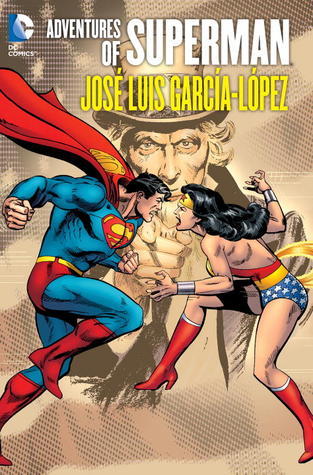
In a sense, Jose Luis Garcia-Lopez is the definitive DC artist. His likenesses of DC’s characters were featured on licensed merchandise for a number of years. Now, we have this collection of Garcia-Lopez Superman work from the years 1975-1980.
Certainly, it’s nice to look at Garcia-Lopez’s art. It’s realistic and dynamic but also contains a certain elegance that I find quite appealing. His Superman is, in a way, a marriage of Curt Swan and Neal Adams. By this, I mean, that it’s definitely Swan’s Superman, i.e. the muscular, noble-looking guy with the spit curl, but traces of the “photorealism” that Adams brought to comics in the late 1960s and early 1970s is on display as well.
Among the stories in this collection, I’d say that “Superman vs. Wonder Woman” is the highlight. This is a seventy-two page epic originally published in tabloid “treasury edition” format in 1978. If you remember treasury editions, then…well, you’re probably about as old as me, but never mind. Set in World War II (as was the Wonder Woman tv show at this time), “Superman vs. Wonder Woman” has our titular hero and heroine strongly disagreeing over the U.S.’s development of the atomic bomb. Super hero slug fests like this were a hallmark of Marvel, rather than DC, and sure enough, ex-Marvel writer Gerry Conway handles the scripting chores. Regardless, it’s a fun story, and I think that Superman and Wonder Woman’s philosophical differences make sense, given what we know about both characters. I enjoyed the tale so much that I had to double check that Gerry Conway actually wrote it. I never cared for much of his Marvel output. One gripe, however: The ‘treasury edition” format doesn’t necessarily translate well to this hardcover glossy book. Certainly, the paper quality is better than that of the original comic, but the art also appears on a smaller-than-intended scale and some art bleeds into the gutters. Since the artwork is a main selling point of the volume, I’d call that a bit disappointing, to say the least.
The volume’s remaining tales are a mixed bag. Prolific 1970s comic writers Gerry Conway, Martin Pasko, Elliot S! Maggin, Len Wein, Denny O'Neil and David Michelinie are among the contributors. Stories in the first one hundred pages originate with the main SUPERMAN title, and these among the worst in the volume. I did enjoy a goofy-but-fun Elliot S! Maggin story in which Lex Luthor causes Superman to grow to giant size, but the others ranged from unmemorable to fairly mediocre. The very first story is inked by Vincent Colletta, whose work is generally loathed by fans and pros alike. I don’t know if this volume is a comprehensive collection of Garcia-Lopez’s Superman comics work, but if not, then I wonder if they couldn’t have replaced the Colletta story with a better showcase of Garcia-Lopez's talents.
In the last one hundred pages, there is one Superman solo story (written by Gerry Conway) and several stories from DC COMICS PRESENTS, the Superman team-up title of the time. That last solo story isn’t bad, but for the most part, I enjoyed the team-ups much more. Teaming Superman with other heroes presents a difficulty, I suspect, because Superman is so powerful that he can easily overshadow his guest stars. There is, in fact, one Superman/Green Arrow team-up (from DC COMICS PRESENTS #20), in which Green Arrow could easily be removed from the story, and the outcome would be exactly the same! Beyond this, I was surprised at how deftly the writers found ways for the guest stars to shine. Aside from “Superman vs. Wonder Woman,” I’d say that the book’s best yarn is the Superman/Flash team-up from DC COMICS PRESENTS #s 1-2. That one’s a fun, sci-fi romp involving aliens, space ships and time travel. For the nostalgic among us, the team-ups provide a nice snap shot of the DC Universe, circa 1978-1980, as you can see how some of the most prominent characters were then being handled. For me, it was particularly fun to see Firestorm again, as I recall liking his series “back in the day” (In retrospect, I think that Gerry Conway had definitely matured as a writer by then, but that’s a topic for another time.).
Overall, then, this was a fun volume with some nice art, but I liked the Gil Kane companion volume (which I reviewed earlier) a little more. The stories in the Kane volume were better, and since Kane inked most of his work, the art was more consistent. Of course, if you're a big Garcia-Lopez fan, then you'll probably want this volume, in any case.