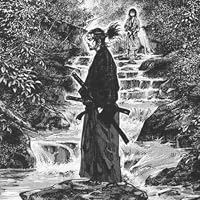
Real-life figure Miyamoto Musashi was the most celebrated samurai of all time. The quintessential warrior-philosopher, Musashi authored A Book of Five Rings, a classic treatise in the canon of world philosophy and military strategy. But the path to enlightenment is an endless journey, and to get there through violent means—by way of the sword—makes mere survival an even greater challenge.
After single-handedly defeating seventy bloodthirsty men from the Yoshioka clan, Musashi is at the greatest crossroads of his life—will he head toward the light and live a life among men, or will the allure of the darkness be too strong for him to resist? A chance encounter with the ferocious master, Itō Ittōsai, may make the decision to live by the sword inevitable.
Almost done with the series now, and it feels like the end is getting ever closer. I know that Inoue haven’t finished the book (yet), but you cannot get away from the feeling that Musashi’s journey is almost over. These three volumes were slower than usual and much heavier on the philosophical side, which is not a bad thing at all, but they also felt just a tad unfocused compared to previous books. This is still one of the most amazing things I’ve ever read though, so it’s only a bit weaker by Vagabond’s own incredibly high standards. I really don’t want to be out of volumes to read, but I also hope that Inoue will find it in himself to finish this masterpiece, and hopefully sooner than later.
Musashi continues to struggle with the demon of anger and pride that seems to lie behind his skill with the blade in search of something greater that he glimpsed in the placid prowess of old masters such as Yagyu Sekishusai and In’ei Hozoin. While he desires to escape from “the spiral of death”, Musashi still notes that he is “not gracious enough to give up [his] life” and reaches the compromise of drawing a circle on the ground, warning any would-be challengers that he will defend himself against those that enter it.
Takuan and Hon'ami Koetsu continue to try and bring Musashi and Kojiro together and attempt to make plans to fully integrate Musashi back into normal society, going so far as to plan a marriage between him and Otsu, though even as it looks as though their plans may bear fruit, Musashi further distances himself from the world by once again disappearing into the wilderness. He soon takes up with a poor farming family whose patriarch, a sculptor of statues of the Buddha, seems to have a valuable lesson for Musashi in his search for peace and perfection. Musashi also attempts to get to the root of Kojiro’s prowess with the blade by emulating his deafness and returning to the natural surroundings in which Musashi himself first learned to master the sword as a child.
Meanwhile Matahachi continues to struggle with the poor choices he has made and comes to (another) crisis point in his life. Inoue also throws a bit of a curveball at the reader by revealing that the story of Musashi as told thus far has in fact been recounted by a much older Matahachi to crowds of listeners. This doesn’t make a lot of sense given the number of storylines that would seemingly be beyond the knowledge of Matahachi, a fact that the character himself acknowledges to the chagrin of his audience. I’m not really sure what to do with this, and I don’t know if I love it, but I don’t hate the idea of Matahachi as the bearer of the fame of Musashi either.
I have to admit, though, that the high point of the volume for me is the return of Ito Ittosai, the sociopathic, yet charismatic, master of the sword who seems to be playing with the lives of both Musashi and Kojiro for his own amusement. A truly feral killer who has embraced the pride and anger that Musashi so desperately hopes to escape, he is nonetheless possessed of a certain strange harmony of soul, or at least an acceptance of the validity of his way of life in his own eyes. A purely self-centered individual who sees all others as belonging to one of two classes: either cattle that are beneath his contempt, or possible rivals to be challenged for his own amusement and advancement, he embraces all that Musashi hopes to avoid. He also seems to be virtually unflappable, seemingly taking everything in stride, and relishing those few moments when the unexpected manages to take him by surprise.
The Way of the Sword, an idea which obviously permeates this manga, has itself come to a crisis point of diversion. Ittosai demonstrates the old way of the sword that existed when using swords in actual combat was still their primary purpose, while Musashi seems to be the harbinger of a new Way, a truly martial “art” in which the sword becomes a vehicle primarily for philosophy as opposed to warfare in which self-control and character-building are more important than a body count. The paradox of utilizing a tool of violence in order to find peace is perhaps one of the most fascinating elements of the story of Musashi overall.
I've said this before but I love the love that this was based on and I admire the artwork even though in these newer volumes the artwork isn't as good. But, the story just isn't that interestingly told here and it seems Inoue is stuck in filler territory. 3.25/5
Another great one! For me this one was of the most well balance volume of the series. Perfect balance between action, story and philosophy. Strong and beautiful artwork like always. There is only one more left... can't wait to read it but I also want to pick it up at the right time to fully enjoy it!
The beginning portions with Matahachi and his Mother were really great. There was such tragedy and beauty in those chapters. The stuff with Musashi figuring out his path was great too. This volume felt like it was setting things up and with the next volume being the end of the road, I am sad to see that this is coming to an end and hope that it concludes satsifyingly.
I really quite enjoyed this volume. Many of its scenes felt unique and memorable, and I felt that they had a distinct Vagabond feeling that I’d been slightly missing in the previous one. For instance, the scene where Matahachi carries his dying mother on his back, the duel between Musashi and Ittosai with the two circles on the ground, and the ending where Kojiro plays innocently with the ball were all very atmospheric and expressive to me.
Part of me suspects that the sequences with the characters exploring a more peaceful daily existence are meant to wind us down before the next big fight. Or perhaps they’re meant to represent a deeper shift in their outlook on life and reflect a positive change in their dispositions, as they begin questioning whether the path of bloodshed can truly be meaningful. Either way, I’m interested to see how the plot will develop going into the final volume of the series.
This entire review has been hidden because of spoilers.
Personally, I think this is one of the strongest volumes in the entire series. They show Musashi's immense development as he finally understands what it truly means to be "invincible". There's a heavy philosophical theme in this volume. Although it is a bit slower paced, it is one of my most impactful manga ever.
I’m still loving this manga series, and I’m sad that I only have one volume left. Gorgeous artwork, beautiful storytelling, amazing characters, and deft handling of philosophical ideas.
I thought it impossible (shame on me), but Inoue has finally made me come around on Matahachi. Inoue pulls this off flawlessly and leaves me more than a little shell shocked. I think this may be one of the volumes I'll always return to in the future. Not for the fighting, but the serene moments and gorgeous set pieces. Reading Vagabond has given me a whole new outlook on nature. This is easily the most calm I've ever been reading a comic. It's a wonderful feeling. I never want to forget it.
It’s crazy to think that I’m almost done with Vagabond.
It’s a 37 volume series (unless Inoue finally finishes it) and it feels like not to much has happened. Only the span of 1 year and a couple months has passes, and Musashi still has grown quite a bit.
It’s a very slow moving series and the last Vizbig (10) and this one focus on the same themes all throughout:
Powerful and touching. Takehiko Inoue has given real depth and life to his characters and even ones I initially disliked have revealed true warmth and genuine care in their development. If the life of a sword instructor is not right for Musashi will a family be more to his taste? And can Matahachi's many lies be forgiven?
“Whether it’s sculpting Buddhas, or my wife and children ... there are indeed differences in things that are close or far away ... but they’re all circles to the same center. And that center is where I’ll always return.”
Jumpin Jaysus what an amazing volume this was. 10/10 would zen again.
"Are you still drawn to darkness, unchanged from when you did battle with us?"
That's the question Musashi seems to be asking himself constantly now. He's at a point where he can retire from his quest to become invicibile under the sun, marry Otsu and live happily ever after. But the spiral of death continues to pull at him.
"Where are you headed, Musashi?"
I'm curious about reading Eiji Yoshikawa's "Musashi" on which this is based because I want to know if the novel is just as meandering and repetative. It's not to say I'm not enjoying it but it does get to a point where it feels like we've seen all this before. I wonder if this is the story of an addict, it'd certainly explain the many relapses.
Some spoilery comments on each volume:
Volume 31 "Are you heading toward the light... or are you still drawn to the darkness...?"
While Musashi ponders his future, his childhood friend Matahatchi has a conclusion of sorts to his story. In fact the whole book suddenly does a bit of a gear change and suddenly we're decades in the future seeing a middle aged Matahatchi telling his story. So is this whole book being told from his point of view? It's a very odd revelation 11 volumes in.
Volume 32
"Kojiro's stronger..."
Musashi once again encounters Itō Ittōsai, Kojiro's one time master and forces him to rethink his strategy. We also see Kojiro's parting with Ito (Kojiro gets 1000 points).
Musashi also comes to a final decision. He can put down the sword but only after confronting Kojiro.
Volume 33
"My friend... I want to see you."
Matahatchi begins his road to redemption by deciding to return the certificate his stole from Kojiro so long ago.
Musashi begins practising while blocking his ears, simulating what it must be like for Kojiro, he also stays with a family where he beings to focus more on his wood sculpting. Obviously it's just a momentary break because we all know where this is heading.
Vagabond Vizbig Volume 11 continues the epic saga of Miyamoto Musashi's journey towards enlightenment and being the strongest warrior, while delving deep into the philosophies of invincibility, strength, and oneness with the sword. Although it occasionally feels stretched to extend its reading time, the overall buildup towards the last arc, the supposed "final duel" remains captivating.
One of the standout strengths of this volume lies in exploring the calmness and confusion within Musashi's soul as he grapples with physical and spiritual struggles. This intimate portrayal of his inner turmoil creates a highly investing and emotionally resonant experience for readers, forging a stronger connection with the protagonist, highlighted by Itō Ittōsai's childish and insane personality as a support character.
Takehiko Inoue, the ever-talented author, deserves commendation for skillfully (finally!) assigning a fitting role to Matahachi. Readers get a clearer understanding of how Matahachi fits into the grand tapestry of the manga's larger narrative, however small his character is in the actual plot. This character development enhances the depth of the story and adds a new layer of complexity to the unfolding events, as we see them from Matahachi's "eyes".
The artwork in Vagabond Vizbig Volume 11 continues to impress, with Inoue's illustrations becoming even more refined and beautiful to behold. The attention to detail and the skillful use of visuals contribute to a mesmerizing visual experience that complements the engaging storyline.
As the manga gradually builds towards what appears to be the last arc, the tension and excitement surrounding the upcoming duel between Miyamoto and Sasaki Kojiro grow steadily. Vagabond takes its time in building this anticipation, making the impending showdown feel exceptionally special and significant compared to Musashi's previous major duels.
While the occasional padding in the story might deter some readers (including myself), the compelling character development and the mesmerizing artwork make Vagabond Vizbig Volume 11 a worthwhile addition to the series. While it delves more into the depths of philosophical struggles than actual lengthy and brutal fights, offering an intimate exploration of Musashi's growth, all while setting the stage for an epic final duel that promises to be a thrilling and unforgettable conclusion to the saga, which all of us hope to see in this lifetime.
I have been putting off reading this volume for a while now as I started it and realised that I am nearing the end of the drawn and written volumes.
I stopped at the end of chapter 275 for a good month as it was at that point that I realised that this series is just beyond everything that I expected. I never knew that a book would be able to make me cry especially over the characters that it happened over, and it was at that point that I realised that this series is something truly special.
Reading vagabond up to this point has been the best experience I have had and it has definitely made me think more deeply about certain aspects of life and how I want to live. I don't know if I want to read the next volume that is currently on my shelf as I don't know how it will feel once I have caught up to the current volume and knowing that the story may never be completed for a long time.
I will definitely be reading other works by Takehiko Inoue once I have finished Vagabond as his works as true masterpieces.
I loved Matahachi’s arc at the start of this volume. His mother’s death was beautifully portrayed and marked a real turning point for him, he’s finally stepping onto his own path, one only he can walk.
Musashi continues to wrestle with the path of the sword versus a life with Otsu. After a short yet impactful encounter with Ito Ittosai, he realizes he still seeks a final, true test—one that pushes him to his limits—and sets his sights on Kojiro. While evading guards who mistake him for a criminal, Musashi takes refuge with a humble farming family. His time with them is moving, culminating in tears as he parts from them. In a powerful moment, the mother tells him he’s the only one who cannot see his own kindness.
Meanwhile, Kojiro arrives in Kokura and is quickly embraced by everyone. His presence brings new energy to the story, and I’m excited to see the inevitable clash between him and Musashi.
Another slow volume with a lot of ruminations and revelations as Musashi is treading, not the spiral of killing but the path of spirituality and enlightenment. Those initial chapters with Matahachi and his mother were a clear cut example of how skilled Inoue is in writing less important characters and giving them depth and emotion, It adds to the world of vagabond.
But when you are this deeply invested in the story it doesn't really matter much if there aren't any deadly duels ( Ittosai vs Musashi? Well it was over before anyone but them could make any sense out of it so I'm not counting that). Also the ever dreadful gut wrench from realizing vol 36 is just over the horizon is unbearable and I'm stalling as much as I can but Alas another vizbig is still a pipe dream.
This Volume is a slow burn much like some before, We say adieu to some important characters in Musashi's Journey and yet there some pages which just might be there to instill the slow shift of Musashi on his self realization and spiritual journey, nevertheless, not much on action sequences or fights in this one, but couple of close to heart moments and a build of for an inevitable showdown in the next book!. As always, the art is amazing and like i always have said, should have made this book in a bigger format to do justice to the art :)
Seeing musashi develop has been nice but I’m wondering where this will end. I don’t want to see Kojuro or Musashi die but it’s hard to think it will end any other way. This chapter was great, and it’s nice to know that old man yagous words stuck with musashi, he’s been able to detach his ego and move forward as a samurai.
This entire review has been hidden because of spoilers.
I really enjoyed this section of the story. It is so quick, yet enjoyable. Seeing musashis growth, and matahachi finally getting his conclusion with his mother. Which brought a tear to my eye. It was great.