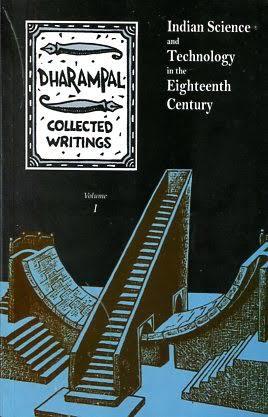
Did you know that the art of plastic surgery was first tried out and perfected in India? That in the eighteenth century, samples of Indian steel manufactured by Indian ironsmith and imported into England were found to be superior in quality to steel from Sheffield? That small-pox inoculation was practised in certain regions of the country much before Edward Jenner introduced vaccination? That India used the drill plough centuries before it was introduced into Europe?
Dharampal's Indian Science and Technology in the Eighteenth Century is the first real modern classic to bring to light the science and technology traditions prevailing in India prior to the arrival of her destructive colonisers. The Book is based on fascinating accounts of various technical processes and practices written by Englishmen and other Europeans in the period when they came to India to learn and before they opted to rule. Besides plastic surgery and inoculation techniques, the book also has accounts on the manufacture of ice and paper; irrigation and agriculture; and some aspects of science including algebra, geometry and astronomy, the last reflected in the establishment of impressive observatories.
The effect of ht book has been to compel historians to radically revise their opinion of the technical capabilities and scientific output of Indian society.
Indian Science and Technology in the Eighteenth Century is the first in the series of five volumes of the Collected Writings of Dharampal
Dharampal was born in 1922 at Kandhala in the Muzaffarnagar district of Uttar Pradesh. He has been associated in various ways with the regeneration of India’s diverse populations and the restoration of their decentralized social, political and economic organization centered on local communities.
After being active in the Quit India Movement (1942-43), he worked for some years with Mirabehn, an associate of Mahatma Gandhi, and in the 1950s founded a cooperative village near Rishikesh. Before that, at the time of Partition, in 1947-48, he was put in charge of the Congress Socialist Party centre for the rehabilitation of refugees coming from Pakistan, and came in close contact with Kamaladevi Chattopadhyaya and Dr. Ram Manohar Lohia, as well as with numerous younger friends, such as L.C. Jain, in Delhi. He was also a founding member of the Indian Cooperative Union in 1948.
From 1958 until 1964 he was General Secretary of the Association of Voluntary Agencies for Rural Development (AVARD) and subsequently Director, Study and Research of the All India Panchayat Parishad, until 1965. He was closely associated with Sri Jaiprakash Narayan, who deeply appreciated his research and writings.
From 1966 Dharampal devoted himself, for almost two decades, to an exploration of Indian archives spread over the British Isles. His published works of this period include: Indian Science and Technology in the Eighteenth Century: Some Contemporary Indian Accounts (1971), Civil Disobedience and the Indian Tradition (1971) and The Beautiful Tree: Indigenous Indian Education in the Eighteenth Century (1983). He also authored Panchayat Raj as the Basis of Indian Polity: An Exploration into the Proceedings of the Constituent Assembly (1962) and The Madras Panchayat System: A General Assessment (1973). Recently several collections of his essays have been compiled and published by several of his younger associates. A complete listing of his published works is compiled below. The total picture of pre-colonized India that emerges from the pioneering historical research of Dharampal, though quite impressive, is yet to have a more widespread impact on India’s historiography. In the 1980s, his guidance served as inspiration for a group of scientists called the People’s Patriot Science and Technology (PPST) with their headquarters in Chennai.
Dharampal served as a member of the Indian Council of Historical Research for two terms in the early 1990s and again for a term recently. He was also the Chairman of the Commission on the Protection of the Cow set up by the Government of India in 2001. From the mid 1980s Dharampal was closely associated with Mahatma Gandhi’s Sevagram Ashram, Wardha (Maharashtra) which he considered his main abode until he passed away there on 24th October 2006. He is survived by his brothers, Yogendra Pal and Yash Pal, his sister, Sushila, and his children, Pradeep, Gita and Anjali. His elder daughter, Gita Dharampal-Frick is a professor of history at the South Asian Institute, University of Heidelberg, Germany.
These are the collection of letters which British east India officers wrote to different people about India's technology in 17th, 18th and 19th centuries. The author found these in the British archives. You have to appreciate the author for his commendable work on patiently going through lakhs or may be crores of letters to understand the India's scientific advances at that time. In this book he has presented a small collection from those archives to show us how much India was advanced in science and technology at that time.
A wonderful collection of correspondence by the British officers and travelers regarding the science and technology which was in use in India that is Bharat, the wide range of topics covered has been covered in this book, like astrology, medicine, metallurgy, agriculture, and animal husbandry. even the method of vaccination practiced by Indians for fighting diseases like smallpox has been very well documented in the book. We had the knowledge of producing ice without any machines, and we were able to produce top-class Iron with our own indigenous technology. If your parent of young kids buy it and make them read the book. Every proud Indian should read this book to know our forgotten past.
Just a mere glance of the book is enough to understand the topic it would be covering. After going through this book, I must admit that author has done a very sophisticated work. Its not easy to go through British letter and extract such a data. This book covers the topics like Hindus already having binomial theorem, Hindu Algebra to method of making best mortar, manufacturing of bar iron.
It covers the technological advancements in different parts of India. Be it norther, southern, western or eastern. Though this book don't cover everything but it makes you aware about your true advancements in the fields of Science and Technology. I would like to thank INDIC ACADEMY at last for providing me a copy of this book.