And a portrait of the artist as a (very) young man.
What do they all have in common?
Nothing! Except that they all inhabit the unique world of Shaun Tan. Collected here for the first time are the fascinating beginnings of stories yet to come, illustrations for books and films, drawings from life, and creative doodles from working sketchbooks. Together with commentary they offer a special insight into the imagination of one of our most celebrated contemporary storytellers, the internationally acclaimed creator of The Arrival, Tales from Outer Suburbia, and Lost and Found: Three by Shaun Tan. A must for budding artists and authors everywhere, and those who appreciate art.
Shaun Tan (born 1974) is the illustrator and author of award-winning children's books. After freelancing for some years from a studio at Mt. Lawley, Tan relocated to Melbourne, Victoria, in 2007. Tan was the Illustrator in Residence at the University of Melbourne's Department of Language Literacy and Arts Education for two weeks through an annual Fellowship offered by the May Gibbs Children’s Literature Trust. 2009 World Fantasy Award for Best Artist. In 2011, he won his first Oscar in the category Best Short Animated Film for his work The Lost Thing.
Shaun Tan may be best known for his wordless fantasy masterpiece about the wonders and horrors of immigration, The Arrival, but he is also generally known for the invention of all these bizarre creatures—his own “Fantastical Creatures and Where to Find Them,” let’s say. The bird king. The heart bell. A mechanical penguin. Where did they come from?
This book is first and foremost an artist’s sketchbook, but it’s one with a purpose, to show you early versions of his creations, and the process of getting there. It’s also a portrait of an artist and how he came about to be one. This would be a 3 star book for the sketches alone, a sampling of twelve years of work, but Tan earns another star for his elegant commentary throughout. If you are teaching The Arrival or another of Tan's book, this seems like a must for a companion text, and a source for getting students to also create as they responsively read.
Wondering how you get started, facing the blank page? I especially loved his anecdote about Paul Klee’s idea of “taking a line for a walk.” Strokes and squiggles develop into faces, animals, hills.
I steal this from Miriam’s review; thanks, Miriam:
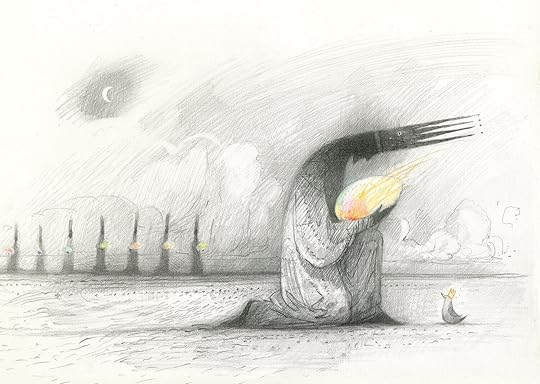
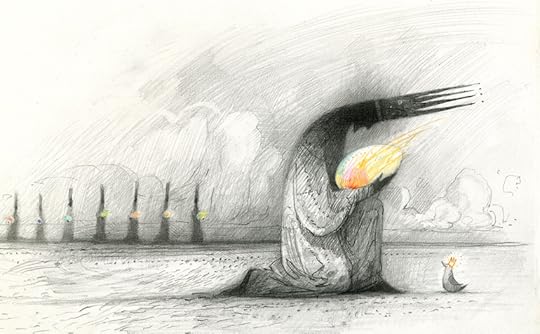
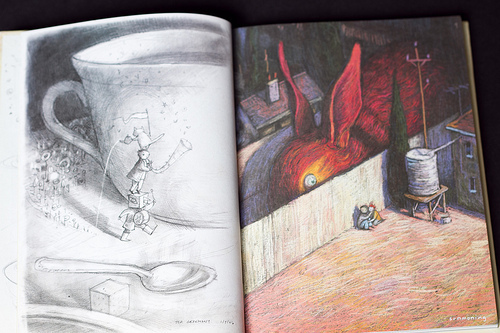
Read June 2022. Edits Aug 2022: additional images .................... Summoning, from The Bird King:
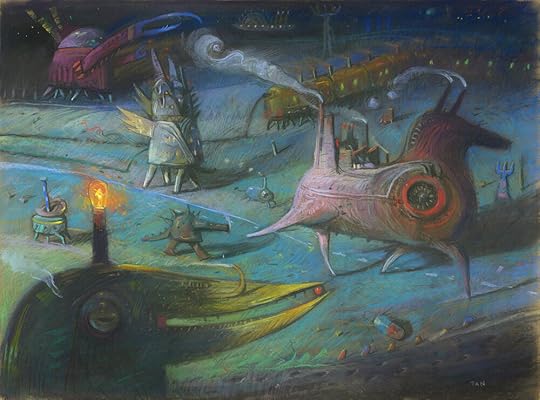
--Image: The March, pastel on paper, 2021. (Not from this book, but representative of ST's work.) Note: if you're using the GR app, you won't see the images.)
This is the sixth book I’ve read by Shaun Tan. It’s probably best I came across this one later, because the other books might be a better introduction to his work. This one, as the title suggests, is a collection of story ideas, sketches, and free form stream of consciousness exercises, some no more than doodles but still interesting. Many of the concepts are from previous works of his, that other fans will recognize as well as I did. The book is categorized YA but this art is for everybody. Anyone, that is, with a yen as large as mine for images such as these: quirky, beautiful, uplifting, and at times, dark.
Once again, it’s apparent: The man can’t help it. He’s really, really, into helmets: diver’s helmets, astronaut helmets. I love it, and it would be interesting to know where this obsession comes from. I tried and tried to post one of them here. But just google shaun tan portrait of the artist as a young man for a telling example.
Note there are several other editions of this book with somewhat different titles and lengths: The Bird King and other Sketches, and The Bird King, an Artist’s Sketchbook. I assume the longer, newer sketchbook is the one to get, if you can.
An excerpt. On artist’s block, which applies to other creative endeavors. Take notes, fiction writers: “Just start drawing …. The artist Paul Klee refers to this simple act as “taking a line for a walk,” an apt description of of my own basic practice: allowing the tip of a pencil to wander through the landscape of a sketchbook, motivated by a vague impulse but hoping to find something much more interesting along the way.”
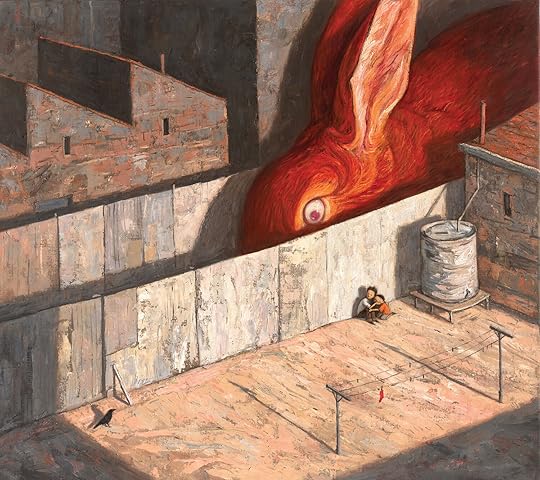
Favorites: Summoning (large, BIG, bunny; a couple cowering on the opposite side of the fence). Automatic teller. The Water Woman (rain from a cloud angling magically into the clay plot at the stern of an old woman’s crude canoe). Never Lost a Case (falcon w ascot and smoking jacket tipping a glass of … claret?). The aquasapiens*--intelligent sea creatures “disguised” as humans (all it takes is a tie apparently!), riding in shrimp cars (blends right in!) to spy on the humans. And many others. See: *https://www.shauntan.net/aquasapiens
Found while browsing. Tan's haunting The Arrival made me a fan (of Tan, har har). These are unfinished sketches and brainstorming doodles that are still bounds better than what I might draw. Most are cute, a few are beautiful. I liked seeing some of his thought processes, the notes that accompanied some of these drawings - the way art, Ahhhhhrt, gets described sometimes, the kind of lofty symbolism and almost pop psychology-speak, makes me impatient. But his slight notes made sense to me. Hah, my favorite note was a placeholder written over a yellow-green patch, 'grassy type stuff.'
Great stuff. Visually, I liked this as much or more than his finished books. Actually, I tended to prefer the pages that were just sketching to the ones that were work towards a particularly project (which is kind of what the author gives as his opinion also).
Shaun Tan's ilustrations are stunning. There is something of childhood magic, of enchantment, of awe. Creatures, wether they look more like animals, like toys or even like apliances, seem elements of a dreamscape. He is a very complete artist, producing figure design and urban scapes, lines and texture, color schemes, details, everything I could think of from a visual artist, with a masterful originality. And his animations are also truly marvelous.
Everything about this little book makes me happy. I love the author's art, and work, and was delighted to get my hands on this collection of art from unfinished projects, finished work, and sketchbooks. I really enjoyed getting a glimpse into the mind and creative process of this artist/author, and flipping through this book is like exploring a delightfully curated art installation.
Shaun Tan is one of the most imaginative artists and storytellers around. I love his stories, simple yet always fascinating.
This sketchbook is a little 128-page hardcover. The spine area is clothed and it comes with a wraparound red rubber band and a ribbon bookmark.
The sketches collected are those he created for his other books, like The Arrival, Tales From Outer Suburbia, Lost and Found, and perhaps some other stories I've yet to discover.
There are also many new sketches including some of his drawings from life which look strangely abstract to me.
Many weird and appealing characters live on these pages, all seemingly alive. It's difficult not to be marveled at his sketches. On one page, there's a giant bird treading through an ocean with sharks and octopus, while carrying a cardboard box with a little girl sleeping in it. On another, there's concepts for Aquasapiens, automobiles crossed with aquatic life that roam the seabed.
His works are best to be seen than described. Highly recommended for sketchbook lovers, those who like doodles and fans of Shaun Tan.
An odd fusion of cage and bird fills the center of the sketch. The head of the bird, on a long graceful neck, peers anxiously towards its midsection, which is a birdcage, inside of which an odd-shaped blob of flesh hovers. A shorter creature (or is it a robot?) with a giant eye that is nearly the entirety of its head, holds up a magnifying glass to examine this, the other claw clutching a few papers. Below, the hand-written lower case title: "cage-bird and obstetrician". It is a one-off sketch, as far as I know not part of any larger story, but it raises a host of questions and scenarios in the mind of the reader. Welcome to the artwork of Shaun Tan.
Some of the sketches are studies for Tan's other published works, such as "The Arrival" (which was the first book of his that I encountered). He introduces this book with a few pages of explanation of what role sketches, mostly unplanned and exploratory, play in his art, but mostly it is looking through one page after another of enigmatic, thought-provoking, wonderful (in the literal sense) little visual koans. It is well to push yourself to look longer at each one than is a 21st century reader's natural tendency, so as to give yourself time to notice small details, and imagine what they mean and where they came from. Can the cage-bird walk on those little birdcage legs? Or does it only fly? Or are those wings too small to lift it up, and it feeds on food that comes by it somehow, like a sponge in the sea? What would the father look like? Is there another bird inside that metallic-looking shell of the obstetrician, or is it some kind of machine? How is it that he has managed to make a robot-bird-obstetrician with a single enormous eye look reassuringly bored as it inspects the developing new cagebird? Does it say anything to the worried expectant mother, and if so how? Give yourself a few minutes, and every page in this book can send you on a small story in your mind.
This book opens the curtain to Tan’s creative process, allowing readers to view art from stories that have not yet been full formed, art from books that have been completed, and beautiful illustrations that may not be stories at all. The courage this book took to produce is to be applauded. Allowing readers and other artists to see a process of creativity is raw and soul baring.
This book is stellar. One turns the pages slowly, lingering in worlds undreamed of, wondering at ideas, and pausing to allow a particular image to sink in more deeply. It is a journey, specially designed for a young creative to see that mistakes can be joyous, that creation is messy, and that works in progress are breathtaking.
This is a book to get in the hands of teens who enjoy art and writing, for it is a look at the unformed and the just formed. It is a book of pure creativity and the creative process. Beautiful. Haunting. Inspiring. Appropriate for ages 10-18.
A semi-random collection from Shaun's sketch books. He uses items like these to post on his wall while he works on a book, to keep focused. These initial inspirations are what form the foundation for his next story (or stories yet untold), and retaining these reminds him of what he wanted to be sure to convey. If you've read his published works, you'll recognize some of these early sketches here. All his art promotes a cerebral response since there is such a fantasy aspect to almost everything he draws.
The "Drawings From Life" section are colorful and more realistic in nature, as he plays with colors and shading.
Sections: 1) Untold Stories 2) Book, Theater, and Film 3) Drawings From Life 4) Notebooks
I greatly appreciate the index in the appendix that lists each of the works here, and describes if it was used in one of his published stories.
Author/Artist Shaun Tan describes this book well in his Introduction: The works collected here present a cross section of such material from the past 12 years, ranging from fairly precise drawings to scruffy scribbles. They reflect a spectrum of interests, starting with my familiar preoccupation with imaginary worlds and creatures, and including observational sketches of people, animals, and landscapes, which I think form the unseen backbone of all my other work. I was also interested in a spontaneity that can sometimes be missing from more finished paintings, which can suffer from excessive revision, polishing, and commercial compromise, leading to a familiar lament: "Why isn't the finished work as good as the sketch?"
I think this has something to do with the directness of small drawings, their lack of self-consciousness. Each piece in this book was generally completed in a single sitting of less than two hours, and not intended to be published at the time of execution (indeed, some have barely escaped the paper-recycling bin). Do they offer a privileged insight into the creative process? That's an interesting question for any audience, whether a general reader or a student of illustrations. From an artist's point of view, at least, I think they do. There are few better expressions of the impulse to draw, an instinct that lingers from childhood, with all it absurdist daydreaming and playful seriousness.
A lovely little sketchbook that's beautifully bound and well presented. It's divided into sections and each has a nice introduction to lead you in and there's a full list of media used on each piece at the back. There's a good variety in pieces and process, and the primary focus of his work seems to be a fusion of nature,machinery, and dream logic. There's a great amount of imagination on display here and the pencil sketches were a particular highlight for me. I feel a little harsh only giving it three stars, but whilst I enjoyed my time with it, it didn't engage me enough to want to hang on to it.
Last night, my brain refused to calm down. I was still trying to make some "sense" of the death of a friend and amazing artist who had passed that morning. I needed something beautiful to soothe my mind. Fortunately, I had The Bird King waiting for me in my stack of library books. It was the perfect book at the perfect time - beautiful, captivating, provocative, unselfconscious, honest, and cool - some of the many awesome qualities my departed friend embodied. It was both comforting and inspiring, which was exactly what I needed.
I loved reading about Tan's creative process. His art continues to astonish and delight, but it was also great to see the wide range of works and their respective styles. Shaun Tan is rapidly becoming one of my all-time favorite artists. :D
I could have spent more time on this but I haven't read any Shaun Tan in a few months. His artwork is amazing in my opinion and this book really shows that. It's full of titled sketches he didn't intend to publish, separated into a few sections with introductory paragraphs.
I would highly recommend his material to fans of graphic art and children's literature. It's not necessarily for children only. He just usually focuses on the artwork instead of the dialogue and the sentences (if that book has any) are usually brief. My only suggestion is starting with another book (like the Arrival or the Lost Thing) and working up to these unrelated sketches after deciding how much you like Tan.
This one really spoke to Clay the artist. In the drawers, flat files and cabinets of my studio, I have hundreds of tissues, drawings in notebooks, unpainted pen and ink drawings, unfinished book illustrations. This is Shaun Tan's collection with brief explanatory textual introductions--maybe more for adults artists--but the drawings will certainly speak to and draw in any artists of any age, doodlers, art teachers, fans of Tan--everybody really. A delightful and true glimpse of the creative process and the many ways to take a line for a walk, Paul Klee's definition of drawing.
Having a glimpse into the mind and creative process of someone so unique as Shaun Tan is to marvel at the way he blends reality and fantasy. This artist's notebook contains brief introductory comments to the different sections--Untold Stories; Book, Theater, and Film; Drawings from Life; Notebooks; Endpapers--from the artist himself. Fans of Tan's work will be delighted to recognize some of the artwork contained here from their reading of The Arrival, Tales from Outer Suburbia, and Lost & Found. This is one to savor and from which to gain insight into one man's artwork.
A sketchbook of Shaun Tan's art, which is fun to look through. Much of it is unfinished ideas, spontaneous sketches, and landscapes. I am always fascinated by those who can sketch with such skill; sketches in their raw form have a certain roughness that appeals to me. Maybe it's because I get a glimpse of the creative mind that I admire so much.
Tan's Drawings often remind me of the art in the game " Machinarium," which I also loved. Anyhow, if you enjoy these things as much as me, you're in for a treat with this one.
Dear Universe, please give me even a quarter of the artistic ability that Shaun Tan has. Sincerely, Ely xx
Truly, I'm in more of awe of Shaun Tan with every book of his I read. While this obviously doesn't have quite the magic as his actual stories do, I really liked what he had to say in the small written part. They made me want to pick up a sketchbook and pencil myself and I'm not much of a visual artist. I can't wait to see what he has in store for me in whichever of his books I decide to pick up next.
If I could only look at one illustrator's work for the rest of my life, that illustrator might be Shaun Tan. Though I prefer his narrative work, this volume was an especially engaging and enlightening look at his process, and the broader range of his skills.
Disappointing, but mostly just because these were drawings, each unrelated to the next one, not following an actual plot. It doesn't compare to The Arrival.
I picked this up one afternoon at work. It is a vast collection of Tan's work, covering everything from pen and ink to full on production work. There is a wide representation of artistic styles. It's fascinating that one artist could produce such a variety of work.
This book contains cool sketches and rough drawings of Shaun Tan's work, such as images from The Bird King, and Arrival. It is interesting to see a peak inside his process, and always a pleasure to view more of his work.
Tan is best known for his fantastical graphic novel about the horrors and wonders of immigration, The Arrival. This is his sketchbook of all of the creatures from his imagination, some of which grew into his other books, others just left right here. Pencil, pen and ink and paintings fill the pages of the book interspersed with either thoughts or half story lines. It is extraordinary. His imagination is truly a wonder.
a delightful book of Shaun Tan’s sketches. I can normally fly through a graphic novel but with this art book I took the time to dissect the details of every drawing. I also really liked his written musings on creativity and art scattered throughout the book. I always find it inspiring to see the process of other creators
Tan is one of my favourite artists, so it was fun to see this snapshot into his creative process, and to peruse a selection of some of his random doodles and ideas.
"Staring at a blank piece of paper, I can't think of anything original. I feel utterly uninspired and unreceptive. It's the familiar malaise of "artist's block" and in such circumstances there is only one thing to do: Just start drawing."
"I find good drawing requires conscientious effort: active research, careful observation of things around me, ongoing experimentation and reference-gathering, all of which exist "behind the scenes.""
"I was also interested in a spontaneity that can sometimes be missing from more finished paintings, which can suffer from excessive revision, polishing, and commercial compromise, leading to a familiar lament: "Why isn't the finished work as good as the sketch?" I think this has something to do with the directness of small drawings, their lack of self-consciousness. Each piece in this book was generally completed in a single sitting of less than two hours, and not intended to be published at the time of execution..."
"My stories generally begin with images rather than words, modest sketches drawn in a fairly aimless way. One of the joys of drawing is that meaning can be constantly postponed, and there is no real pressure to "say" anything special when working privately in a sketchbook. Nevertheless, interesting or profound ideas can emerge of their own accord, not so much in the form of a "message," but rather as a strangely articulated question. A scene or character seems to look back from the page and ask, "What do you make of this?" A drawing feels successful to me when it is both clear and ambiguous, something I try to underscore by adding an equally ambiguous title."
"Realizing a vision can be a long and complicated affair because there's so much revision and problem-solving involved, and unfortunately the original ideas that inspire a project can easily be clouded or forgotten along the way. Quick sketches are an essential means of recording some of this source energy, like pinning ephemeral butterflies to the page, a library of fresh impressions that can be used for later reference. I usually have my preliminary studies pinned to the walls of my studio for the duration of a project, as a constant reminder of what I was "getting at" in the first place."
"Sometimes I will also cut up and rearrange drawings with scissors and tape, which can awaken further "accidental" concepts."
"I'm especially interested in the tensions between natural and man-made forms, and this is a a recurring theme in all of my paintings and stories. My drawings of people and animals relate to another abiding interest: the relationship between individuals and their respective environments, their sense of "belonging" to a place."
"At a more elemental level, the sketches represented here are studies in the relationship of line, form, color, and light, where I'm trying to learn a vocabulary of visual ideas and skills that will inform all my other studio work. More importantly, I'm trying to develop a certain sensibility too, finding some emotional empathy with a subject, whether it is a person, a tree, or just a shadow on water."
"It's surprising what sense can emerge from nonsense [of quick sketches], and how the juxtaposition of odd images on a page can have a serendipitous effect, catching ideas that might otherwise be hidden beneath the waves."