Picking up cries for help from Pellucidar, Jason Gridley of Tarzana enlists Tarzan. Gridley and Lord Greystoke travel to the exotic and strange land within the Earth to save Pellucidar Emperor David Innes, captured by Korsar pirates. The savage realm has eternal noon and bizarre monsters.
Edgar Rice Burroughs was an American author, best known for his creation of the jungle hero Tarzan and the heroic John Carter, although he produced works in many genres.
In a book about a lost Stone Age world, the characters suddenly encounter pirates about eighty percent of the way through, and then Vikings in the last few pages. Picking a lane would have been nice, or establishing that there were three of them from the beginning. And yet somehow the part that most strained suspension of belief was Tarzan being approached at the beginning to come along on the expedition. Because when you think flying into the earth’s core via the north pole, you think, “First, let's track down the guy who grew up in the jungle with apes.”
"what will one not do to have one's curiosity satisfied,"
Bringing out of the usual surrounding of Tarzan's jungles, this story moves literally through another world. Some elements are similar to Pal-ul-don, and also referred to as well.
This book, the 13th of Tarzan series, is the 4th book on ERB's Pellucidar series. To give some sense to the readers, the author provides a very brief description of events leading to this Journey.
And similar to Pal-ul-don, most items are pure fantasy, and in my opinion, some of the parts were a little too over-descriptive. But overall, story is fun and the ending is epic as always.
"Good-bye, Thoar," she said. "Good-Bye?" he asked. "What do you mean?" "I am going to Sari with the man I love," replied The Red Flower of Zoram."
This was a book I loved when I was fifteen. It involves Tarzan joining an expedition to the hollow world at the Earth’s core, the dinosaur haunted setting of Burroughs Pellucidar novels, to rescue David Innes from the clutches of the Korsars. It’s an odd book which features a lot of running around, cliff-hanger endings and prehistoric monsters. It ends abruptly as if Burroughs had reached his contractual word count for the project and just shut the whole thing down. There is no real structure, very little characterisation and the writing is clumsy. And still, I not only finished the book, I enjoyed it. Some of it was nostalgia for sure but some of it was the sheer efficiency of Burroughs story-telling and some of it was the pure pulpy joy of reading about adventures in a stone age world full of dinosaurs and sabre-tooth anachronisms.
A direct continuation of the story begun in Tanar of Pellucidar. And, for a long time, something of a white whale for me personally. Back when I started reading Burroughs, I was mostly getting Tarzan novels from the local public library, supplemented by occasional trips to the used book store; and at some point I also picked up At the Earth's Core/Pellucidar/Tanar of Pellucidar; but for some reason, although I knew it existed (thanks to the helpful listing of Tarzan titles in every Tarzan paperback), I could never lay hands on a copy. Maybe due to some weird rights issues? At the time, Ace had Pellucidar and Venus, and Ballantine had Tarzan and John Carter, and maybe this one slipped through the cracks somehow? Whatever the case, it frustrated me no end back at the time.
So this book (well, I guess it started in Tanar if not before, but this really makes it concrete) establishes the Burroughs Cinematic Universe, where all of his major series take place within the same world -- the previous book introduces Jason Gridley, inventor/discoverer of the Gridley Wave (a sort of magical radio), which is initially used to make contact with Pellucidar, but subsequently provides the explanation for how ERB learns of some of the later Martian stories, and is how they discover the fate of "Wrong-Way" Carson (who was trying to get to Mars but landed on Venus instead; should've taken that left turn at Albuquerque).
And it's honestly one of the better Tarzan novels; at least, I think everything after this is on a bit of a descending slope.
Gridley, having learned of David Innes' capture in Pellucidar by the descendants of Spanish pirates, hares off to Africa to recruit one Lord Greystoke for the rescue mission, which will be undertaken on a fancy new German dirigible (it being 1929, far enough after the end of the Great War to start moving the Germans back into the "Heroic" column; and surely they learned their lesson after all that unpleasantness, right?) -- this dirigible is so fancy that instead of hydrogen or helium, its lifting tanks are filled with a pure vacuum. Well, I'm not sure "filled with" is the correct term, but bear with me. And I guess actually technically that could work, if you could find a material light enough to allow for lift but strong enough not to just collapse inward under the pressure of the external atmosphere (and airtight enough not to allow the external atmosphere to just seep in).
So Greystoke says, "Yeah, sure, why not?" and they head up to Germany, board the dirigible and point their nose north in search of the same polar opening the Korsars' ancestors must've used centuries past.
And sure enough, they do reach the Inner Earth and they promptly split the party and Tarzan gets lost(!), as do Gridley and a party of would-be scouts because nobody thought about how you actually navigate when the sun never moves, and then the real adventures commence.
And as I said, this is one of the better Tarzan novels, mostly because it's fresh -- no Russian revolutionaries or conk-on-the-head amnesia this time around, and it's a jungle that's entirely new to Tarzan so there's some element of actual peril at times.
And if the wheels of coincidence creak a few times too often and if the actual reason they're there in the first place (to rescue David Innes) just kind of gets handwaved to resolution at the end of the book, well, it's Burroughs after all.
Tarzan at the Earth's Core (Tarzan, #13) (Pellucidar #4) by Edgar Rice Burroughs (Ballantine 1929) (Fiction). This book is from a separate series than "Tarzan of the Apes." Tarzan must go to the earth's hollow core in order to save a famous scientist. Along the way he battles monsters and eternal sunlight before saving the day in his own inimical fashion. My rating: 6/10, finished 1973.
Luin Tarzan maan uumenissa -teoksen ensimmäisen kerran varhaisteininä, kuten muutkin Äänekosken kirjastossa olleet Burroughsin kirjat. Alkuperäisessä järjestyksessä tämä oli kolmastoista Tarzan, mutta 1970-luvun uudessa suomennossarjassa se julkaistiin vasta numerolla 21. Tämä oli hiukan erikoista, koska jo penskana olin sillä kannalla, että tämä oli myöhempien Tarzanien parhaimmistoa. Olen edelleen sitä mieltä, että tämä on varsin laadukasta vanhan ajan seikkailua scifi-höysteillä, joten uuden suomennoksen lykkääminen sarjan lappumetreille tuntuu hiukan erikoiselta ratkaisulta.
Luulin, että lukisin tämän nyt toiseen kertaan. Tarina oli kuitenkin sen verran tuttu, että mitä ilmeisimmin olen viimeisen kymmenen vuoden aikana lukenut tämän Kindlellä englanniksi. Eipä tuo haitannut, sillä tarina kyllä kestää useammat lukukerrat. Ja jos on aiemmin lukenut Burroughsin kirjoja, tietää kyllä mitä luvassa on, joten kirjan rakenteessa ja juonen pääpiirteissä ei olisi isoja yllätyksiä, vaikka kirjan lukisi ensimmäistä kertaa.
Olen tietysti Burroughs-fanina vähän jäävi sanomaan, mutta minusta Burroughs ei ole koskaan saanut riittävästi kunniaa siitä, että oli luultavasti ensimmäinen scifi-seikkailukirjailija, joka rakensi romaanisarjoistaan yhtenäisen universumin. Ainakin Tarzan-, Pellucidar-, Mars- ja Venus-sarjat tapahtuvat täysin kiistattomasti samassa unversumissa. Samoin samassa maailmassa tapahtuu varmuudella pari irrallisempaa romaania (joita en toistaiseksi ole lukenut). Caspak- ja Kuu-trilogiat eivät muistaakseni sisällä suoria viittauksia muihin sarjoihin, mutta eivät tainneet toisaalta sisältää mitään sellaistakaan, joka olisi yhtenäisessä universumissa sijaitsemisen estänyt (tosin kolmas Kuu-sarjan romaani itseltäni jäi kesken). Joka tapauksessa olen vakaasti sillä kannalla, että Burroughs ansaitsisi massiivisen maailman rakentamisesta paljon enemmän arvostusta kuin mitä hän vallankaan nykypäivänä osakseen saa.
Burroughsin ongelma oli, että lähes kokonaisuudessaan loisteliasta Mars-sarjaa lukuun ottamatta kaikissa saagoissa taso laski pahasti loppua kohti. Tarzan maan uumenissa on siis Tarzan-sarjan puolivälin kirja #13 ja samalla Pellucidar-sarjan kirja #4. Pellucidar-sarja oli tässä vaiheessa vielä vahvassa vedossa. Tarzan maan uumenissa on sille erinomaista jatkoa ja sikäli kun oikein muistan, parempi kuin sarjan jälkipuoliskon Tarzanit.
Pellucidar on ”ikuisen päivän maa” onton maapallon sisällä, jota valaisee oma aurinkonsa. Ontto Maa oli aikoinaan ihan vakavasti otettava hypoteesi, joskin Burroughsin aikaan se oli jo osoitettu mahdottomaksi. Onton Maan lisäksi Pellucidarin scifi-antia on käsitys ajasta, tai oikeastaan sen puute. Koska Pellucidarissa ei ole päivän ja yön vaihtelua, vuodenaikoja tai esimerkiksi Kuuta, pellucidarilaiset mittaavat aikaa lähinnä sen mukaan, kuinka monesti heidän on nukuttava tai syötävä.
Maan pintaosien ja Pellucidarin välillä on yhteys napojen kohdilla olevien aukkojen kautta. Kirjassa Tarzan, Muviron johtamat jalojen villien arkkityypit eli urheat wazirit ja Gridley-aallon keksijä Jason Gridley (kuten kaikki Burroughsinsa lukeneet tietävät, Gridley-aalto mahdollisti kommunikoinnin maanpinnan ja Pellucidarin, samoin kuin Maan ja Barsoomin (eli Marsin) välillä) miehistöineen matkaavat erikoisvalmisteisella tyhjiötankkeihin perustuvalla zeppeliinillä Pellucidariin Pohjoisnavalla sijaitsevan aukon kautta. Muistan kuinka jo ensimmäisellä lukukerralla ihmettelin, miten lennon geometria oikein oli mahdollinen, enkä minä sitä vieläkään käsitä. Eipä tuo tosin niin vakavaa ole. Muita viittauksia Burroughsin aiempiin teoksiin ovat mm. Erich von Harbenin luona piipahdus teoksen alussa (harbeniittia tarvitaan, jotta tyhjiötankit kestävät ilmanpaineen, mutta ovat silti riittävän kevyitä zeppeliinissä käytettäviksi), ja Tarzanin maininta Pal-ul-donin ”kadonneesta maailmasta”. Burroughs-faneja nämä tietenkin miellyttävät.
Samoin ilahduttavia ovat periburroughslaiset kuvaukset villin luonnon autuudesta verrattuna moderniin maailmaan: • s. 76: Jason Gridley "...muisti jokseenkin tarkasti tilastotieteilijäin osoittaneen ihmiskunnan kasvavan parissa sadassa vuodessa tai lyhyemmässäkin ajassa niin, että ulkomaailman luonnonvarat ehtyvät siinä määrin, että viimeinen sukupolvi joko kuolee nälkään tai ryhtyy ihmissyöjiksi pitkittääkseen vihattavaa olemassaoloaan vielä uuden lyhyen jakson." • s. 76–77: ”Gridley oli varma, että ihmisen jälkeen tulisi jotakin, ihmisen joka epäilemättä on Luojan suurin virhe, johon ovat yhdistyneet kaikkien edellisten tyyppien virheet — selkärangattomista imettäväisiin — mutta jossa on vain harvoja niiden hyveistä.” • s. 95–96: ”Jos ihminen puhuisi vain kun hänellä on todella tärkeää sanottavaa ja sanoisi sanottavansa niin lyhyesti kuin mahdollista, niin 98 % ihmiskunnasta voisi yhtä hyvin olla mykkiä. Ja taivaallinen sopusointu vallitsisi.” Mitähän Burroughs sanoisi nykymaailman täyttävästä turhasta höpötyksestä?
Kirjan rasismi on aika maltillista. Zeppeliinin alabamalaisesta kokista Robert Jonesista käytetään n-sanaa ja hänet kuvataan erittäin ystävällisenä ja hyvänä kokkina, mutta myös hieman yksinkertaisena ja taikauskoisena.
Naishahmoja, joilla on merkittävä määrä vuorosanoja, on vain yksi. Hän on Zoramin Punainen Kukka, eli kaunis, älykäs ja urhea luolanainen Jana. Hän on varsin perinteinen Burroughsin sankaritar, eli hyvinkin pätevä naishahmo 1920-luvun lopun seikkailukirjallisuudessa: ”Vain miehinen mies pystyy kulkemaan siellä missä Zoramin Punainen Kukka kulkee.” (s. 164).
Kirjan kuvitus ansaitsee muutaman kommentin, siinä ei nimittäin ole juuri kehumista. Sekä kansikuva että sisäsivujen kuvitus ovat kotimaista käsialaa, mutta eri taiteilijoilta. Kumpikaan ei ole ilmeisesti lukenut kirjasta kuin korkeintaan lyhyitä katkelmia, sillä ne eivät yksityiskohdiltaan ollenkaan vastaa kirjan kuvauksia, eivätkä kuvat ole myöskään synkassa toistensa kanssa. Kannessa zeppeliini 0-220 näyttää omituiselta avaruusalukselta, mutta sisäsivuilla tämä zeppeliinikuva taas on ehkä kirjan onnistunein piirros. Zeppeliinissä mukana roikkui lentokone, joka kuvituksessa on modernin näköinen yksitaso, eikä suinkaan 1920-luvun kaksitaso. Yhdessä vaiheessa Jason Gridley taisteli lähes nakupellenä, mutta kuvituksessa hänellä on säädyllisesti pitkä paita tai takki päällään. Ei näin.
Tarzan maan uumenissa ei ole yhtä hyvä kuin parhaat Tarzan- tai Pellucidar-romaanit. Kirjan lopulla juonenkuljetuksessa käytetään vähän liikaa uskomattomia yhteensattumia minun makuuni, ja tarina etenee kiipelistä ja kiperästä tilanteesta toiseen hieman turhan vikkelästi. Burroughsin erittäin laajan tuotannon parempaan puoliskoon tämä kuitenkin selvästi menee.
Suoraa jatkoa tälle on Pellucidar-sarjan viides romaani Back to the Stone Age, joka muistaakseni oli vielä ihan kelvollinen. Kuudes kirja Land of Terror olikin sitten niin kökkö että jäi itseltäni kesken.
This isn't exactly one of the best Tarzan books, but it has some very entertaining moments in it. If you can set you disbelief aside for this one, you get Tarzan and his crew fighting dinosaurs, sabre tooth tigers, snake-people, and various other creatures and denizens in the unrealistically large and diverse world of Pellucidor. It's a bit messy and chaotic at times, and also has some typical and formulaic plot beats such as a cringy romance (thankfully only takes up a small portion of the book) and Tarzan being captured by a mysterious tribe (how many times now has he been held prisoner and escaped in this series???) - but if you can get past all that this book is quite action packed and more entertaining than the last few entries in this series.
Tarzan at the Eath's core? Brought by a proto-steampunk dirigible? Fighting mammoths, flying stegosaurus, and Spanish pirates? Man, you'd think this would be right in my wheelhouse. But, tragically, the book... just...wasn't any good. It was one long climax, with each new phase of the adventure getting less exciting and more plain weird. Everything that happened was awfully convenient, and I never felt it was really building toward anything anyway. Poor storytelling, stilted language, and a big disappointment. I give it two stars for the sheer creativity demonstrated, but this didn't make me feel much of anything.
All I remember about this book now, nearly 45 years later, was Tarzan, an orphan raised by gorillas, in an airship flying around a jungle in the center of the Earth having crazy adventures with a lost civilization. I can only hope there were also dinosaurs.
After you read something like this, no idea seems too outlandish.
All right, I admit, this is not great literature, but it is a terrific Tarzan adventure. Scientists discover a super light super strong metal, and don't waste their time figuring out the ways it could completely transform society - that would be boring, I guess. Instead, they build a giant blimp and head out on a high risk adventure to explore the earth's core. And, being wise, they invite Tarzan along to help out. It's amazing - the earth turns out to be hollow with a mini sun suspended in the middle, and animals from all sorts of eras running around. Apparently gravity is reversed inside the earth's hollow skin, so there is no fear of falling to your death. There are the usual excellent battles, awkward love story, and embarrassingly racist attitudes (although Burroughs seems to have toned it down in this one). It was the stegosaurus episode that clinched that 5th star. A vicious stegosaurus decides to attack and eat our hero, so he spreads his plates flat, leaps from the top of a cliff, and glides down in a deadly flight. Paleontologists may object on many counts, but it is my favorite dinosaur description ever.
I have waited several years to come across a copy of this book (my first foray into author ERB) and it was worth the wait. This novel is a merger of two of Burroughs' most well-known literary creations, Tarzan and Pellucidar (the timeless world inside the earth; a concept done well I must say). If you like adventure, here it is! Readers should be advised, however, that this book falls into the pulp fiction genre (written in 1930). So if racial inequality and/or cultural insensitivity bothers you, skip this one. If, however, you can remember this is just a fictional tale, you are in for a good read.
This one was interesting because it put Tarzan in the prehistoric world of Pellucidar, which seems a perfect match. To me, however, the story didn't quite reach expectations. It was a little more sci fi than the usual Tarzan stories with some of the inventions, plus the entire point of the expedition was solved in a few pages near the end, although all of the action takes place before then anyway. The true climax of the book was a whimper rather than a bang.
That being said, this was still a good read and if you liked the other Tarzan novels you probably won't be disappointed here. I mean, after all, Tarzan and...dinosaurs!
I just read Burroughs back to back. I need help; these things are the literary equivalent of crack.
In trying to figure out why they're fun to read, I've come to the conclusion that aside from simple wish fulfillment they also present a universe that is profoundly simple. Men are men, women are...I'm honestly not sure, and a person is honorable or not. It's relaxing to be able to have clear good and evil.
Tarzan at the Earth's Core is one of my favorites of both the Pellucidar and the Tarzan series. The ape-man feels at home in ERB's Pellucidar, which is understandable given that the inner world was practically created with him in mind. I was actually reading the Tarzan series when I came to this one and decided to pause and read the entire Pellucidar series before continuing with the Tarzans. Oddly, Earth's Core lies smack, dead center of both series.
Burroughs was one of the first--if not the first--authors to create multiple series and begin tying them together with what we term today as "crossovers." In Burroughs's Moon series, he references his Mars series. The Tarzan series crosses over with The Mad King and The Eternal Lover. ERB's Venus series also references the Mars series (recall, Carson Napier is attempting to reach Mars when he fails to account for the Moon's gravitation and ends up on Venus).
But this novel is the most solid example of these attempts, transporting a character from one series (Tarzan) to the setting of another series (Pellucidar), with ERB himself going along for the ride, taking a role, as he often does, as the chronicler of the tale.
Although Jason Gridley starts out as yet another of ERB's minor characters he quickly assumes greater importance as he becomes--not just a nerdy inventor (or "discoverer" might be a better term) of The Gridley Wave, the manner by which he receives and translates the story of Tanar of Pellucidar--but an intrepid hero who sets out to rescue the character who first introduced the world to Pellucidar, that being David Innes, from the Korsars (am I alone in mixing up the Korsars and the Kalkars of the Moons series?)
Yes, even in this brutally savage novel--and there is savagery aplenty--ERB manages to weave in a romance. But, although it may grow tiresome at times that he felt the need to give every hero a girl, and every girl a hero, I find the love story of Jason and Jana (it's probably no accident that their names both begin with a J and therefore roll off the tongue with ease) to be one of my favorite of his many romances (nearly every story he wrote has one with possibly the only exception being The Little Door LOL.) I feel ERB hit it out of the park with his romantic entanglements in which he casts Jason.
But ERB also hits it out of the park in both plot and his imaginative inventions in this novel, which are manifold. In the story we are introduced to the O-220, a super-lightweight dirigible our heroes use to venture to Pellucidar via the Polar Opening; Horibs, a horrid reptilian race; the dyor, a sort of flying squirrel by way of a stegosaurus; the dyal, a killer bird known to the surface as a Phororhacos, etc. Granted, he was tempted, and often, to visit the old "we've been captured and now need to escape" plot device, but at least these are interesting, with ERB often using them, I think, simply to flesh out Pellucidar with interesting races and creatures.
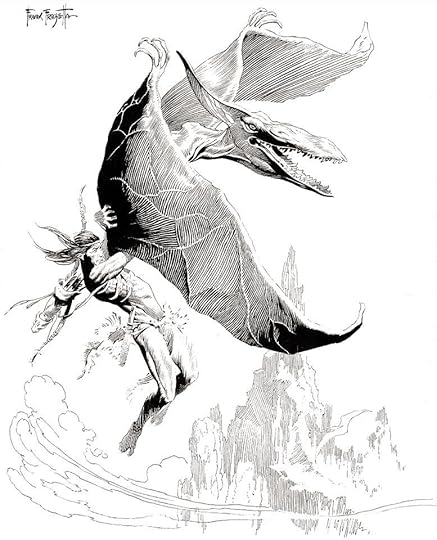
A final note: some of the greatest ERB art stems from the scene of Tarzan's capture in this novel by a Thipdar, a form of pterodactyl. The fact that this scene has been painted and sketched by some of the world's most famous artists (Neal Adams, Frank Frazetta, etc) says a lot. The scene is gobsmacking in its power and imagery. Bravo, ERB.
Thumbs up!
Visit ERBzine to view these images and others related to Tarzan at the Earth's Core.
I first read this book as a 9 year old in 1982; I re read the first half of it at Pennsic War XLVIII. While I found enough merit to award 3 stars, I should begin with some of the parts of it that made me uncomfortable. I am reminded of why I stopped reading Edgar Rice Burroughs after this novel. I was inspired to pick this up again after completing Lin Carter's Green Star series early in January; and it is true that the Green Star Series is a love letter to Burroughs ( as Carter states in the introduction to his first volume ) but it is Burroughs without the dated, antiquated, understated racist attitude that kept me from reading beyond this book ( Other than that I've read the first 3 or 4 Tarzan novels ).
Don't get me wrong; I understand context historical context, and in one sense it is a marker of how far we've come as a society; but the idea of certain groups of people ( in this case blacks and Filipinos are treated as barely literate people who are stuck in menial labor jobs. ) And after a while it just gets on my nerves. The whole of the expedition thinks that their dirigible is the greatest thing ever and the transportation choice of the future ... of course this was 1929 and before the Hindenburg but ...
The only parts I remembered of this book from the age of 9 was the battle with the cave bear which was the cover painting by Frank Frazetta ~ and the gilding Stegosaurus that attacks Jason Gridley.
Another thing I find odd about this book is it really does not treat Tarzan like a central character rather it is Gridley and his romance with the cave girl Jana of Zoram that seems to take up the focus of most of the book. Perhaps it should have been called Jason Gridley at the Earth's Core but ....
It is entertainment for summer reading and it can be enjoyed in the same way we all still enjoy Robert E. Howard, who, writing in the same period has in his writing some of the same understated bias, but you need to keep in mind that it is there and it may detract from your enjoyment of the book. If you can put the antiquated parts of the book in historical context it can be a fine old adventure novel.
I really liked the snake / lizard people The Horibs, and wish they'd shown up in the book a lot earlier.
Edgar Rice Burroughs is a master at world building and this story is absolutely no exception. The only real complaints are that the book is a bit dated and the ending is rather abrupt and has a bit of a cliffhanger to it. That being said, fans of Tarzan will enjoy this book.
I read several of the Pellucidar books, but this one sticks in my memory.
I tend to say that Burroughs never let facts (or his ignorance thereof) interfere with his narrative. The laws of physics, the facts of biology, or geography, or optics--all ignored. Bur this is something of an oversimplification. Much of what Burroughs said (about the behavior of nonhuman apes, for example) was not known to be untrue in the literature of the times when he wrote, and he often did correct things when he learned more accurate versions.
Many current scientists, science fiction authors, etc started with Burroughs as children--so he succeeded in getting to the curiosity and sense of exploration that children naturally have, and directing it toward the sciences, in many cases. Not a legacy to be despised.
This is a cross over pulp novel. It's actually Tarzan #13, but also Pellucidar #4. It's actually more relevant to the latter as the main plot is an expedition to rescue Tanar of Pellucidar.
Some good pulp era speculative science here. Lord Greystoke and Jason Gridley build an vacuum power airship and fly into Pellicidar via the hole at the Earths north pole. Once they get there they get split up and the story follows them on their adventures from the two POVs. As you might expect, they all meet up again in the end, the good guy gets the girl etc, etc.
I'm going to finish the Pellucidar series as they are not so well known as most of ERB's other works. The only problem being that they are not that easy to find.
While reading these books, it's useful to have a map of Pellucidar, of which there are several on the internet.
Great ERB. My favorite three scenes are: 1) the detailed description of a huge pack of saber tooth tigers attacking and destroying a large conglomeration of other animal species for feeding purposes; 2) the nine or ten Waziri warriors opening up with their rifles on the charging man-eating Horibs; 3) Tarzan saving the heroine from a huge Horib by dropping down on it from a tree, and literally beating it to death by lifting it bodily and slamming it up and down on the ground until the detestable creature was lifeless.
Burroughs' art is making impossible scenarios seem realistic while you are reading them. His greatest art is his detailed, colorful, artistic descriptions of scenes and landscapes.
This work contains six complete novels about the adventures of Tarzan of the Apes. It does not include the original story. These stories are classics suitable for all ages.
Aynı iskelet ve yapı üzerine döneme göre popüler olan tarzan karakterini koymuş. Betimlemeler vs gene evren kurulumu güzel ama karakter motivasyonları zayıf kalmış .
Edgar Rice Burroughs' 1929 Tarzan at the Earth's Core, fourth in his hollow-Earth "Pellucidar" series, is classic pulp fiction/fantasy of the '20s. By joining two of his famous series, Tarzan and Pellucidar, in a crossover novel, the author cleverly aims at widening his audience still further, since a reader of one series thus introduced to the other may very well end up purchasing those other books as well. And back when Burroughs was plotting such literary mischiefs, of course, more sales meant more money.
As usual for Burroughs, the novel begins with a seemingly serious nod to truthfulness, as if the tale were reality rather than fiction, and is predicated upon the cliffhanger of the previous book in the series. "Pellucidar, as every schoolboy knows," begins the first line, "is a world within a world, lying, as it does, upon the inner surface of the hollow sphere, which is the Earth" (Early 1960s Ace paperback, page 5). After giving a brief summary of the discovery of Pellucidar by David Innes and Abner Perry and a lesson on the inner world's size and geography that would not have been out of place in a 1920s classroom, the Foreword closes by reminding us of the cliffhanger that ended Tanar of Pellucidar, the previous book: "The last word that we received from Perry before his messages faltered and died out was to the effect that David Innes, first Emperor of Pellucidar, was languishing in a dark dungeon in the land of the Korsars, far across continent and ocean from his beloved land of Sari, which lies upon a great plateau not far inland from the Lural Az" (page 7). Sounds like somebody needs to send an expedition to rescue Innes, huh?
Well, then how 'bout if Jason Gridley, the guy who invented the ultra-radio-majiggy which received Perry's messages that became Tanar of Pellucidar, heads over to Africa to seek out Tarzan "for the purpose of enlisting [his] personal and financial support" (page 10)? In addition to being an expert of all jungley things, after all, Tarzan also is an English lord and presumably has a tremendous account of pounds sterling somewhere. And as long as Pellucidar was discovered by one science-fictional machine, why not use yet a different one here? To pass through the polar opening to the inner world we'll make a dirigible--a nifty thing in any interwar pulp circumstance--that naturally has a gun platform on the top and a machinegun turret at the tail, along with "a small scout monoplane" launchable from the lower rear (pages 15-16). Instead of using helium in fabric bags, though, we'll double-justify the trip to Africa by visiting Dr. von Harben at his mission in "the Urambi country," since his son "had discovered a lake-dwelling tribe using canoes made of a metal that was apparently as light as cork and stronger than steel" (page 14), and with this super-duper metal we'll get "the utmost and maximum of buoyancy in a ship supported entirely by vacuum tanks" (page 13). The ship then will be crewed by requisite former "officers in the Imperial air forces" plus "twelve engineers and eight mechanics" and, um..."a negro cook and two Filipino cabin boys" (page 18). It is 1927, after all.
The structure is standard Burroughs: an endless-seeming quest through perilous lands, with monsters, friendships, treachery, and of course a haughty dame who thinks she's soooooo special and after whom the protagonist, gallant and yet boyishly unable to identify the reason, must follow worshipfully. The narrative is third-person omniscient, and, after a wild stampede that separates the explorers into several different and hopelessly lost groups, bops back and forth among the characters. Even within the groups there's a lot of head-hopping that nowadays is no longer a favored literary convention; a bit oddly, changes of scene within chapters are not signaled by the break of a blank line, which isn't the most helpful. And the characterization of the "negro cook"...ouch, even worse than usual.
Edgar Rice Burroughs' Tarzan the the Earth's Core to me is a notch down from some of the earlier installments of the Pellucidar series--I'll call it 3.5 stars, or maybe 4. For what the work is, it's decent, and it indeed is worth reading on the way through to the books that follow.
Despite the 2 Star Rating (reasons why will be revealed shortly), this was actually a rather fun and good read by Burroughs. To take this book at face value, it was perhaps one of the best Tarzan Books so far.
This is a story in a similar vein of the greats - H G Wells and Jules Verne (Journey to the Centre of the Earth). It is reminiscent of an era of “Science Fiction Fantasy”. The story follows Tarzan and an American, Jason Gridley who heard stories of an undiscovered “new world” beyond the North Pole towards the Centre of the Earth. They go on an expedition to explore and find an old colleague lost there. So they do and action and adventure begins. Based on this, yes, it is a wonderfully entertaining read.
Now, for the 2 Star Rating. By reading book 13 of the Tarzan Novels, you become to accept that Burroughs CANNOT ‘conclude’ a story. It is all summed up way too quickly. You then really look at the plot, alas, the first two chapters really destroy this Novel. An American. wishing to travel beyond the North Pole to the earths core (or there abouts) goes off to the jungles of Africa to seek out Tarzan’s help. Why? He soon looses his guide, by luck finds Tarzan to enlist his help, oh yes, and money for the expedition. They need to build an air ship, of which, Tarzan just so knows of a tribe of people with a newly undiscovered light weight, yet strong enough metal to do the job. By Chapter 2, Tarzan has joined the quest, the ship is built, part of his tribe of loyal and faithful warriors are joining him. Barely 1 test flight finished and they’re flying over Northern Europe. All this happens in less than 2 chapters. No mention of Tarzan’s family, he’s off.
Then, Tarzan goes off exploring. A seemingly great hunter, tracker and knowledgeable of “jungle ways” Tarzan gets caught in a trap. For someone who has spent his life in a jungle, he is perhaps the worst tracker/ hunter there is. I don’t think a story has gone bye where he hasn’t been caught, lost his memory, trapped, shrunk in size, or, some disaster happen to him. For these reasons the story was marked down.
বইয়ের নামঃ টারজান সমগ্র লেখকঃ এডগার রাইজ বারোজ প্রকাশকালঃ1912-1966 ( the lost adventure was complete by Joe R. Lansdale in 1995) ব্যক্তিগত রেটিংসঃ ৫/৫
টারজান সম্পর্কে বই পড়েন নি কিংবা মুভি দেখেন নি বা টারজানের নাম শুনেন নি এরকম লোক হয়ত খুঁজে পাওয়া দুষ্কর। টারজান সামগ্র এ মোট 29 টি উপন্যাস রয়েছে। এখানে টারজানের জন্মের আগে থেকে শুরু করে মৃত্যু পর্যন্ত ঘটনাগুলো বলা হয়েছে। আসলে প্রথম উপন্যাস পড়ে আমি টারজানের প্রেমে পড়ে যায় পরে সবগুলো সবগুলো উপন্যাস শেষ করি। অনুবাদকের প্রশংসা করতেই হয়। অনুবাদগুলো সহজ সরল ছিল।
জঙ্গল সম্পর্কে পড়তে হলে টারজান এবং জিম করবেট সমগ্র পড়া উচিত। টারজানের যে চরিত্র গুলোর কথা বলা হয়েছে সবগুলোই কাল্পনিক কিন্তু জিম কর্বেট এ সবই বাস্তব।
টারজান সিরিজের উপন্যাস গুলোঃ Tarzan of the Apes The Return of Tarzan The Beasts of Tarzan The Son of Tarzan Tarzan and the Jewels of Opar Jungle Tales of Tarzan Tarzan the Untamed Tarzan the Terrible Tarzan and the Golden Lion Tarzan and the Ant Men Tarzan, Lord of the Jungle Tarzan and the Lost Empire Tarzan at the Earth's Core Tarzan the Invincible Tarzan Triumphant Tarzan and the City of Gold Tarzan and the Lion Man Tarzan and the Leopard Men Tarzan's Quest Tarzan and the Forbidden City Tarzan the Magnificent Tarzan and the Foreign Legion Tarzan and the Madman Tarzan and the Castaways Tarzan and the Tarzan Twins Tarzan and the Valley of Gold Tarzan: the Lost Adventure Tarzan: The Epic Adventures The Dark Heart of Time
Tarzan book 13 of 24… why do I keep doing this to myself?
10% into the book: man I missed Tarzan! 25%: Oh yeah… these are bad. 50%: I really should just stop reading these 75%: This is actually pretty entertaining 80%: wow, that was a well-crated turn of phrase! “It was a scene to inspire the loftiest sentiments in the lowliest heart.” 99%: I need to see what else happens in this series.
These books are literary junk food. I know I should quit… but I’ve already “eaten half the bag”. Might as well finish it off.
This 13th entry into the Tarzan series is also the 4th entry in ERB’s Pelicudar series. I gave up on Pelucidar after the first book. Thankfully this crossover requires no previous knowledge of the series. Hollow Earth and Dinosaurs abound, which are always welcome additions to any pulpy adventure tale.
As always with these “authorized library” editions, the forewords and afterwards are packed with historical context and insight. This 10 hour audiobook dedicated nearly 2 whole hours to an incredibly in-depth afterward which was honestly more intriguing than the book itself.
I’m going to take a little break from Lord Greystoke and his jungle pals, but I’ll be back for more as soon as my better judgement wanes.
Série Pellucidar, Tome 4 : Tarzan au coeur de la terre
Pellucidar, un monde de légende, situé au centre de notre terre, éclairé par son propre soleil immobile et peuplé de peuplades primitives et de bêtes de tous genres.
Tarzan est invité à participer à une expédition pour libérer un homme prisonnier d'une des tribus barbares de Pellucidar. Son esprit d'aventure l'emporte, mais il ne se doutait pas des dangers d'une expédition dans un lieu où vivent des bêtes gigantesques d'un lointain passé et des tribus primitives. Le danger est ...constant.
Ma lecture des BD de tarzan dans ma jeunesse m'avait fait rêver sur le monde de Pellucidar. Quoi de mieux que de retourner à l'original.
Un récit d'aventure mâtiné de science-fiction avec sa terre creuse, ses animaux préhistoriques et ses tribus diversifiées, des hommes singes aux hommes serpents.
L'action ne manque pas, que ce soit avec des monstres préhistoriques comme dans le film "Le parc jurassique" ou avec des tribus primitives et brutales dont les hommes serpents sans aucune pitié.
J'ai aimé. Le roman a vieilli, mais il ne faut pas oublier que Burroughs est un des pionniers des romans d'aventure et que son héros Tarzan a fait fureur à son époque.