

What do you think?
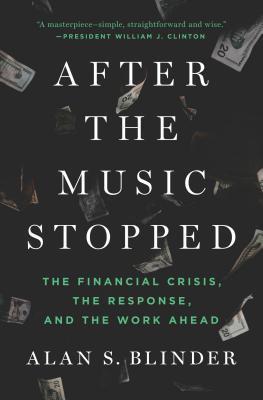
After the Music Stopped: The Financial Crisis, the Response, and the Work Ahead
With bracing clarity, Blinder shows us how the U.S. financial system, which had grown far too complex for its own good-and too unregulated for the public good-experienced a perfect storm beginning in 2007. When America's financial structure crumbled, the damage proved to be not only deep, but wide. It took the crisis for the world to discover, to its horror, just how truly interconnected-and fragile-the global financial system is. The second part of the story explains how American and international government intervention kept us from a total meltdown. Many of the U.S. government's actions, particularly the Fed's, were previously unimaginable. And to an amazing-and certainly misunderstood-extent, they worked. The worst did not happen. Blinder offers clear-eyed answers to the questions still before us, even if some of the choices ahead are as divisive as they are unavoidable. After the Music Stopped is an essential history that we cannot afford to forget, because one thing history teaches is that it will happen here again.
496 pages, Hardcover
First published January 24, 2013
About the author
Alan S. Blinder
78 books83 followersAlan Stuart Blinder is an American economist at Princeton University serving as the Gordon S. Rentschler Memorial Professor of Economics and Public Affairs in the Economics Department, and vice chairman of The Observatory Group. He founded Princeton’s Griswold Center for Economic Policy Studies in 1990. Since 1978 he has been a Research Associate of the National Bureau of Economic Research. He is also a co-founder and a vice chairman of the Promontory Interfinancial Network, LLC. He is among the most influential economists in the world according to IDEAS/RePEc, and is "considered one of the great economic minds of his generation."
Blinder served on President Bill Clinton's Council of Economic Advisors (January 1993 - June 1994), and as the Vice Chairman of the Board of Governors of the Federal Reserve System from June 1994 to January 1996.
Blinder served on President Bill Clinton's Council of Economic Advisors (January 1993 - June 1994), and as the Vice Chairman of the Board of Governors of the Federal Reserve System from June 1994 to January 1996.
Ratings & Reviews
Friends & Following
Create a free account to discover what your friends think of this book!
Community Reviews
Displaying 1 - 30 of 215 reviews

March 14, 2013
Bought the book, unpacked it and noticed the endorsement from Bill Clinton on the cover. "Oh no," I thought to myself. "A Clinton whitewash." Entertained thoughts of putting it up for sale, but in the end I decided what on earth, Blinder's worth reading.
And so it proved.
I've read the lot. From Kaletsky to Krugman, from Stiglitz to Shiller, and what they all have in common is an angle; an axe to grind. Blinder, you feel, has written this book as a mere starting point. He just wants to get the facts documented as they happened. And he's not out to cover his tracks either. He does not spare his former masters any punches. The Clinton administration's misdeeds could very easily have been shoved under the carpet, since that presidency ended a good seven-eight years before the crash, but there's mention of both the "well-publicised drives to increase homeownership -including by relatively low-income families" (p. 59) and of the Clinton Treasury having been on the wrong side on the regulation of financial derivatives (p.279).
Blinder has done his level best to produce an honest, meticulous account of the crisis. That is by far the strongest part of the book. He starts with seven causes of the crash. Most accounts concentrate on one or two, but he gives us a long, if prosaic, list:
1. the bubbles in housing and housing-related debt,
2. leverage,
3. lack of regulation, especially of shadow banking,
4. disgraceful practices in subprime lending,
5. complexity,
6. the poor incentive structure and inflated significance of rating agencies,
7. compensation-related incentives and Other People's Money.
As you can see, he keeps it simple and he keeps it all within the realms of finance. You won't find tirades about inequality, global imbalances, or the global glut of savings here. The case is built from lower-level, almost technical, stuff.
I was particularly impressed by a distinction he makes about the Fed. When it comes to the housing bubble, the way he puts it "the enemy is us." People fooled themselves into thinking they had discovered the financial wizard inside them and bought more house. To blame the Fed is probably disingenuous. Low Fed-administered rates, on the other hand, are blamed for the frenzy of housing-related debt that fed back (pun not intended) into the housing market. So the Fed can only be held accountable for what the author calls the "bond bubble" but not the housing bubble. I personally disagree a bit with the author on this. I think he underestimates the power of the feedback loop between more housing-related debt and housing prices going mad as the Wall Street / mortgage banking axis went ape, "sourcing" more "product." But it is a very legitimate distinction and one well worth making.
He then dives straight into a day-by-day account of the two most intense years of the crisis and how it unfolded. What institution got hurt when, how the authorities responded, what worked, what didn't, and all of it as if you were in the control room. You really feel like you were riding along with Bernanke, Paulson and Geithner as they battled the crisis. He also makes a very good distinction between the first part of the fight, which was all about bailing out Bear, Fannie and Freddie, Merrill, Lehman, AIG, Wachovia, WaMu, Citi and Bank of America, and the second part of the fight, where the authorities changed tack and concentrated on saving entire markets, rather than individual institutions: the money market, the CP market, the market for bank bonds etc. I'm convinced he correctly identifies this as the turning point where the "war was won" and depression was averted.
Very importantly, this book is ACCESSIBLE. The author explains everything in plain English. I think you can follow the whole thing without being an expert. With non-expert readers in mind, the author has tons of "boxes" interspersed through the book, that explain all sorts of financial concepts in plain English: "Leverage and Financial Returns," "What is a Derivative," "Insolvency vs. Illiquidity," "The Moral Hazard Debate," "Contagion and Financial Panics," "Signalling and Stigma," "Bid-Ask Spreads," "Keynesian Economics and Stimulus," "The Expectations Theory of the Yield Curve," "Quantitative Easing," "Proprietary Trading" and "Information and Free-Riding." I really really wish he had dedicated another box to explaining what the Fed does outside of a crisis and how we have substituted Federal obligations (backed by taxes on Americans) for gold at the heart of the monetary system and that all money used is printed. He often refers to this, and clearly he is at total peace with it, but he assumes his readership also understands this. Many people don't.
Regardless, the great thing about the first, dunno, 200 pages of the book is that it is a 100% honest account of how we got into and out of big trouble. I would recommend it with zero reservation to anybody who would like an objective historical overview of the crisis in plain English. The account is straight and plain, it has a beginning and an end, it's balanced and it never attempts to over-reach.
Sadly, it's a bit downhill from there. Not terribly downhill. But not as strong as the first half of the book, that's all.
For example, I loved the chapter about Dodd-Frank. It's really all there. You find out where it started, what's in it, how it got there and what's left open. There are extensive tables to help you track the reforms. I think I'll make a spreadsheet of that table and keep it on my computer so I can carry on keeping track for myself as we go on.
On the other hand, the book goes partisan at some stage. When it comes to discussing the Obama stimulus package, it goes almost into full-front attack on the Republican party. It's a crying shame. It means I can't recommend his book to my Republican friends and family. They will read the first 200 pages, which I find excellent and fair, and then they will read what the author has to say about the stimulus and they will (unjustifiably) doubt the first 200 pages. They will think I duped them into reading a Democrat pamphlet, and a 400-page pamphlet at that. Ach!
And it goes catty too. If anything, I find Blinder is far too careful (dare I say American?) in going out of his way to never doubt the guys in charge. He defers to Paulson's and Geithner's best judgement when it comes to their single-mindedness with reference to bailing out some institutions and people who had been on horrible behaviour (though he does decry that only one man, Lee Farkas, has been convicted of any crime relating to the crisis to this day) and he is not merely deferential to Bernanke (in a very strong chapter on "Unconventional Monetary Policy"), his prose amounts to grovelling. He thinks TARP is the best thing since sliced bread and chooses to not mention that some of its financial returns were funded by other parts of government. So be it. But in that context it is very dissonant to hear him repeatedly pan Larry Summers. If there is no room for backseat drivers, and that's very much the tone of the book, leave him alone. It is unthinkable to me that Summers broke more rules than Paulson, Geithner or Bernanke or that he was anywhere nearly as conflicted or involved, for that matter.
My conclusion about this book is that it's a fantastic guide to the crisis for the uninitiated. Not for me, though, because I've lived the crisis from my trading desk and because I've read tons about it. With five years' worth of hindsight, I was hoping for some synthesis after the exquisite analysis.
Blinder defines the problem narrowly enough to declare the response a triumph. He does not ask where we're left, other than to refer to issues everybody with a pulse knows about, like the future costs of Medicare and the need for both lower spending and higher taxes in the future, but lax fiscal policy now. If you watch CNBC for an hour somebody will mention all of that. Twice.
The only concession he makes is to call the foreclosure situation a "train wreck" and to admit that it should have been dealt with better. But, having discussed moral hazard extensively, he does not tell us if he thinks we're now awaiting the next moral-hazard-induced train wreck or if we're OK. Having started his book by stating the whole crisis was caused by letting Lehman go, he does not return to the topic to let us know if this was a rhetorical flourish or what he considers to be fact. He does not offer a view of where we'd be without Lehman, of whether it was one of many accidents waiting to happen or the one key we'd have to turn to avoid the crisis (which is a commonly held view of the establishment). He does not attempt to tell us if the 2008 victory was Pyrrhic or decisive.
Also, his perfunctory chapter on Europe should have been left out, it is not to the standard of the rest of the book.
Same goes for his ten commandments and seven recommendations. Blinder strongly commends Paulson / Geithner / Bernanke for their "laser-beam focus" on the narrow issue-at-hand. He should follow his own advice, decide where the economy needs to head and then go making recommendations for the future and focus them around this one core. Instead, he goes scattergun.
So I think what we have here is 200 pages of a five-star book that focuses on analysis, maybe even a six star book, followed by an honest but flawed three-star book that does not do a terribly good job of synthesis. I'm better off for having read it, though, and I have not found a better one.
Halfway through the book I was ready to say my search was over, that's what rankles...
And so it proved.
I've read the lot. From Kaletsky to Krugman, from Stiglitz to Shiller, and what they all have in common is an angle; an axe to grind. Blinder, you feel, has written this book as a mere starting point. He just wants to get the facts documented as they happened. And he's not out to cover his tracks either. He does not spare his former masters any punches. The Clinton administration's misdeeds could very easily have been shoved under the carpet, since that presidency ended a good seven-eight years before the crash, but there's mention of both the "well-publicised drives to increase homeownership -including by relatively low-income families" (p. 59) and of the Clinton Treasury having been on the wrong side on the regulation of financial derivatives (p.279).
Blinder has done his level best to produce an honest, meticulous account of the crisis. That is by far the strongest part of the book. He starts with seven causes of the crash. Most accounts concentrate on one or two, but he gives us a long, if prosaic, list:
1. the bubbles in housing and housing-related debt,
2. leverage,
3. lack of regulation, especially of shadow banking,
4. disgraceful practices in subprime lending,
5. complexity,
6. the poor incentive structure and inflated significance of rating agencies,
7. compensation-related incentives and Other People's Money.
As you can see, he keeps it simple and he keeps it all within the realms of finance. You won't find tirades about inequality, global imbalances, or the global glut of savings here. The case is built from lower-level, almost technical, stuff.
I was particularly impressed by a distinction he makes about the Fed. When it comes to the housing bubble, the way he puts it "the enemy is us." People fooled themselves into thinking they had discovered the financial wizard inside them and bought more house. To blame the Fed is probably disingenuous. Low Fed-administered rates, on the other hand, are blamed for the frenzy of housing-related debt that fed back (pun not intended) into the housing market. So the Fed can only be held accountable for what the author calls the "bond bubble" but not the housing bubble. I personally disagree a bit with the author on this. I think he underestimates the power of the feedback loop between more housing-related debt and housing prices going mad as the Wall Street / mortgage banking axis went ape, "sourcing" more "product." But it is a very legitimate distinction and one well worth making.
He then dives straight into a day-by-day account of the two most intense years of the crisis and how it unfolded. What institution got hurt when, how the authorities responded, what worked, what didn't, and all of it as if you were in the control room. You really feel like you were riding along with Bernanke, Paulson and Geithner as they battled the crisis. He also makes a very good distinction between the first part of the fight, which was all about bailing out Bear, Fannie and Freddie, Merrill, Lehman, AIG, Wachovia, WaMu, Citi and Bank of America, and the second part of the fight, where the authorities changed tack and concentrated on saving entire markets, rather than individual institutions: the money market, the CP market, the market for bank bonds etc. I'm convinced he correctly identifies this as the turning point where the "war was won" and depression was averted.
Very importantly, this book is ACCESSIBLE. The author explains everything in plain English. I think you can follow the whole thing without being an expert. With non-expert readers in mind, the author has tons of "boxes" interspersed through the book, that explain all sorts of financial concepts in plain English: "Leverage and Financial Returns," "What is a Derivative," "Insolvency vs. Illiquidity," "The Moral Hazard Debate," "Contagion and Financial Panics," "Signalling and Stigma," "Bid-Ask Spreads," "Keynesian Economics and Stimulus," "The Expectations Theory of the Yield Curve," "Quantitative Easing," "Proprietary Trading" and "Information and Free-Riding." I really really wish he had dedicated another box to explaining what the Fed does outside of a crisis and how we have substituted Federal obligations (backed by taxes on Americans) for gold at the heart of the monetary system and that all money used is printed. He often refers to this, and clearly he is at total peace with it, but he assumes his readership also understands this. Many people don't.
Regardless, the great thing about the first, dunno, 200 pages of the book is that it is a 100% honest account of how we got into and out of big trouble. I would recommend it with zero reservation to anybody who would like an objective historical overview of the crisis in plain English. The account is straight and plain, it has a beginning and an end, it's balanced and it never attempts to over-reach.
Sadly, it's a bit downhill from there. Not terribly downhill. But not as strong as the first half of the book, that's all.
For example, I loved the chapter about Dodd-Frank. It's really all there. You find out where it started, what's in it, how it got there and what's left open. There are extensive tables to help you track the reforms. I think I'll make a spreadsheet of that table and keep it on my computer so I can carry on keeping track for myself as we go on.
On the other hand, the book goes partisan at some stage. When it comes to discussing the Obama stimulus package, it goes almost into full-front attack on the Republican party. It's a crying shame. It means I can't recommend his book to my Republican friends and family. They will read the first 200 pages, which I find excellent and fair, and then they will read what the author has to say about the stimulus and they will (unjustifiably) doubt the first 200 pages. They will think I duped them into reading a Democrat pamphlet, and a 400-page pamphlet at that. Ach!
And it goes catty too. If anything, I find Blinder is far too careful (dare I say American?) in going out of his way to never doubt the guys in charge. He defers to Paulson's and Geithner's best judgement when it comes to their single-mindedness with reference to bailing out some institutions and people who had been on horrible behaviour (though he does decry that only one man, Lee Farkas, has been convicted of any crime relating to the crisis to this day) and he is not merely deferential to Bernanke (in a very strong chapter on "Unconventional Monetary Policy"), his prose amounts to grovelling. He thinks TARP is the best thing since sliced bread and chooses to not mention that some of its financial returns were funded by other parts of government. So be it. But in that context it is very dissonant to hear him repeatedly pan Larry Summers. If there is no room for backseat drivers, and that's very much the tone of the book, leave him alone. It is unthinkable to me that Summers broke more rules than Paulson, Geithner or Bernanke or that he was anywhere nearly as conflicted or involved, for that matter.
My conclusion about this book is that it's a fantastic guide to the crisis for the uninitiated. Not for me, though, because I've lived the crisis from my trading desk and because I've read tons about it. With five years' worth of hindsight, I was hoping for some synthesis after the exquisite analysis.
Blinder defines the problem narrowly enough to declare the response a triumph. He does not ask where we're left, other than to refer to issues everybody with a pulse knows about, like the future costs of Medicare and the need for both lower spending and higher taxes in the future, but lax fiscal policy now. If you watch CNBC for an hour somebody will mention all of that. Twice.
The only concession he makes is to call the foreclosure situation a "train wreck" and to admit that it should have been dealt with better. But, having discussed moral hazard extensively, he does not tell us if he thinks we're now awaiting the next moral-hazard-induced train wreck or if we're OK. Having started his book by stating the whole crisis was caused by letting Lehman go, he does not return to the topic to let us know if this was a rhetorical flourish or what he considers to be fact. He does not offer a view of where we'd be without Lehman, of whether it was one of many accidents waiting to happen or the one key we'd have to turn to avoid the crisis (which is a commonly held view of the establishment). He does not attempt to tell us if the 2008 victory was Pyrrhic or decisive.
Also, his perfunctory chapter on Europe should have been left out, it is not to the standard of the rest of the book.
Same goes for his ten commandments and seven recommendations. Blinder strongly commends Paulson / Geithner / Bernanke for their "laser-beam focus" on the narrow issue-at-hand. He should follow his own advice, decide where the economy needs to head and then go making recommendations for the future and focus them around this one core. Instead, he goes scattergun.
So I think what we have here is 200 pages of a five-star book that focuses on analysis, maybe even a six star book, followed by an honest but flawed three-star book that does not do a terribly good job of synthesis. I'm better off for having read it, though, and I have not found a better one.
Halfway through the book I was ready to say my search was over, that's what rankles...

May 19, 2014
Found an excellent article on ten questions that any explanation for the global financial crisis must address. The beauty of these questions is that they help weed out any spurious, politically motivated narrative for why the crisis occurred.
Article here: Bad Explanations for the Financial Crisis Won't Die
Article here: Bad Explanations for the Financial Crisis Won't Die
February 12, 2013
An excellent reference on the first recession of the 21st Century. Unlike many books, it doesn't use a single incident like the banking industry bailout or the Lehman Brothers failure -- and points out that housing was already in trouble before the financial bubble burst in 2007-2009. Instead it takes an economist's view of the whole economy to assess where things were out of balance.
Blinder blames regulatory failures, noting the positions of Alan Greenspan and the Bush-era administrators at the Federal Reserve, Office of Thrift Supervsion and Federal Deposit Insurance Corporation. In addition, subprime lending soared to 20% of ll mortgages as early as 2005 -- and nine of the 10 originators were not commercial banks (though commercial banks like Washington Mutual) would try to cash in by buying subprime mortgage originators.
The villains in the crash, according to the economist author:
* inflated asset prices in both housing and bonds
* excessive borrowing throughout the financial system
* lax financial regulation
* "disgraceful" banking practices in the subprime and mortgage markets
* derivatives built on portfolios of the subprime mortgages
* failure of the rating agencies to detect fraud and weak statistical logic
* "perverse" compensation systems at commercial banks, investment banks and mortgage companies that created the incentive for risk
Blinder also ties in the European economic crisis with that in the U.S. near the end of this book. In both cases he is skeptical that politicians will be able to take the actions necessary to clear up core structural problems in finance.
Blinder blames regulatory failures, noting the positions of Alan Greenspan and the Bush-era administrators at the Federal Reserve, Office of Thrift Supervsion and Federal Deposit Insurance Corporation. In addition, subprime lending soared to 20% of ll mortgages as early as 2005 -- and nine of the 10 originators were not commercial banks (though commercial banks like Washington Mutual) would try to cash in by buying subprime mortgage originators.
The villains in the crash, according to the economist author:
* inflated asset prices in both housing and bonds
* excessive borrowing throughout the financial system
* lax financial regulation
* "disgraceful" banking practices in the subprime and mortgage markets
* derivatives built on portfolios of the subprime mortgages
* failure of the rating agencies to detect fraud and weak statistical logic
* "perverse" compensation systems at commercial banks, investment banks and mortgage companies that created the incentive for risk
Blinder also ties in the European economic crisis with that in the U.S. near the end of this book. In both cases he is skeptical that politicians will be able to take the actions necessary to clear up core structural problems in finance.

March 15, 2013
A solid first draft of the history of the financial crisis and its consequences. We all lived through it, but every time I read another book on the financial crisis, it strikes me again: What a tale -- a Shakespearean tragedy.
Imagine you went back in time and told someone a decade ago that the whole house of cards would collapse, that the world would be confronted with a second Great Depression, that the Fed would take trillions on its balance sheet alongside a $700 billion congressional measure to rescue the financial system, that we would enact a massive (yet still insufficient) $787 stimulus bill, followed by Wall Street reform, the possible demise of the Euro, and god knows what else. ("Well, if you believe that, then I've got some real estate in Nevada to sell you...")
Blinder's book is on the short list of must-reads for anyone who seeks to understand the "why" and the "how" of the crisis, recession, and response. Probably worth reading alongside Michael Grunwald's THE NEW NEW DEAL, which zeroes in on the macro and fiscal stimulus perspective to complement Blinder's financial and monetary focus.
Though not all of Blinder's arguments are persuasive -- he buys into the spurious argument that President Obama "didn't focus" on the economy, as if major additional stimulus were actually politically possible after February 2009! -- you'd be hard-pressed to find a better explanation of the cause of, and response to, the worst American economic crisis since the 1930s.
Imagine you went back in time and told someone a decade ago that the whole house of cards would collapse, that the world would be confronted with a second Great Depression, that the Fed would take trillions on its balance sheet alongside a $700 billion congressional measure to rescue the financial system, that we would enact a massive (yet still insufficient) $787 stimulus bill, followed by Wall Street reform, the possible demise of the Euro, and god knows what else. ("Well, if you believe that, then I've got some real estate in Nevada to sell you...")
Blinder's book is on the short list of must-reads for anyone who seeks to understand the "why" and the "how" of the crisis, recession, and response. Probably worth reading alongside Michael Grunwald's THE NEW NEW DEAL, which zeroes in on the macro and fiscal stimulus perspective to complement Blinder's financial and monetary focus.
Though not all of Blinder's arguments are persuasive -- he buys into the spurious argument that President Obama "didn't focus" on the economy, as if major additional stimulus were actually politically possible after February 2009! -- you'd be hard-pressed to find a better explanation of the cause of, and response to, the worst American economic crisis since the 1930s.

February 3, 2013
Best quote so far, from page 236:
He [John Maynard Keynes] would have been shocked to hear that anyone in 2011 was still asking the question. The earth is not flat. The moon is not made of cheese. Evolution really happened. And you don't give your economy a short-run boost by cutting public spending.
He [John Maynard Keynes] would have been shocked to hear that anyone in 2011 was still asking the question. The earth is not flat. The moon is not made of cheese. Evolution really happened. And you don't give your economy a short-run boost by cutting public spending.

February 7, 2013
After the Music Stopped: an excellent book. A readable description of the financial crisis, its causes, its repercussions, a rating of the reactions to it, and some suggestions for the future. I thought the book made a complicated subject understandable, though whether I will be able to repeat what I learned in a week’s time is another story. It was remarkably timely, including post-election November 2012 insights. It describes a problem created by complicated and opaque financial products, excessive leverage, and lax or lacking regulation. The author points out that most people have the wrong impression of both the Bush TARP and the Obama stimulus (which the public equates as being the same thing). Both are perceived as giveaways to banks, which they were not. (TARP seems to have made money for the government). He plausibly gives the Bush and Obama administrations a good grade for preventing the recession from being worse than it actually was, via whatever imaginative means possible. However, he rates them as bad when it comes to correcting the problems of the individuals whose houses have been foreclosed. It seems we can apply “moral hazard” arguments at the individual level, but not at the corporate level. Anyway a great educational book.

December 11, 2013
This is one of the very best books on the financial crisis that has been written to date. It goes over the territory covered by other accounts, while bringing the crisis and recovery up to date. What makes it especially good are three strengths. First, the author is a master at explaining the issues and research in terms that are easy to understand yet sophisticated enough to convey the richness of the problem situation. He is a top flight economist who can communicate to non-economists. Second, the book also evaluates the various policy responses to the crisis according to how effective they have been. What was a given program attempting to accomplish? How can one tell how successful it has been in accomplishing its goals? Identifying the problems here is hard enough. Figuring out how to respond - and provide evidence of the response - is another arguably more difficult problem. Third, the book is exquisitely written. The book is easy to read and fun to follow. Reading work like this can easily make one jealous. In terms of ideology, the author is a democrat but to me that is irrelevant if the analysis is solid, which it is here. If you have to read one book on the financial crisis, this is a good one to choose. It is also worthwhile if you have read a lot on this set of crises.

March 2, 2014
Alan Binder's book has something to make everyone angry, from the far left to the far right. The bottom line is, despite it's unfairness, the government's reaction to the financial meltdown saved many of us from the breadline. After the Music Stopped makes sense of what I experienced through soundbites and daily news stories. Sometimes I got a little lost in the intricacies of Wall Street, but overall it gave me a clear picture of what went wrong, and what we can do to keep it from happening again. (And surprise, surprise, it doesn't involve less regulation.)

April 4, 2017
Nothing new or revelatory in here if you've followed the crisis commentary from the beginning, but if not, this is a very comprehensive and somewhat unbiased story. Sometimes it gets too deep in the weeds and sometimes not enough, but it's really hard to write a book about the crisis and its aftermath. Believe me, I know...

October 17, 2023
read per the recommendation of a finance bro... lol. well, this book is pretty well written. but despite being a student in economics, i have zero interest in the fed, and macroeconomic policy related to inflation, interest rates, and unemployment has always gone in one ear and out the other (i blame the fact that i took AP Macroeconomics during COVID and they skipped the entire chapter on fed policy).
despite that, blinder writes in a fairly digestible, attention-grabbing style and really breaks down the recession into some key questions / issues. this is supplemented with visuals (such as graphs and tables). he highlights all the key players, both political and nonpolitical, as well as the key policy mistakes. this made me realized how academia economics is such an ivory tower and so different than actually implementing policies that impact hundreds of millions of people who are not educated on the topic. who don't understand the gray matter that is wall street. who don't know the difference between derivatives and stocks.
this book illuminated how much I don't know about the economy, that taking econometrics can't ever help with. sometimes it's really about handling your personal finances, the decision to purchase a house, how to pay back debt, etc. these are the questions that every day citizens face, not which Instrumental Variable to use in regression analysis. thinking back, i hardly knew the 2008 financial crisis even happened. this book led me to question how my view of money/personal finance has also been shaped by my chinese parent's cultural values--and their own lack of understanding of the american economy as well.
there's still a lot for me left to learn. at the same time, it has strengthened one of my perverse thoughts: "if i'm rich enough, none of this would matter."
despite that, blinder writes in a fairly digestible, attention-grabbing style and really breaks down the recession into some key questions / issues. this is supplemented with visuals (such as graphs and tables). he highlights all the key players, both political and nonpolitical, as well as the key policy mistakes. this made me realized how academia economics is such an ivory tower and so different than actually implementing policies that impact hundreds of millions of people who are not educated on the topic. who don't understand the gray matter that is wall street. who don't know the difference between derivatives and stocks.
this book illuminated how much I don't know about the economy, that taking econometrics can't ever help with. sometimes it's really about handling your personal finances, the decision to purchase a house, how to pay back debt, etc. these are the questions that every day citizens face, not which Instrumental Variable to use in regression analysis. thinking back, i hardly knew the 2008 financial crisis even happened. this book led me to question how my view of money/personal finance has also been shaped by my chinese parent's cultural values--and their own lack of understanding of the american economy as well.
there's still a lot for me left to learn. at the same time, it has strengthened one of my perverse thoughts: "if i'm rich enough, none of this would matter."

September 24, 2019
It gives a great and deep-without-being-boring account of the events and behaviors that led to the Subprime crisis, explaining the solutions provided by the government during 08-09 and the aftermatch of it.
Despite being sometimes too keynesian and biased to interventionism it's really rich in important details and crucial data which are essential to understand thoroughly the crisis.
Despite being sometimes too keynesian and biased to interventionism it's really rich in important details and crucial data which are essential to understand thoroughly the crisis.

October 21, 2019
Extremely informative on the post sub prime crisis measures that leaders took to bring the Financial world under control
April 9, 2023
After the failure of Silicon Valley Bank, I saw Alan Blinder, former Vice Chairman on Federal Reserve talking about the fiasco. The host mentioned Blinder had a new book on the US financial system. I went to MD Digital Library. Though they didn’t have his new book yet, I borrowed his analysis of the Great Recession, to learn what I could about a crisis that I remember well as it happened shortly before I retired.
His thumbnail of the causes of the 2007-2009 Great Recession are:
1. asset-price bubbles
2. exaggerated by irresponsible leverage, encouraged by crazy compensation schemes and excessive complexity
3. embarrassingly bad underwriting standards
4. dismal performances by the statistical rating agencies
5. lax financial regulation
He explains clearly these various components that resulted in economic turmoil for people around the world.
He takes it for granted that everyone realizes it's normal for speculative markets to go to extremes.
Also, that higher capital requirements are bound to diminish banks’ profitability. Thus, banks will always fight such regulations and financial organizations will always try to avoid being labelled banks and subject to strict oversight.
A little nugget he offered. 40-1 leverage implies that 2.5% decline in assets wipes out all shareholder value.
His thumbnail of the causes of the 2007-2009 Great Recession are:
1. asset-price bubbles
2. exaggerated by irresponsible leverage, encouraged by crazy compensation schemes and excessive complexity
3. embarrassingly bad underwriting standards
4. dismal performances by the statistical rating agencies
5. lax financial regulation
He explains clearly these various components that resulted in economic turmoil for people around the world.
He takes it for granted that everyone realizes it's normal for speculative markets to go to extremes.
Also, that higher capital requirements are bound to diminish banks’ profitability. Thus, banks will always fight such regulations and financial organizations will always try to avoid being labelled banks and subject to strict oversight.
A little nugget he offered. 40-1 leverage implies that 2.5% decline in assets wipes out all shareholder value.

June 9, 2019
If you want to understand the 2008 financial crises and aftermath of it, this book is the one indeed.

December 15, 2020
I have read at least a dozen books on the financial crisis and this one is the one to read. It is a great introduction for the uninitiated, detailed enough for the wonks, and a great read of history and policy. Blinder nails it with great writing, and as good as Martin Wolf's "The Shift and the Shocks" is about the crisis and financial thinking, this one is a step above.

April 5, 2023
Decent summary of the financial crisis and following monetary and fiscal policy response. Feels a bit more populist and written for the masses than other similar books.

August 21, 2025
guys dw when i am the ultimate finance bro and leader of all the banks i will ensure another financial crisis doesnt occur 🥰🥰🥰 i picked up like 60% of it but its okay i learnt lots
September 29, 2026
Read some time ago, but from what I can recall there was nothing especially new or groundbreaking in it. A good account of the crisis, nonetheless.

June 30, 2013
This is as good of a work as any to date in putting many of the events that led to The Great Recession into common parlance as any I've seen thus far. Blinder sometimes over simplifies in fact but not excessively and I recommend if you check it out from the library or what have you that you read at least the first half to get the events, actions, and rational of what transpired. The second half of the book essentially changes gears I think adding a thoughtful analysis of what has been done, has not been done, and perhaps most importantly what should be done to prevent another such catastrophe. He also does a credible job in covering the Eurozone Crisis without writing a whole other book but it is just a passing mention and as such not intended to be a deep analysis.
The author acknowledges that this work is still an early work and that many more will follow in the years come.
He is a Keynesian economist and as such some of the book may not set well with those of a right wing small government mindset. He's not entirely critical of the Bush administration however nor does he give Obama a pass for that matter but I think it accurate to say that he fairly well excoriates the GOP members in the House of Representatives as contributing little if anything to solving the crisis except under duress.
I think one key thing here to keep in mind is the goal of the book which might well be summed up by outlining one of the things he finds sorely lacking in the records of both Bush and Obama. Accurately he points out that no one at any point did a very good job of explaining what was happening, why it happened, what caused it, or why the government did the things it did. Obama was much better than Bush in this regard in some respects but to this day the average person does not have the information to form an informed understanding of it all. Even if over simplified in some respects the author takes this issue on.
If you don't understand the differences between QE1, QE2, TARP, and Obama's fiscal stimulas don't be embarrassed most folks really don't. This book will give you the basics needed to get your arms around the basics of what happened.
I also think he does us credit by explaining some things that go against popular wisdom. For example most folks would see the immense amount of money used to stem the crisis as handouts to bankers and others who got us into trouble in the first place. In fact TARP addressed the banks and was not a give away. Initial estimates called for $700 billion but only about $500 billion was utilized and contrary to what some political pundits say it was not under Obama but Bush that $350 billion of it was mobilized. In addition in the end the total bill to tax payers while still a lot of money comes to perhaps $35 billion with the rest repaid.
People get Obama's economic stimulas mixed up with TARP when in fact the later was more a creation of the Bush Treasury under Paulson that was then handed over mid stream to his successor. Obama also essentially bailed out an important sector of the economy but it wasn't the financial it was automotive.
One important point that he comes back to again and again is the extremely poor job both administrations have done in handling the foreclosures of single family homes. While roughly $1.5 trillan was appropriated for the banks and an infusion into the economy no appreciable measures were taken to keep people in their homes. It was after all a housing bubble that burst which then caused a bond bubble to burst then leading to the collapse of several highly leveraged investment banks that created the mess in the first place. The author suggests that for a price tag of around $200 billion over 1 million homes could have been saved or less than 1/7th of what was spent in direct government appropriation. This issue as of the publishing of the book has not yet played out some six years latter largely because of politics. The Tea Party and conservative members of Congress blocked it.
I think people are likely still going to scratch their heads as to how over 700 banks got themselves into so many bad loans. Then those loans where repackaged. Then they were insured against default often by people who did not even own them. This is oversimplified as well and it just begins to describe the vast complicated structure of financial instruments that are thought to have represented something in the order of $500 trillion dollars of underlying assets. The thing is the assets were far smaller than do to a seemingly never ending line of financial instruments that were created based on them.
Anyways I won't delve any further but if you aren't totally sure what it was all about I do recommend this book as it will lift the blinders to a considerable degree for the average person :)
The author acknowledges that this work is still an early work and that many more will follow in the years come.
He is a Keynesian economist and as such some of the book may not set well with those of a right wing small government mindset. He's not entirely critical of the Bush administration however nor does he give Obama a pass for that matter but I think it accurate to say that he fairly well excoriates the GOP members in the House of Representatives as contributing little if anything to solving the crisis except under duress.
I think one key thing here to keep in mind is the goal of the book which might well be summed up by outlining one of the things he finds sorely lacking in the records of both Bush and Obama. Accurately he points out that no one at any point did a very good job of explaining what was happening, why it happened, what caused it, or why the government did the things it did. Obama was much better than Bush in this regard in some respects but to this day the average person does not have the information to form an informed understanding of it all. Even if over simplified in some respects the author takes this issue on.
If you don't understand the differences between QE1, QE2, TARP, and Obama's fiscal stimulas don't be embarrassed most folks really don't. This book will give you the basics needed to get your arms around the basics of what happened.
I also think he does us credit by explaining some things that go against popular wisdom. For example most folks would see the immense amount of money used to stem the crisis as handouts to bankers and others who got us into trouble in the first place. In fact TARP addressed the banks and was not a give away. Initial estimates called for $700 billion but only about $500 billion was utilized and contrary to what some political pundits say it was not under Obama but Bush that $350 billion of it was mobilized. In addition in the end the total bill to tax payers while still a lot of money comes to perhaps $35 billion with the rest repaid.
People get Obama's economic stimulas mixed up with TARP when in fact the later was more a creation of the Bush Treasury under Paulson that was then handed over mid stream to his successor. Obama also essentially bailed out an important sector of the economy but it wasn't the financial it was automotive.
One important point that he comes back to again and again is the extremely poor job both administrations have done in handling the foreclosures of single family homes. While roughly $1.5 trillan was appropriated for the banks and an infusion into the economy no appreciable measures were taken to keep people in their homes. It was after all a housing bubble that burst which then caused a bond bubble to burst then leading to the collapse of several highly leveraged investment banks that created the mess in the first place. The author suggests that for a price tag of around $200 billion over 1 million homes could have been saved or less than 1/7th of what was spent in direct government appropriation. This issue as of the publishing of the book has not yet played out some six years latter largely because of politics. The Tea Party and conservative members of Congress blocked it.
I think people are likely still going to scratch their heads as to how over 700 banks got themselves into so many bad loans. Then those loans where repackaged. Then they were insured against default often by people who did not even own them. This is oversimplified as well and it just begins to describe the vast complicated structure of financial instruments that are thought to have represented something in the order of $500 trillion dollars of underlying assets. The thing is the assets were far smaller than do to a seemingly never ending line of financial instruments that were created based on them.
Anyways I won't delve any further but if you aren't totally sure what it was all about I do recommend this book as it will lift the blinders to a considerable degree for the average person :)

January 13, 2026
After the Music Stopped: A Veteran's Perspective on Financial Crisis and Response
After the Music Stopped: The Financial Crisis, the Response, and the Work Ahead
By Alan S. Blinder Copyright 2013
Alan Blinder's comprehensive examination of the 2008 financial crisis takes its title from Citibank CEO Chuck Prince's infamous July 2007 remark about dancing while the music plays: “As long as the music is playing, you've got to get up and dance,” a metaphor for the reckless participation in derivatives trading that characterized the era. Writing as both economist and former Federal Reserve vice chairman, Blinder provides an authoritative account of how the financial system collapsed and how policymakers responded.
The Scope of the Disaster
Blinder establishes the crisis's unprecedented nature with stark statistics. Between February 1984 and January 2009, American unemployment never reached 8%. The 2007-2009 recession shattered that record and stands without peer among postwar U.S. recessions. Housing prices peaked in May 2006 with homeownership at 69%, then plummeted as the massive bubble burst. Real housing prices had soared 85% between 1997 and 2006—a rise that proved unsustainable.
Seven Fatal Weaknesses
Blinder identifies seven critical vulnerabilities that made the crisis inevitable: inflated housing prices, excessive leverage, lax financial regulation, disgraceful subprime banking practices, a "crazy quilt" of unregulated securities and derivatives built on bad mortgages, abysmal performance by rating agencies, and perverse compensation systems at financial institutions. Each weakness compounded the others, creating a financial house of cards.
The subprime mortgage catastrophe exemplifies the madness. Blinder describes two Mexican strawberry pickers earning $12,000-$15,000 annually who obtained a $720,000 mortgage—perhaps 60 times their income, with their occupations listed as "field technicians." Subprime originations exploded from $35 billion (under 5% of total mortgages) in 1994 to $625 billion (20%) in 2005. Terms like "low doc," "no doc," "liar loans," and "NINJA loans" (no income, no job, no assets) became commonplace. About one-third of all subprime mortgages were low-doc or no-doc.
The Derivatives Time Bomb
The shadow banking system created instruments of staggering complexity and risk. In 2000, credit default swaps (CDS) emerged—insurance contracts masquerading as derivatives. By late 2007, CDS volume reached $62 trillion. These instruments were used less for hedging than for pure gambling through "naked" CDS, where neither party owned the underlying securities. As Blinder notes, regulators were "more enamored of innovation than safety."
When Brooksley Born, head of the Commodity Futures Trading Commission, suggested regulating over-the-counter derivatives, her efforts were blocked by Alan Greenspan, Robert Rubin, Larry Summers, and Arthur Levitt. Summers later pushed through the Commodity Futures Modernization Act of 2000, explicitly removing any threat of CFTC regulation.
The securitization machinery added layer upon layer of opacity. Mortgage-backed securities were sliced into seven or eight tranches (some had more), from toxic waste designed to absorb the first losses to senior tranches supposedly safe from all but catastrophic defaults. Collateralized debt obligations (CDOs) then aggregated the toxic waste from multiple securitized portfolios. Wall Street wrote derivatives based on these already shaky securities. As Blinder observes, these instruments were so complex that no one really knew what they contained or what they were worth.
The Unraveling
When housing prices finally stopped rising in July 2007, the jig was up. For the first time, home prices dropped everywhere simultaneously, not just in isolated markets. Most bad mortgages originated in California, though Florida, Arizona, and Nevada contributed significantly. The dash for cash began, but the Federal Reserve responded slowly with interest rate cuts.
The dominoes fell rapidly. Bear Stearns required a Fed-Treasury rescue costing $30 billion in March 2008. Fannie Mae and Freddie Mac, which had increased their subprime mortgage-backed securities from 16% in 2001 to 33% in 2004, eventually required $140 billion in government support by August 2012. Lehman Brothers, with almost one million derivative contracts and massive repo market borrowing, was allowed to fail in September 2008—a decision that nearly destroyed the financial system.
AIG's collapse revealed the interconnectedness of the system. The insurance giant had $2.7 trillion in notional derivative exposure, including one trillion with just twelve major institutions. The Fed took 79.9% of AIG's common stock while maintaining the fiction of private ownership. Reserve Primary Fund, the world's oldest money market mutual fund, broke the buck after losing $785 million on Lehman commercial paper. The commercial paper market collapsed, threatening even IBM and General Electric.
Merrill Lynch, the number one global CDO underwriter which had purchased one of the nation's biggest subprime lenders, was sold to Bank of America in a deal that produced severe buyer's remorse. Washington Mutual became the largest bank failure in U.S. history and was sold to JP Morgan Chase.
The Response
Congress appropriated $700 billion for TARP (Troubled Asset Relief Program)—the largest sum ever appropriated—based on a three-page request. The American Recovery and Reinvestment Act followed. By February 2010, the market was off life support, though the damage to the real economy persisted.
Blinder's assessment of the rescue efforts is nuanced. He rejects simplistic narratives about bailing out fat cats, noting that Bear Stearns CEO Jimmy Cayne lost a billion dollars personally. The rescues primarily saved creditors and prevented systemic collapse rather than enriching executives—though the $1 million monthly consulting fee paid to AIG Financial Products' former head and bonuses to 400 AIG employees remained embarrassing.
Lessons and Reforms
Blinder dismisses blaming Glass-Steagall's repeal as "simply an urban myth." The real problems lay in inadequate regulation of shadow banking, perverse incentives, and instruments like credit default swaps that created risk where none previously existed. The 2,300-page Dodd-Frank bill attempted comprehensive reform, though Blinder notes it made no attempt to fix the broken mortgage finance system.
His harshest criticism targets enforcement. Only one person faced prosecution from the crisis—a failure of justice that he finds inexcusable. He also laments "America's system of government by lobbyist," where lobbyists sometimes act "like virtual congressional staff."
Assessment
Blinder's account combines technical expertise with accessible explanation. His insider perspective provides valuable context for understanding how policymakers thought and acted under extreme pressure. The book succeeds as both history and cautionary tale, documenting how "too big to fail" became reality and how the financial system's complexity created vulnerabilities that regulators failed to address until catastrophe struck.
The work would have benefited from deeper exploration of why regulatory capture proved so complete and why the political will for prosecution evaporated. Nevertheless, as a comprehensive chronicle of the crisis from someone who helped manage the response, Blinder's book remains essential reading for understanding how modern financial systems can fail and what it takes to prevent total collapse.
After the Music Stopped: The Financial Crisis, the Response, and the Work Ahead
By Alan S. Blinder Copyright 2013
Alan Blinder's comprehensive examination of the 2008 financial crisis takes its title from Citibank CEO Chuck Prince's infamous July 2007 remark about dancing while the music plays: “As long as the music is playing, you've got to get up and dance,” a metaphor for the reckless participation in derivatives trading that characterized the era. Writing as both economist and former Federal Reserve vice chairman, Blinder provides an authoritative account of how the financial system collapsed and how policymakers responded.
The Scope of the Disaster
Blinder establishes the crisis's unprecedented nature with stark statistics. Between February 1984 and January 2009, American unemployment never reached 8%. The 2007-2009 recession shattered that record and stands without peer among postwar U.S. recessions. Housing prices peaked in May 2006 with homeownership at 69%, then plummeted as the massive bubble burst. Real housing prices had soared 85% between 1997 and 2006—a rise that proved unsustainable.
Seven Fatal Weaknesses
Blinder identifies seven critical vulnerabilities that made the crisis inevitable: inflated housing prices, excessive leverage, lax financial regulation, disgraceful subprime banking practices, a "crazy quilt" of unregulated securities and derivatives built on bad mortgages, abysmal performance by rating agencies, and perverse compensation systems at financial institutions. Each weakness compounded the others, creating a financial house of cards.
The subprime mortgage catastrophe exemplifies the madness. Blinder describes two Mexican strawberry pickers earning $12,000-$15,000 annually who obtained a $720,000 mortgage—perhaps 60 times their income, with their occupations listed as "field technicians." Subprime originations exploded from $35 billion (under 5% of total mortgages) in 1994 to $625 billion (20%) in 2005. Terms like "low doc," "no doc," "liar loans," and "NINJA loans" (no income, no job, no assets) became commonplace. About one-third of all subprime mortgages were low-doc or no-doc.
The Derivatives Time Bomb
The shadow banking system created instruments of staggering complexity and risk. In 2000, credit default swaps (CDS) emerged—insurance contracts masquerading as derivatives. By late 2007, CDS volume reached $62 trillion. These instruments were used less for hedging than for pure gambling through "naked" CDS, where neither party owned the underlying securities. As Blinder notes, regulators were "more enamored of innovation than safety."
When Brooksley Born, head of the Commodity Futures Trading Commission, suggested regulating over-the-counter derivatives, her efforts were blocked by Alan Greenspan, Robert Rubin, Larry Summers, and Arthur Levitt. Summers later pushed through the Commodity Futures Modernization Act of 2000, explicitly removing any threat of CFTC regulation.
The securitization machinery added layer upon layer of opacity. Mortgage-backed securities were sliced into seven or eight tranches (some had more), from toxic waste designed to absorb the first losses to senior tranches supposedly safe from all but catastrophic defaults. Collateralized debt obligations (CDOs) then aggregated the toxic waste from multiple securitized portfolios. Wall Street wrote derivatives based on these already shaky securities. As Blinder observes, these instruments were so complex that no one really knew what they contained or what they were worth.
The Unraveling
When housing prices finally stopped rising in July 2007, the jig was up. For the first time, home prices dropped everywhere simultaneously, not just in isolated markets. Most bad mortgages originated in California, though Florida, Arizona, and Nevada contributed significantly. The dash for cash began, but the Federal Reserve responded slowly with interest rate cuts.
The dominoes fell rapidly. Bear Stearns required a Fed-Treasury rescue costing $30 billion in March 2008. Fannie Mae and Freddie Mac, which had increased their subprime mortgage-backed securities from 16% in 2001 to 33% in 2004, eventually required $140 billion in government support by August 2012. Lehman Brothers, with almost one million derivative contracts and massive repo market borrowing, was allowed to fail in September 2008—a decision that nearly destroyed the financial system.
AIG's collapse revealed the interconnectedness of the system. The insurance giant had $2.7 trillion in notional derivative exposure, including one trillion with just twelve major institutions. The Fed took 79.9% of AIG's common stock while maintaining the fiction of private ownership. Reserve Primary Fund, the world's oldest money market mutual fund, broke the buck after losing $785 million on Lehman commercial paper. The commercial paper market collapsed, threatening even IBM and General Electric.
Merrill Lynch, the number one global CDO underwriter which had purchased one of the nation's biggest subprime lenders, was sold to Bank of America in a deal that produced severe buyer's remorse. Washington Mutual became the largest bank failure in U.S. history and was sold to JP Morgan Chase.
The Response
Congress appropriated $700 billion for TARP (Troubled Asset Relief Program)—the largest sum ever appropriated—based on a three-page request. The American Recovery and Reinvestment Act followed. By February 2010, the market was off life support, though the damage to the real economy persisted.
Blinder's assessment of the rescue efforts is nuanced. He rejects simplistic narratives about bailing out fat cats, noting that Bear Stearns CEO Jimmy Cayne lost a billion dollars personally. The rescues primarily saved creditors and prevented systemic collapse rather than enriching executives—though the $1 million monthly consulting fee paid to AIG Financial Products' former head and bonuses to 400 AIG employees remained embarrassing.
Lessons and Reforms
Blinder dismisses blaming Glass-Steagall's repeal as "simply an urban myth." The real problems lay in inadequate regulation of shadow banking, perverse incentives, and instruments like credit default swaps that created risk where none previously existed. The 2,300-page Dodd-Frank bill attempted comprehensive reform, though Blinder notes it made no attempt to fix the broken mortgage finance system.
His harshest criticism targets enforcement. Only one person faced prosecution from the crisis—a failure of justice that he finds inexcusable. He also laments "America's system of government by lobbyist," where lobbyists sometimes act "like virtual congressional staff."
Assessment
Blinder's account combines technical expertise with accessible explanation. His insider perspective provides valuable context for understanding how policymakers thought and acted under extreme pressure. The book succeeds as both history and cautionary tale, documenting how "too big to fail" became reality and how the financial system's complexity created vulnerabilities that regulators failed to address until catastrophe struck.
The work would have benefited from deeper exploration of why regulatory capture proved so complete and why the political will for prosecution evaporated. Nevertheless, as a comprehensive chronicle of the crisis from someone who helped manage the response, Blinder's book remains essential reading for understanding how modern financial systems can fail and what it takes to prevent total collapse.

July 8, 2013
Kudos to Alan Blinder, who manages to make economic policy both readable AND interesting, while adding some humor to boot. And kudos to him for doing so in the service of explaining exactly what went wrong in the lead-up to the 2008 financial crisis, and how the government managed to prevent the worst from occurring. As Blinder makes clear over and over again, this was a private-sector catastrophe mitigated by federal government actions; attempts to explain the crisis otherwise simply don't hold water.
As Blinder also shows, the economy-saving federal actions had the perverse and maddening effect of sparking a backlash against the government. His efforts to explain why this occurred fall short, however, and he seems to fault the Obama administration for not doing enough to clearly explain the ins and outs of the crisis and the response – but Blinder himself needed a 400-page book to do just that! He also points out numerous examples where voters misunderstand very basic facts of the crisis (that Bush, not Obama signed the $700 billion TARP bailout; that the bailout and the stimulus were two separate actions, despite their dollar figures both beginning with a "7"). As a result, Blinder's final chapter, where he tries to wrap up with a bow some practical lessons for politicians moving forward, is fairly useless, as it assumes a responsible, independent electorate that simply does not exist anymore, if it ever did.
But that quibble aside, this is a clear, compelling read, one that I highly recommend for those wanting to understand what happened seven years ago, and why it continues to affect our society.
As Blinder also shows, the economy-saving federal actions had the perverse and maddening effect of sparking a backlash against the government. His efforts to explain why this occurred fall short, however, and he seems to fault the Obama administration for not doing enough to clearly explain the ins and outs of the crisis and the response – but Blinder himself needed a 400-page book to do just that! He also points out numerous examples where voters misunderstand very basic facts of the crisis (that Bush, not Obama signed the $700 billion TARP bailout; that the bailout and the stimulus were two separate actions, despite their dollar figures both beginning with a "7"). As a result, Blinder's final chapter, where he tries to wrap up with a bow some practical lessons for politicians moving forward, is fairly useless, as it assumes a responsible, independent electorate that simply does not exist anymore, if it ever did.
But that quibble aside, this is a clear, compelling read, one that I highly recommend for those wanting to understand what happened seven years ago, and why it continues to affect our society.

December 31, 2015
This is a good, even-handed synopsis of the financial crisis of 2007-2008 and the political response that occurred in the years that followed. I am deeply interested in this topic and followed the events of the crisis very closely as they happened. After the Music Stopped doesn't bring a whole lot of new insight into the crisis, but it covers a lot of ground in a relatively clear and factually accurate manner.
Blinder is an establishment type of guy. He served on the Federal Open Market Committee of the Fed, and was an economic advisor to Bill Clinton. His sympathies are vaguely to the left of center, but he treats both Republican and Democratic policymakers with respect throughout the book. If anything, he is perhaps too deferential.
His writing style is generally pretty plain, though writing an exciting description of a Collateralized Debt Obligation may not be possible even for the most talented of writers. All things considered, the book moves along pretty quickly while also managing to be thorough. It covers the causes of the crisis, the failure of various financial services institutions, TARP, responses within the Fed, the economic stimulus bill, and finally Dodd-Frank. In each case, we get a pretty good description of what was happening, why policymakers made the choices they did, and some thoughts about whether these policy solutions are likely to be effective over the long term.
In terms of a one-stop primer on this monumentally important event in recent history that is accessible to the lay person, I doubt you are likely to find anything better.
Blinder is an establishment type of guy. He served on the Federal Open Market Committee of the Fed, and was an economic advisor to Bill Clinton. His sympathies are vaguely to the left of center, but he treats both Republican and Democratic policymakers with respect throughout the book. If anything, he is perhaps too deferential.
His writing style is generally pretty plain, though writing an exciting description of a Collateralized Debt Obligation may not be possible even for the most talented of writers. All things considered, the book moves along pretty quickly while also managing to be thorough. It covers the causes of the crisis, the failure of various financial services institutions, TARP, responses within the Fed, the economic stimulus bill, and finally Dodd-Frank. In each case, we get a pretty good description of what was happening, why policymakers made the choices they did, and some thoughts about whether these policy solutions are likely to be effective over the long term.
In terms of a one-stop primer on this monumentally important event in recent history that is accessible to the lay person, I doubt you are likely to find anything better.

July 17, 2025
My biggest takeaways:
1. I really love the Fed. While they certainly made mistakes, we would have been in a far worse position in the hands of economically illiterate elected officials.
2. Government spends != taxpayers foot the bill (always). This is an important distinction. TARP spent $700 billion, backlash ensued at perceived unfairness in regard to bank bailouts, and many still have a negative opinion of the program. Yet, in the end, the government turned a profit! They spent $700 billion (perhaps “invested” is a better term) to bolster the economy, and taxpayers weren’t left to shoulder a single cent. Someone should write a book on this concept.
I will admit that reading this book opened my eyes to just how little I actually knew about the events of the ‘08 crisis (in my defense, I was 3 years old at the time!). It was an excellent account that remained comprehensible enough to the general public while still explaining the technicals needed for a deeper understanding of the crisis. Some parts were certainly a little dense, but without ASB's engaging and energetic writing it would have been much more so.
This book is worth a read if for no other reason than to be reminded that the hubris that has plagued financial markets in the past will certainly do so again in the future. What goes up must come down.
1. I really love the Fed. While they certainly made mistakes, we would have been in a far worse position in the hands of economically illiterate elected officials.
2. Government spends != taxpayers foot the bill (always). This is an important distinction. TARP spent $700 billion, backlash ensued at perceived unfairness in regard to bank bailouts, and many still have a negative opinion of the program. Yet, in the end, the government turned a profit! They spent $700 billion (perhaps “invested” is a better term) to bolster the economy, and taxpayers weren’t left to shoulder a single cent. Someone should write a book on this concept.
I will admit that reading this book opened my eyes to just how little I actually knew about the events of the ‘08 crisis (in my defense, I was 3 years old at the time!). It was an excellent account that remained comprehensible enough to the general public while still explaining the technicals needed for a deeper understanding of the crisis. Some parts were certainly a little dense, but without ASB's engaging and energetic writing it would have been much more so.
This book is worth a read if for no other reason than to be reminded that the hubris that has plagued financial markets in the past will certainly do so again in the future. What goes up must come down.

February 17, 2014
Well as they all do it says: if you are to read just one book on the financial crisis, this is it. Except it isn't. I think Gillian Tett's Fools Gold is the one. But hey given it probably messed up your life maybe you should read more than one on this topic. Anyone the author is the consumate insider and writes well about how it all came to be and what it felt like trying to stop the world falling over the cliff back to the 1930s. The unlikely heroes of this book are George W Bush (though he also helped cause the problem) and Barack Obama for both of them coldly doing what was needed, who kept their heads when all about were losing theirs and who also collaborated to do what needed to be done. Neither has got any real credit for this; so let me say thanks guys, a return to 1932 would not have been pretty.

June 17, 2013
I've always appreciated writing that successfully explains complex issues in digestible ways without dumbing things down. Not only does this book do that, but with its blend of wry humor and outright snark the author kept it fun and surprisingly riveting along the way. Things can get overly wonky and dry real fast when discussing monetary policy, but somehow this book managed to be a page-turner (by and large). Although I don't think I came away with a perfect understanding of the issues after a single read, I did come away feeling as if this book was thorough enough to answer most of my questions about the financial crisis (and the response) if I put in the time to absorb it all.

Read
December 9, 2014I recommend Alan S. Blinder's After the Music Stopped: The Financial Crisis, the Response, and Work Ahead. This is the book for anyone who wants to know what caused the financial crisis of 2007-2008, and would like to gain the analysis and facts necessary to have an informed view of what needs to happen to prevent such a financial crisis in the future. The author is a highly respected Princeton economics professor but perhaps more importantly is a former vice chairman of the Federal Reserve. Unlike most books on economic policy, it's a great read. —Kenneth W. Dam

December 19, 2013
A deeply comprehensive and yet very readable account of the events leading to, during, and following the global financial crisis of 2007-2009. During my daily work, I encounter all of these jargon-y phrases and bits of the narrative, but it was helpful to have all of the information brought together into a comprehensive story. An important book for us "normal" Americans (e.g., not policymakers or portfolio managers), who are still reeling from the effects of the crisis.

September 9, 2020
An excellent evaluation of what the hell happened in 2008 for the the precipitation of the Great Recession. Written by a brilliant man and one of the most popular professors at Princeton in an easily understood voice that clears the mist from our eyes and how we see the banking industry. Ugly indeed.

December 19, 2020
This book offers an explanation to the financial crisis, its origins the steps taken by government, feds, treasury. The stimulus package the bank bail out and a lot more. It is an excellent read which makes you challenge any preconceived notions one has about the evils of economics, banking and government. There is one glaring omission in the book it, there is no mention of capitalism!

January 1, 2017
A necessary and clear description of what actually happened during the financial crisis that led to the Great Recession, and what the Obama administration did to avert an even greater disaster. With a lot of misinformation out there, this book is sorely needed.
Displaying 1 - 30 of 215 reviews