Jump to ratings and reviews
Rate this book

New and Selected Poems: 1962-2012

Rate this book
For over fifty years, Charles Simic has been widely celebrated for his brilliant and innovative poetic imagery, his sardonic wit, and a voice all his own. He has been awarded nearly every major literary prize for his poetry, including a Pulitzer and a MacArthur grant, in addition to serving as the poet laureate of the United States in 2007 and 2008.

In this new volume, he distills his life’s work, combining for the first time the best of his early poems with his later works—including nearly three dozen revisions—along with seventeen new, never-before-published poems. Simic’s body of work draws inspiration from a range of topics, from the inscrutability of ordinary life to American blues, from folktales to marriage and war.

Consistently exciting and unexpected, the nearly four hundred poems in this volume represent the best of one of America’s most distinguished and original poets.

384 pages, Hardcover

First published March 26, 2013

83 people are currently reading
511 people want to read

About the author

Charles Simic

257 books471 followers
U.S. Poet Laureate, 2007-2008

Dušan Charles Simic was born in Belgrade, former Yugoslavia, on May 9, 1938. Simic’s childhood was complicated by the events of World War II. He moved to Paris with his mother when he was 15; a year later, they joined his father in New York and then moved to Oak Park, a suburb of Chicago, where he graduated from the same high school as Ernest Hemingway. Simic attended the University of Chicago, working nights in an office at the Chicago Sun Times, but was drafted into the U.S. Army in 1961 and served until 1963.

Simic is the author of more than 30 poetry collections, including The World Doesn’t End: Prose Poems (1989), which received the Pulitzer Prize; Jackstraws (1999); Selected Poems: 1963-2003 (2004), which received the International Griffin Poetry Prize; and Scribbled in the Dark (2017). He is also an essayist, translator, editor, and professor emeritus of creative writing and literature at the University of New Hampshire, where he taught for over 30 years.

Simic has received fellowships from the Guggenheim Foundation, the MacArthur Foundation, the Academy of American Poets, and the National Endowment for the Arts. His other honors and awards include the Frost Medal, the Wallace Stevens Award from the Academy of American Poets, and the PEN Translation Prize. He served as the 15th Poet Laureate Consultant in Poetry to the Library of Congress, and was elected as Chancellor of the Academy of American Poets in 2001. Simic has also been elected into the American Academy of Arts and Letters.

Ratings & Reviews

What do you think?
Rate this book

Friends & Following

Create a free account to discover what your friends think of this book!

Community Reviews

5 stars
133 (49%)
4 stars
94 (34%)
3 stars
28 (10%)
2 stars
11 (4%)
1 star
4 (1%)
Displaying 1 - 30 of 32 reviews
Profile Image for s.penkevich [hiatus-will return-miss you all].
1,573 reviews15.2k followers
January 12, 2023
I was saddened to learn today of the passing of an absolute favorite poet, the great Charles Simic, at the age of 84. Born in Belgrade in 1938, Simic arrived in the US in 1954 after having witnessed the horrors of WWII and would launch an impressive poetry career that would earn him a MacArthur Genius Grant, a Pulitzer Prize and a seat as the 15th US Poet Laureate in 2007. Charles Simic has always held an extremely important place in my heart, being the first poet to really enrapture me to the point that I simply had to try to write my own poetry, so enamored with the dexterity and abstract agency he granted to language through his own poetry. Not only was his poetry so irresistible to me, but his whole persona as a poet who taught and talked about poetry bolstered my love, particularly when he discussed his methods for poetry as being like a game of chess with words, or a line I quote often that a good poem is like a bank robbery: you get in, get attention, get the goods and get out fast. True to his teachings, Simic has always excelled in packing so much in a succinct package of poetry, being works you can read quickly but then spend the rest of the day unpacking in your mind; meaning hides in all the nooks and crannies of word choices and if you shake his poems and entire civilization of thought comes spilling out he pockets. Towards the end of his life—he passed from complications due to dementia—his poems began to move inward, growing shorter and shorter as if he had found the secret shortcut to fold a world of ideas into a few sparse lines. He is a perfect balance of thought-provoking depth and accessibility, and one of the first I always recommend for people looking for a start in poetry. Now, if you’ll bear with me, I’d like to dive through a lifetime of poems and a cosmos of beauty in tribute to an absolute favorite poet. ‘The secret ambition of all lyric poetry is to stop time,’ Simic wrote. While time could not be stopped and Simic has passed on, he has left a legacy of brilliance (he published over 30 books) and his words will live on through all those who read them.

46FBFEC7-1366-4C75-811E-1A537291F92E
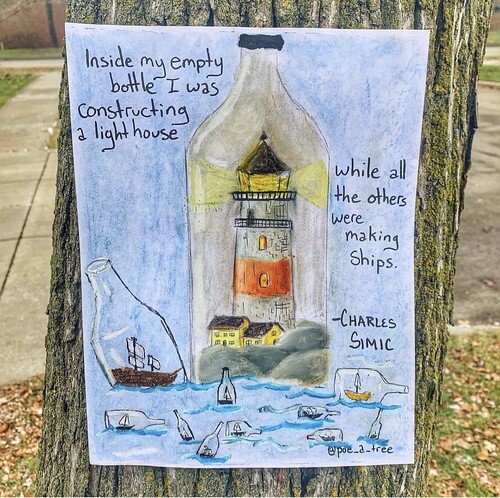
I left a significant amount of Simic quotes around on trees in my community as part of my public poetry project.
Inside my empty bottle
I was constructing a lighthouse
While all the others
Were making ships.


Charles Simic once wrote that ‘a poem is a secret shared by people who have never met each other.’ I think of this often and the way a poem can be a lightning strike of emotion and meaning straight into the heart of the reader who looks back to the page to feel the poet nodding to them. ‘Everyone wants to explain the poem,’ say Simic, ‘except the poet,’ and I believe the perfect poem is designed to say something in a way that can’t fully be said otherwise—an essay on the meaning of a poem still can’t quite grasp the way the succinctness of a poem packs a world of ideas into a linguistic stab at the ineffable. To attempt to net reality in the faulty net of language. For me, Simic was the first to explain and demonstrate this and I will always be grateful for that. ‘Poetry is an orphan of silence,’ he wrote, ‘the words never quite equal the experience beneath them.’ I think it is the way his poetry leans into the surreal that enhances this effect, and the way a simple statement is often just the translucent lid on a container of ideas you can glean bustling about underneath. Simic leans into the abstract with imagery that traverses through the grit of world war and family history, illustrating scenes as if in sepia tones or photographs curling at the edges, and often bears the black and white vibes of noir aesthetics. These are poems that would feel at home read in back alleyways clouded with fog and cigarette smoke, or half drunk into a fading glass of bourbon. One of the first to ever jump out at me came from the collection Walking the Black Cat:

CLUB MIDNIGHTt

Are you the owner of a seedy night club?

Are you its sole customer, sole bartender,
Sole waiter prowling around the empty tables?

Do you put on wee-hour girlie shows
With dead stars of black and white films?

Is your office upstairs over the neon lights,
Or down deep in the dank rat cellar?

Are bearded Russian thinkers your silent partners?
Do you have a doorman by the name of Dostoyevsky?

Is Fu Manchu coming tonight?
Is Miss Emily Dickinson?

Do you happen to have an immortal soul?
Do you have a sneaky suspicion that you have none?

Is that why you throw a white pair of dice,
In the dark, long after the joint closes?

Something about this shook me. The noir aspects, the seediness, the philosophical undertones of eternity and our finite space in it grasping at the history of literature for it’s immortality as we plunge forward in time. I was working at a Barnes and Noble in Holland after having uprooted my entire life and living in this new space where I knew nobody, and bonding over Simic poetry was one of the ways I met my friend Pete who became a very dear friend. So I have Simic to thank for that as well. Ah hell, this is supposed to be a review but to be frank, I’m drunk on gin because I just learned a hero of mine is gone and I’m gonna spew some random thoughts at all of you. Here is another poem I love and love to post every Labor Day on social media (from That Little Something but they are all found here in this Selected Poems):

LABOR AND CAPITAL

The softness of this motel bed
On which we made love
Demonstrates to me in an impressive
manner
The superiority of capitalism.
At the mattress factory, l imagine,
The employees are happy today.
It's Sunday and they are working
Extra hours, like us, for no pay.
Still, the way you open your legs
And reach for me with your hand
Makes me think of the Revolution,
Red banners, crowd charging.
Someone stepping on a soapbox
As the flames engulf the palace,
And the old prince in full view
Steps to his death from a balcony.

Simic had a decorated career, winning the Pulitzer Prize for The World Doesn't End (a brilliant collection of prose poetry) and being the 15th US Poet Laureate. I’ve always been charmed by Simic having served in this role during the George W Bush administration and with the weight of this role having released Master of Disguises full of anti war poetry. I don’t know how apocryphal this is but supposedly he was supposed to do a reading in the White House Rose Garden but someone got wind of him planning on reading only anti-war poems and it was canceled. I choose to believe this and love this. Speaking of anti-war poems, I’ve always loved this one from Selected Early Poems where he even discards the heroes for the sake of peace, Simic who grew up in occupied Serbia during WWII which appears in many of his poems:

MY WEARINESS OF EPIC PROPORTIONS

I like it when
Achilles
Gets killed
And even his buddy Patroclus-
And that hothead Hector
And the whole Greek and Trojan
Jeunesse dorée
Are more or less
Expertly slaughtered
So there's finally
Peace and quiet
(The gods having momentarily
Shut up)
One can hear
A bird sing
And a daughter ask her mother
Whether she can go to the well
And of course she can
By that lovely little path
That winds through
The olive orchard.

The thing you need to know about Simic is that in his hands language could be anything. He can truly embody a moment with all the emotional context and make a poem that feels full from a single image. With Simic, life is always a cosmic joke, death is overworked while his lover awaits him at the end of the day, watermelons are something where ‘we eat the smile / and spit out the teeth,’ history books have the face of executioners and the rustle of a newspaper is ‘the silence of the night writing in its diary.’ Simic made a name for himself through his exquisite wordplay that could move between nuanced and layer abstractions to something as simple as My Secret Identity Is // The room is empty, And the window is open.’ He won a Pulitzer for prose poems, a style often overlooked and difficult to perfect but Simic managed to orchestra into something haunting and visceral:

My mother was a braid of black smoke.
She bore me swaddled over the burning cities.
The sky was a vast and windy place for a child to play.
We met many others who were just like us. They were trying
to put on their overcoats with arms made of smoke.
The high heavens were full of little shrunken deaf ears
instead of stars.

Something that has always charmed me about Simic is the way his words disrupt your reality, jostling it until the pieces align in a new image that gives a lucid impression of the abstract realities coursing through the veins of life. He also does this with poetry in general, having worked of several projects that exist in a poetic realm between prose and verse, and often in communication with images such as photographs of the night sky or Joseph Cornell’s boxes in Dime-Store Alchemy (a title I used for social media names often in life). ‘All art is a magic operation, or, if you prefer, a prayer for a new image,’ he writes in Alchemy, and through a poetic remix of the pieces Cornell molded from found objects to leave them teeming with abstract emotion, Simic conjures a new image within the image. ‘Making art in America is about saving one's soul,’ he wrote, and through his words we may not find evidence of a soul (the question of one is often fluttering through his pages) but we certainly find a liminal space of beauty that makes existence worth it all regardless. After reading Dime-Store Alchemy, I took a trip to The Art Institute of Chicago to see Cornell's boxes (they have one of the largest collections of them) only to find they were currently off display and then got stranded by a snowstorm. I sat in a bar writing bad poetry. I think Simic would appreciate that moment, and I have since seen the Cornell boxes.

THE BODY

This last continent
Still to be discovered.
My hand is dreaming, is building
Its ship. For crew it takes
A pack of bones, for food
A beer-bottle full of blood.
It knows the breath that blows north.
With the breath from the west
It will sail east each night.
The scent of your body as it sleeps
Are the land-birds sighted at sea.
My touch is on the highest mast.
It cries at four in the morning
For a lantern to be lit
On the rim of the world.

It is sad to know Simic has passed on. He is of the last of a group of poets that all meant a lot to me in my early 20s, a group that also all knew each other well. Russell Edson, James Tate, Mark Strand and Charles Simic, all of them now passed on but leaving behind a trail of immaculate poetry to follow them and remember them by. Simic even wrote a beautiful eulogy for Strand after his passing. In his later and last poems, the ones collected beyond this amazing Selected work, Simic’s poetry would seemingly retreat inward, trying to pack as much into as little a space as possible, but would also frequently comment upon an impending death.

AT TENDER MERCY

O lone streetlight,
Trying to shed
What light you can
On a spider repairing his web
This autumn night,
Stay with me,
As I push further and further
Into the dark.

Poetry can stop time in order to move around within a moment, but it can’t stop the inevitable. In his final collection Simic includes the following:

THE WIND HAS DIED

My little boat,
Take care.

There is no
Land is sight.

Simic’s little boat may have departed us but what a glorious gift it has left us. I once found his professor email and after too many drinks decided to send him a lengthy and blatantly obviously intoxicated email. I awoke to a response from him where he kindly answered every question and thanked me for my enthusiasm. What a guy, what a poet, what a legend. Farewell to a hero of mine, thanks for the lovely words.

5/5

STONE

Go inside a stone
That would be my way.
Let somebody else become a dove
Or gnash with a tiger's tooth.
I am happy to be a stone.
From the outside the stone is a riddle:
No one knows how to answer it.
Yet within, it must be cool and quiet
Even though a cow steps on it full weight,
Even though a child throws it in a river;
The stone sinks, slow, unperturbed
To the river bottom
Where the fishes come to knock on it
And listen.
I have seen sparks fly out
When two stones are rubbed,
So perhaps it is not dark inside after all;
Perhaps there is a moon shining
From somewhere, as though behind a hill-
Just enough light to make out
The strange writings, the star-charts
On the inner walls.

EVENING WALK

You give the appearance of listening
To my thoughts, o trees,
Bent over the road I am walking
On a late summer evening
When every one of you is a steep staircase
The night is descending.
The leaves like my mother's lips
Forever trembling, unable to decide,
For there's a bit of wind,
And it's like hearing voices,
Or a mouth full of muffled laughter,
A huge dark mouth we can all fit in
Suddenly covered by a hand.
Everything quiet. Light
Of some other evening strolling ahead,
Long-ago evening of long dresses,
Pointy shoes, silver cigarette cases.
Happy heart, what heavy steps you take
As you hurry after them in the thickening
shadows.
The sky above still blue.
The nightbirds like children
Who won't come to dinner.
Lost children singing to themselves.
Profile Image for Vesna.
239 reviews168 followers
January 28, 2023
The literary world lost Charles Simic earlier this month. English was not his native tongue and yet he wrote only in English which he learned at the age of 15 when he and his family moved to the United States. His name often appeared on the list of deserving candidates for the Nobel Prize, but what amazes me the most is that, as an immigrant who wrote in his second language, he earned the highest poetry award in the United States - the US Poet Laureate (the great Russian poet Joseph Brodsky was the only other immigrant with this quintessential American laurel). Bravo, Mr. Charles Simic (and born Dušan Simić)!

This collection spans over 50 years of Simic’s writing and inevitably a reader cannot connect the same way to all of the poems. My responses to his poetry were both personal and emotional as well as literary, as he is my father’s generation who was born and experienced war as a child in the same city, the memories of which kept coming through Simic’s poems throughout his life. Besides his childhood memories of war, the other themes that persist are the enigmas of fate and perplexing disturbances behind the outward tranquility and ordinariness of life.

There are many poems I loved:
The Butcher Shop
Fear
Summer Morning
Stone
Prodigy
Midpoint
My guardian angel is afraid of the dark
The time of minor poets is coming.
My Secret Identity Is
Evening Talk
The White Room
The Immortal
In the Library
Folk Songs: “Sausage makers of History”
The Chair
Country Fair
Café Paradiso
Late Arrival
Emily’s Theme
Cameo Appearance
Sunday Papers
Minds Roaming
Snowy Morning Blues
To Fate
The Absentee Landlord

Here are a few:
FEAR

Fear passes from man to man
Unknowing,
As one leaf passes its shudder
To another.
 
All at once the whole tree is trembling,
And there is no sign of the wind.


PRODIGY

I grew up bent over
a chessboard.
 
I loved the word endgame.
 
All my cousins looked worried.
 
It was a small house
near a Roman graveyard.

Planes and tanks
shook its windowpanes.
 
A retired professor of astronomy
taught me how to play.
 
That must have been in 1944 .
 
In the set we were using,
the paint had almost chipped off
the black pieces.
 
The white King was missing
and had to be substituted for.
 
I’m told but do not believe
that that summer I witnessed
men hung from telephone poles.
 
I remember my mother
blindfolding me a lot.
She had a way of tucking my head
suddenly under her overcoat.
 
In chess, too, the professor told me,
the masters play blindfolded,
the great ones on several boards
at the same time.


CAMEO APPEARANCE

I had a small, nonspeaking part
In a bloody epic. I was one of the
Bombed and fleeing humanity.
In the distance our great leader
Crowed like a rooster from a balcony,
Or was it a great actor
Impersonating our great leader?

That’s me there, I said to the kiddies.
I’m squeezed between the man
With two bandaged hands raised
And the old woman with her mouth open
As if she were showing us a tooth
 
That hurts badly. The hundred times
I rewound the tape, not once
Could they catch sight of me
In that huge gray crowd,
That was like any other gray crowd.
 
Trot off to bed, I said finally.
I know I was there. One take
Is all they had time for.
We ran, and the planes grazed our hair,
And then they were no more
As we stood dazed in the burning city,
But, of course, they didn’t film that.
Cities, clouds, insects, dogs, cats, … are often encountered in the poems. Also food - perhaps because of the starvation he (like my late father) experienced as a child of war? But besides darkness, there is also a refreshing humor in some poems as in this little ode of his to food:
CAFÉ PARADISO

My chicken soup thickened with pounded young almonds
My blend of winter greens.
Dearest tagliatelle with mushrooms, fennel, anchovies,
Tomatoes and vermouth sauce.
Beloved monkfish braised with onions, capers
And green olives.
Give me your tongue tasting of white beans and garlic,
Sexy little assortment of formaggi and frutta!
I want to drown with you in red wine like a pear,
Then sleep in a macédoine of wild berries with cream.
Profile Image for Ken.
Author 3 books1,257 followers
Read
May 21, 2017
For layman readers like me, Charles Simic's short poems are accessible yet thought-provoking. His images run the gamut, from the ordinary (ants, cockroaches, chairs, windows) to the abstract (war, age, death, grief). At times, his war-torn background (he hails from Belgrade) informs his poems. Here he attacks despots and their lust for power, there he questions God and His silence. In one poem, "What the Gypsies Told My Grandmother While She Was Still a Young Girl," this bluntness is all too evident: "War, illness and famine will make you their favorite grandchild./ You'll be like a blind person watching a silent movie./ You'll chop onions and pieces o your heart into the same hot skillet./ Your children will sleep in a suitcase tied with a rope."

And yet Simic is capable of more cheerful imagery, too. There's the much anthologized "Watermelons," which has a white chicken/red wheelbarrow effect to it:

Green Buddhas
On the fruit stand.
We eat the smile
And spit out the teeth.

In other poems, you find some wonderful images and brilliant juxtaposition of words. Here's "Summer Morning," an early effort that speaks to anyone who has awakened in the country:

I love to stay in bed
All morning,
Covers thrown off, naked,
Eyes closed, listening.

Outside they are opening
Their primers
In the little school
Of the cornfield.

There's a smell of damp hay,
Of horses, laziness,
Summer sky and eternal life.

I know all the dark places
Where the sun hasn't reached yet,
Where the last cricket
Has just hushed; anthills
Where it sounds like it's raining;
Slumbering spiders spinning wedding dresses.

I pass over the farmhouses
Where the little mouths open to suck,
Barnyards where a man, naked to the waist,
Washes his face and shoulders with a hose,
Where the dishes begin to rattle in the kitchen.

The good tree with its voice
Of a mountain stream
Knows my steps.
It, too, hushes.

I stop and listen:
Somewhere close by
A stone cracks a knuckle,
Another rolls over in its sleep.

I hear a butterfly stirring
Inside a caterpillar,
I hear the dust talking
Of last night's storm.

Farther ahead, someone
Even more silent
Passes over the grass
Without bending it.

And all of a sudden!
In the midst of that quiet,
It seems possible
To live simply on this earth.

It's a beautiful thing, remembering the smell of damp hay, horses, and laziness. More beautiful still? The dream that it's still possible "To live simply on this earth."

Many of Simic's poems provide just that simplicity. Others, simplicity in sheep's clothing. Either way, and despite the unevenness expected in any volume this large, the trip is worth the fare. I'm glad I ordered this book and got to know Charles Simic and his world, some of it familiar and much of it foreign. It does what good poetry should do -- disturb and delight.


MAY 2017 UPDATE:

Amazing that, 125 pages into this, despite many poems sounding familiar, I'm only now realizing I've read his collected works before--in 2013! The mind's a terrible thing to waste, but rereading brings it back, I suppose, so have at it again I will and I am!
Profile Image for robin friedman.
1,952 reviews424 followers
October 18, 2020
Charles Simic's Poems Of Fifty Years

As a child, Charles Simic (b. 1938) immigrated to the United States with his family from war-torn Europe and did not speak English until the age of 15. He published his first volume of poetry in 1959 when he was 21. Since that time, Simic has won a large reputation and an enviable readership for an American poet. Among other honors, he has won the Pulitzer Prize, the MacArthur "Genius" Award, and the Wallace Stevens Award. From 2007-2008, Simic served as the poet laureate of the United States.

In his new book, "New and Selected Poems: 1962 -- 2012" Simic gathers together nearly 400 poems beginning with a selection of early works and concluding with 17 new poems. The selections cover 13 previously published volumes. With its size and comprehensiveness, the volume offers and outstanding overview of Simic's poetry. Readers new to Simic who persevere will get an understanding of his work. Readers familiar with the poet will find their favorites together with much that is new.

Even though his work cannot readily be categorized, critical reviews over the years and the perceptive reader reviews on Goodreads and Amazon offer an unusually consistent portrayal of what Simic is about. The reader reviews and "Poetry" magazine's discussion of Simic (the source of the quotes which follow) helped confirm my own reading of this volume. Some of Simic's poems offer "a surreal metaphysical bent" while others offer "grimly realistic portraits of violence and despair". They frequently "challenge the dividing line between the ordinary and extraordinary". As one critic has aptly written: "Simic's work has frequently been described by a handful of adjectives: words like 'inimitable', 'surreal', and 'nightmarish' have followed him around in countless reviews and articles". Another critic has said that Simic "draws on the dark satire of Central Europe, the sensual rhapsody of Latin America, and the fraught juxtapositions of French Surrealism to create a style like nothing else in American literature. Yet Mr. Simic's verse remains recognizably American -- not just in its grainy hard-boiled textures, straight out of 1940's film noir, but in the very confidence of its eclecticism."

Although there are a number of extended works in this volume, most of the poems are short. They tend to be written in short, unrhymed lines and in stanzas. The poems move frequently in a quiet, unassuming tone with an often unexpected and jarring figure at the end. A number of poems have an overtly historical or political theme, with the early poems especially emphasizing Simic's traumatic early life in Europe while the latter poems tend to transfer the situation to current world affairs and to the United States. Many of the poems have country settings as Simic has lived in rural New England for many years. For me, the more characteristic poems showed scenes of lonely and harsh city life with settings in both crowded and deserted streets ("Tattooed City"), seedy hotels, ("Hotel Insomnia", "Night Clerk in a Roach Hotel") or small, frequently shabby establishments ("Used Clothing Store", "In the Junk Store", "Used Book Store"). The poems have a feeling of wandering, grit, and a search for meaning that is indeed shared with some of the noir and other fiction I have been reading of late.

The poems I tended to notice were those of an expressly theological or philosophical turn. Simic is a nonbeliever whose poems are informed by a search for God and by a transcendental turn. Poems such as "The Absentee Landlord" "Master of Disguises" and "Puppet Maker" are meditations upon an absent God. As do some other people of nontraditional theologies, Simic shows a strong interest in mysticism, reflected most immediately in poems with titles such as "The Writings of the Mystics", "De Occulta Philosophia", "Mystic Life", "Mystics", "St. Thomas Aquinas", "The Lives of the Alchemists", "The Tragic Sense of Life" and others.

Philosophers, philosophical issues, and philosophical discussions with others in cafes and on street corners abound in these pages. The most immediately striking of these poems to me was "The Friends of Heraclitus". The poem begins with an announcement that "Your friend has died, with whom/ You roamed the streets,/At all hours, talking philosophy." The surviving companion must go it alone, arguing with himself about the "subject of appearances:/The world we see in our heads/And the world we see daily,/ So difficult to tell apart/ When grief and sorrow bow us over." As the lonely individual wanders the streets, the poet asks: "What was that fragment of Heraclitus/You were trying to remember/As you stepped on the butcher's cat?" Then the poem pivots to conclude with the philosopher's "sudden terror and exhilaration/At the sight of a girl/Dressed up for a night of dancing/Speeding by on roller skates."

Although some readers may disagree, I don't see a major shifts in themes or style from the earliest to the most recent of these poems. The works display a consistency of approach over time. The poems still manage to remain, on the whole, cohesive, fresh, and unusual in their scope.

I enjoyed the opportunity to take a broad look at Simic's poetry over his life through this volume. The book can be read from cover to cover, as in my reading, or, as with any work consisting of a large number of poems, browsed selectively and repeatedly over time.

Robin Friedman
Profile Image for Surya V.n.
27 reviews12 followers
February 21, 2021
Charles Simic Poems

(1)
FEAR

Fear passes from man to man
Unknowing,
As one leaf passes its shudder
To another.
All at once the whole tree is trembling,
And there is no sign of the wind.

(2)
CARRYING ON LIKE A CROW

Are you authorized to speak
For these trees without leaves?
Are you able to explain
What the wind intends to do
With a man’s shirt and a woman’s nightgown
Left on the laundry line?
What do you know about dark clouds?
Ponds full of fallen leaves?
Old model cars rusting in a driveway?
Who gave you permission
To look at the beer can in a ditch?
The white cross by the side of the road?
The swing set in the widow’s yard?
Ask yourself, if words are enough,
Or if you’d be better off
Flapping your wings from tree to tree
And carrying on like a crow?

(3)
WAR

The trembling finger of a woman
Goes down the list of casualties
On the evening of the first snow.
The house is cold and the list is long.
All our names are included.

(4)
SUMMER LIGHT

It likes empty churches
At the blue hour of dawn.
The shadows parting
Like curtains in a sideshow,
The eyes of the crucified
Staring down from the cross
As if seeing his bloody feet
For the very first time.

(5)
STONE

Go inside a stone
That would be my way.
Let somebody else become a dove
Or gnash with a tiger’s tooth.
I am happy to be a stone.
From the outside the stone is a riddle:
No one knows how to answer it.
Yet within, it must be cool and quiet
Even though a cow steps on it full weight,
Even though a child throws it in a river;
The stone sinks, slow, unperturbed
To the river bottom
Where the fishes come to knock on it
And listen.
I have seen sparks fly out
When two stones are rubbed,
So perhaps it is not dark inside after all;
Perhaps there is a moon shining
From somewhere, as though behind a hill—
Just enough light to make out
The strange writings, the star charts
On the inner walls.

**
Profile Image for Domhnall.
459 reviews374 followers
March 28, 2018
Very clever and amusing - which is necessary (at least desirable) but not sufficient. Too good not to read and want to read more. Highly recommended. But I have not yet found anything especially meaningful for me. Maybe that is about me or my current mood. I have picked this up and put it down quite a few times. Perhaps eventually it will work. Not yet though. Maybe I will come across a good guide sometime.
Profile Image for C. Varn.
Author 3 books403 followers
May 22, 2018
This covers the highlights of the majority of Simic's career--his themes and dark humor are consistent throughout, although his language gets richer as he ages. The book itself is a nicely produced hardcover, although the font layout can be slightly frustrating. It's a great introductory collection with a balance of representation from his works.
Profile Image for Grady.
Author 51 books1,823 followers
January 23, 2013
His Poetic Eminence, Charles Simic

Dusan "Charles" Simić (born 9 May 1938) is a Serbian-American poet and was co-poetry editor of the Paris Review. He received the Pulitzer Prize for Poetry in 1990 for The World Doesn't End, and was a finalist of the Pulitzer Prize in 1986 for Selected Poems, 1963-1983 and in 1987 for Unending Blues. He was appointed the fifteenth Poet Laureate Consultant in Poetry to the Library of Congress in 2007. From Wikipedia we learn, `Simic was born in Belgrade, Serbia then part of Yugoslavia. Growing up as a child in war-torn Europe shaped much of his world-view, Simic states. In an interview from the Cortland Review he said, "Being one of the millions of displaced persons made an impression on me. In addition to my own little story of bad luck, I heard plenty of others. I'm still amazed by all the vileness and stupidity I witnessed in my life." Simic immigrated to the United States with his family in 1954 when he was sixteen. He grew up in Chicago and received his B.A. from New York University. He is professor emeritus of American literature and creative writing at the University of New Hampshire and lives on the shore of Bow Lake in Strafford, New Hampshire.'
So though we all know the poetry of Charles Simic, this new book is the most comprehensive representation of his work to date. Ranging form his earliest poems to his current works this book takes the reader on a journey of Simic's peculiar and endearing view of life and human folly and sadness and serves to prove why he is so celebrated. But as usual his poems speak for themselves:

SOLITUDE
There now, where the first crumb
Falls form the table
You think no one hears it
As it hits the floor.

But somewhere already
The ants are putting on
Their Quaker hats
And setting out to visit you.

DECEMBER
It snows
and still the derelicts
go
carrying sandwich boards -
one proclaiming
the end of the world
the other
the rates of a local barbershop.

WAR
The trembling finger of a woman
Goes down the list of casualties
On the evening of the first snow.

The house is cold and the list is long.

All our names are included.

IN A DARK HOUSE
One night, as I was dropping off to sleep,
I saw a strip of light under a door
I had never noticed was there before,
And both feared and wanted
To go over and knock on it softly.

In a dark house, where a strip of light
Under a door I didn't know existed
Appeared and disappeared, as if they
Ha turned off the light and lay awake
Like me waiting for what comes next.

This last poem is the final insertion in this collection and as such it opens so many possibilities, knowing that Simic's mind is fertile and will continue to compose such eloquent and simple poems.

Grady Harp
77 reviews1 follower
December 30, 2014
I was familiar with only a few poems by Simic when I began to work through New and Selected Poems, reading front to back, back to front, and sometimes in the middle. Most of the unrhymed poems themselves are not long or particularly difficult to read, but the recurring themes---war, childhood loneliness, adult loneliness, darkening city evenings, shabby apartments---are often painful to read about.

There are bits of happiness, too---a fragment of natural beauty, jazz, a lover, a book of poetry. In fact, one of my favorite lines, from "Romantic Sonnet," is this one: "Happiness, you are the bright red lining/Of the dark winter coat/Grief wears inside out." That expresses the feeling of reading Simic.

There is a fine essay on Simic's poetry, entitled " A World of Foreboding," in Soul Says, Helen Vendler's collection of essays on contemporary poetry.

M. Feldman
Profile Image for Joan Colby.
Author 48 books71 followers
July 27, 2013
Simic is rightly renowned for the originality of his imagery and the often surreal content of his poetry. He has had wide recognition which is well deserved. Some of his poems such as “Fork” should be considered classics.
Profile Image for Bistra.
132 reviews1 follower
January 2, 2022
I discovered Charles Simic’s poetry by chance - saw something by him online and then read one of his translations of the contemporary Serbian poet Radmila Lazic. It obviously took me a long time to read this book, it’s 300+ pages of poetry after all, one can’t read it in one sitting. But I feel so drawn to the mix of melancholy, nostalgia, crudeness and tenderness in his poems. A lot about sleepless nights, brooding minds, self-reflection, loneliness, going back to childhood and a lot of love. Like all great poets he seems to be a constant observer giving descriptions of moments in life that may be an allegory for something profound or just an observation of the beauty in mundanity. But best of all describing feelings with such precision that it jolts my mind when I read it -

Conscience, that awful power,
With its vast network of spies,
Secret arrests at night,
Dreaded prisons and reform schools,
Beatings and forced confessions,
Wee-hour crucifixions.
A small, dead bird in my hand
Is all the evidence they had.

To Fate
You were always more real to me than God.
Setting up the props for a tragedy,
Hammering the nails in
With only a few close friends invited to watch.

Just to be neighborly, you made a pretty girl lame,
Ran over a child with a motorcycle.
I can think of many other examples.
Ditto: How the two of us keep meeting.

A fortunetelling gumball machine in Chinatown
May have the answer,
An old creaky door opening in a horror film,
A pack of cards I left on a beach.

I can feel you snuggle close to me at night,
With your hot breath, your cold hands—
And me already like an old piano
Dangling out of a window at the end of a rope.
Profile Image for Marcelo Abreu.
45 reviews1 follower
January 11, 2025
In another attempt to find some (English) poetry I can say I appreciate, I decided to read Charles Simic, when I came across this collection.

I was hoping to get to know enough of his work, and by that I mean, his best work.

Soon found not to be a fan of his poems but those in prose (from “The Word Doesn’t End” - which, ironic enough, is his most regarded work, with one Pulitzer Prize win).

Problem being, I didn’t figure this out by reading this collection, but rather the content it lacks, which are, in my point of view, some of his best prose poems [(O the great God); (Things were not as black); (From inside the pot); (Where ignorance is bliss)].
Profile Image for Deirdre Anne.
12 reviews2 followers
January 28, 2023
Love Simic's work and this book did not disappoint. It gives a small selection of poems from several collections giving the reader a good overview of his development as a poet
Profile Image for Bruce Gunther.
32 reviews
March 25, 2023
I'm always amazed at how Simic's poems are like a journey, sometimes brief, leading through surprise, humor, and rich imagery and metaphor.
Profile Image for Jenny (Reading Envy).
3,876 reviews3,727 followers
March 5, 2013
I was vaguely aware of Simic as a poet, although I'm not sure I could rattle off any of his lines off the top of my head, so I was happy to take a look at this volume of new and selected poems from NetGalley. The book contains almost four hundred pages of poems selected from various past publications - Selected Early Poems, Unending Blues, The World Doesn't End, The Book of Gods and Devils, Hotel Insomnia, A Wedding in Hell, Walking the Black Cat, Jackstraws, Night Picnic: Poems, My Noiseless Entourage, That Little Something, Master of Disguises, The Voice at 3:00 A.M.: Selected Late and New Poems, as well as a selection of new poems. As the subtitle states, these span five decades as well, which is quite the poetic career. Simic was born in Serbia but the poems originate in English, although sometimes his sense of being an outsider comes through.

To get a sense of these poems, I'd like to start at the end. Something he said in one of the new poems struck me as being fairly descriptive of the themes of his poems and poetic outlook in general. This is the last stanza in "Things Need Me:"

Dead alarm clock, empty birdcage, piano I never play,
I'll be your waiter tonight
Ready to take your order,
And you'll be my distinguished dinner guests,
Each one with a story to tell.


Throughout his poems, he seems to imagine the possibilities of what objects had experienced, the potential for story in the people he encounters, and reflecting on events that touched his life in some way. One powerful poem had his birth set within the feelings and emotions of the beginning of World War II.

One thing I always wonder about anthologies or "selected works of X" is what is being left out? How is something chosen for inclusion? Ever since I fell in love with a Teasdale poem that was not included even in her "complete works," I've read poetry volumes with a critical eye. Whether or not it was intentional, I noticed a lot of flies, and a lot of libraries, in the poems that were included.

My favorites were Late Arrival, Filthy Landscape (about a meadow), Eternity's Orphans, In the Library, Evening Talk (reminded me of a friend), and My Secret Identity Is (a tiny tiny two line poem, three if you count the title.)

from "In the Library:"

The great secret lies
On some shelf Miss Jones
Passes every day on her rounds.

She's very tall, so she keeps
Her head tipped as if listening.
The books are whispering.
I hear nothing, but she does.


Profile Image for Ben Thurley.
493 reviews31 followers
November 25, 2020
I'd only read a handful of Simic's poems before being given this collection as a gift – thanks, Laurence! These gritty, surreal, gems are often glum but also occasionally gleeful to the point of hilarity. They pitch sharp and clean in plain, almost prosaic, language, and in them the ordinary is set alight with a satiric vision and a surrealist's delight in forging unfathomable connections that never fail to work some metaphorical and metaphysical magic.

Some have made much of Simic's atheism, but to me the most explicitly (a)theological of his poems are often the least successful; the god he doesn't believe in, it seems, only inspires flat or clichéd metphors such as absentee landlord or master of disguises.

They are celebrations and ponderings on life, in full awareness that so much of what he is celebrating is full of absurdity, futility and cruelty and death. I really enjoyed the collection.
Profile Image for Kelly.
447 reviews251 followers
May 7, 2015
The truth is dark under your eyelids.
What are you going to do about it?
The birds are silent; there's no one to ask.
All day long you'll squint at the gray sky.
When the wind blows you'll shiver like straw.

A meek little lamb you grew your wool
Till they came after you with huge shears.
Flies hovered over open mouth,
Then they, too, flew off like the leaves,
The bare branches reached after them in vain.

Winter coming. Like the last heroic soldier
Of a defeated army, you'll stay at your post,
Head bared to the first snow flake.
Till a neighbor comes to yell at you,
You're crazier than the weather, Charlie
Profile Image for James.
127 reviews15 followers
May 16, 2013
Simic's work seems even stronger collected together. The wonderful, quotidian strangeness of his poems shines and will not dim or dull simply because of the length of this selected poems. This is a testament to the strength and integrity of each poem. I've given this four stars instead of five (which the poetry deserves) because of the layout: I cannot stand that each poem does not begin its own page; the compactness of most of Simic's poems deserve this attention.
762 reviews10 followers
September 22, 2013
This large selection of poems by Simic portrays his often morose, fantastical metaphors
of war and injustice. Some are dream-like. Almost all are arresting. A short poem
called My Secret Identity Is
The room is empty,
And the window is open

demonstrates his evocative style. There are eighteen new poems that deal with aging
and the query of what happens next?
Profile Image for John Tessitore.
Author 31 books9 followers
April 21, 2015
There is no great variety in this fifty year retrospective. Simic never really changes the focus or shape of his verse. But he doesn't really need to. He's a poet of bright characters and sharp characterizations, a story teller in three to five stanzas. With a wise, humane voice and a light touch with even the darkest subject matter, he writes like the kind of person I'd like to be.
Profile Image for Karen Douglass.
Author 14 books12 followers
February 28, 2014
Simic's poems challenge me. As with any large collection, not all of these poems "please" me, but very many do offer insights and shared experience in language that is fresh and unique to Simic. A treasured book.
Profile Image for Paul.
260 reviews9 followers
July 28, 2015
I can't believe I read a 300+ page book of poems, but I'm glad I did. This was an enjoyable collection from an author I was unfamiliar with. Pretty sure one of his books will be on one of my bookshelves soon.
Profile Image for Hannah Jane.
814 reviews27 followers
August 23, 2017
Favorites:

From the poem, Fork: "This strange thing must have crept right out of hell. It resembles a bird's foot worn around the cannibal's neck."

From the poem, Stone: "I am happy to be a stone... It must be cool and quiet even though a cow steps on it full weight."
Profile Image for Rebecca Askew.
13 reviews2 followers
June 25, 2016
This book is a plethora of fantastic poetry. Simic's images are extremely evocative and vivid. He balances surrealism with realism like a yoga master. This was a large collection spanning his whole career, and I tried to make it last as long as possible.
I definitely recommend this book.
Profile Image for Edward Moore.
44 reviews4 followers
April 13, 2014
Very interesting. Non-native English writers. The poetry has their home sensibilities filtered and sculpted through English. I like Simic's spare verse and short poems. It is my style of writing.
Displaying 1 - 30 of 32 reviews

Can't find what you're looking for?

Get help and learn more about the design.