In 1979, the Sandinista National Liberation Front in Nicaragua overthrew the Somoza dynasty and replaced it with a revolutionary new government. Meanwhile, Thatcher and Reagan aided counterrevolutionary terrorists to suppress the rise of socialism. Thatcher even attempted to ban the word “Sandinista.” The Clash responded by aligning themselves with the socialist revolutionaries and named their fourth album after the Nicaraguan rebels.
Sandinista! consists of 36 songs divided on six sides of vinyl, delivering their message through genres ranging from hip hop, reggae, dub, jazz, gospel, calypso, and punk. The result is exceptional piece of socialist art unlike any other, but despite being counted among the greatest albums of all-time, critics and fans have spent over 40 years debating whether the album would be better as a 12-track LP. This book entertains that idea, then considers what is lost or gained in the process. Apart from the other 24 tracks, you lose the story of a band sacrificing their royalties to have a politically subversive triple LP available to their listeners for the price of one to tell them what the news, their schools, and their governments will not.
What Clash is This? Review of the Bloomsbury Academic 33 and 1/3 Kindle edition (March 7, 2024) released simultaneously with the paperback.
The original album was a complete puzzle to me when first released in 1980 in a triple-LP set which retailed for a bargain price, now explained by the info that the band agreed to reduced royalties at the time. There was the shock of the supposed "Only Band That Matters" following up their 1979 breakthrough London Calling with a sprawling 2 & 1/2 hour survey through skiffle, rockabilly, ska, reggae, dub, jazz & gospel, with only the occasional punk-rock rager to be found. I'm pretty sure that I didn't even listen to all of it at the time, but I still hung onto the vinyl regardless.
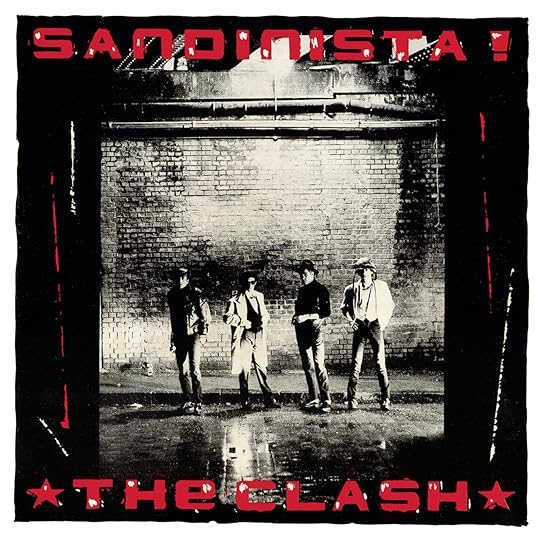
Album cover for Sandinista! by The Clash from 1980.
This survey for the 33 & 1/3 series of (usually vinyl LP) record reassessments was intriguing therefore as a chance to revisit an album which I hardly understood at the time and could never appreciate. Reading the track by track overview did explain a lot about why the album didn't have a recognizable Clash sound. There are so many guest vocalists and instrumentalists performing that it barely seems to be a Clash album. Even the bass on most of my favourite tracks was apparently played by the bassist for the Ian Dury and Blockheads band. So many vocals were either bizarre cameos (guest keyboardist Micky Gallagher's (again from the Blockheads) kids on an out-of-tune recital/revisit of "Career Opportunities" from the 1977 debut The Clash) or just mixed too far back and not front and centre or lost in the murky dub versions.
Henley also takes a look at whether the 12-track promo disc of supposed "Best Of" would have been more appealing and catchy. In an addendum, a few dozen other folks provide their own favourite 12-track selections. For myself I can't even find 12 favourites and had to double up a few to make up a 12-pack😅.
Other Reviews of the Album Read other assessments of the Sandinista! album by Simon Reynolds for Tidal in 2020 here and by Jack Whatley for Far Out Magazine in 2024 here.
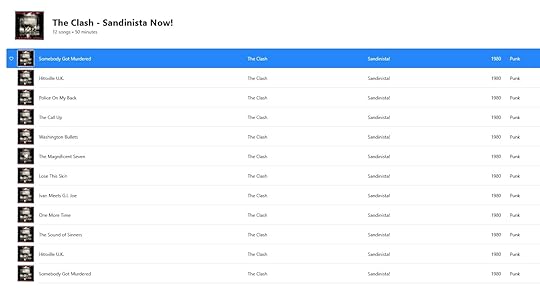
Soundtrack Listen to the official 12-track version of the album, issued as a radio promo, on a YouTube playlist here.
Listen to the full 36-track album on a YouTube playlist which starts here or on Spotify here.
Trivia and Links Listen to a podcast where author Micajah Henley discusses the band, the album and the book at New Books Network.
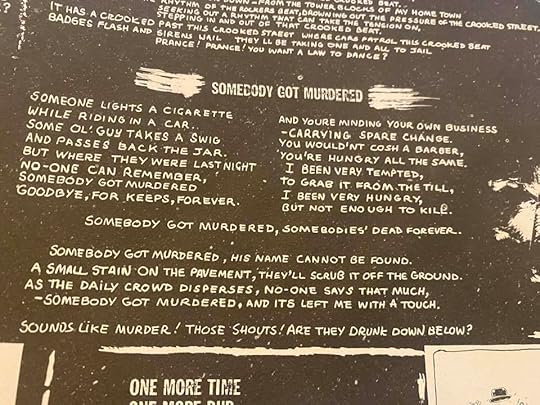
Lyrics for "Somebody Got Murdered" as printed on the original lyrics booklet.
The stated objective of this book is to judge whether the triple-LP album Sandinista! should have been shorter. I already believe it shouldn’t, so it’s fair to wonder why I read on, especially when the author says in the introduction that he is of the same belief. I paid for the book, so of course I wanted to continue. Then, there’s the pleasure of reading about something you love, as well as in learning things you might not have known before, as well as being reminded of things you forgot because you learned them so long ago.
I even enjoyed the extraneous tidbits, even when I was bemused at their inclusion, e.g., “The Sound of Sinners” being a favorite of Elvis Costello. I wish the author had come across as more confident and less apologetic when it came to his interpretations though. They were good takes, including the connection he makes with Slaughterhouse-Five and “Mensforth Hill” (itself a reversal of “Something About England”).
The Clash's fourth Album, Sandinista is an album that has grown on me over the years. Although critics call it inconsistent, I think it's pretty solid. Unfortunately I have never loved the dub section that dominates the last third of the album and if the band got rid of that I would state that it's just as good as London Calling - even better than that as it displays a variety of genres.
This particular book is a 33 1/3 by the numbers: a little prehistory of triple albums. The Clash at the point of recording the album and a track by track study, concluding with various 33 1/3 authors creating their ideal 12 track album - inspired by the Sandinista Now! promo that was mailed to radio djs back in the day.
Sandanista! is a sprawling, epic album that has had its share of critics over the years. This book attempts to review the triple album. It does a reasonable job but is flawed in its excessive focus on the 'should it have been edited down to a single album?' question. As a result, it has no overview of how it fits together as a unified work. It reviews the single alum promo Sandanista Now! and then goes through the remaing tracks as if they are mere extras. It also spends too little time discussing the music. Instead, it says too much about the message. The message matters, but Sandanista! is an album of music. I don't regret buying this book, but feel it to have been poorly structured.
3.5 rounded up – as with many entries in this series, it’s not exactly a deep dive; it‘s also kind of unsatisfactory as an analysis (mostly focusing on lyrics) and as a piece of music criticism. it did, however, make me listen much closer to an album I’d never been able to wrap my head around: would recommend
Back in 1980, I was a rather un-precocious teen who defined himself—much like American youth over the last generations—by the music he listened to. No band was more important to me than the Clash, whose double album, released in the waning moments of the 70’s, has been deemed by many rock critics as a defining album of the 80’s.
In my immature mind, I wanted all future Clash released to be in the vein of London Calling. I wanted punk, pop, rockabilly, inciteful lyrics, and an aesthetic of four young men playing in a tight cohesive structure. I eagerly awaited the next release by the Clash, Sandinista, travelling by bus to Manhattan’s City Hall where J&R Music World stood like a shrine to purchase the imported vinyl in December 1980, the first day it was released.* I left feeling like I was holding a rare treasure, until I arrived home and put on side one. I was appalled by the rap/disco of the opening track, “The Magnificent Seven.” My ire was hard to contain. I spent weeks trying to salvage tracks that I could listen to happily, not fully understanding the band's intent incorporating an endless amalgam of styles and influences, most of them Black. I finally settled on the Clash cover of "Police on my Back," which merely regurgitated their anti-authoritarian message, already voiced stentoriously on “Police and Thieves” and “I Fought the Law.” I wanted the Clash to stay as they were . . . at the pinnacle of success but without the wherewithal to experiment and be free! Thankfully The Clash remained free. Almost a quarter century later, I am still deciphering their triple album ode to countless genres and influences and torn whether to just consider the album a big F You to their record company (similar to Lou Reed’s Metal Machine Music) or a neglected treasure that still deserves playing time, specifically for all the tracks I discounted in my youth.
That spring, I saw The Clash for the first time, at their infamous “homestand” at BONDS disco casino on Broadway. I was in what I would estimate to be the sixth row opening night (there was no seating). When The Clash took the stage, I was caught in a press. My feet did not touch the ground until the conclusion of the 3rd song, “Complete Control.”** During that break, Clash frontman Joe Strummer berated the audience for their disrespect of the opening act, Grandmaster Flash and the Furious Five. This black rap act had appalled the almost entirely white audience. Bottle flew. Middle fingers were brandished (mine among them); the Five returned the favor, while ducking the flying bottles, but always scratching the vinyl they were spinning. Why was this Black act sullying The Clash? After the show, heads were counted by the NYFD. The show had been tremendously oversold by greedy promoters in cahoots with Clash manager Randy Rhodes. The Clash had to perform for a solid month to make good all the oversold tickets with the listed capacity audience; I ended up seeing them three times including opening night. Thanks to Micajah Henley’s 33 and 1/3 imprint addition, Sandinista I now know I was there that opening night with Steve Buscemi!
This personal history in mind, I eagerly awaited the 33 & 1/3 imprint’s take on Sandinista, 44 years later, by Micajah Henley. 33 & 1/3 is an admiral, if occasionally uneven, series dedicated to a specific album. Authors pitch 33 & 1/3 and can focus on the band, the record or even how the band or record influenced a fan. Since Sandinista was such a massive yet quickly thought-out endeavor that can still resonate, I was eager and anxious to revisit my raw youth aesthetics and outrage, even though I’ve now come to appreciate the album as an artist manifesto of a band celebrating their influences and friends with numerous guest appearances. It is an admirable album with some of the band’s best work. I wanted to be sent back in time when 1980 wouldn’t be a mere anachronism.
As Mr. Henly tacitly alludes, we cannot comprehend how radical the release was without pushing ourselves back to a time when we played vinyl LP’s almost exclusively. Unlike the world of Spotify and Pandora, song order mattered in 1980. LP order mattered in a 3 LP release. Burning a mixed “tape” was not as easy as downloading MP3’s and then clicking/dragging. The listener had to change LP sides or move a stylus to hear different songs that could be buried on one of the more obscure LP sides, e.g. “Charlie Don’t Surf.” Thus, the now antiquated LP format allowed for the question of whether the release would have been “better” as a double album, a single album or—as Joe Strummer once snidely quipped—as an EP.
As a point of departure, Henly begins by breaking down and analyzing the songs that appeared on the CBS/Epic promotional LP “Sandinista Now! which was sent to radio stations as the triple album was released. This single album promo (which I had never heard of)—for the most part—has the stronger and more accessible tracks (particularly for a US audience). Predictably, Henley then goes on to discuss the other tracks on the album and concludes with a discussion on the daunting length of Sandinista and whether so many filler tracks are essential, or whether the album is intrinsically more powerful because there are so much filler and buried gems that—due to the original format—might take years for a listener to notice or appreciate:
“The album was built to last. In fact, the excess of the album strengthens its longevity by offering more to revisit and discover over time. Suddenly, long overlooked tracks become personal favorites.” (Pg. 108-9).
I’ve certainly found this to be the case, especially since—in 2024—the album can be bought on a single CD and played in my car on random. I’m way more into ambient sounds today than I was as a teen, and therein lies the brilliance of Sandinista, at least for me: the gems that pop up and sound like something completely different from my or the original conception of the Clash. The entire album is barely dated.
As with any strong 33 & 1/3, a serious fan of an album should be able to learn something new (something beyond what may be found in a Wikipedia entry on a song). Arcane tidbits occur throughout Henley's track-by-track analysis and overall discussion. Among other things, I was unaware that:
--Bassist Paul Simenon only appears on a few tracks. He was starring in a movie during most of the sessions. He is only prominent on “Crooked Beat.” --“The Leader” is about the Profumo scandal. --The Clash make a cameo appearance in Scorcese’s The King of Comedy and that Scorcese was probably also at the opening night at BONDS. --That “I Fought the Law” was not originally recorded by The Bobby Fuller Four, but by Sony Curtis, who fronted the Crickets after Buddy Holly’s death. . . .!? (Glaring gap in my knowledge there).
My only quibble with Henley’s work is that he doesn’t delve into the two Clash releases that came after London Calling and were part of the Sandinista sessions both in spirit and sound: The single “Bankrobber” and the import (and now exceedingly rare) LP “Armegeddon Time w. Justice Tonight/Kick It Over. The former is the first Clash release to not sound like the Clash, much to the chagrin of CBS, and the latter employs reggae and the dub studio mixing of Mikey Dread, a prominent force of Sandinista. However, all quibbles aside, Henley’s addition to the 33 & 1/3 imprint is a welcome one and allows Clash fans to revisit their own inherent prejudices for and against this unique triple album set. Henley ends his appraisal asking friends and critics to include their 12 “essential” Sandinista tracks, creating their own promo record or mixed tape. I’ll end with mine. Although I’ve outgrown my inherent childhood racism, I still dislike The Magnificent Seven.
In no particular order:
--Lose this Skin --Charlie Don’t Surf --Police on My Back (though by this time Clash police tropes were a bad cliché) --The Equaliser --Washington Bullets --Hitsville U.K. --Junco Partner --Somebody Got Murdered --One More Time --The Crooked Beat --Something About England --The Sound of Sinners
*As Henley reminds me, the album was released within a week of John Lennon being shot. Those two events immediately evoke my sophomore home room and sitting through the Pledge of Allegiance that Ronnie R.--whose toxic influence affected the Clash's album title--inflicted on us schoolkids. ** Also produced by Mikey Dread.
I first heard this album in 1983 as an impressionable 13-year-old with a more sophisticated older friend who knew "Combat Rock" was the first album I had ever bought. At that time, I had zero context for this sprawling, genre-spanning, triple-album given that I had zero exposure to most of the politics or musical traditions that influenced it. That said, it was beguiling in its weirdness, with the accompanying "Armageddon Times" insert, giving me a lot to chew on, even if I hadn't yet grown the teeth to do so.
Over the years, The Clash have remained my favorite band, as I've dipped into bits and pieces of some of the previous 33 1/3 series -- so I was so excited to finally see this. I've read a bunch of the Clash books, so I already had some background knowledge of the chaotic creative process that led to the album and its inspirations. Somehow, however, I'd missed a whole thread of Clash fandom that revolves around the idea that there's a great 12-song single album to be distilled from what was released. There was apparently a DJ-promo version of the album that did just that, and the book is largely organized around this premise.
The author is an academic, and so the book opens with an explanation of Joe Strummer's politics and how they relate to his art, with Ernst Fischer's The Necessity of Art as the Marxist framework for analysis. While I found some of Fischer's concepts interesting, and can appreciate the links being made to the messiness of the Clash aesthetic, it's a bit of a slog at times. So after some pages about the relation of politics to the music and some pages on the making of the album, the bulk of the book (roughly 2/3) is a song-by-song recap of the album. This often felt like I was just scrolling through Wikipedia entries, as meaning and influences and connections patiently explained.
It then rounds out to a rather flat conclusion returning to the question of whether the album would have been better edited down or not, along with the author's own 12-track playlist and those of eight friends of his. Given that Rob Sheffield is the only one of those other people I've heard of, it's a particularly weak note to end on. Readers who are Clash completists will probably want to take the two hours it takes to read this, and hopefully it'll introduce the album to some fans of the 33 1/3 series who may find it intriguing, but I was hoping for a more interesting or personal approach.
One of the weaker - and certainly most slight - 33 1/3's I have read. Henley's thesis is sound: Sandinista! is good precisely because it is a stylistically wild triple album, and that it is optimistic about the 1980s because of the example set by the FSLN. Unfortunately, the book is slight and structurally its track-by-track approach only reenforces what a slog the record actually is.
It might be more illuminating to have some fun with The Clash's politics, but instead Henley reads Strummer's politic beliefs - and, for some reason, it is only Strummer whose politics receive any sustained analysis - entirely through the lens of Ernst Fischer, bending Strummer's statements to the author's will and producing an unsatisfying portrait of The Clash in doing so (this is a shame, because as the bewildering success of IDLES shows, there's something enduring in The Clash's non-committal ideological vagueposting.) Henley's prose is flat - "brand", "iconic", "chill" - and his grasp of musicology and production poor (what on earth does "streamlined mixing" of London Calling mean in production terms?).
The standard of writing about British music between 1977 to 1984 has been set high, and there's a duty to be more interesting than Channel 5 received wisdom about "soulless" tower blocks where "lack of pride" led to vandalism etc. It doesn't feel rooted in the geography of Notting Hill, not least with the shoehorned reference to Notting Hill. What if the economic security and multi-ethnic melting pot that the tower blocks sustained was, in fact, the motor of the best things behind The Clash, given their fullest expression on a project like Sandinista? Someone should try and find out.
I've been waiting for a book in this series to cover a Clash album for what seems like forever. The one on London Calling never materialized, so I was so happy when this one was published. Honestly, I could read a book on each album The Clash did (except Cut the Crap) and this one was a really fun track-by-track analysis of lyrics and players and overall happenings around the record. (Even though they didn't spend nearly enough time on my favorite song, Lose This Skin.)
Apparently, a record came out at the same time which condensed this triple album into a 12-song single album, which, to me, totally misses the point of the epic. But I realized that when I listen online, I totally used to skip around the tracks, until I started listening all the way through again and finding new favorites.
The end of the book lists various music experts most essential 12 tracks on the record, and, since I'm a music nerd, here's my 12... what's yours?
1. Magnificent Seven 2. Hitsville UK 3. Somebody Got Murdered 4. Police on my Back 5. Up in Heaven (Not Only Here) 6. The Call Up 7. Lose This Skin 8. Rebel Waltz 9. Charlie Don't Surf 10. The Sound of Sinners 11. One More Time 12. Career Opportunities
The 33 1/3 series can be kinda hit or miss, and this one is both hit and miss.
There’s a lot in here I didn’t know about the making of the album, so that was all worthwhile.
The book is essentially organized around the 1-LP “Sandinista Now!” promo sampler that the record company sent out to keep DJs and reviewers from being put off by the 36 song triple LP, and whether or not that selection best represented the larger project. I remember coming across that sampler in a used record store at the time and passing on it because, well, it didn’t have anything new on it, so why bother. As a result, “Sandinista Now!” is not something I’ve thought about in four decades.
Which doesn’t make this organizing principle a bad one; it just doesn’t seem hugely relevant to me. I’ve never really thought Sandinista needed to be cut down, so I don’t find it as entertaining as others might.
I also found that some of the interpretations of the lyrics were a bit speculative. I would have appreciated, for instance, more interviews with participants or a little more research with nice juicy references 🤣🤣🤓.
Anyway, it’s worth reading if you like this album at all.
I've owned a copy of Sandinista! for 20+ years since I was introduced to the Clash in a History of Rock 'n' Roll undergraduate course. My younger self was unfortunately overwhelmed by the extent of the album's tracks and scope. Henley's approach, explaining the politics of (mostly) Strummer, and the label-released 12-tracks Sandinista Now! promo as a means to explore the album, was at first concerning, but the results played out nicely. I enjoyed the short bios and excerpts for each track, some with longer contextual backgrounds, some with trivia and anecdotal connections to cultural developments of the 1960s-1970s, and finally, the historical threads hinted at and conjured within the tracks. The conclusion demonstrates that both the promo and the full Triple LP are valuable, as fans have a wealth of music to pick their favorite, build mix tapes and playlists, and share among friends and fellow fans. Henley's book is a nice little primer for the album.
Did exactly want you want from a book like this, which is to both deepen your understanding of the record in question, which you probably already know well, and taught me some interesting things that I didn't already know.
One of them was that the record company, probably pissed at having the band record a massive triple record and then insist on selling it at usual prices, sent out Sandinista Now! which was a 12 song sampler to give DJs a taste.
The collection of single LP play lists, distilling the classic to one LP length, is really fun and intriguing as an idea.
I'd totally do one but it'll have to wait for now...
Probably like Henley, I put this record to the side as a young Clash fan, so didn't really return to it until later when I began to move away from traditional punk sounds, so was definitely a nice way to revisit the record yet again. I loved the approach, using the sort of "singles" approach with Sandinista Now, then moving onto the other pieces. Perhaps would have delved into a bit more with some of the song's themselves, but like the Clash, there's some quality moments and also some spots that felt like filler here. Good, light read with reminders about how great that band truly was...way ahead of their time in so many ways.
A lot of these just got added on Libby so I had to start with the one about my favorite band's favorite album. It's devastatingly still so relevant. I agree that Sandinista! is a brilliantly, messy, whole and better than any cut down version.
That being said, my 12-track Sandinista! (playlist titled A Sandinista! Of One's Own) is as follows: 1. The Magnificent Seven 2. Police On My Back 3. Rebel Waltz 4. Washington Bullets 5. Let's Go Crazy 6. If Music Could Talk 7. Up In Heaven (Not Only Here) 8. Corner Soul 9. Something About England 10. One More Time 11. The Sound of The Sinners 12. The Street Parade
Sandinista has always been an album I've struggled to fully embrace. I like large swaths of it and have always dove back in after years off to discover new wonders, but Henley's book really did help me appreciate it anew. I wish there would have been slightly less focus on the whole idea of whittling it down to a single LP, but this had a lot of interesting insight.
I remember the first time I heard Sandanista (bought the week it was first released). It was, to me, a bit of a mish mash however, I grew to love it, getting over the it should have been a single album or maybe a double album. This was the Clash showing their influences, old and new.
This book. Well it was a bit dull at times, hence the three stars.
Mostly just describes the songs and gives quick explanations of the references - what a Sandinista is, who Victor Jara was, etc. Doesn’t offer much of anything you couldn’t find on Genius.com or Wikipedia.
Song by song breakdown of one of my favorites. Focuses mainly on the politics of Strummer's lyrics which helps to tie together this puzzle of an album.